Viipuri recaptured.
A ceasefire is in effect in Iran as new Prime Minister Mohammed Foroughi discusses a settlement with the British and Soviets. A key question is what happens to German and Italian nationals present in Tehran. Foroughi basically agrees with the Allies that all Axis nationals should be handed over to the Allies and the German, Italian, Romanian, and Hungarian legations expelled. However, the decision is up to Reza Shah, and he prefers to allow them the Axis nationals and their families to escape.
The negotiations take on a weird slant because Foroughi fundamentally opposes Reza Shah’s rule (Foroughi had been dismissed from a previous appointment as prime minister in 1935 due to family connections with an anti-reform riot in Mashhad). Basically, Foroughi views an Allied takeover as “liberation” from Reza Shah. Thus, in effect, Foroughi simply wants to surrender, let the Allies have whatever they want, and doesn’t care what happens to Reza Shah or the Axis nationals. At least on his end, it is not an adversarial negotiation.
Reza Shah has different goals. He thus becomes the major stumbling block to a quick settlement, being the only one who wants to protect some semblance of Iranian sovereignty. The issue becomes critical because the Soviets have no time to waste and simply want to occupy the half of the country allocated to them and get back to fighting the Germans. They also are eager to open up as quickly as possible an “Iranian corridor” for Allied supplies safe from Axis submarines and Luftwaffe attacks. The British are more patient because the Qajar dynasty has served their interests over the years, but the Soviets are in a better position to take Tehran — which gives their wishes a little more emphasis.
In his war diary, OKH Chief of Staff General Franz Halder confesses that “We still have no clear idea what the enemy is up to.” This is the truest statement of the war. Halder notes in his entry total casualties for Operation Barbarossa through 13 August 1941:
Wounded: 9,516 officers and 277,472 NCOs and soldiers;
Killed: 3,874 officers and 79,643 NCOs and soldiers;
Missing: 362 officers and 18,957 NCOs and soldiers;
Total casualties to date are 389,924, or 11.4% of the initial strength of the Eastern Army.
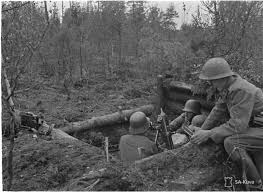
In the Far North sector, Soviet forces at Viipuri (Vyborg) receive orders to retreat. Finnish 4th and 8th Infantry Divisions march into the city unopposed. One of the first things that the Finnish troops do is to raise a flag (actually, since they can’t find a flag, they use a soldier’s shirt) over the medieval castle’s main tower. The flag that flew over the tower when the Finns handed the city over to the Soviets at the end of the Winter War is soon found and raised again (the flag is now in the central War Museum at Helsinki).
The Soviet troops are gone, but they remain intact and undefeated. They also have left many “presents” for the Finns throughout Viipuri in the form of boobytraps and time bombs. The news of the capture (or, recapture) electrifies the nation and is probably the happiest day of the entire war for the people of Finland. The Finns also make further advances in the direction of Leningrad, capturing Terioki, which is about 30 miles north of the city. They also cut the railroad running to Leningrad along the northwestern shore of Lake Ladoga. All of these successes, however, only bring the moment of truth closer in which they will have to tell the Germans that they will not attack Leningrad.
In the Army Group North sector, German troops complete the occupation of Tallinn, the capital of Estonia. Elsewhere, the front is relatively quiet due to poor weather. German troops are approaching the outer line of Leningrad’s fortifications, but progress is slow all across the front. General Halder notes hopefully that “The Finns are making encouraging progress on Leningrad from the north.” He does not realize yet that Field Marshal Mannerheim has no intention of actually attacking the city.
In the Army Group Center sector, General Guderian’s Panzer Group 2 is counterattacked from both the west and east as he tries to break out from his bridgehead across the Desna River. General Halder, however, has no sympathy, noting in his diary that:
“It is all Guderian’s own fault. He devised this plan of attack and even the most naive enemy could not be expected to stand by passively while an enemy flank is pounding past his front.”
Halder’s real beef with Guderian is lingering anger over the latter’s failure to convince Hitler to focus on Moscow rather than Kyiv. Halder is correct about tactics, of course, as a lateral movement along the front does, invariably, invite a flank attack. Guderian is struggling toward Konotop, the first stop on his way to a junction with Panzer Group 1 to the east of Kyiv.
In the Army Group South sector, the Soviets encircled at Odessa mount a fierce counterattack. They manage to push back the Romanian 4th, 11th, and 1st Army Corps in the area of Gnileakovo and Vakarzhany and give themselves a little breathing room. The Axis forces, however, remain in control and prepare to resume their own attacks on the 30th.
The Baltic is littered with sinking and sunk Soviet ships from the evacuation convoys that left Tallinn. Destroyer Yakov Sverdlov, damaged on the 28th, goes under today, having been mined along with many other ships off Cape Juminda. Overall, about 30 of 200 Soviet vessels have been lost in one of the greatest naval disasters of the war.
Luftwaffe Junkers Ju-88s from II/KG77 and KGR806 return to the attack today after having had great success on the 28th. They again attack the Soviet convoys, now off Suursaari (Hogland Island).
VT-523/Kazakhstan barely makes it to port, and only does so after disembarking 2,300 out of 5,000 fleeing troops on board at Steinskar. The beached ships usually are destroyed quickly by the Luftwaffe, but at least most of the passengers can reach the shore.
Other German aircraft are in operation and hit additional ships in the Soviet evacuation convoys.
In addition, another Soviet ship, transport VT-501/Balhash, hits a mine off of Lavansaari Island and sinks. Estonian 1879-ton transport Naissaar has especially bad luck. First, it hits a mine east of Mohni Island, Estonia, then the Luftwaffe finds it and sinks it.
There are scenes of chaos. For example, fully loaded 2026-ton passenger ship/freighter Vironia, bombed and damaged on the 28th, is taken in tow by Saturn. However, then Saturn hits a mine and has to release the tow. In the early morning hours of the 29th, Vironia drifts into a mine off Cape Juminda and sinks within five minutes. There are 1300 deaths.
The Soviets know that a disaster is happening offshore, of course, and organize a rescue operation composed of anything that floats on Suursaari. They sail out under the command of Captain G. Svayskov in a dozen old minesweepers, a division of patrol boats, six motor torpedo boats, eight submarine chasers, two tugs, four motorboats, two cutters, and rescue ship Meteor. It is a motley collection, but the ships float and manage to rescue 12,160 Soviet troops who otherwise would drown. Soviet submarine SHCH-322 accompanies the rescue ships but is lost at sea — presumably due to hitting a mine in the same minefield off Juminda Point.
The Germans and Finns know about the Soviet disaster as well. Finnish minelayers add another 24 mines to Minefield Juminda. After dark, German 5th R-Boat Flotilla adds another 32 mines between Minefield Juminda and Finnish Minefield Valjarvi — just in case the Soviets get wise to the location of the Juminda minefield (after losing over 30 ships there) and decide to try to sidestep it.
The Luftwaffe bombs and sinks 5117-ton freighter Kamenets-Podolsk between Kerch, Crimea, and Sevastopol.
Operation GAUNTLET, the raid on Spitzbergen and its associated activities, continues. Today, 21,517-ton HMT Empress of Canada offloads the 1800 Russian coalminers that it evacuated from Spitzbergen to two Soviet ships that meet it off the Dvina lightship. Empress of Canada then returns to Spitzbergen to join light cruiser HMS Aurora, carrying 200 Free French escaped prisoners of war who managed to make it across the lines.
Mussolini has met Hitler at the Führer’s military headquarters at Rastenburg in East Prussia. After talks about military and political strategy, the dictators toured the recently-conquered territory in the Ukraine and visited the Italian units serving alongside the Germans. This, the seventh meeting between the two men since the start of the war, was a full-scale affair with Mussolini resplendent in uniform, striding past knocked-out tanks and blasted buildings.
General Milan Nedic is chosen to lead the Germans’ revamped puppet government, the Government of National Salvation. This succeeds the Commissioner Government. The completes the partition of Serbia. Nedic institutes the Serbian State Guard, a paramilitary organization designed to maintain control within the puppet state. The Serbian State Guard assists in executions at the Banjica Concentration camp in Belgrade.
Kamenets-Podolski, Ukraine: After a two-day “special action”, SS troops have massacred 11,000 Jewish Hungarian forced laborers.
German Einsatzkommando kills 1,469 Jewish children in Russia.
Operation TREACLE concludes as Royal Navy destroyers HMS Griffin and HMS Havock bring the last batch of Polish troops into Tobruk and carry the final group of Australians out. The ships return safely to Alexandria without incident in the early hours of the 30th.
An Italian convoy three troopships (Neptunia, Oceania, and Victoria) departs from Naples for Tripoli by way of Sicily. Royal Navy submarine HMS Urge fires a torpedo at Victoria off Capri but misses. It alerts the Admiralty about the tempting targets, which dispatches fellow submarines HMS Upholder and HMS Ursula from Malta.
Another Italian convoy departs from Tripoli bound for Naples. So, there will be a lot of targets for the British over the next 48 hours.
The Royal Navy begins patrols of the Straits of Gibraltar, hunting for any U-boats making the passage. This patrol involves destroyers HMS Vimy, HMS Midette, and HMS Wild Swan, and corvettes HMS Campanula, HMS Wallflower, HMS Campion, and HMS Hydrangea, along with a couple of motor launches (ML-170 and ML-172).
British freighters Deucalion (7516 tons) and Farndale arrive safely at Gibraltar after sailing from Malta. The Admiralty has stopped any further such independent journeys due to the danger.
Free French Naval Forces Capitaine de corvette (lieutenant commander) Henri Honoré d’Estienne d’Orves, codenamed “Jean-Pierre Girard,” and 25 other members of the French resistance network “Nemrod” are executed at dawn at the Fort du Mont Valérien. They were betrayed by their radio operator, Alfred Gaessler, who became a double agent. Henri Honoré d’Estienne d’Orves, an associate of Charles de Gaulle and a leader of the group, is buried in Verrières-le-Buisson. The Germans advertise the executions throughout Paris as an “example,” and this leads other Frenchmen to join the Resistance. The Capitaine de corvette d’Estienne d’Orves was later posthumously promoted to Capitaine de frégate (Commander) and made a Compagnon de la Libération (“Fellow of the Liberation”).
The Royal Navy and U.S. Neutrality patrols have been fruitlessly searching for a reported German heavy cruiser in the North Atlantic for several days. However, today an RAF reconnaissance plane spots the three known German cruisers in the Atlantic — Scharnhorst, Gneisenau, and Prinz Eugen — in port at Brest.
Weather is poor throughout the day and night, so not as much is accomplished as the RAF probably wished.
RAF Bomber Command, Day of 29 August 1941
6 Blenheims on Circus operation to Hazebrouck but only 1 aircraft dropped bombs on this target. 1 Fortress to Düsseldorf turned back. No losses.
RAF Bomber Command, Night of 29/30 August 1941
Frankfurt
143 aircraft — 73 Hampdens, 62 Whitleys, 5 Halifaxes, 3 Manchesters — on the first 100-plus aircraft raid on this city, with railways and harbors as aiming points. The first sortie by an Australian squadron was flown in this raid when Squadron Leader French (no initials recorded) and his crew took a 455 Squadron Hampden to Frankfurt and returned safely. 2 Hampdens and 1 Whitley lost. Bad weather prevented accurate bombing and crews reported that the attack became general in the Frankfurt area Frankfurt reports only light and scattered bombing, with damage to a gasworks, a cask merchant’s depot and to several houses. 8 people were killed, 7 of them in one house which was struck by a bomb.
Mannheim
94 Wellingtons; 2 lost. The weather was bad and Mannheim’s report confirms that bombing results were poor with only scattered damage. 5 commercial firms, none employing more than 70 people, suffered production losses because of damage. 1 person was injured.
5 ‘freshmen’ Wellingtons were sent to Le Havre. No losses.
Total effort for the night: 242 sorties, 5 aircraft (2.1 percent) lost.
Resistance Operations
The first flights by Bomber Command in support of Resistance groups in the German-occupied countries were carried out on this night by an unknown number and type of aircraft from the newly formed 138 Squadron, based at Newmarket. This unit was joined in this work by 161 Squadron in February 1942. Both Squadrons belonged to 3 Group and a permanent base was later established for them at Tempsford. Supplies and agents were dropped regularly by parachute in many parts of Europe and sometimes agents or urgent packages were collected by small aircraft, usually Lysanders, which landed in fields. Many types of aircraft were used for the dropping of supplies or agents by parachute. Bomber Command’s Operations Record Books do not record details of these operations until the night of 7/8 January 1944 but, from the Record Books of 138 and 161 Squadrons, it appears that 2,654 sorties were flown and 73 aircraft were lost between the commencement of these operations and 7/8 January 1944. These sorties and losses, which cannot be included in the nightly diary entries or in the periodic operational statistics until January 1944, have been added into the final table at the end of the war.
Fifteen Wellington bombers based on Malta raid Tripoli, reporting hits on both ships and shore targets. The RAF conducts daily raids on the North African coast, but the British do not publicize these raids because they want to keep the Germans confused as to their source.
Royal Australian Air Force pilot Clive Caldwell, in a P-40 “Tomahawk” of No. 250 Squadron, is flying northwest of Sidi Barrani when he is jumped by two Bf 109E-7s. They badly damage Caldwell’s Tomahawk and wound him in the back, left shoulder, and leg. However, he manages to maneuver into position to shoot one of the planes down (the wingman of Luftwaffe ace Leutnant Werner Schroer, who watches in bemusement) and nurse his flaming plane back to base. It is incidents such as this that give him the nickname “Killer Caldwell” (a nickname he despises) and make him the top Allied ace in North Africa and of any pilot flying a P-40. Caldwell finishes the war with 28 total victories: 20 German/Italian and 8 Japanese.
Battlecruiser HMS Repulse, light cruiser HMS Sheffield, and destroyers HMS Lightning, HMS Badsworth, and HMS Vivacious departed Scapa Flow for the Clyde. The battlecruiser and light cruiser were required for escort duties with convoy WS.11. The ships arrived in the Clyde at 1000/30th. The destroyers returned to Scapa Flow, arriving at 0730/31st.
Destroyer HMS Laforey (Captain R. M. J. Hutton, D.19) arrived at Scapa Flow at 1340 to carry out working up exercises.
Destroyer HMS St. Marys was damaged in a collision with troopship Royal Ulsterman (3244grt) in convoy SD 10 off the west coast of Scotland. The destroyer proceeded to Greenock for temporary repairs, then proceeded to Liverpool, arriving on 2 September. The destroyer was repaired at Liverpool, completing on 15 December.
Convoy OG.73 departed Liverpool escorted by destroyers HMS Campbeltown, HNoMS St. Albans, HMS Wanderer, and HMS Westcott, sloop HMS Fowey, corvettes HMS Gentian, HMS Jasmine, HMS Myosotis, HMS Periwinkle, and HMS Stonecrop, anti-aircraft ship HMS Springbank, and ocean boarding vessel HMS Hilary. The ocean boarding vessel was detached that night. Corvettes HMS Begonia and HMS Larkspur joined the escort on the 30th. The destroyers were detached on 2 September. On 2 September, corvette HMS Hibiscus joined the escort. Corvette Gentian was detached on 11 September. Destroyers HMS Duncan and HMS Vidette departed Gibraltar on 6 September joined the escort on 8 September. Destroyers HMS Farndale and HMS Wild Swan after refueling at Ponta Delgada joined the escort on 8 September. Destroyer HMS Fury also joined the escort on 8 September. The convoy arrived at Gibraltar on 13 September.
Soviet destroyer Yakov Sverdlov was mined and sunk off Cape Juminda.
Destroyers HMS Griffin and HMS Havock departed Alexandria for Tobruk in the tenth and final series of the TREACLE operation. The destroyers arrived back at Alexandria on the 30th.
Destroyers HMS Kingston and HMS Hasty departed Alexandria for Beirut.
An Italian convoy of troopships Neptunia, Oceania, and Victoria, escorted by destroyers Aviere, Da Noli, Camicia Nera, Gioberti, Usodimare, and Pessagno, departed Naples for Tripoli.
Submarine HMS Urge made an unsuccessful attack on Victoria off Capri.
Submarines HMS Upholder and HMS Ursula departed Malta to intercept a convoy east of Tripoli.
Destroyers HMS Vimy, HMS Vidette, and HMS Wild Swan, corvettes HMS Campanula, HMS Wallflower, HMS Campion, and HMS Hydrangea, and motor launches ML.170 and ML.172 departed Gibraltar to patrol in the Straits of Gibraltar to intercept any U-boat attempting passage.
Convoy HX.147 departed Halifax escorted by armed merchant cruiser HMS Laconia and corvettes HMS Gladiolus, HMS Mimosa, and HMCS Wetaskiwin. Destroyer HMCS Columbia joined on 2 September. On 8 September, the corvettes were detached when relieved by destroyers HMS Amazon, HMS Belmont and HMS Bulldog, French corvette HMS Aconit, Royal Navy corvettes HMS Aubretia, HMS Heartsease, and HMS Nigella, and anti-submarine trawlers HMS Daneman, HMS Northern Wave, and HMS St. Apollo. Destroyer Columbia was detached on 8 September. On 11 September, destroyers Amazon, Belmont, and Bulldog and corvette Aconit were detached. The convoy arrived at Liverpool on 12 September.
In Washington, President Roosevelt announced that W. Averell Harriman, Minister to London, would head the American delegation at the three-power conference to be held soon at Moscow. He met with the Cabinet and late tonight went to Hyde Park. His callers included Secretary Hull and Under-Secretary Welles.
The Senate met briefly and adjourned at 12:20 until noon Tuesday. Its Finance Committee completed work on the $3,672,400,000 tax bill; a special committee continued hearings on the East Coast gasoline shortage.
The House was in recess.
The Roosevelt Administration moved today toward a reappraisal of British and Russian war aid by ordering two high civilian defense officials and the chief of the army air corps to undertake special missions abroad. President Roosevelt disclosed that W. Averell Harriman, whom he once called his Lend-Lease expediter In London, would head an American delegation to Moscow soon for conferences on Russian munitions requirements. Harriman, Mr. Roosevelt said, will be succeeded In London by John Biggers, O.P.M. production chief. Biggers will have the task not only of handling Lend-Lease transportation problems from the London end but also of coordinating British and American production schedules wherever possible.
About 200,000 men are due to be released by the U.S. Army before the end of the year under regulations issued today by the War Department in Washington. The releases from active duty will be made in the following priorities:
- Dependency and hardship cases when properly established.
- Men enlisted for three years in the Regular Army and men enlisted for one year in the Army of the United States at expiration of term of enlistment. Those who desire and are qualified for re-enlistment will be re-enlisted in the Regular Army and will not be included in quotas for release.
- Selective service and National Guard enlisted men who request release from active duty in writing, and who had attained their twenty-eighth birthday on or prior to July 1, and prior to their induction, in the order of length of active Federal service. Such men will not be required to complete one year of active duty.
- Enlisted men (except Regular Army) who are married, who have completed one year and who request release from active duty in writing, in order of length of Federal service.
- Enlisted men of all components who have completed their normal term of Federal service, in order of length of Federal service beyond the normal term of twelve months.
The War Department decided that 200,000 men could be sent home “without greatly lowering the military efficiency of any of the units comprising the Army,” and directed commanding officers to compile lists of men who will be released in proportion to the accretion of replacements through continued operation of the draft or by voluntary enlistment of young men.
They are scheduled to be released after December 10.
December 10, 1941.
Of course, in the event, none of them will be going home then, or anytime soon.
Charles Lindbergh said at an America First Committee rally in Oklahoma City that Britain might turn against the United States “as she has turned against France and Finland.” Montana Senator Burton K. Wheeler spoke next and said, “If our interventionists want to free a country from the dominion of another country, we ought to declare war on Great Britain to free India. I have never seen such slavery as I saw in India a few years ago.” Many Americans started turning against Lindbergh at this time. Lindbergh and Wheeler are fighting against the tide, as Gallup public opinion polling suggests that more of the public is beginning to accept President Roosevelt’s interventionist policies.
Director William S. Knudsen, hinting that working hours may be extended in defense industries, today hailed President Roosevelt’s creation of the new “ministry of supply” as a major step toward speeding up arms production. Simultaneously he announced appointment of W. H. Harrison, formerly deputy O.P.M. production director, as head of the priorities division, and of William L. Batt, another deputy production director, to head the new O.P.M. division of materials created to accelerate acquisition and allotment of supplies needed for defense production.
A record-breaking revenue bill, digging deeper into the pockets of all present taxpayers, bringing more than 6,000,000 additional persons under the federal income tax structure, and estimated to yield $3,672,400,000 annually, was approved today by the Senate Finance Committee. Chairman George, Georgia Democrat, of the committee said he believed the total estimated by the treasury was too low. He predicted the measure would raise approximately $4,000,000,000 a year.
Transfer of the west coast (army) air corps training center headquarters from Moffett field to Santa Ana, California, within the next few months was announced today by Major General Barton K. Yount, commanding officer of the W.C.A.C.T.C. Details of the transfer have not yet been completed, General Yount said, but it is expected the move will be made sometime after Jan. 1, 1942. The army is evacuating Moffett field to make room for a navy lighter-than-air (blimp) base.
Jack Heyn enlists in the United States Army Air Corps in Omaha, Nebraska. Heyn becomes a top war photographer, memorializing events in the Pacific Theater.
Paramount Pictures releases “Flying Blind,” a war comedy/action film starring Richard Arlen and Jean Parker. This is a typical entry from Pine-Thomas Productions which costs very little to make ($90,000) but returns big profits (gross of $500,000+). The film has some interesting stock aerial footage, such as of a Lockheed 12A Junior Electra, Boeing 247, and Douglas DC-3.
The motion picture “Sun Valley Serenade” is released. This musical, directed by H. Bruce Humberstone, stars Sonja Henie, John Payne, Milton Berle, Lynn Bari, Joan Davis, the Nicholas Brothers, Dorothy Dandridge and Glenn Miller and his Orchestra including Ray Anthony, Tex Beneke, Ray Eberle, Paula Kelly, Chummy MacGregor and Billy May. The plot has Payne, the pianist with Miller’s Orchestra, sponsoring a Norwegian war refuge who he thinks is a little girl but she is actually Henie. When the band soloist (Bari) quits, Henie puts on an ice skating show as a substitute. Miller’s Orchestra performs “Chattanooga Choo Choo,” “It Happened in Sun Valley,” “At Last,” “Moonlight Serenade,” and “In The Mood.” The film is nominated for three Academy Awards.
Major League Baseball:
The high-flying Dodgers once again are a game and a half ahead in the National League pennant drive. While the St. Louis Cardinals were taking a day off, Leo Durocher’s band hammered out a 5–4 victory over the Giants yesterday, the result bringing joy to the majority in a crowd of 27,533 at the Polo Grounds.
Excellent relief pitching by Joe Haynes came too late for the White Sox today. The Browns scored five runs off Buck Ross in the first three innings to gain a 5–2 victory. Mike Kreevich’s double with the bases full in the fifth inning drove in both Chicago runs, but otherwise the Sox were held at bay by Elden Auker.
Brooklyn Dodgers 5, New York Giants 4
Chicago White Sox 2, St. Louis Browns 5
Both the Japanese and the Americans wish to keep their negotiations out of the press for a variety of reasons. These include the effect on public opinion in Japan and the reactions of their allies. This has led to some unhelpful incidents, such as Winston Churchill making bellicose statements directed at Japan during a radio address, but, on the whole, it has succeeded. Today, however, some cracks appear in the curtain of secrecy. The New York Times prints a story that notes the meeting between Ambassador Nomura and President Roosevelt on the 28th, and the Japanese release some details from the diplomatic note given to Roosevelt at that meeting. The Japanese accuse the Americans of publicizing the meeting in order to alienate them from their German and Italian allies — who are completely oblivious to the negotiations — tell Nomura that henceforth he must consult with the Foreign Office before releasing any public statements.
Overall, Tokyo is pleased with the slight movement in negotiations that resulted from Nomura’s visit with Roosevelt. However, Nomura is instructed to avoid any meetings on U.S. soil — which apparently does not include Hawaii or Alaska — and that a meeting at sea would be acceptable, too.
The Chinese War Ministry said today that Chinese vanguards had reached the outskirts of two Japanese-occupied provincial capitals in counter-attacks that started Monday. The capitals were Nanchang, in Kiangsi Province, 590 miles east of Chungking, and Foochow, in coastal Fukien Province, 870 miles east of Chungking. The Ministry spokesman said small scale attacks launched against Japanese outposts in Kiangsi, Fukien, Chekiang, Southern Kiangsu and Southern Anhwei provinces had inflicted 2,500 casualties on the Japanese. Four towns were said to have been recaptured, including Kaoshun, forty-five miles south of Nanking, and Futsing, south of Foochow. Chinese forces north of the Tsiengtang River were said to have entered three towns on the Nanking-Hangchow highway and to have withdrawn later “according to plan.” Chinese troops reached the city walls of Shaohing, Chekiang Province wine center, the spokesman said, and Japanese troops were expected to withdraw.
Franco-Laotian Treaty of Protectorate signed by Vichy French Admiral Jean Decoux, Governor General of Indochina and King Sisavang Vong of Louangphrabang attaches the provinces of Vientiane, Xiangkhoang and Louang Namtha to the King’s domain recompensing the loss of Lao territories to Thailand and normalizing the status of Laos as a protectorate of Vichy.
The Imperial Japanese Navy requisitions 10,439-ton freighter Hokoku Maru. The IJN also begins converting 8691-ton Hoyo Maru and 5350-ton freighter Bangkok Maru, the former into an auxiliary tanker and the latter into an armed merchant cruiser.
Arthur W. Fadden became 13th Prime Minister of Australia. Fadden replaced Robert G. Menzies as Prime Minister of Australia, who resigned due to lack of support within his own party. Menzies stays on as Minister for Defense Coordination.
New Zealand Division light cruiser HMS Achilles departed Auckland and met British steamer Rimutaka (16,576grt) off Cape Palliser. The steamer was escorted to 250 miles southeast of Chatham Island. On 2 September, the steamer was detached and the light cruiser joined another steamer which was escorted to Wellington.
Dow Jones Industrial Average: 127.43 (-0.34)
Born:
Robin Leach, English entertainment reporter (“Life Styles of Rich & Famous”) and writer, in Perivale, London, England, United Kingdom (d. 2018).
Ellen Geer, American actress, director and professor, in New York, New York.
Died:
Henri Louis Honoré, comte d’Estienne d’Orves, 40, French Navy officer and one of the major heroes of the French Resistance, said to be the “first martyr of Free France”, executed by the Nazi occupiers of France.
Jan Louis Guillaume Doornik, 36, Dutch resistance fighter (Free French Forces), executed for treason by the Nazi occupiers of France.
Naval Construction:
The Royal Navy YMS-1-class auxiliary motor minesweeper HMS BYMS 2004 (J 804) is laid down by the American Car and Foundry Co. (Wilmington, Delaware, U.S.A.).
The U.S. Navy YMS-1-class auxiliary motor minesweeper USS YMS-112 is laid down by the Burger Boat Co. (Manitowoc, Wisconsin, U.S.A.).
The Royal Navy Bangor-class (Turbine-engined) minesweeper HMS Padstow (J 180) is laid down by William Hamilton & Co. (Port Glasgow, Scotland); completed by Parsons. Transferred to the Royal Indian Navy before completion, she commissions as the HMIS Rohilkhand (J 180).
The U.S. Navy SC-497-class (110-foot wooden hull) submarine chaser USS PC-636 (later SC-636) is laid down by the Vineyard Shipbuilding Co. (Milford, Delaware, U.S.A.).
The U.S. Navy Gato-class submarine USS Kingfish (SS-234) is laid down by the Portsmouth Navy Yard (Kittery, Maine, U.S.A.).
The Royal Navy Hunt-class (Type III) escort destroyer HMS Rockwood (L 39) is laid down by Vickers Armstrong (Barrow-in-Furness, U.K.).
The U.S. Navy 80-foot Elco patrol motor torpedo boat USS PT-50 is launched by the Electric Launch Company Ltd. (Elco), (Bayonne, New Jersey, U.S.A.). She is transferred to the Royal Navy on completion and commissions as HMS MTB 308.
The Royal Navy Fairmile B-class motor launch HMS ML 286 is commissioned.
The Sjøforsvaret (Royal Norwegian Navy) Flower-class corvette HNoMS Eglantine (K 197) is commissioned. Her first commanding officer is Kapt. Lt. Harald Voltersvik.
100 Days to Pearl Harbor.
 History Diaries