The invasion of Iran by British and Soviet forces continues without too much hindrance from the defenders on 27 August 1941, but there are some isolated situations where the Iranian Army shows its mettle. British forces reach Ahvaz, where Iranian troops under General Mohammad Shahbakhti has prepared a fortified position on the far side of the Karun River. Ahvaz controls the entrance to the Zagros Mountains, through which the British hope to drive north toward Tehran. However, British probing attacks show that Ahvaz would require a costly battle, so the British Indian troops come to a halt and wait for the campaign to be decided elsewhere.
In central Iran, the 10th Indian Infantry Division is hindered more by the rough terrain than by the defenders. Defenders in the town of Gilan-e-Gharb put up a spirited resistance, but it is soon overcome. This opens the Pai Tak Pass, which leads toward Tehran. The retreating Iranians cut down some trees across the road and dynamite it in places, slowing the British down but not stopping them.
In the northwest, the Soviets face stiffer opposition, but overcome it with the aid of Red Air Force bombers and utter ruthlessness (along with taking a lot of casualties of their own). The Iranians retreat on Ramsar and hope to make a stand there. In the northeast, the Soviets invading from Turkmenistan SSR have a real battle against Iran’s 9th Infantry Division at Mashhad and Khorasan province. The Soviets have been stopped for three days at the frontier, but the Iranians have taken heavy casualties and their hold on Mashhad is becoming tenuous.
Australian sloop HMAS Yarra captures 4901-ton Italian freighter Hilda at Banda Addas. The Iranian crew sets Hilda on fire, but the British put them out. Royal Navy tug Sydney Thubron tows Hilda to Karachi, where it is converted into a Royal Navy repair ship.
In Tehran, everyone can see how things will turn out. The Prime Minister resigns and German nationals look for escape routes. Mohammad Ali Foroughi becomes the new Prime Minister, but everyone knows that it won’t be for long. Reza Shah of Iran appointed Foroughi as the Prime Minister, who immediately began negotiations with the Soviet Union and the United Kingdom to end the hostilities.
OKH Chief of Staff General Franz Halder’s war diary for the 27th is full of notations that the Soviet positions are “weak” and “beaten.” He notes that the Soviets in the Valdai Hills are trying to regroup their “beaten” forces, that that the Soviet position southeast of Bryansk is “still very weak,” that the Soviet troops on the Dneipr between Kyiv and Zaporozhe are “weak forces,” that the Soviets on the lower Dneipr are building up a defensive line “though only with weak forces.” These are not the only times he points out how “weak” the Soviets are. What is missing from Halder’s diary, however, are any indications that the Germans are strong enough to take advantage of all this Soviet weakness.
The Germans are beginning to formulate a plan for taking Kyiv. General von Sodenstern, Chief of Staff at Army Group South, cautions that Sixth Army must not become “locked” with the Soviet defenders, but instead should circle around the city to the east and cut off its supplies and escape route. This is extremely wise counsel that the same Sixth Army would have been well to heed exactly a year later at Stalingrad.
In the Far North sector, the Finns mount major attacks on the Soviet-held port of Hango in southwest Finland by both land and sea. The heavily fortified Soviets, though, are well-provisioned and the small beachhead is heavily armed. The Soviets resist the assaults.
The Finnish Light Brigade T, 12th Division, and 18th Division continue pursuing the Soviet 43rd, 115th, and 123rd Rifle Divisions near the Vuoksi River. Finnish troops are spreading out all across the Karelian Isthmus, cutting off Viipuri tightening their grip on the shore of Lake Ladoga. However, despite being experts at forest warfare, they are having difficulty drawing tight lines to hem in the retreating Soviets because the terrain offers too many chances to escape unseen.
Northeast of Nurmi Lake, a bloody battle develops between Finnish XXXVI Corps and fleeing Soviet troops. A German SS battalion fails to close a pincer at the narrows at Kayrala in the morning, allowing Soviets to escape on foot without any equipment. The Axis troops quickly regroup, and XXXVI Corps sends some Finnish troops to the Wehrmacht’s 169th Division while attaching three SS battalions to the Finnish 6th Division. The Axis troops hurry toward the town of Allakurtti along a road and a railway line, but the Soviets get there ahead of them and prepare fortified positions. The Soviets fight for their lives and manage to hold their line sufficiently for most of their troops to escape.
In the Army Group North sector, German troops of 18th Army advance on Tallinn (Reval), the capital of Estonia as the Soviet 10th Rifle Corps and affiliated troops and civilians begin a massive evacuation. Once Tallinn is taken, it will free up German soldiers for the all-important advance on Leningrad. So, no matter how the evacuation turns out, it is a strategic victory for the Wehrmacht.
In the Army Group Center sector, Panzer Group 3 recaptures Velikie Luki after Soviet counterattacks. Group Stumme at Velikie Luki prepares for a drive on Toropets. General Stumme reports to headquarters that his troops have captured 34,000 Soviet soldiers and 300 guns of 22nd Army. German 250th Infantry Division, the Spanish Blue Division, begins marching on foot from the Polish border to Smolensk. General Guderian’s Panzer Group 2 expands its bridgehead south of the Desna River at Novgorod-Seversk, but the going is slow both for the Panzer Group and Second Army which is also moving toward Kyiv.
In the Army Group South sector, the Germans complete their movement of an assault battalion and ten heavy artillery battalions to assist the Romanians in a resumption of the attack on Odessa. The Soviets have little chance of prevailing but have been ordered to fight to the end. Hitler and Mussolini tour areas behind the front lines and meet with army leaders. In what may be a related incident, the leader of Panzer Group 2, General Paul von Kleist, is mentioned in the Wehrmachtbericht, one of the Reich’s highest honors.
Soviet bombers hit Koenigsberg during the night.
There is a short, sharp action off Cape Domesnas, Latvia. Four Soviet TKA boats attack a German motorboat convoy. No boats are sunk, but two of the German boats (Adele and Diete Korner) are damaged and beached
The Soviet Baltic Fleet evacuates Tallinn, Estonia in a maximum effort of over 200 vessels. The ships head toward Kronstadt, Kotlin Island near Leningrad. There are four separate convoys and a Soviet main covering force commanded by Vice Admiral V.F. Tributs. Prior to leaving, the Soviets scuttle a number of vessels. The Soviet evacuation proceeds without incident today (it runs into difficulties on the 28th). Shortly after the last ship leaves, the Germans occupy the port. It is an audacious gamble made in the teeth of German aerial and naval supremacy of the mine-infested Baltic even though the route only covers 150 miles.
Operation GAUNTLET continues in Spitzbergen without any interference from the Germans. The Norwegians are sending the Germans in mainland Norway false weather reports of fog which keep away Luftwaffe reconnaissance flights by Wettererkundungsstaffel (Wekusta 5). The Canadians settle in and continue destroying mining equipment and coal dumps in the midnight sun. The Germans don’t know anything is amiss, so they continue sending colliers to pick up loads of coal — which the Canadians gladly seize.
German 250th Infantry Division, consisted of Spanish volunteers, began to march on foot from the Polish-Lithuanian border toward Smolensk, Russia.
Paul von Kleist was mentioned in the Wehrmachtbericht daily radio report.
SS units under the command of the Higher SS and Police Leader for the southern region, SS General Friedrich Jeckeln, murder 23,600 Hungarian Jews at Kamianets-Podilskyi, Ukrainian SSR. This figure is taken from Jeckeln’s own report, and some estimates place the number closer to 25,000. As usual in such incidents, the victims are marched to pits outside of town and shot so that they fall into them (in this case, bomb craters). This incident is the largest mass execution to date and a precursor of much larger ones to come in September 1941 and thereafter. The Jews were marched to the killing pits by policemen of Police Battalion 320, were ordered to enter the pits and were murdered by members of Einsatzgruppe D.
Operation TREACLE, the replacement of Australian soldiers at Tobruk with Polish soldiers of the Carpathian Brigade, continues. Royal Navy minelaying cruiser HMS Abdiel and destroyers Hotspur, Kingston, and Kipling are escorted to Tobruk after dark from Alexandria. Unlike previous Treacle missions, however, the Italian Regia Aeronautica makes a successful attack on the convoy. An Italian S.79 of 279 Squadron hits escorting light cruiser Phoebe with an aerial torpedo about 100 miles northeast of Tobruk. The attack kills eight sailors. Phoebe makes it back to Tobruk under its own power, and the rest of the ships make it to Tobruk and back without suffering further attacks. Phoebe later proceeds to New York Navy Yard for repairs that last until 15 April 1942.
While en route from Naples to Tripoli, an Italian convoy is attacked. Royal Navy submarine HMS Urge (Lt Cdr Tomkinson) torpedoes 497-ton Italian freighter Aquitania, but Aquitania is able to return to Trapani, Sicily at reduced speed. Italian torpedo boat Clio counterattacks Urge and damages the British submarine. Two other Royal Navy submarines, Unbeaten and Utmost, also attack ships in the area but miss.
Royal Navy submarine HMS Triumph (Cdr Woods) captures and then sinks an Italian fishing boat off the Furano River, Sicily.
Operation GUILLOTINE, the British reinforcement of Cyprus, continues today with the departure from Port Said of Australian sloop HMAS Parramatta and transport Salamaua. The ships proceed to Famagusta, arriving on the 29th, and then return to Alexandria to conclude the operation.
There is an invasion alert on Gozo beach at Malta due to reports of Italian torpedo boats in the area. However, there is no invasion.
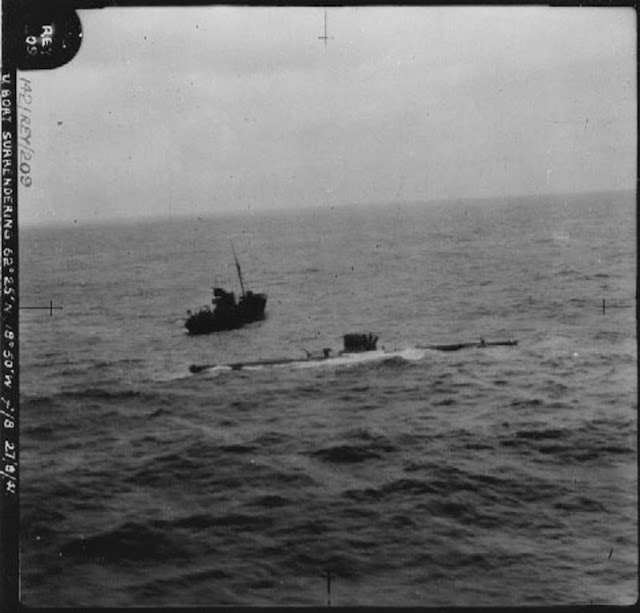
German submarine U-570, attacked by an RAF Hudson (No. 269 Squadron), is captured intact by British surface force in the North Atlantic. The Royal Navy thoroughly evaluated the submarine, the first to be captured intact for intensive study; the U-boat served as HMS Graph until it was wrecked in 1944. Among the ships that captured the submarine was Canadian destroyer HMCS Niagara, formerly USS Thatcher (DD-162), one of the fifty destroyers transferred in the destroyers-for-bases agreement of August 1940.
U-570, captured by the Royal Navy today, has its cipher gear intact. The scientists at Bletchley Park know all about German cipher equipment already, though extra and current copies are always welcome. Contrary to myth, this capture does prove of war-winning benefit to the codebreakers at Bletchley Park. The German crew has plenty of time (actually, all day long, as the British take that long to get ships in the area) to destroy its current codes and anything else of value before being taken as prisoners. Thus, the capture is worth less than it might seem from a codebreaking standpoint, though of course it is a daring feat and does deprive the Kriegsmarine of a submarine. Many Kriegsmarine codes remain unbreakable throughout the war because German sailors are the best-trained and most disciplined ciphers in the Wehrmacht. Lapses in coding are the main source of codebreaking — not having copies of the equipment used — and the Kriegsmarine makes relatively few errors that give codebreakers an opening.
German submarine U-557 attacked Allied convoy OS.4 300 miles west of Ireland between 0125 and 0426 hours, sinking four ships.
German submarine U-202 sank British trawler Ladylove off Iceland at 1435 hours, killing the entire crew of 14.
The German 6th Destroyer Division, based at Kirkenes, Norway, already is suffering from combat and the elements. After only six weeks in Northern Norway, destroyers Richard Beitzen and Hermann Schoemann must return to German for repairs. This leaves only two destroyers to patrol the northern convoy routes — right when activity is starting to ramp up with British supply missions to Murmansk and Archangel.
Former French Prime Minister Pierre Laval and Marcel Déat, editor of the pro-German Paris newspaper L’Oeuvre were shot and wounded near Versailles by Paul Colette, a young member of the Resistance. Pierre Laval was shot four times by student Paul Collete as he saw off French volunteers going off to fight with the Germans in Russia. Laval survived the assassination attempt, but was seriously wounded particularly by a bullet that penetrated his body about an inch from his heart. The incident is used as an excuse by the Vichy government to round up many of its opponents, describing them as communists. Few Frenchmen are upset by the shooting. Laval — who rose from peasant prime minister, and favors strong collaboration with Germany — is not popular in France as Marshal Petain is.
Paul Collete was arrested after shooting and wounding Pierre Laval; Laval would recommend giving Collete a light sentence, citing that the young man was likely only a pawn used by more senior plotters behind the scenes. Laval, shortly after being shot, prevents the Germans from immediately shooting Collette. He tells the German officer who has apprehended the shooter, “Don’t do that. You do not know how the French will react like I do.” However, Collette is not let go — he will go on trial, be sentenced to death, have his sentence commuted by Petain, and then be sent to a succession of French prisons and ultimately Mauthausen concentration camp. Collette, despite his own arduous path for the duration of the war and murky motives, becomes something of a symbol for the French Resistance. He survives the war, publishes a book, “I Shot Laval,” in 1946, and dies in 1995.
The incident hardens the Vichy government’s resolve to eliminate dissent within its zone. It arrests political opponents and simply calls them “communists” to justify the arrests regardless of their true political affiliations.
The British government took over the control of railways for the duration of the war; the private owners and operators were to receive £43,000,000 per year as compensation.
Winston Churchill approves the MAUD Committee’s suggestion that an atomic bomb should be developed:
“Although personally, I am quite content with the existing explosives, I feel we must not stand in the path of improvement, and I therefore think that action should be taken in the sense proposed by Lord Cherwell.”
The Americans already are working toward an atomic bomb, and also have reached the same conclusions as Churchill based on their reading of the same MAUD Report.
An RN Fairey Fulmer makes a forced landing on Tramore Strand in County Donegal. The crew and aircraft are returned to Northern Ireland.
Pilot Officer William R. Dunn, an American pilot flying a Spitfire Mk II with RAF No. 71 “Eagle” Squadron, downs two Bf 109 Fs — his 4th and 5th aerial victories. Dunn, who also got the squadron’s first confirmed victory on 21 July 1941, thereby becomes the first American ace of World War II. Dunn is wounded in the right leg in the action and, after recovery, becomes an instructor.
RAF Bomber Command, Day of 27 August 1941
13 Blenheims on Circus operations to Lille and St-Omer were recalled.
RAF Bomber Command, Night of 27/28 August 1941
Mannheim
91 aircraft — 35 Hampdens, 41 Wellingtons, 15 Whitleys. No aircraft were lost but 7 Wellingtons and 1 Whitley crashed in England. Good bombing and many fires were claimed though there was ground haze. Mannheim reports only 41 high-explosive and 25 incendiary bombs in the city, though the latter figure is probably too low. 13 premises were damaged — 2 store buildings on a military camp, 1 hotel, 2 shops, 5 houses, 1 factory air-raid post and 2 small warehouse& The only casualties were 13 people injured in the hotel incident.
Minor Operations: 2 Wellingtons to Boulogne, 2 to Dunkirk, 17 Hampdens minelaying in the Frisians. No losses.
The Luftwaffe attacks Tobruk, and a Junkers Ju-87 Stuka sinks 245-ton whaler Skudd III. There are three deaths immediately, another man dies later of wounds, and two sailors are missing. An additional six men are wounded.
Luftwaffe ace Hans-Joachim Marseille shoots down a Hurricane fighter near Gambut, Libya.
U-570, commanded by Kapitänleutnant Hans-Joachim Rahmlow, was damaged by British bombing SW of Iceland in 52-15N, 18-35W and captured by Royal Navy forces. The forty four German crewmen were taken prisoner. Anti-submarine trawler HMS Northern Chief arrived during the evening of 27 August. During the morning of 28 August, trawlers HMS Kingston Agate, HMS Wastwater, and HMS Windermere and destroyers HMS Burwell and HMCS Niagara arrived on the scene. The submarine towed to Thorlakshavn, Iceland by two trawlers. On arrival on the 28th, the submarine was beached. On 5 September, the submarine was towed off by tug Salvonia. Submarine U-570 was alongside depot ship HMS Hecla at Hvalfjord on 6 September. On 29 September, the submarine departed Hvalfjord escorted by destroyer HMS Saladin and arrived at Barrow on 3 October. The Royal Navy thoroughly evaluated the submarine, the first to be captured intact for intensive study; the U-boat served as HMS Graph until it was wrecked in 1944.
Canadian T/Lt C. A. Keefer RCNVR, of escort vessel HMS Lulworth, drowned rescuing a passenger from Norwegian steamer Ingria (4391grt). Both ships were in convoy OS.4. Keefer was awarded the Albert Medal.
U-557, commanded by Oberleutnant zur See Ottokar Arnold Paulssen, sank Norwegian steamer Segundo (4414grt) and British steamer Saugor (6303grt) from convoy OS.4 in 53-36N, 16-40W. Between 0125 and 0143 hours on 27 Aug 1941, U-557 fired four single torpedoes at the convoy OS.4 west of Ireland and reported three ships sunk and another damaged which was hit after the torpedo had missed the intended target. In fact, only Segundo and Saugor were hit and sunk.
The Segundo (Master Karsten B. Wilhelmsen) was struck on the port side at the #2 hold by a torpedo and sank by the bow within seven minutes. The crew stopped the engines and abandoned ship in the starboard lifeboat and the port motor boat and by jumping overboard. After about 30 minutes, HMS Lulworth (Y 60) (LtCdr C. Gwinner, RN) picked up two men from rafts, then 23 survivors from the boats and after a couple of hours another two men hanging on to some debris. The master, five crew members and the female secretary Gudrun Torgersen (the wife of the first mate) were lost. The first mate Arnt Olav Torgersen was awarded the Lloyds War Medal for bravery at sea. He jumped into the rough sea from a lifeboat in an attempt to rescue two men, but in spite of his desperate efforts they drifted away. He was not able to return to the boat and clung to a hatch cover until he was rescued by the sloop. The 4,414 ton Segundo was carrying ballast and was headed for Curaçao.
52 crew members and seven gunners from the Saugor (Master James Arthur Aitken Steel) were lost. The master and 22 survivors were picked up by the British rescue ship Perth (Master Keith Williamson, OBE) and landed at Greenock the next day. The 6,303 ton Saugor was carrying general cargo and 28 aircraft and was headed for Calcutta, India.
Submarine U-557 then sank British steamer Tremoda (4736grt) from convoy OS.4 in 53-36N, 16-40W. At 0205 hours on 27 Aug 1941 the Tremoda (Master James Sincock Bastian) in convoy OS.4 was torpedoed by U-557 west of Achill Island and was last seen drifting in 54°08N/15°28W the next day. The master, 25 crew members and six gunners were lost. 20 crew members and one gunner were picked up by FFL Chevreuil and landed at Kingston, Jamaica. The 4,736 ton Tremoda was carrying general cargo and war stores and was headed for Duala, Cameroons.
Submarine U-557 later sank British steamer Embassage (4954grt) from convoy OS.4 in 54N, 13W. At 0426 hours on 27 Aug 1941 the Embassage (Master Edward Kiddie) in convoy OS.4 was torpedoed and sunk by U-557 about 100 miles west of Achill Island. The master, 32 crew members and six gunners were lost. Three crew members were picked up after four days by HMCS Assiniboine (I 18) (A/LtCdr J.H. Stubbs, RCN) and landed at Greenock. The submarine also reported damaging a steamer in the convoy. The 4,954 ton Embassage was carrying general cargo, including trucks and aircraft and was headed for Pepel, Sierra Leone.
U-202, commanded by Kapitänleutnant Hans-Heinz Linder, sank British trawler Ladylove (230grt) near Iceland. At 1435 hours on 27 Aug 1941, U-202 hit a trawler with a torpedo and observed the vessel to sink within 15 seconds. This vessel must have been the Ladylove, which was reported missing since 30 August near Iceland.
U-752, commanded by Kapitänleutnant Karl-Ernst Schroeter, sank Soviet fishing trawler RT.8 Seld´ (608 GRT). At 1210 hours on 27 August 1941, U-752 fired one G7e torpedo at a patrol vessel off Cape Kanin Nos and observed how the ship disappeared in an explosion after being hit aft of the funnel after 1 minute 37 seconds. The ship sunk must have been the fishing trawler RT.8 Seld´ (Master .N. Demidova) which had left port in late August 1941 and was reported missing in October 1941 after she failed to return.
A Fulmar of 809 Squadron crashed off the deck during landing. Lt H. E. Yates and the observer were picked up by a destroyer.
Light cruiser HMS Euryalus and destroyer HMS Puckeridge departed Scapa Flow at 0100 to join Battleship HMS Malaya and destroyer HMS Punjabi off May Island and escort the battleship to Scapa Flow, where they arrived at 2000.
Destroyer HMS Lively departed Scapa Flow at 1930 for Greenock having completed her working up exercises. The destroyer arrived at 1230/28th.
Leading Airman D. C. Stewart of 1 SFTS Netheravon was killed when his Master crashed into the ground at Shrewton LG.
Light cruisers HMS Naiad, HMS Galatea, and HMS Phoebe departed Alexandria covering minelaying cruiser HMS Abdiel and destroyers HMS Kipling, HMS Kingston, and HMS Hotspur in the eighth series of the TREACLE operation. Light cruiser Phoebe was torpedoed by an Italian aircraft at 2145/27th 32-15N, 24-53E, one hundred miles northeast of Tobruk. The light cruiser reported eight ratings killed.
Destroyers HMS Jervis, HMS Kandahar, HMS Kimberley, and HMS Hasty departed Alexandria to escort the damaged ship. Light cruiser HMS Phoebe was able to proceed to Alexandria under her own power. Minelaying cruiser HMS Abdiel and destroyers HMS Kipling, HMS Kingston, and HMS Hotspur returned to Alexandria from Tobruk, independently, arriving on the 28th. The light cruiser after temporary repairs was sent to the United States for permanent repairs. She was undocked at Alexandria on 9 October and passed through the Suez Canal on 13 October. On 26 October, the light cruiser arrived at Durban from Mombasa and departed on 28 October for Simonstown. Light cruiser Phoebe was under repair at New York Navy Yard from 20 November to 15 April 1942.
Australian sloop HMAS Parramatta departed Port Said for Famagusta with Motor transport ship Salamaua (6676grt) of Serial 24, the last of the GUILLOTINE operations. The ships, plus steamer Rodi (3220grt), arrived at Famagusta on the 29th. The sloop returned to Alexandria.
Whaler HMS Skudd III (245grt, Lt R. C. Macmillan RCNVR) was sunk by German bombing at Tobruk. T/Midshipman J. T. Bloxham RNR, and two ratings were killed. T/Sub Lt E. R. Swift RNVR, died of wounds. Two ratings were missing and six ratings were wounded.
Submarine HMS Urge unsuccessfully attacked steamer Pozarica off Marettimo.
On the 27th, Submarine HMS Urge torpedoed steamer Aquitania. The steamer and torpedo boat Orsa arrived at Trapani on the 27th. The convoy arrived at Tripoli on the 29th.
Submarine HMS Urge was not damaged by heavy counterattacks by torpedo boat Clio.
Submarine HMS Triumph captured, then sank a small fishing vessel off the Furiano River.
Dutch submarine HNLMS O.21 departed Gibraltar for patrol in the South Tyrrhenian Sea.
Submarine HMS Upholder arrived at Malta from patrol.
Heavy cruiser HMS Exeter departed Aden, escorting troopship Mauretania, and arrived at Durban on 2 September.
Convoy ON.10 departed Liverpool. The convoy was joined on the 29th by destroyers HMS Keppel, HMS Lincoln, HMS Sabre, HMS Shikari, and HMS Venomous, corvettes HMS Alisma and HMS Dianella, and anti-submarine trawlers HMS Lady Elsa and HMS Man O’ War. On 1 September, the convoy was joined by corvettes HMS Dianthus, HMS Honeysuckle, and HMCS Snowberry. Destroyers Keppel, Lincoln, Sabre, and Shikari were detached on 1 September. On 2 September, destroyer HMCS Niagara and corvettes HMCS Alysse, HMCS Celandine, and HMCS Collingwood joined. These escorts, less Dianthus, were detached on 10 September. The convoy was dispersed on 11 September and the corvette was detached.
An Italian convoy of steamers Ernesto (7272grt), Aquitania (4971grt), Col Di Lana (5891grt), and Pozarica (7751grt) departed Naples on the 26th for Tripoli escorted by destroyers Oriani and Euro and torpedo boats Procione, Orsa, and Clio. Torpedo boat Pegaso joined at Trapani.
In Washington today, President Roosevelt put more articles under export control, closing gaps in the Philippines through which military supplies might reach Axis countries. He set up a Maritime Commission warrant system to expedite movement of strategic materials. His callers included Mark Ethridge and the Committee on Fair Employment Practices, Breckinridge Long, assistant Secretary of State; Frederick A. Sterling, Minister to Sweden, and Postmaster General Walker.
The Senate was in recess. Its Finance Committee continued work on the tax bill.
The House was in recess.
The U.S. National Safety council, acting on a request by President Roosevelt, planned today to mobilize an army of safety-minded citizens for a campaign to curb accidents hampering the defense program. The council urged governors, mayors and other public officials to take emergency action, asked 100 labor unions, engineering societies, civic clubs and other nation-wide organizations to join the movement and called upon its own membership of 5,000 community safety bodies, industrial corporations and governmental departments to revitalize their safety efforts. Deaths and injuries of workers in traffic accidents alone in the first seven months of 1941 resulted in the loss of man-hours of work sufficient to build 20,000 fighter planes or 50,000 light tanks. During 1940, occupational accidents resulted In 17,000 deaths, 60,000 permanent disabilities and 1,350,000 temporary injuries in the U.S.
In Washington, D.C., Dusko Popov meets with FBI Chief J. Edgar Hoover. Popov is a putative spy for the Germans who is a double agent for the Allies. Popov has in his possession a list of questions given to him to ask about which prominently features Pearl Harbor, Hawaii — the main base of the U.S. Pacific Fleet. Hoover, however, sees no significance in these questions.
Senator Burton K. Wheeler, Democrat of Montana, declared tonight that he was more apprehensive of war with Japan than in Europe, and he contended that if war with Japain eventuated, “we will be preserving the British domination of Asia rather than helping the Unite States.”
President Roosevelt moved today to plug leaks by which military equipment, munitions and machine tools could filter through the Philippine Islands to Axis and non-democratic countries. He issued a proclamation subjecting to full export control all such materials which had not been previously placed under such control.
All manufacturers and producers are required under an OPM regulation issued today to accept defense orders, subject to a few specific limitations, even if this will prevent or delay deliveries on non-defense orders, or defense orders with lower preference ratings.
The Senate Finance Committee eliminated from the defense tax bill today the excise taxes on radio broadcasting stations and outdoor advertising, and drove to within comparatively easy striking distance of completion of the measure. The tax on soft drinks voted by the House was eliminated by the committee. The rate as approved by the House was one-sixth cent a bottle, and the House calculated that the levy would bring in $22,600,000. The committee virtually completed action on excise levies, adopted by the House, approving some, easing others and eliminating some. According to Senator George of Georgia, chairman, the committee did not give up the idea of taxing radio broadcasting stations, but instructed the Treasury Department and the Joint Committee on Revenue Taxation to study a possible franchise tax. Whether these studies would be completed in time to give the committee an idea of what it ought to do in this tax measure was conjectural, said Senator George, who indicated that the question would be considered either in connection with this bill or a later revenue measure.
Two important steps in the government’s program for solving problems relating to gasoline shortage were taken today on the eve of a Senate subcommittee investigation. Leon Henderson, head of the Office of Price Administration and Civilian Supply, made public a schedule of “fair maximum retail service station prices” for “regular” gasoline in forty Eastern cities, and a new Tanker Control Board was set up “to coordinate all effort bearing on the allocation and utilization of tankers owned or controlled by American companies.”
The Congress of Industrial Organizations today suffered its first major defeat in the Detroit area when employees of the Detroit transit system voted to be represented in collective bargaining by an A.F.L. union, 3,076 to 1,925. The election was agreed upon by Mayor Edward Jeffries and A.F.L. officials to end a five-day strike which last week paralyzed the city’s municipal transportation facilities.
Dismissal of Secretary Perkins as head of the Department of Labor because she has demonstrated “her lack of ability” was requested of President Roosevelt today by the Veterans of Foreign Wars in a resolution adopted at the national encampment.
U.S. Navy Battleship USS Mississippi (BB-41) departs from Hampton Roads, Virginia on a neutrality patrol. American Task Group TG 2.5, led by aircraft carrier Yorktown, arrives at Bermuda to conclude a neutrality patrol. Royal Navy battleship Rodney departs from Bermuda and joins American Task Force TG 2.6 to search for a reported Kriegsmarine cruiser in the North Atlantic (reported by Canadian AMC Prince David).
Three 24-passenger land planes set a new record for the San Francisco-Honolulu run for commercial aircraft today when they arrived in Honolulu at approximately 4:40 PM (7:10 PM P.S.T.) tonight. The planes flew the 2,091 nautical miles in about 13 hours, 55 minutes. The old mark was 14 hours, 58 minutes, held by Pan-American airways clippers. The aircraft, Douglas DC-3’s, left Oakland at 5:15 AM today destined for delivery to Inter-Island airways, a subsidiary of the Matson Steamship Lines, for service in the Hawaii area.
Paramount’s “Aloma of the South Seas” premieres. It stars Dorothy Lamour as Aloma and is directed by Alfred Santell. The film, in Technicolor, is later nominated for two Academy Awards for cinematography and visual effects.
Major League Baseball:
The Boston-Washington game of August 15, which rain ended in the eighth inning with the Senators in front, 6 to 3, will go down in the books as a 1–0 Red Sox victory by forfeit, under a ruling announced today by President William Harridge of the American League. Harridge held that Washington violated a rule which provides that the home team must have a groundkeeper and assistants on hand and under control of the umpires. The report to Harridge said that the umpires were unable to find the ground crew and that failure to cover the field with canvas made resumption of play impossible.
In a night game at Ebbets Field, Kirby Higbe outpitches the Reds Johnny Vander Meer to win, 4–2. Higbe walks and singles his first 2 at bats, giving him 9-for–10 in his last 3 games. With 2 outs in the 4th, Ernie Lombardi swipes 2nd: it is his first steal, or attempted steal, since August 10, 1937, when he also stole against the Dodgers Mickey Owens.
Charlie Root uses his arm and then his bat, hitting a clutch single with the sacks full in the Cubs 3-run 9th inning, to win his 200th game. The Braves get one back but the visiting Cubs win 6–4. The 42-year-old Root had taken over in the first inning from Ken Raffensberger. Root will win one more and his 201 wins is the all-time Cub mark. He will also hold the club record for games (605) and innings pitched (3137.1). Root is best known for giving up Babe Ruth’s “called” home run in the third game of the 1932 World Series.
The tail-end Senators cut loose with a barrage of extra-base hits today to defeat the second-place White Sox, 11–3. Pounding out eighteen hits for twenty-seven bases, the Senators drove Johnny Rigney from the mound in the fifth inning and continued the assault against Jack Hallett. Rigney, who suffered his eleventh defeat against ten victories, previously had hurled two consecutive three-hit shut-outs.
Cleveland’s Jeff Heath has a triple and two 3-run homers off Tom Ferrick to lead the Tribe to an 11–4 win over the A’s. Ferrick goes the distance giving up 18 hits, 5 to Soup Campbell. Rookie Steve Gromek wins his first Major League game. The former minor league infielder turned to pitching this year and compiled a 14–2 record for Flint (Michigan-State League).
Pitching to Detroit leadoff hitter Tuck Stainback, Boston’s Lefty Grove pulls a muscle in his side and is out for a month. Wilson then relieves and allows just 5 hits but loses to Gorsica, in relief of Newhouser, 6–3.
For six innings at the Polo Grounds last night the Cardinals acted as if they still were battling the Dodgers, but then they discovered that it was only the harmless Giants they were facing and so smashed over six runs for a spectacular 8–5 victory.
Paced by Arky Vaughan, the Pirates fired a 21-hit barrage against the Phillies today to scuttle the cellar occupants, 12–2. The Bucs pounded their one-time team-mate. Cy Blanton. for nine hits in three and one-third innings, blasted Si Johnson for nine more in three and two-thirds innings and tapered off with three against Lefty Lee Grissom. Vaughan led the hit parade with five safeties, including three consecutive doubles.
The Yankees, traveling all by themselves in the American League flag race, appeared in an extraordinarily vengeful mood tonight, belting the Browns into submission by 11 to 1 and with one full swoop bringing about a series of wholesale mathematical eliminations. The Bronx Bombers’ victory definitely ended 1941 pennant possibilities for the Browns, Athleticsand Senators. Behind Ernie Bonham’s brilliant three-hit pitching, the Bombers showered the Brownies with a barrage of seventeen blows, which included Tommy Henrich’s twenty-fifth homer of the year. It was by far their most forceful attack since Joe DiMaggio went on the sidelines with a sprained ankle a week ago yesterday.
Cincinnati Reds 2, Brooklyn Dodgers 4
Chicago Cubs 0, Boston Braves 6
Chicago Cubs 6, Boston Braves 4
Washington Senators 11, Chicago White Sox 3
Philadelphia Athletics 4, Cleveland Indians 11
Boston Red Sox 3, Detroit Tigers 6
St. Louis Cardinals 8, New York Giants 5
Pittsburgh Pirates 12, Philadelphia Phillies 2
New York Yankees 11, St. Louis Browns 1
Ambassador Nomura hand-delivers a note from Prime Minister Prince Fumimaro Konoe to Secretary of State Cordell Hull. It states in part that he wants:
“…to discuss from a broad standpoint all important problems between Japan and America covering the entire Pacific area, and to explore the possibility of saving the situation.”
In a sign of things to come, the Japanese embassy staff has difficulty completing the translation of Prince Konoe’s message in time for Nomura’s meeting with the Secretary of State — even though they have the message a full day in advance. Thus, Nomura must deliver the message only partly in writing and partly orally. Hull denies Nomura’s request to see President Roosevelt immediately but says he will try to set up a meeting in the morning.
Japan protests shipment of U.S. goods to Vladivostok, Soviet Far East, through Japanese waters. The Director of the American Bureau for Japanese Foreign Affairs, Mr. Terasaki, delivers a statement intended for U.S. Ambassador Joseph Grew. It demands that the U.S. tankers bound for Vladivostok be recalled or, if that is impossible, be rerouted to avoid passing through the Straits of Saya and Tsugaru. The Japanese note says that Imperial Japan resents supplies being sent through Japanese waters to the USSR, which may later use those supplies against Japan. Japan’s relations with the United States and Russia reached a new low today when it was revealed that neither Washington nor Moscow had given “satisfactory replies” to this country’s representations against-American “munitions shipments” to Vladivostok. Sources close to the government described the situation as a “stalemate” and indicated that no decision yet has been reached as to whether American vessels now en route to the Soviet far eastern port with aviation gasoline and other supplies would be turned back by Japanese warships. The United States, insisting on freedom of the seas in supporting foes of the axis, indicated today that Japanese protests would fail to halt the movement of American war supplies to Russia’s Pacific port of Vladivostok.
In China, the Japanese heavily bomb Changsha, Kiating, and Yenan.
At Macau, the Japanese issue an ultimatum to the Portuguese administrators of the city: either the city takes a pro-Japanese stance, or the Japanese will block all food imports.
The Imperial Japanese Navy aircraft carrier HIJMS Akagi arrives at Yokosuka. She carries out maintenance and refitting.
The Imperial Japanese Navy requisitions 6667-ton freighter Onoe Maru.
Answering William Perry, president of the New Zealand World War Veterans, who had asserted in the Legislative Council that an open conflict with Japan was inevitable, the Japanese Consulate issued a general statement today saying that, while no one should underestimate the tension in the Far East, exaggerated alarms were deplorable.
Dow Jones Industrial Average: 127.08 (+0.52)
Born:
Yuri Malyshev, Russian Soviet cosmonaut (Air Force Group 4; Soyuz T-2, 1980; Soyuz T-11, 1984), in Nikolayevsk, Russian SFSR, Soviet Union (d. 1999).
Jerry Logan, NFL safety (NFL Champions-Colts, 1968 [lost Super Bowl III], and 1970 [won Super Bowl V]; Pro Bowl, 1965, 1970, 1971; Baltimore Colts), in Graham, Texas.
Bernard J. Ebbers, Canadian-American businessman and founder of WorldCom who was convicted of fraud, born in Edmonton, Alberta, Canada (d. 2020).
Harrison Page, American character actor (“Sledge Hammer!”; “C.P.O. Sharkey”), in Atlanta, Georgia.
Cesária Évora, Cape Verdean singer, in Mindelo, Cape Verde (d. 2011).
Naval Construction:
The Royal Navy Assurance-class rescue tug HMS Hengist (W 110) is laid down by Cochrane & Sons Shipbuilders Ltd. (Selby, U.K.).
The U.S. Navy YMS-1-class auxiliary motor minesweeper USS YMS-111 is laid down by the Burger Boat Co. (Manitowoc, Wisconsin, U.S.A.)
The U.S. Navy Accentor-class coastal minesweeper USS Chief (AMc-67) is laid down by the Bristol Yacht Building Co. (South Bristol, Maine, U.S.A.). She is subsequently renamed USS Bold (AMc-67).
The Royal Australian Navy Bathurst-class minesweeper-corvette HMAS Kapunda (J 218) is laid down by Poole & Steel Pty. Ltd. (Sydney, New South Wales, Australia).
The Royal Australian Navy Bathurst-class minesweeper-corvette HMAS Gympie (J 238) is laid down by Evans Deakin Ltd. (Brisbane, Queensland, Australia).
The U.S. Navy 77-foot Elco patrol motor torpedo boat USS PT-68 is laid down by the Electric Launch Company Ltd. (Elco), (Bayonne, New Jersey, U.S.A.).
The Royal Navy LCT (Mk 2)-class landing craft, tank HMS LCT 162 is launched by Redpath Brown (Meadowside, Scotland, U.K.).
The Royal Navy “T”-class (Second Group) submarine HMS Traveler (N 48) is launched by the Scotts Shipbuilding & Engineering Co. (Greenock, Scotland).
The Royal Navy Hunt-class (Type III) escort destroyer HMS Aldenham (L 22) is launched by the Cammell Laird Shipyard (Birkenhead, U.K.).
The U.S. Navy 77-foot Elco patrol motor torpedo boat USS PT-36 is completed and placed in service and assigned to Motor Torpedo Boat Squadron Two (PTRon 2).
 History Diaries