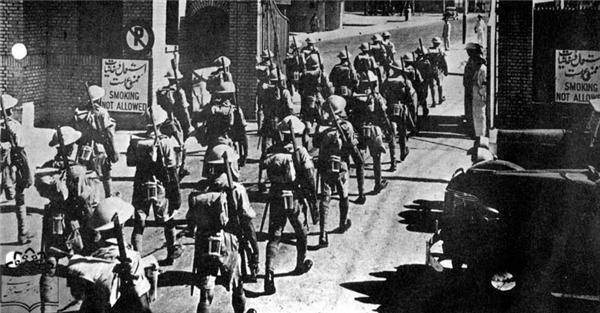
British troops captured Abadan, Iran, along with the oil-related installations there. Far to the north, Soviet troops captured Tabriz while aircraft bombed Tehran.
The invasion of Iraq by the Soviet Union and Great Britain that began on 25 August continues on 26 August 1941. Overall, resistance is virtually nonexistent, but isolated Iranian positions composed of very small groups of men sometimes fight to the death. Both the Soviet and British forces have overwhelming superiority in their respective zones of operations. While Tehran is not yet threatened with capture, Soviet bombers attack it.
In the northern sphere of operations, the Soviet Union begins using heavy bombers in groups of four bombers each. They bomb Rasht, Bandar Pahlavi, and other civilian and military targets throughout Gilan Province. There are 200+ civilian deaths. These attacks help the Soviet 44th Army to capture both Rasht and Bandar Pahlavi. Soviet 47th Army moves south through Dilman and Urmia against a smattering of fanatical resistance, while other Soviet forces continue their invasion from the Turkmenistan SSR. The Soviet 47th Army captures Tabriz.
The British secure the entire Shatt-al-Arab region (the Khazalabad area between Khorramshahr and Abadan) on land, and also including the waterway in Operation Mopup. Having secured their landing zones, the British next plan to drive north to Ahvaz and through the Zagros Mountains to Qazvin. The 10th Indian Infantry Division attacks from Iraq through Khanaqin, facing little resistance but slowed by the rough mountainous terrain. Iranian forces give up Paltak Pass. Iranian troops at Gilan-e Gharb, 30 km inside Iran, make a stand, and RAF fighters shoot down six Iranian fighters in the vicinity in fierce air battles, but the resistance is quickly overcome.
The invasion of the Soviet Union by Germany has succeeded in occupying a lot of ground, with more in the offing. However, casualties during Operation BARBAROSSA already dwarf those of previous campaigns. To date, the Wehrmacht reports that it has suffered 461,100 casualties, with 94,222 dead, 345,650 wounded, and 21,228 missing. Officer losses also are steep, with 4,264 killed, 10,792 wounded, and 381 missing. This amounts to 12% of the 3,780,000 men that began the campaign. The daily loss rate is 6,683 soldiers and 300+ officers, including 1,435 killed. Of course, the Red Army also is taking heavy casualties, perhaps some multiple of German losses, but the Kremlin is able to draw upon a much larger population (roughly three times as large) — and it also is not engaged in a completely separate war on its other border.
In the Far North sector, the Soviet 43rd, 115th, and 123rd Rifle Divisions attacking the Finnish bridgehead across the Vuoksi River are repulsed. The Finns are well acquainted with Soviet troop tendencies and set about encircling them in the woods. The Soviet troops have no orders to retreat and know that they would face recriminations and possibly worse from their commanders, so they stand and fight without retreating. Finnish troops also are prevailing between Nurmi Lake and Nurmi Mountain. There, Soviet defenders are frantically trying to escape to the east while the Finns and an SS battalion are trying to cut them off at the Kayrala narrows. The battle has become a race, with the Soviet troops abandoning their equipment and running for their lives and the Axis troops right behind them.
In the Army Group North sector, the Soviets attack General Hoth’s Panzer Group 3 at Velikiye Luki without success. The Soviets, in turn, are surrounded and wiped out. German Panzer Group 4 continues compressing the defending Soviet forces north toward Leningrad.
In the Army Group Center sector, General Guderian’s Panzer Group 2 seizes a key bridge at Novgorod-Seversky over the Desna River. Within the Wehrmacht, this becomes legendary as an example of German heroism. However, the Germans meet stiff Soviet resistance on the other side in its drive south from Starodub toward Kyiv. German 2nd Army, advancing south 75 miles to the west, has an easier time and makes more progress.
The Soviets have their eye on the Starodub position that Guderian is vacating. Of course, the Soviets don’t know Guderian’s intentions. The Stavka sends General Eremenko of the Bryansk Front a strong hint to attack it:
“It seems possible to envelop the Starodub position, destroy the enemy in Starodub and close up the 13th and 21st Armies’ flanks. The Supreme High Command considers the conduct of such an operation completely feasible and capable of yielding good results. “
Of course, even with Guderian heading south, the prospects of the Soviets accomplishing a major envelopment of German forces at this stage of the war are dim. However, the Stavka remains optimistic despite all evidence to the contrary.
In the Army Group South sector, there is a lull in the fighting around Odessa. The Germans are bringing forward reinforcements to stiffen the Romanian troops who have pinned the defending Soviet troops in the city. Both sides are taking heavy casualties, and the Romanians continue pounding the Soviets with artillery based at Kubanka. The defending Soviet troops have been told to stand and fight — there is no retreat or evacuation for them.
The German XLVII Panzer Corps (General Lemelsen) captures Chernobyl outside Kyiv. The tankers of General von Kleist’s Panzer Group 1 also tighten their hold on Dnepropetrovsk (some sources say it is taken on the 25th, others on the 26th, both are probably right because cities are often taken gradually). Soviet 6th Army counterattacks to no avail.
U-571 (Kptlt. Helmut Möhlmann), on its first patrol out of Trondheim, fires two torpedoes at 3870-ton Soviet freighter Marija Uljanova north of Cape Teriberka, Kola Peninsula. Even a third torpedo does not sink the wrecked ship, which the master eventually beaches at Teriberka (it is used as an oil storage depot hulk for the remainder of the war and then scrapped). The only reason that U-571 does not actually sink the ship, perhaps using its deck gun, is that escorts attack it with depth charges, preventing further attacks. There are 14 survivors.
British Operation GAUNTLET at Spitzbergen continues. After nightfall, 21,517-ton transport Empress of Canada embarks the 1800 Russian coal miners and the Soviet Consul and heads to Archangelsk. Other Canadian troops of Force A stay behind and begin destroying coal at the Bergensburg coalfields, mining equipment, and fuel oil. They also burn down Barentsburg, which appears to have been a mistake. Everything is very hurried because nobody knows if the Germans will show up. It is the land of the midnight sun, so there is no darkness — meaning Luftwaffe attacks could come at any time. Despite this, the landing parties have no plans to leave quickly unless they are forced to, and, so far, there is no indication that the Germans even know the Canadians are there.
Recruiting for the Wehrmacht in Sweden begins.
An OKW memorandum accepted by Hitler states that the war against Soviet Union won’t be finished before the end of 1941.
Otto Skorzeny was awarded the Iron Cross 2nd Class medal for recovering a damaged vehicle under enemy fire at the bridgehead in Yelnya, Russia.
The carrier HMS Argus (D 49) set sail from Reykjavik bound for the Soviet Union with a cargo of Hurricane fighter planes and the RAF pilots who will fly them.
Adolf Hitler and Benito Mussolini inspect the Duce’s troops at Uman, Ukraine. Morale in the Italian troops appears high, but commanding general Messe warns that the troops are poorly equipped, especially in anti-tank rounds.
The Hungarian Army rounded up 18,000 Jews at Kamenets-Podolsk, Ukraine.
Operation TREACLE, the replacement of Australian troops in Tobruk with Polish troops of the Carpathian Brigade, continues. Minelaying cruiser Latona and destroyers Griffin, Havock, and Jervis, escorted by light cruisers Ajax and Neptune, depart from Alexandria and carry out their mission without incident.
Royal Navy submarine Rorqual lays fifty mines off Skinari, Greece.
Having successfully laid mines off the Italian coast in Operation Mincemeat, minelayer Manxman departs from Gibraltar and returns to England. The rest of the Operation MINCEMEAT force, headed by battleship Nelson and aircraft carrier Ark Royal, arrives back at Gibraltar (minelayers are very fast).
The Italian fleet that sortied on news of the Operation MINCEMEAT force, and having accomplished exactly nothing but at least not having lost any ships (probably the main objective), returns to port. However, not so fast — Royal Navy submarine HMS Triumph spots the fleet and puts a torpedo into heavy cruiser Bolzano north of Messina, Sicily. Bolzano limps into port.
Royal Navy submarine Urge (Lt. Cdr. Tomkinson) spots an Italian supply convoy heading from Palermo to Tripoli and stalks it.
Due to shipping losses, all merchant shipping journeys heading from Malta to Gibraltar are canceled for the time being.
German and French authorities seeking to stem a tide of disorders in occupied France decreed new death penalties today for failure to halt railway sabotage. French civilian watchmen conscripted to mount guard over railways around Paris will pay with their lives for any sabotage in their sectors under the new ruling. Tomorrow a special French summary court authorized to sentence to death all Communists and anarchists in the occupied zone is to start hearings. It was created by the Vichy government four days ago. The Vichy regime also fell into step with the German program of “Aryanizing” of Jewish business by empowering Jewish Commissioner Xavier Vallat to name Aryan administrators for Jewish-owned establishments throughout France.
Paul von Kleist was mentioned in the Wehrmachtbericht daily radio report.
RAF Bomber Command, Day of 26 August 1941
36 Blenheims on coastal sweeps. Many attacks were made and 2 ships claimed sunk but 7 Blenheims were lost. 6 further Blenheims on a Circus operation to St-Omer airfield bombed without loss to the Blenheims.
RAF Bomber Command, Night of 26/27 August 1941
Cologne
99 aircraft — 47 Wellingtons, 29 Hampdens, 22 Whitleys, 1 Manchester — to the city centre and to railway yards. 6 further Hampdens made searchlight suppression flights 10 miles west of Cologne without loss. Good bombing was claimed in clear visibility. Cologne records indicate that most of the bombing was probably east of the city, with only about 15 percent of the bombs dropped being inside the city limits. S people were killed in Cologne. 1 Wellington and 1 Whitley lost.
Minor Operations: 29 Wellingtons and Whitleys to Le Havre, 14 Wellingtons and 2 Stirlings to Boulogne, 17 Hampdens minelaying in the Frisians and off Kiel and the Danish coast 1 minelaying Hampden lost.
French RAF pilot Rene Mouchotte gets his first victory, a Junkers Ju-88 over the Irish Sea.
Wing Commander David Lascelles, a cousin of the British Royal family, perishes while leading one of the daylight anti-shipping strikes. Lascelles was No. 82 Squadron’s seventh commanding officer in eleven months and the third to be killed. While hardly desirable, such sacrifices by the Royals help to show that they are in the fight along with everyone else.
An RAF Blenheim of No. 105 Squadron is lost during an attack on shipping off the north African coast. All aboard perish.
The RAF shoots down an Italian aircraft over Cyprus, the first Italian loss there. The Regia Aeronautica has been mounting small raids on the island.
Italian aircraft attack the Dockyard Victualling Yard, Boiler Wharf and a nearby depot, as well as Vittoriosa, Marsa, Birkirkara, and Hamrun and Malta. In this and other actions, the RAF shoots down two BR-20 bombers and a Macchi 200 fighter.
U-571, commanded by Kapitänleutnant Helmut Möhlmann, damaged Soviet submarine depot ship Marija Uljanova (3870grt) north of Cape Retiberka, north of Teriberskij lighthouse in the Arctic Ocean. At 0459 hours on 26 August 1941 the Marija Uljanova (SLt Yevdokimov), escorted by Uritskij and Valerian Kujbyshev, was hit on the starboard side aft by one torpedo from U-571 27 miles north of Teriberskij lighthouse and hit by a coup de grâce at 0502 hours. After chasing away the U.boat with depth charges the destroyers returned and Valerian Kujbyshev picked up 14 survivors who had been blown overboard by the explosions. Two hours after being hit about 11 meters from the stern of Marija Uljanova broke off, but the vessel remained afloat and was taken in tow by Uritskij, later assisted by the Soviet salvage tug Pamyat’ Ruslana. The tow convoy was soon screened by the destroyers Gromkij and Gremiascij, one SKR patrol vessel and three MO submarine chasers. German aircraft unsuccessfully attacked the ships twice, the Soviets claiming two aircraft shot down. The next day, the badly damaged ship was beached at Teriberka and declared a total loss. She was later used as oil storage hulk and broken up after the end of the war.
The auxiliary minelayer HMS Southern Prince was torpedoed and damaged by the U-652, commanded by Kapitänleutnant Georg-Werner Fraatz, while returning from laying minefield SN-70A in the Northern Barrage in the North Sea. At 0044 hours on 26 Aug 1941, U-652 fired a spread of three torpedoes at a convoy running south.southeast and observed one hit near the bridge on a motor vessel, which stopped shortly thereafter and was missed by a coup de grâce at 0053 hours. HMS Southern Prince (M 47) (A/Capt John Creswell, RN) was not in a mercantile convoy but part of a minelaying task force which was returning from laying the minefield SN.70A in the Northern Barrage. HMS Lightning (G 55) (Cdr R.G. Stewart, RN) and HMS Lamerton (L 88) (LtCdr H.C. Simms, RN) left Scapa Flow to assist the torpedoed ship and escorted her to the Minches. She was repaired at Belfast and returned to service.
U-141 (ObltzS Schiller) stalks Convoy OS.4, but cannot maneuver into attack position because of the escort.
Heavy cruiser HMS London departed the Clyde after boiler cleaning and arrived at Scapa Flow on the 27th.
Destroyer HMS Intrepid departed Scapa Flow at 0600 to join convoy ES.78 off May Island and act as additional escort to Sheerness. Destroyer Intrepid arrived at Sheerness at 1520/28th to disembark ammunition. The destroyer then proceeded to refitting at London, arriving at 1400/29th. The destroyer departed Sheerness for Scapa Flow on 23 October after the refit.
Destroyer HMS Tartar departed the Tyne and joined convoy FS.577 as additional anti-aircraft protection to the Humber. The destroyer arrived at Sheerness at 1222 on the 27th to disembark ammunition prior to going up river to refit. Destroyer Tartar arrived at London at 1600/28th for refitting which continued until 17 October.
Light cruisers HMS Ajax and HMS Neptune departed Alexandria escorting minelaying cruiser HMS Latona and destroyers HMS Jervis (Rear Admiral Destroyers, Mediterranean Fleet embarked), HMS Griffin, and HMS Havock in the seventh series of the TREACLE operation. The ships arrived back at Alexandria on the 27th.
Anti-aircraft ship HMS Carlisle, having passed through the Canal on the 24th, arrived at Alexandria.
Destroyers HMS Decoy and HMS Hotspur arrived at Alexandria from Haifa.
Submarine HMS Rorqual laid fifty mines off Skinari.
Sub Lt (A) G. B. Pudney was killed when his Hurricane of 806 Squadron was shot down ten miles north of Sidi Barrani.
The 166th South African Minesweeping Group, consisting of trawlers HMSAS Gribb, HMSAS Imhoff, HMSAS Seksern, and HMSAS Treern, arrived at Suez. The trawlers were sent to Haifa to fit out.
Convoy St. 1 of four steamers departed Freetown. The convoy arrived at Takoradi on the 31st.
Heavy cruiser HMS Hawkins arrived at Simonstown.
Canadian troop convoy TC.12B departed Halifax with British steamers Dominion Monarch (27,155grt), Empress of Russia (16,810grt), and Strathden (23,722grt). The convoy was escorted on 26 and 27 August by destroyers HMCS Annapolis and HMS Richmond. On the 27th, destroyers HMCS Assiniboine, HMS Harvester, HMS Havelock, HMS Ripley, HMCS Saguenay, and HMCS St. Laurent joined the convoy and remained with it until its arrival on 1 September.
In Washington, President Roosevelt announced that the United States would send a military mission to China, held the usual afternoon press conference and received Cornelius Vanderbilt, Dr. Hu Shih, the Chinese Ambassador; Peter Fraser, Prime Minister of New Zealand; William J. Donovan, William C. Bullitt and Basil O’Connor.
The Senate was in recess. The Finance Committee continued work on the tax bill and the Commerce Committee approved resolutions for investigations of the gasoline shortage and the defense priority system.
The House was in recess.
President Roosevelt said today there can be no doubt that an organized campaign of rumors, distortions, half-truths and falsehoods has been launched to sabotage the United States program of aiding opponents of the axis. Charges that lend-lease funds are being misused fall within this category, he added. Pointedly repeating himself at his semi-weekly press conference, Mr. Roosevelt said he considered it fair to say that all such stories are either vicious rumor, distortion of fact, or falsehood.
The Ship Warrants Act is invoked by Executive Order, empowering President Roosevelt to direct Maritime Commission to establish cargo handling, ship repair, and maintenance priorities for merchant ships. This EO provides that Roosevelt can direct the Maritime Commission to establish proper rules and regulations for cargo handling, ship repair, and maintenance priorities for civilian freighters.
Charles A. Lindbergh will speak in Oklahoma Friday “even if he has to use a cow pasture,” a spokesman for the America First committee said today after the city council cancelled a permit for use of the municipal auditorium. “If we can’t get a place here we’ll go somewhere else. But he definitely will speak, and it will be in Oklahoma, added Herbert K. Hyde, a former U. S. district attorney and Oklahoma City chairman of the America First committee.
The Senate Finance Committee joined the House today in backing the alternative methods of computing corporation excess profits in the defense tax bill, ruling out the recommendation made by President Roosevelt and the Treasury Department for permitting only the capital gains method. Senator George, chairman of the committee, said that no formal vote was taken, but he indicated that conversations of members behind closed doors had established their stand. The committee approved a recommendation of the Treasury for a simplified chart system which would enable small taxpayers, with incomes of $3,000 or less, to compute their tax bill by the use of a table, without filling out a complicated return. The chart system, however, would be optional. If the taxpayer, by taking deductions not figured in the chart, could reduce his tax, he would be allowed to do so by using the regular return. Under the decision of the committee to recommend lowering exemptions for married persons from $2,000 to $1,500 and for single persons from $800 to $750, about 6,000,000 new taxpayers would be added to the tax rolls. It is to help them that the Treasury recommended the chart system, to be computed by the Treasury and posted at all public places. The committee voted small increases in the normal corporation rates for those earning less than $25,000. These raises, it was explained, absorbed the defense tax in the normal rates. The change would add about $3,200,000 in revenue, it was estimated. The rates on corporations earning more than $25,000 were not changed.
An investigation of the East Coast fuel shortage was unanimously approved today by the Senate Commerce Committee, on motion of Senator Maloney of Connecticut, after three Senate opponents of the President’s foreign policies had challenged the Administration to prove that the shortage was real and not just an attempt to bolster the war spirit. Meanwhile President Roosevelt predicted an easing of the gasoline situation by Spring, because of the absence of a strong Nazi offensive in the North Atlantic, and Federal price officials moved to halt a rise in prices at Eastern points. In a joint statement Senators Nye of North Dakota, Clark of Idaho and Danaher of Connecticut said that the gasoline shortage was a 100 percent occasion for a performance to create a war consciousness. “There have been so many conflicting statements from various government agencies that it is impossible for an observer to ascertain the facts,” said Mr. Nye. “There should be an investigation and Administration officials should come before Congress and present facts and figures demonstrating whether this shortage really exists.”
The Duke of Kent, brother of King George VI, declared today in Washington that Britain was confident of victory in the war against Hitlerism and emphasized that “the more you can give us, the quicker we shall win.”
Lord Mountbatten, a hero of the campaign in Crete (he barely survived his ship sinking), embarks on a goodwill tour of the United States. At the end of it, he is scheduled to take command of the aircraft carrier HMS Illustrious, currently under repair in Virginia.
A hurricane blows along the East Coast, wreaking havoc all along the coast and destroying many homes in New Jersey.
Streets, sidewalks, two subways and part of a railroad line caved in like paper bags tonight as New York City suffered its worst transportation tie-up in history under a violent deluge that held New York in its fury for several hours. Within an hour and a half, sheets of rain, driven by a 50-mile-an-hour wind, inundated the metropolitan area with 2.13 inches of water and plunged the mercury from 87 to 70 degrees. The transportation tieup, caused by the cave-ins and floods, marooned thousands of persons in all parts of the city on subway and railroad trains. More than 2,000 cars, including lines of automobiles inside the tunnel, were involved in a traffic tie-up at the Holland tunnel, between New Jersey and lower New York. Police took more than an hour to unravel the tangle. Thunderclouds moving over the lower Hudson valley, eastern New York and part of Connecticut blanketed the metropolis in midnight darkness during the dinner hour. Traffic signals and street lights failed in many sections, and motorists pulled to the curbs. A pencil peddler was killed by a bus, the driver of which told police he could not see through the rain.
Major League Baseball:
That crucial series at Ebbets Field ended in almost pitch darkness at 6:35 yesterday evening with the Dodgers still holding their game-and-a-half lead over the second-place Cardinals. At that time ominous black clouds rolled over the field and the overflow crowd of 39,107, terminating the second game abruptly in the midst of the Cardinals’ ninth and giving them an eight-inning, 3–1 triumph. The Dodgers had taken the early contest, 8–3, behind the seven-hit pitching of Curt Davis and the heavy twelve-hit bombardment by his mates against four Redbird hurlers.
After the veteran Jim Tobin gained his eleventh victory for the Braves by limiting the Pirates to four hits for a 4–3 decision, the visitors clouted three of his battery-mates for a 6–1 triumph to divide today’s double-header.
The slugging Red Sox regained third place from Cleveland today with a 9–4 triumph pegged on Boston’s thirteen-hit attack and three errors by the Indians’ outfielder Roy Weatherly. Cleveland’s Jim Bagby walks Ted Williams 4 times but loses to the Red Sox. Williams is 1-for–1.
In Detroit, the A’s take two from the Tigers, 9–1 and 2–1. Sam Chapman ices the first game with a 9th inning grand slam. The Athletics, making their final appearance of the season here, moved into sixth place in the American League race by sweeping the twinbill.
The New York Giants beat the Cincinnati Reds, 7-4, in the opener of their doubleheader. However, Cincinnati’s hopes were not destroyed entirely, since the Reds wrested away the nightcap, 5 to 4, in a battle that was halted by darkness and the approaching storm just after the ninth inning had started.
In the nightcap of a doubleheader at Shibe Park, Dom Dallessandro drives in 7 runs on 4 hits to give the Cubs an 11–3 win over the Phils. One of the hits is a grand slam, his 2nd of the season. The Cubs also won the opener, 5–4.
Dutch Leonard, Washington’s knuckleball pitcher, allowed the Browns ten hits today, but mastered every threat to safeguard a 3–0 victory, as the Senators scored three runs in the second inning.
St. Louis Cardinals 3, Brooklyn Dodgers 8
St. Louis Cardinals 3, Brooklyn Dodgers 1
Pittsburgh Pirates 3, Boston Braves 4
Pittsburgh Pirates 6, Boston Braves 1
Boston Red Sox 9, Cleveland Indians 4
Philadelphia Athletics 9, Detroit Tigers 1
Philadelphia Athletics 2, Detroit Tigers 1
Cincinnati Reds 4, New York Giants 7
Cincinnati Reds 5, New York Giants 4
Chicago Cubs 5, Philadelphia Phillies 4
Chicago Cubs 11, Philadelphia Phillies 3
Washington Senators 3, St. Louis Browns 0
Based on the recent discovery by researchers at McGill University of a poison gas based on fluorine, a Privy Council order establishes an offensive chemical warfare station in Suffield, Alberta, Canada. The deadly chemical is called “Compound Z.” Chemical weapons are outlawed, thus this is kept secret for decades after the war.
Ambassador Nomura protests to Secretary of State Cordell Hull about the United States government sending supplies to the Soviet Union via Vladivostok. These can make it to Moscow in about a week via the Trans-Siberian Railroad. Hull responds that the shipments are supported by the Japanese-Russian agreement of Portsmouth. Nomura responds that this may be true, but it is stirring up animosity in the Japanese public because Japanese civilians must use coal while oil in U.S. tankers is passing them by. The two men try to reach an agreement whereby two Japanese tankers be allowed to bring oil to Japan every month, subject to approval by their respective governments.
Behind the scenes, and unbeknownst to allies of both parties, furious negotiations are going on behind the scenes between the United States and the Empire of Japan. Prince Konoye sends a new peace offer to Ambassador Nomura for passage to the Americans. Secretary Cordell Hull agrees to arrange a meeting between Ambassador Nomura and President Roosevelt on the 27th to discuss the new Japanese offer. Nomura comments negatively on recent comments by British Prime Minister Winston Churchill about the situation in the Pacific but fervently wants to negotiate a settlement.
Lieutenant Gregory Boyington resigns his commission in the U.S. Marines to join the American Volunteer Group heading to China, better known as the Flying Tigers. In actual fact, due to the clandestine nature of the operation, Boyington signs on as a contract employee with a private company, Central Aircraft Manufacturing Company (CAMCO). This is just a cover, of course, and the US government is behind the whole operation under leader Claire Chennault. Boyington soon heads for Burma.
The United States announced it was sending a military mission to China to determine what materials were needed to defend against Japanese aggression. The White House issues a statement:
“[T]his Government is preparing to send a military mission to China. The mission will be sent for the purpose of assisting in carrying out the purposes of the Lend-Lease Act. It is being organized and it will operate under the direction of the Secretary of War. Its chief will be Brigadier General John Magruder.”
The international situation confronting Japan was discussed today by the Cabinet on the basis of a detailed report submitted by the Foreign Minister, Vice Admiral Teijiro Toyoda, which precipitated what the press refers to as a “brisk” debate among the members.
The Imperial Japanese Navy requisitions 6784-ton freighter Aratama Maru for assignment to the Kure Naval District.
The Philippine Department Air Force, an independent unit within the U.S. military, is re-designated USAFFE Air Force. The Philippine National Army, under Major General Basilio J. Valdez, AFP, also comes under the control of United States Army Forces Far East (USAFFE) commanded by Field Marshal General Douglas MacArthur. Members of these units are inducted into the US Army, subject to certain requirements.
The Philippine National Army is brought into existence.
New Zealand will “cooperate fully” with the United States and Great Britain if the war spreads to the Pacific, Peter Fraser, Laborite Prime Minister of that British dominion, said today.
Dow Jones Industrial Average: 126.56 (+0.7)
Born:
Akiko Wakabayashi, Japanese actress (“You Only Live Twice”), in Tokyo, Japan.
Barbet Schroeder, Iranian-Swiss director (“Barfly”, “Single White Female”, “More”), in Tehran, Iran.
Chris Curtis [Crummey], British rock drummer, songwriter and vocalist (The Searchers — “Needles And Pins”), in Oldham, Lancashire, United Kingdom (d. 2005).
Fred Wenz, MLB pitcher (Boston Red Sox, Philadelphia Phillies), in Bound Brook, New Jersey (d. 2020).
Barbara Ehrenreich, American author and political activist, in Butte, Montana (d. 2022).
Naval Construction:
The U.S. Navy Gleaves-class destroyer USS Hendon (DD-638) is laid down by the Norfolk Navy Yard (Portsmouth, Virginia, U.S.A.).
The Royal Navy MMS I-class motor minesweeper HMS MMS 80 (J 580) is launched by George Forbes (Peterhead, England, U.K.).
The Royal New Zealand Navy Kiwi-class minesweeping trawler HMNZS Tui (T 234) is launched by Henry Robb Ltd. (Leith, U.K.); completed by G. Plenty Ltd. (Newbury, U.K.).
The U.S. Navy minesweeper USS Auk (AM-57), lead ship of her class of 95, is launched by the Norfolk Navy Yard (Portsmouth, Virginia, U.S.A.).
The Royal Navy 77-foot Elco patrol motor torpedo boat HMS MTB 307 is launched by the Electric Launch Company Ltd. (Elco), (Bayonne, New Jersey, U.S.A.).
The U.S. Navy 77-foot Elco patrol motor torpedo boat USS PT-49 is launched by the Electric Launch Company Ltd. (Elco), (Bayonne, New Jersey, U.S.A.).
The U.S. Navy Gato-class submarine USS Silversides (SS-236) is launched by the Mare Island Navy Yard (Vallejo, California, U.S.A.).
The Royal Canadian Navy Flower-class corvette HMCS Vancouver (K 240) is launched by Yarrows Ltd. (Esquimalt, British Columbia, Canada).
The U.S. Navy Harris-class transport ship USS American Legion (AP-35) [ex-USAT American Legion] is commissioned. Her first commanding officer is Thomas Dickens Warner, USN.
The U.S. Navy Accentor-class coastal minesweeper USS Skimmer (AMc-53) is commissioned.
The Royal Navy “T”-class (Second Group) submarine HMS Thorn (N 11) is commissioned. Her first commanding officer is Lieutenant Commander Robert Galliano Norfolk, RN.
The Kriegsmarine (German Navy) Type IXC U-boat U-505 is commissioned. Her first commanding officer is Kapitänleutnant Axel-Olaf Loewe. Captured on 4 June 1944 off Mauritania, French West Africa, in position 21.30N, 19.20W, by the warships of Task Force 22.3, consisting of the US escort carrier USS Guadalcanal and the US destroyer escorts USS Pillsbury, USS Chatelain, USS Flaherty, USS Jenks and USS Pope, after being badly damaged by depth charges from USS Chatelain and strafing by two Wildcat aircraft (VC-8 USN/F-1 & F-7). 1 dead and 59 survivors. Gifted to the Chicago Museum of Science and Industry on 9 March 1954. Now on display in Chicago.
The Royal Navy “L”-class destroyer (Flotilla leader) HMS Laforey (G 99) is commissioned. Her first commanding officer is Captain Reginald Maurice James Hutton, RN.

