The War comes to Iran
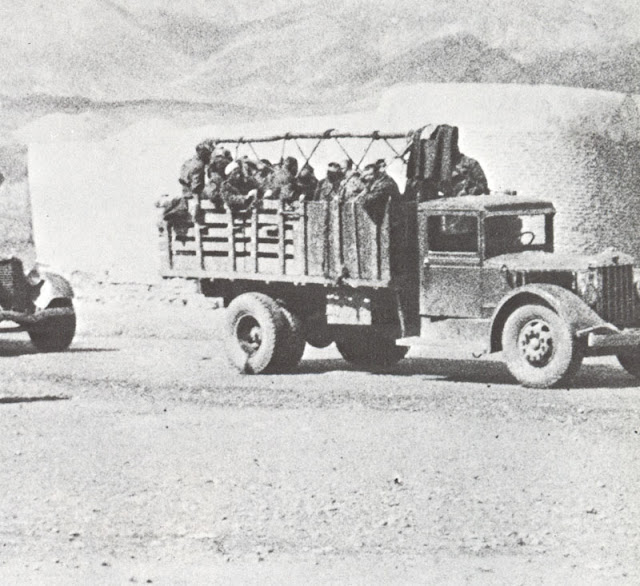
British and Soviet forces invade Iran from south and north respectively. The purpose of the invasion was to secure the oil fields and lines of communications to from the Indian Ocean to the Soviet Union. The United Kingdom and the Soviet Union jointly attacked pro-German regime in Iran. The British land troops at Bandar Shapur, Abadan and Khoramshahr, Iran. The Soviets move into Iran with one column advancing on Tabriz, which is bombed. Two additional Soviet columns are advancing around the Caspian Sea. While the British troops crossed the western border and Soviets to the north, the respective ambassadors in Tehran demanded Iran to accept British and Soviet protection of oil supplies. British forces sank two small Iranian warships. The Soviet 44th, 47th and 53rd armies of the recently formed Transcaucasian Front (General Dmitry Timofeyevich Kozlov) invade by land primarily from Transcaucasia. The Soviets use about 1,000 T-26 tanks and quickly occupy large portions of Iran’s northern provinces. Red Air Force and naval units also participate where they can be used, with planes bombing Tabriz, Ardabil, and Rasht.
In Operation COUNTENANCE, RAF aircraft based in Iraq beginning bombing Tehran, Qazvin, and other targets before dawn. The Royal Navy and Royal Australian Navy, under the command of Commodore Cosmo Graham, land at Abadan (Operation DEMON), Khorramshahr and Bandar Shapur in the Persian Gulf. Resistance is extremely light, and the British sink two Iranian gunboats and quickly seize 7 Axis ships. The British are aided by clandestine reconnaissance missions conducted since the collapse of resistance in Iraq in May 1941. The invading units are organized as “Iraq Command.”
The Iranian Army is taken by complete surprise. It mobilizes nine infantry divisions, two armored. The Iranians have good equipment, including the vz. 24 rifle that compares with the Wehrmacht’s Mauser, and also has about 100 tanks (FT-6 and Panzer 38(t) light tanks that the Wehrmacht also uses). In addition, the Iranian army has La France TK-6 armored cars. However, the Iranian equipment by and large is obsolete, poorly handled, and overwhelmed by tactical surprise.
Iranian generals argue for a “scorched earth” policy of destroying bridges and other infrastructure in order to at least slow the invasion. Reza Shah refuses because he is proud of the great advances in roadways and buildings made in Iran during his reign and does not want to destroy them.
Iranian leader Rezā Shāh Pahlavi quickly summons Sir Reader Bullard and Andrey Andreyevich Smirnov, the British and Soviet ambassadors to Iran, to demand an explanation. They refer to two previous warnings made on 19 July and 17 August to expel German nationals which had not been carried out. There indeed are many Germans and Italians working on railways, telegraphs and the like, but they have been there for decades. Reza Shah also sends a telegram to US President Franklin D. Roosevelt. Roosevelt lamely responds that the “territorial integrity” of Iran should be respected, but otherwise does nothing.
Electricity goes out in Tehran at around 22:00, causing the lights to go out everywhere, including the Shah’s palaces. For many Iranians, this is the first that they learn of the invasion.
By the end of the day, the British are control of Abadan after fierce hand-to-hand fighting around the refinery. There are light casualties on both sides, but the Iranian Naval Commander in Chief Rear Admiral Bayendor dies in defense of the naval base. Other areas such as Qasr Sheikh and Khorramshahr, both near Abadan also fall today. The Soviet troops capture Jolfa and drive south toward Tabriz and Lake Urmia against virtually no resistance. The Soviet Caspian Sea Flotilla (Rear-Admiral Sedelnikov) lands troops in Gilan Province wile 44th Army enters the same province by land. The Iranians score some rare successes at Pahlavi Harbour in Bandar Pahlavi, where they prevent a Soviet landing by sinking barges at the entrance to the harbor and fiercely defend Rasht.
AP Reports: “British and Russian troops invaded Iran (Persia)’ and moved last night toward their a union that will establish an allied line to Russia from the Persian gulf, put imperial forces in position to help defend the Soviet Caucasus and complete a middle eastern wall against the Nazis from the Baltic to the Arabian sea. They smashed into Iran the British under Gen. Sir Archibald P. Wavell eastward from Iraq and northeastward from the gulf and the Russians southward from the Caucasian frontier with the avowed purpose of making an end to the axis intrigues of German agents in that ancient land, and with every assurance they had no design upon Iranian territory or independence. Adolf Hitler was reported in axis quarters tonight to have promised German military aid to Iran if the Iranian army, which is battling the British-Russian invaders, puts up effective resistance for one month. Hitler’s promise, posing a new acute menace to Turkey in the opinion of neutral observers, was said to have been transmitted to Reza Shah Pahlavi by the German minister to Tehran, Hans von Ettel, during a three-hour conference today.”
In the Far North sector of the Eastern Front, the Soviet 115th and 123rd Rifle Divisions continue their attempt to throw leading Finnish elements of Light Brigade T back across the Vuoksi river. Soviet artillery kills Light Brigade T’s commander, Colonel Tiiainen. Finnish reinforcements soon arrive, however, and force the Soviets back.
Further north, Finnish troops find themselves blocked in their attempt to cut the Murmansk railway line at Loukhi. General Hjalmar Siilasvuo, commander of III Corps, tells General Falkenhorst, commander of Army of Norway, that the attack has failed and that he needs a fresh Finnish division to resume the offensive. Falkenhorst arranges a meeting with Siilasvuo for the 29th.
Finnish 36 Corps, operating between Nurmi Lake and Nurmi Mountain, is trying to cut off Soviet troops who have discovered an unmarked logging road. The Finns managed to cut the escape route today, trapping at least some of the fleeing Soviet troops. The weather improves, and bombers and dive-bombers are able to attack the Soviet troops. The Soviets, though, refuse to give up on their escape route and fight savagely to reopen it.
In the Army Group North sector, the Germans capture Novgorod south of Leningrad. German LVI Corps (General von Manstein) and 39 Corps (motorized) attack east of the Volkhov River toward Lyuban and the Neva River. The Soviets defend with the 4th, 52nd, and 54th Armies. German LVI Corps pushes the Soviet 34th and 11th Armies back to the Lovat River.
In the Army Group Center sector, General Guderian has Panzer Group 2 begin its offensive south toward Kyiv from Starodub, while the 2nd Army also joins in 75 miles to the west. Second Army quickly seizes a key bridge, but Panzer Group 2 just as quickly runs into fierce Soviet resistance which slows his advance to a crawl. Panzer Group 3 continues fighting into Velikiye Luki.
In the Army Group South sector, General von Kleist’s Panzer Group 2 captures Dnepropetrovsk south of Kyiv. Kleist aims to secure the town and its important river crossing and then head north to meet Guderian’s Panzer Group 2 heading south to encircle the Soviet troops at Kyiv. Fighting dies down on the Odesa perimeter, with the Romanians relying on artillery based at Kubanka to wear down the defending Soviet troops.
The Bryansk front commander, General Eremenko, tells Stalin, “I will smash this scoundrel Guderian, no doubt about it.”
General Malinovsky takes over the Soviet 6th Army.
Luftwaffe ace Hermann-Friedrich Joppien, an Experten with 70 victories (42 on the Western Front), is shot down and killed southwest of Bryansk. A Soviet Polikarpov I-16 fighter shoots him down while Joppien and his wingman are attacking three Petlyakov Pe-2 bombers. He receives a posthumous Wehrmachtbericht mention on 29 August 1941, his third mention.
The German 3rd S-Boat Flotilla lays 30 TMB mines off Cape Ristna (Dago). German minelayers Brummer and Roland lay 170 EMC mines in minefield Rusto north of Cape Ristna.
The Luftwaffe bombs and sinks Soviet tanker Zheleznodrozhnik and freighters Daugava and Lunacharsk. There are seven deaths on the Lunacharski.
Soviet icebreaker Truvor hits a mine and sinks in the Gulf of Finland. There are 22 survivors.
Auxiliary Soviet river gunboat Vernyy is sunk during action while assisting the Red Army.
Russian reports yesterday stated rain had been falling heavily at the front for the last 24 hours. It was said roads other than main routes already were bogged and that more rain would make impassable both the soft soil of the Ukraine and the marshy country around Leningrad. Moscow claimed yesterday the Soviet troops were materially pushing the invaders back, while Berlin insisted to the contrary the defenders had been broken with enormous Russian losses. The Nazi high command itself said merely “operations in the east are making good progress everywhere,” giving no specific information of any sector.
Benito Mussolini arrived at Adolf Hitler’s Wolfsschanze headquarters in eastern Germany (now Poland). Mussolini visited the Wolf’s Lair for the first time. Mussolini visits Hitler at the latter’s headquarters at the Wolfsschanze (Wolf’s Lair) headquarters in East Prussia along with Italian Foreign Minister Count Ciano. Hitler rails against Franco, who still refuses to join the war, while Mussolini complains that his army is disloyal. Hitler asks for more Italian troops to take over garrison duty in the Balkans to free up German troops to serve on the Eastern Front. The men then depart for an inspection tour of captured towns in Ukraine. This will be Mussolini’s longest visit with Hitler of the war, lasting until 29 August. Also today, Hitler receives Count Hiroshi Oshima, the Japanese ambassador, for consultation.
Tykocin pogrom: About 1,400 to 1,700 Jewish residents of Tykocin in occupied Poland were taken to nearby Łopuchowo forest and massacred by the SS.
German SS and civilian authorities meet at Vinnytsia, Ukraine to discuss the fate of 20,000 Hungarian Jews interned at Kamianets-Podilskyi, Ukraine. The plan arrived at is to liquidate them by 1 September.
German authorities in Belgrade transport about 8000 Jewish residents to Topovske Supe for execution.
Operation TREACLE, the replacement of Australian troops at Tobruk with Polish troops of the Carpathian Brigade, continues. Minelaying cruiser Abdiel and destroyers Jackal, Hasty, and Kandahar take the troops from Alexandria to Tobruk late in the day. The Luftwaffe spots them and attacks at twilight but scores no hits.
Royal Navy minelayer Manxman completes laying its mines off of Livorno, Italy as part of Operation MINCEMEAT and heads back to Gibraltar.
Royal Navy submarine Rorqual (Lt. Napier) lays mines off Cape Skinari, Greece.
Hans-Joachim Marseille returned to Ain el Gazala, Libya from his home leave in Berlin, Germany to Libya.
In his broadcast this evening, Churchill accused the Germans of perpetrating the wholesale massacre of civilians in occupied Soviet territories. “Whole districts are being exterminated,” Churchill said. “Since the Mongol invasions of Europe in the 16th century there has never been methodical, merciless butchery on such a scale. We are in the presence of a crime without a name.” Churchill made no mention of Jews beings the main victims; to have done so would have let the Germans know that British intelligence is intercepting secret reports to Berlin from the Nazi extermination squads in the field. These conscientiously list the locations and numbers of those shot and thrown into ditches, often several thousand at a time.
Pierre Laval narrowly escaped an assassination attempt by a student as he was seeing off French volunteers going to fight alongside the Germans in Russia. One of the four bullets that struck him missed his heart by about an inch.
The Allies launched Operation GAUNTLET, a raid on the Norwegian island of Spitsbergen. A contingent of Canadian engineers, a Norwegian platoon and troops of the Royal Army Service Corps successfully raided the Norwegian island of Spitzbergen in the Arctic Sea. The purpose of the raid was to destroy coal mines and stocks of free coal, transit facilities between mines and harbor installations, and wireless and meteorological stations. A secondary purpose of the raid was to repatriate all Soviets on the island to Archangel and to evacuate all Norwegians to the United Kingdom.
Operation GAUNTLET, the raid on Spitzbergen, begins at 04:30 when destroyer HMS Icarus lands a signal party at the Kap Linne radio station at the entrance to Isfjoren on Spitzbergen Island. At first, the local Norwegians think the soldiers are Germans, but soon spot the flag of Norway on an officer’s shoulder. Finding no resistance (the Norwegians are happy to see the British and there are no Germans), the Royal Navy ships steam into Isfjorden and then on to Grønfjorden at 08:00. The ships anchor at Barentsburg, populated by Russians who also are happy to see the Royal Navy. Brigadier Arthur Poss, commander of the 2nd Canadian Infantry Brigade, goes ashore and offers the Russians safe transport to Archangelsk if they wish. Facing no opposition, other Canadian units occupy strategic points along the coast. The locals now have a tough choice of whether to stay on the island or be evacuated.
Held responsible for the failure of the Luftwaffe in the Battle of Britain, and believing that his superiors had abandoned him, and convinced that his arch rival Inspector General Erhard Milch was plotting his down fall, the normally ebullient Ernst Udet (who was already showing signs of illness through depression and strain) reported sick. Udet indeed is sick, but it is not a physical illness — he is beset by depression and raging paranoia.
In essence, Udet’s job is to decide what plane designs get built and which to terminate. An ace pilot and World War I hero, Udet finds administrative work extremely stressful — though he is good at it and largely responsible for turning the Luftwaffe into a deadly instrument of war. Udet is a great friend of Reichsmarschall Hermann Göring, to whom he owes his position, and feels that he has let both Göring and himself down by failing in the Battle of Britain. Udet is replaced for the time being by Inspector General Erhard Milch.
A group of about 20 Norwegian citizens attempting to flee the Germans boards fishing boat “Hod” at Ulstein. They leave for England on the evening of 25 August 1941. The boat is never seen again, but one woman’s body is found later offshore and the boat’s registration plate and some parts of it are later found. It is speculated that a German patrol plane spotted the boat offshore and bombed it.
British anti-submarine trawler HMS Vascama and a British Catalina aircraft of No. 209 Squadron sank German submarine U-452 with depth charges in the North Sea, killing all 42 aboard.
German submarine U-752 sank Soviet minesweeping trawler T-898 in the Barents Sea 80 miles east of Cape Chernyi, northern Russia at 1011 hours; 41 were killed, 2 survived.
Destroyer HMS Wolsey rammed and sank British minesweeper Kos XVI (with Norwegian crew) 30 miles off Grimsby, England, United Kingdom just before midnight.
RAF Bomber Command, Day of 25 August 1941
6 Blenheims on uneventful sweep off the mouth of the River Scheldt.
RAF Bomber Command, Night of 25/26 August 1941
Karlsruhe
37 Wellingtons and 12 Stirlings to the city center; storms and thick cloud prevented accurate bombing. 2 Wellingtons and 1 Stirling lost.
Mannheim
38 Hampdens and 7 Manchesters to the city center with moderate results claimed. 3 Hampdens lost.
There are scattered Luftwaffe raids across northeast England, with reports of five reconnaissance aircraft crossing the coast. Slight damage at Ashington, Whitley Bay, and Wallsend.
The production of the Handley Page Halifax heavy bomber has now been subcontracted to to a number of firms, including English Electric at Preston, Rootes at Speke, Fairey at Stockport and the London Aircraft Production Group. The first of these aircraft, a MK II (V 9976), flies today.
Nine Wellington bombers based on Malta attack Tripoli, causing moderate damage. One Wellington crashes while landing at Luqa airfield.
The U-452, commanded by Kapitänleutnant Jürgen March, was sunk in the North Sea southeast of Iceland in 61-30N, 15-30W by depth charges from the Anti-Submarine Trawler HMS Vascama (FY 185) and depth charges from a British Catalina aircraft. All of the ship’s complement of 42 died. During its career the U-452 sank or damaged no ships.
U-752, commanded by Kapitänleutnant Karl-Ernst Schroeter, sank Soviet minesweeping trawler T-898 (No 44, ex-Dvina) (633grt) northwest of Svyatoy, about 80 miles east of Cape Chernyj in the Arctic Ocean. At 1011 hours on 25 Aug 1941, U-752 fired a stern torpedo at T.898 (No 44) and scored a hit after 47 seconds. The vessel was alone on guard duty between Cape Chernyj and Cape Svyatoj Nos and sank almost immediately after the hit.
Light cruiser HMS Kenya departed Rosyth after repairs and arrived back at Scapa Flow. Her repair trial was not satisfactory and speed was limited to a maximum of 28.5 knots.
Anti-aircraft ship HMS Ulster Queen arrived at Scapa Flow at 1200 from Belfast to carry out working up exercises.
Cruiser minelayer HMS Welshman departed Rosyth at 2200 to carry out a practice lay of mines and then proceed to Scapa Flow where she arrived at 0910/26th. The cruiser then carried out working up exercises.
Minelayers HMS Southern Prince, HMS Port Quebec, and minelaying cruiser HMS Adventure, escorted by destroyers HMS Castleton, HMS Newark, and HMS Charlestown, laid minefield SN.70 A in the Northern Barrage. Auxiliary minelayer Southern Prince (10,917grt), returning from laying the minefield, was damaged by a U-652 west of the Faroes in 62-55N, 9-55W. There were no casualties in the minelayer. Destroyers HMS Lightning and HMS Lamerton departed Scapa Flow at 0615/26th to assist the minelayer. The minelayer was escorted as far the Minches. The destroyers arrived back at Scapa Flow on the 27th. The minelayer was repaired at Belfast.
T/A/Sub Lt (A) G. L. Stewart RNVR, was killed when his Walrus of 749 Squadron crashed near Piarco. Two students, Leading Airman B. C. Hamilton, RNZNVR, and Leading Airman H. Hunt RNVR, were also killed.
German steamer Troyburg (2288grt) was lost when she was stranded at Faresund.
Light cruisers HMS Naiad, HMS Phoebe, HMS Galatea departed Alexandria to cover minelaying cruiser HMS Abdiel and destroyers HMS Jackal, HMS Hasty, and HMS Kandahar on the series six of the TREACLE operation. The light cruisers were unsuccessfully attacked at dusk on the 25th. The ships safely returned to Alexandria on the 26th.
Yugoslav torpedo boats Durmitor and Kajmakcalan, completely out of service after two operations off Bardia, were ordered to depart Mersa Matruh and return to Alexandria. The boats arrived on the 26th.
Corvettes HMS Jonquil and HMS Coreopsis arrived at Gibraltar, escorting British tanker Cardium from Curacao.
Operation COUNTENANCE was the overall operation supporting the British invasion of Iran. There were three naval operations and two ground forces operations in this plan. The name RAPIER was originally given to operations at Abadan and Korramshahr, but was not used. Operation BISHOP was the capture of the port and shipping at Bandar Shapur.
Armed merchant cruiser HMAS Kanimbla, gunboat HMS Cockchafer, sloop HMS Lawrence, corvette HMS Snapdragon, minesweeping trawlers HMS Arthur Cavanagh and HMS Lilac, Anglo Iranian Oil Company salvage tugs St. Athan and Delavar, R.A.F. Launch 20, and dhow Daif were in BISHOP.
Sloop HMS Lawrence seized Iranian gunboats Chazbaaz and Karkaz.
German steamer Hohenfels (7862 tons) was captured by a boarding party from HMAS Kanimbla and renamed Empire Kemal. The steamer left Bandar Shahpur under tow for Karachi on 11 October.
German steamer Marienfels (7575 tons) was captured by a boarding party from HMAS Kanimbla and was renamed Empire Rani. The steamer sailed for Karachi on 8 September.
German steamer Wildenfels (6224 tons) was captured by a boarding party from HMAS Kanimbla and was renamed Empire Raja. The steamer departed on 2 September for Karachi.
German steamer Sturmfels (6288 tons) was captured by corvette HMS Snapdragon and was renamed Empire Kumari. The steamer sailed for Karachi on 5 September.
German steamer Weissenfels (7861 tons) was scuttled and was beyond salvage.
Italian steamer Barbara (3065 tons) was set afire, but sloop HMS Lawrence put a fire fighting unit aboard the steamer, assisted by HMS Arthur Cavanagh and Delavar. The steamer was renamed Empire Taj. The steamer departed Bandar Shahpur under of tow of Snapdragon on 3 September 1941 for Karachi. At Chahbar on 9 September, Australian sloop HMAS Yarra took over the tow and they arrived at Karachi on 13 September.
Italian tanker Bronte (4769 tons) was set afire by her crew, but was salved and renamed Empire Peri. On 4 September, tanker Bronte left Basra in tow of British sloop HMS Falmouth for Karachi.
Italian steamer Caboto (5225 tons) was scuttled to prevent her capture by sloop HMS Lawrence. The steamer had been set afire, but the fire was extinguished by Lawrence, HMS Arthur Cavanagh, and Delavar. The steamer was towed by sloop HMS Shoreham to Karachi departing on 1 September.
Gunboat HMS Cockchafer captured a floating dock.
US steamers Puerto Rico (6076 tons) and Anniston City (5687 tons) were at Bandar Shapur.
Operation MARMALADE was the destruction of Iranian Naval Forces at Khorramshahr at the junction of the Shatt Al-Arab and the Karun River.
Sloops HMS Falmouth and HMS Yarra, Kenyan launch Baleeka, and armed river tug Souriya operated at Khorranshahr.
HMAS Yarra sank Babr at Khorranshahr in Operation MARMALADE and captured gunboats Charogh and Simorgh, depot ship IVY, and tug Neyrou. In the defense of the Iranian naval base, the Iranian Naval Commander in Chief Rear Admiral Bayendor was killed ashore.
Italian steamer Hilda (4901 tons) was captured at Banda Addas on 27 August by Australian sloop HMAS Yarra. The ship was afire, but the fires were extinguished. The sloop towed her to Chahbar Bay before a salvage tug was required. The departed Chahbar Bay for Karachi under tow of the tug Sydney Thubron on 8 September.
Operation CRACKLER was the capture of the island of Abadan and its attendant oil refinery and facilities.
Armed yacht HMS Seabelle, sloop HMS Shoreham, Indian auxiliary minesweeper HMIS Lilavati, armed river steamers HMS Ihsan and HMS Zenobia, five Eureka motor boats, two motor dhows, and one motor launch were deployed against Abadan in CRACKLER.
Sloop HMS Shoreham sank Iranian gunboat Palang.
The landing of troops at Abadan was Operation DEMON.
Operation MOPUP was successfully undertaken on 26 August to clear the Khazalabad area between Khorramshahr and Abadan.
On the 25th, Italian steamers in Argentine ports were taken over by Argentina for their own use.
In Washington today, President Roosevelt vetoed the bill to withhold government loan wheat and cotton from the domestic market during the emergency; signed the $7,596,000,000 War Department Supplemental Appropriation Bill; sent to the Senate the nomination of Francis Biddle to be Attorney General; was host to the Duke of Kent at dinner, conferred with Congressional leaders and received other callers, including Lincoln MacVeagh, Minister to Iceland; Willys Peck, Minister to Thailand; Judge Matthew Maguire, and Cordell Hull, Secretary of State.
The Senate confirmed the nomination of Rexford G. Tugwell as Governor of Puerto Rico, confirmed the nomination of Brigadier Gen. Reybold as Chief of Army Engineers and adjourned at 12:39 PM until noon Thursday. The Finance Committee agreed on tax bill revisions.
The House met briefly and adjourned at 12:18 until noon Thursday.
President Roosevelt signed into law today the First Supplemental National Defense Appropriation Bill of 1942, making available to the Army, Navy and Maritime Commission more than $7,500,000,000 in cash and contract authority for urgently needed armament and defense works. Meanwhile the President received assurances from Congressional leaders who called on him at the White House that the legislative ways would be kept open for a supplementary fund with which to finance lease-lend aid to Britain and her non-Axis allies. Many law-makers have estimated such aid at $5,000,000,000. The supplemental deficiency appropriation included $3,503,000,000 for the War Department, $1,576,000,000 for expansion of Navy shore and fleet facilities, $1,000,000,000 in contract authorizations for the Maritime Commission, and other items, chiefly for ordnance, bringing the total to nearly $7,596,948,000.
Senator Hiram W. Johnson, puffing his cigar with old-time vigor, came home today with the prediction that the United States would be in “a shooting war within two months.” The California senior senator and veteran isolationist arrived from Washington on the same train with Alfred Duff Cooper, recently appointed British coordinator for the Far East, but the two never met during the trip, and each refused to pose with the other for photographers.
Striving to increase the record-breaking $3,236,700,000 house-approved tax bill still further, the Senate Finance Committee voted today to raise an estimated $350,000,000 of additional revenue by broadening the income tax base and changing the existing law governing the so-called “community property” returns. The base-broadening proposal, approved 10 to 6, would lower existing income exemptions from $2,000 to $1,500 for married persons and from $800 to $750 for single individuals. The plan would bring approximately 7,000,000 additional persons under the federal income tax structure and would raise an additional $300,000,000 annually, congressional tax experts estimated.
Solicitor General Francis Biddle, who has been acting Attorney General since the elevation of Robert H. Jackson to the Supreme Court, was nominated by President Roosevelt today to succeed Mr. Jackson. The nomination, which had been expected, will make Mr. Biddle, if confirmed, the fifty-eighth Attorney General of the United States. His great-great-grandfather, Edmund Randolph, was the first. It is expected that Charles Fahy, assistant solicitor general, will succeed Mr. Biddle in his present post. Mr. Fahy formerly was general counsel of the National Labor Relations Board and later a member of the President’s base lease commission. It is reported that Thomas Corcoran, former RFC counsel, is a receptive candidate for the Solicitor Generalship.
The United States expects to supply, in increasing quantities, the defense materials urgently needed from this country by Latin-American governments, Sumner Welles, Under Secretary of State, declared tonight in a nationally broadcast radio speech that was rebroadcast by short-wave in Spanish. Speaking on the anniversary of the Uruguayan Declaration of Independence, the Under Secretary of State pledged that goods of which the United States was the sole or principal supplier, would be made available to Latin Americans as liberally as to the people of this country and upon “an equal basis.”
Brigadier General John C. McDonnell, in command of the First Interceptor Force, announced today that the air forces would test the permanent air defense system in part of the Northeast from October 9 to 16 in the largest air maneuvers of their kind in our history. Three hundred and fifty interceptors and bombers, as well as anti-aircraft and Signal Corps detachments, will participate in the tests in five air defense regions covering eight States and the District of Columbia. Nearest in size and scope in the scheduled maneuvers were the tests of the temporary air defense set-up in the Boston and New York regions about a year ago, in which fifty planes participated. The regions affected by the tests are the most vulnerable to air attack and also the most vital to our defense, and the War Department gave them priority in authorizing establishment of a permanent air defense system. They comprise about one-third of the area of the First Air Force, charged with air defense from North Carolina northward to the Canadian border and as far West as the Mississippi. The States affected by the exercises are New York, New Jersey, Pennsylvania, Connecticut, Massachusetts, Rhode Island, Maryland and Virginia.
Harry Bridges, west coast labor leader, accused the Federal Bureau of Investigation tonight of using a wiretapping device to spy on him in his New York hotel room. He made the charge at a press conference and added that ‘ telephone company mechanics removed from the phone box in the room the mouthpiece of a device which he said he discovered there early last week. From the time he originally checked in at the Hotel Edison, he said, the adjoining room was occupied by men who had amplifying machinery. , “But while they spied on me, I spied on them,” said the 40-year-old labor leader who is awaiting a decision on his recent deportation trial in San Francisco. He and friends maintained a constant vigil at the door of the room next to his, he said, adding that at one time a federal agent whom he recognized emerged and, on seeing the watchers, ran along the hall and disappeared down a fire escape. Bridges said he would make public a photograph of the fleeing man, “after it is presented to labor circles.”
The Federal Shipbuilding and Drydock Company yard in Kearny, New Jersey, which has been strike-bound since August 7, tying up $493,000,000 worth of Navy and Maritime Commission construction, was made ready today for full operation under Navy control tomorrow at 7:30 AM.
Film star Marlene Dietrich late today fractured an ankle when she fell while working in a scene for a movie but the actress saved a 7-month-old baby she was carrying in her arms from injury. The blonde star was carrying the infant through a film set littered with toys when she tripped over a miniature fire engine. As she fell, the actress turned so she would not land upon the child and the infant was unhurt in the mishap. Miss Dietrich was taken from Columbia studios to the Cedars of Lebanon hospital where an X-ray examination disclosed she had fractured her ankle. She also suffered a twisted back. The physician said that the ankle would have to be kept in a cast for at least four weeks.
U.S. Navy Task Group 2.6 (Rear Admiral H. Kent Hewitt), comprising USS Wasp (CV-7), light cruiser USS Savannah (CL-42), and destroyers USS Meredith (DD-434) and USS Gwin (DD-433), departs Hampton Roads, Virginia, on a neutrality patrol that will conclude at Bermuda on 10 September.
Richard “Dick” Winters enlists in U.S. Army. He becomes famous later in the war for commanding Easy Company of the 2nd Battalion, 506th Parachute Infantry Regiment, part of the 101st Airborne Division. He is a major character in “Band of Brothers” (2001).
American jazz singer Billie Holiday (26) weds American jazz trombonist Jimmy Monroe; they divorce in 1947.
Major League Baseball:
The Yankees again were victims of some rearguard sniping today as the Chicago White Sox, with their left-handed Edgar Smith on the firing line, made a bit of a mess of the Bronx bombers’ evacuation of the city. The Chicagoans battered Marius Russo off the mound in seven rounds, helped themselves to an even dozen blows and stalked off with the series finale, 9–1, to the annoyance of Manager Joe McCarthy, who once again started what he is pleased to call his Yankee junior varsity. The victory kept the Chicagoans in second place, a mere matter of sixteen lengths behind the Yanks.
The Red Sox moved within half a game of third-place Cleveland tonight by beating the Indians, 1–0, on Charley Wagner’s four-hit pitching. Bob Feller also allowed four blows in losing his eleventh game against twenty-one victories.
Darkness stopped the second St. Louis-Washington game today with the score tied at 3–3 after ten innings, but the Browns won the first, 6–3, to strengthen their grip on sixth place.
The scheduled game between the Cincinnati Reds and the Giants at New York was postponed due to rain. The game will be made up as part of a doubleheader tomorrow.
The scheduled game between the St. Louis Cardinals and the Dodgers at Brooklyn was postponed due to rain. The game will be made up as part of a doubleheader tomorrow.
The scheduled game between the Pittsburgh Pirates and the Braves at Boston was postponed due to rain. The game will be made up as part of a doubleheader tomorrow.
The scheduled game between the Philadelphia Athletics and the Tigers at Detroit was postponed due to rain. The game will be made up as part of a doubleheader tomorrow.
New York Yankees 1, Chicago White Sox 9
Boston Red Sox 1, Cleveland Indians 0
Washington Senators 3, St. Louis Browns 6
Washington Senators 3, St. Louis Browns 3
U.S. authorities seize 5039-ton Italian tanker Colorado at San Juan, Puerto Rico. It is renamed Typhoon under Panamanian registration.
The Argentine government seizes 16 Italian freighters in Argentine ports and puts them into Argentine service under new names.
Secretary of State Cordell Hull declared today that conversations with Japan have been purely informal and emphasized that any settlement of difficulties with Japan would have to be based upon the fundamental principles he enunciated in 1937.
Alfred Duff Cooper, British Coordinator for the Far East, warned Japan in a speech today that it would be virtual suicide for her to enter the war. She was, he added, one year too late to have grounds for optimism.
Convoy BA.5 departed Bombay, escorted by armed merchant cruiser HMS Hector and auxiliary patrol vessels HMIS Dipavati and HMIS Sonavati. The patrol vessels were detached on the 26th. The convoy was dispersed on the 31st. There were no convoys BA.6 and BA.7.
Light cruiser HMS Emerald arrived at Seychelles.
The Japanese drive to clean up Chinese forces holding out in the mountains south of the Fen River in Southwest Shansi has been repulsed by Chinese troops, declared a military spokesman in Chungking tonight. Some fighting is taking place in Northern Hupeh Province, northwest of Hankow, where Chinese forces are attacking the walled town of Suihien.
The Japanese Army has launched an “annihilating” offensive against 5,000 Communist troops surrounded in the mountains on the Hopei-Shansi border, Domei, official Japanese news agency. reported today. The agency said that the Japanese, in the first major offensive since the appointment of General Yasuji Okamura as Commander in Chief of Japanese forces in North China, have been engaged in a week-long offensive against 40,000 Chinese guerrillas in the Chahar-Shansi-Hopei border region.
Light cruiser HMS Danae arrived at Singapore.
The Imperial Japanese Navy aircraft carrier HIJMS Akagi departs Ariake Bay for Yokosuka.
The Imperial Japanese Navy light cruisers HIJMS Kitakami and HIJMS Oi are ordered to Sasebo for conversion to a “torpedo cruiser” design with eleven Type 92 quadruple 61-cm torpedo tube (TT) mounts, a total of 44 tubes.
The Imperial Japanese Navy begins converting 10,020-ton tanker Shinkoku Maru into a naval auxiliary at Naniwa Dockyard, Osaka.
German blockade river Munsterland departs from Yokohama carrying supplies for other raiders in the Pacific.
Strong R.A.F. groups, Indian infantry and artillery units and a 306-man medical detachment landed today in Singapore to reinforce Britain’s Malayan bases, emphasizing Prime Minister Churchill’s declaration that Japanese aggression “has got to stop.” The largest single body of Royal Air Force personnel to arrive in more than a year poured down the gangplanks of this equatorial naval bastion to help man the empire’s expanding string of bomber and fighter bases in the Far East.
Dow Jones Industrial Average: 125.86 (-0.05)
Born:
Shirley Carter Burden, American photographer and patrician, born in Manhattan, New York, New York (d. 1996).
Died:
Hermann-Friedrich Joppien, 29, German fighter ace (killed in action on the Eastern Front).
Naval Construction:
The Kriegsmarine (German Navy) Type VIIC U-boats U-313, U-314, U-315, and U-316 are ordered from Flender Werke AG, Lübeck (werk 313–316).
The Kriegsmarine (German Navy) Type VIIC U-boats U-367, U-368, U-369, and U-370 are ordered from Flensburger Schiffsbau-Ges, Flensburg (werk 490–493).
The Kriegsmarine (German Navy) Type VIIC U-boats U-399 and U-400 are ordered from Howaldtswerke AG, Kiel (werk 31 and 32).
The Kriegsmarine (German Navy) Type VIIC U-boats U-429 and U-430 are ordered from Danziger Werft AG, Danzig (werk 130 and 131).
The Kriegsmarine (German Navy) Type VIIC U-boats U-681, U-682, and U-683 are ordered from Howaldtswerke Hamburg AG, Hamburg (werk 830–832).
The Kriegsmarine (German Navy) Type VIIC U-boats U-719, U-720, U-721, and U-722 are ordered from H C Stülcken Sohn, Hamburg (werk 785–788).
The Kriegsmarine (German Navy) Type VIIC U-boats U-747, U-748, U-749, and U-750 are ordered from F Schichau GmbH, Danzig (werk 1557–1560).
The Kriegsmarine (German Navy) Type IXC/40 U-boats U-865, U-866, U-867, U-868, U-869, and U-870 are ordered from AG Weser, Bremen (werk 1073–1078).
The Kriegsmarine (German Navy) Type IXD2 U-boats U-871, U-872, U-873, U-874, U-875, and U-876 are ordered from AG Weser, Bremen (werk 1079–1084).
The Kriegsmarine (German Navy) Type VIIC U-boats U-925, U-926, U-927, and U-928 are ordered from Neptun Werft AG, Rostock (werk 512–515).
The Kriegsmarine (German Navy) Type VIIF U-boats U-1059, U-1060, U-1061, and U-1062 are ordered from F. Krupp Germaniawerft AG, Kiel (werk 693–696).
The Kriegsmarine (German Navy) Type VIIC U-boats U-1131 and U-1132 are ordered from Howaldtswerke AG, Kiel (werk 33 and 34).
The Kriegsmarine (German Navy) Type VIIC U-boats U-1161 and U-1162 are ordered from Danziger Werft AG, Danzig (werk 133 and 134).
The Kriegsmarine (German Navy) Type VIIC U-boats U-1191, U-1192, U-1193, U-1194, U-1195, U-1196, U-1197, and U-1198 are ordered from F Schichau GmbH, Danzig (werk 1561–1568).
The Kriegsmarine (German Navy) Type IXC/40 U-boats U-1221, U-1222, U-1223, U-1224, U-1225, and U-1226 are ordered from Deutsche Werft AG, Hamburg (werk 384–389).
The Royal Navy YMS-1-class auxiliary motor minesweeper HMS BYMS 2003 (J 803) is laid down by the American Car and Foundry Co. (Wilmington, Delaware, U.S.A.)
The U.S. Navy YMS-1-class auxiliary motor minesweeper USS YMS-53 is laid down by Wheeler Shipbuilding Corp. (Whitestone, Long Island, New York, U.S.A.).
The U.S. Navy YMS-1-class auxiliary motor minesweeper USS YMS-110 is laid down by Burger Boat Co. (Manitowoc, Wisconsin, U.S.A.).
The Royal Australian Navy Bathurst-class minesweeper-corvette HMAS Tamworth (J 181) is laid down by Walkers Ltd. (Maryborough, Queensland, Australia).
The U.S. Navy SC-497-class (110-foot wooden hull) submarine chaser USS PC-628 (later USS SC-628) is laid down by the Quincy Adams Yacht Yard Inc. (Quincy, Massachusetts, U.S.A.).
The Royal Navy Assurance-class rescue tug HMS Adept (W 107) is launched by Cochrane & Sons Shipbuilders Ltd. (Selby, U.K.).
The U.S. Navy Aloe-class net tender USS Pepperwood (YN-31; later AN-36) is launched by the John H. Mathias Co. (Camden, New Jersey, U.S.A.).
The Royal Navy Isles-class minesweeping trawler HMS Inchmarnock (T 166) is launched by J. Lewis & Sons Ltd. (Aberdeen, Scotland).
The U.S. Navy Accentor-class coastal minesweeper USS Conquest (AMc-71) is launched by the Warren Fish Co. (Pensacola, Florida, U.S.A.).
The U.S. Navy Gato-class submarine USS Finback (SS-230) is launched by the Portsmouth Navy Yard (Kittery, Maine, U.S.A.).
The Royal Navy Flower-class corvette HMS Loosestrife (K 105) is launched by Hall, Russell & Co. Ltd. (Aberdeen, Scotland).
The Royal Navy Fairmile B-class motor launch HMS ML 209 is commissioned.
The Royal Navy Fairmile B-class motor launch HMS ML 294 is commissioned.
The U.S. Navy transport ship USS Stratford (AP-41) [ex-Lake Greenwood, later ex-Catherine] is commissioned.
The Royal Navy Abdiel-class minelayer HMS Welshman (M 84) is commissioned. Her first commanding officer is Captain Wiliam Howard Dennis Friedberger, RN.
The U.S. Navy seaplane carrier USS Tangier (AV-8) is commissioned. Her first commanding officer is Commander Clifton Albert Frederick “Ziggy” Sprague, USN.
The Kriegsmarine (German Navy) Type VIIC U-boat U-333 is commissioned. Her first commanding officer is Kapitänleutnant Peter-Erich Cremer.

