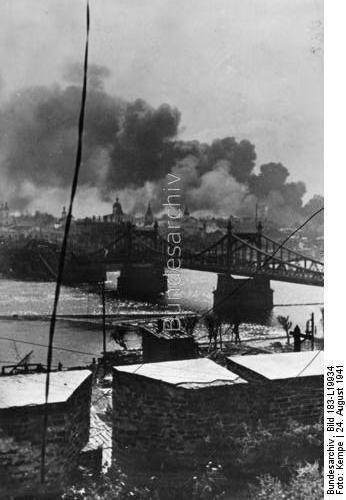
General Halder is furious with General Guderian on 24 August 1941. Guderian had been drafted by Halder, Army Group Center commander Field Marshal von Bock, and others to change Hitler’s mind about the wisdom of attacking Moscow rather than Kyiv during their meeting on the 23rd. Halder writes a scathing critique of Guderian’s failure. He notes that Guderian told Hitler that his troops could not attack south due to weariness and lack of fuel, then notes that today Guderian has completely changed his position and now maintains that he can, in fact, immediately attack south. Halder writes:
“My reply to [Guderian] is that I had no sympathy for such a 100% change of mind. His retort was: What he told us yesterday was framed with a view to furnishing OKH with arguments against the ordered operation to the south. Now, having become convinced by his interview that the Führer was firmly resolved to execute this drive to the south, it was his duty to make the impossible possible in order to put those ideas into effect.”
Halder concludes that “This conversation shows with devastating clearness with what complete irresponsibility official reports are twisted to fit any specific purposes.”
In the Far North sector, the Soviet 115th and 123rd Rifle Divisions launch a counterattack against the Finnish bridgehead across the Vuoksi River. The Finnish Light Brigade T is partially surrounded and forced to fight for its life. Things look grim, but the Finns have reinforcements available while the Soviets do not, and the Soviet units are tired from long marches. The Finns quickly send units of IV Corps which are due to arrive on the 25th.
Finnish 8th Division (Col. Winell) crosses Viipuri Bay unopposed, isolating the Soviet forces in Viipuri by cutting their escape route along the coast. The Soviet troops are not going to retreat without orders anyway, as they know from experience that bad things happened to troops that retreated on their own initiative during the Winter War and the opening stages of Operation Barbarossa. Thus, the Soviets essentially allow the Finnish crossing because they are staying put anyway.
Finnish 36 Corps continues advancing in the area of Nurmi Lake and Nurmi Mountain. On their right flank, the Finns take the village of Vuoriyarvi, while in the left the Finnish 6th Division is racing to cut off Soviet troops that are trying to escape to the north along a logging road that they have found which is not on maps.
In the Army Group North sector, the fighting features only local actions. The Soviets at Tallinn (Reval) realize their plight as German 18th Army presses in and organize a convoy to transfer troops and any remaining dependents back to Leningrad — with disastrous results (see below). Heavy fighting at Novgorod.
In the Army Group Center sector, Soviet General Ivan Konev attacks toward Gomel, recently taken by the German 2nd Army. Second Army itself is planning an attack on the south in conjunction with General Guderian’s Panzer Group 2, which is about 75 miles to the east at Starodub. General Hoth’s Panzer Group 3 continues thrusting in the direction of Velikie Luki, advancing to within a mile of the city.
Field Marshal von Bock is bitter about the emphasis on Kyiv and Leningrad over Moscow, writing:
“This is the seventh or eighth time in this campaign that the army group has succeeded in encircling the enemy. But I’m not really happy about it, because the objective to which I have devoted all my thought, the destruction of the enemy armies, has been dropped. Perhaps we will overrun the Russians in from of my northern wing and thus get things going to the point that at least pressure on my eastern front is relieved… If, after all the successes, the campaign in the east now trickles away in dismal defensive fighting for my army group, it is not my fault”
In the Army Group South sector, the Romanian 4th Army is bogged down around Odessa. The Soviet defenders are fighting desperately, helped by timely bombardments from the Black Sea Fleet and, as with their comrades in Karelia, a lack of authorization to retreat. The Romanians report that they have suffered 5,329 killed and 27,307 total casualties. On the bright side for the Romanians, they have inflicted heavy casualties on the defenders, and their artillery at Kubanka is pounding the Soviet port facilities. OKH agrees to send some spare battalions to help the Romanians get their attack moving again.
There is heavy fighting at Dnepropetrovsk and south of Kyiv. German 6th Army continues pulling the noose tight around Kyiv. German 11th Panzer Division reaches the Desna at Oster, but the retreating Soviets set it on fire.
Luftwaffe Oblt. Hans Philipp of II./JG 54 receives the Eichenlaub, becoming the 33rd soldier to receive it. Philipp has 62 kills, over 40 in the USSR.
The Germans are closing in on Tallinn (Reval), Estonia, so the Soviets send a convoy carrying departing troops and refugees. The convoy sails into a German minefield off Cape Juminda (near Keri Island), with disastrous results. The following ships hit mines and sink:
• Destroyer Engels (formerly the Desna);
• Minesweeper T-209/Knecht;
• Minesweeper T-213/Krambol;
• Minesweeper T-212/Shtag;
• 3,618-ton freighter Lunacharski;
• 1,430-ton freighter Daugava;
• 2,029-ton freighter Zheleznodorozhnik.
Soviet tanker No. 11 also sinks in the Gulf of Finland, it is not clear if this was part of the convoy.
The Luftwaffe bombs and damages Soviet freighter VT-532 in the Baltic. The master manages to beach the freighter near Prangli Island. There are 44 deaths.
Soviet submarine L-4 (Lt Cdr Polyakov) lays 20 mines off Cape Olinka, Romania. The Soviets have four other submarines patrolling off the Romanian coast while two others patrol off the Bulgarian coast.
The Germans in Vilna, Lithuania arrest local leader Dr. Jacob Wigodsky, 86 years old. They schedule his execution to take place in a week.
Vichy France passed anti-terrorist laws, punishable with death sentences, to deal with the resistance movement.
Adolf Hitler ordered the end of the euthanasia program that had already killed 70,273 mentally-ill people. Reacting to public pressure stirred up by sermons delivered by the Bishop of Münster von Galen and others, Hitler terminates the Aktion T4 euthanasia program (a name not actually used by the Germans themselves, T4 stands for Tiergartenstraße 4, the address of the Berlin headquarters of the Gemeinnützige Stiftung für Heil- und Anstaltspflege which runs the euthanasia program — it is a euphemism, “Charitable Foundation for Curative and Institutional Care”). The T4 program targets those “deemed incurably sick, after most critical medical examination.” Naturally, the criteria are subjective, and some people judged “insane” and exterminated aren’t necessarily mentally ill at all. They may, however, have offended someone important or said something ill-advised.
It is a rare instance of popular pressure within the Reich forcing Hitler’s hand. Hitler, however, knows that the Catholic Church is one of the only institutions that have a large following other than him — and privately he vows retribution after “final victory.” This also is a rare case of the Church opposing Hitler, something for which it gets scant credit in postwar histories. The killings, however, continue within concentration camps after this date. It is estimated that about 70,000 people perish before this date and about 20,000 people after under the T-4 program, including one of Hitler’s own relatives.
The now-unemployed T-4 personnel are not out of work for long. They soon are shipped to the Eastern Front, where they turn their extermination expertise against Jews.
Although the euthanasia program was officially ended, the killing of physically or mentally impaired people continued in secret in individual cases. Some doctors would continue to kill the mentally-ill through the end of the European War.
Operation MINCEMEAT gets into gear as minelayer HMS Manxman, disguised as a Vichy French destroyer, lays 140 mines (70 contact mines, 70 magnetic) off Livorno, Italy. Royal Navy aircraft carrier Ark Royal sends Swordfish torpedo-bombers on a sweep over Sardinia, dropping incendiary bombs west and southwest of Tempio. Later, the Ark Royal sends off ten more Swordfish to bomb Tempio airport.
The Italian fleet, led by battleships, continues patrolling off the western Italian coast but does not locate the British ships. The Royal Navy, however, does spot the Italian fleet. After aerial reconnaissance reveals the presence of battleships, the British head back to Gibraltar. In any event, the British have accomplished their main objective, the minelaying of Manxman.
The Italian Navy sets up a patrol line of five submarines and 13 motor torpedo (MAS) boats across the Sicilian Strait in order to waylay an expected Royal Navy move through the Mediterranean. Other submarines take up position southwest of Sardinia. The Italian fleet sets up station at the entrance to the Sicilian Strait, waiting for the British — while ships of the Royal Navy now are heading in the other direction. Royal Navy submarine Upholder spots the fleet and attacks light cruiser Luigi Di Savoia, but misses.
The Royal Navy officially writes off submarine P-33 (Lieutenant R.D. Whiteway-Wilkinson). It is the second U-Class submarine lost in two days, the other being P-32.
Operation TREACLE, the replacement of Australian soldiers at Tobruk with Polish troops of the Carpathian Brigade, continues. The Polish troops depart from Alexandria aboard minelaying cruiser Latona and destroyers Griffin, Kingston, and Kipling. The mission proceeds without incident.
British patrol planes from Malta spot Italian patrol boat Grazioli Lante between Tripoli and Benghazi and sink it.
Oberleutnant Hans Philipp became the 33rd member recipient of the Oak Leaves to the Knight’s Cross.
British Prime Minister Winston Churchill made a radio broadcast about his meeting with U.S. President Franklin D. Roosevelt. In it Churchill promised unhesitating aid to the United States if hopes for a peaceful settlement with Japan failed: Because of “…the deep underlying unities which stir and, at decisive moments, rule the English-speaking peoples throughout the world.”
Winston Churchill broadcast a message to the world about his recent meeting with President Roosevelt and the signing of the Atlantic Charter. Churchill explained that the Charter differed from the attitude adopted by the Allies in the latter part of World War I because it did not assume that there would never be any war again, and “that instead of trying to ruin German trade by all kinds of additional trade barriers and hindrances, as was the mood of 1917, we have definitely adopted the view that it is not in the interests of the world and of our two countries that any large nation should be unprosperous or shut out from the means of making a decent living for itself and its people by its industry and enterprise..”
In a broadcast to the British people, Churchill, referring to the mass murders committed by the Germans, states: “We are in the presence of a crime without a name.” Churchill refers to the “scores of thousands” of executions of civilians by the Germans. He does not, however, mention that the primary victims are Jews.
In a speech to the House of Commons Churchill says: “Napoleon in his glory and genius spread his Empire far and wide. … Napoleon’s armies had a theme. They carried with them the surges of the French Revolution — Liberty, Equality and Fraternity. … There was a sweeping away of outworn, medieval systems and aristocratic privilege. There was the land for the people, a new code of law. Nevertheless, Napoleon’s empire vanished like a dream.”
In Operation CUTTING, Royal Navy sloop Milford departs from Freetown escorting 1984-ton British freighter Lady Denison-Pender. The latter ship is to cut and remove the Dakar-Pernambuco cable.
Royal Navy Force A, beginning operations in the Arctic, arrives at a point 60 miles west of Isfjord, Spitsbergen. It prepares to conduct Operation GAUNTLET, a Royal Navy raid on Spitzbergen scheduled to begin in the early hours of 25 August.
First Lord of the Admiralty A.V. Alexander visits Scapa Flow for an inspection tour of battleship HMS Prince of Wales.
The Luftwaffe bombs and damages Royal Navy sloop HMS Black Swan while Black Swan is escorting a convoy in the Irish Sea. Black Swan makes it to Milford Haven for repairs that take three weeks.
The Luftwaffe bombs British 1,283-ton freighter Skagerak with a FAB-XI aerial a mine and sinks it in the River Orwell, Harwich. There are 18 deaths, including the river pilot, and six survivors. This is a new German mine and its first success.
The Luftwaffe takes advantage of low cloud cover over England to send six planes against targets from Blyth to Teesside. The RAF responds, and a tragedy results. There is a friendly fire incident when RCAF Hurricane Mk. I Hurricanes of No. 1 Squadron based at Northolt, Middlesex mistake two Blenheim bombers for Junkers Ju-88s and shoot them down.
RAF Bomber Command, Day of 24 August 1941
6 Blenheims on sweep in the Bremerhaven area. 1 ship was attacked but not hit. No aircraft lost.
RAF Bomber Command, Night of 24/25 August 1941
Düsseldorf
44 aircraft — 25 Whitleys, 12 Hampdens, 7 Halifaxes; only the estimated position of the target was bombed, through cloud. 2 Whitleys and 1 Halifax lost.
6 Hampdens were dispatched to the Wesel area for searchlight suppression operations in the German searchlight belt. These aircraft attacked any searchlight which was holding another bomber in its beam. The Hampdens dived to attack with small bombs and with machine guns; this usually caused the searchlight to lose the bomber which it had been holding. The Hampdens operating on this night found that, after 25 minutes of this type of attack, all the searchlights in the area became erratic and some were extinguished.
Nine RAF Wellingtons attack Tripoli and damage the docks and the city.
Light cruiser HMS Arethusa departed Scapa Flow to refit in the Tyne.
Destroyer HMS Vivacious arrived at Scapa Flow at 1900 from Rosyth to carry out working up practices.
Destroyer HMS Somali departed Scapa Flow at 2200 for Loch Alsh to embark the First Lord of the Admiralty. The destroyer arrived at 0800/25th and after embarking the First Lord of the Admiralty sailed for Stornoway at 1400. Destroyer Somali arrived at 1550. At 1630 the destroyer departed for Scapa Flow and arrived at 0930/26th. The First Lord of the Admiralty was transferred to battleship HMS Prince of Wales.
Sloop HMS Black Swan, escorting a convoy in the Irish Sea, was damaged by German bombing. The damage required three weeks to repair at Milford Haven.
British steamer Skagerak (1283grt) was sunk on a mine in the River Orwell, Harwich in 51-58-08N, 1-16-06E. Seventeen crew and the pilot were killed.
Anti-submarine whaler HMS Kos XVI was sunk in a collision with Destroyer HMS Wolsey in the Irish Sea. Damage to the destroyer was minor and did not remove her from service.
Soviet destroyer Engels (ex-Desna) was sunk on a mine off Cape Juminda while operating with the Baltic Fleet.
Light cruisers HMS Ajax and HMS Neptune departed Alexandria covering minelaying cruiser HMS Latona and destroyers HMS Kipling, HMS Kingston, and HMS Griffin in the fifth series of the TREACLE operation. The ships arrived back at Alexandria on the 25th.
A Catalina aircraft sighted and attacked a U-boat 30 miles SW of the River Tagus. Destroyers HMS Boreas and HMS Wivern searched the area without result.
In Operation CUTTING, British steamer Lady Denison-Pender (1984grt) departed Freetown, escorted by sloop HMS Milford, to cut and lift about sixty miles of the Dakar — Pernambuco cable. The ship arrived in position on the 28th and the operation required one week to complete.
Convoy SC.41 departed Sydney, CB escorted by armed merchant cruiser HMS Ranpura and corvettes HMCS Arvida, HMCS Chicoutimi, and HMCS Matapedia. The corvettes were detached on the 26th when relieved by destroyer HMCS St. Croix and corvettes HMCS Buctouche, HMCS Galt, and HMCS Pictou. Destroyer HMS Ramsey joined on 2 September. Corvettes HMS Arabis, HMS Monkshood, and HMS Petunia and anti-submarine trawlers HMS Northern Gem, HMS Northern Pride, and HMS Northern Wave joined on 5 September, destroyer HMS Sardonyx on 6 September, and destroyers HMS Malcolm and HMS Watchman on 11 September. Destroyer St. Croix was detached on 5 September and destroyer Ramsey and corvettes Buctouche and Galt on 6 September. The convoy arrived at Liverpool on 11 September.
Convoy SL.85 departed Freetown escorted by destroyer HMS Vansittart to 28 August, sloop HMS Milford to 28 August, and corvettes HMS Aster, HMS Burdock, HMS Starwort, and HMS Vervain to 28 August. On the 28th, sloop HMS Sandwich to 17 September, sloop Commandant Domine to 17 September, and anti-submarine yacht HMS Philante to 17 September joined. On 2 September, corvette HMS Wallflower joined to 11 September. On 11 September, destroyers HMS Boreas, HMS Caldwell, HMS Vanoc, HMS Volunteer, and HMS Walker and corvettes HMS Bluebell, HMS Campanula, HMS Campion, HMS Carnation, HMS Heliotrope, HMS Hydrangea, HMS La Malouine, and HMS Mallow joined. Sloop HMS Leith joined on 14 September. The convoy arrived at Liverpool on 17 September with ocean boarding vessel HMS Cavina and the escorts which joined on 11 and 14 September.
Accompanied by the Duke of Kent, President Roosevelt is on his way tonight to Washington after moving today to relieve the British shipping stringency and the Eastern oil shortage, and arranging to meet legislative leaders tomorrow morning for what it was reported would be a final conference before the introduction of another lease-lend bill running to from $5,000,000,000 to $10,000,000,000. The President spent most of today entertaining the brother of King George VI, but found time to announce the approval of legislation empowering the employment of foreign officers and crews on American vessels, thus permitting British use of foreign vessels seized here, and to authorize construction of a pipeline from Baton Rouge to Greensboro, North Carolina, to compensate in part for the transfer of American tankers to Britain. Important as were these two steps, they were overshadowed for many observers by the Executive’s apparent concern over the introduction of new legislation to permit a broadening of the scope of the whole armaments program. Mr. Roosevelt requested leaders in the Senate and House to meet him at the White House almost immediately after his arrival in the capital early tomorrow morning.
Brigadier General Lewis B. Hershey directed local draft officials today to make certain citizen soldiers soon to be released from military service are “protected in their legal right to reemployment in civilian occupations.” National selective service headquarters, Hershey said, has planned that each local draft board should appoint a reemployment committeeman to see that returning soldiers get their old jobs back or new ones if the old are for some legal reason unavailable. The army announced last week that barring any change for the worse in the international situation approximately 200,000 men would be out of uniform by Christmas.
Decks were cleared today for resumption of work on $493,000,000 worth of naval and merchant shipping contracts held by the Federal Shipbuilding & Drydock Co. as a naval official announced first steps were about to be taken to reopen the idle yards and a union president stated the 17-day-old strike was “definitely over.” After a long conference with company officials and union representatives, Rear Admiral Harold G. Bowen, who will direct the resumption of production, announced plant superintendents, foremen and department heads would meet tomorrow to complete plans for operation. He expressed belief work would be in full swing Tuesday.
Administration supporters tonight applauded Prime Minister Churchill’s speech particularly the warning to Japan but the isolationist leader, Senator Wheeler, Montana Democrat, charged it was “designed to frighten the United States into the idea that we have got to get into the war now or else Hitler will get us.” Some State Department officials listened to the speech but they declined comment on all its phases. Unofficial sources interpreted Churchill’s pledge that Britain will stand “unhesitatingly on the side of the United States if these hopes (for peaceful settlement of U. S.-Japanese problems) fail” as one of the most sweeping British commitments to American Far East policy. Wheeler, referring to the Churchill pledge of aid, bluntly remarked: “We don’t need any help from Great Britain or anybody else. We’re able to take care of ourselves.”
Americans were warned to expect changes in the order of the Board of Governors of the Federal Reserve System restricting installment credit, in a statement today by Marriner S. Eccles, chairman of the board. Mr. Eccles said that the regulation would be subject to change from time to time “as experience with its administration develops, and as economic conditions require a further dampening of buying power.” The Federal Reserve head appealed to the people to take advantage of higher incomes to reduce their debts “or get out of debt.”
The street car and bus strike which halted service on the city-owned Detroit street railway system at 4 AM Wednesday ended at 4 PM today after the A.F. of L. Amalgamated Association of Street, Electric Railway and Motor Coach Employes of America had ratified an agreement for a system-wide election Tuesday among the 5,500 employes.
Tom Dewey, District Attorney of New York County, gives a speech to the Williamstown Institute of Human Relations. He concludes that “Only by a respect for the rights of every other individual can we protect our own rights.”
A rag tag group of five musicians, dubbed the Dodger Symphony by radio announcer Red Barber, make their debut at a Brooklyn Dodgers baseball game in Ebbets Field, Brooklyn. This band, none of which could read music, perform their zany antics at all evening and weekend games.
Major League Baseball:
Meeting head-on at Ebbets Field yesterday before a crowd of 31,523 fervid Flatbush fans, the first-place Dodgers and the second-place Cardinals split a double-header, St. Louis Inking the opener, 7–3, behind Ernie White, and the Brooklyn pennant chasers annexing the nightcap, 3–2, to retain their game-and-a-half lead. In game 2, with darkness setting in pitcher Whit Wyatt drives home the winner with one out in the 9th off young Howie Pollet. The games are enlivened by the music of a pickup band, generating a good response from the crowd. The musicians will come to be called the Dodger Symphony.
Bob Klinger won his eighth consecutive game for the Pirates, 7–3, today after a twelve-inning opener in which the Braves twice came from behind to snatch a 4–3 decision. Vince DiMaggio hit his 17th homer of the season in the opener.
The New York Yankees, without star Joe DiMaggio, swept a doubleheader from the host Chicago White Sox. Charlie Ruffing, belting home three runs, captured the opener from Chicago’s 41-year-old Ted Lyons, 5–1, four runs in the ninth settling this conflict. In the nightcap the big guns began to roar once more. Charlie Keller hit two homers, his thirty-first and thirty-second of the year; Tommy Henrich exploded his No. 23. and these mighty clouts, along with sundry other blows, sank the left-handed Thornton Lee, 8–5.
The Cleveland Indians climbed past Boston into third place today by inflicting upon the Red Sox a double defeat, 4–3 and 5–2, in their first twin killing since July 13 against the same team. Both were battles of southpaw pitchers, Al Milnar taking the first from Mickey Harris and Al Smith topping Earl Johnson in the second.
Big AI Benton, yanked out of the relief class this year, hurled his ninth victory today as the Tigers defeated the Athletics, 7–4. Every Tiger except Benton, who hasn’t had a safety in two years, and Rudy York made at least one hit in pounding Starter Les McCrabb and Jack Knott for fourteen blows that included a triple and a homer by Tucker Stainback.
The Giants submitted quietly to a double beating by the Reds at the Polo Grounds before a gathering of 22,860. Harry Craft hits two homers, one a grand slam, and a double to lead the Reds to a 13–9 win over the Giants at the Polo Grounds. Craft has 6 RBIs in the game 1 win. In game 2, the 3rd-place Reds win, 6–4, as Elmer Riddle goes 8 innings to run his record to 15–2. Bucky Walters earns the save but gives up 2 hits in the 9th.
The Phillies, still in last place but currently playing like wild fire, unleashed two styles of baseball today to sweep a double-header from the Cubs, 8–5 and 7–6. In the first game, under the urging of John Hans Lobert, acting as manager while Doc Prothro searches for new talent, the Phils ran wild on the bases, stealing six on Catcher Clyde McCullough. In the second contest they laid down a barrage of home runs, Danny Litwhiler getting his second of the afternoon and Stan Benjamin and Joe Marty one each.
The revitalized Browns vaulted from the cellar into sixth place ahead of Washington and the Athletics today by squeezing out a 4-to-3 victory over the Senators in the tenth inning. It was an uphill battle from the second inning, when Washington scored all its runs on three hits, including a home run by Jim Bloodworth, to take a 3-1 lead. But Pitcher Elden Auker resumed command, allowing only two more hits to score his twelfth triumph in the extra frame, when Bob Swift bunted safely on a squeeze play with the bases loaded.
The scheduled second game of the doubleheader between the Washington Senators and the Browns at St. Louis was postponed due to rain. The game will be made up as part of a doubleheader tomorrow.
St. Louis Cardinals 7, Brooklyn Dodgers 3
St. Louis Cardinals 2, Brooklyn Dodgers 3
Pittsburgh Pirates 3, Boston Braves 4
Pittsburgh Pirates 7, Boston Braves 3
New York Yankees 5, Chicago White Sox 1
New York Yankees 8, Chicago White Sox 5
Boston Red Sox 3, Cleveland Indians 4
Boston Red Sox 2, Cleveland Indians 5
Philadelphia Athletics 4, Detroit Tigers 7
Cincinnati Reds 13, New York Giants 9
Cincinnati Reds 6, New York Giants 4
Chicago Cubs 5, Philadelphia Phillies 8
Chicago Cubs 6, Philadelphia Phillies 7
Washington Senators 3, St. Louis Browns 4
The Newfoundland Escort Force (NEF), established at St. John’s on 23 May, continues adding ships and expanding its operations. Today, the Canadian corvettes HMCS Agassiz, HMCS Alberni, HMCS Chambly, HMCS Cobalt, HMCS Collingwood, HMCS Orillia, and HMCS Wetaskiwin depart from Halifax for St. John’s, while corvette HMCS Kenogami arrives there.
A United States government loan, the first to be granted to a Latin American country under the lend-lease act, will finance construction and equipment of Uruguay’s powerful air base at Punta Del Este, near the mouth of the river Plate, an authoritative quarter said today.
Churchill warns Japan that Great Britain will aid the Americans in the Pacific if war breaks out.
Light cruiser HMS Ceres was damaged in a collision with Norwegian tanker Gylfe (6129grt) off Bombay. The cruiser’s stem was fractured, but the cruiser was able to depart Bombay that day escorting convoy BM.8 to Trincomalee.
Convoy BM.8 departed Bombay with steamers Ekma (5108grt), Nevasa (9213grt), Egra (5108grt), Ethiopia (5574grt), and El Madina (3962grt), escorted by light cruiser HMS Ceres to Trincomalee. The convoy was escorted on by armed merchant cruiser HMS Antenor to 31 August, when light cruiser HMS Dauntless relieved her. The convoy arrived at Port Swettenham on 2 September.
Japanese planes sink Chinese gunboats Chiang Hsi and Chiang Kum at Patung, Szechuan, China.
Although, the Japanese press continues to expatiate on the alleged Anglo-American maneuvers to “encircle” Japan with the “ABCDS alliance” — meaning American, British, Chinese, Dutch and Soviet — the main attention this morning is concentrated, for the moment, on Saturday’s conference in Washington between Secretary of State Cordell Hull and Ambassador Kichisaburō Nomura. There is some hope for a reduction in tensions.
The Imperial Japanese Navy begins reconstructing patrol boat PB-2, adding 4.47-inch/45 cal main guns. It also is modified to be able to carry and launch two 46-foot Daihatsu landing craft.
The United States is weighing the possibility of commandeering the Japanese-owned hemp industry in the Philippine province of Davao to forestall a threatened shortage of hemp for the U.S. Navy, it was disclosed tonight. Government officials were revealed to be increasingly concerned over a shortage possibility since the treasury froze Japanese assets, including those in the Philippines. Japanese nationals have a monopoly on hemp production in Davao, which supplies 75 percent of this country’s imports.
Australian coaster Dellie (formerly Sphene) runs aground and is wrecked at Tweed Heads, Fingal Light, New South Wales, Australia while on a voyage to Tasmania. Her crew of 15 survives.
Born:
Ernest Wright Jr, American R&B vocalist (Imperials — “Tears On My Pillow”; “Goin’ Out of My Head”), in Brooklyn, New York, New York.
Hatch Rosdahl, AFL defensive end, defensive tackle, and guard (Buffalo Bills, Kansas City Chiefs), in Hackensack, New Jersey (d. 2004, from injuries suffered in a fall at his home).
Died:
Theodore Mavrogordato, 58, British tennis player.
Naval Construction:
The Royal Navy Bangor-class (Reciprocating-engined) minesweeper HMS Fort York (J 119) is launched by the Dufferin Shipbuilding Co. (Toronto, Ontario, Canada); completed by Montreal-Loco.
The Royal Navy “U”-class (Third Group) submarine HMS P-41 is launched by Vickers Armstrong (Barrow-in-Furness, U.K.). She is transferred to the Sjøforsvaret (Royal Norwegian Navy) on 7 December and commissions five days later as HNoMS Uredd (P 41).

