In the Far North sector on 18 August 1941, German XX Mountain Corps launches a renewed offensive toward Murmansk. It makes no progress against fierce Soviet resistance.
Finnish 18th Division consolidates its newly won bridgehead across the Vuoksi River. The Finns remain on the move in the Karelian Isthmus but are blocked everywhere else. The Finnish troops are getting worn out, too, because, aside from the Soviet resistance, the terrain of forests and swamps and few towns make supply difficult and rest impossible. The Finns are building roads to carry artillery. The Germans are completing the transfer today of 169th Division in a 110-mile march in order to replace the Finnish 6th Division. The march is so long because it involves marching in a roundabout fashion to confuse any Soviet spies.
Colonel-General Nikolaus von Falkenhorst, commander of Army of Norway, (Armeeoberkommando Norwegen, or AOK Norwegen), is not the most tactful of generals. He visits 36 Corps headquarters today and gets into an argument with General Hans Feige, implying that Feige’s request for additional troops to continue the offensive is unnecessary. Due to Falkenhorst’s pressure, the 6th Division is planning an offensive on the 19th in the Salla sector toward Lehtokangas and Nurmi Mountain. Feige points out that while his forces may have rough parity with the defending Soviet troops, they are receiving reinforcements while his troops are not — a fairly common situation across the entire Eastern Front.
In the Army Group North sector, Kingisepp (Yamburg) on the Luga falls to the Germans. The Germans consolidate their hold on Narva. The Germans rebuff with difficulty Soviet attacks on Staraya Russa and Novgorod, the “bookends” on Lake Ilmen. Field Marshal von Leeb calls General Halder at OKH and, according to Halder’s war diary, paints a “Very gloomy picture of the situation in X Corps” in the Staraya Russa area where “The last man has been thrown into the fighting” and “troops are exhausted.”
In the Army Group Center sector, the Soviets have infiltrated small forces behind the army group’s right flank in the Pripet Marshes. While not a serious threat, these small groups (roughly battalion size) disrupt rear areas that should be quiet and disrupt supplies. There are heavy Soviet attacks north of the main road to Moscow against the 161st Division.
In the Army Group South sector, SS officer Kurt “Panzer” Meyer turns a reconnaissance-in-force of the approaches to the town of Cherson (Kherson) into an all-out assault. He leads his small force down from the heights above the busy town and attempts a “coup de main.” His small force takes the Soviet defenders by surprise by sneaking into town along a small road along the Dneipr rather than from the road from Nikolayev (i.e., from the west). The reconnaissance turns into an all-out battle for control of the heart of the city, with Soviet artillery from the east bank of the river forcing Meyer’s men to dismount as infantry.
The Romanian 4th Army continues attacking across the Odessa perimeter. Both sides are taking heavy casualties, and progress is slow. The Soviets have nowhere to run and know they will likely be shot if they somehow do make it back through German lines, so they stand and fight.
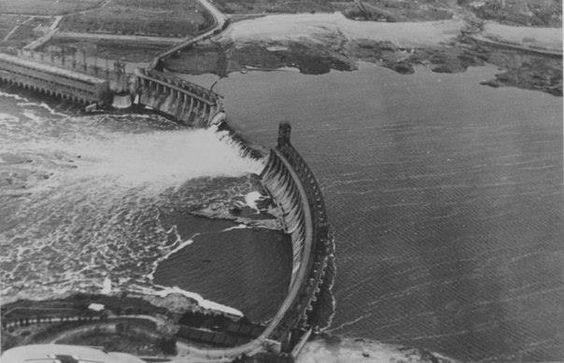
German Panzer Group 1 (von Kleist) establishes a bridgehead across the Dneiper at Zaporozhye (Zaporizhzhia). The Soviets dynamite the Dneipr Hydroelectric Station to swell the river, causing widespread death and destruction, but the Germans get across anyway. German 50th Division reaches the Black Sea Coast at Ochakov.
The Soviet Southern Armies, under Budenny, begin a withdrawal behind the Dnieper.
Lt. Max-Hellmuth Ostermann of 7./JG 54 shoots down two Russian I-16s over Leningrad.
The Red Air Force raids Berlin with five bombers. Today is the last of a series of small-scale Red Air Force raids against the Ploesti, Romania oil fields.
Soviet destroyer Statnyi hits a mine and sinks in Moon Sound off Saaremaa (Oesel).
The Luftwaffe attacks Leningrad harbor and sinks 2170-ton Soviet freighter Axel Carl.
The Luftwaffe bombs and sinks Soviet submarine depot ship Boug at Cherson (Kherson).
The retreating Soviets scuttle freighter Volochaevka at Cherson.
The Germans confer the Knight’s Cross (Ritterkreuz) on Marshal Mannerheim.
Rastenburg: Hitler rejects proposals from General Franz Halder, the chief of staff, and Field Marshal Walter von Brauchitsch, the army C-in-C, for an attack on Moscow.
Undersecretary of State Sumner Welles informs the Finnish Ambassador Hjalmar Procope that Soviet Union is willing to discuss peace terms with Finland. The Soviets are even willing to modify the terms of the Peace of Moscow of 1940 (ending the Winter War) more advantageous to Finland. Welles stresses that he is merely passing the information on, not acting as an official middle-man. Stalin had earlier, on 4 Aug, written to Roosevelt that he would appreciate if Finland could be withdrawn from the war. Procope replies by asking if the western powers are willing to give guarantees to Finland in the case Germany loses the war. Welles is unwilling to discuss the matter. In the end Finnish government is forced to give no definite answer to the tentative peace offer. As the German armies are advancing everywhere in the eastern front, there is perceived to be no sound basis for a peace between Finland and Soviet Union.
Hitler also orders the deportation of Berlin’s remaining 76,000 Jews to ghettoes in Poland.
German Chancellor Adolf Hitler ordered a temporary halt to the systematic euthanasia of mentally ill and handicapped persons due to protests within Germany. Following a widely discussed series of sermons in German churches condemning euthanasia, Hitler orders a halt — or, more accurately, a pause — in the program. About 50,000 mentally challenged and elderly people have been put to death under the program, including a relation of Hitler himself.
German concentration camp Amersfoort opens in the Netherlands.
“Swing Kids” (Swingjugend) dancing has become an underground phenomenon in the Reich, and the government is not happy at this intrusion of what it considers a decadent foreign culture. The Swing Kids listen to American and British records, tend to have long hair, dispute authority, and mock military customs such as the Hitler Salute. In general, the police forces (led by Reinhard Heydrich) see this as a dangerous infusion of “anglophile tendencies” that cannot be tolerated.
Today, the police decide to end this scourge. They send men into the clubs, arrest over 300 Swing Kids, and institute various punishments against them. These punishments range from sending the kids back to school or to concentration camps. Some boys are sent to the youth camp at Moringen and girls to the women’s camp at Ravensbruck. This incites further resistance by Swing Kids who aren’t captured, of course, and they begin doing anti-government acts like handing out anti-fascist leaflets.
Tobruk: The eyes of the world have focused since April on this dusty, sand-blown seaport, much of it lying in ruins after four months of bombardment. In Berlin, the Göbbels propaganda machine has delighted in calling the Australian garrison “rats caught in a trap”. It was not long before the Aussies themselves took up the title and were calling themselves “the Rats of Tobruk.” They beat off one massive German assault and have remained a major thorn in the flesh for Rommel, who desperately needs Tobruk’s port facilities to ease his heavily-stretched supply lines. Despite the Luftwaffe’s nightly bombings — the record so far is 21 raids between dusk and dawn — the real hazards for the garrison are boredom and monotony of a diet of bully beef, tinned stew and canned fruit supplemented by vitamin tablets. The local water, rationed to six pints a day per man, tastes foul. For all the air-raids and frequent long-range bombardments, morale is good in Tobruk. The Aussies make their own bawdy stage entertainments, and their local newspaper Tobruk Truth, is printed each morning using BBC news. Although the siege continues, night-time ferries have nonetheless brought in some supplies, and the Australians were delighted last night when Polish, British, South African and Indian troops broke through to join them after a daring naval operation in darkness.
In a statement released to the press U.S. President Franklin D. Roosevelt announced an important step to speed delivery of planes directly to the British forces in the Middle East. The statement announced that agreements had been concluded under which the Pan American Airways System would ferry aircraft from the United States to West Africa and would then ferry those planes on to the Middle East.
Royal Navy submarine HMS P-33 (Lt R. D. Whiteway-Wilkinson DSC), operating off Tripoli and with 32 crewmen, disappears on or around 18 August while attacking an Italian convoy. This is one of the unsolved disappearances of submarines that are common during World War II. An Italian Cant Z501 is flying overhead and sends a ship to look for survivors that the plane’s crew see in the water, but it is unclear if it sees survivors of P-33 or another ship. It is assumed by some that P-33 is destroyed by a depth charge attack by an Italian torpedo boat either today or on 23 August, but there is no confirmation of that. Nobody survives.
Royal Navy submarine HMS P-32 (Lt. D. A. B. Abdy)is operating near P-33 and surfaces while an Italian depth charge attack is underway nearby. It is very close to the entrance to Tripoli Harbor. Lieutenant Abdy attempts to run under a known minefield to get into a better firing position but surfaces too soon and P-32 hits a mine. This sends P-32 to the seafloor at a depth of 210 feet with the entire area forward of the control room flooded, killing 8 crew. Abdy manages to escape through the conning tower hatch along with Coxswain E. Kirk, but the rest of the crew in the engine room proves unable to use their escape hatch for some reason. This is likely because an iron bar may have been welded over the rear hatch (though this is not proven). The commander of the Italian ship that picks up Abdy and his mate agrees to stick around to await more survivors, but nobody else gets out. It one of the most dramatic escapes from a submarine during the entire war, as a depth of over 150 feet is considered fatal. A total of 30 men perish.
There are still thousands of Commonwealth troops hiding out on Crete. Royal Navy submarine HMS Torbay (Lt. Comdr. Miers) enters Messara Bay and picks up 28 British and 12 Greek soldiers. Torbay stays in the area submerged on the seafloor and enters the bay again on the 19th, picking up an additional 92 men and returning them to Alexandria.
Royal Navy submarine HMS Tetrarch fires torpedoes into Benghazi Harbor, damaging the port boom defense.
Royal Navy destroyers HMS Jackal and HMS Kingston make the nightly supply run from Alexandria to Tobruk and back without incident. The relief of Australian troops is in progress, with replacement Polish soldiers landed.
Radio Belgrade played an obscure German record which had been found in a pile of dusty 78s in the cellar of Radio Vienna. The song, “Lili Marleen,” sung by Lale Andersen, was an instant success. Within a week the station was receiving thousands of requests from the soldiers of the Deutsche Afrika Korps for it to be played over and over again. The song’s success did not end there for, with English lyrics, it would become equally popular with the British and Commonwealth soldiers fighting in the Western Desert.
Joseph Goebbels hates the song and demands Radio Belgrade to stop playing it. However, Axis soldiers across the Mediterranean hear the song and love it, including General Erwin Rommel. He asks the station to continue playing the song. Goebbels, who is a friend of Rommel’s, relents and allows the song to be played. The song becomes the sign-off tune of the station at 21:55 every night, and soldiers on both sides start to tune in at that moment to hear the song every night. It becomes the most famous song of the war and sells over a million copies.
Contrary to popular belief, the famous version of “Lil Marleen” is not by Marlene Dietrich, though she does record a version (retitled “Lili Marlene” in her honor) for the Morale Operations Branch of the U.S. Office of Strategic Services (OSS) in 1944.
German Reorganization of the Dutch Government: The Reich commission in the Netherlands suppressed the kingdom’s representative bodies and established an authoritarian administrative model.
Joseph Goebbels calls President Roosevelt the “agent of international Jewry.”
Following the Atlantic Conference in Placentia Bay, Newfoundland and a brief stop in Iceland, Prime Minister Churchill returns to Scapa Flow, Scotland aboard battleship HMS Prince of Wales.
The National Fire Service was inaugurated in the UK today. 118,000 strong, with 180,000 auxiliaries and 60,000 women, under Sir Aylmer Firebrace, a former London fire chief. Some 1,450 previous commands have been merged into 37 fire forces and 200 divisions. Fire drills have been standardized and emergency water tanks are now installed on bomb sites.
On 18 August 1941, in the heat of an English summer day, teenage fighter pilot John Gillespie Magee of the Royal Canadian Air Force’s 412 “Falcon” Squadron strapped himself into a Spitfire Mk I at No. 53 Operational Training Unit at RAF Llandow. After going through his checklist, he fired up the Rolls-Royce Merlin engine and waited for it to settle into a steady rhythm. The Spit, RAF Serial R6976, was a Battle of Britain survivor from 610 Squadron and though war weary, was well maintained and running smoothly. Today, it would be his seventh flight in a Spitfire and he was gaining confidence. When he was ready, he trundled to the edge of the airfield, turned into the wind and moments later moved the throttle forward to full power. The Spitfire thundered to life, bouncing on the dry grass, tail coming up, rushing headlong, lifting easily… into history.
On that day, Magee circled and climbed through canyons of clouds, topping out at 33,000 feet on a warm sunlit day. We do not know exactly what he did on this solo training flight, but it is very likely that he simply had a lot of fun horsing the beautiful aircraft through aerobatics, carving turns through clouds, delighting in three dimensional freedom and getting to know the Spitfire, the already iconic aircraft that would soon carry him to battle. It must have been a glorious thing for a teenager to do. He stayed up for a full two hours.
When he landed, he recorded the flight without any embellishment in his logbook, but it clearly had a profound impact on the young American. In the next few hours, he penned what many consider the greatest poem to come out of the Second World War and certainly the most enduring verse about the unbridled joy and glory of flight. The poem, which Magee entitled “High Flight”, is known by every English-speaking pilot on the planet — carried in their wallets, pinned to their walls, tattooed on their bodies, read at their funerals, carved on their headstones.
Four months later, Magee would be killed when his Spitfire, descending through a hole in the clouds collided with an Avro Anson flying beneath the cloud. Both pilots were on a training flight. Both were killed. It was a sad end to a very short life for Magee, who was born in Shanghai, China to a British mother and American missionary father. Magee was later educated at England’s famous Rugby School in Warwickshire where he had exhibited a nascent talent as a poet. He had joined the Royal Canadian Air Force from the United States in 1940, declining scholarship to Yale University.
David Bensusan-Butt, a civil servant in the War Cabinet Secretariat and an assistant of Lord Cherwell, chief scientific advisor to the Cabinet, submits his “Butt Report” on the accuracy of RAF bombing. The results are startling because they conclude that bombing accuracy is horrendous. Among the more prominent conclusions of the report:
• Only one aircraft of three that claims to have attacked a target actually got within 5 miles (8 km).
• Over Germany, the ratio is even worse, with only one in four bombers getting within five miles and one in ten over the industrial Ruhr river valley
• Accuracy depends upon the amount of moonlight available, with accuracy rising to two in five when there is a full moon and falling to one in fifteen during a new moon.
The “Butt Report” does not even go far enough, as post-war studies show that 49% of RAF bombs fall in the open countryside. Butt’s report also excludes all bombers that never reached the target due to mechanical reasons, weather, or enemy action.
RAF Bomber Command ordered Gee into production at Dynatron and Cossor. Gee was the code name given to a long-range general navigation system used by the RAF during the war and the first mass-produced sets arrived in May 1942.
RAF Bomber Command, Day of 18 August 1941
39 Blenheims on coastal sweeps off Holland and on Circus operations to Lille and Marquise. 2 trawlers were sunk and Lille was bombed. 1 Blenheim lost. A Blenheim of 188 Squadron, flying on one of the Circus raids, dropped a spare artificial leg by parachute for Wing Commander Douglas Bader, who had recently been taken prisoner. It reached Bader safely.
RAF Bomber Command, Night of 18/19 August 1941
Cologne
62 aircraft — 42 Hampdens, 17 Whitleys, 3 Wellingtons — with the West Station as the aiming point. 5 Whitleys and 1 Wellington lost. Crews reported many fires on the west side of the Rhine but Cologne reports few bombs, only 1 building damaged and no casualties, so this was probably another occasion when a decoy fire site attracted most of the bombs from a bomber force, which suffered nearly 10 percent casualties.
Duisburg
41 Wellingtons to attack railway yards. 2 aircraft lost. Good bombing results were claimed in clear weather. Minor Operations: 11 Whitleys and 7 Wellingtons to Dunkirk, 1 O.T.U. sortie. No losses.
By prior arrangement between the RAF and Luftwaffe, the RAF successfully drops a spare prosthetic leg for captured RAF Wing Commander Douglas Bader while flying over St. Omer airfield. The Germans are somewhat nonplussed when the charitable gesture is followed by the RAF planes attacking the airfield.
The Luftwaffe sends a few bombers across to raid the Tyneside and Teesside areas. These are pinprick raids that occasionally hit a populated building, tonight West Hartlepool suffers a tragedy when an ambulance depot is hit with 23 people killed and 45 injured. In addition, about 100 people are made homeless. In Norton, bombs hit a house on Benson Street, killing three people, while next door three others are killed.
U-38, commanded by Heinrich Schuch, sank Panamanian steamer Longtaker (1700grt) in 61-26N, 30-50W. At 0250 hours on 18 Aug 1941 the unescorted Longtaker (Master N. Nielsen) was hit in the bow and amidships by two torpedoes from U-38 and sank within one minute. Six crew members survived, but three of them died before being picked up by USS Lansdale (DD-426) on 5 September. A Danish officer, Hendrik Bjerregaard, maintains a log that receives widespread publicity in the American media. The 1,700 ton Longtaker was carrying timber and food stuffs (supplies for the U.S. Marines) and was headed for Reykjavik, Iceland.
Heavy cruiser HMS London arrived at Scapa Flow from convoy WS.10 escort and Biscay patrol.
Destroyer HMS Newark arrived at Scapa Flow at 0900 to carry out a short program of working up exercises.
Destroyer HMS Anthony departed Scapa Flow for Greenock to join destroyers HMS Intrepid and HMS Antelope to provide escort for aircraft carrier HMS Argus and troopship Empress of Canada. The ships sailed at 0200/19th. At 1530/19th, Force A in light cruiser HMS Nigeria with light cruiser HMS Aurora and destroyers HMS Tartar, HMS Icarus, and HMS Eclipse departed Scapa Flow to meet the Argus force. Fifteen miles north of the Butt of Lewis at 2100, the two forces rendezvoused. Aircraft carrier Argus with destroyers Tartar, Intrepid, and Eclipse proceeded to Scapa Flow where they arrived at 2030/20th. The troopship and light cruisers Nigeria and Aurora and destroyers Icarus, Antelope, and Anthony proceeded to Reykjavik, where they arrived at 0730/21st.
Anti-submarine whaler HMS Wastwater departed Scapa Flow for Iceland, escorting motor launches ML.1043 and ML.1045, via the Faroes.
Destroyer HMS Quorn, between Harwich and Chatham, was damaged on a mine. The damage was repaired at Chatham and was completed on 13 September.
British P/T/Midshipman (A) J. M. Down RNVR, was killed when his Martlett of 802 Squadron crashed after an engine failure on takeoff near Campbeltown.
Destroyers HMS Jackal and HMS Kingston departed Alexandria to carry supplies to Tobruk. The destroyers arrived back at Alexandria on the 19th.
Submarine HMS P.33 (Lt R. D. Whiteway-Wilkinson DSC), which departed Malta on the 6th, was sunk by mining or by Italian anti-submarine attack north of Tripoli on the 18th. Whiteway-Wilkinson, Lt R. H. Bygott, Lt R. L. Cunningham, Lt R. S. Frost RNR, and twenty eight ratings were lost.
Submarine HMS P.32 (Lt D. A. B. Abdy) had departed Malta on the 12th. Attempting to attack the convoy, she was damaged on a mine off Tripoli. The damage immediately killed the eight crewmen forward in the submarine. The submarine was grounded on the bottom. Only Abdy and one rating were able to successfully evacuate the submarine and were picked up by an Italian MAS boat. Sub Lt M. F. Millar, Lt R. L. S. Morris, Sub Lt R. M. Smithard and twenty seven ratings were lost on the submarine.
Submarines HMS Unbeaten and HMS Urge departed Malta to intercept a convoy north of Pantelleria.
Submarine HMS Tetrarch fired torpedoes into Benghazi Harbour. The torpedoes exploded on the boom defense.
Australian minesweeper HMAS Bathurst arrived at Port Said from Alexandria to pass through the Suez Canal. The minesweeper joined the East Indies Fleet. Australian minesweeper HMAS Lismore was also transferred to the East Indies Fleet, passing through the Canal on the 21st.
In exchange, armed boarding vessels HMS Chantala, which passed through the Canal on the 20th, and HMS Chakdina, which arrived at Suez on the 29th, were attached to the Mediterranean Fleet. Armed boarding vessel Chakdina arrived at Alexandria on 2 September.
Soviet destroyer Statny was mined and sunk in Moon Sound off Oesel.
Soviet steamer Axel Carl (2170grt) was sunk by German bombing in Leningrad Harbour.
Destroyers HMS Avonvale and HMS Eridge departed Gibraltar for Freetown, en route to the Mediterranean Fleet.
Submarine HMS Clyde departed Gibraltar for patrol in the Atlantic.
Convoy HG.71 departed Gibraltar escorted by destroyer HMS Wild Swan, sloop HMS Deptford, corvettes HMS Auricula, HMS Convolvulus, HMS Marigold, HMS Samphire and anti-submarine trawler HMS St. Nectan. The trawler was detached that night. Destroyer Wild Swan was detached on the 23rd and destroyer Vimy, which departed Gibraltar on the 19th, relieved her in the escort on that date. Destroyer Vimy was detached on the 25th and arrived at Gibraltar on the 28th. Anti-aircraft ship HMS Palmares joined the escort on the 29th. Destroyers HMS Caldwell and HMS Castleton joined on the 30th. The convoy arrived at Liverpool on 1 September.
Today in Washington, President Roosevelt stated that Pan American Airways would ferry war planes to the British in the Levant by way of West Africa. He signed three measures from Congress: the extension of military service of selectees, guardsmen and reserve officers, the determent of men past 28 from military service, and for increasing facilities for lighter-than-air craft. He met with Democratic leaders from the Capitol to discuss his meeting with Prime Minister Churchill.
The Senate was in recess. The Finance Committee continued hearings on the tax bill; the Territories and Insular Affairs Committee confirmed the nomination of Rexford G. Tugwell as Governor of Puerto Rico.
The House met briefly and adjourned at 12:12 PM until noon Thursday.
The U.S. Congress passed an amendment to the 1940 Selective Service Law extending the length of service for U.S. inductees from one year to two-and-a-half years. President Roosevelt then signs the legislation. The army’s top draft age was officially lowered to 28 today and at the same time the way was cleared for an order extending the service periods of the army’s rank and file by 18 months. With swift stokes of his pen, President Roosevelt signed into law two measures revising the draft act and affecting the lives of millions of young men. The first granted mandatory deferment from the draft to men who were 28 years old last July 1. Registrants whose twenty-eighth birth day falls after that date will be liable for induction up until the following July 1 when they, too, will receive automatic mandatory deferment. The second, source of prolonged controversy in congress and approved by only one vote in the house, gives Mr. Roosevelt authority to keep selectees, national guardsmen, reservists and enlisted men in service for as much as 18 months beyond the period for which they were inducted. It was believed an executive order extending the service of these men, with some possible exceptions, would be issued by Roosevelt soon. The service extension measure also will permit a swift expansion of the army should the danger of war become more imminent or actual hostilities involve this country.
Congressman John Dingell of Michigan sends President Roosevelt a letter in which he proposes to take 10,000 Japanese-Americans in Hawaii as hostages for Japan’s “good behavior.” This is the earliest suggestion of incarcerating Japanese-Americans.
President Roosevelt’s White House issues a statement announcing that the US will institute an air transport service from the United States to Africa via Brazil, thence to Egypt. A new aerial “ferry service” is to link up with this in order to deliver military planes to Egypt for the British. The statement reads in part:
The ferry system and the transport service provide direct and speedy delivery of aircraft from the ‘arsenal of democracy’ to a critical point in the front against aggression. The importance of this direct line of communications between our country and strategic outposts in Africa cannot be overestimated.”
Pan American Airways, Inc. quietly on 24 July has formed three subsidiaries to conduct the operations:
• Pan American Air Ferries, Inc.
• Pan American Airways Co.
• Pan American Airways-Africa, Ltd.
The ferry service is to take the military planes across the Atlantic to Africa, while the transport service is to return the pilots to the United States, with the third company handling administrative details. Pan Am and the US government already have signed agreements on 12 August to start the service. The British also sign agreements with Pan American Airways-Africa and Pan American Air Ferries — the transport company, the one that returns the pilots to the United States, is not their concern.
The ferry service supposedly derives from a request by Winston Churchill at the Atlantic Charter conference and a subsequent meeting between Roosevelt and Pan Am chairman Juan Trippe on or about 18 August 1941. However, as indicated by the earlier formation of the Pan Am corporations, the idea actually has been under consideration for some time and the conference itself is just a formality to finalize it.
The Soviet Union uses U.S. Secretary of State Sumner Welles as an intermediary to discuss peace terms with Finland. The Soviet proposal is to modify the Peace of Moscow of 1940, which ended the Winter War, to grant Finland some concessions. Finnish Ambassador Hjalmar Procope replies to Welles that the future of Finland depends upon what happens to the Soviet Union after the war, and requests a guarantee to Finland from the Western powers that they will protect Finland if Germany loses the war (which nobody expects at this point). Welles refuses to even consider such a guarantee. The peace feelers go no further.
Defense officials hinted tonight that presidential appeal was going forth immediately to the Federal Shipbuilding & Drydock Co. to accept national defense mediation board formula for ending the C.I.O. strike which has halted $493,000,000 worth of navy and merchant ship construction at Kearny, New Jersey. These officials, who declined to be quoted by name, indicated that if the White House appeal was rejected, an executive order would be issued immediately for government occupation and operation of the big shipyard.
Fire that spread with phenomenal speed destroyed Pier 27 in Brooklyn yesterday and wrecked the New York Cuba Mail Line freighter Panuco, which was being unloaded alongside. Nineteen men were believed to have died.
Chesty Manly, the Washington, D.C. correspondent of the Chicago Tribune, publishes a story claiming that a “leak” has informed him that President Roosevelt has plans to send an American expeditionary force to Europe. The story creates an uproar in the capital, and a vigorous debate breaks out in the press about the truthfulness of the story. It is one of several stories run by the isolationist Manly that is of questionable veracity.
The Reverend John A. O’Brien makes a radio address that urges the world to “choose the road to peace.” He rhetorically asks what the warring powers have accomplished by two years of war and deplores war’s futility. He concludes with a plea to President Roosevelt to put his power “into the Christ-like work of halting the brutal European strife.”
The War Department asks the Coast Guard to help with national security by patrolling the sea lanes in Alaskan waters and keeping them open.
Major League Baseball:
The Dodgers notch win over the Pirates, 6–5, despite 6 errors. Pete Reiser’s homer in the 9th wins it for reliever Casey, and increases the Brooklyn Dodgers’ lead over the idle Cardinals to one game. Reiser earlier had a two-run triple.
Playing before 72,000 empty seats, the Senators defeated the skidding Indians tonight, 4–2. Only 8,365 fans were at the Municipal Stadium to watch Steve Sundra limit the Redskins to seven hits and hand them their thirteenth setback in the last fourteen games.
All thoughts of Sunday’s double debacle at Philadelphia were brushed aside yesterday as the Giants squared off twice against the Cubs at the Polo Grounds and in double-quick time twice polished off the Chicagoans, 6–4 and 7–1. With Hal Schumacher and Cliff Melton in control and the Giants resorting to sound baseball again, the slim turnout under Coogan’s Bluff was treated to some fine fielding and timely hitting.
The Reds sweep a pair from the bumbling Phillies, winning 13–5 and 5–4. In the first game, the Reds build a 10–1 lead after 2 innings and are helped in the win by the Phillies’ 8 errors, which ties a team record set in 1922 (a record the Phillies list as a post–1911 one). Bill Werber has 3 hits and 5 RBIs.
The scheduled game between the New York Yankees and the Tigers at Detroit was postponed due to rain. The game will be made up as part of a doubleheader tomorrow.
The scheduled game between the Boston Red Sox and the Browns at St. Louis was postponed due to rain. The game will not be made up.
Pittsburgh Pirates 5, Brooklyn Dodgers 6
Washington Senators 4, Cleveland Indians 2
Chicago Cubs 4, New York Giants 6
Chicago Cubs 1, New York Giants 7
Cincinnati Reds 13, Philadelphia Phillies 5
Cincinnati Reds 5, Philadelphia Phillies 4
A Panair do Brasil Lockheed 18-10 Lodestar, msn 18-2083, registered PP-PBD, crashes near Sao Paulo; all 8 aboard the aircraft are killed.
A sharp protest against obstacles put in the way of Americans who wish to leave Japan or Japanese-controlled territory in China was submitted to Foreign Minister Teijiro Toyoda yesterday by United States Ambassador Joseph C. Grew, who called on the Minister and discussed the situation with him for more than two hours. At 16:00, U.S. Ambassador Grew meets with Foreign Minister Toyoda in Tokyo. Toyoda speaks for two and a half hours straight. He defends Japanese actions in the Pacific and denies that Japan is acting in concert with Germany and says its only objective is the settling of issues in China. For these reasons, a summit meeting between the leaders of the two powers should occur. Grew responds that the Japanese position has not responded adequately to President Roosevelt’s concerns, but he will forward the Japanese request for a summit meeting to the U.S. government with his personal support (which he does).
Japan has given no satisfactory explanation of her refusal to allow more than 100 American citizens to return home, Secretary of State Cordell Hull declared today as diplomatic conversations both in Washington and Tokyo indicated that tension in Japanese-American relations had not abated.
Relations between the United States and Japan were reported near the breaking point today following a long conference between the United States Ambassador, Joseph C. Grew, and Foreign Minister Teijiro Toyoda, at which Mr. Grew is reported to have warned that American pressure on Japan would be intensified unless she made fundamental alterations in her foreign policy.
The second group of Imperial Japanese Navy midget submarine trainees conducts its final exercise, using seaplane tender HIJMS Chiyoda as the target. During a subsequent conference, some crewmembers suggest use of the new weapon to penetrate enemy naval bases to attack capital ships. They also suggest the use of “mother” submarines as midget carriers to overcome the midget submarines’ short range problem. Soon thereafter, training of the second group is completed.
The Japanese have heard about the American Volunteer Group (AVG, or “Flying Tigers”) assembling at Kyedaw, Burma, so they send a reconnaissance plane overhead.
The U.S. Marine Corps 1st Defense battalion arrives at Wake Island aboard U.S. Navy cargo ship USS Regulus (AK-14).
Dow Jones Industrial Average: 125.62 (+0.57)
Born:
Matt Snell, AFL-NFL fullback (AFL champions, Super Bowl III Champions-Jets, 1968; AFL All-Star, 1964, 1966, 1969; New York Jets), in Garfield, Georgia (d. 2026).
Dennis Claridge, NFL quarterback (Green Bay Packers, Atlanta Falcons), in Phoenix, Arizona (d. 2018).
Terry Dillon, NFL safety (Minnesota Vikings), in Waukesha, Wisconsin (d. 1964, drowned after a bridge construction accident).
Bob Woytowich, Canadian NHL and WHA defenseman (NHL All-star, 1970; Boston Bruins, Minnesota North Stars, Pittsburgh Penguins, Los Angeles Kings; WHA: Winnipeg Jets, Indianapolis Racers), in Winnipeg, Manitoba, Canada (d. 1988, from a heart attack while driving his car).
Christopher Jones, American actor (“Wild in the Streets”), in Jackson, Tennessee (d. 2014).
Naval Construction:
The Royal Canadian Navy Bangor-class (Reciprocating-engined) minesweepers HMCS Kenora (J 281), HMCS Fort William (J 311), and HMCS Milltown (J 317) are laid down by the Port Arthur Shipbuilding Co. (Port Arthur, Ontario, Canada).
The U.S. Navy Accentor-class coastal minesweeper USS Reliable (AMc-100) is laid down by Anderson & Cristofani (San Francisco, California, U.S.A.).
The U.S. Navy Adroit-class minesweeper USS Advent (AM-83) is laid down by the Commercial Iron Works (Portland, Oregon, U.S.A.).
The U.S. Navy PC-461-class (173-foot steel hull) submarine chaser USS PC-473 is laid down by the Defoe Shipbuilding Co. (Bay City, Michigan, U.S.A.).
The Kriegsmarine (German Navy) Type IXC/40 U-boat U-188 is laid down by AG Weser, Bremen (werk 1028).
The Royal Navy “M”-class destroyer HMS Mahratta (G 23) is laid down by the Scotts Shipbuilding & Engineering Co. (Greenock, Scotland).
The Royal Navy harbor defence motor launch HMS HDML 1056 is commissioned.
The Royal Navy MMS I-class motor minesweeper HMS MMS 37 (J 537) is commissioned.
The Royal Navy MMS I-class motor minesweeper HMS MMS 47 (J 547) is commissioned. Her first commanding officer is T/Lieutenant Stephen Crichton Dickinson, RNVR.
The U.S. Navy Accentor-class coastal minesweeper USS Bateleur (AMc-37) is commissioned.
The Royal Navy British Power Boat 63-foot motor anti-submarine boat HMS MA/SB 30 is commissioned.
The Royal Navy Fairmile C-class motor gun boat HMS MGB 326 is commissioned.
The Royal Navy Hunt-class (Type II) escort destroyer HMS Badsworth (L 03) is commissioned. Her first commanding officer is Lieutenant Commander Michael Southcote Townsend, DSC, OBE, RN.

