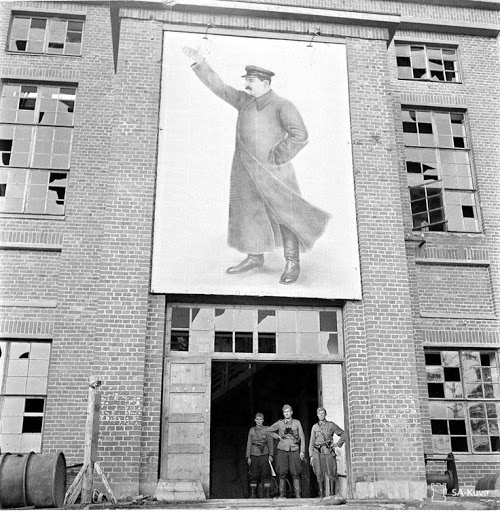
Joseph Stalin issued Order No. 270, ordering all deserters executed and deserters’ families arrested. In a move that has immediate and lasting repercussions on the Eastern Front, on 16 August 1941 Soviet Premier Joseph Stalin issues Order No. 270. This order sets forth penalties for dereliction of duty and desertion (execution and imprisonment of deserters’ families), commands soldiers not to surrender, and sets forth severe penalties for any acts detrimental to the Soviet war effort. The lengthy order is somewhat unusual in that it gives detailed examples of “heroic” behavior, which includes Lieutenant-General Boldin’s escape from encirclement while deputy commander of the Western Front (the commander of the Western Front, General Pavlov, was shot on Stalin’s command for dereliction of duty). It also gives examples of “cowardice,” which includes the surrender of 28th Army Commander Lieutenant General Katchalov.
The order is quite plain: don’t surrender unless we tell you to. While signed by all of the members of the State Defense Committee, it clearly reflects Stalin’s own views on how troops should conduct themselves. The concerns raised in Order No. 270 never go away, and, in fact, they remain Stalin’s obsession throughout the war. Stalin will return to this basic issue of “keeping the men at their guns” repeatedly throughout the war, particularly during the bitter summer of 1942, but nothing ever works to his complete satisfaction.
Regarding Order No. 270, comrade Stalin is heard to say, “There are no Soviet prisoners of war, only traitors.”
In the Far North sector, the Germans remain blocked on the Murmansk front, while the Finns trying to reach the Murmansk railway at Loukhi also have come to a standstill about 20 miles southwest of the main railway line after a recent rapid advance. Finnish Group F of III Corps is attempting probing attacks but remains stalled just north of Ukhta (Kalevala) in its separate advance to the Murmansk Railway. As usual, the Soviets have found just enough forces to stop each of the separate thrusts heading toward strategic objectives.
The Finns are still on the move in the direction of Leningrad, however. Today, they capture three encircled Soviet battalions at Tolvajaervi and Aeglaejaervi. This is about 50 miles north of Lake Ladoga and about 170 miles north of Leningrad and enhances Axis control of the region.
In the Army Group North sector, LVI Panzer Corps (von Manstein) of Panzer Group 4 (Hoepner) secures Novgorod after fighting into it on the 15th and attacks southwest toward Dno. The Germans also secure a bridgehead across the Volkhov River. This is a strategically vital city at the northern tip of Lake Ilmen that, in conjunction with holding Staraya Russa at the lake’s southern tip, enables the Wehrmacht to use the lake as part of the front line and shift units due north toward Leningrad.
The Soviets, of course, realize this and are counterattacking the German position at Staraya Russa. While the Soviets make some progress to the south of the old Russian town, the Germans defend it fiercely, and by day’s end OKH Chief of Staff Franz Halder is able to write in the war diary that “south of Lake Ilmen the danger appears to have passed if there ever was any.”
Elsewhere in the Army Group North area, the Germans make progress at Luga. There are about 20,000 Soviet troops there who have little chance of escape, and Stalin’s Order No. 270 requires them to stand and fight anyway upon pain of death.
In the Army Group Center sector, General Guderian’s panzers continue making progress in the direction of Gomel and Bryansk. The attacks, however, are taking longer than the high command would like. Otherwise, the front is unusually quiet.
Complying with Hitler’s orders, the OKH reassigns three divisions (12th Panzer, 20th Motorized, and 18th Motorized) from General Hoth’s Panzer Group 3 to Army Group North. Hitler hopes that these divisions will help Army Group North take Leningrad quickly, enabling a later attack on Moscow.
In the Army Group South sector, Romanian leader Ion Antonescu authorizes a resumption of the offensive against Odessa following a three-day pause. The Romanians make progress across the entire line, particularly in the area of the city’s water reservoirs. The Soviet defenders, under orders to fight to the last man, resist bitterly.
The Germans solidify capture Nikolayev, which the Soviets have evacuated after a brief but fierce defense. The port is stocked with equipment, including coastal guns, the hulks of half-finished ships, ammunition, and repair facilities. As the Soviets withdraw from Nikolayev, they blow up submarines S-36 and S-37. However, they do a very poor of destroying the port facilities, and they all fall into the hands of the Germans.
Soviet submarine L-5 (Lt. Cmdr. Zhdanov) lays 14 mines off Mangalia, Romania.
The Red Air Force raids the oilfields at Ploesti, Romania. A Romanian Heinkel He 112 shoots down one of the bombers.
A Soviet convoy led by icebreaker Oktyabr runs into a German minefield (“Juminda”) while en route from Suursaari (Hogland (Island) to Tallinn (Reval), Estonia. Losses are unknown, but apparently, several ships hit mines and sink.
The Germans organize their operations in northern Norway and Finland by establishing an Arctic Ocean U-boat Command. The Kriegsmarine has U-451 and U-566 operating in the area with plans to send more there. The Royal Navy now also has a submarine operating in the area, HMS Trident (Cmdr. Sladen), which is based in Polyarny and today leaves port on a patrol.
While Marshal Mannerheim carefully guards his independent control over the Finnish military, he has no issue with close economic ties with the Reich. Today, the Finns reach an agreement with the Germans to devote the entire output of the nickel mines in the far North at Petsamo to the Germans. The Germans, with Finnish agreement, already control the mines and huge processing plant, so this is simply an official recognition of the reality of the situation.
Great Britain and the Soviet Union warned Iran to evict its German community: “Germans resident in Iran, as in other countries, have long been subjected to organized discipline by the German Nazi party. As in other neutral countries, German authorities have endeavored to pursue in Iran a policy of infiltration by sending their agents to mingle with and replace the resident German community…”
While the note’s reasoning is quite accurate, there actually aren’t many Germans in Iran. However, the Allies want to set up a casus belli because Iran is a strategically important country due to its location on the Strait of Hormuz and oil supplies. It also is a potential route for England and the United States to supply the Soviet Union in the event of further German advances.
In Moscow, British and Soviet representatives sign a trade pact. The British grant the Soviets a £10 million credit at 3% interest, which is set quite low as a gesture of good faith. At this time, the British expect the Soviets to pay in cash for all deliveries, with the value of Soviet purchases offset for any sales to the British.
Convoy Dervish, carrying British supplies bound for the USSR, departs from Scapa Flow today.
There is little question that, however little he knows about the true state of the Soviet military, Hitler does understand how Stalin’s cynical mind works — because they think alike in many ways. Hitler discusses the inner workings of the Soviet Union over dinner:
“When Russia barricades herself within her frontiers, it’s to prevent people from leaving the country and making certain comparisons. That’s why Stalin was obliged to introduce Bolshevism into the Baltic countries so that his army of occupation should be deprived of all means of comparison with another system. At the beginning that wasn’t Stalin’s idea at all.”
One can see the Iron Curtain descending across Europe in 1946 in Hitler’s words.
The many thousands of Russian prisoners of war swept up in the great German encircling movements are being abominably treated. To some this is because the Panzer forces simply do not have the resources to cope with large numbers of prisoners. They are often left to their own devices, without food, water or shelter. Many of them, having been forced to surrender, disappear into the woods and join the partisans. Like the Jews, however, the Russians are regarded as Untermenschen [sub-humans] by the Germans and are treated as such. As far as the Germans are concerned, the Geneva Convention’s rules on the treatment of PoWs does not apply to the Russians. Reports from the occupied territories speak of them being brutally beaten and shot if they show any signs of resisting their tormentors. Anyone thought of being a member of the Communist Party is shot out of hand. Partisans are hanged without trial whether they are in uniform or not. The ordinary German soldier has been given a dispensation from normal military law to deal with prisoners as he wishes. Disciplinary action for ill-treating or killing prisoners is only taken by unit commanders “for the preservation of discipline”. This reign of terror is not, however, having its intended effect. Even some Russians who greeted the Germans as liberators have turned against them.
British Secretary of State for War David Margesson gives a speech which stresses the need for vigilance despite inevitable boredom between attacks. He holds up Malta as an example, citing the 26 July 1941 Italian attack using speedboats. He states in part:
“On 26 July there were certain coast defences on the Island of Malta manned by the Royal Malta Artillery which had not opened fire for the whole of the war. There they had stood at their posts, day after day, night after night. What a good reason for boredom; what an excuse for relaxing vigilance… by the skill and unceasing watchfulness of the Royal Malta Artillery, a British machine-gun detachment and some anti-aircraft guns manned by Maltese, this first serious attack of Italian surface craft was smashed.”
The Italian attack actually was “smashed” by Italian clumsiness when a charge they set to remove a net from a bridge blew up the bridge itself. However, this is a rare moment for the isolated defenders of Malta to bask in the publicity of a speech disseminated around the world.
Destroyers HMS Kandahar and Kimberley make the nightly supply run to Tobruk, immediately unloading and heading back to Alexandria as usual. This is part of the continuing rotation of Australian troops out of Tobruk and Polish troops in to replace them. During the entire operation, which lasts about a week, about 5,000 men rotate out and are replaced.
Royal Navy submarine HMS Torbay sinks 28-ton Greek steamboat Evangelistra (being used by the Italians) near Benghazi.
Italian minelayers Aspromonte and Reggio lay minefield SN-42 in the Sicilian Strait.
An Italian supply convoy departs from Naples bound for Tripoli. It has six freighters/transports escorted by three destroyers and three torpedo boats. Dutch submarine O-23 spots an Italian ship midway between Naples and Palermo and attacks but misses — it is probably this convoy.
Operation GUILLOTINE, the British reinforcement of Cyprus, continues as Royal Navy sloop Flamingo escorts transport Salamaua from Port Said toward Famagusta.
Prime Minister Churchill is in Reykjavik, Iceland as a stop on his way back to England from the Atlantic Conference. Churchill gives a speech to the crews of the ships in Reykjavik, including that of US battleship USS New Mexico (BB-40) and other US ships. Churchill, aboard battleship HMS Prince of Wales, departs in the evening.
While visiting Alþingi, the Icelandic parliament, Churchill allegedly leaves a half-smoked cigar in an ashtray. Someone retrieves the cigar, then gives it to his son. It goes on sale in 2012.
An appeal to German housewives to donate unwanted rags and cloth for recycling is to end next week. They have been asked to bring their “textile scrap” to collection points so that it can be used to make reprocessed wool and cotton wool — both of which are used in the production of synthetic fibre and artificial silk. Nazi propaganda explains that the money saved by recycling will be used for the armaments industry. But the people have been unenthusiastic, many fearing that a bottleneck in textile supplies will result in more rationing.
Dutch prisoners Steinmetz and Larive escaped the Oflag IV-C prisoners of war camp at Colditz Castle in Germany; they would later become the first successful Dutch escapees of Colditz.
With the British satisfied that the Vichy French have returned Commonwealth prisoners from metropolitan France, they permit another Vichy French convoy carrying 5,094 troops to depart from Haifa to France.
HMS Mercury, the Royal Navy Signals School and Combined Signals School, opens at Leydene near Petersfield, England.
The 17th Motor Launch Flotilla departs from Gibraltar bound for Bathurst.
After taking a day off, the RAF swings back into action today.
RAF Bomber Command, Day of 16 August 1941
30 Blenheims on coastal sweeps and Circus operations to Marquise and St-Omer. No ships were seen but the Marquise shell factory was bombed. No aircraft were lost. 2 Fortresses to Brest and 2 to Düsseldorf No aircraft were lost but 1 Fortress was attacked by 5 fighters over Brest; it crashed in England and was written off, to become the first R.A.F. Fortress casualty.
RAF Bomber Command, Night of 16/17 August 1941
Cologne
72 aircraft — 37 Wellingtons, 29 Whitleys, 6 Halifaxes — to railway targets. 7 Whitleys and 1 Wellington lost. Haze and smoke obscured targets but a large fire was seen. Cologne reports only a few bombs with light damage and no casualties; the fire may have been a decoy.
Düsseldorf
52 Hampdens and 6 Manchesters to railways. 3 Hampdens and 2 Manchesters lost. Many fires were seen.
Duisburg
54 Wellingtons to attack railway targets. 1 aircraft lost. ‘Several fires’ seen by crews. Minor Operations: 10 Wellingtons to Rotterdam, 4 Hampdens and 2 Manchesters to Ostend, 1 O.T.U. sortie. No losses.
Luftwaffe Lt. Hans Hahn of I./NJG 2 downs a Wellington over Scunthorpe. Shrapnel from the exploding plane destroys one of the engines on his own Junkers Ju 88 night fighter, but he manages to nurse the plane back to base.
The RAF bombs Syracuse and Catania airfields on Sicily.
Light cruiser HMS Arethusa departed the Clyde for Scapa Flow, arriving on the 17th.
Destroyer HMS Lively departed Scapa Flow at 1845 for Scrabster. The destroyer embarked the Senior Officer of Force A, Rear Admiral P. L. Vian DSO, and returned to Scapa Flow, arriving at 2100.
Destroyer HMS Vivacious departed the Humber at 1800 for Scapa Flow to work up. En route, the destroyer developed engine defects and put into Rosyth for repairs.
Anti-aircraft ship HMS Alynbank departed Scapa Flow at 1430 and escorted convoy WN.67 from the Pentland Firth to Methil, where they arrived at 1930/17th. The ship proceeded to Rosyth to clean boilers.
Submarine HMS Trident departed Murmansk on patrol. On the 19th, the submarine damaged German steamer Levante (4769grt) by gunfire in 71-01N, 24-34E. On the 22nd, the submarine sank German steamer Ostpreussen (3030grt) in 70-12N, 21-05W. On the 30th, submarine Trident sank German steamers Donau (2931grt) and Bahia Laura (8561grt) off the Lofotens in 70-27N, 21-55E, from a convoy of German Donau and Bahia Laura, French Cornouaille (3290grt), and Norwegian August Bolten (3665grt), escorted by destroyers Lody and Galster, submarine chaser UJ.178, and auxiliary submarine chasers Vp.6113 and Vp.6111, joined by UJ.176 and UJ.177 off Nordkinn. The survivors from the two ships were rescued by destroyer Galster (490 men), destroyer Lody (38 men), Vp.6111 (178 men), Vp.6113 (360 men), Norwegian steamer Mittnattsol (200 men), and R.153 twenty three men.
On the 31st, Russian submarine ShCh-402 unsuccessfully attacked this convoy in Kjoellefjord.
Tug Ness Point was damaged by a near miss of German bombing at Lowestoft, sank, but was raised on the 23rd and repaired.
Sloop HMS Flamingo departed Port Said escorting a motor transport ship Salamaua to Famagusta in Serial S.22 of the GUILLOTINE operation. The sloop arrived at Famagusta on the 18th and returned to Port Said.
Destroyers HMS Kandahar and HMS Kimberley carried supplies to Tobruk. The destroyers arrived back at Alexandria on the 17th.
Submarine HMS Torbay sank Greek steamer Evangelistra (28grt)near Benghazi.
Dutch submarine HNLMS O.23 unsuccessfully attacked a steamer in 39-35N, 13-18E.
Yugoslav torpedo boats Durmitor and Kajmakalan departed Alexandria to operate for Mersa Matruh to operate off Bardia.
Corvettes HMS Jonquil and HMS Coreopsis departed Gibraltar escorting ocean boarding vessel HMS Cavina. Out of the local approaches, the corvettes joined arriving tanker Cardium.
Convoy WS.10X departed Liverpool on the 15th and the Clyde on the 16th. On the 16th, the two sections rendezvoused. The convoy was composed of liners Strathnaver, Palma, Strathmore, Brisbane Star, Orion, and Port Jackson. The convoy was escorted by light cruiser HNLMS Heemskerk and destroyers HMS Whitehall and HMS Witch from 15 to 19 August. Destroyers HMS Gurkha, HMS Lance, ORP Piorun, and HNLMS Isaac Sweers escorted the convoy from 17 to 19 August. Heavy cruiser HMS Dorsetshire escorted the convoy from 17 to 28 August, when the convoy arrived at Freetown. Destroyers HMS Brilliant and HMS Wrestler and corvettes HMS Crocus and HMS Clematis escorted the convoy from 26 to 28 August. Destroyer HMS Velox escorted the convoy on 26 and 27 August. The convoy arrived at Freetown on the 28th and sailed on 1 September. The convoy was escorted by battleship HMS Revenge from 1 to 11 September, when the convoy arrived at Capetown. Corvette HMS Amaranthus escorted the convoy on 1 and 2 September. Corvettes HMS Woodruff, HMS Mignonette, and HMS Armeria from 1 to 3 September. Battleship Revenge was in a collision with liner Orion on 2 September and sustained slight damage to her bulges. The convoy arrived at Capetown on 11 September and sailed on 14 September. The convoy was escorted by battleship Revenge until 23 September when light cruiser HMS Ceres took over the convoy. Light cruiser Ceres remained with the convoy until 27 September when the convoy arrived at Aden. The liners proceeded independently to Suez.
Convoy ON.8 departed Liverpool escorted by corvettes HMS Abelia and HMS Anemone. The convoy was joined on the 17th by corvette HMS Veronica and anti-submarine trawlers HMS St. Elstan and HMS St. Zeno. On the 18th, destroyers HMS Douglas, HMS Leamington, HMS Saladin, and HMS Veteran, minesweepers HMS Leda and HMS Speedy, and anti-submarine trawlers HMS St. Kenan and HMS Vizalma joined. These were all detached on the 21st when relieved by destroyer HMS Burnham, armed merchant cruiser HMS Wolfe, and corvettes HMCS Agassiz, HMCS Levis, and HMCS Mayflower. The convoy was dispersed on the 25th.
Convoy HX.145 departed Halifax escorted by destroyer HMS Broadwater, armed merchant cruiser HMS California, corvettes HMCS Rimouski and HMCS Spikenard, and anti-submarine whalers HMS Kos IX and HMS Kos VIII. The whalers were detached that night. Corvettes HMCS Arvida and HMCS Matapedia joined on the 17th for the day. Corvette HMCS Chilliwack joined on the 20th. The escorts were detached on the 25th when relieved by destroyers HMS Beagle, HMS Boadicea, and HMS Salisbury, corvettes HMS Heather and HMS Narcissus, minesweeper HMS Seagull, and anti-submarine trawlers HMS Arab, HMS Norwich City, and HMS St. Loman. The minesweeper and the trawlers were detached later that day. On the 29th, destroyers HMS Skate and HMS Witch and minesweepers HMS Hebe and HMS Speedwell joined. Destroyer Salisbury, corvettes Heather and Narcissus, and the minesweepers were detached on the 30th. The convoy arrived at Liverpool on the 31st.
President Roosevelt intimated today that he and Winston Churchill were in complete accord upon tense developments in the far east, as well as the Russo-German conflict, but asserted this nation was no nearer to war than when he sailed away to meet the British prime minister at sea. The chief executive spoke aboard the yacht Potomac, with anti-aircraft guns mounted on her deck, just before he came ashore at Rockland, Maine, and boarded his special train for conferences in Washington tomorrow with Secretary Hull on both the Far East and French situations. Tanned and obviously happy at what he called the eminently successful swapping of ideas with Britain’s leader, Mr. Roosevelt told more than a score of newsmen crowded into the Potomac’s ward room that there was not a single section of a single continent that went undiscussed during their dramatic meeting.
Presidential yacht USS Potomac (AG-25) reaches Rockland, Maine, and disembarks President Roosevelt and his party. The chief executive returns by train to Washington the following morning.
Faced with requests from Russia for enormous quantities of war supplies, and urged by Lord Beaver-brook, British Supply Minister, to send Britain “more and more of everything,” Washington officials said today the defense production program must be expanded from, beginning to end.
The House began today a series of recesses scheduled to continue until September 15 unless International developments become so threatening as to interrupt the vacation, its first In 20 months.
The Defense Base Act was enacted in the United States. This is an extension of the Longshore and Harbor Workers’ Compensation Act to cover persons employed at United States defense bases overseas. Workers covered include civilians working for private employers on U.S. military bases or anywhere the U.S. military is operating. Compensation is given to those injured while working on such projects.
Holding that the destiny of the United States will be determined by the nation’s course of action in the next eight months, Rear Admiral Richard E. Byrd in an interview yesterday called upon all Americans to subjugate their personal beliefs to the national safety and welfare and face the coming decisive period in world history as a united nation.
Office of Production Management Council, officially admitting concern over the “non-use of existing facilities caused by the impact of priorities and the undue concentration” of defense orders, has given its defense contract service new and far-reaching powers to spread defense work. The aim is to speed up the production of arms and to prevent permanent dislocation of an estimated 2,000,000 consumer goods workers whose jobs are threatened by early shortages of materials. The Army and Navy have endorsed the objectives of the new program, which would put teeth in the subcontracting policy, and have assigned representatives of their procurement branches to meet with OPM officials who are mapping reforms in contract practices which resulted in the placing of 75 percent of the supply orders with fifty-six corporations during the first year of the defense effort.
Some officials expressed the belief that the government would take over the giant Kearny, New Jersey, yards of the Federal Shipbuilding & Drydock Co. with $493,000,000 of defense contracts tied up for 10 days by a strike within 48 hours. The dispute has been in a stalemate since the company declined to accept a recommendation made by the defense mediation board that it sign a contract with the C.I.O. industrial union of marine and ship building workers providing for union maintenance.
The government order curtailing by 10 percent deliveries on gasoline to retailers in seventeen Atlantic seaboard States received a mixed reception yesterday. At the same time it was indicated that the order would not be put into effect until after the weekend. With the bulk of deliveries for the week-end already made or contracted for and with no formal notification from Washington, it was the general attitude among the major distributors in the New York area that nothing could or would be done until tomorrow morning. Most of them were working with skeleton staffs, with major executives away for the day. Not one was found that had put the 10 percent cut into effect. The order apparently was issued without warning.
At a ship building site which seven months ago was only a bare mud flat the 10,000-ton freighter Ocean Vanguard slid into San Francisco Bay late today as the first of a fleet of cargo vessels to be launched in this country for the British Government. As if eager to be at her job of carrying munitions and supplies to help win the Battle of the Atlantic for the democracies, the sturdy craft, painted a battle gray and with British and American flags flying from her bow, jumped the gun by six minutes and hit the water at 5:22 PM Pacific standard time, at the height of the heaviest running tide. She started sliding down the ways at the new East Bay plant of the Todd-California Shipbuilding Corporation almost before her sponsor, the wife of Rear Admiral Emory S. Land, chairman of the United States Maritime Commission, had time to swing a bottle of champagne against the bow and shout: “I christen thee Ocean Vanguard and wish good luck to thee and all who sail thee.” The Todd corporation is building sixty such vessels, divided equally between its California and Maine shipyards, rushing construction to prevent severance of Britain’s lifeline by Nazi raiders.
The 206th Coast Artillery Regiment (Anti-aircraft) arrives at Dutch Harbor, Alaska after training at Fort Bliss, Texas since early January 1941.
The top song on the Billboard charts in today’s weekly issue is “Daddy” by Swing and Sway with Sammy Kaye with the Kaye Choir. It is in week 7 of an 8-week run atop the chart.
Major League Baseball:
23-year-old pitcher Tom Earley and an outfielder almost twice that age — Johnny Cooney — combined their potent efforts to stall the Brooklyn pennant drive today as Professor Casey Stengel’s Braves took the opener of the three-game series, 4–1, from the Dodgers, who thus blew a chance to take the league lead and still trail the Cards by half a game.
On a three-hit shut-out by Johnny Rigney, the White Sox moved to within half a game of the third-place Red Sox and a game of the second-place Indians by beating the Tribe, 1–0, today. The lone run that gave Rigney the shade over Jim Bagby Jr. in a pitching duel came in the first inning when White Sox Second Baseman Don Kolloway led off with a safe bunt and; after advancing two notches on grounders, scored on Taft Wright’s single to center.
The Reds made it four-in-a-row over Chicago and won their fifth straight victory today, 4–1, behind Elmer Riddle’s brilliant three-hit hurling. A four-run sixth inning, featured by Bill Werber’s second homer of the year with two on, turned the trick after Cub manager Jimmy Wilson, former Red coach, had been ejected from the game after a vociferous protest over a play at third.
The Philadelphia Athletics hammered out a dozen hits today and took advantage of two Yankee errors in the sixth inning to score four runs, three of them unearned, and defeat the New York Yankees, 6–4. Red Rolfe homered for New York.
Shelling four Phillies’ pitchers for fifteen hits, the Giants submerged the National League tailenders, 4–1. It was generously estimated that 1,000 saw the spectacle. And, it might be mentioned in passing that, while the Giant hitting was adequate, it fell short of maximum production, nine runners being stranded. Johnny Wittig sneaked through with his third victory of the campaign, breaking a losing streak of five straight, under cover of this noisy bombardment.
A three-run rally, launched by Ernie White’s wild throw on Frankie Gustine’s squeeze bunt, gave the Pittsburgh Pirates three runs in the eighth inning and a 4–2 decision over the Cards today.
Elden Auker, the Browns’ submarine ball pitcher, torpedoed the Detroit Tigers, 3–2, today on five hits, moving St. Louis out of its old homestead — the cellar — into seventh place ahead of the Washington Senators.
The Red Sox rallied in the last three inning’s today to trounce Washington, 8–6, after the Senators had taken the lead at the expense of the veteran Bob Grove. Trailing by four runs, the Sox brought in a pair of scores in the seventh on hits by Bobby Doerr and Lou Finney, a pass to Frank Pytlak and Pete Fox’s outfield fly. Boston added three more in the eighth on singles by Ted Williams, Jim Tabor and Jimmy Foxx, Cecil Travis’s error, a walk to Pytlak and Joe Dobson’s fly. Williams scored the final run in the ninth.
Brooklyn Dodgers 1, Boston Braves 4
Cleveland Indians 0, Chicago White Sox 1
Chicago Cubs 1, Cincinnati Reds 4
Philadelphia Athletics 6, New York Yankees 4
New York Giants 4, Philadelphia Phillies 1
St. Louis Cardinals 2, Pittsburgh Pirates 4
Detroit Tigers 2, St. Louis Browns 3
Boston Red Sox 8, Washington Senators 6
With all sorts of different interpretations regarding the Atlantic Charter and its effects upon the Pacific region being floated, Japanese Ambassador Nomura meets with Secretary of State Cordell Hull in Washington in an effort to renew relations. Nomura stresses the need for peace because a war would last for several years until one side or the other were exhausted. He hints that it is important for the United States not to allow Britain to drag it into a war. Nomura denies that Japan is under a military dictatorship and only sought to defend the region. He again, as he has in the past, proposes a summit meeting between the leaders of the United States and Japan.
Hull, at least in Nomura’s opinion as relayed to Tokyo, seems less rigid than previously about Japanese activities. Hull promises to talk to President Roosevelt about the matter when the President returns to Washington. However, Nomura is clear about the consequences of any further Japanese adventurism.
Nomura sends the following message to the Foreign Ministry in Tokyo: “As I have successively reported to you, Japanese-American relations have today reached a stage in which anything might happen at any moment, and they are likely to grow worse suddenly as soon as Japan makes her next move. That this sudden change will take place with Japan’s occupation of Thailand is a view upon which both Japanese and Americans agree.”
Nomura also notes in his report that Allied confidence in ultimate victory was growing because the war in the Soviet Union was turning into a battle of attrition which would weaken Germany regardless of whether it conquered the USSR or not.
Large-scale Japanese troop movements are believed in progress in Manchukuo. Japanese authorities have virtually closed the Manchukuoan borders to foreigners. Peiping dispatches warned foreign residents of Manchukuo who now are in North China to return to their residences by Monday and foreigners visiting Manchukuo were ordered to leave the country by Monday.
The Japanese continued their unopposed air offensive against China. Chungking escaped a bombing today, but the Japanese raided Paoning in Northeast Szechwan. Wanhsien, 150 miles east of Chungking, was bombed yesterday, when bad weather prevented them Japanese from reaching the capital. Two days without raids here have permitted Chungking to return almost to normal. Electricity has been restored to some parts of the city and food stocks have been replenished.
Startled by the eight-point program proclaimed by President Roosevelt and Prime Minister Churchill and the secret military agreements believed to be behind the program, Japan was further alarmed today by the British-American offer of maximum aid to Russia, backed by the statement that “already many shiploads have left our shores and more will leave in the immediate future.”
Japan refuses permission for the liner President Coolidge to call at a Japanese port and transport a hundred stranded Americans home.
Japanese liner Heian Maru returns from Seattle to Yokohama today. It marks the last Japanese ship from Seattle until after the war. It returns empty.
Douglas MacArthur received word from his superiors in Washington D.C., United States that the Philippine Islands would start receiving reinforcements, shipped from the U.S. no later than 5 September 1941. This included the 200th Coastal Artillery Regiment, a tank battalion, and an ordnance battalion.
Philippine President Manuel Quezon’s tenure of office was assured until 1943 today when his Nacionalista party nominated him as the sole candidate for the national elections in November. The convention at Manila resembled the unanimity of President Roosevelt’s Democratic nomination at Chicago.
U.S. Navy heavy cruisers USS Northampton (CA-26) and Salt Lake City (CA-25) call at Rabaul, New Britain on a goodwill visit. The port of Rabaul has been used by the Australians as a regional base, but the eruption of volcanoes Tavurvur and Vulcan in 1937 forced them to shift most operations to Lae. However, a fairly large Australian population remains there, along with some Australian navy operations.
Dow Jones Industrial Average: 125.05 (+0.15)
Born:
Gene Brabender, MLB pitcher (Baltimore Orioles, Seattle Pilots-Milwaukee Brewers), in Madison, Wisconsin (d. 1996, of a brain aneurysm).
Bill Edgerton, MLB pitcher (Kansas City A’s, Seattle Pilots), in South Bend, Indiana.
Larry Loughlin, MLB pitcher (Philadelphia Phillies), in Tacoma, Washington (d. 1999).
Barry MacKenzie, Canadian NHL defenseman (Minnesota North Stars), in Toronto, Ontario, Canada.
Théoneste Bagosora, Rwandan military officer, in Giciye, Western Province, Rwanda (d. 2021).
David Dickinson, English antiques expert and television presenter, in Stockport, Cheshire, England, United Kingdom.
Naval Construction:
The U.S. Navy SC-497-class (110-foot wooden hull) submarine chaser USS PC-639 (later SC-639) is laid down by the Elizabeth City Shipyard (Elizabeth City, North Carolina, U.S.A.).
The U.S. Navy 77-foot Elco patrol motor torpedo boat USS PT-65 is laid down by the Electric Launch Company Ltd. (Elco), (Bayonne, New Jersey, U.S.A.).
The Kriegsmarine (German Navy) Type VIIC U-boat U-667 is laid down by Howaldtswerke Hamburg AG, Hamburg (werk 816).
The Royal Navy Fairmile B-class motor launch HMS ML 362 is launched by United Engineers (Singapore). She is lost incomplete at Singapore in February 1942.
The Royal Australian Navy Bar-class boom defense vessel HMAS Karangi (Z 216) is launched by the Cockatoo Docks and Engineering Co. Ltd. (Sydney, New South Wales, Australia).
The U.S. Navy Accentor-class coastal minesweeper USS Prestige (AMc-97) is launched by Anderson & Cristofani (San Francisco, California, U.S.A.).
The U.S. Navy SC-497-class (110-foot wooden hull) submarine chaser USS PC-530 (later SC-530) is launched by the Westergard Boat Works Inc. (Rockport, Texas, U.S.A.).
The Royal Australian Navy Bathurst-class minesweeper-corvette HMAS Geraldton (J 178) is launched by Poole & Steel Pty. Ltd. (Sydney, New South Wales, Australia).
The Kriegsmarine (German Navy) Type VIIC U-boat U-88 is launched by Flender Werke AG, Lübeck (werk 292).
The Kriegsmarine (German Navy) Type VIIC U-boat U-407 is launched by Danziger Werft AG, Danzig (werk 108).
The Royal Canadian Navy Flower-class corvette HMCS The Pas (K 168) launched by Collingwood Shipyards Ltd. (Collingwood, Ontario, Canada).
The Kriegsmarine (German Navy) Type VIIC U-boat U-135 is commissioned. Her first commanding officer is Oberleutnant zur See Friedrich-Hermann Praetorius.
The Royal Navy Hunt-class (Type II) escort destroyer HMS Lamerton (L 88) is commissioned. Her first commanding officer is Lieutenant Commander Hugh Crofton Simms, RN.

