A very common theme in German recollections of Operation BARBAROSSA is the unexpected weight of Soviet military resistance. This is the case on 15 August 1941 at the highest levels, as OKH Chief of Staff General Franz Halder notes in the war diary that “It appears” that the 16th Infantry Division has run into “a larger enemy group than expected” at Cherson (Kherson), Ukraine. He notes that the “advance” is “held up as a result.” It is easy to read into such writings a sense of bewilderment as to where all these Soviet troops are coming from. They are stopping the panzers from Finland to the Black Sea every time it seems an opening has been found, and nobody has a good explanation of why — it was supposed to be easier than this.
The Germans estimate that they have lost 30,000 lives so far in the Russian campaign.
In the Far North sector, the Finns and Germans are stopped cold in their attempts to seize Murmansk and the Murmansk railway, but the Soviet position in the Karelian Isthmus is falling apart. The Finns are tightening their grip on the northern half of the lake, which is important because the Soviets are using the lake to supply many of their units, and any loss of control also could imperil shipping of supplies to Leningrad (though that is not necessary — yet) near its southern tip. Towns in Karelia have outsized importance because there are so few of them, and they control the few roads through the dense forests. The Soviets continue to demonstrate their difficulties operating in the dense forests and marshy areas of Karelia that they displayed during the Winter War (and which, incidentally, German troops share).
The Soviets send in the fresh 265th Division over the lake, but Finnish 10th Division mauls it in battle near Lake Ladoga today, encircling the hapless Soviets. Nearby, Finnish I Corps (2nd, 7th, and 19th Divisions) takes Sortavala on the northern fringes of Lake Ladoga (7th Division under Colonel Svensson enters first). The defending Soviet 168th Rifle Division has nowhere to run except the forests, and its only hope of survival is a seaborne rescue. The Finns take 540 Soviet prisoners, but many escape into the woods. It is a double-whammy in one day that drastically undermines the Soviet grasp on the lake.
Sortavala is today Serdobol in Russian Karelia. In the lands that were lost to Soviet Union in 1940 there lived some 400, 000 people before the Winter War. Practically everybody left rather than stayed to live under the new masters (the fact that everybody left was so embarrassing to the Soviet propagandists that they claimed that the capitalists and their henchmen forcibly evacuated the civilians). Now, when it seems that these lost lands are about to be reconquered, the first Finnish civilians are returning. As the recaptured areas are still unsafe, the returnees are warned to have weapons with them and move around with caution. Only people able to take care of themselves are allowed back. Children, elderly and sick have to wait until later date.
In the Army Group North sector, the Germans of I Corps supported by VIII Air Corps take Novgorod at the northern tip of Lake Ilmen after a vicious struggle. With difficulty, 16th Army is retaining its hold on Staraya Russa at the lake’s southern tip. They now can use the lake to form a solid defensive barrier — although the Wehrmacht going on the defensive is not the plan. The Soviet breakthrough south of Staraya Russa is stopped. Hitler, concerned by the breakthrough, orders reinforcements sent in from all sides, which Halder in his diary notes is “that old mistake” of overreacting to a perceived threat and thereby allowing the 2-4 Soviet divisions to “tie up three to four German Divisions.”
Field Marshal von Leeb of Army Group North asks for more troops. Hitler hears of this, calls von Leeb in for a conference, and orders the transfer to von Leeb of a panzer division and two motorized divisions from General Hoth’s Panzer Group 3. Field Marshal von Bock of Army Group Center, Halder records in the war diary, is “furious” and warns that this means his army group will have to go over to the defensive.
In the Army Group Center sector, the German high command continues to debate whether or not to give up the “lightning rod” position at Yelnya. The German advance continues at Rogachev, but the going is slow elsewhere, though XII and XIII Corps appear in good shape to link up soon with XXXII Corps north of Gomel and trap some more Soviet soldiers.
In the Army Group South sector, the Romanians continue their pause in their attack on Odessa as they bring forward forces. The German 6th Division of 11th Army runs into strong resistance at Nikolayev, and Soviets in a pocket near Kanev on the Dneipr are refusing to surrender. The Soviets at Nikolayev, while fighting a ferocious rearguard action and fooling the Germans into thinking they are making a stand there, continue evacuating while covered by naval forces.
The Red Air Force sends 15 bombers to raid Berlin, but they cause little damage.
The Luftwaffe bombs and sinks Soviet reefer Kretinga in the Gulf of Finland. All 24 crew perish.
Soviet 441-ton minesweeper T-202/Buy hits a mine and sinks off Cape Yuminda, Suursaari (Hogland Island), Finland. The mine was laid by German S-boats.
German 542-ton freighter Memelland hits a mine and sinks south of Helsinki.
Soviet submarine ShCh-211 (Lt. Cdr. Devyatko) torpedoes and sinks 5706-ton Romanian freighter Peles near Cape Ermine, Romania.
Soviet gunboats Krasnaya Armeniya and Krasnaya Gruziya give fire support to Soviet ground troops at Grigorevka and Spridovka, Odessa, Ukraine.
The Soviets continued to evacuate their Black Sea naval base at Nikolayev. Eight destroyers of the Black Sea fleet cover the operation.
President Roosevelt and Prime Minister Churchill send a joint message to Soviet Premier Joseph Stalin. The message reads in part that it is time to discuss “long term policy” at a special conference:
“In order that all of us may be in a position to arrive at speedy decisions as to the apportionment of our joint resources, we suggest that we prepare for a meeting to be held at Moscow, to which we would send high representatives who could discuss these matters directly with you.”
The President and PM also note that they will continue to send supplies (as in the current Operation Dervish) pending Stalin’s response. As with virtually all messages sent by the western allies to Stalin, he does not respond directly, but only through intermediaries.
In Tokyo, Richard Sorge sends a message to Moscow stating that the Japanese have decided not to attack the Soviet Union. Sorge’s messages are taken much more seriously now following his accurate warning of Operation BARBAROSSA.
Following the successful institution of the practice in the former Yugoslavia, Reich Commissioner for Eastern Territories Heinrich Lohse in Minsk decrees that Jews must wear the Yellow Star of David. This actually includes two yellow badges, one on the chest and one on the back. He also orders that Jews are not to own radios or automobiles. Jews also are prohibited from using public accommodations such as trains, parks, and theaters.
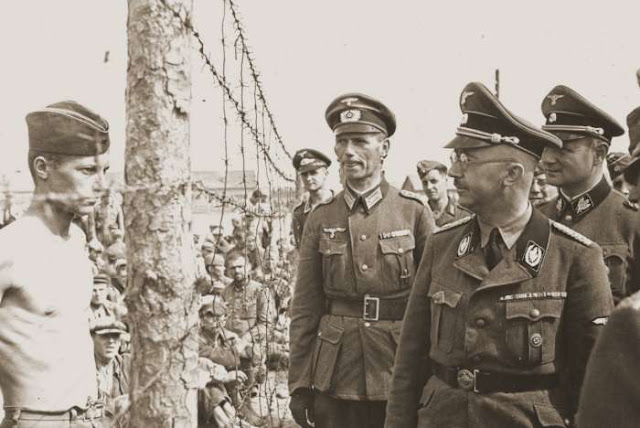
Reichsführer-SS Heinrich Himmler visits Minsk and witnesses the execution of Jews at a nearby concentration camp. In company with SS General Erich von dem Bach-Zelewski and adjutant Karl Wolf Himmler also inspects an insane asylum. Bach-Zalewski claims to have told Himmler that using firing squads for euthanasia damages the shooters psychologically. Himmler orders them to try using dynamite on the inmates instead, which later is done with poor results. After exhausting these choices, they try gas.
In the town of Roskiskis on the Lithuanian-Latvian border, locals riot and institute a pogrom against Jews that ultimately claims an estimated 3200 lives.
At Kovno, Lithuania, surviving Jews who have survived earlier purges are forced into the suburban Ghetto in Viliampole. German authorities seal off the Kovno (Kaunas; Yiddish: Kovne) ghetto, with approximately 30,000 Jewish inhabitants. The ghetto was in an area of small primitive houses and no running water. It had two parts, called the “small” and “large” ghetto, separated by Paneriu Street. Each ghetto was overcrowded, enclosed by barbed wire, and closely guarded.
The German authorities at Riga, Latvia establish a Jewish ghetto.
Einsatzcommando 3 executes 425 Jewish men, 19 Jewish women, and 17 non-Jews in Vilnius.
The RAF bombs and sinks 400-ton Italian freighter Adua in the Gulf of Sirte.
Royal Navy submarine HMS Thrasher attacks German freighter Ankara in Mandri Channel, Greece, but misses.
Royal Navy battleship arrives at Suez and proceeds toward Alexandria now that its battle-damage from the Crete campaign has been repaired in Durban. It sails in company with four destroyers, anti-aircraft ship Coventry, and troopship Glengyle.
Operation Guillotine, the British reinforcement of Cyprus, continues with Australian light cruiser HMAS Hobart arriving in Famagusta with three other ships and unloading troops there.
Royal Navy destroyers Kandahar and Kimberley make the nightly supply run to Tobruk and return safely to Alexandria before dawn breaks on the 15th. Destroyers Hasty and Jaguar make the run after dark.
At Malta, Royal Navy submarine Osiris arrives safely carrying supplies.
On his way back to England from the Atlantic Conference aboard battleship HMS Prince of Wales, Prime Minister Churchill stops for a day at Iceland.
Over dinner, Hitler relaxes with friends and goes into one of his monologues about whatever topic has crossed his mind during the day. Today, because there has been a high-profile murder in Berlin, the topic is the penal system. This does give some insight into the Reich’s justice system:
“The greatest vice of our penal system is the exaggerated importance attached to a first sentence. Corporal punishment would often be much better than a term of imprisonment. In prison and in penitentiary establishments, the delinquent is at too good a school. The old lags he meets there teach him, first that he was stupid to be caught, and secondly to do better next time. All that his stay in prison amounts to in the end is only an uninterrupted course of instruction in the art of doing wrong. In such a case, I see no sense in a long trial, with all its formalities, to study the question of responsibility or irresponsibility. In my view, whether responsible or not, the author of that crime should disappear.”
It turns out that Hitler is not a big fan of due process.
German parachutist Josef Jakobs, captured in Britain on 1 Feb 1941, was executed by firing squad at the Tower of London in England, United Kingdom at 0715 hours. He was the last person to be executed at that site. Jakobs is given this “honor” — and Germans do consider it more dignified to be shot than hanged — because, unlike most spies, he is a member of the Wehrmacht.
Battlecruiser HMS Repulse departed Rosyth at 0720 escorted by destroyers HMS Impulsive, HMS Eclipse, and HMS Active, and arrived at Scapa Flow at 1900.
Heavy cruiser HMS Dorsetshire departed Scapa Flow for the Clyde for escort duty with convoy WS.10X, and arrived on the 16th.
Royal Navy light cruiser HMS Despatch stops 3667-ton German freighter Nordeney northeast of the Amazon Estuary. Like many crews of blockade runners, the German crewmen scuttle the ship and become prisoners.
German raider Orion, back in the Atlantic following a lengthy sojourn in the Indian Ocean, arrives in Spanish territorial waters and disguises itself as Spanish freighter Contramestre Casado.
RAF Bomber Command takes the day and night off after several maximum efforts in recent days, most famously the daylight raid on Cologne power station on 12 August. RAF Bombers — the ones that make it back — struggle in before dawn from their raids on Hannover, Brunswick, and Magdeburg.
The Luftwaffe raids northeastern England in small raids by individual bombers. One bomb land on a house killing all seven people inside, including five boys aged 6-14. Another bomb lands on a house nearby and kills a 64-year-old widow and apparently others in the house. Other houses also are destroyed. The night’s events prove that even “pinprick” attacks can cause large numbers of casualties, especially considering that the British public has been lulled into a false sense of security since the end of large-scale Luftwaffe raids in May.
David Bensusan-Butt, a civil servant in the War Cabinet Secretariat and an assistant of Winston Churchill’s friend Lord Cherwell, completes his report based on analysis of RAF bombing missions. The report is not circulated until 18 August, but the reports are obvious at a glance and can be summarized in a phrase: RAF bombing is wildly inaccurate and only rarely hits the actual target. The Butt Report’s results are explosive (no pun intended) and will lead to major changes in RAF bombing strategy. Churchill takes a few days to think about the findings before releasing them to the War Cabinet and RAF.
RAF No. 105 Squadron sends 5 Blenheims (two lost) from Malta to attack Benghazi. Early on the 16th, they claim to destroy one tanker, damage another and leave two other ships damaged.
German steamer Memelland (542grt) was lost on a mine south of Helsinki.
Italian steamer Adua (400grt) was sunk by British bombing in the Gulf of Sirte in 31-31N, 15-42E.
German steamer Nordeney (3667grt) scuttled herself when she was intercepted by light cruiser HMS Despatch and armed merchant cruiser HMS Pretoria Castle northeast of the Amazon Estuary.
Battleship HMS Barham arrived at Suez after repairs of Crete battle damages in Durban. The battleship departed Port Said that evening escorted by anti-aircraft ship HMS Coventry and destroyers HMS Jackal, HMAS Nizam, HMS Kipling, and HMS Kingston. Troopship Glengyle was in company. The ships arrived at Alexandria on the 16th.
Australian light cruiser HMAS Hobart, minelaying cruiser HMS Abdiel, and destroyers HMS Decoy and HMS Havock departed Port Said for Famagusta with troops in Seruak S.21 of the GUILLOTINE operation. Australian sloop HMAS Parramatta was at Famagusta to provide anti-submarine protection. After departing Port Said on 13 July, Corvette HMS Peony arrived at Famagusta with motor transport ship Gujarat of Serial S.19 and then departed for Beirut. The Hobart group disembarked their troops at Famagusta during the night of 15/16 August. Minelaying cruiser HMS Abdiel departed for Alexandria; the remainder of the group proceeded to Haifa. Sloop HMAS Parramatta departed Famagusta on the 16th for Port Said, where she arrived on the 17th.
Destroyers HMS Kandahar and HMS Kimberley landed stores at Tobruk during the night of 14/15 August and returned to Alexandria.
Destroyers HMS Hasty and HMS Jaguar departed Alexandria with stores for Tobruk. The destroyers returned to Alexandria on the 16th.
Submarine HMS Thrasher unsuccessfully attacked German steamer Ankara, escorted by torpedo boat Sirio, in Mandri Channel.
Dutch submarine HNLMS O.24 arrived at Gibraltar after patrol in the Gulf of Genoa and Tyrrhenian Sea.
Submarine HMS Osiris arrived at Malta from Alexandria, having departed on the 7th, to discharge petrol, stores, mail, and passengers.
Convoy ON.7 departed Liverpool. The convoy was joined on the 16th by destroyers HMS Amazon, HMS Bulldog, ORP Burza, and HMS Georgetown, corvettes HMS Aubretia, HMS Heartsease, HMS Nigella, minesweeper HMS Britomart, and anti-submarine trawlers HMS Angle, HMS Cape Warwick, HMS Daneman, and HMS Notts County. Destroyers Amazon and Burza were detached on the 18th. The remainder of the escort was detached on the 21st when the convoy was joined by destroyer HMS Churchill and corvettes HMCS Arrowhead, HMCS Camellia, and HMCS Eyebright. The destroyer was detached on the 23rd and the corvettes on the 25th when the convoy was dispersed.
Convoy SL.84 departed Freetown escorted by destroyer HMS Brilliant, corvettes HMS Amaranthus, HMS Armeria, HMS Mignonette, and HMS Woodruff, and anti-submarine trawlers HMS Sarabande and HMS St. Wistan to 19 August. On the 18th, sloops HMS Folkestone and HMS Londonderry joined the convoy to 8 September. Sloop HMS Weston joined on the 20th to 8 September. Destroyer HNoMS St. Albans joined on 2 September to 8 September. Catapult ship HMS Springbank and destroyers HMS Campbeltown, HMS Wanderer, and HMS Westcott joined on 3 September to 8 September. The convoy arrived at Liverpool on 8 September.
The United States is expected to become the chief guardian of “the democracies’ ramparts” in the Pacific, while providing a steady flow of war aid to Russia, under plans worked out by President Roosevelt and Prime Minister Winston Churchill, it was stated in London early today.
President Roosevelt fishes with “indifferent luck” off Deer Island from presidential yacht USS Potomac (AG-25); the ship anchors in Pulpit Harbor, Penobscot Bay for the night. The precedent-shattering cruise that opened a new era of British-American relations when President Roosevelt agreed with Prime Minister Churchill to peace aims predicated upon prior “destruction of the Nazi tyranny,” will end tomorrow when the President debarks at Rockland, Maine.
Secretary of the Navy Frank Knox tonight expressed the hope that President Roosevelt, upon his return from, his historic meeting with Prime Minister Winston Churchill, would submit the eight-point declaration of peace terms for formal adoption by Congress as “America’s principles.”
Secretary of War Henry L. Stimson gives a radio address in which he goes through various aspects of the international situation, such as the bases obtained as leases from Great Britain recently. He remarks in all seriousness that an invasion of the United States by Axis troops “would be no playboy affair.”
Congress sent to the White House today a $7,550,000,000 Supplemental Defense Appropriation Bill after restoring $750,000,000 of the $1,347,000,000 eliminated from the measure yesterday by the Senate. The restoration in part came after Secretary Stimson had appealed by letter for inclusion of the full amount. Some of the money, he explained, would be used to install in tanks a revolutionary stabilizing device, enabling them to fire accurately while in motion. The conference committee acted quickly in making the restoration in part and in sending the bill back to both houses for final action. Efforts to find a quorum held up for a time the final voice vote in the Senate, but the House approved the report by a voice vote after only ten minutes of discussion.
Director Leon Henderson of the Office of Price Administration and civilian supply tonight ordered a 10 percent cut in deliveries of gasoline to filling stations on the eastern seaboard, effective immediately. He acted at the request of Defense Oil Coordinator Harold L. Ickes. While avoiding use of the word “rationing,” Henderson warned that “more severe curtailments will be necessary in the future.”
The Federal Reserve board tonight published a tentative draft of the first of its proposed regulations to curb installment buying, listing 20 categories of articles to be covered, including automobiles, refrigerators and other household appliances. The proposed regulations, one of several steps being taken to ward off inflation, would establish a maximum period of 18 months for installment credit purchases of the listed articles. They also would require down payments ranging from 15 to 33 1-3 per cent of the maximum credit value of articles purchased on time.
Taxation of all wages and salaries, dividends and interest at their source was proposed to the Senate Finance Committee today by the United States Chamber of Commerce as one way of increasing Federal revenues by 54,500,000,000 annually.
Because more than 40 percent of examined men are being classified as unfit for general military service, an “alarming” percentage, the Commission on Physical Rehabilitation recommended today a government-financed program of voluntary physical rehabilitation of rejected selectees.
A joint United States Army-Civil Aeronautics program for the training in this country of more than 600 Latin-American pilots and technicians was announced today by Jesse Jones, Secretary of Commerce.
In a brief debate which was slowed up by repeated efforts to obtain a quorum, the Senate passed today and sent to the House a substitute defense highway bill for that vetoed recently by President Roosevelt.
The anti-Communist forces led by President R.J. Thomas and Walter P. Reuther of Detroit won a majority of the membership on the executive board of the United Automobile Workers, C.I.O., tonight.
Naval Air Station, Palmyra Island, and Naval Air Facility, Johnston Island, are established. The U.S. Navy commissions Palmyra Island Naval Air Station. Although widely separated from the other islands in the chain, Palmyra Atoll is part of the Hawaiian Island chain. It has been under naval jurisdiction since 1934, codified by Executive Order 8616. U.S. control of part of the atoll is legally disputed by private parties throughout the war (and ultimately overturned by the U.S. Supreme Court), but that does not affect NAS Palmyra Island. The government has plans to dredge a ship channel, lay roads and causeways, and even build new islands.
TG 2.5, comprising carrier USS Yorktown (CV-5) (VF 42, VS 41, and VT 5), light cruiser USS Brooklyn (CL-40) and destroyers USS Roe (DD-418), USS Grayson (DD-435), and USS Eberle (DD-430), departs Bermuda to begin 4,064-mile neutrality patrol that will conclude at Bermuda on 27 August.
The motion picture “Life Begins for Andy Hardy” is released. Directed by George B. Seitz, this comedy drama stars Lewis Stone, Mickey Rooney, Ann Rutherford and Judy Garland. The plot has Andy Hardy (Rooney) going to New York for a job before he enters college and grows up fast when he is in the real world. This was Judy Garland’s third and last Andy Hardy movie.
Benny Goodman records “Elmer’s Tune” in Chicago for Columbia (36359), four days after Glenn Miller records his version for Bluebird Records. Goodman uses his new “girl singer,” known as Peggy Lee (real name Norma Deloris Egstrom). It is Lee’s first recording with the Benny Goodman Orchestra and apparently her first recording ever. While Miller’s version goes to number one on the Billboard chart in December, Goodman’s and Lee’s version does not chart — but it begins a very long and productive career for Miss Peggy Lee.
Major League Baseball:
The Chicago White Sox climbed to within a half game of third place in the American League tonight by defeating Cleveland, 5 to 2, before 34,879. It was their twelfth victory in fifteen games.
Johnny Vander Meer’s twelfth victory of the year and his fourth in succession sent Cincinnati into a third-place tie with the idle Pittsburgh Pirates today as the Reds, held to five hits, defeated Chicago, 3–1.
Rookie Bob Muncrief checked the Detroit Tigers on six hits tonight, while the St. Louis Browns made the same number of blows good enough for a 6–1 triumph, largely because of Outfielder Joe Grace’s third-inning homer with two on base.
Because of rain, the game between the Red Sox and the Senators is stopped in the 8th inning, with Washington ahead 6–3. After a 40-minute wait the game is called. But because of Washington’s failure to cover the field in case play is resumed, Boston manager Joe Cronin protests the game. On August 28th, the protest is upheld by league president Will Harridge, who calls it “the case of the missing grounds keeper,” and the forfeit goes to Boston. Per the rules, there are no pitcher wins or losses.
The scheduled game between the Philadelphia Athletics and the Yankees at New York was postponed due to rain. The game will be made up as part of a doubleheader on August 17.
The scheduled game between the New York Giants and the Phillies at Philadelphia was postponed due to rain. The game will be made up as part of a doubleheader on September 24.
The scheduled game between the St. Louis Cardinals and the Pirates at Pittsburgh was postponed due to rain. The game will be made up as part of a doubleheader on September 23.
Cleveland Indians 2, Chicago White Sox 5
Chicago Cubs 1, Cincinnati Reds 3
Detroit Tigers 1, St. Louis Browns 6
Boston Red Sox 3, Washington Senators 6 (forfeited to Boston, 1–0)
The Philippine Army Air Corps was officially inducted into the United States Army Forces in the Far East. Douglas MacArthur oversaw the induction of the Philippine Army Air Corps. General Douglas MacArthur, recently recalled to U.S. Army service, chairs a meeting of senior commanders and holds a ceremony at Camp Murphy. The overall gist of his message is that the U.S. is going to fight for the islands. He also announces that the Philippine Air Corps has been inducted into federal service.
Newspapers in Japan today loosed a torrent of abuse against President Roosevelt and Prime Minister Churchill for their joint war aims declaration of Thursday, charging that it is part of an intensified campaign to encircle Japan, a Jewish plot and a scheme for Anglo-American domination of the world. Apparently inspired editorial writers made these points: 1. Britain now has drawn the United States definitely into the war and President Roosevelt has made a solemn commitment to stand with Britain against the axis powers until Germany is crushed. 2. Japan places no faith in the vague promises of the “British-American clique” and will remain in the axis, since it is obvious that if Germany falls Japan will fall with her and lose all the gains the empire has made in the Asiatic continent in the past half-century. 3. Britain’s record of “broken promises” after the World war demonstrates that Japan would be “foolish to listen to any London siren song.”
The program for the post-war world proclaimed by President Roosevelt and Prime Minister Churchill is attacked in Japan as contrary to her aim to create a “Greater East Asia co-prosperity sphere” and to “liberate the Orient from the shackles of white capitalism.”
The Imperial Japanese Navy heavy cruiser HIJMS Ashigara departs Samah, for a cruise in Chinese waters.
Japanese 8,360-ton seaplane tender Sanyo Maru completes its conversion and is attached to the Sasebo Naval District. It embarks six Type 0 Mitsubishi F1M2 “Pete” scout float biplanes and two Type O Aichi E13A1 “Jake” three-seat reconnaissance floatplanes, with two Type 95 Nakajima E8N2 “Dave” two-seat reconnaissance float biplanes in reserve.
The Imperial Japanese Navy fits AMC Hokoku Maru with searchlights and equipment for handling floatplanes. She will carry one Type 94 Kawanishi E7K2 “Alf” floatplane and one spare plane.
The IJN requisitions 5,181-ton freighter Hide Maru for use as an ammunition ship, 10,383-ton tanker Kuroshio Maru, and 5,350-ton freighter Bangkok Maru as a specialty cruiser.
The IJN commissions 6,795-ton salvage vessel Yamabiko Maru.
The Australian 27th Infantry Brigade arrives in Singapore.
Dow Jones Industrial Average: 124.9 (-1.06)
Born:
Don Rich [as Donald Eugene Ulrich], American country musician (“Hee Haw”), in Olympia, Washington (d. 1974).
Tommie Reynolds, MLB outfielder and pinch hitter (Kansas City-Oakland A’s, New York Mets, California Angels, Milwaukee Brewers), in Homer, Louisiana (d. 2025).
Died:
Josef Jakobs, 43, German spy (executed at the Tower of London by firing squad).
Naval Construction:
The U.S. Navy Accentor-class coastal minesweeper USS Merit (AMc-90) is laid down by the F. L. Fulton Shipyard (Antioch, California, U.S.A.).
The Royal Navy Bangor-class (Reciprocating-engined) minesweeper HMS Tilbury (J 228) is laid down by Lobnitz & Co. Ltd. (Renfrew, Scotland). She is transferred on completion to the Royal Indian Navy and commissions as HMIS Konkan (J 228).
The U.S. Navy Barnegat-class small seaplane tender USS Coos Bay (AVP-25) is laid down by the Lake Washington Shipyard (Houghton, Washington, U.S.A.).
The Kriegsmarine (German Navy) Type XB U-boat U-233 is laid down by F. Krupp Germaniawerft AG, Kiel (werk 663).
The Royal Navy Flower-class corvette HMS Test (K 239) is laid down by Hall, Russell & Co. Ltd. (Aberdeen, Scotland).
The U.S. Navy cargo ship USS Bellatrix (AK-20) is launched at Tampa Shipbuilding and Drydock Co., Tampa, Florida.
The Kriegsmarine (German Navy) Type IXC U-boat U-165 is launched by Deutsche Schiff und Maschinenbau AG, Bremen (werk 704).
The Kriegsmarine (German Navy) Type VIIC U-boat U-334 is launched by Nordseewerke, Emden (werk 206).
The Kriegsmarine (German Navy) Type VIIC U-boat U-377 is launched by Howaldtswerke AG, Kiel (werk 8).
The Kriegsmarine (German Navy) Type 1936A (Mob) destroyer Z32 is launched by AG Weser (Deschimag), Bremen (werk 1002).
The Kriegsmarine (German Navy) Type 1936A (Mob) destroyer Z38 is launched by Germaniawerft, Kiel (werk 628).
The Royal Navy Fairmile B-class motor launch HMS ML 289 is commissioned.
The U.S. Navy Aloe-class net tender USS Cinchona (YN-7; later AN-12) is commissioned. Her first commanding officer is Lieutenant Commander Horace Hall Breed, USNR.
The U.S. Navy coastal patrol yacht USS Sardonyx (PYc-12) [ex-Queen Anne] is commissioned.

