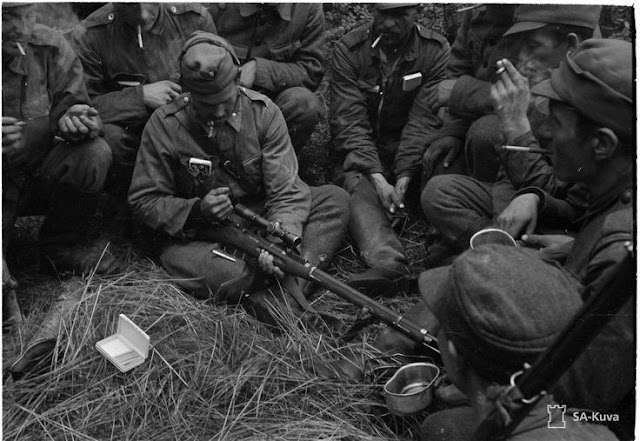
OKH Chief of Staff Franz Halder notes in the war diary on 14 August 1941 that Finnish achievements so far in the war are “truly remarkable.” Morale is good in the army, but he notes that “Losses in the armored and rifle units considerable.” Due to tank losses, the armored divisions have “an abundance of personnel,” while the rifle divisions are short of men. Field Marshal von Bock, commander of Army Group Center, complains that Reichsmarschall Hermann Goering is shifting air support without consulting him, and a fierce debate rages whether Yelnya is worth keeping due to the heavy losses there.
Reports in other army commands are a little more direct about the actual situation than Halder. Generalleutnant Hans Reichsfreiherr von Boineburg-Lengsfeld, commander of the 4th Panzer Division which is with XXIV Panzer Corps, notes in his war diary that
“Battles on 13 and 14 [August] very costly, also in material. There was little benefit [in the fighting] because the enemy mass had already evacuated. Trucks in bad condition. Men tired. Division increasingly more worn out…Russian tanks, especially the heavy ones, are good.”
The troops may be tired, but there is a lot of fighting left, with no end in sight.
In the Far North sector, the Finnish 18th Division of II Corps captures the key town of Antrea (Kamennogorsk) in the center of the Karelian Isthmus on the left bank of the Vuoksa River. The Finns now are 170 km (110 miles) northwest of Leningrad. Antrea is important strategically because it controls one of the few bridges across the river, and taking it traps Soviet 115th Rifle Division on the wrong side of the river. The Soviet division now must either succumb or find a way to cross the forests and river to rejoin Soviet 19th Corps near Vyborg (Viipuri), the prime target in the sector.
Going is slow in this region due to the harsh terrain with few roads, which slows down even the Finns who are experts at going across the roughest country. Already, some Soviet units such as 142nd Rifle and 198s Motorized Divisions are backed against Lake Ladoga with no way out except by boat. Finnish I Corps also is making good progress to the east, with 2nd, 7th, and 19th divisions on the verge of taking Sortavala, where the Soviets also have no landward line of retreat.
A little further north, Finnish Group J of III Corps today confirms that the Soviets have brought in the 88th Rifle Division from Archangel (Arkhangelsk) to the north in order to block their advance to Loukhi. Thus, the Finnish advance to the Murmansk railway, a key strategic objective only 20 miles away along a spur railway line and improved road, is stopped for the time being.
In the Army Group North sector, the Germans make some forward progress at Luga and on either end of Lake Ilmen. The Soviets pierce the German line south of Lake Ilmen with a cavalry division, a reminder that the German line is being stretched thin with little behind the hard crust at the front.
In the Army Group Center sector, General Halder notes in the war diary that there are “gratifying successes against the enemy in the Rogachev salient” but that “costly fighting continues” at Yelnya. “All quiet elsewhere on the front.” Panzer Group 2 approaches Bryansk, where the Soviets are concentrating in order to protect Kyiv from exactly what the Germans have in mind — an attack south toward Kyiv.
In the Army Group South sector, the German capture of Cherson on the Dneiper makes the Soviet position at Nikolayev (Nikolaev) untenable. Thus, after dark today the Soviets begin evacuating the port, and in the process destroy the unfinished 59,150-ton battleship Sovetskaya Ukraina and several other ships under construction, including:
• 11,300-ton heavy cruiser Ordzhonikidze;
• submarines S-36, S-37, S-38;
• two gunboats;
• 34,540-ton battlecruiser Sevastopol;
• 11,300-ton heavy cruiser Sverdlov;
• destroyers Obshitelny, Obuchenny, Otchayanny, and Otmenny.
The retreating Soviets also destroy other potentially useable items. Several warships undergoing refits, including the following, are towed away to other ports:
• 11,300-ton heavy cruiser Frunze;
• 11,300-ton heavy cruiser Kuibyshev;
• destroyer leaders Erevan and Kiev;
• destroyers Ognevoi, Ozornoi, and Svododny;
• submarines S-35, L-23, L-24, and L-25;
• icebreaker Mikoyan.
This evacuation continues for the next three nights. A large flotilla of Soviet destroyers covers the retreat.
The Romanian 4th Army advance on Odessa is temporarily paused on direct orders from leader Ion Antonescu. The Romanians are busy bringing troops forward to reinforce their coastal positions along the Hadjibey bank, and the Soviets in the town are under orders to resist to the last man.
The Germans advance to within sight of Krivoy Rog (Kryvi Rih) due north of the neck of the Crimea. It is a regional center of iron-ore mining, one of the economic objectives that Hitler prefers over political objectives such as Moscow.
Luftwaffe Oblt. Heinz Bär of JG 51 receives the Eichenlaub for achieving 60 kills, while Hptm. Hans ‘Assi’ Hahn of JG 2 also receives it for 42 victories. In the air, Lt. Max-Hellmuth Ostermann of 7./JG 54 claims two Soviet I-153s over the Bay of Kolga. German pilots are racking up huge sums of victories on the Eastern Front, much quicker than has happened on the Western Front.
Following up on the Sikorski-Mayski agreement of 30 July 1941, the two nations sign a military agreement. It sets forth a complicated arrangement in which freed Polish POWs in the Soviet Union operate as part of the Red Army but under the control of the Polish government-in-exile. As amply proven later, Stalin doesn’t care for Polish control over anything, but the situation on the Eastern Front is so dire that he is willing to make concessions. The Poles in London, led by General Władysław Sikorski, appoint General Władysław Anders, just released from the Lubyanka prison in Moscow, as the commander. The Anders Army, as it becomes known, relies on “volunteers” recently released from the Soviet POW camps who are in poor health and often dressed in rags. There also is a very noticeable shortage of Polish officers which the Soviets cannot explain. Those officers were, of course, murdered in the Katyn Forest by the Soviet NKVD.
Adolf Hitler plans to invade the Soviet-held Baltic Islands. For this purpose, he places the army high command (OKH) in control of all Luftwaffe and Kriegsmarine units to be used.
The Soviet transport ship Sibir, carrying 2,500 wounded soldiers from Estonia, was bombed by German aircraft. There were few survivors.
At Auschwitz, ten Polish prisoners had been condemned to die after a prisoner had escaped. When the ten were selected, one begged and pleaded to be saved for his wife and children. Fr. Maximilian Kolbe, a Franciscan friar and fellow prisoner, had stepped forward and asked to take the place of the family man. The offer was accepted. The ten were marched off to a starvation bunker. As one by one they died, Fr. Maximilian comforted them. The last survivor of the ten, Fr. Maximilian was executed by lethal injection on August 14. Kolbe is executed by lethal injection of carbolic acid at the Auschwitz concentration camp. In late July, Father Kolbe voluntarily took the place of another man with a family who had been chosen for death in reprisal for an escaped inmate. This execution follows two weeks of dehydration and starvation which did not kill Kolbe — the guards finally lost patience with Kolbe and wanted his space. Kolbe is recognized as a Servant of God on 12 May 1955, declared venerable on 30 January 1969, beatified as a Confessor of the Faith in 1971, and finally canonized as a saint by John Paul II on 10 October 1982. There is now a feast day (August 14) on the General Roman Calendar in Kolbe’s honor and a statue of Kolbe above the Great West Door of Westminster Abbey in London. The man he died to save was present in St. Peter’s Square in 1982 when Fr. Maximilian was proclaimed St. Maximilian Kolbe.
Residents of the Jewish community of Lesko, Poland, are transported to Zaslaw, Poland, and executed.
Lionello Alatri, the spokesman for the Union of Italian Jewish Communities, writes to Vatican Secretary of State Cardinal Luigi Maglione to beg the pope’s help for Croatian Jews. The letter describes brutalities against Jews in Zagreb and other Croatian cities. Maglione does not respond.
In the Yugoslavian village of Skela, partisans of the Posavina Company, Kosmaj Partisan Detachment ambush a German police car. Four German officers are killed and the partisans throw their bodies in the Sava River. The Germans discover the car and shoot 15 suspected villagers on the spot and hang an additional 50 Communists. The Germans also burn the village to the ground.
Over lunch, Hitler expounds on the subject of … top hats. It turns out that he has very definite views on top hats, and they are not favorable. He views them as a sign of the control of the plutocracy over the worker:
“I sometimes entertain myselfby rummaging through old back-numbers of the [weekly newsreels]. I have a collection of them. It’s truly instructive to plunge one’s nose in them. At the launching of a ship, nothing but top-hats, even after the revolution! The people were invited to such festivities only as stage extras. The Kaiser received a delegation of workers just once. He gave them a fine scolding, threatening simply to withdraw the Imperial favour from them!”
These ramblings are illuminating on several scores. For one, they show one of the hidden sources of Hitler’s appeal to the “masses” (as he likes to call them), and that is his dislike of the high-hat approaches (to borrow an apt phrase) of the past. In addition, he also critiques the German government’s management of World War I, and not long after the Kaiser’s passing in the Netherlands. This seems somewhat contrary to his constant public assertions of the “stab in the back” theory. Finally, while Hitler is deliberately gathering the operational reins of military command with both hands to the consternation of his generals, he is sitting around blithely talking about abstractions that reflect his true orientation and training — the political, and not the military.
There is almost a tragic case of friendly fire outside the port of Alexandria when Royal Navy submarine HMS Talisman spots a submarine and fires a torpedo at it. Instead of an Axis submarine, however, it is fellow Royal Navy submarine Otus, which is on a supply mission to Malta. Neither submarine is damaged.
Royal Navy antiaircraft cruiser Coventry and destroyers Nizam and Kingston escort 9809-ton troopship from Alexandria to Port Said en route to the Suez Canal. This apparently is part of the relief of the Australian troops at Tobruk which is ongoing at this time.
German 1297-ton freighter Bellona has been sitting in Bardia, Libya near the front for some time. Tonight, it makes the hazardous journey north to Suda Bay, Crete without being spotted by the British.
Greek destroyer Vasilissa Olga, participating in Operation Guillotine, the British reinforcement of Cyprus, departs from Alexandria for Famagusta.
An Axis convoy departs from Naples bound for Tripoli.
Australian Edmund Herring is promoted to Major-General and given command of the 6th Division in Egypt.
Italian submarine Guglielmo Marconi spots independent 2589-ton Yugoslavian freighter Sud hundreds of miles west of Portugal. Marconi fires a torpedo and misses, then surfaces and uses its deck gun, severely damaging but not sinking Sud. U-126 (Kptlt. Ernst Bauer), on its first patrol out of Kiel, also is in the vicinity and torpedoes and finishes off Sud four hours later. The entire 33-man crew survives and picked up by Portuguese freighter Alferrarede. Sud was traveling as part of Convoy HG-70 but fell behind. This is the fifth success of the patrol for Bauer and U-126, with sinkings totaling 13,693 tons.
Edmund Herring was promoted to the temporary rank of major general and was given command of Australian 6th Division in Egypt.
British deputy Prime Minister, Clement Attlee, broadcasts the terms of a joint Anglo-American declaration of common principles. While Winston Churchill is returning to Britain from Newfoundland aboard battleship HMS Prince of Wales, Clement Attlee makes sure that the terms of the Atlantic Charter (which is not yet called that, it is still referred to as the “Joint Declaration by the President and the Prime Minister”) are announced. Due to the fact that there is no “final document” of the charter, but is instead is a partially handwritten, partially verbal agreement, there is a slight difference between the US “version” that is broadcast over US radio and the British “version” that is broadcast over the BBC. This difference is quickly corrected. The Charter does not include any war objectives, just post-war plans.
Incidentally, most histories record 14 August 1941 as the date of the Atlantic Conference that results in the Atlantic Charter. However, in fact, the conference already is over by 14 August and both President Roosevelt and Prime Minister Churchill are heading back to their respective capitals. The joint communique is issued today, so this is when it comes to the public’s attention, but the actual agreement is finalized on 13 August 1941.
RAF Bomber Command, Day of 14 August 1941
26 Blenheims on coastal sweeps over a wide area. Ships off the Dutch coast and in Boulogne docks were bombed. 1 aircraft lost. 5 further Blenheims to Marquise shell factory turned back.
RAF Bomber Command, Night of 14/15 August 1941
Hannover
152 aircraft — 96 Wellingtons, 55 Whitleys, 1 Stirling — with railway stations as aiming points. 9 aircraft — 5 Wellingtons, 4 Whitleys — lost.
Brunswick
81 Hampdens to railway targets. 1 aircraft lost.
Magdeburg
52 aircraft — 27 Wellingtons, 9 Halifaxes, 9 Stirlings, 7 Manchesters — to railway targets but visibility was poor and no bombing results were observed. 4 aircraft — 2 Wellingtons, 1 Halifax. 1 Stirling — lost.
Minor Operations: 13 Wellingtons to Boulogne, 9 Wellingtons and Whitleys to Rotterdam, 2 Wellingtons to Dunkirk, 5 Hampdens minelaying in the Frisians. No losses.
Overall, it is not a bad night for the RAF. For 314 sorties, the British only lose 14 bombers for a 4.5% loss rate. In terms of maintaining a sustainable bombing campaign, this is considered acceptable, as the average crewman can be expected to survive a 20-mission tour. Naturally, the lower, the better, 14 bombers is still a lot to lose and a lot of RAF crewmen wind up in POW camps after a night like this.
The Luftwaffe sends a few bombers against the north of England. The German planes drop their bombs at random, in fields and along roads, then head home quickly. Targets hit include the vicinities of Northumberland, Gateshead (4 killed), and Bishop Auckland. The damage is minimal, but occasional “lucky hits” destroy a road here or there, cut some utility lines, or land on luckless people in their homes.
Luftwaffe Oberstleutnant Wolfgang Schenck earns the Knight’s Cross Oberleutnant and Staffelkapitän of the 1./SKG 210.
RAF Coastal Command planes bombs and sinks 1193-ton German freighter Lotte Halm off Borkum.
Destroyer HMS Matabele departed Barrow at 1600 to carry out trials after repairs, and arrived at Scapa Flow on the 16th.
Destroyer HMS Foxhound arrived at Scapa Flow at 1400 for fuel while on passage from the Force H to Sheerness. Anti-aircraft ship HMS Alynbank departed Scapa Flow at 1145 and escorted convoy WN.66 to the south. Off Buchan Ness that night, German aircraft attacked the convoy, but no damage was done. The ship transferred to convoy EC.59 shortly after midnight. On arrival in Pentland Firth, she left the convoy and arrived at Scapa Flow at 1700.
Armed merchant cruiser HMS Circassia captured Italian steamer Stella (4272grt), which had departed Recife, west of Cape Verde Island at 24-55N, 40-23W. She was sent under prize crew to Bermuda, and used by the British as Empire Planet.
Yugoslav steamer Sud (2589grt), steaming independently, was damaged by gunfire from Italian submarine Marconi, which was part of the group attempting to attack convoy HG.69, in 41N, 17-41W. The Sud was then sunk by U-126, commanded by Kapitänleutnant Ernst Bauer. At 09.55 hours on 14 Aug 1941, U-126 spotted the Sud, a straggler from convoy HG.70 and tried to get into an attack position. In the meantime, the Italian submarine Marconi (Cdr Pollina) first unsucessfully attacked the same ship at 1201 hours with a torpedo and then shelled her with the 100mm deck gun, scoring hits with about 25 rounds. Shortly after 1515 hours, the U.boat also opened fire with the deck gun and scored eight hits with 33 rounds fired. Both submarines ceased fire as the freighter began to burn, but the ship did not sink and Pollina refused to use another torpedo for the small ship, so Bauer fired a stern torpedo at 16.01 hours and hit Sud near the aft mast causing her to settle within two minutes. The survivors were picked up by the Portuguese steam merchant Alferrarede. The 2,589 ton Sud was carrying ballast and was headed for Halifax, Canada.
German steamer Lotte Halm (1193grt) was sunk by British bombing off Borkum.
Anti-aircraft cruiser HMS Coventry departed Alexandria with destroyers HMAS Nizam and HMS Kingston escorting troopship Glenroy to Port Said. She was passed through the Suez Canal on the 15th.
Greek destroyer RHS Vasilissa Olga departed Alexandria for Famagusta, arrived on the 16th and departed that day to return to Alexandria.
Submarine HMS Talisman fired torpedoes in error at submarine HMS Otus in 32-41N, 27-35E. At the time, Talisman was arriving at Alexandria while Otus had just left for Malta with stores. Neither submarine was damaged.
Battleship HMS Nelson, aircraft carrier HMS Ark Royal, light cruiser HMS Hermione and destroyers departed Gibraltar for the east for exercises. On the 16th, Nelson, Hermione, and destroyer HMS Vimy arrived back at Gibraltar, followed on the 17th, by Ark Royal with destroyers HMAS Nestor, HMS Encounter, HMS Fury, HMS Foresight, and HMS Forester.
Steamer Australind (5020grt) was sunk by German raider Komet in 4-13S, 91-03W. Two crew were killed, and the rest made prisoners of war, but one died on the raider.
President Roosevelt, on board heavy cruiser USS Augusta (CA-31), returning from the Atlantic Charter conference, witnesses exhibition of flight operations by aircraft escort vessel USS Long Island (AVG 1) off Cape Sable, Nova Scotia. Roosevelt had been instrumental in championing conversion of merchant vessels to auxiliary aircraft carriers. Long Island’s embarked scouting squadron (VS 201) is equipped with F2As and SOCs. That afternoon, Augusta reaches Blue Hill Bay, Maine, where the chief executive reembarks in presidential yacht USS Potomac (AG-25).
In Washington today, the White House announced the post-war objectives of Great Britain and the United States as decided upon by President Roosevelt and Prime Minister Churchill at their recent meeting “somewhere” in the North Atlantic.
The Senate passed the $6,838,436,000 supplemental defense appropriation bill, received a bill to limit election campaign expenditures, completed Congressional action on the resolution extending military service for eighteen months, received the defense investigating committee’s report on Army camp construction and adjourned at 5:02 until noon tomorrow. The Finance Committee continued the tax bill hearing; the Insular Affairs Committee deferred action on nomination of Rexford G. Tugwell to be Governor of Puerto Rico.
The House approved a resolution for investigation of progress of the merchant shipping program and adjourned at 1:49 until noon tomorrow. The Banking and Currency Committee continued questioning of Leon Henderson on the price control bill.
Franklin D. Roosevelt and Winston Churchill jointly issued the Atlantic Charter, stating the Allied goals for the post-war world. The United States and Great Britain issued as a joint declaration that was a statement of principles that states that all countries have the right to hold free elections and to be free from foreign pressure. This would later be called “The Atlantic Charter” although initially there was no formal, legal document by that name. The term “Atlantic Charter” was coined by the Daily Herald, a London newspaper, after the joint declaration had been published.
Expectations of new moves by the United States Government to enlarge and accelerate material aid to Great Britain, Russia and China and other countries that may later resist the aggressions of the Axis powers sprang high in Washington today following disclosure of the Roosevelt-Churchill meeting at sea.
President Roosevelt continues a leisurely return to Washington from the Atlantic Conference with Prime Minister Churchill at Placentia Bay in Newfoundland. Today, Roosevelt, aboard heavy cruiser USS Augusta (CA-31), stops off Cape Sable, Nova Scotia to observe flight operations off of escort carrier USS Long Island (AVG-1). Long Island is the first “jeep” carrier and thus of particular interest to the President.
After watching the F2A Buffaloes and SOC Seagulls of Scouting Squadron 201 (VS-201), Roosevelt continues down to Blue Hill Bay, Maine, where he re-embarks presidential yacht USS Potomac (AG-25).
The Senate completed Congressional action today on the Army service extension bill, adopting the House version by a vote of 37 to 19. The action came without debate on a motion by Senator Thomas of Colorado, who has been in charge of the measure. Mr. Thomas told the Senate that the minor amendments to its measure adopted by the House Tuesday by a margin of one vote, were improvements in the bill and would not require sending the measure to conference.
The Senate completed action today on a $6,838,436,000 supplemental national defense appropriation bill and sent it back to the House for consideration of amendments.
Former President Herbert Hoover, declining to comment directly on the Roosevelt -Churchill “joint agreement,” said today that “whatever course we take, the dangers are great.” Hoover and his wife, on a vacation trip through Colorado, stopped here and visited a newspaper office to read the complete text of the agreement. “Of course, everyone is deeply concerned with the path this country is traveling and with the approaching dangers of war,” he said.
William C. Bullitt, former Ambassador to France, warned today that the United States faced war “sooner or later” and made it plain that he felt there would be less risk in immediate involvement.
The German foreign office mouthpiece, Deutsche Diplomatisch Politische Korrespondenz, tonight called the Roosevelt-Churchill program “a plagiarism of President Wilson’s points and a bad one at that.” The publication declared “the plagiarism can find no drawing power because the authors are the same as those who deceived the world 24 years ago by a sham of promises not seriously Intended.”
Apparently convinced that appeals for public curtailment of gasoline consumption had failed, Secretary of Interior Ickes declared today new and “more rigid” measures to meet the threatened shortage in the east were imminent. The coordinator declined to discuss the contemplated action, but there was speculation that he would call for rationing of gas to filling stations. It was not indicated how the individual service stations would distribute the supplies among automobile operators.
Secretary Morgenthau stated today that the Treasury was studying the question .of higher social security taxes on a broader basis and the supplementing of them by a “dismissal” wage with a view to preventing inflation now and providing a cushion against post-war dislocation. He said that he had intended to suggest such a plan to the House Banking and Currency Committee if that body had not postponed his appearance from today to September 15. Mr. Morgenthau explained that the Treasury had considered various means of controlling inflation, including the restriction of installment buying and fixing of prices which already have been decided on, the diminution of consumer purchasing power by the sale of defense bonds and higher taxes, and lastly an increase in social security contributions.
After two and a half hours of turbulent debate, the United Automobile Workers-C.I.O. convention tonight adopted a strong declaration amending the constitution to bar from office members of Communist, Fascist or Nazi organizations.
A new factory which will raise the Buffalo output of Curtiss pursuit planes to 500 a month was dedicated today in the presence of government officials and thousands of workmen.
U.S. Navy sailor Thomas Barwiss Hagstoz Askin Jr. begins a diary entitled “Memorys (sic) and Incidents of My Last 60 (?) Days in the United States Navy.” Askin is serving aboard USS Memphis, which is at sea, and his scheduled discharge date is 13 October 1941. While Memphis is at sea on that date and cannot be discharged, when he gets back to shore on 6 December 1941 Askin is notified that he should proceed to New York to be discharged. However, greater events intervene on 7 December, and all discharges are canceled. Askin winds up staying in the US Navy through 1958.
The U.S. Navy submarine chaser USS PC-457 is accidentally sunk in collision with U.S. freighter Norluna off Puerto Rico.
U.S. Navy battleship USS New Mexico (BB-40) departs from Hampton Beach, Virginia with accompanying destroyers on a Neutrality Patrol.
Major League Baseball:
After almost a year of patient waiting, Fiddler Bill McGee today experienced the strange sensation of starting, finishing and winning a ball game. The rotund right-hander, who once was No. 1 violin for Pepper Martin’s Mississippi Mudcats, hurled the Giants to a 4–3 triumph over Casey Stengel’s Braves before 1,651 cash customers for his first victory since last September 19, when he turned back the Pirates with five hits.
White Sox swept through the Tigers today in both games of a double-header, 3–1 and 3–0, to run their spurt to eleven victories in their last fourteen contests. Lefty Thornton Lee shaded Tommy Bridges for his season’s fifteenth victory in the opener, and Johnny Humphries, making his second start of the season, shut out the Tigers with six hits in the second game.
Behind a brilliantly pitched three-hitter by Marius Russo, the Yankees bagged the first game of their doubleheader with the Senators, 7–0, Charlie Keller and Tommy Henrich spicing the program with their twenty-ninth and twenty-second homers, respectively. Then, with Atley Donald pitching not quite so well but ably enough, the Yanks crushed Bucky Harris’s men in the nightcap, 10–3. Johnny Sturm modestly set the pace in this conflict with a homer, triple and single, while four blows, two of them three-baggers, thundered off the bat of Joe DiMaggio in the two games.
The Athletics and the Red Sox delighted a ladies’ day crowd of 22,493 today by slamming out a total of sixty-two hits, including six home runs, two triples and ten doubles. When the firing subsided the teams had split a doubleheader and the A’s had ended a six-game losing streak. The Sox, battling to oust Cleveland from second place, won the first game in eleven innings, 11–8, when Jimmy Foxx smashed a homer over the left-field pavilion with two on. A three-run homer by Ted Williams in the eighth had tied the score. The Athletics won the second game, 10–8, although Foxx connected for another homer, while Bobby Doerr got two round trippers.
Chicago handed Pittsburgh its fourth straight lacing today in a 6–2 game that saw four Pirate pitchers fail to silence the Cubs’ busy bats. Clyde McCullough’s seventh homer of the season, made with two aboard in the second inning, chased Max Butcher from the mound and put the Cubs too far ahead for the Pirates to catch up.
The umpires would have saved a lot of time and work if they had called the game between the Indians and the Browns today when rain fell in the sixth inning, with the score tied at 2–2. After a delay of an hour and twenty minutes, while workmen got the diamond in shape, the teams took the field again, only to have darkness end the game in a 3–3 tie after ten innings.
New York Giants 4, Boston Braves 3
Detroit Tigers 1, Chicago White Sox 3
Detroit Tigers 0, Chicago White Sox 3
Washington Senators 0, New York Yankees 7
Washington Senators 3, New York Yankees 10
Boston Red Sox 11, Philadelphia Athletics 8
Boston Red Sox 8, Philadelphia Athletics 10
Chicago Cubs 6, Pittsburgh Pirates 2
Cleveland Indians 3, St. Louis Browns 3
Prime Minister William MacKenzie King today expressed on behalf of the Dominion of Canada full association with the declaration that was issued at the close of the Atlantic conference between President Roosevelt and Prime Minister Winston Churchill.
During Japanese bombing raid on Chungking, China, Japanese planes approach the city from the east, passing directly over the U.S. Embassy chancery and the river gunboat USS Tutuila (PR-4). The pilots seem to taunt the Americans in the embassy and the nearby Tutuila, flying directly over them before dropping their loads elsewhere. There is no repetition of the incident of 30 July.
Japan will restrict the entrance into Manchukuo of all foreigners, including Chinese, beginning next Monday, a Tokyo War Office spokesman said tonight. The spokesman implied that the regulations were designed to prevent knowledge of Japanese military preparations in Manchukuo, where, he said, huge numbers of Japanese troops have been concentrated for possible operations against Soviet Russia.
The joint declaration yesterday by President Roosevelt and Prime Minister Winston Churchill “contains nothing new,” and even if their eight points for a new world order could be enforced they are “now too late,” authorized quarters in Tokyo said today. Tokyo was most interested in the fourth point of the “Anglo-American bloc” — the one concerning trade and equality of access to world supplies of raw materials — but its language was denounced as “vague” and “noncommittal.” In this point, it was said, lies the “whole cause of the present world struggle.” Japan, it was added, has reason to know that London and Washington never have been able to envisage economic equality on the part of any “have-not nation,” and Japan will be unwilling to believe that President Roosevelt and Prime Minister Churchill intend, or will be able in the future, to give this country “an equal chance in world markets.”
The attempt to assassinate Baron Kiichiro Hiranuma, veteran Japanese statesman and the strong man in the second and third Konoe Cabinets, has proved a profound shock to the Japanese people, who have rallied around him and his cause.
Operating a few hundred kilometers south of the Galapagos Islands, German raider Komet (KAdm Eyssen), disguised as Japanese freighter Ryoku Maru, sinks 5020-ton British freighter Australind. There are two deaths during the encounter and another crewman perishes later. The other crewmen are made prisoners.
Dow Jones Industrial Average: 125.96 (+0.31)
Born:
David Crosby, American rock singer-songwriter (The Byrds — “Eight Miles High”; Crosby, Stills & Nash — “Guinevere”; “Wooden Ships”), in Los Angeles, California (d. 2023).
Connie Smith, American country music singer-songwriter (“Once A Day”; “Dream Painter”; “Tiny Blue Transistor Radio”), in Elkhart, Indiana.
Lynne Cheney, wife of Vice-President Dick Cheney, in Casper, Wyoming.
Died:
Maximilian Kolbe, 47, Polish friar who volunteered to die in place of a stranger in the Auschwitz concentration camp.
Josef Jakobs, 43, German spy, executed in the Tower of London.
Paul Sabatier, 86, French chemist (Nobel 1912 — improving the hydrogenation of organic species in the presence of metals).
Rick Duncan, AFL and NFL kicker and punter (Denver Broncos, Philadelphia Eagles, Detroit Lions), in Mattoon, Illinois.
Naval Construction:
The Royal Navy Assurance-class rescue tug HMS Charon (W 109) is laid down by Cochrane & Sons Shipbuilders Ltd. (Selby, U.K.).
The U.S. Navy YMS-1-class auxiliary motor minesweeper USS YMS-5 is laid down by Henry B. Nevins Inc. (City Island, New York, U.S.A.).
The Royal Navy Isles-class minesweeping trawlers HMS Rousay (T 210) and HMS Ruskholm (T 211) are laid down by the Goole Shipbuilding & Repairing Co. Ltd. (Goole, U.K.); completed by Amos & Smith.
The U.S. Navy Accentor-class coastal minesweeper USS Fortitute (AMc-81) is laid down by W.A. Robinson Inc. (Ipswich, Massachusetts, U.S.A.).
The U.S. Navy PC-461-class (173-foot steel hull) submarine chasers USS PC-565 and USS PC-566 are laid down by the Brown Shipbuilding Co. (Houston, Texas, U.S.A.).
The Royal Navy “S”-class destroyer HMS Serapis (G 94) is laid down by the Scotts Shipbuilding & Engineering Co. (Greenock, Scotland). She is later transferred postwar to the Royal Netherlands Navy as the HNMS Piet Hein.
The U.S. Navy 77-foot Elco patrol motor torpedo boat USS PT-47 is launched by the Electric Launch Company Ltd. (Elco), (Bayonne, New Jersey, U.S.A.).
The Kriegsmarine (German Navy) Type VIIC U-boat U-252 is launched by Bremer Vulkan-Vegesacker Werft, Bremen-Vegesack (werk 17).
The Kriegsmarine (German Navy) Type VIIC U-boat U-583 is commissioned. Her first commanding officer is Oberleutnant zur See Heinrich Ratsch.

