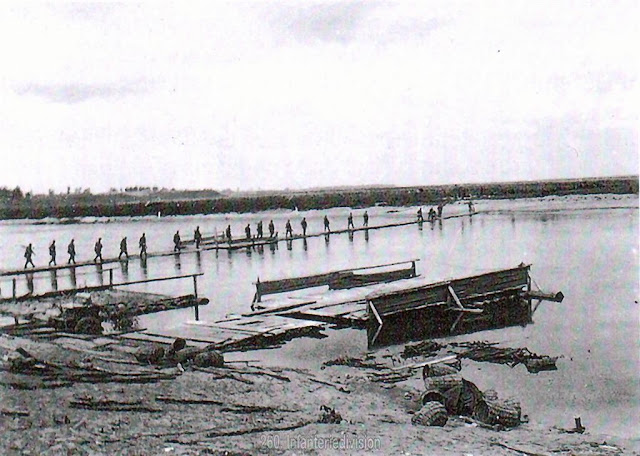
OKH Chief of Staff Franz Halder on 13 August 1941 has a conference with Chief of Staff for Army Group South at Uman and the army generals under Field Marshal von Rundstedt’s command. Afterward, Halder writes:
“The consensus is that the projected missions can be carried out. At present we have no clear plans yet for solving the Kiev problem and for swiftly occupying the Crimea.”
Considering that the capture of Kyiv and the Crimea, in fact, are the two primary missions of the Army Group, not having a plan for achieving these objectives is not overly reassuring for the Army Group’s prospects.
Halder also sets down his impression of Hitler’s most recent Fuhrer Directive, “Supplement to Directive 34.” Halder writes:
“Attack on Moscow by Army Group Center is approved, but approval is made conditional on so many factors… that the freedom of action which we need for the execution of the plan is severely restricted.”
Note that Halder says the army does not have the full freedom of action “which we need.” Not want, need. Already, doubt is creeping into the high command as to whether Moscow will or even can be captured.
In the Far North sector, The Finns continue making slow progress around Lake Ladoga. However, the advance toward the Murmansk railway at Loukhi has slowed to a crawl as the Soviets bring in reinforcements by rail — a luxury the Finns do not have.
In the Army Group North sector, there are fierce battles at Luga, where Panzer Group 4 is attempting to blast out of a bridgehead, and Staraya Russa, where the Germans are pulling back. In effect, for the moment the German offensive has run tight and the Soviets are giving as good as they get.
In the Army Group Center sector, the Soviets continue beating against the exposed German Yelnya bridgehead. General Guderian refuses a request for a pullback there. At Krichev, XXIV Corps (General of Panzer Troops Geyr von Schweppenburg) subdues a pocket of Soviet troops and takes 16,000 prisoners, 76 guns, and 15 tanks.
In the Army Group South sector, leader Ion Antonescu orders the Romanian 4th Army to stop its offensive at Odessa. He orders the generals to build up a position along the Khadzhibey Estuary to the northwest of the city before proceeding further. The halt doesn’t really affect the battle because the Soviet troops in Odesa are under orders to stay put anyway — and anyone who disobeys a Red Army order to hold their position usually winds up wishing they had regardless of what would have happened to them in the position.
German 11th Army captures Cherson (Kherson), a key crossing over the Dneipr. While still over a hundred miles from the Crimea, Cherson controls the main line of communications to it. Soviet destroyers and gunboats are used in the defense.
Soviet minesweeper Tralshik hits a mine and sinks in the Gulf of Finland.
Estonian submarines Kalev and Lembit lay mines off Cape Ushava.
The German 2nd S-Boat Flotilla lays minefield Mona I, composed of 18 TMB mines in the south entrance to Moon Sound.
The German 5th M-Boat Flotilla lays minefields Pinnass V and Pinnass VI with 28 mines at Cape Domesnas.
German E-boats sink Soviet minesweeper No. 41 in the Gulf of Finland north of Tallinn, Estonia. Another Soviet minesweeper, No. 89, also is lost today.
The 1st Marine Rifle Regiment makes an attack at Grigorevka, Ukraine. Soviet destroyers Shaumyan and Nezamozhink and gunboat Krasny Adzharistan support the attack. Coastal defense batteries No. 412 and 726 also support the attack.
Soviet destroyers Shaumyan, Nezamozhnik, Frunze, and Dzerzhinski support the defense of Odesa by firing at Romanian positions today and throughout the week. Soviet river gunboat Akhiti sinks today from unknown causes.
The Luftwaffe bombs and sinks Soviet freighter Polina Osipenko in the Black Sea.
Ostland Reichkommissar Hinrich Lohse orders Jews to turn in all property to have it registered and confiscated, including money and other valuables such as rings and watches.
At Raseiniai, Einsatzcommando 3 executes 294 Jewish women and three Jewish children.
Journalist Richard Capell paid tribute in a radio broadcast the defenders of Tobruk, Libya, with specific mention of anti-aircraft gunners but also generally of Australians, Indians, and British “[b]oys”, who “within weeks, turn[ed] into hardened men.”
The British continue replacing worn-out Australian troops with Polish soldiers at Tobruk. This is done at night throughout the week with the usual fast nightly supply runs.
Royal Navy 1267-ton schooner Kephallinia makes a supply run from Alexandria to Tobruk, but sinks for unexplained reasons not far from Alexandria. HMS Hero is nearby and picks up survivors.
According to some sources, landing craft tank HMS LCT-14 hits a mine and sinks today. According to other sources, it sinks on the 12th. Whichever day it is, LCT 15 sinks near Tobruk.
Operation Guillotine, the British reinforcement of Cyprus, continues as Royal Navy light cruiser HMS Neptune, minelaying cruiser Abdiel, and destroyer Jackal take troops to the island.
An Italian departs from Naples bound for Tripoli. The convoy is composed of five freighters escorted by five destroyers and a torpedo boat.
Captains A.L.C. Dufour and J.G. Imit of the Royal Netherlands Indies Army and E.H. Larive and F. Steinmetz of the Royal Netherlands Navy escape from Colditz POW camp through a manhole. The first two are recaptured and returned to Colditz, the second two make it to Switzerland.
Apparently in response to Premier Petain’s somewhat authoritarian speech on the evening of the 12th, communist protesters riot in Paris. The French and German authorities make many arrests. At the Porte Saint-Denis and the Porte Saint-Martin in Paris, fighting breaks out between demonstrators and the French and German police. Those arrested are communists.
Activity is light today on the Channel front following the maximum effort of RAF Bomber Command during the night of 12/13 August. The British took unacceptable casualties overnight for a sustained bombing offensive regardless of the damaged caused to Cologne and the other targets. However, the RAF is gearing up for another major effort on the 14th and has plenty of bombers at its disposal.
The Luftwaffe attacks the northeast British coast at Sunderland, Alnmouth and Horden Colliery. The raids kill four people at Sunderland and two dead at Horden Colliery Yard, with others injured.
The Luftwaffe attacks Alexandria during the night.
At Malta, a Maryland sent to drop propaganda leaflets on Tunisia is shot down.
There is some disagreement regarding the date of the first powered flight of the Messerschmitt Me 163 VI Komet. Some accounts state that it takes place today at Karlshagen, Peenemunde and reaches a speed of 497 mph (800 km/h) at the hands of Heini Dittmar. Other dates vary wildly, from about a week earlier to some time in 1942. Today seems to be the most generally accepted date.
Destroyer HMS Lightning departed Greenock at 2000 for Scapa Flow to rejoin the Home Fleet after operations in the Western Approaches and Western Mediterranean. She arrived at Scapa Flow at 1530/14th.
Faroes fishing vessel Sjoborg (158grt) was sunk on a mine about 61-31N, 5-40W while fishing in a prohibited area.
Light cruiser HMS Neptune, minelaying cruiser HMS Abdiel, and destroyer HMS Jackal departed Port Said with personnel for Famagusta in Serial S.20 of the GUILLOTINE operation. The troops were landed on the 14th, after which Neptune proceeded to Alexandria, and Abdiel and Jackal to Port Said. Australian light cruiser HMAS Hobart and destroyers HMS Decoy and HMS Havock departed Alexandria for Port Said to relieve Neptune.
Anti-aircraft ship HMS Coventry departed Beirut to return to Alexandria, where she arrived on the 14th.
Destroyers HMS Hasty and HMS Jaguar departed Alexandria with supplies for Tobruk.
British schooner Kephallinia (1267grt) foundered and sank off Alexandria, while en route to Tobruk with supplies. Destroyer HMS Hero assisted her.
Convoy OG.71 departed Liverpool escorted by destroyer HNoMS Bath, sloop HMS Leith, and corvette HMS Zinnia. Corvettes HMS Bluebell, HMS Campanula, HMS Campion, HMS Hydrangea, and HMS Wallflower joined on the 15th. HNoMS Bath was detached on the 18th and was sunk early the next day by U-204. Destroyers HMS Gurkha and HMS Lance from convoy WS.10 X joined the escort on the 20th and destroyers HMS Boreas departed Gibraltar on the 19th, joining on the 23rd and HMS Wivern on the 20th to join on the 22nd. Destroyer HMS Vidette departed Gibraltar on the 21st and joined the convoy on the 23rd. HMS Zinnia was sunk on the 23rd by U-564 in 40-43N, 11-39W. The convoy was dispersed on the 23rd to Lisbon. Hydrangea arrived at Gibraltar on the 22nd with nine survivors from Bath. Destroyers Lance and Gurkha and corvettes Wallflower, Campion, and Campanula arrived at Gibraltar on the 24th. On the 25th, Lance and corvette HMS Spiraea departed Gibraltar to carry out an anti-submarine patrol off Cape St Vincent to cover steamers sailing independently from Lisbon to Gibraltar from the former convoy. Later in the day, destroyer Wild Swan arrived at Gibraltar and departed to join in the patrol off Cape St Vincent. Wild Swan, Vidette, Leith, Bluebell and Spiraea arrived at Gibraltar on the 27th.
Convoy OS.3 departed Liverpool, escorted by destroyer HNoMS St. Albans which was detached on the 18th and corvette HMS Campion which was detached on the 15th. On the 14th, destroyers HMS Campbeltown and HMS Wanderer joined and was detached on the 17th and 29 August, respectively, armed merchant cruiser HMS Dunnottar Castle joined and arrived with the convoy on 1 September, escort vessel HMS Banff joined and detached to Bathurst on the 29th, and ocean boarding vessel HMS Maron joined and was detached on the 17th. On the 15th, sloop HMS Egret joined and was detached on the 29th to Bathurst. On the 16th, escort vessel HMS Fishguard joined and was detached to Bathurst on the 29th. On the 29th, corvettes HMS Aster, HMS Burdock, and HMS Starwort joined and arrived with the convoy at Freetown on 1 September.
Italian convoy of steamers Andrea Gritti, Rialto, Vettor Pisani. Francesco Barbaro, and Sebastiano Venier, escorted by destroyers Vivaldi, Folgore, Strale, Malocello, and Fulmine and torpedo boat Orsa departed Naples for Tripoli. On the 14th, during an air attack, one of Vivaldi’s guns exploded and she was forced to return to Italy. There were also reported submarine attacks during the air attack, but there is no corresponding report. The convoy arrived at Tripoli and 15 August, undamaged by the British.
Due to the growing war emergency, President Roosevelt signs an executive order suspending the 8-hour workday for certain skilled trades such as mechanics and laborers who are working for the War Department. These men are building infrastructure for the military such as airfields and barracks which has a high priority.
President Roosevelt, after an unprecedented mystery cruise in a week of grave world events, is expected to come ashore in New England within a few days ready to open a new chapter in Anglo-American collaboration against Hitlerism.
Senator Nye of North Dakota said tonight in a speech under the auspices of America First that the American people would not be moved by any decisions reached at the reported conference among President Roosevelt, Prime Minister Churchill and “perhaps Mr. Stalin…”
“Rumor and mystery are not controlling 130,000,000 Americans as they did a few months back,” he said. “Americans are seeing today how some of their leaders, those in whom they placed largest confidence, have been misleading and cheating the people of the one remaining great democracy upon this earth. The American public is rather complacent about what might or might not be occurring off the coast of New England.”
In Washington today, the Senate was in recess. The Finance Committee continued hearings on the Tax Bill; the Banking and Currency Committee approved a bill increasing FHA defense housing insurance authority.
The House completed Congressional action on the bill forbidding the marketing of government-loan cotton and wheat during the emergency, rejected the conference report on the Property Requisitioning Bill, completed Congressional action on the bill to safeguard patents and adjourned at 4:21 PM until noon tomorrow. The Banking and Currency Committee continued hearings on the Price Control Bill.
The Senate will be asked tomorrow to accept the House version of the Army service extension bill, thus avoiding the delay of a conference to reconcile differences. Quick agreement is expected, Senate Administration leaders said today. This action also is intended to avert another vote on the controversial measure in the House, where it was approved last night by a margin of only one vote in an exciting roll-call and recapitulation. Senator Barkley, Democratic leader, said the slight House changes would be accepted in the interest of speed in sending the measure to President Roosevelt for his signature.
Senator Thomas of Utah, ranking Democrat on the Military Affairs Committee, who has been in charge of the bill, said that a study of House changes from the draft passed by the Senate showed that all amounted to improvements in the bill. In major aspects the two measures are considered the same. As originally introduced in both Houses they were practically identical, as are the only important floor amendments adopted by both bodies-one fixing the added service at eighteen months instead of indefinitely, and another providing an additional $10 a month pay for enlistees for service beyond a year. Senator Thomas said he expected no opposition to the motion to accept the House draft.
Piling up at the rate of $277.50 a second, the U.S. federal debt towered above the $50,000,000,000 mark today, a figure almost double the $26,596,701,648 peak in World war days. Treasury officials said that since the new fiscal year began July 1 the debt had increased about $1,040,000,000. It has not, however, kept pace with defense expenditures, which aggregated $1,400,000,000 during that six-week period. On the basis of an estimated population of 132,633,000, the present debt amounts to $376.97 per person. The principal factor in the rising debt has been the sale of defense savings bonds, which netted about $180,000,000 in the six weeks. Issuance of the $1,040,000,000 of new securities entailed the printing and distribution of bonds and notes which, statisticians said, would cover 2,560 acres of land. Statisticians also figured that If the amount of new debt in the last six weeks was transferred into one-dollar bills, they would make a stack over five miles high.
The Congress of Industrial Organizations took sides today against the Administration’s proposal to widen the Income tax base in the quest for new revenue to finance the defense program.
The Senate Finance Committee heard new suggestions for a general sales tax today but Senator Barkley of Kentucky, the Democratic leader, suggested that “we should save at least one source for the tax bill we are going to have next year.” Alvin E. Dodd of New York, president of the American Management association, and John V. Lawrence of Washington, representing the American Trucking association, said a general sales tax would be fairer than proposed increased excise levies on a selected group of products. Chairman George, Georgia Democrat, of the finance group agreed with Barkley that a new tax measure would be necessary next year. He said that he would prefer a “withholding tax” on incomes.
William S. Knudsen, director general of the Office of Production Management, said yesterday that once defense production hits its peak, which should be by next July, “America can write its own ticket on war material, and this ticket can, as far as I am concerned, be twice anybody else’s ticket.”
Henry Ford’s prototype soybean car, supposedly designed in part by George Washington Carver, is introduced to the public at a community festival in Dearborn, Michigan. The car has a tubular steel frame to which are attached 14 plastic panels that are extremely thin. Ford claims that they are made at least in large part from biodegradable materials such as soybeans and hemp. The project is a personal project of Henry Ford, who hopes to integrate agriculture and industry.
Much mystery surrounds this soybean car (which does not survive because Ford had it destroyed almost immediately after showing it), and at least some scientists today think that the whole “soybean” angle was a scam and, in fact, the car was made of simple plastic — itself revolutionary for the time. In fact, some license plates are made of soybean products during the war, and the drivers learn that farm animals find them quite tasty.
Warner Bros. releases “International Squadron,” directed by Lewis Seiler and Lothar Mendes and starring Ronald Reagan and Olympia Bradna. As is often the case during this period, Reagan plays the friend of someone (James Stephenson) who inspires the Reagan character into action. Reagan’s character ultimately winds up in the RAF’s Eagle Squadron and ultimately becomes a big hero. The film is notable for including actual aerial combat footage shot by Warners’ Teddington studios technicians during the Battle of Britain and shipped over the United States. However, the close-up shots of “RAF” aircraft show a motley group of contemporary civilian aircraft dressed up as fighters.
Major League Baseball:
Third base coach Leo Durocher admits to napping as the Phillies Bobby Bragan nabs Dixie Walker at second base with the hidden ball trick. The Dodgers still win, 7–2, behind Curt Davis. Larry MacPhail, General Manager of the Brooklyn Dodgers, stages a fashion show before a Ladies Day crowd at Ebbets Field in Brooklyn. Such promotions, as well as the Dodgers pennant race, will push the home gate to over one million fans.
The Giants had taken the opening game, 7–6, a struggle in which Bill Lohrman and the huge Jumbo Brown were more effective than Al Javery, Manuel Salvo, Bill Posedel and Dick Merriwell Errickson, and they were looking forward expectantly to stretching their winning streak to four games. But Casey Stengel tossed Lefty Art Johnson at his guests and Mr. Johnson tossed a brand of ball that baffled the Giants. So it was that the Braves romped off with the nightcap, 3–1.
Buck Newsom, whose pitching victories for the Tigers totaled twenty-one last year, scored his ninth triumph of the current season today as his team defeated the White Sox, 4–1, aided by three Sox errors in the third inning.
Frank McCormick singled in the tenth inning to bring the Reds a 3–2 victory over the Cardinals before 30,151 fans tonight. Bucky Walters, Cincinnati pitcher, thus avenged an extra-inning loss last Thursday to Morton Cooper and recorded his fourteenth victory.
The Yankees went eleven innings today before dropping the first game of a doubleheader to the Senators, 5–3, a home run by George Archie with a comrade aboard forcing Ernie Bonham to bow to Sid Hudson in a spirited mound duel. But in the nightcap the Bronx Bombers served swift notice on all and sundry that any serious encroachments on their tremendous first-place margin were not to be tolerated for a moment. Behind Marvin Breuer’s skillful five-hit pitching the Yanks flattened the Senators, 5–1, and since the Indians lost they increased their lead to fourteen and one-half games.
The Red Sox climbed within one and a half games of the second-place Indians in the American League tonight by opportune hitting. behind Charley Wagner’s shutout pitching to beat the Athletics, 4–0, before 19,106 at Shibe Park. It was the Athletics’ fifth straight defeat.
Scoring five runs in the ninth inning on two hits, the Cubs surged from behind tonight to beat the Pirates, 6–4, before 24,373 fans. Charlie Gilbert, pinch hitting, drove in the tying and winning runs with a single. Going into the ninth, pitcher Johnny Lanning was coasting along on a 4–1 lead. A walk to Bill Nicholson, Arky Vaughan’s fumble of Hank Lieber’s grounder and Babe Dahlgren’s single scored a run. Then Debs Garms fumbled Clyde McCullough’s grounder, letting Lieber score. An infield out and a pass filled the sacks and young Gilbert, up from Montreal, greeted the relief pitcher, Floyd Dietz, with his winning two-run single. The fifth run came on an infield out.
Denny Galehouse held the Indians to eight hits, allowed no runs after the first inning and smacked three singles himself as the Browns won today, 9–3. The Browns’ big splurge came in the third, when seven runs were scored on seven hits, a wild pitch and a walk. Only one of the hits was an extra-baser — George McQuinn’s double, which drove in the sixth and seventh runs.
Philadelphia Phillies 2, Brooklyn Dodgers 7
New York Giants 7, Boston Braves 6
New York Giants 1, Boston Braves 3
Detroit Tigers 4, Chicago White Sox 1
St. Louis Cardinals 2, Cincinnati Reds 3
Washington Senators 5, New York Yankees 3
Washington Senators 1, New York Yankees 5
Boston Red Sox 4, Philadelphia Athletics 0
Chicago Cubs 6, Pittsburgh Pirates 4
Cleveland Indians 3, St. Louis Browns 9
The Canadian government authorized the creation of the Canadian Women’s Army Corps (CWAC).
After seven days of heavy Japanese bombing, the city of Chungking is devastated. The Japanese bomb Chungking for the seventh day in a row, a total of 40 separate air raids. The city’s air defenses have been worn down from ceaseless combat, and the Japanese now have total control of the skies over the Nationalist capital.
Baron Kiichiro Hiranuma, Vice Premier and Minister Without Portfolio in the Konoye Cabinet and leader of the conservative forces within it, was shot this morning by an assailant. The baron was only slightly wounded, and proceeded to give chase and help capture his assailant.
While all the world is speculating about the new crisis in the Far East and even the Japanese press is clamoring for more information, Japanese Government quarters wrapped themselves in deep silence today.
The Imperial Japanese Navy heavy cruiser Ashigara arrives at Samah.
Heavy cruisers USS Northampton (CA-26) and USS Salt Lake City (CA-25), arrive at Port Moresby, Papua, Australian Territory of New Guinea, for a goodwill visit.
The Australian Women’s Army Service (AWAS) was raised.
Hopes for unity in the Australian Parliament received a setback today as a result of a Labour Party demand that Prime Minister Robert G. Menzies resign before going to London.
Dow Jones Industrial Average: 125.65 (-0.16)
Born:
Chris Hanburger, NFL linebacker (Hall of Fame, inducted, 2011; Pro Bowl, 1966–1969, 1972–1976; Washington Redskins), in Fort Bragg, North Carolina.
Erin Fleming, Canadian actress, companion and manager of comedian Groucho Marx during his final years, in New Liskeard, Ontario, Canada (d. 2003).
Died:
J. Stuart Blackton, 66, English-born American film producer.
Naval Construction:
The U.S. Navy YMS-1-class auxiliary motor minesweeper USS YMS-134 is laid down by the Western Boat Building Co. (Tacoma, Washington, U.S.A.)
The Royal Navy Hill-class ASW trawler HMS Inkpen (T 225) is laid down by Cook, Welton & Gemmill (Beverley, U.K.); completed by Holmes.
The U.S. Navy 77-foot Elco patrol motor torpedo boat USS PT-64 is laid down by the Electric Launch Company Ltd. (Elco), (Bayonne, New Jersey, U.S.A.).
The Royal Navy Fairmile C-class motor gun boat HMS MGB 331 is commissioned.
The Royal Navy Isles-class minesweeping trawler HMS Rysa (T 164) is commissioned. Her first commanding officer is T/Lieutenant John Handley Cooper, RNVR.
 History Diaries