In a supplement to his war directive no. 34, Hitler orders increased efforts by Army Group North to capture Leningrad and a new offensive by Army Group South to take Kharkov, the Donets Industrial Basin and the Crimea, suspending military activity by Army Group Centre in the central front around Moscow. Instead it is to aid the other Army Groups:
The High Command of the Armed Forces.
The Führer’s Headquarters. 12th August, 1941. 14 copies.
Supplement to Directive No. 34
The Führer has issued the following orders for the prosecution of operations in the east, supplementary to Directive 34:
- Southeastern Front:
Through the battle of annihilation at Uman, Army Group South has won definite superiority over the enemy and freedom to undertake extensive operations on the further side of the Dnieper River. As soon as it has gained a firm foothold east of the river, and has ensured the safety of its communications in the rear, it will possess the necessary strength, with corresponding action by allied forces and the cooperation of the Romanian Army, to achieve with its own forces the far reaching objectives which lie ahead of it.
Its next task is:
(a) To prevent the establishment by the enemy of a planned defensive front behind the Dnieper River.
For this purpose the largest possible portion of enemy forces still west of the Dnieper River must be destroyed, and bridgeheads across the Dnieper River won as soon as possible.
(b) To occupy the Crimean peninsula, which is particularly dangerous as an enemy air base against the Romanian oilfields.
(c) To occupy the Donets area and the industrial area of Kharkov.
The battle for the Crimean peninsula may require Mountain Troops. The possibility of their use later, across the Kerch Straits, in the direction of Batum, will be considered.
The attack on the city of Kiev itself will be halted. It is proposed to destroy the city by incendiary bombs and gunfire as soon as the supply position allows.
This entails a large number of tasks for the Airforce. These cannot be carried out simultaneously, but must be accomplished one after another through the largest possible concentration of forces. Such concentrations will be achieved by the addition of dive bomber units, first in the battles between Kanev and Boguslav, and then for the purpose of securing a bridgehead over the Dnieper River.
- Central Part of the Eastern Front:
The most important task here is to eliminate the enemy flanking positions, projecting deeply to the west, with which he is holding down large forces of infantry on both flanks of Army Group Centre. For this purpose close cooperation in timing and direction on the southern flank, between the adjoining flanks of Army Group South and Army Group Centre, is particularly important. The Russian 5th Army must be deprived of any further power to operate by cutting the roads to Ovruch and Mozyr, by which it obtains supplies and reinforcements, and then finally annihilated.
On the northern flank the enemy must be defeated as soon as possible by the employment of mobile forces west of Toropets. The left flank of Army Group Centre will then be moved as far northwards as is necessary to relieve Army Group North of anxiety about its right flank and to enable it to transfer Infantry Divisions to take part in the attack on Leningrad.
Apart from this, efforts will be made beforehand to move some one Division (102nd Division) to Army Group North in reserve.
Only after these threats to our flanks have been entirely overcome and armored formations have been rehabilitated will it be possible to continue the offensive, on a wide front and with echeloning of both flanks, against the strong enemy forces which have been concentrated for the defense of Moscow. The object of operations must then be to deprive the enemy, before the coming of winter, of his government, armament, and traffic center around Moscow, and thus prevent the rebuilding of his defeated forces and the orderly working of government control.
Before the beginning of this attack on Moscow operations against Leningrad must be concluded, and the aircraft from 2nd Air Fleet which are at present attached to 1st Air Fleet must again be available to 2nd Air Fleet.
- Northeastern Front:
The attack which is now in progress should result in the encirclement of Leningrad and a junction with the Finnish forces.
With regard to cooperation by the Airforce, it should be a principle, as far as the position of our own airfields allows, always, if possible, to concentrate on a single point, in order to secure the utmost effect.
As soon as the situation allows, enemy air and naval bases on Dagö and Ösel will be eliminated by a combined operation by Army, Naval, and the Airforce.
It is urgently necessary that enemy airfields from which attacks on Berlin are evidently being made should be destroyed.
The Army is responsible for the coordinated planning of operations.
Signed,
The Chief of the High Command of the Armed Forces.
Keitel.
In some respects, Führer Directive No. 34A already is outdated, because General Kleist has started moving his Panzer Group No. 1 north towards Kiev in order to effect a junction with General Guderian’s Panzer Group No. 2, which is heading south toward Gomel. However, the main effect of Directive No. 34A is to eliminate any misunderstandings among the general that Hitler is going to change his mind about advancing on Moscow any time soon.
Some warning signs are starting to appear in the Wehrmacht concerning manpower. The Liaison Officer for Army Group North to OKH, Lt. Colonel Langhaeusor, reports that it has no reserves and manpower is “tight.” OKH addresses this by keeping Luftwaffe units in the area to make up for manpower shortages. For the moment, this problem can be remedied once some convenient railroad lines are taken, as they are the only way to bring forward large numbers of troops. In order to form strength to advance, OKH has to juggle units and focus on one area at a time — which at the moment is at Lake Ilmen.
In the Far North sector, the Finns now are within striking distance of the Murmansk railway at Loukhi. However, the Soviets are frantically bringing in the 88th Rifle Division to block the remaining 20 miles northeast to the main railway line.
In the Army Group North sector, German 16th Army makes some local gains around Lake Ilmen. The Germans also make some minor gains near Narva. Soviet 34th Army counterattacks toward Lake Ladoga. Overall, Army Group North is fairly static for the moment.
In the Army Group Center sector, units south of Rogachev reach the Dneipr River and II Corps puts three divisions across the river south of Zhlobin. General Guderian’s Panzer Group II attack toward Gomel. The Germans encircle parts of the Central Front near Krichev. The Soviets are counterattacking in several places without success.
In the Army Group South sector, the Romanian 4th Army continues closing the land routes to the Soviet port of Odesa. The Romanian navy begins deploying submarine Delfinul and torpedo boats Viscolul, Vijelia, and Viforul along the Soviet coast to intercept any relief attempts. The Soviets, meanwhile, use the Danube Flotilla to begin evacuating Soviet troops from the lower Dneipr River. Soviet river gunboat Peredovoy sinks in action today.
German Eleventh Army reaches the outskirts of Mykolaiv, isolating it. The Germans begin rushing reinforcements to the city to cut off the Soviet lines of retreat.
In the air, Oblt. Kurt Sochatzy, the Staffelkapitän of 7th Staffel of JG 3, has his airplane rammed by a Soviet I-16 fighter over Kyiv. Sochatzy is taken as a prisoner, but the Luftwaffe awards him the Ritterkreuz later in the day anyway. Siegfried Freytag of JG 77 downs a MiG 3 for his tenth victory.
The Soviets begin preparing the Volga region for combat. The Central Committee orders the deportation of the population of the Volga German Autonomous Republic to Siberia and Central Asia.
The Soviet Politburo granted thousands of Polish prisoners of war amnesty for the formation of a Polish unit under General Wladislaw Anders to fight against Germany.
Semyon Timoshenko drafted an order calling for the execution of deserters; it would be revised by Joseph Stalin and issued as Order No. 270 four days later.
The Finnish Ambassador in Berlin, T. M. Kivimäki informs the German Foreign Ministry that Finland doesn’t think it necessary to join the Anti-Comintern Pact, because “the Finnish attitude towards communism is already clear.” In fact, Finland wants to remain a co-belligerent rather than an ally of the Reich and prefers to have few agreements tying the two countries together militarily.
Ships of the German 1st S-Boat Flotilla sink Soviet minesweeper R-101 “Rybinci” in the Gulf of Finland.
German torpedo boats sink Soviet minesweeper Tsczcz-41.
Soviet submarine L-4 (Lt. Cmdr. Polyakov) lays 20 mines southeast of Mangalia, Romania.
All Rumanian Jews are forced to register for forced labor.
In response to pressure from the Australian government concerning the relief of their troops in Tobruk, Allied naval forces evacuated 5,000 Australian troops from Tobruk. The Allies began landing 6,000 fresh troops from a Polish Brigade. The fast minelayers HMS Abdiel and HMS Latona are prominent in these moves. A cruiser and two destroyers were also employed.
The Australians at Tobruk have endured months of artillery shelling, flies, and scorching desert sun. Lieutenant-General Thomas Blamey of XIII Corps, backed by the Australian government, has convinced Whitehall to evacuate them and replace the Tobruk garrison with fresh soldiers. The 5,000 Australian troops begin leaving tonight and are replaced by Polish troops.
Royal Navy 372-ton lighter HMS A.14 (aka LCT.14, Lt. Mullens) hits an aerial mine laid by a Junkers Ju-88 of LG-1 and sinks in Tobruk Harbor. Everyone survives.
Dutch submarine makes an unsuccessful attack on a freighter in the Ligurian sea.
Royal Navy submarine HMS Torbay (Cdr. Miersa) unsuccessfully attacks an Axis convoy four miles west of Benghazi.
Royal Navy destroyers HMS Kandahar and Kimberley depart from Alexandria on a supply run to Tobruk, first stopping at Mersa Matruh.
Italian minelayers Aspromonte and Reggio lay minefield SN-41 in the Sicilian Strait.
Troops of the 8th Battalion of the Manchester Regiment begin training on Gozo Island.
U-568 (Kptlt. Joachim Preuss), on its first patrol out of Trondheim and operating with wolfpack Grönland, torpedoes and sinks Royal Navy corvette Picotee (Lt. R.A. Harrison), which is escorting Convoy ON.5, south of Iceland. Everybody perishes — there are 65 deaths. U-586 also claims to torpedo another ship, but there is no confirmation.
Vichy French Vice-Premier François Darlan was made the Minister for War, the Navy, the Air and the Colonies. President Philippe Pétain made an address announcing the appointment in which he also announced a series of harsh new measures including the dissolution all political parties, the creation of a Council of Justice to judge “those responsible for our disaster,” and the new requirement that all ministers and high officials swear an oath of loyalty directly to him. “In 1917 I put an end to mutiny,” Pétain said. “In 1940 I put an end to rout. Today I wish to save you from yourselves..”
Marshal Philippe Petain said in a radio broadcast that Germany is fighting “in defense of civilization” in the war against the Soviet Union. He announced new measures for the suppression of political parties and the creation of a stronger police force and special courts. He also announced that Admiral François Darlan was appointed to the Ministry of National Defense. Marshal Petain, responding to what he called an “evil wind” of discontent, has introduced what is, in effect, a fascist constitution for France. All political activity has been suspended, and political meetings are banned. The powers of the police and of the departmental prefects have been increased, and a council for political justice will be set up to punish those responsible for the collapse of France last year. Commissioners will be appointed to root out secret societies and action will be taken immediately against Freemasons in particular. All ministers and high officials will be required to take an oath of allegiance to Marshal Petain. The marshal acknowledged that his “national revolution” was proving more difficult than he had expected, and that the collaboration “offered with great courtesy” by Hitler was slow. Minds were falling prey to anxiety, he conceded; he even admitted that this unease was in part caused by “insidious propaganda”, an apparent admission of the widespread popularity of the BBC news broadcasts from London. In effect, the Marshal proposes to replace “Petainism by persuasion” with “Petainism by discipline,” thus imposing on the French people a conservative revolution which they have refused to adopt of their own free will.
The radio broadcast reinforces in the minds of some that perhaps Petain has let his position of authority go to his head a little bit.
The RAF makes a maximum effort on 12 August 1941. The Royal Air Force conducted the heaviest daylight bombing raid against Germany since the war began. Weather is good again after a long unsettled period. The British wish to demonstrate to ally Joseph Stalin that it is doing its best to draw Luftwaffe units from the Eastern Front to the defense of the Reich. The Luftwaffe still has fighter defenses in the west, but they are depleted by the needs of the Eastern Front.
RAF Bomber Command, Day of 12 August 1941
Cologne Power-Stations
This was another special daylight operation. In an attempt to help Russia by drawing German fighters back to the West, raids by 54 Blenheims were made on the important Knapsack and Quadrath power-stations near Cologne. 38 aircraft were dispatched to Knapsack and 18 to Quadrath. An extensive series of diversions and fighter-escort flights was also carried out, but the limit of the fighters’ range was reached well short of Cologne. The Blenheims, each carrying two 500-lb bombs, made fast, low-level approaches. Most crews reached the targets and reported accurate bombing but 10 aircraft were shot down by Flak or fighters — 18.5 percent of the attacking force, entirely unacceptable for a sustained bombing campaign.
The diversions and supporting operations all proceeded according to plan. 2 forces each of 6 Hampdens carried out escorted raids to St-Omer and Gosnay and 6 Blenheims bombed Le Trait shipyard, all without loss. 4 Fortresses made high-level raids on Cologne, De Kooy airfield and Emden, also without loss. 175 Fighter Command sorties were flown, claiming 10 German fighters destroyed or ‘probables’ but losing 6 Spitfires. 2 Blenheims detailed to act as navigation leaders to R.A.F. fighter formations were both lost, bringing the Bomber Command losses to 12 aircraft, 15.4 percent of the 78 bomber sorties dispatched.
There also is heavy air fighter combat during the day over France and the Low Countries. RAF Fighter Command puts 174 sorties in the air, and the RAF claims 4 Luftwaffe fighters destroyed and 6 probably destroyed, along with 10 others damaged. The RAF loses 6 Spitfires.
RAF Bomber Command, Night of 12/13 August 1941
Hannover
65 Wellingtons and 13 Hampdens. 4 Wellingtons were lost including one of the Gee trial aircraft but the loss of this aircraft did not result in the Germans discovering any details of the still secret equipment.
Berlin
70 aircraft — 40 Wellingtons, 12 Halifaxes, 9 Stirlings, 9 Manchesters; the Air Ministry building in the Alexander Platz was the aiming point but only 32 aircraft reached and bombed in the Berlin area and 9 aircraft — 3 Manchesters, 3 Wellingtons, 2 Halifaxes, 1 Stirling — were lost.
Magdeburg
36 Hampdens; none lost.
Essen
35 aircraft — 30 Wellingtons, 3 Stirlings, 2 Halifaxes; the target, the Krupps works, was not hit. 1 Wellington was shot down over England by an Intruder. Minor Operations: 14 Wellingtons to Le Havre, 1 Stirling to Bielefeld. No losses.
Total effort for the night: 234 sorties, 14 aircraft (60 percent) lost in Europe and 6 more crashed in England.
Overall, it is a rough night for both sides. The German cities take moderate damage, while the RAF loses 20 planes out of 234 sorties, an 8.5% loss ratio.
No. 489 (NZ) Squadron RAF was formed at RAF Leuchars, Fife, Scotland, United Kingdom from New Zealand personnel under the command of Wing Commander J. A. S. Brown. The squadron would see extensive service on anti-shipping strikes in the North Sea and protection of the North Cape convoys.
On a raid over Hanover a Gee-equipped Vickers Wellington was lost. The Gee set did not contain self-destruct systems and it was possible that it had fallen into German hands. Gee was the code name given to a long-range general navigation system used by the RAF during the war. Operational testing of the system was immediately suspended. The RAF immediately responded by starting a disinformation campaign to hide the existence of the system.
On Biscay patrol in 40-24N, 29-51W, heavy cruiser HMS London sighted a submarine, which was bombed by her Walrus aircraft.
Light cruiser HMS Sheffield, after refitting, departed Rosyth for Scapa Flow to work up, and arrived that evening.
Destroyer HMS Anthony, escorting salvage tug HMS Le Lutteur, departed Scapa Flow at 2030 for Skaalefjord, where the tug was to effect repairs to destroyer HMS Achates to render her seaworthy for the passage to the Tyne. They arrived at Skaalefjord at 0200/14th, and Anthony sailed at 2000 to return to Scapa Flow, where she arrived at 0700/15th.
Anti-aircraft ship HMS Alynbank departed Methil at 1130 and escorted convoy EC.58 from May Island to Pentland Firth. In the Firth on the 13th, the ship left the convoy and arrived at Scapa Flow at 1000.
Minesweepers HMS Harrier, HMS Salamander, and HMS Halcyon departed Seidisfjord for Reykjavik. Halcyon with defects put into Reydarsfjord and with Salamander returned to Seidisfjord. Harrier arrived at Reykjavik on the 13th.
Steamer Eaglescliffe Hall (1900grt) was damaged by German bombing 1/2 mile south of S.2 Buoy, approximately two miles east of Sunderland. She was towed to Sunderland arriving on the 13th.
Auxiliary vessel HMS Express (16grt) was sunk on a mine one mile SW of East Spaniard Buoy off Whitstable.
Corvette HMS Picotee (Lt R. A. Harrison RNR), escorting convoy ON.5, was sunk by U-568, commanded by Kapitänleutnant Joachim Preuss, south of Iceland. At 0311 hours on 12 Aug 1941, U-568 fired torpedoes at the convoy ON.4 south of Iceland, observed a hit on a corvette and heard another detonation. Preuss assumed that he had probably damaged a tanker in the convoy but this was not the case. HMS Picotee (K 63) (Lt R.A. Harrison, RNR) was hit by the torpedo underneath the bridge, broke in two and sank immediately, while her own depth charges detonated. The commander, four officers and 61 ratings were lost. The corvette of the 4th Escort Group was reported missing after she did not return to the convoy from a search for a reported U.boat.
Light cruiser HMS Neptune, minelaying cruiser HMS Abdiel, and destroyer HMS Jackal departed Haifa for Port Said for a GUILLOTINE operation.
Destroyers HMS Kandahar and HMS Kimberley departed Alexandria for Mersa Matruh to load then proceed to Tobruk. They arrived back at Alexandria on the 13th.
Submarine HMS Torbay attacked a convoy of steamers Bosforo and Iseo, escorted by torpedo boat Partenope, four miles west of Benghazi, without success.
Submarine HMS Rorqual arrived at Malta from Alexandria, having departed on 31 July, with petrol and stores.
Submarine HMS P.33 departed Malta on patrol.
Dutch submarine HNLMS O.24, commanded by Lt. Commander Otto de Booy, unsuccessfully attacked a steamer in the Ligurian Sea.
Lighter A.14 (Lt A. S. Mullens RNR) was sunk on a mine in Tobruk Harbour. No crewmen were killed.
Italian submarine Tazzoli attacked and claimed to have damaged steamer Sangara (5445grt) in 4N, 9W, but she was unharmed.
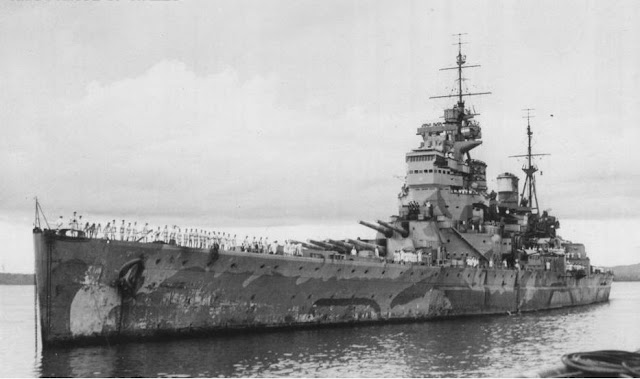
Atlantic Charter Conference concludes as President Roosevelt confers with Prime Minister Churchill on board heavy cruiser USS Augusta (CA-31). Discussions have concerned British needs for support, joint strategy, and the political character of the postwar world. The Atlantic Charter, the joint declaration that result from the meetings, outline goals in the war against Germany and emphasize the principles of freedom, self-determination, peace, and cooperation. Roosevelt privately reassures Churchill that when the United States enters the war, it would accord the defeat of Germany first priority. He also pledges that U.S. warships would escort British merchant ships between the United States and Iceland. After the last meeting, Prime Minister Churchill embarks in battleship HMS Prince of Wales and departs Placentia Bay. Soon thereafter, Augusta, accompanied by the same ships that had steamed with her to Newfoundland, sails for Blue Hill Bay, Maine, to rendezvous with presidential yacht USS Potomac (AG-25) and USS Calypso (AG-35).
By the margin of a single vote, the United States House of Representatives approved an 18-month extension of the Selective Training and Service Act of 1940. The U.S. House of Representatives passed a modification to the Selective Service Act, which extended the service period of draftees as requested by Franklin Roosevelt from one year to thirty months and a similar increase for service in the National Guard after considerable debate. The bill is passed by one vote (203-202). In an atmosphere of hushed tension alternating with clamorous uproar, the house passed the army service extension bill tonight by a single vote 203 to 202. By that narrow margin, it saved the administration, from a devastating defeat and apparently assured the ultimate enactment of the legislation. Twenty-one Republicans joined 182 Democrats in voting for the bill. The opposition votes were cast by 65 Democrats, 133 Republicans and four minor party members.
The Placentia Bay meetings between Roosevelt and Churchill concluded. The Atlantic Charter was signed but not made public until two days later. President Roosevelt and Prime Minister Winston agree to the Atlantic Charter (a name only later applied to it at this time it is called “Joint Declaration by the President and the Prime Minister,” or more commonly simply as the “Joint Declaration”) at Placentia Bay, Newfoundland. There isn’t any formal document, and nothing ever is signed. Instead, the staffs prepare a “final draft” and give copies to the radio operators of the USS Augusta and HMS Prince of Wales to send out to the media. The Atlantic Charter sets forth eight points, twice as many as Roosevelt’s “Four Freedoms” but in many cases similar in tone to them.
The striking thing about the eight points is that they don’t mention military aims — because the United States is not at war. Instead, they refer to what appears to be post-war objectives. However, they very subtly reach out to peoples of the Axis powers by, for example, reassuring them that there won’t be post-war trade sanctions on the losers. After the communique is issued, Churchill departs back for Britain aboard Prince of Wales, while Roosevelt sails aboard cruiser Augusta down to Blue Hill Bay, Maine, where Presidential yacht Potomac (AG-25) is anchored.
President Roosevelt declared in a letter to Secretary Wickard made public today that “food is a weapon against Hitlerism just as much as munitions.” He added that “we need not only abundant production for ourselves and for other nations resisting aggression, but we need reserves to meet emergencies which can as yet be only dimly foreseen.”
A major crisis developed tonight in Franco-American relations, and predictions were heard on Capitol Hill that the United States would break off diplomatic links with Vichy and perhaps take over such strategic French possessions as the island of Martinique. Secretary of State Hull clearly hinted that his worst fears had been confirmed by the elevation of Vice-Admiral Jean Darlan to supreme command of France’s armed forces and other indications of French collaboration with Hitler. The subsequent broadcast of Chief of State Henri Petain, despite reassuring words directed to the United States, served mainly to strengthen the impression here that far-reaching decisions had been taken to fit France into Adolf Hitler’s “new order” in Europe.
Governor Charles Edison, of New Jersey intervened yesterday in the strike of 16,000 employees at the shipyard of the Federal Shipbuilding and Drydock Company at Kearny, New Jersey, with a plea against government operation of the plant and a request that such action be withheld pending efforts by the State to settle the dispute.
Price Administrator Leon Henderson testified today he would oppose wage increases if they forced a manufacturer too close to the point of earning no profit. Appearing before the House Banking Committee on the administration’s price control bill, Henderson said, however, he would never recommend wage decreases merely to lower a price celling.
Criticizing speculators who had pushed prices upward with “scare” stories of shortages, Leon Henderson, administrator of the Office of Price Administration and Civilian Supply, today established a ceiling of three and a half cents a pound on 96 degree raw sugars, duty-paid, delivered in New York, and called on consumers to refuse to pay more than present retail prices.
The U.S. Army-U.S. Marine Corps 1st Joint Training Force under Major General Holland M. Smith was redesignated the Atlantic Amphibious Force.
Maneuvers at New River, North Carolina, conclude. The maneuvers that began on August 4 consisted of the U.S. 1st Marine Division and the U.S. Army First Infantry Division engaging in amphibious exercises. The aircraft escort vessel USS Long Island (AVG-1) participated and provides close air support in a test of that type of ship in that role.
U.S. naval authorities seize 5592-ton Italian freighter Dino in Boston. The U.S. reflags Dino as Panamanian Meridian.
“I Love Lucy” actress Vivian Vance (32) weds actor Philip Ober (39)
Two motion pictures are released:
- “Dive Bomber,” a drama directed by Michael Curtiz, stars Errol Flynn, Fred MacMurray, Ralph Belamy, Alexis Smith, Regis Toomey and Craig Stevens; Alan Hale, Jr., George Meeker and Gig Young appear in uncredited roles. The plot involves Navy flight surgeons attempting to solve the problem of blackouts experienced by dive bomber pilots but of course, the real stars are the Navy aircraft in their pre-war markings. The film is nominated for one technical Academy Award.
- “Dr. Jekyll and Mr. Hyde,” a horror drama based on Robert Louis Stevenson’s novel “The Strange Case of Dr. Jekyll and Mr. Hyde,” is directed by Victor Fleming and stars Spencer Tracy, Ingrid Bergman, Lana Turner, Donald Crisp and Barton MacLane; Hillary Brooke appears in an uncredited role. The plot involves the good Dr. Jekyll and his other half, the evil Mr. Hyde. The film is nominated for three technical Academy Awards. This is a direct remake of a 1931 film of the same name and cements a “theatrical” version of the tale that is different than the original Robert Louis Stevenson 1886 novella. In fact, the studio goes to the extreme lengths of finding and destroying every copy of the 1931 version that it can, though decades later a full version of that earlier film is found and restored. The film turns a $350,000 profit on a budget of $2.351 million and earns three Academy Award nominations in technical categories. The film is notable for Tracy’s iconic performance in the lead role and Bergman playing against type as a “bad” girl.
Major League Baseball:
For the humiliating treatment accorded them on Monday by the Dodgers, the Giants yesterday took revenge in full measure and today the Brooklyn boys are back in second place, a game and a half behind the Cardinals and wondering what hit them. The Giants won both games, the first one, 8–5, for Carl Hubbell, and the second one, 2–0, for Cliff Melton, with Mel Ott walloping two home runs in the opener to drive in six tallies.
Tommy Livingston’s thirteenth-inning double with Merrill May on base gave the Phillies a 2–1 triumph today and a sweep of their two-game series with the Braves. Jim Tobin went the distance and received the win for the Braves.
White Sox and the Browns played a fourteen-inning 6–6 tie today, the game being called on account of darkness after 3 hours 30 minutes of play. Neither team scored after the sixth inning. The Browns grabbed a 6–0 lead off Chicago’s” Bill Dietrich with three-run clusters in the second and fifth innings. Then, after being held to one hit for four frames, the Sox ganged Bob Harris for four runs in the fifth and drove him out with the tying pair in the sixth.
A six-game losing streak of the Indians came to an end today, but it was Al Milnar, not Rapid Robert Feller, who turned the trick. Milnar beat the Tigers, 4–1, in the nightcap of a bargain bill, scattering five hits, after Feller, still seeking victory No. 21, and his team-mates were whitewashed by big Al Benton, just up from the relief ranks, in the opener, 2–0. Benton yielded four hits and on several occasions was in trouble, but each time bore down.
After thirty one consecutive scoreless innings at Yankee Stadium, the Yankees cut loose with a four-run barrage in the eighth yesterday, broke up a tense pitching duel between Spud Chandler and Dick Newsome, achieved a 4-0 victory over the Red Sox and soared to a fourteen-game lead over the Indians.
Dutch Leonard chalked up his seventh straight victory behind the seventeen-hit attack of the Senators today for a 9–3 triumph over the Athletics. The A’s also lose left fielder Wally Moses for 3 weeks when he steps on a corn cob while retrieving a hit. Buddy Lewis has a pair of homers for the visiting A’s.
The St. Louis Cardinals downed the Chicago Cubs, 8–7, today in a see-saw battle and took over first place in the National League from Brooklyn, which lost two to the Giants. The tying and winning runs came in the eighth on Frank Crespi’s fourth hit of the game. It sent Martin Marion and Walker Cooper home.
New York Giants 8, Brooklyn Dodgers 5
New York Giants 2, Brooklyn Dodgers 0
Philadelphia Phillies 2, Boston Braves 1
St. Louis Browns 6, Chicago White Sox 6
Cleveland Indians 0, Detroit Tigers 2
Cleveland Indians 4, Detroit Tigers 1
Boston Red Sox 0, New York Yankees 4
Washington Senators 9, Philadelphia Athletics 3
Chicago Cubs 7, St. Louis Cardinals 8
The Canadian government ordered all Japanese Canadians to carry a registration card.
An Ecuadorean communique said tonight Peruvian forces had captured and then abandoned the town of Zapotillo in a bloody revival of their border warfare. Ecuadorean forces, it said, withdrew to Sabanilla In the face of the Peruvian assault.
The Japanese recall liner Asama Maru, which is nearing the United States with American passengers and a cargo of silk, due to the imposition of U.S. sanctions.
Japanese Canadians are required to carry registration cards that have their thumbprint and photo.
A thunderstorm this afternoon ended the worst ordeal by air bombardment Chungking has ever endured. Japanese raids had gone on with only short intervals between them since Friday afternoon. From Sunday morning to Monday afternoon Japanese planes bombed Chungking eight times. These raids came on top of six separate attacks from Friday afternoon to Saturday night. The Japanese squadrons were small, ranging from three planes to twenty-seven, but following the recent change in the manner of the Chungking attacks they spaced their arrival to keep the city under almost perpetual alarm and habitants constantly in dugouts.
The Japanese High Command is planning to place 180,000 troops in French Indo-China, the majority of them in West Cambodia adjoining the border of Thailand, it was learned authoritatively tonight.
Chinese General Zhao Chengshou, commander of the Chinese 7th Army, signs a secret armistice with the Japanese. Zhao has been convinced by Chinese collaborators that the Japanese are willing to work with the Chinese and not just conquer them.
Crown Prince Yi Un was assigned to Jinzhou, Liaoning Province, China.
The Imperial Japanese Navy light carrier HIJMS Hosho becomes the flagship of Carrier Division 3.
The Imperial Japanese Navy heavy cruiser HIJMS Ashigara departs Saigon.
The Imperial Japanese Navy battleship No. 1 (to be named HIJMS Yamato) departs Kure, Japan for trials.
U.S. Navy Motor Torpedo Boat Squadron 3 is commissioned and sent to the Philippines.
Dow Jones Industrial Average: 125.81 (-0.2)
Born:
Deborah Walley, American actress (“Mothers-in-Law”, “Beach Blanket Bingo”), in Bridgeport, Connecticut (d. 2001).
Jennifer Warren, American actress (“Slap Shot”, “Fatal Beauty”, “Mutant”), in New York, New York.
Craig Douglas [Terence Perkins], British pop singer (“Only Sixteen”), in Newport, England, United Kingdom.
Edwin Feulner Jr, American right-wing personality and co-founder of The Heritage Foundation, in Chicago, Illinois (d. 2025).
Rudy Johnson, NFL halfback (San Francisco 49ers, Atlanta Falcons), in Houston, Texas.
Died:
Bobby Peel, 84, English cricketer.
Naval Construction:
The Royal Navy YMS-1-class auxiliary motor minesweeper HMS BYMS 2025 (J 825) and HMS BYMS 2026 (J 826) are laid down by the Ballard Marine Railway Co. (Seattle, Washington, U.S.A.).
The Royal Navy Flower-class corvette HMS Meadowsweet (K 144) is laid down by Charles Hill & Sons Ltd. (Bristol, U.K.); completed by Richardson, Westgarth & Clark.
The U.S. Navy SC-497-class (110-foot wooden hull) submarine chaser USS SC-512 is laid down by the American Cruiser Co. (Detroit, Michigan, U.S.A.).
The Royal Navy “P”-class (First group) HMS Protest (T 195) is launched by Mario Bolias Monica (Aviero, Portugal).
The Royal Navy Bangor-class (Reciprocating-engined) minesweeper HMS Shippigan (J 212) is launched by the Dufferin Shipbuilding Co. (Toronto, Ontario, Canada); completed by Montreal-Loco.
The Kriegsmarine (German Navy) Type VIIC U-boat U-657 is launched by Howaldtswerke Hamburg AG, Hamburg (werk 806).
The Royal Navy Hunt-class (Type II) escort destroyer HMS Tetcott (L 99) is launched by J.S. White & Co. (Cowes, U.K.).
The Royal Navy Hunt-class (Type III) escort destroyer HMS Airedale (L 07) is launched by the John Brown Shipbuilding & Engineering Company Ltd. (Clydebank, Scotland).
The Royal Navy harbor defence motor launch HMS HDML 1077 is commissioned.
The U.S. Navy Accentor-class coastal minesweeper USS Roller (AMc-52) is commissioned.
The U.S. Navy (prototype wooden hull) submarine chaser USS PC-453 (later SC-453) is commissioned. Raising the Ensign on this chaser at Detroit marked the first formal commissioning of a line vessel on the Great Lakes since Commodore Oliver Perry built his wood fleet on Lake Erie in 1812.

