Adolf Hitler on 11 August 1941 reiterates that he wants the Wehrmacht to take Kiev before advancing on Moscow. To do this, Army Group Center is to divert forces to the south. With much grumbling and half-hearted cooperation, General Guderian and the other generals comply.
In the Far North sector, Finnish 15th Division, with 10th Division, capture Khitola (Khityola) just northwest of Lake Ladoga. This forces Soviet 142nd Rifle and 198th Motorized Division to withdraw into a “motti” (surrounded fortress) on the shores of Lake Ladoga. The Soviets there can serve as a thorn in the side of the Finnish advance toward Leningrad, with the availability of escape over the lake. In the center of the Karelian Isthmus, Finnish troops of IV Corps take Vuosalmi.
Finnish Group J of III Corps continues a rapid advance from Kestenga toward the Murmansk railway. Today, following the embankment of a spur line of the railway, it reaches the vicinity of the narrows between Yelovoye Lake and Lebedevo Lake. At this point, about 20 miles southwest of Loukhi, the Soviets make a stand and bring the Finns to a grinding halt. The Soviets are bringing in the 88th Rifle Division from Archangel (Arkhangelsk). Ordinarily, the arrival of one rifle division on the main front would mean little, but in the far north, it can have a huge impact. The Germans know something is up because they have been monitoring frantic Soviet radio traffic in the area, but they don’t know what. The only question is if the Soviet defenders on the spot can hold out until the reinforcements arrive in a few days.
Another Finnish advance by Group F a little further south has become stalled at the Kis Kis River line on the Korpiyarvi-Ukhta Road. The Finns are attempting some probing attacks, but there are no signs of weakness.
In the Army Group North sector, the Germans continue pushing across the Luga River toward Leningrad.
In the Army Group Center sector, Red Army counterattacks continue at Yelnya. Guderian continues sending his panzers south to Gomel.
In the Army Group South sector, the Hungarian air force attacks Nikolayev. They manage to destroy a key bridge which eliminates a prime escape route for retreating Soviet soldiers (there are only three crossings on the entire southern section of the Dnepr River).
Soviet auxiliary river gunboats Issa, Plyussa, and Surop are lost today while in action on rivers within the Soviet Union. Soviet monitor SB-37 (Zhemchuzin) is heavily damaged by German panzers and artillery on the Dnepr River. SB-37 is a total write-off and scuttled on the 12th. Incidentally, there is some confusion about this sinking of SB-37. It often is confused with a completely separate Soviet warship sunk in the Arctic Ocean by U-451 on 10 August (that one is Soviet corvette Zhemchug No. 27).
Soviet minesweeper T-213 “Krambol” hits a mine and sinks off Cape Yuminda.
The Soviets use motor torpedo boats to intentionally sink Soviet destroyer Karl Marx at Loxa Bight, Estonia. It was damaged by the Luftwaffe on 8 August 1941.
Before dawn, German 2nd S-Boat Flotilla lays 24 mines in minefield Allirahu in Riga Bay. After dark, German 5th M-Boat Flotilla lays 45 EMC mines in minefield Pinnassi I, Pinnassi II, and Pinnassi III off Cape Domesnas.
General Wladyslaw Anders, released from the Soviet Lubyanka prison in Moscow on 4 August, is made commander of a new Polish Army in the Soviet Union and begins collecting Polish POWs in Buzuluk and Totskoye. It is estimated that 1.7 million men are POWs, but, in fact, about a third of those are dead from mistreatment. Those that survive and are able to serve, about 400,000 men, are given amnesty and struggle to get to the collection points in rags and using whatever transportation they can find. The Poles forming the army notice a surprising absence of officers among the released Polish POWs. Poles in the prison camps who are not soldiers are sent to work on collective farms (Kolkhoz) in Tashkent and Bukhara and the southern Aral regions.
14 large Soviet bombers raided Berlin.
Vichy France enacted a law to exclude Jewish doctors.
King George VI, who arrived at Scapa Flow on 9 August, continues his inspection tour of the naval base. Today, he visits destroyers, including HMS Charlestown and Eclipse, and also destroyer depot ship Tyne. He then boards on destroyer Inglefield at 12:30 to Scrabster, returning to Scapa Flow later in the day.
General Huntziger, Minister of War who signed the armistice with Germany in 1940, becomes Commander-in-Chief of Vichy French ground forces.
The Luftwaffe (a Focke-Wulf FW-200 of I,/KG40) attacks and sinks 2852-ton British freighter Empire Hurst in the Atlantic about 100 miles southwest of the southern tip of Portugal. Empire Hurst had fallen behind Convoy HG-70 and was being escorted by anti-submarine trawler HMS Lady Hogarth. There are 26 deaths and nine survivors.
Italian submarine Guglielmo Marconi I (Lt Cdr Pollina) attacks Convoy HG-70 about 100 miles off the southern Portuguese coast. It misses and then is attacked by Royal Navy corvette Convolvulus and sloop Deptford, but the submarine escapes.
German E-boats attack shipping in the Thames Estuary. S-49 (LtzS Günther) of the 4th Motor Torpedo Boat Flotilla sinks 1548-ton British freighter Sir Russell near No. 10 Buoy. Everyone survives. S-20 also claims to sink a freighter, but there is no confirmation of this.
The Italian hospital ship California was sunk off Syracuse, Sicily by RAF Fairey Swordfish torpedo aircraft of 830 Naval Air Squadron. Swordfish torpedo-bombers of RAF No. 830 Squadron based on Malta attack shipping in Syracuse harbor on Sicily. This is a standard target for the RAF which they hit every week, and sometimes daily. This attack is slightly different than the norm because one of the torpedoes sink 13,060-ton Italian hospital ship California (formerly SS Albania pre-1930). The wreck is in 30 feet of water.
While all sorts of factors are usually taken into account to “define away” war crimes (“It was a mistake” “I was aiming at something else”) and they seldom are prosecuted, sinking a hospital ship — they are clearly marked — is a war crime.
The Luftwaffe bombs and badly damages Royal Navy net-layer Protector with an aerial torpedo while en route from Port Said to Alexandria. Corvette HMS Salvia takes Protector in tow back to Port Said, where they arrive in the evening.
Operation GUILLOTINE, the British reinforcement of Cyprus, continues as Australian sloop HMAS Parramatta departs from Port Said for Famagusta.
The Red Sea is full of German mines, and US ships have been traversing it since the last Italian port in East Africa fell. Today, one of those US freighters, 5685-ton Iberville, hits one and is damaged. It makes it to port.
There is little activity during the day aside from training and the usual reconnaissance over France.
Two Wellingtons of No. 115 Squadron carried out the first operational trial of Bomber Commands new navigational device Gee. The two planes used Gee coordinates only and delivered “uncanny accuracy.” On August 18, 1941 Bomber Command ordered Gee into production at Dynatron and Cossor, with the first mass-produced sets expected to arrive in May 1942.
RAF Bomber Command, Night of 11/12 August 1941
Rotterdam
31 Hampdens and 3 Wellingtons bombed dock targets. 1 further Wellington to Antwerp. No losses. Hampdens of 50 Squadron dropped 500 bags of tea from the Dutch East Indies for civilians during the Rotterdam raid.
Krefeld
20 Hampdens and 9 Whitleys to the railway yards; they encountered cloud over the target and only 1 aircraft claimed to have hit the yards. There were no losses.
Mönchengladbach
29 Wellingtons to a railway target; the area was completely cloud-covered. No aircraft lost.
2 Wellingtons of 115 Squadron carried out the first trial of the new Gee navigation device on this raid. The trials were continued for a further 2 nights. They were successful but the flights then stopped to allow mass production of the equipment for later use to commence.
At Malta, Luftwaffe Junkers Ju-87 reappear over Malta for the first time in weeks. Nine Stukas attack the Ta Qali area and Grand Harbour, damaging some warehouses and private dwellings. The RAF claims two of the Stukas. Rome radio claims that this small raid is a massive success, stating “A veritable shower of bombs was rained down on [Luqa] aerodrome” and “The attack on the naval base of Valletta was extremely effective. Loud explosions were heard and huge fires visible from a great distance were started.”
His Majesty King George VI, who had arrived at Scapa Flow, on the 9th, visited the destroyer depot ship HMS Tyne during the forenoon and inspected representative contingents from the Home Fleet destroyers. He then visited destroyers HMS Eclipse and HMS Charlestown berthed alongside. The King inspected the Lyness Base and then embarked in destroyer HMS Inglefield at 1230 for transport to Scrabster, escorted by destroyers HMS Tartar and HMS Punjabi. Destroyer Icarus departed Scapa Flow at 1340 and proceeded to Scrabser to provide passage back to Scapa Flow for the Captain of the Fleet.
Destroyers HMS Tartar, HMS Punjabi, and HMS Escapade departed Scapa Flow at 1530 for Hvalfjord, arriving at 2100/12th.
Destroyer HMS Echo departed Scapa Flow at 0600 for Sheerness for refitting, and arrived at 1630/13th.
Minelayer HMS Port Quebec, escorted by surveying ship HMS Scott, laid minefield SN.22 A in the Northern Barrage.
Submarine HMS Tigris departed Murmansk on patrol, and on the 17th, sank Norwegian coaster Haakon JARL (1482grt) in 70-58N, 26-48E.
Steamer Sir Russell (1548grt) was sunk by German S-boat S.49 of the 4th Motor Torpedo Boat Flotilla six cables 349° from No.10 Buoy. The entire crew was rescued.
Italian submarine Marconi attacked and claimed to have sunk sloop HMS Deptford, which had been detached from convoy OG.70 to join convoy HG.70 in 37-16N, 9-50W. She was undamaged, and with corvette HMS Convolvulus carried out a search for the submarine.
Steamer Empire Hurst (2852grt), which had fallen astern of convoy HG.70, was being escorted by anti-submarine trawler HMS Lady Hogarth, when she was sunk by German bombing in 36-48N, 9-50W. Twenty six crew were killed, and nine survivors rescued by the trawler.
Netlayer HMS Protector, on passage from Port Said to Alexandria, was badly damaged by an aerial torpedo in 31-42N, 32-04E at 1700. Destroyer HMS Hero was sent from Alexandria to assist, and sloop HMS Flamingo, corvette HMS Salvia, and trawlers from Port Said. Salvia was able to take her in tow and they arrived at Port Said at 0600/12th. She received temporary repairs at Suez, and on 25 November, departed in tow of British steamer Empire Kangaroo (6219grt).
Destroyers HMS Jervis and HMS Kingston departed Alexandria for Mersa Matruh to act as a striking force, and arrived back at Alexandria on the 13th.
Australian sloop HMAS Parramatta departed Port Said, escorting motor transport ship Kevinbank, for Famagusta in serial S.18 of the GUILLOTINE operation. They arrived on 13 July.
Italian hospital ship California (13,060grt) at Syracuse was sunk by a Swordfish from the 830 Squadron from Malta.
Destroyers HMS Forester, HMS Fury, HMS Duncan, HMS Boreas, and HMS Wild Swan departed Gibraltar to sweep. Boreas and Wild Swan were then ordered to join convoy HG.70, while Forester, Fury, and Duncan arrived at Gibraltar late on the 11th.
Atlantic Charter Conference continues: President Roosevelt and Prime Minister Churchill confer twice on board heavy cruiser USS Augusta (CA-31).
Convoy ON.6 departed Liverpool, escorted by corvette HMS Arabis. Anti-submarine trawler HMS Northern Spray joined the next day. The convoy was joined on the 13th by destroyers HMS Malcolm, HMS Sardonyx, HMS Scimitar, and HMS Watchman, corvettes HMS Verbena and HMS Violet, and anti-submarine trawlers HMS Northern Pride and HMS Northern Wave. Destroyers Malcolm and Watchman and corvette Verbena were detached on the 15th, destroyer Scimitar and anti-submarine trawlers Northern Pride and Northern Wave on the 16th, and corvettes Arabis and Violet and anti-submarine trawler Northern Spray on the 17th. On the 17th, destroyers HMS Chesterfield and HMS Ripley, armed merchant cruiser HMS Ausonia, and corvettes HMCS Hepatica, HMCS Trillium, and HMCS Windflower joined and escorted the convoy until it was dispersed on the 24th.
In Washington, the Senate received the $275,000,000 defense highway bill; confirmed the nominations of Robert F. Webb, Nelson Lee Smith and C. E. Childe to the Transportation Board of Investigation and Research and recessed at 2:54 PM until noon Thursday. The Post Offices and Post Roads Committee made a favorable report on the $275,000,000 defense highway bill; an Appropriations sub-committee approved the $8,163,000,000 supplemental defense appropriation bill and the Finance Committee heard testimony on the tax bill.
The House heard the late Representative Alfred G. Rutherford of Pennsylvania eulogized and adjourned in respect to his memory at 12:07 until 10 AM tomorrow. The Banking and Currency Committee continued its questioning of Leon Henderson on’ the price bill; the Military Affairs Committee considered amendments to the military service extension resolution and a Dies sub-committee resumed hearings on Communist activities.
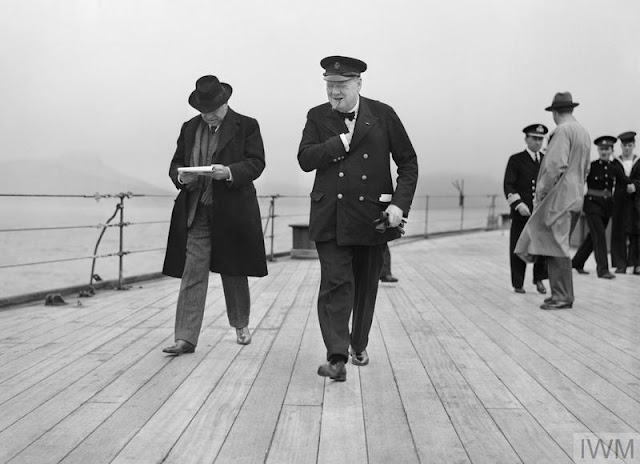
President Roosevelt and Prime Minister Churchill spend their third day (second official day of the Atlantic Conference) conferring at Placentia Bay, Newfoundland. They meet twice aboard Roosevelt’s ship USS Augusta (CA-31). The British War Cabinet is kept apprised of developments and writes in the Minutes:
“America is as yet far from being prepared for active operations on a war footing. While the American Navy is in a more advanced state of readiness, the building up, training and equipping of the American army and air corps is still in embryo and the shortage of equipment is acute.”
The bottom line, the Minutes reveal, is that American needs come first, and then surplus production will be sent to Great Britain.
Most of the real work of the meeting, of course, is being done by their staff throughout the day.
A warning that failure of Congress to extend the service of the army rank and file would have an “exceedingly bad” effect on American foreign relations came from Secretary of State Hull today as administration forces prepared for a bitter fight in the house tomorrow on an 18-months extension. Hull, speaking at a press conference, authorized quotation of the words “exceedingly bad.”
The speeding up of warship building, cutting the construction time on new men-of-war by an average of 12 ½ per cent for each vessel, will give the United States its two-ocean fleet two years earlier than originally scheduled, Navy sources said today.
In a far-reaching step that brought the effects of the defense program close home to the ordinary man, President Roosevelt today set up a system of control for the huge installment credit business carried on through the nation’s banks, stores and personal finance companies He issued an executive order directing’ the federal reserve beard to use a World war statute and its criminal penalties to curb installment credit used for the purchase of “consumers’ durable goods.” Although not affecting the man who can afford to pay cash, the order covered merchandise and small loan business involving $10,000,000,000 of credit. Some types of those credits may be exempted, however. The president said the regulation was intended to discourage consumers from buying many things. The aim is to conserve the materials that go into automobiles and washing machines, for instance, and also to curb inflationary tendencies.
Eleven large oil companies submitted to Secretary Ickes today a plan for a new 1,820-mile pipeline system, the longest in the world, designed to pour 250,000 barrels of crude oil daily into the New York-Philadelphia area.
Government operation of the Federal Shipbuilding and Drydock Company’s plant at Kearny, N.J., closed for the last five days by a strike of 16,000 members of Local 16 of the Industrial Union of Marine and Shipbuilding Workers, C. I.O., appeared certain yesterday as the company itself moved to have the government take over the plant for “immediate possession and operation.”
U.A.W.-C.I.O. delegates, torn by bitter strife over the issue of strike leadership, adopted a sub-minority grievance committee report today recommending a mild penalty for Lew H. Michener, west coast regional director. Official tabulation on a roll call vote taken on the report at the sixth rational convention of the United Automobile, Aircraft & Agricultural Implement Workers showed 1,558 favored adoption and 1,460 opposed The delegates were polled after Michener defended his support of the five-day unauthorized strike at the North American Aviation plant at Inglewood, California, last June and termed his case a “political issue.”
With uniformed members of the Women’s Voluntary Services at the wheels, nine sleek “R.A.F.-Blue” ambulances were on their way to Canada last night, the latest gift of the British-American Ambulance Corps.
Actress Rita Hayworth (born Margarita Carmen Cansino) appears in a classic spread in Life magazine. One of the shots inside, of Rita on a bed dressed in a satin negligee and black lace bodice sitting on a bed, becomes the most requested pin-up for GI’s during World War II until a 1943 shot of actress Betty Grable appears. Hayworth broke through as a major film star with “Only Angels Have Wings” (1939) and is at the peak of her fame during World War II. Incidentally, that nightgown in the photo is preserved and sold for $26,888 in 2002.
Glenn Miller and his Orchestra record “Elmer’s Tune,” written by Elmer Albrecht, Dick Jurgens, and Sammy Gallop. Previous versions of the song did not have lyrics, so Miller has the song’s publisher, Robbins Music Company, hire Sammy Gallop to write some lyrics. Ray Eberle does the lead vocals, backed by the Modernairnes. Released later in the year, it hits No. 1 on the Billboard Best Selling Retail Records chart of 13 December 1941 and spends 20 weeks in total on the chart. It becomes a classic of the big band era.
Major League Baseball:
Pitcher Kirby Higbe leads the Dodger charge against the Giants, as he collects three singles and a double, good for 4 RBIs. The Dodgers pound out 16 hits off Bob Carpenter and Bob Bowman, and Brooklyn wins, 15–7.
Given a surprising four-run lead by his Philadelphia team-mates, Walter (Boom Boom) Beck scored his first triumph of the season today, defeating the Braves, 6–3. Beck had dropped six games this season, two of them to the Braves, but today he survived sporadic Boston assaults on the four-run margin the Phillies had gained in the second.
The White Sox and Browns today divided a double-header in which fifty-six hits were recorded. The Chicagoans won the opener, 14–9, and then bowed, 10–3. Pitcher Elden Auker and Utility Infielder Alan Strange of St. Louis and First Baseman Joe Kuhel of Chicago were dismissed from the opener in the seventh inning following a fist fight which flared after Kuhel had been hit on the shoulder by one of Auker’s pitches.
Joe DiMaggio went hitless, Charlie Keller got only a lucky single and Marvin Breuer didn’t stay around long enough to become well acquainted. Whatever the reason-it might have been some highly effective pitching by Jack Wilson-the Yankees started the week at home on the wrong foot today. In fact, they never did get going, as the Red Sox handed them a humiliating 8–0 blanking before 9,071 fans at Yankee Stadium.
At Sportsman’s Park, a first in Cubs’ history occurs in the 5th inning when Phil Cavarretta, Stan Hack, and Bill Nicholson hit consecutive homers. It’s not enough as the Cards win 7–5, but it’s a costly victory as they lose Enos Slaughter for the season. Chasing a line drive, Enos tries to avoid colliding teammate Terry Moore and he hits the right field wall breaking his collarbone.
The scheduled game between the Cleveland Indians and the Tigers at Detroit was postponed due to rain. The game will be made up as part of a doubleheader tomorrow.
New York Giants 7, Brooklyn Dodgers 15
Philadelphia Phillies 6, Boston Braves 3
St. Louis Browns 9, Chicago White Sox 14
St. Louis Browns 10, Chicago White Sox 3
Boston Red Sox 8, New York Yankees 0
Chicago Cubs 5, St. Louis Cardinals 7
Secretary of State Cordell Hull declared today that the United States would discuss a settlement of difficulties with Japan only on a basis of the fourteen points he enunciated in July, 1937.
The Japanese Government was operating today under wartime economic powers granted by the National Mobilization Act as its Minister to Washington warned the country that the United States was now ready to meet any further Japanese advance in the Pacific, whatever the consequences.
Lieutenant Colonel Harold D. Shannon, executive officer of the U.S. Marine Corps 6th Defense Battalion, arrived at Midway to prepare for his battalion to relieve the 3rd Defense Battalion.
Japanese bombers attack Chungking again. The Japanese lose another three out of four I-153 fighters sent up to intercept them. In a subsequent action, the last of the I-153 fighters is destroyed. The Chinese manage to shoot down one plane.
Koh Ishii, Japanese cabinet information bureau spokesman, said today Japan was watching with urgent concern United States shipments of war materials to Vladivostok. His statement came during a press conference in which he was asked what was meant by his use recently of the word “embarrassing” in connection with such United States shipments. Ishii replied: “Japan wishes that the United States would not send munitions. Japan desires peace in the Pacific and so Japan is watching such shipments with urgent concern.”
Japanese ships will stop calling at Singapore next month and Japanese residents are leaving the Straits Settlements and Malaya as result of the tense situation following Britain’s action in imposing drastic economic penalties on Japan, it was revealed today.
The Japanese steamer Asama Maru, which had been en route to San Francisco with an undetermined number of Americans and a big silk cargo, has turned back toward Japan, Koh Ishii, cabinet information bureau spokesman, said today.
Matome Ugaki was named the chief of staff of the Japanese Navy Combined Fleet.
Captain Yoshioki Tawara was named the commanding officer of the IJN light cruiser Naka.
The special Cabinet session convened by Prime Minister Robert G. Menzies sat all day today discussing the Pacific situation. The chiefs of the three armed services attended the meeting.
Dow Jones Industrial Average: 126.01 (-0.39)
Born:
Elizabeth Holtzman, American attorney and politician (D-Rep-New York, Watergate Committee), in Brooklyn, New York, New York.
Bill Munson, NFL quarterback (Los Angeles Rams, Detroit Lions, Seattle Seahawks, San Diego Chargers, Buffalo Bills), in Sacramento, California (d. 2000).
John Ellison, American-Canadian guitarist and songwriter (“Some Kind of Wonderful”), in Montgomery, West Virginia.
John Simon, American record producer (The Band), and singer-songwriter, in Norwalk, Connecticut.
Patricio Guzman, Chilean film director (“The Battle of Chile”), in Santiago, Chile.
Naval Construction:
The Royal Navy YMS-1-class auxiliary motor minesweeper HMS BYMS 2002 (J 802) is laid down by the American Car and Foundry Co. (Wilmington, Delaware, U.S.A.).
The Royal Navy YMS-1-class auxiliary motor minesweeper HMS BYMS 2021 (J 821) is laid down by the Seattle Ship Building and Dry Dock Co. (Seattle, Washington, U.S.A.)
The Royal Navy YMS-1-class auxiliary motor minesweepers HMS BYMS 2029 (J 829) and HMS BYMS 2030 (J 830) are laid down by the Barbour Boat Works (New Bern, North Carolina, U.S.A.).
The U.S. Navy SC-497-class (110-foot wooden hull) submarine chaser USS PC-638 (later SC-638) is laid down by the Elizabeth City Shipyard (Elizabeth City, North Carolina, U.S.A.).
The Kriegsmarine (German Navy) Type VIIC U-boat U-416 is laid down by Danziger Werft AG, Danzig (werk 117).
The Royal Navy “U”-class (Third Group) submarine HMS Unsparing (P 55) is laid down by Vickers Armstrong (Newcastle-on-Tyne, U.K.); completed by Davey Paxman & Ricardo.
The U.S. Navy Cleveland-class light cruiser USS New Haven (CL-76) is laid down by the New York Shipbuilding Corp. (Camden, New Jersey, U.S.A.). On 16 February 1942, this ship is designated for conversion while under construction to an Independence-class light aircraft carrier, and commissions as USS Belleau Wood (CVL-24).
The Royal Navy LCT (Mk 2)-class landing craft, tank HMS LCT 123 is launched by Tees-Side Bridge (Middlesbrough, U.K.).
The Royal Australian Navy Bathurst-class minesweeper-corvette HMAS Ipswich (J 186) is launched by Evans Deakin Ltd. (Brisbane, Queensland, Australia).
The Kriegsmarine (German Navy) Type IXC U-boat U-173 is launched by AG Weser, Bremen (werk 1013).
The Royal Navy Flower-class corvette HMS Bellwort (K 114) is launched by George Brown & Co. (Greenock, Scotland); completed by Kincaid.
The Royal Canadian Navy Flower-class corvette HMCS Moncton (K 139) is launched by the Saint John Dry Dock and Shipbuilding Co. Ltd. (Saint John, New Brunswick, Canada).
The Royal Navy British Power Boat 70-foot motor gun boat HMS MGB 20 is commissioned.
The Kriegsmarine (German Navy) Type VIIC U-boat U-655 is commissioned. Her first commanding officer is Kapitänleutnant Adolf Dumrese.
The Royal Navy Flower-class corvette HMS Vetch (K 132) is commissioned. Her first commanding officer is T/A/Lieutenant Commander Herbert James Beverley, DSC, RNR.

