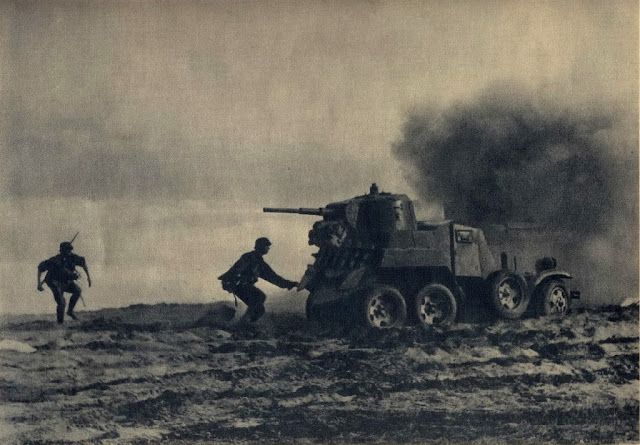
Weather is poor across much of the Eastern Front on 10 August 1941, particularly in the north. It is high summer, and when it isn’t stifling hot, it is raining in torrents. This makes the roads muddy and briefly impassable in places. In general, Soviet vehicles handle the mud better, as the peasant Panje carts that are built somewhat like boats can skim along the top of muddy quagmires while German trucks and heavy horse-drawn wagons bog down. Soviet tanks also do better in the mud, having broader tracks that give more of a grip. Overall, the Germans retain the advantage, but poor weather and attrition due to the conditions and battles whittles that advantage down noticeably.
In the Far North sector, Finnish Group J of III Corps continues advancing relatively quickly from Kestenga toward the Murmansk railway line at Loukhi. The Finns have their choice of an improved road or a spur line of the railway to advance through the forest and choose to focus on following the train tracks. The Finns are approaching the narrows between Yelovoye Lake and Lebedevo Lake and are about 25 miles southwest of Loukhi. Soviet resistance on the road and between the road and railway, however, is growing as the Soviets bring in reinforcements — which is a common theme in all advances in the sector.
In the Army Group North sector, the German offensive toward Novgorod at the northern tip of Lake Ilmen faces strong opposition. The Germans hope to create a continuous front, using the lake, between Novgorod and Staraya Russa at the southern tip of the lake — but the Soviets have good defensive positions. If the Germans succeed, they can wheel directly to the north and invest Leningrad. At the close of the day, General Halder notes in the OKH war diary that “The attack is making slow progress in bad weather and against very stiff enemy opposition.” Another attack by Panzer Group 4 on the Luga River is doing a bit better.
SS-Gruppenführer und Generalleutnant der Schutzpolizei Arthur Mülverstedt, Commander of the 4th SS Polizei Division, is killed in action by artillery fire — a growing Soviet priority, as Stalin believes wholeheartedly that artillery is the “Queen of Battle.”
In the Army Group Center sector, the German XXIV Corps of Second Army is attacking but the Soviets are adroitly juggling their forces to meet successive attacks. This leaves some areas very poorly defended, such as between Bryansk and Roslavl — but the Germans have to move quickly to take advantage of the gaps. The Soviets always seem to plug the holes at the last minute, a pattern that is becoming irritating to the German high command.
There are bypassed Soviet laggards throughout the German area of control. General Ivan Boldin, the deputy to the (deceased) General Dmitry Pavlov, leads one such rag-tag group of 1650 officers and men in the Western Front sector. Boldin today, after a 45-day trek, leads his men back across to Soviet lines east of Smolensk. Stavka Order No. 270 praises Boldin. The Soviets turn Boldin into a propaganda hero. His boss Pavlov is shot for his troops’ failures, while Boldin becomes a big hero — such are the fortunes of war.
In the Army Group South sector, the Romanian 4th Army continue to tighten their grip on Odessa. Romanian 7th Division of 3rd Corps takes Elsas and 1st Guard Division also moves up. Romanian 1st Armored Division of 5th Corps breaks through the outer Soviet line and closes on the second line of defense. The Romanians are making ground, but the Soviet defenders exhibit excellent morale and tenacity that does not bode well for quick capture of the port.
General Halder notes in the OKH war diary that “the situation on the northern wing … (Sixth Army) had badly deteriorated.” He notes with some surprise that “the enemy is attempting to cross the Dniepr.” This should not be, as it is the Germans who are supposed to be advancing, not the Soviets. He notes many “enemy railroad movement from Poltava to Kyiv,” usually a sign of a coming enemy offensive. Given the precarious situation, Field Marshal von Rundstedt prudently postpones an attack on Kyiv and orders Sixth Army to go over to the defensive — a first in the southern sector.
After dark, the Soviets again attempt to bomb Berlin, as they did on 7 August. The first mission went smoothly, but this one… not so much. The Red Air Force, in order to restore its honor after the navy staged the first (moderately successful) raid, assembles a grandiose unit of twin-engine Yermolayev Yer-2 medium bombers and 14 four-engine Petlyakov Pe-8 (TB-7) long-range bombers at Pushkino Airfield in Leningrad. Problems begin right from the start when only three of the overloaded Yer-2 bombers can even get off the ground, while one of the Pe-8s suffers catastrophic engine failure upon liftoff and crashes, killing all 11 crewmen.
After that inauspicious beginning, things just get progressively worse for the Red Air Force crews. Soviet Flak gunners shoot down one of the planes, another turns back with engine trouble, and other misfortunes plague the flight. Ultimately, eleven Pe-8s and three Yer-2s struggle to Berlin, but, unlike the first raid, the Berlin air defenses are primed for revenge. Flak damage and more engine problems take their toll on the way home, and only 7 of the original 17 planes makes it back to Leningrad. Overall, it is a disaster, mangling Stalin’s supply of big bombers and depressing morale among the crews tasked with flying future missions.
The Luftwaffe sends an air raid over Moscow, but it is a shadow of earlier efforts, more a nuisance raid than a grand London-style attack. Overall, the Luftwaffe claims 54 Soviet planes today. Over most areas of the front, the Luftwaffe can achieve air superiority at will — but it is a very long front, and the Luftwaffe can’t be everywhere at the same time.
An official British-Soviet declaration was presented by the British and Soviet ambassadors in Ankara to the Turkish government which stated that the two governments “have no aggressive intentions or claims whatever with regard to the Straits.” The Soviet ambassador added that in view of “the malicious propaganda being intensively conducted by the German government, an exchange of views should take place on the subject of relations between the Soviet Union, Turkey, and Great Britain.”
U-144 is sunk in Gulf of Finland north of Dagö, in approximate position 59N, 23E, by torpedoes from the Russian submarine SC-307. 28 dead (all hands lost)
Soviet submarine S-6 (Lt Cdr Kuligin) hits a mine and sinks southeast of the Swedish island of Oeland around this date. (The wreck of what is believed to be S-6 is found in 2012 by civilian divers).
Soviet minesweeper T-201 “Zaryad” his a mine off Suursaari while escorting a convoy from Tallinn to Kronstadt. The mine explodes, sinking T-201 and damaging 7,484-ton troopship Vyacheslav Molotov, which has thousands of wounded men aboard.
In the far north, German destroyers continue their aggressive patrols. Z4 Richard Beitzen, Z10 Hans Lody, and Z16 Friedrich Eckoldt, operating off the Kola Peninsula, use their guns to sink Soviet guard ship Tuman DK-10.
A Soviet convoy departs from Revel carrying an estimated 3,500 Soviet troops. It proceeds to Suursaari and then Kronstadt, Kotlin Island.
Destroyers HMS Decoy and Havock depart Alexandria for the nightly supply run to Tobruk. They complete the mission and return without incident.
At Malta, morale is a huge concern of the British administration. Mail service has been a priority because many soldiers have loved ones back in England who are being subjected to Luftwaffe bombing (though not so much recently). Accordingly, Governor Dobbie sends a message to the War Department in London requesting an official Post Office Section, staffed by experienced postal employees, stating: “Prompt delivery and despatch of the very limited and intermittent mail is considered absolutely essential for the maintenance of morale.”
The Britsh and Soviet Union submit identical statements to the Turkish foreign embassy. Both countries agree to go to the assistance of Turkey and “observe the territorial integrity of the Turkish republic.” It is an odd statement that is sort of a mirror image of the Tripartite Pact — except Turkey does not sign anything. Hitler still holds out high hopes that he can draw Turkey into the Axis by dangling the chance for it to even old scores with old enemy Russia, but the Turks officially are maintaining a purely neutral stance (though the British strongly suspect that it was aiding the Vichy French during the recent campaign in the Levant).
The RAF bombs and damages German patrol boat V.1506 near Ostend, Belgium.
German E-boat S-49 torpedoes and sinks British freighter Sir Russell off Dungeness in the English Channel. Some sources place this sinking on 11 August.
Damaged 1392-ton Norwegian freighter Dagny I, in tow of trawler Leicester City, sinks between the Faroes and Scotland. All of the crew are picked up by Leicester City.
U-79 (Kptlt. Wolfgang Kaufmann), on its second patrol out of Lorient, spots Allied Convoy HG.69 and reports it to BdU in Paris, which redirects U-boats to intercept it.
A Maryland on photo-reconnaissance crashes on approach at Malta due to engine failure, killing two of the crew and injuring a third.
The Luftwaffe attacks Alexandria, Suez, Port Said, and Ismailia after dark.
It is a quiet day in the air in Northwest Europe.
RAF Bomber Command, Day of 10 August 1941
6 Blenheims on a sweep along the French coast. 3 aircraft claimed direct hits on ships off Gravelines. 2 aircraft lost.
U-79, U 93, U-94, U-109, U-124, U-126, U-331, and U-371 and Italian boats Finzi, Marconi, and Veniero concentrate on shipping, thought to be convoy HG.69, from 10 to 16 August, but no ships were lost.
U-451, commanded by Eberhard Hoffmann, sank Soviet patrol ship Zhemchung (No. 27) west of Kanin. At 2112 hours on 10 August 1941 the 550-ton patrol corvette Zhemchug (No 27) was hit by one torpedo from U-451 while on patrol duties between Sviatoj Nos Cape and Kanin Nos Cape. The U.boat observed how the ship sank immediately west of Kanin Nos and later saw debris and two survivors, but all hands were lost. Only a life buoy of the ship was found ashore some days later.
U-144 was sunk by Soviet submarine ShCh-307 in the Gulf of Bothnia. The U-144, commanded by Kapitänleutnant Gert von Mittelstaedt, was sunk in Gulf of Finland north of Dagö by torpedoes from the Soviet submarine ShCh-307. All of the ship’s complement of 28 died. During its career the U-144 sank 1 warship.
Light cruiser HMS Arethusa arrived in the Clyde from Gibraltar.
Anti-aircraft ship HMS Alynbank departed Scapa Flow at 2130 and escorted convoy WN.65 from Pentland Firth to Methil, where they arrived at 2039 on the 11th.
German fishing vessel H. A. W. Muller (460grt) was sunk by British bombing near Lindesnes.
Destroyers HMS Kandahar and HMS Kimberley departed Alexandria for Mersa Matruh to act as a strike force. Originally, their orders called for an attack on Bardia harbour during the night of 10/11 August, but this was later cancelled. They returned to Alexandria on the 11th.
Destroyers HMS Decoy and HMS Havock departed Alexandria to carry supplies to Tobruk, and arrived back at Alexandria on the 11th.
Australian destroyer HMAS Vendetta departed Alexandria for Haifa for mechanical repairs.
Corvettes HMS Fleur de Lys and HMS Azalea departed Gibraltar to meet arriving tanker Capsa (8229grt) from Trinidad, while destroyer HMS Vidette and anti-submarine trawler HMS St. Nectan left to meet arriving tanker Benedick (6978grt) from Curacao. Both groups arrived at Gibraltar on the 17th.
Submarine HMS Severn arrived at Gibraltar from patrol in the Atlantic.
Atlantic Charter Conference continues: President Roosevelt, transported in destroyer USS McDougal (DD-358), attends divine services in British battleship HMS Prince of Wales as guest of Prime Minister Churchill, Placentia Bay, Newfoundland. About 250 U.S. sailors and marines attend the service as well, wherein hymns “O God, Our Help in Ages Past,” “Onward, Christian Soldiers,” and “Eternal Father, Strong to Save” [the Navy hymn] are sung by all hands. “O God Our Help in Ages Past” was also sung during the funeral service for the late Lord Lothian, the British Ambassador to the United States, at the National Cathedral in Washington, D.C., on 15 December 1940. After inspecting the topsides of the British battleship, the President returns in McDougal to heavy cruiser USS Augusta (CA-31); that night, the chief executive hosts the Prime Minister at dinner.
Convoy HX.144 departed Halifax, escorted by destroyer HMCS Annapolis and armed merchant cruiser HMS Maloja. On the 11th, corvettes HMCS Dauphin and HMCS Napanee joined, and on the 13th the destroyers HMS Burwell and HMCS Columbia and corvettes HMS Dianthus, HMS Honeysuckle, and HMCS Snowberry. Corvettes Dauphin and Napanee were detached on the 12th and destroyer Annapolis was detached on the 13th. The remaining escorts were detached on the 22nd when relieved by destroyers HMS Amazon, HMS Belmont, HMS Bulldog, HMS Georgetown, HMS Skate, HMS Westcott, HMS Whitehall, and HMS Witch, corvettes HMS Aubretia and HMS Heartsease, minesweeper HMS Britomart, and anti-submarine trawlers HMS Angle, HMS Cape Warwick, HMS Daneman, and HMS Notts County. Destroyers Skate, Westcott, Whitehall, and Witch, the minesweeper, and the trawlers were detached later that day. Corvette HMS Nigella joined on the 23rd. On the 24th, destroyers HMS Burnham and HMS Churchill joined for the day. Destroyers Belmont and Georgetown were detached on the 27th, destroyers Amazon and Bulldog and corvette Aubretia on the 28th, and corvettes Heartsease and Nigella on the 29th. The convoy arrived at Liverpool on the 30th.
Convoy SC.40 departed Sydney, CB escorted by corvettes HMCS Barrie, HMCS Chicoutimi, and HMCS Matapedia. These escorts were detached on the 13th, when relieved by destroyer HMCS Niagara and corvettes HMCS Alysse, HMS Celandine, and HMCS Collingwood. Armed merchant cruiser HMS Chitral joined on the 19th. The escorts were detached on the 22nd. On the 22nd, destroyers HMS Douglas, HMS Leamington, and HMS Veteran, corvettes HMS Abelia, HMS Anemone, and HMS Veronica, and minesweepers HMS Leda and HMS Speedy. On the 28th, minesweepers HMS Gossamer, HMS Hazard, and HMS Hebe joined. The convoy arrived at Liverpool on the 29th.
It is day two of the Atlantic Conference at Placentia Bay, Newfoundland (it officially opens today). Yesterday Prime Minister Churchill visited President Roosevelt’s ship, so today Roosevelt returns the favor and boards Royal Navy battleship Prince of Wales. President Roosevelt and his representatives came aboard the Prince of Wales for a Sunday prayer service with Churchill, who later recalled the event as “a deeply moving expression of the unity of faith of our two peoples.” Churchill selected the hymns himself, ending with “Our God, Our Help in Ages Past”. As Churchill later recalls:
“This service was felt by us all to be a deeply moving expression of the unity of faith of our two peoples, and none who took part in it will forget the spectacle presented that sunlit morning on the crowded quarterdeck – the symbolism of the Union Jack and the Stars and Stripes draped side by side on the pulpit; the American and British chaplains sharing in the reading of the prayers; the highest naval, military, and air officers of Britain and the United States grouped in one body behind the President and me; the close-packed ranks of British and American sailors, completely intermingled, sharing the same books and joining fervently together in the prayers and hymns familiar to both.”
After a brief inspection topside, Roosevelt returns to his heavy cruiser USS Augusta (CA-31) aboard destroyer USS McDougal (DD-358). Churchill then visits the Augusta and has dinner with the President.
The House of Representatives tomorrow will begin voting on amendments to its resolution to extend the military service of selectees, Guardsmen, Reserve Officers and enlisted personnel of the regular Army. As the House resolution was drafted it calls for extension of service for duration of the emergency, and tomorrow, after two hours of general debate, the House is expected to vote on several amendments that would set various definite time limits for such extension. The Senate resolution as adopted last week provides for an eighteen-month extension, removes the 900,000 limitation, provides for a $10-a-month pay rise for all soldiers after their first year and authorizes discharge of selectees over 28 years of age or those who would face particular difficulties because of continued service.
Two New Jersey strikes affecting more than half a billion dollars of defense work appeared no nearer settlement yesterday but workers at the New York Shipbuilding Corp., Camden, New Jersey, which has another half billion dollars of orders, approved a two-year contract. The vast yards of the Federal Shipbuilding & Drydock Co. at Kearny, New Jersey, remained idle for a fourth day as a result of a C.I.O. strike while word was awaited from the defense mediation board.
Possibility that San Diego and other Pacific coast cities may be placed in the same status as Atlantic coast communities by having gasoline for automobiles sharply curtailed was expressed here today by oil company executives. The Standard Oil Co. said no more tankers of its fleet would call in San Diego this year. The company’s fleet was depleted further when the oiler H. T. Harper was requisitioned by the government to transport oil from Caracas, Venezuela, to Halifax, N. S. The Richfield Oil Co. still has its fleet of six tankers and the Union Oil Co. has vessels plying in the coastwise trade and three to Honolulu. How long they will remain in these trade routes is problematical, in view of the government’s policy to divert more vessels to transport fuel to Britain and the Russian port of Vladivostok.
The Vichy government’s apparent move toward closer collaboration with Germany encouraged administration leaders in the belief today that the House would approve an extension of service for the army’s rank and file. Without making any prediction, Chairman May, Kentucky Democrat, of the military committee said he hoped the developments abroad would strengthen support for the service extension measure. However, another proponent of extended service, unwilling to be quoted by name, said ‘it certainly should make votes for the bill.” Nevertheless, leaders had virtually abandoned hope of winning an indefinite extension of service as provided in the pending bill. With the fate of the measure apparently resting on about 40 uncertain votes, some were more than a little worried about the prospects of getting even the 18-months extension already approved by the senate.
Queen Elizabeth makes a radio address over the NBC broadcasting system directed primarily toward American women. She quickly emphasizes the stakes:
“Women and children have been killed and even the sufferers in hospitals have not been spared. Yet hardship has only steeled our hearts and strengthened our resolution.”
The Queen praises the “many roles” that women play in the war effort and concludes with a plea “for our children”:
“The things for which we will fight to the death are no less sacred, and to my mind, at any rate, your generosity is born of your conviction that we fight to save a cause that is yours no less than ours; of your high resolve, however great the cost and however long the struggle, liberty, and freedom, human dignity and kindness shall not perish from the earth, I look to the day when we shall go forward, hand in hand, to build a better, a kinder, a happier world for our children, May God bless you all.”
As with many themes enunciated during World War II, this resonates through subsequent decades.
Attendance figures at beaches in the New York area yesterday indicated that, whatever effect on gasoline consumption the present conservation campaign might be having, motorists did not give up their usual Sunday outings.
Warden Jess Dunn of Oklahoma State prison at McAlester, two convicts and a county jailer were slain today in a bloody bid for liberty by four long-term prisoners who shot the warden, held as a hostage, when officers closed in.
American Task Group TG.2.5, on a neutrality patrol, arrives in Bermuda. It is led by the aircraft carrier USS Yorktown (CV-5).
American actor Jackie Coogan (26) weds American actress Flower Parry in Gardnerville, Nevada; they divorce in 1943.
Major League Baseball:
Alejandro Carrasquel, Washington’s Venezuelan hurler, chalked up his fifth victory of the season today in the second half of a double-header with the Red Sox to give the Senators an even split in the four-game series. Washington bats came to life behind Carrasquel to batter the Sox, 8–2, after Manager Joe Cronin and Bobby Doerr had given Boston the necessary edge with home runs in the first game to gain a 7–6 verdict. The second game was called at the end of the seventh inning to conform with the Sunday law.
The Dodgers match the Cards by sweeping a doubleheader, topping the Braves, 14–4 and 4–0. Hamlin wins the opener and Freddy Fitzsimmons (5–0) takes the nightcap. In the 5th inning of game 1, reliever Dick “Leif” Errickson hits Joe Medwick on the right elbow and follows by hitting Dolph Camilli in the head. When he plunks Pete Reiser, the fans start tossing cushions. The 3 HBP are one short of the record.
At Wrigley Field, 18,739 fans cheer for “Charlie Root Day.” The popular pitcher, the winningest pitcher in franchise history, whose retirement was announced, receives a check, a station wagon paid for by the fans, and a pig for his farm. The Reds are unimpressed and hand Root and the Cubs a 3–1 defeat. Johnny Vander Meer gets the win.
The WHite Sox floored the Indians twice today, Ted Lyons getting his eleventh triumph of the season, 5–2, and Thornton Lee his fourteenth, 2–1. The Sox swept the three-game series and ran the Indians’ losing streak to five games.
The Browns backed Bob Muncrief with enough power in their bats to stay in front all the way and defeat the Tigers, 7–3, today. Louis (Bobo) Newsom, touched for nine hits in four innings, lost his sixteenth game. Manager Del Baker sent in Lynwood (Schoolboy) Rowe against the Brownies, but they battered him for six safeties.
The threat of bagging a twin bill and sweeping a series from the aimless Phillies proved too much for the fading Giants yesterday at the Polo Grounds. So Colonel Bill Terry settled for a split before 9,877 fans. The Giants win, 5–4 as Gabby Hartnett hits a pinch homer in the 8th, and then lose the nightcap, 4–3.
The Yankees flay the A’s twice, 11–2 and 4–1, to increase their margin to 14 games. Knott gives up 17 hits in losing the opener to Mario Russo, while Bill Dickey’s 9th inning triple with 2 on decides the nightcap. DiMaggio has a pair of hits in the opener, but goes hitless in the nightcap, the 5th game in the last 8 that he’s been collared.
The Cardinals stopped fast-climbing Pittsburgh, 3–2 and 4–2, today, dropping the Pirates nine and one-half games out of first place and temporarily squelching their hopes of making it a three-team race.
Washington Senators 6, Boston Red Sox 7
Washington Senators 8, Boston Red Sox 2
Boston Braves 4, Brooklyn Dodgers 14
Boston Braves 0, Brooklyn Dodgers 4
Cincinnati Reds 3, Chicago Cubs 1
Chicago White Sox 5, Cleveland Indians 2
Chicago White Sox 2, Cleveland Indians 1
St. Louis Browns 7, Detroit Tigers 3
Philadelphia Phillies 4, New York Giants 5
Philadelphia Phillies 4, New York Giants 3
New York Yankees 11, Philadelphia Athletics 2
New York Yankees 4, Philadelphia Athletics 1
Pittsburgh Pirates 2, St. Louis Cardinals 3
Pittsburgh Pirates 2, St. Louis Cardinals 4
FBI Director J. Edgar Hoover announces that his organization has uncovered German plots throughout Latin America — in Argentia, Chile, and Cuba. The FBI isn’t really equipped for such international investigations, and there is some doubt in retrospect whether these “plots” are actually fabrications by British Intelligence to create an atmosphere of crisis in Washington and the Americas. However, MI6 does its work extremely artfully and knows how to pull off “Black Ops” without being caught.
Heavy cruiser HMS Exeter arrived at Bombay from Aden, and departed on the 11th, escorting convoy BP.12 of troopships Khedive Ismael, Rajula, Talma, Varela, Lancashire, Rohna, Santhia, and Varsova to Basra. She returned to Bombay on the 17th. There was no convoy BP.13.
Soviet submarine M-63 hits a mine and sinks off Vladivostok. Everyone aboard perishes. Odds are good that this is a “friendly” mine.
Japanese air raids on Chungking continue on a daily basis. The Chinese air force defenders, stuck with poor Soviet equipment and facing the superior Japanese Mitsubishi A6M fighter and fast bombers, are losing ground. Chinese Captain Ou Yangdeng (no. 7261) of the Chinese 21st PS is killed while flying with the remnants of the 5th PG. There is relief on the horizon for the Chinese, as the American Volunteer Group “Flying Tigers” are starting to embark for China, but they are heading for Burma and will need months to work up into combat readiness.
The Imperial Japanese Navy requisitions Japanese liner Kiki Maru for use as a hospital ship.
Japanese 16,975-ton liner Asama Maru, which got caught between Hawaii and San Francisco when the United States imposed its oil embargo, arrives back in Yokohama, Japan with all of her 98 passengers and cargo.
Federal Security Administrator Paul V. McNutt declared tonight that Japan should be warned now that any further aggression in the Far Bast would be met by the “united force” of the United States, Great Britain and the Netherlands.
Born:
Chuck Walker, NFL defensive tackle and defensive end (Pro Bowl, 1966; St. Louis Cardinals, Atlanta Falcons), in Uniontown, Pennsylvania.
Tommy Crutcher, NFL linebacker (NFL champions, 1965–1967; Super Bowl champion-Packers, 1966, 1967; Green Bay Packers, New York Giants), in McKinney, Texas (d. 2002).
Anita Lonsbrough, English 200m backstroke swimmer (Olympic gold medal, 1960), in York, England, United Kingdom.
George Bellamy, English rock guitarist (The Tornados, 1962-65 — “Telstar”, “Globetrotter”), in Sunderland, England, United Kingdom.
Died:
Arthur Mülverstedt, 47, German SS General (killed in action near Luga).
Naval Construction:
The U.S. Navy PC-461-class (173-foot steel hull) submarine chaser USS PC-463 is laid down by George Lawley & Sons Inc. (Neponset, Massachusetts, U.S.A.).
The Royal Navy LCT (Mk 2)-class landing craft, tank HMS LCT 122 is launched by Tees-Side Bridge (Middlesbrough, U.K.).
The Royal Navy MMS I-class motor minesweeper HMS MMS 35 (J 535) is commissioned. Her first commanding officer is T/Lieutenant Geoffrey Herbert Syrett, RNVR.

