The Atlantic Conference at Placentia Bay
In the Army Group North sector, German 16th Army begins an offensive on 9 August 1941 toward Kingisepp and Novgorod at the northern tip of Lake Ilmen. German troops already are in Staraya Russa to the south of Lake Ilmen, taking Novgorod would enable the Germans to use the lake as part of the German line. The 21st Infantry Division (General Sponheimer), reinforced by 424th Infantry Regiment of 126th Infantry Division, attacks east along the main road. The offensive advances five miles by nightfall in a very rough and well-fortified area.
A battalion of Swedish volunteers under Finnish command is ordered into the line in southern Finland facing the Soviet enclave of Hango.
In the Army Group Center sector, the Soviets continue attacking the German “lightning rod” position at Yelnya. The Germans repulse the attacks after hard fighting.
In the Army Group South sector, the Uman pocket now has surrendered and the 100,000 prisoners are being processed prior to being sent to POW camps. Pursuant to orders, General von Kleist is driving north toward Kyiv in order to effect a junction with General Guderian’s Panzer Group 2. While this makes some sense from an operational viewpoint because the possibility exists of surrounding a large force of Soviet troops, it also alters the initial Army Group South goal of heading south and taking the Crimea, an important objective in Hitler’s view. The Stavka takes advantage of this new diversion and begins reinforcing the neck of the Crimea with the 9th Coastal Army (independent) and remnants of other battered armies.
Romanian 4th Army makes some small gains in Ukraine, with 30th Dorobanti Regiment capturing the villages of Ponyatovka and Razdelnaya, while the German 11th and 17th Armies attack along the Southern Bug River. German 6th Army continues pressing forward in the Kyiv area.
The Germans continue their aggressive patrols in the far north at the Kola Inlet, sending a destroyer force (Hans Lody, Freidrich Eckholdt, and Richard Beitzen) that sinks Soviet patrol ship SKR.12. The Soviets, as they have done elsewhere when the Germans begin operations in a new area, have reinforced the area and now are able to fight back. They furiously attack the German ships with artillery and air attacks and force them to withdraw. Destroyer Richard Beitzen is damaged by near misses but makes it back to port with the other ships.
The Soviet ShChuka-class submarine ShCh-307 (Treska), commanded by N. I. Petrov, torpedoed and sank the German submarine U-144 west of Hiiumaa Island in the Baltic Sea. All 28 men on U-144 perish. This is revenge for U-144 sinking 206-ton Soviet submarine M-78 on 23 June 1941, the only victory claimed by U-144.
The Germans killed 534 Jews in Kaunas.
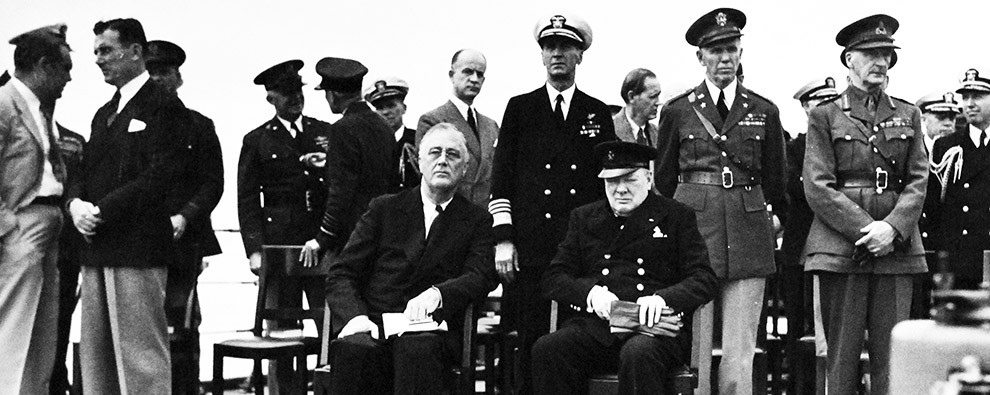
The Atlantic Charter Conference began between U.S. and UK leadership. Royal Navy battleship HMS Prince of Wales arrives in Placentia Bay carrying British Prime Minister Winston Churchill to the Atlantic Conference (codenamed Riviera). President Roosevelt has been waiting there for Churchill aboard heavy cruiser USS Augusta for a couple of days idling his time by fishing off the forecastle. The two men quickly get down to business. Meeting on Augusta over lunch and dinner, Churchill and Roosevelt hammer out any remaining issues concerning the Atlantic Charter which the two men intend to sign during the four-day conference. After dinner, Churchill returns to Prince of Wales. The top military staff of the U.S. and the UK get to know each other in a similar fashion.
King George VI arrives at Scapa Flow for an inspection.
Food Minister Lord Woolton warned the British today that they could not expect any increase in the present meat ration until the end of the war. The present ration is one shilling two pence worth a person a week.
The British are preparing to take vigorous direct action in Iran within ten days to force the expulsion of the large numbers of Germans from Iranian territory, according to information disclosed by high foreign military and diplomatic sources today at Ankara.
As the one hundred-first week of the war ended today, Associated Press records showed that at least 1,813 ships of all nations had been lost and 14,859 persons killed in the conflict at sea. From the sinking of the 13,581-ton liner Athenia on Sept. 3, 1939, the day that Britain declared war on Germany, to the newly-reported torpedoing of the 3,576-ton Greek freighter Nikoklis, a known total of 6,829,004 tons of merchant and naval shipping has been sunk or scuttled. This represent an average of two ships and 21 lives lost each day. The tragic toll also includes the listing of 9,217 persons as missing nearly 13 a day most of whom must be given up as dead.
Royal Navy destroyer HMS Croome rams and sinks Italian submarine Maggiore Baracca northeast of the Azores.
Some sources state that U-206 (ObltzS Herbert Opitz), on its first patrol out of Trondheim, sinks 202-ton British fishing trawler Ocean Victor today. Other sources claim that Ocean Victor is sunk by the Luftwaffe. In any event, Ocean Victor sinks southeast of Iceland roughly halfway between Iceland and the Faroe Islands.
The Luftwaffe bombs and sinks 2345-ton British freighter Cordene, which is traveling in Convoy FN.503 a few miles east of Cromer in the North Sea. Escorting destroyer HMS Electra, on its first escort mission after a refit, picks up the entire crew and takes them to Scapa Flow.
The Luftwaffe bombs and sinks Norwegian 1392-ton freighter Dagny about 20 km east of the southern Faroe Islands. Dagny is in tow of trawler Leicester City when it is attacked. There are two deaths, the rest of the remaining 61 crew and passengers on board are picked up by the trawler.
The Luftwaffe bombs and damages 868-ton British freighter Glendalough near where the Cordene is sunk off Cromer. Another ship tows Glendalough to Yarmouth Roads for emergency repairs, then to Hull for permanent repairs.
Royal Navy gunboat HMS MGB 62 collides with the gunboat HMS MGB 67, in the North Sea and sinks.
Norwegian submarine B.1 has an explosion in her engine room caused by her battery at Blyth. The explosion sets off some ammunition, causing extensive damage. The submarine is already under repair and this just adds to its time in the shipyard.
Royal Navy destroyers HMS Jervis and Kingston make a supply run from Alexandria to Mersa Matruh, while destroyers Decoy and Havock make a supply run from Alexandria to Tobruk.
The body of Captain Pilot Bruno Mussolini, who was killed two days ago in an air crash at Pisa, Italy, was buried with elaborate ceremony today in the family crypt at Dovia Di Predappio. Premier Benito Mussolini walked behind his son’s coffin for two miles In the procession from the church to the grave. Among the wreaths were two from the United States embassy. They were sent by Capt. Lawrence MacNair, naval air attaché, and Col. Norman Fiske, army air attaché.
The RAF has a light schedule today. Its only mission is a Circus Operation with five Blenheim bombers against the Gosnay power station. The bombers get lost or are deterred by fighter opposition and bomb Gravelines instead. All return to base.
During this mission, RAF Wing Commander Douglas Bader in his Spitfire Mk VA shoots down a Bf 109 and maybe a second when apparently his plane is hit by either friendly or enemy fire (Bader himself thinks it is a mid-air collision, but other records indicate this is unlikely). Bader successfully parachutes out after losing his right prosthetic leg which becomes ensnared in the falling aircraft (it is later found in an open field but is too damaged to use again). No German pilot is awarded the victory, suggesting strongly that it may have been friendly fire, and there is some other inconclusive evidence to support that theory.
Bader has 22 aerial victories, four shared victories, six probable victories, one shared probable victory, and 11 enemy aircraft damaged.
The Germans treat Bader with great respect, as they are well aware of RAF propaganda heroes. JG 26 commander Adolf Galland has lunch with Bader but refuses Bader’s request to “try out” a Bf 109, explaining, “It would pain me to have to chase you and shoot you down.” The Germans are a little too respectful, it turns out, as Bader attempts to escape from his hospital but is quickly recaptured.
Hermann Göring, a former fighter pilot himself, personally authorizes the RAF to air-drop a replacement artificial leg for Bader at St. Omer airfield in the “Leg Operation” on 19 August. Galland later recalls that the British also drop bombs on the Luftwaffe airport in addition to the replacement leg.
RAF Bomber Command, Day of 9 August 1941
5 Blenheims on a Circus operation to Gosnay power-station bombed an unidentified target at Gravelines instead, without loss.
At Malta, an RAF No. 69 Maryland on patrol over Sicily drops a few bombs in August, damaging some buildings.
Air Marshal Arthur Coningham arrives in Egypt from London and takes command of RAF No. 204 Group in North Africa.
The fourth raid on the Suez Canal area this week killed eleven persons overnight, wounded seven and caused slight damage, it was reported today.
Destroyer HMS Electra, her refitting completed, departed Sheerness at 0615 as additional escort for convoy FN.503. Steamer Cordene (2345grt) in the convoy was sunk by German bombing in 53-00-32N, 1-48-30E, but the entire crew was rescued. Electra arrived at Scapa Flow on the 11th.
Dutch submarine HNLMS O.14 departed Scapa Flow for the Faroes and anti-submarine patrol.
Motor gunboat MGB.62 was sunk in a collision in the North Sea.
Norwegian submarine HNoMS B.1 was damaged by an explosion of her battery and ammunition while under repair at Blyth.
Steamer Glendalough (868grt) was damaged by German bombing in 52-56N, 2-02E, towed to Yarmouth Roads, then to Hull.
Norwegian steamer Dagny I (1392grt) was sent by light cruiser HMS Nigeria from Spitzbergen to Thorshavn, and safely arrived on the 7th. The steamer and whaler Wastwater then departed at 1105/9th for Kirkwall. En route, Dagny I was attacked by German bombers in 61-40N, 6-10W at 1430/9th and sank at 0900/10th in tow of trawler Leicester City. Two passengers were killed, and the survivors rescued by Leicester City.
Destroyer HMS Impulsive departed Scapa Flow at 0600/10th and proceeded to Thorshavn to embark the 61 survivors from the steamer. She arrived at 1800 and departed at 1930 for Scrabster, arrived there at 0700/11th and disembarked the volunteers. Impulsive arrived back at Scapa Flow at 0840.
U-206, commanded by Oberleutnant zur See Herbert Opitz, sank the British steamer Ocean Victor (202 GRT). At 0528 hours on 9 Aug 1941 the Ocean Victor (Master Marquis Silverstone Slater) was hit by one torpedo from U-206 and sank immediately southeast of Iceland. The trawler was reported missing after leaving Iceland.
German destroyers Hans Lody, Friedrich Eckholdt, and Richard Beitzen made a sweep towards Kilden Island and the mouth of the Kola Inlet, and sank Soviet patrol ship SKR.12. On their return, Richard Beitzen was bombed and damaged by near misses from Soviet aircraft. The destroyers arrived back on the 10th.
German steamer Gertrud III (210grt) was sunk on a mine near Windau.
Destroyers HMS Jervis and HMS Kingston departed Alexandria for Mersa Matruh, and returned to Alexandria on the 10th.
Destroyers HMS Decoy and HMS Havock departed Alexandria with supplies for Tobruk.
Destroyers HMS Kandahar and HMAS Vendetta departed Alexandria to rescue a crew of a bomber in the sea about 180 miles northwest of Alexandria, but were later recalled.
Convoy HG.70 departed Gibraltar, escorted by destroyers HMS Eridge and HMS Avonvale, submarine HMS Clyde, corvettes HMS Begonia, HMS Jasmine, HMS Larkspur, HMS Pimpernel, and HMS Rhododendron, and anti-submarine trawlers HMS Lady Hogarth and HMS Lady Shirley. The trawlers were detached that night. Destroyers HMS Faulknor joined the escort on the 10th as Senior Office Escort. She was returning to England for turbine repairs at Portsmouth. Clyde was detached and arrived at Gibraltar on the 11th. On the 11th, destroyers HMS Encounter, HMAS Nestor, sloop HMS Deptford, and corvette HMS Convolvulus joined. All but Nestor of this group were detached that evening. On the 12th, HMS Boreas and HMS Wild Swan joined the escort. They had departed Gibraltar on the 11th with destroyers HMS Duncan and HMS Forester, later joined by destroyer HMS Fury, for an anti-submarine sweep west. After the sweep, the two destroyers proceeded to join HG.70. Sloop HMS Stork joined the convoy on the 13th and was detached that evening. Boreas and Nestor were detached on the 13th, Avonvale and Eridge on the 14th, and Wild Swan on the 15th. They all arrived at Gibraltar on the 16th. Destroyer HMS Cossack joined the escort on the 14th and was detached that night. Destroyer HMS Duncan, which departed Gibraltar on the 13th, and sloop HMS Black Swan joined the escort on the 15th. Black Swan was detached on the 21st. Duncan arrived at Londonderry on the 20th; she departed on the 22nd for convoy OG.72 for the return to Gibraltar. The convoy arrived at Liverpool on the 23rd.
After a commercial aircraft sighted a suspicious merchant ship in 46-37N, 9-22W, destroyer HMS Wishart, which had been detached from convoy HG.34F on the 8th, was directed to investigate. Light cruiser HMS Hermione departed Gibraltar at 2330/9th to attempt to locate merchant ship. On the 10th, heavy cruiser HMS London, detached from convoy WS.10, also proceeded to this position. No contact was made by any of the searching warships. On the 11th, Hermione was ordered to return to Gibraltar, arriving on the 13th.
Destroyer HMS Duncan departed Gibraltar to join destroyers HMS Wivern, HMS Wild Swan, and HMS Boreas, which had departed Freetown on the 3rd and refueled at Bathurst, en route. Wivern had developed condenser problems and was in tow. The four destroyers arrived at Gibraltar on the 10th.
Submarine HMS Severn sighted an Italian submarine in 35-16N, 10-09W, but the Italian submerged before Severn could attack.
Submarine HMS Parthian arrived at Gibraltar from Malta. On the 11th, she departed Gibraltar for Portsmouth. On the 28th, she left Portsmouth and arrived at Portsmouth, New Hampshire on 16 September for refitting completed on 30 January 1942.
The Atlantic Charter Conference began. British battleship HMS Prince of Wales, with British Prime Minister Winston L.S. Churchill embarked, arrives at Placentia Bay, Newfoundland, escorted by destroyer HMS Ripley [ex-U.S. destroyer Shubrick (DD-268)] and Canadian destroyers HMCS Restigouche and HMCS Assiniboine. In this first meeting between the two men, Churchill calls upon President Roosevelt on board heavy cruiser USS Augusta (CA-31); the two confer over luncheon and dinner before the prime minister returns to Prince of Wales.
Winston Churchill arrived at Placentia Bay aboard the battleship HMS Prince of Wales and ferried over to Roosevelt’s ship for their first meeting.
In a memorandum from U.S. Secretary of State Cordell Hull to British Ambassador to the United States Lord Halifax, Hull resolved to confer at once with Britain in the event of further Japanese movements south: “The Ambassador made some inquiry about the amount of aid this Government might give in case Singapore or the Dutch East Indies should be attacked.”
House Republicans drafted amendments by the dozen today for attempts to modify Administration legislation which would keep the Army’s rank and file in service indefinitely, while Democratic leaders talked privately of compromise. Polls taken by leaders of both parties showed that the vote next week on the question of unlimited extension of service would be so close that a few members, now uncommitted, might turn the outcome either way. But, at the same time, these surveys indicated that an eighteen-month continuation, already approved by the Senate, might win a House majority. Democrats said the fate of the bill probably would be determined by the votes of their large groups from New York City, Philadelphia and Chicago. As the leaders sought to influence a group of thirty or forty “doubtful” Democrats, Republican members of the House Military Committee arranged a conference to discuss their strategy.
Steel, most basic of war materials, was placed under 100 percent priority control by the Office of Production Management today to insure that defense requirements are met “uncompromisingly ahead of non-defense needs.” A steel deficit of 11,000,000 tons for the current year was forecast officially, but it was emphasized that there was plenty for defense and that it would be civilian supplies which would be reduced. An important feature of the priorities order, signed by E. R. Stettinius Jr., OPM Priorities Director and former chairman of the board of United States Steel Corporation, is that steel companies must accept all defense orders, even though their mill capacity may be fully contracted for by defense and non-defense orders, and must fill the new defense orders ahead of previously placed civilian contracts.
Charles A. Lindbergh made a speech in Cleveland in which he accused American interventionists of plotting to create “incidents and situations” that would plunge the United States into war “under the guise of defending America..” Lindbergh charged tonight that the nation was operating under a policy of government by subterfuge leading to war. “I fully realize that the charge of subterfuge is serious in the extreme,” he said in an address at an America First rally, “but let me recall to your mind a few facts that lie behind it.” Lindbergh asserted that while the American people were promised peace, the British were told the United States would enter the war. He charged that President Roosevelt had not renewed his election promise that American boys would not be sent to fight in a foreign war. He said the American people were misled by substituting the word “patrol” for “convoy.” “The hypocrisy and subterfuge that surrounds us comes out in every statement of the war party,” he asserted.
Labor difficulties developed yesterday at the Philadelphia Navy Yard while the strike which has immobilized the huge Kearny, New Jersey, yards of the Federal Ship Building & Dry Dock Co. showed no sign of ending. Navy officials said that a work stoppage by 348 A.F.L. carpenters and dock workers had seriously delayed national defense work at the Philadelphia yard, where some of the country’s big fighting ships are built. The commandant referred the case to the navy department at Washington. He said that the stoppage was due to refusal of the carpenters to abide by a master wage agreement fixing a uniform pay of time and a half for overtime and Saturdays. No further word came from officials who indicated Friday that the government was prepared to take direct action to get production resumed at the Kearny yards. The strike, affecting $193,000,000 of ship orders, centers on demands by the C.I.O. Industrial Union of Marine and Shipbuilding workers for a union shop. About 17,000 employees are idle.
The Navy Department announced tonight that it planned to take over Pier 92, on the Hudson River in New York City, formerly used by the Italian Line. A naval receiving station will be established there, the announcement said.
A sharp earth shock at 9:05 PM broke windows and cracked plaster in buildings in Juneau, Alaska. Residents rushed from the downtown section, but no injuries were reported.
Warner Bros. releases “Manpower,” directed by Raoul Walsh and starring Edward G. Robinson, Marlene Dietrich, and George Raft. The film received a lot of publicity during filming due to a reported fistfight on the set between Raft and Robinson, reportedly due to Raft’s resentment at Robinson’s late hiring which made Robinson the headliner instead of Raft (this may all be studio fakery, though, because it rather suspiciously mirrors a film plot point). Raft turned down “The Maltese Falcon” to make “Manpower,” a pretty poor career decision, as “Falcon” made Humphrey Bogart a major film star after years of being just a character actor. “Manpower” goes on to become a box office hit, though it gets mixed reviews and never achieves the rank of a true classic in most filmgoers’ eyes.
The Looney Tunes cartoon “We, the Animals Squeak” is released on 9 August 1941. It is a colorized Looney Tunes cartoon starring Porky Pig. The cartoon is directed by Bob Clampett. The voices are performed by Mel Blanc, Sara Berner, Billy Bletcher and Michael Maltese. This is one of the Porgy Pig cartoons that is colorized. “We, the Animals Squeak” is a parody of the 1930s radio program, “We the People,” an early reality program where people would share unusual stories with the audience. Porky Pig is the program’s moderator.
Major League Baseball:
The Washington Senators knocked Lefty Grove out of the box today and went on to win their first game of the season at Boston’s Fenway Park from the Red Sox, 8–6. The Senators’ winning runs came in the ninth inning at the expense of young Joe Dobson, who had relieved Grove in the eighth after that veteran had been pounded for sixteen hits.
At Ebbets Field, a grand slam by veteran Paul Waner is the difference as Boston edges the Dodgers, 8–7. Waner was released by the Dodgers in May. Brooklyn stays in first place by .003 as the Cardinals lose to the Pirates in 13 innings.
Elmer Riddle, victor in eleven straight before he lost two games, went back into winning ways today when the Reds defeated the Cubs, 7–2, with a volley of twelve hits. Riddle limited Chicago to eight hits, one of which was Bill Nicholson’s twentieth homer. Babe Dahlgren accounted for three safeties.
The White Sox blasted the Indians for five runs in the fourth and a pair in the tenth, including Taft Wright’s homer, to give Fireman Bob Feller his eighth defeat of the season today, 7–5.
The Tigers regained fifth place today in the American League in their seesaw battle with the Athletics by defeating the Browns, 3–0, behind the six-hit pitching of Lefty Hal Newhouser. It was the third straight victory and the fifth in six starts for the Tigers.
The Phillies tried to steal a ball game yesterday at the Polo Grounds, but the Giants thwarted the desperate plot, beating Philadelphia, 1–0. As a reward, the Giants romped off the field with victory in their possession to celebrate their longest winning streak since July 13–14, two straight.
The New York Yankees subdued the Philadelphia Athletics, 8–3, as Charlie Keller (28th of the year) and Joe DiMaggio (27th) homered for the Yankees. Charlie Ruffing (13–4) got the victory. A’s starter Johnny Babich lasted just wo batters before a line drive to the hand ended his day.
Frankie Frisch’s red-hot Pirates are really taking this pennant drive business seriously. Already within striking distance of Brooklyn and St. Louis, they moved up another notch today by taking a 5–4 decision from the Cardinals in a thrilling contest that went thirteen innings after it appeared they were going to enjoy a field day. Now the Pirates are seven and one-half games behind the leading Dodgers and the runner-up Cards.
Washington Senators 8, Boston Red Sox 6
Boston Braves 8, Brooklyn Dodgers 7
Cincinnati Reds 7, Chicago Cubs 2
Chicago White Sox 7, Cleveland Indians 5
St. Louis Browns 0, Detroit Tigers 3
Philadelphia Phillies 0, New York Giants 1
New York Yankees 8, Philadelphia Athletics 3
Pittsburgh Pirates 5, St. Louis Cardinals 4
The morale of U.S. Army troops stationed at the Panama Canal is exceptionally high and military contingents there are “ready for any emergency,” according to Major General Sanderford Jarman, who recently left his post as commander of the Panama Coast Artillery to take over a new assignment as commander of the Camp Stewart Anti-Aircraft Center in Georgia.
Authoritative sources announced today the detention of four persons and the seizure of a quantity of arms at Puerto Montt in what was described as a pro-Nazi plot in far southern Chile. Authorities at Puerto Montt said the plot, in a section where numerous German colonists have settled, was directed against “democratic institutions” of Chile.
U.S. Secretary of State Cordell Hull gives a memorandum to Lord Halifax, the British Ambassador. It provides that Hull will confer with his counterpart in England (currently Anthony Eden) in the case of further Japanese military movements to the south (apparently meaning beyond French Indochina).
Incendiary time bombs destroyed the five story Central China Daily News building today on the anniversary of the outbreak of hostilities between Japan and Chinese forces here in 1937. The newspaper, owned by Wang Ching-wei, head of the Japanese-sponsored Nanking regime, was forced to suspend publication. The building was gutted. Paper stores and the printing plant were destroyed.
The Imperial Japanese Navy requisitions 8606-ton freighter Kanto Maru and begins converting it into an armed auxiliary aircraft transport. The military version receives 120-mm (4.7-inch) guns at the bow and the stern.
The Imperial General Headquarters staff once again approves a strategy of attacking south toward the oil fields in Indonesia rather than attacking north into the USSR. Attacking the Soviet Union remains under consideration. However, the high command makes a firm decision to do nothing in that regard before the spring of 1942.
Australia now feels increasingly vulnerable to the menace of Japan. Notwithstanding all the crippling trade embargoes imposed on Japan following its move into Indochina, the Australian government is pressing for a definite joint declaration by Britain and the United States which might halt any further Japanese encroachment into Southeast Asia. As another Australian brigade, the 27th is committed to the Far Eastern garrisons, Robert Menzies, the Australian Prime Minister, is urging Britain to warn Japan that war will result if it attacks Thailand, with the consequent threat to Singapore. He believes that the war is taking an ominous turn.
Dow Jones Industrial Average: 126.4 (-1.08)
Born:
Paul Lindblad, American baseball pitcher (World Series champions, 1973-1974-A’s, 1978-Yankees; Kansas City-Oakland Athletics, Washington Senators-Texas Rangers, New York Yankees), in Chanute, Kansas (d. 2006).
Dick Sheridan, American College Football HOF coach (Furman University, North Carolina State University), in Augusta, Georgia (d. 2023).
Viv Prince, British drummer (Pretty Things — “Honey I Need”), born in Loughborough, England, United Kingom (d. 2025).
Shirlee Busbee, American romance novelist, in San Jose, California.
Naval Construction:
The Royal Navy LCT (Mk 2)-class landing craft, tank HMS LCT 135 is laid down by Stockton Construction (Thornaby, U.K.).
The U.S. Navy PC-461-class (173-foot steel hull) submarine chasers USS PC-493 and USS PC-494 are laid down by the Dravo Corp. (Pittsburgh, Pennsylvania, U.S.A.).
The U.S. Navy 77-foot Elco patrol motor torpedo boat USS PT-63 is laid down by the Electric Launch Company Ltd. (Elco), (Bayonne, New Jersey, U.S.A.).
The Kriegsmarine (German Navy) Type VIIC U-boat U-267 is laid down by Bremer Vulkan-Vegesacker Werft, Bremen-Vegesack (werk 32).
The Kriegsmarine (German Navy) Type VIIC U-boat U-360 is laid down by Flensburger Schiffsbau-Ges, Flensburg (werk 479).
The Royal Navy Isles-class minesweeping trawler HMS Shiant (T 170) is launched by the Goole Shipbuilding & Repairing Co. Ltd. (Goole, U.K.); completed by Amos & Smith.
The Royal Navy MMS I-class motor minesweeper HMS MMS 48 (J 548) is launched by the J.W. & A. Upham Shipyard (Brixham, England, U.K.).
The U.S. Navy coastal minesweeper USS Rhea (AMc-58) [ex-purse seiner], sole ship of her class, is launched by the Martinolich Shipbuilding Co. (Tacoma, Washington, U.S.A.).
The U.S. Navy Accentor-class coastal minesweepers USS Paramount (AMc-92) and USS Peerless (AMc-93) are launched by the Delaware Bay Shipbuilding Co. (Leesburg, New Jersey, U.S.A.).
The U.S. Navy 77-foot Elco patrol motor torpedo boat USS PT-46 is launched by the Electric Launch Company Ltd. (Elco), (Bayonne, New Jersey, U.S.A.).
The Royal Navy Bar-class boom defense vessel HMS Barbour (Z 169) is commissioned.
The U.S. Navy hospital ship USS Solace (AH-5) [ex-SS Iroquois] is commissioned. Her first commanding officer is Captain Benjamin Perlman, USN.
The Royal Navy Flower-class corvette HMS Cowslip (K 196) is commissioned. Her first commanding officer is Lieutenant Frederick Granger, RNR.
The Kriegsmarine (German Navy) Type 1936A destroyer Z28 is commissioned. Her first commanding officer is Korvettenkapitän (Lieutenant Commander) Hans Erdmenger.

