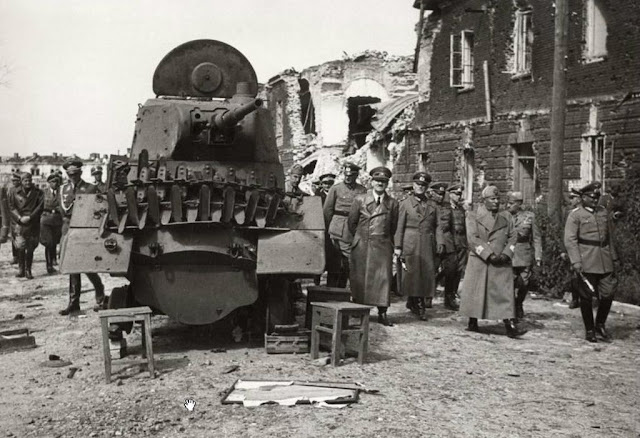
Adolf Hitler and Benito Mussolini possibly come very close to death at the hands of one or more Soviet soldiers on 8 August 1941 — if some unverified accounts are to believed. It is possible that Hitler comes closer to an armed and unsubdued Soviet soldier today than he does at any other point while he is alive — and the incident receives no attention at all. Why and how this happens requires a little explaining.
The Germans captured Brest Fortress back near the border with Poland on 29 June. According to some accounts, the fortress held out for another month, but that is contradicted by the evidence. The Wehrmacht’s 45th Infantry Division (Austrian) which subdued the fortress then moved east to join the general offensive by 2 July. Virtually all sources agree that Brest Fortress was solidly in German hands by the end of July, if not in June.
However, Brest Fortress was in ruins after multiple Luftwaffe raids and days of tank and artillery fire. There were lots of bombed-out areas that made good hiding places — collapsed rooms and the like. Apparently, one or more Soviet soldiers remained hidden in the ruins, undetected by the occupying Germans, long past the surrender in June (or July, if you like). There is an inscription on the fortress walls that is dated 7 July 1941 (“I’m dying but I won’t surrender. Farewell, Motherland. 20.VII.41”), presumably made by a trapped and uncaptured Soviet soldier. So, there is proof of Soviet resistance extending into July, at least.
At this point, the story gets sketchy. Major Pyotr Gavrilov, later decorated as a Hero of the Soviet Union as if to stamp certainty on the later presence of unsubdued Soviet defenders, reportedly (everything about the details is uncertain) is captured only on 23 or 24 July (accounts vary on the exact date). That may be the end of Soviet resistance — but maybe not. Some believe that at least one Soviet soldier remains hidden even longer. And that’s where Hitler and Mussolini (literally and figuratively) come in.
After visiting the headquarters of Army Group Center and South on 6 and 7 August, respectively, Hitler decides to lead his fellow dictator on a tour of significant locations in the rear. It is a sort of sightseeing tour, designed to impress Mussolini with the mighty destructive power of the Wehrmacht. Today, 8 August 1941, the pair decide to visit Brest Fortress, which has received a great deal of attention in the international press during the first month of Operation Barbarossa. They come attended by the usual heavy security, walk through the fortress, and then leave.
Here is where the two stories intertwine. According to some accounts, only today are the final armed Soviet defenders rooted out of the bombed-out ruins of Brest Fortress. As noted, this coincides with Hitler’s visit. Given Hitler’s predilection for walking ahead of most of those accompanying him (as evidenced by photos of such walk-throughs by Hitler, including the one above), it is not beyond the realm of possibility that one of those hidden Soviet soldiers could have had a clear sight and gotten off a lucky shot at just the right moment. This would have altered history for both Germany and Italy and, really, the entire world.
But that doesn’t happen. Hitler and Mussolini visit and then leave unharmed. And, the course of World War II continues on toward its inevitable conclusion.
In the Far North sector, The Finns consolidate their new holds on Kestenga and the northern shore of Lake Ladoga. Finnish Group J of 6th Division of III Corps (a reinforced regiment) Continues pursuing the retreating Soviets east past Kestenga. A good road and a railway line lead directly to the Murmansk railway a few dozen miles away, and prospects appear good for cutting that line and further isolating the Soviets from the West. The Soviets are frantically directing troops to Loukhi on the railway line, but there are few spare units to be found.
In the Army Group North sector, the Germans open an offensive against the Soviet Luga River defensive line. German 1 Panzer Division (Lieutenant General Friedrich Kirchner) and 6 Panzer Division (Major General Franz Landgraf) battle Soviet 111th and 125th Rifle Divisions. Other German troops in 41 and 38 Corps advance to attempt to cut the Narva-Leningrad railroad.
In the Army Group Center sector, German XXIV Corps (General of Panzer Troops Geyr von Schweppenburg) eliminates a Soviet pocket at Roslavl and take 38,000 prisoners. The German 3rd Panzer Division (Lieutenant General Model) complains that it has to wait too long for supplies to arrive on the overburdened railroads.
In the Army Group South sector, Soviet resistance at Uman ends. About 103,000 captured Soviet troops of the Soviet 6th and 12th Armies, the commanders of the 6th and 12th armies, four corps commanders, and 11 division commanders are among those waiting to be processed and sent to POW camps. General von Kleist redirects his Panzer Group 1 north toward Kieve to support Sixth Arm and form a pincer envelopment by meeting Guderian’s Panzer Group 2 advancing from the north.
The Romanian General Staff issued Directive No. 31 calling for the capture of Odesa and the defeat of Soviet forces between the Dniester River and the Tiligulskiy Estuary in Ukraine.
It is day three of the Romanian investment of the Soviet-held port of Odesa. The Romanian 4th Army gradually extends its line to form a solid line around the city. Some sources claim that today is the real start of the Siege of Odessa and not 5 August. The surrender at Uman further isolates Odesa and makes any kind of relief increasingly unlikely.
The Russian Black Sea Fleet (Rear Admiral G. V. Zhukov) establishes a new task group to support army operations along the coast in the Black Sea. Part of the new task group is based at the besieged port of Odesa.
Soviet Marshal Timoshenko, commanding the armies defending Moscow, issues a proclamation to all Soviet citizens behind enemy lines encouraging them to become partisans. He urges them to “wreak merciless vengeance on the enemy… for the death of your children…” Given the style of the Wehrmacht’s advance, which has been to drive east along the roads as fast as possible while bypassing Soviet troops in the forests and marshes, there is a large reservoir of potential Soviet manpower hidden to the west of the “front.”
In Montenegro, General Alessandro Pirzio Biroli orders the confiscation of insurgents’ property. The revolt that began on 13 July still continues with little interference from the Italian occupation authorities. The Italians are assembling strong forces for a counter-offensive which include six divisions (Messina, Puglie, Pusteria, Taro, Venezia, and Cacciatori delle Alpi), two Blackshirts Legion (Nos. 108 and 164), two combat groups (I group of Cavalry Regiment Cavalleggeri Guide and Skanderbeg) and two battalions of the border guard. While this is a formidable force, the territory is very rugged and difficult to subdue.
The pro-Nazi Rexist leader Léon Degrelle, a deeply committed fascist and now a member of the “Walloon Legion” of the Wehrmacht, accompanies the 800+ troops east toward the front. As Degrelle will be otherwise engaged for some time to come, he turns over the leadership of the Rexists to Victory Matthys. While some sources claim that Degrelle “leads” the Walloon legion into combat, in fact, he has no military experience and has joined as a private.
A big fan of artillery (he calls it the “Queen of battle”), Joseph Stalin orders the formation of eight Guards mortar regiments to operate Katyusha rocket launchers. These units will be placed with Guards formations, which are ordinary army units that have distinguished themselves in combat.
The Soviets officially form the Stavka of the Supreme High Command [Stavka Verkhnogo Glavnokomandovaniia — SVGK]. This replaces some previous temporary command arrangements and more closely resembles the command structure of previous wars. Stalin, of course, is the Supreme High Commander and uses the other members of the Stavka (such as General Georgy Zhukov) to submit ideas and act as troubleshooters to go to special Fronts and run special operations there.
During the night, a Soviet air attack was made on Berlin, Germany by naval Ilyushin Il-4 twin-engine bombers.
Soviet destroyer Valerian Kuibyshev made rendezvous with British submarine HMS Tigris off northern Russia.
The Soviet Izyaslav-class destroyer Karl Marx was bombed and sunk in Loksa Bay by the Luftwaffe.
The Russian Danube Flotilla supports the Red Army’s withdrawal past the Bug River Delta from today through 12 August.
The Luftwaffe (Ju-88 aircraft of KGR.806) bombs and sinks Soviet Izyaslav-class destroyer Karl Marx in Loksa Bay near the Estonian capital of Tallinn (Reval).
Soviet destroyers Statny and Surovy park offshore in Moon Sound and shell German coastal battery Markgraf.
Soviet patrol vessel No. 410 and auxiliary minesweeper No. 76 are lost today from unknown causes, perhaps scuttling to avoid German capture.
German minelayers lay minefields D.10 to D.30 and Finnish minelayers lay minefields F-18 to F-22 in the Gulf of Finland.
German troops and Lithuanian collaborators massacre Jews in the village of Zeimel. A plaque is later erected in the Chamber of the Holocaust at Mount Zion which reads:
“For an everlasting remembrance. For the martyrs of the Zeimel Community (Lithuania) who were annihilated by the Germans and their Lithuanian collaborators (may their names be erased) on the 8th day of August 1941. Remembrance Day 15 Av 5701. May their souls be bound up in the bond of life. [Signed]The Emigrants of Zeimel in Israel and the Diaspora.”
Thousands of Jews from Dvinsk, Latvia, are transported to the Pogulanka Forest and murdered.
The Nazi controlled “robber bank” in the Netherlands of Lippmann, Rosenthal and Co., referred to as “Liro”, issues its first decree, requiring Jews to register all assets and private property; additionally, they are to turn over to the Liro Bank all credits, securities, and large sums of Dutch and foreign currency. Jewish “customers” are allowed to keep a thousand guilders in cash, which they can use at their discretion.
Hungary also enacts anti-Jewish laws.
At the top-secret research center at Peenemünde, a German island in the Baltic, the Ministry of Aviation makes the first powered test flight of the rocket-powered Me-163 V1 KE+SW. Test pilot Heini Dittmar flies the revolutionary plane with its Walter RI-203b engine and achieves speeds of over 800 km/hr. Dittmar will continue testing this prototype throughout the fall, flying it roughly once a day while it is being tested, and achieve speeds over 1000 km/hr.
The swept-wing plane is extremely dangerous to fly for several reasons, including the fact that its rocket engine only works for about seven minutes to get to altitude, and then the pilot must glide from extreme heights to make an unpowered landing — with only one opportunity to “stick the landing.” In addition, the fuel is composed of two separate liquids that must be keep separated until ignition — and if for some reason they come into contact with each other, a massive explosion occurs.
Luftwaffe General Alexander Löhr was mentioned in the Wehrmachtbericht daily radio report for the third time. This is a high honor, akin to receiving a medal in terms of prestige gained. It is especially significant because Löhr is not German, but Austrian.
Convoy WS.8C (Winston Special) departs from the Clyde and heads to Scapa Flow as part of Operation LEAPFROG. This is a scheduled operation to seize the Azores Islands. There are numerous landing ships, oilers, and freighters escorted by eight destroyers.
Operation Famagusta, the British reinforcement of Cyprus, continues when Royal Navy sloop Flamingo departs Port Saudi with 6676-ton transport Salamaua heading for Famagusta.
An Axis convoy of four freighters and four destroyers departs from Naples bound for Tripoli.
Royal Navy submarine HMS Thunderbolt arrives in Malta carrying aviation fuel.
Yugoslavia was dissolved, with Italy annexing large areas.
RAF Bomber Command, Night of 8/9 August 1941
Kiel
50 Hampdens and 4 Whitleys to attack the submarine yards. 2 Hampdens and 1 Whitley lost. The Kiel diarist makes some interesting points on this raid.* The Flak barrage was so intense ‘that it reminded old soldiers of 1914-1918 Western Front offensives’. 13 people were killed but 11 of these were Italian workers housed at an experimental farm outside Kiel. The survivors of ‘our allies’ then expressed a wish to return to Italy. There was little damage in Kiel; a gasometer is mentioned as having been damaged.
Hamburg
44 Wellingtons to railway and shipyard aiming points. 1 aircraft lost. The target was cloud-covered and only scattered bombing resulted. 5 people were killed, 8 injured and 20 bombed out and the fire brigade had to deal with only one fire.
The RAF also sends seven Hampdens without loss to lay mines in the Frisian Islands, off Kiel, and in the Norwegian fjords.
First rocket powered flight by the Me 163 V1 KE+SW.
7 Hampdens minelaying in the Frisians, off Kiel and in the Norwegian fjords. No losses.
Destroyer HMS Puckeridge arrived at Scapa Flow at 1300 from Rosyth to work up.
Destroyer HMS Active departed Scapa Flow at 2000 for Rosyth for boiler cleaning. The destroyer arrived at 0700/9th.
Destroyer HMS Croome departed Scapa Flow at 1730 for Liverpool on completion of working up exercises, and arrived at 1500/9th.
Polish destroyer ORP Garland arrived at Hvalfjord with anti-submarine trawler Sealyham and oiler RFA Oligarch, and then reverted to the Western Approaches Command.
Anti-aircraft ship HMS Curacoa departed Scapa Flow at 1200 to escort convoy WN.63 from Pentland Firth southward. She arrived at Rosyth at 0600/11th to clean boilers and carry out repairs.
Minesweeper HMS Selkirk was damaged by a near miss of German bombing, but did not spend any time out of action.
Swedish steamer Venersborg (1065grt) was damaged by bombing in the Great Belt, and towed to a Danish port.
Soviet destroyer Karl Marx was sunk by German bombing at Reval.
Destroyers HMS Hero and HMS Jaguar departed Alexandria for Mersa Matruh to intercept an enemy supply ship reported by air. No contact was made and the destroyers returned to Alexandria, arriving on the 9th.
Destroyers HMS Decoy and HMS Hotspur were at sea exercising with submarine HMS Otus.
Sloop HMS Flamingo departed Port Said with motor transport ship Salamaua for Famagusta in Serial S.16 of the GUILLOTINE operation. The sloop arrived at Famagusta on the 10th and sailed for Port Said, where she arrived on the 11th. Serial S.17 of the Operation was cancelled.
Destroyers HMS Vansittart and HMS Velox joined aircraft carrier HMS Eagle and light cruiser HMS Dunedin at sea and escorted them to Freetown, arriving on the 10th.
Convoy WS.8C (Exercise LEAPFROG) departed the Clyde at 0500/8th with landing ships Karanja, Royal Scotsman, Ulster Monarch, Bachaquero, Misoa, Queen Emma, and Prince Charles, oilers RFA Dewdale and RFA Ennerdale, steamers Narkunda, Winchester Castle, Batory, Ormonde, Clan Macdonald, Macharda, Suffolk, Dunedin Star, Silverteak, and Potaro, escorted by destroyers HMS Bulldog, HMS Intrepid, HMS Echo, HMS Charlestown, HMS Castleton, HMS Whitehall, HMS Winchelsea, and HMS Witch. This convoy was the force for the intended seizure of the Azores Islands. The convoy entered Scapa Flow on the 10th. Steamers Suffolk and Potaro were in a collision when entering Scapa Flow. Destroyers HMS Douglas, HMS Leamington, HMS Georgetown, and HMS Saladin arrived at Scapa Flow on the 15th to escort the convoy.
When the operation was cancelled, the ships, less Suffolk and Potaro, sailed for the Clyde at 1400/15th, escorted by destroyers HMS Douglas, HMS Leamington, HMS Intrepid, HMS Charlestown, HMS Castleton, HMS Georgetown, HMS Antelope, HMS Saladin, and HMS Leamington and anti-aircraft ship HMS Pozarica. The convoy arrived back in the Clyde on the 17th.
President Roosevelt continues waiting aboard a cruiser at Placentia Bay for the arrival of British Prime Minister Winston Churchill aboard a battleship.
A special navy dispatch from the yacht USS Potomac said today that President Roosevelt’s cruise off the New England coast has been “uneventful.” He spent most of the day working on official papers. The yacht and the escort coast guard cutter Calypso moved close in shore today and received “fuel, water and provisions,” the message reported. Use of the word “uneventful” was the first indication from the Potomac that Mr. Roosevelt is cognizant of the widespread but unconfirmed reports that he had a rendezvous at sea with British Prime Minister Winston Churchill and Lend-Lease Administrator Harry L. Hopkins.
The Senate was in recess. Its Finance Committee opened hearings on the tax bill, hearing Secretary Morgenthau and Assistant Secretary Sullivan on Treasury recommendations.
The House debated the Military Service Extension Resolution and adjourned at 5:24 PM until 11 AM Monday. The Banking and Currency Committee continued questioning of Leon Henderson on the price control bill and the Rivers and Harbors Committee, tentatively approved by the St. Lawrence seaway project.
The House began consideration of the draft extension bill today, with prospects growing that even sharper modifications regarding retention of selectees than those adopted by the Senate might be forced into the measure before final enactment. Some House leaders even said that the provision to retain selectees for more than a year might be defeated. The bill came from the House committee in essentially the same form as the original Senate bill, giving the President authority to extend indefinitely the period of service of all members of the Army on the ground that the national interests were now imperiled. The Senate modified this by its vote of yesterday so as to permit retention of the men for only eighteen months beyond the periods now set by law. To this the opposition, as voiced by seven of the eleven Republican members of the House Military Affairs Committee, offered the argument that the national interests are now in better condition than they were a year ago; that there is, therefore, no necessity to retain the selectees longer than the year originally planned, and that if the national interests do become further imperiled the President has authority to call selectees discharged at the end of their year’s service back to duty for another year’s training.
Talks continue between the U.S. State Department and Japanese Ambassador Nomura in D.C. The Japanese now are proposing a summit meeting between President Roosevelt and Japanese Prime Minister Fumimaro Konoe, but U.S. Secretary of State Cordell Hull merely agrees to take the proposal under consideration.
U.S. Secretary of State Cordell Hull informed Japanese Ambassador to the United States, Admiral Nomura Kichisaburō that Japan’s counterproposal could not be considered as responsive to the U.S. President Franklin D. Roosevelt’s proposal for the neutralization of Indochina. The Ambassador then inquired whether it might be possible to arrange for a meeting of the responsible heads of the two governments to discuss means of adjusting relations between the two countries.
If Japan imagines she finds herself dangerously encircled, she has accomplished that encirclement herself, Secretary of State Cordell Hull said today at his press conference.
While Leon Henderson was advocating the administration’s price-control bill today before a congressional committee as a weapon of democracy, he was denounced on the house floor by Representative Dies, Texas Democrat, as having been a member of “five Communist-controlled organizations.” “I wouldn’t put him In charge of dog catchers,’” Dies shouted. “The time has come to speak frankly.” Dies did not mention Henderson by name on the house floor, merely saying he was referring to a man who was about to be placed in charge of all price-fixing. Off the floor, however, he told newsmen he meant Henderson, who is head of the Office of Price Administration.
Treasury officials, declaring that the house-approved $3,200,000,000 tax bill was inadequate, submitted to the Senate Finance Committee today recommendations for raising $800,000,000 to $1,000,000,000 additional, partly by broadening the income tax base to cover millions of persons now exempt. The recommendations, submitted by Secretary Morgenthau, included: 1. Reduce personal exemptions. The official submitted a schedule based on $1,500 for married persons and $750 for single persons, as against present exemptions of $2,000 and $800. 2. Revise excess profits levies to reach earnings of many corporations now exempt. Increase in Estate, Gift Taxes Favored 3. Require Joint returns for husband and wife, but provide special relief when both work outside the home. 4. Reduce the “depletion allowances” granted to concerns engaged in extracting such natural resources as oil. 5. Abolish tax exemptions on state and local bonds. 6. Increase estate and gift taxes. Morgenthau and John L. Sullivan, assistant secretary of the treasury, promised to supply more detailed recommendations later.
The probability that President Roosevelt will be asked to commandeer the strike-bound Kearny, New Jersey, yard of the Federal Shipbuilding and Drydock Corporation increased today as Ralph Bard, Acting Secretary of the Navy, again asked the company to accept the recommendation of the National Mediation Board that it grant a “maintenance of membership” clause to the C.I.O.’s Industrial Union of Marine and Shipbuilding Workers.
Challenging the results of a National Labor Relations Board election at the Curtiss-Wright propeller plant near Caldwell, the International Association of Machinists tonight stepped in to take control of an unauthorized work stoppage of 300 of the 1,500 employees of the plant and called a strike effective tomorrow morning.
President William Green of the American Federation of Labor declared tonight that the European conflict “is no longer a foreign war” and enjoined trade unionists to hew “a great battle line against enemies of our nation.” He envisioned a crisis “in the months ahead” when “wage earners of America will probably be called upon to make decisions which will have far-reaching effect upon our lives,” but he promised that labor would “face the future vigilant, determined and unafraid.”
Anti-Communist forces at today’s session of the convention of the United Automobile Workers-C.I.O. decisively defeated a committee report intended to permit Lew Michener, alleged tool of the Communists in the North American Aviation strike, to resume his post as regional director on the West Coast.
Paramount Pictures releases “Wide Open Town,” a Hopalong Cassidy film starring William Boyd and Russell Hayden. Evelyn Brent appears as a villainous saloon owner who develops feelings for Hopalong Cassidy, which ultimately dooms her corrupt regime in the town. A “wide-open town” is Wild West parlance meaning there is no sheriff.
MGM releases “Whistling in the Dark,” a comedy directed by S. Sylvan Simon and starring Red Skelton, Conrad Veidt, and Ann Rutherford. This becomes a very successful film about an actor in radio murder mysteries (Skelton) who gets involved in solving crimes. This film leads to two sequels, “Whistling in Dixie” (1942) and “Whistling in Brooklyn” (1943). Eve Arden also appears.
Les Brown and His Orchestra, with vocal by Betty Bonney, record the song “Joltin’ Joe DiMaggio” for Okeh Records. The song pays tribute to baseball great Joe DiMaggio who set a new record this year by getting hits in 56 consecutive games.
Major League Baseball:
The Senators, who haven’t won a game this season in Boston, never had a chance today to break that spell as the Red Sox let loose with a six-run barrage in the first inning and coasted to a 15–8 victory. Jimmy Foxx went 4-for-5 to lead the 16-hit Boston onslaught.
The Dodgers beat the Braves, 6–2, and vaulted back into first place in the National League, moving ahead of the idle Cardinals by three percentage points. John Whitlow Wyatt recorded his fifteenth triumph of the campaign. The Dodgers collected a dozen hits off Jim Tobin, including Joe Medwick’s thirteenth homer of the year, as well as doubles by Medwick, Wyatt and Jimmy Wasdell.
The Cubs 23-year-old rookie Paul Erickson wins his first Major League game, pitching a nifty one-hitter to beat the Pirates Johnny Lanning, 1–0. The Cubs collect 10 hits while Bob Elliott’s hit in the 7th is the lone Buc shot. That snapped a six-game Pirate winning streak.
The New York Giants beat the Philadelphia Phillies 3–2, as Babe Young hits his 15th homer of the year in the 11th inning. Bill Lohrman (7–7) gets the win, going the distance. Cy Blanton goes the distance for the Phillies and pitches about as well, but suffers the defeat.
The Philadelphia Athletics rallied for four runs in the fifth inning to defeat the New York Yankees, 5–3. Bob Johnson’s three-run homer was the major blow. Charlie Keller has three doubles and a single, but the rest of the Yankees have no success against Phil Marchildon. Even Joe DiMaggio is held hitless today.
The White Sox trounced the Browns, 16–2, today as Bill Dietrich tossed a neat four-hit performance. Taft Wright, who rapped out his fifth and sixth homers of the season, as well as a double, and George Dickey accounted for nine RBIs between them, with Wright driving in six.
Washington Senators 8, Boston Red Sox 15
Boston Braves 2, Brooklyn Dodgers 6
Pittsburgh Pirates 0, Chicago Cubs 1
Philadelphia Phillies 2, New York Giants 3
New York Yankees 3, Philadelphia Athletics 5
Chicago White Sox 16, St. Louis Browns 2
Convoy BA.4 departed Bombay, escorted by armed merchant cruiser HMS Hector, sloop HMS Cornwallis, and auxiliary patrol ship HMIS Dipavati. The sloop and patrol vessel were detached on the 9th. The convoy was dispersed on the 12th.
The Japanese continue their intensified air assault on the Nationalist capital at Chungking. As a climax to four days of sweeping air attacks on cities in Hunan, Kwangsi, Kiangsi, Shensi and Kansu Provinces, 140 Japanese planes subjected Chungking to a short but intensive bombing today.
Newspapers today published the United States and British warnings to Japan against occupation of Thai territory and interpreted them to mean that the United States and Britain would defend Thailand. Officials were quoted as reiterating that Thailand needed no protection and would fight to preserve her independence even if “attacked on all sides.”
A stream of Japanese infantry, artillery and mechanized forces is said to be arriving daily in Phnom Penh and moving west and southwest to new garrison points. The location of the garrison points is a military secret. General Kabashi, commander of Japanese forces in Cambodia, established headquarters here.
Chinese sources say Chungking has ordered Kwangtung troops to remain at their posts because they were not needed on the Indo-China border. It is reported the Chinese are massing picked armies on the border with headquarters at Lungchow. These troops are said to be capable of meeting any Japanese thrust toward the Burma Road, even capable of taking the initiative against the Japanese. Informed quarters expect the Pearl River, Canton’s waterway, to be closed soon.
In conformity with the declaration of Koh Ishii, spokesman of the Cabinet Infomation Board, that, irrespective of British assurances to the contrary, the Japanese Government considers that military, economic and political encirclement of Japan by the United States, Britain China and the Netherlands Indies is an established fact, the Japanese press continued today to denounce the alleged actions of these powers and to warn of the consequences.
The Imperial Japanese Navy commissions 30,000-ton aircraft carrier HIJMS Shōkaku (翔鶴; “Soaring Crane”).
Australian Navy Minister W.M. Hughes, commenting on the Pacific situation, said yesterday that whether there was peace or war depended on Japan. Australia had done nothing to disturb the peace but was just sitting up and taking notice, he declared.
Dow Jones Industrial Average: 127.48 (-0.61)
Born:
George Tiller, American physician, in Wichita, Kansas (d. 2009).
Jeffery Flaws, Canadian Ultrarunner, in Calgary, Alberta, Canada.
Naval Construction:
The U.S. Navy YMS-1-class auxiliary motor minesweeper USS YMS-6 is laid down by Henry B. Nevins Inc. (City Island, New York, U.S.A.).
The U.S. Navy PC-461-class (173-foot steel hull) submarine chaser USS PC-464 is laid down by George Lawley & Sons Inc. (Neponset, Massachusetts, U.S.A.).
The Kriegsmarine (German Navy) Type VIIC U-boat U-627 is laid down by Blohm & Voss, Hamburg (werk 603).
The Nihon Kaigun (Imperial Japanese Navy) destroyer HIJMS Shimakaze (島風, “Island Wind”), sole ship of her class, is laid down by the Maizuru Naval Arsenal, Maizuru, Kyoto Prefecture, Japan.
The Royal Navy Bar-class boom defense vessel HMS Barbridge (Z 222) is launched by Lobnitz & Co. Ltd. (Renfrew, Scotland).
The Royal Navy Bangor-class (Diesel-engined) minesweeper HMCS Esquimalt (J 272) is launched by Marine Industries Ltd. (Sorel, Quebec, Canada).
The U.S. Navy cargo ship USS Procyon (AK-19; later AKA-2) [laid down as SS Sweepstakes] is commissioned. Her first commanding officer is Commander Lemuel Phillips Padgett, Jr., USN.
The Royal Navy LCT (Mk 2)-class landing craft, tank HMS LCT 131 is commissioned.
The U.S. Navy Accentor-class coastal minesweeper USS Limpkin (AMc-48) is commissioned.
The U.S. Navy Accentor-class coastal minesweeper USS Lorikeet (AMc-49) is commissioned.
The Royal Navy Dance-class ASW trawler HMS Coverley (T 106) is commissioned. Her first commanding officer is Lieutenant Robert Robertson Taylor, RNR.
The Nihon Kaigun (Imperial Japanese Navy) aircraft carrier HIJMS Shōkaku (翔鶴; “Soaring Crane”), lead ship of her class of 2, is commissioned. Her first commanding officer is Captain Jojima Takatsugu.

