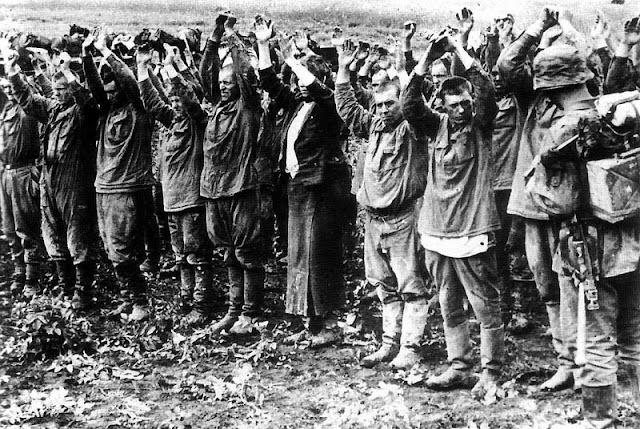
Most of these men are going to die in the next year and a half.
While the Wehrmacht retains the initiative throughout the Soviet Union as of 5 August 1941, casualties are mounting. Virtually every active division has thousands of casualties, some topping 4,000 men (out of a strength of 17,000). The OKH requires 24 trains a day just to maintain daily supplies to the troops, but only 18 make the trip on average. Of course, Soviet losses are high as well. Aside from the many divisions captured in the large encirclements, Soviet divisions still in the field have been whittled down in some cases to fewer than 2000 men. The Soviets, however, have large reserves, while the Germans keep a much higher proportion of their total strength at the front.
In the Far North sector, Finnish troops continue advancing east toward Kestenga and the Murmansk railroad. At Petsamo, Finnish authorities take control of the very valuable Petsamo Nickel Company, a major source of nickel that the Germans badly need.
In the far North, German Dornier reconnaissance aircraft shadow Force A off the coast of Norway. Following the disastrous raids on Kirkenes and Petsamo and the desultory results at Spitzbergen, the Admiralty decides that further actions in the region are a bad idea and recalls the force.
In the Army Group North sector, German 18th Army (Colonel General Georg von Kuchler) approaches the Narva River and is besieging Tallinn. The Army Group has a line running from Kingisepp running south just east of Staraya Russa and Kholm and then linking up with Army Group Center’s 9th Army at Velikiye Luki.
In the Army Group Center sector, Soviet 16th and 20th armies in the “Smolensk pocket” (which isn’t actually in Smolensk) surrender. About 310,000 Soviets go into captivity along with their 3200 tanks and 3100 guns. It is a shattering defeat for the Red Army. The pocket was created by General Hoth’s Panzer Group 3 and General Guderian’s Panzer Group 2 sweeping on from their victory at Minsk and then splitting north and south to encircle Smolensk. Smolensk itself, the “gateway to Moscow”, fell on 16 July and the Russian forces east of the city were surrounded. At first they were contained only by the tanks, which had to wait for the infantry to arrive before attacking the pocket.
Marshal Timoshenko assembles a sketchy new defensive line about 20 miles east of Smolensk.
The German High Command claimed: “the mass of Soviet forces surrounded east of Smolensk is now annihilated. The remainder faces disbandment.”
Marshal Timoshenko, commanding several newly-raised armies, tried to rescue the trapped armies, but his attacks were poorly prepared and, although some units broke through, the rescue attempt failed.
The German infantry released by the end of Soviet resistance at Smolensk immediately moves forward to replace the 10th Panzer Division and Das Reich Motorized Division at Yelnya. The two German armored divisions are exhausted after having defended this “lightning rod” salient. The Soviets know that Yelnya is a key location because it controls a crossing over the Desna River and an east-west rail station.
General Guderian’s Panzer Group 2 continues to battle Soviet 28th Army near Roslavl, which the Germans have captured. The Soviets have about 35,000 troops trapped there with little hope of escape. Guderian launched his tanks against Roslavl on 1 August, captured it three days ago and badly mauled the Twenty-Eighth Army in the process. So total is this victory that many of the German soldiers think that there is little left between them and Moscow; they are putting up signposts pointing the way to the Russian capital. However, Hitler has already decided to switch Hoth to the north to reinforce the attack on Leningrad and Guderian to Kiev to the south, leaving Moscow to the infantry.
In the Army Group South sector, Romanian 4th Army (Lieutenant-general Nicolae Ciupercă) and German 11th Army approach the port of Odesa on the Black Sea. Today generally is accepted as the first day of the defense of Odessa. Romanian leader Ion Antonescu has been promised control over the entire region between the Dniester and the Bug rivers, but he has to occupy it first. The Soviets in Odessa have orders to make a last stand there — which means there will be no evacuation by sea. At Kyiv, the Soviet 5th Army counterattacks the German 6th Army with little effect.
The Provisional Government of Lithuania, a temporary government formed by members of the Lithuanian Activist Front (LAF) in Kaunas and Vilnius and seeking the goal of an independent Lithuania, is disbanded by the Germans. The Germans have no interest in independent states within their area of control, and the provisional government also is opposed to the Holocaust.
German communiqués continue to insist that territorial gains are not the main object of warfare — “what matters is that battles of extermination are proceeding.”
On the 5th of August 1941, 8,000 Jewish males were killed by the first cavalry company of the SS, near the village of Posienicze – Iwaniki, approx. 4 Km. north from Pińsk. The Nazis used the pretext that Jews were being taken to work as laborers for three days. About 8,000 Jewish men, including 20 members of the Judenrat, are ordered to repair a railroad track. However, they are marched to pits outside of town and executed. The murdering continued through the 6th of August. The German fourth cavalry arrived in Pińsk later on August 6th to help expedite the actions. On the 7th of August 1941, the two companies along with the local Polish militia drove Jews out of their homes to the gathering area near the village of Kozlakowicze, west from the Pinsk along the Pina river. The murder of Jewish males from the age of 6 upwards continued and another 3,000 were murdered. During these tragic days in the first days of August 1941 at least 11,000 Jewish males lost their lives. During the evening of the 8th of August, orders were received by the cavalry company to leave Pińsk and continue on to other destinations while combing the area as per the original plan. This later order enabled part of the Pinsk community – made up mainly of women and children – to live for a little over a year. Approximately 20,000 Jews were left behind after the departure of the SS cavalry units.
The siege of Tobruk drags on, with nightly bombing and Australian soldiers getting sick from bad food and water. The Germans bomb every night, but the days are generally quiet… and hot. And full of flies.
Operation Guillotine, the British reinforcement of Cyprus, continues. Australian light cruiser Hobart and three destroyers leave Port Said bound for Famagusta. In separate sailings, Australian sloop Parramatta also departs from Port Said escorting freighter Gujarat to Famagusta, while destroyer Kipling proceeds from Port Said to Famagusta as well. Greek destroyer Kondouriotis departs from Alexandria bound for Famagusta carrying torpedoes for the Fleet Air Arm Squadron No. 815.
Destroyers HMS Decoy and Hero make the nightly supply run to Tobruk without incident.
An Axis convoy departs from Naples bound for Tripoli with five freighters.
Secret Intelligence Service (SIS aka MI6) agent Bradley Davis parachutes into France to join the Alliance Réseau (network) partisan organization as a radio operator. He later turns into a double agent working on behalf of the Germans.
General Alessandro Pirzio Biroli, under orders from Mussolini to suppress the ongoing uprising in Montenegro “at whatever cost,” issues an order to the local population to surrender all firearms. Biroli makes plans to launch an Italian counter-offensive, the first by Axis troops against partisans in Yugoslavia or apparently anywhere else. He has six divisions with a total of 70,000 troops.
Vichy limits wine consumption to two liters per person per week.
Admiral Darlan is placed in charge of the Vichy police in North Africa. General Weygand is his subordinate.
The British imprison Vichy French General Dentz, former commander of French forces in the Levant. They refuse to release him until all Allied troops captured in the Levant and then spirited away to metropolitan France are returned and released.
RAF Bomber Command, Day of 5 August 1941
20 Blenheims on sweeps between the River Scheldt and the Frisians and on a Circus operation to St-Omer which was recalled. Several ships were attacked. No Blenheims lost.
RAF Bomber Command, Night of 5/6 August 1941
Mannheim
65 Wellingtons and 33 Hampdens; 2 Wellingtons and 1 Hampden lost. Good bombing results reported. The Mannheim — Ludwigshafen air-raid service recorded serious damage in several areas of Mannheim and in the northern part of Ludwigshafen. 5 commercial premises were totally destroyed — a cigar manufacturers, 2 paperworks, a shoe wholesalers and a railway office — and 3 more were damaged, including a rubber and celluloid factory badly damaged by fire when a bomber crashed on to it. The factory employed 2,200 people and production was reduced by 75 percent for 8 days. 10 dwelling-houses were destroyed and 572 damaged. 27 people were killed and 55 injured, though it is not known whether the 12 people known to have been hurt by falling Flak splinters are included in this total.
Karlsruhe
97 aircraft — 50 Hampdens, 28 Wellingtons, 11 Halifaxes, 8 Stirlings — to railway targets. 3 aircraft — 1 Halifax, 1 Hampden, 1 Wellington — lost. Karlsruhe reports bombing in the Rhine harbour and in the Weststadt and Mthlberg areas — all on the western side of the city; 34 people were killed.
Frankfurt
46 Whitleys and 22 Wellingtons. 2 Whitleys and 1 Wellington lost. Good bombing claimed. Mainz, 20 miles away, reports that some bombs fell there.
Minor Operations: 13 Wellingtons to Aachen, 8 Wellingtons to Boulogne, 5 Hampdens mine-laying off the east coast of Denmark. 2 Wellingtons on the Aachen raid were lost.
Total effort for the night: 289 sorties, 11 aircraft (3.8 percent) lost. The loss rate is under the 5% threshold usually considered sustainable.
A Lockheed Hudson V9055 crashes at Kaldaðarnes, Iceland when sheep run across the runway during takeoff, collapsing the left landing gear. The ensuing fire causes the depth charges in the Hudson to explode. The crew survives, but a bystander has his left arm cut off by a piece of a propeller blade that flies across the runway.
New Zealand Sergeant J.A. Ward is awarded the Victoria Cross. Ward earned it on the night of 7 July 1941 while serving as a co-pilot in an RAF No. 75 Squadron Vickers Wellington.
Axis bombers attack Malta from about 21:38 to about an hour after midnight. The Italians lose at least two Italian BR-20 bombers and possibly a third.
Convoy SL.81 was attacked on the 5th by U-boats. The Germans have known about the location of North Atlantic Convoy SL.81 long enough from reconnaissance to set up a picket line of U-boats in front of it. Today, they attack.
U-372, commanded by Kapitänleutnant Heinz-Joachim Neumann, sank steamers Belgravian (3136grt) in 53-03N, 16-54W and Swiftpool (5205grt) in 53-03N, 16-00W. Between 0150 and 0159 hours on 5 Aug 1941, U-372 fired four single torpedoes at ships in the convoy SL.81 west of Ireland. First the stern torpedo struck the Belgravian, which burned out and sank the next day. Neumann reported that the second torpedo missed the intended target but exploded on a ship beyond, the third torpedo was a dud and the fourth hit an ammunition freighter, which exploded and sank by the bow in 50 seconds. The ship missed was the British steam merchant Volturno, but a hit on another ship is not confirmed. The ship sunk was the Swiftpool.
Three crew members from the Belgravian (Master Reginald Sanderson Kearon, OBE) were lost. The master, 40 crew members and six gunners were picked up by HMS Bluebell (K 80) (LtCdr Robert E. Sherwood, RNR) and landed at Gourock. The 3,136 ton Belgravian was carrying kernels, groundnuts, and tin ore and was headed for Hull, England.
The master, 35 crew members and five gunners from the Swiftpool (Master Harry Raymond Clark) were lost. Three crew members were picked up by HMS Bluebell (K 80) (LtCdr R.E. Sherwood, RNR), but one of them died of exposure and was buried at sea the next day. The survivors were landed at Greenock. The 5,205 ton Swiftpool was carrying iron ore and was headed for Middlesbrough, England.
U-75, commanded by Kapitänleutnant Helmuth Ringelmann, sank steamer Harlingen (5415grt) and badly damaged Cape Rodney (4512grt) in 53-26N, 15-40W. At 0520 hours on 5 Aug 1941, U-75 attacked the convoy SL.81 west of Ireland and observed a column of fire and water after a first hit and a column of water after a second hit. Ringelmann then had to dive and was not able to make further observations. The two ships hit were the Harlingen and the Cape Rodney.
Three crew members from the Harlingen (Master Jack Willingham) were lost. The master, 34 crew members and four gunners were picked up by HMS Hydrangea (K 39) (T/Lt J.E. Woolfendon, RNR) and landed at Gourock. The 4,922 ton Harlingen was carrying West African produce and was headed for Liverpool, England.
The Cape Rodney (Master Peter Allan Wallace) was taken in tow by the tug HMS Zwarte Zee (W 163) two days later in 52°11N/14°42W. On 9 August, the ship foundered west of Ushant in 52°44N/11°41W. The master, 31 crew members and four gunners were picked up by the British corvette HMS Hydrangea (K 39) (Lt J.E. Woolfenden) and landed at Gourock. Three crew members were picked up by the corvette HMS Zinnia (K 98) (LtCdr C.G. Cuthberston) and landed at Londonderry. The 4,922 ton Cape Rodney was carrying palm kernels, groundnuts, and manganese ore and was headed for London, England.
U-74, commanded by Kapitänleutnant Eitel-Friedrich Kentrat, made four attacks on the convoy and sank steamer Kumasian (4922grt) in 53-26N, 15-40W. At 0540 hours on 5 Aug 1941, U-74 fired a spread of two torpedoes at the convoy SL.81 west of Ireland and three single torpedoes at 0541 and 0542 hours. The U.boat observed a hit amidships with the second torpedo and heard three detonations after the boat had to dive. Kentrat reported one ship sunk and three others damaged, however, only the Kumasian (Master William Edward Pelisser) was hit and sunk. One crew member was lost. The master, 43 crew members, six gunners and nine passengers were picked up by HMS La Malouine (K 46) (T/Lt V.D.H. Bidwell, RNR) and landed at Liverpool. The 4,922 ton Kumasian was carrying general cargo and was headed for London, England.
So, in the span of a few hours, Convoy SL.81 effectively loses five ships totaling about 23,000 tons. U-204 also claims to make a hit on a large ship, but there is no confirmation.
Heavy cruiser HMS Devonshire, aircraft carrier HMS Victorious, and destroyers HMS Inglefield, HMS Icarus, and HMS Escapade arrived at Seidisfjord. The ships departed the next day for Scapa Flow, where they arrived on the 7th.
Heavy cruiser HMS Shropshire departed Hvalfjord to cover minelaying cruiser HMS Adventure’s return from Archangel. After successfully escorting Adventure, Shropshire arrived back at Hvalfjord on the 10th. Adventure arrived at Loch Alsh on the 11th.
French submarine Minerve arrived at Scapa Flow from a submarine patrol off the Faroes.
Battleship HMS Queen Elizabeth, light cruiser HMS Naiad, and destroyer HMS Jervis, HMS Kingston, HMS Hero, and HMS Vendetta departed Alexandria for exercises. Battleship, cruiser, Hero and Vendetta arrived back at Alexandria on the 6th. However, Jervis and Kingston were detached for Mersa Matruh to intercept a reported enemy supply ship. No contact was made and they returned to Alexandria, arriving on the 7th.
Australian light cruiser HMAS Hobart and destroyers HMS Kandahar, HMS Kimberley, and HMS Kipling arrived at Port Said from Haifa. They sailed again later that day for Famagusta in Serial S.14 of the GUILLOTINE operation. They arrived on the 8th. The light cruiser and the destroyers arrived back at Alexandria on the 6th. Australian sloop HMAS Parramatta departed Port Said, escorting motor ship Gujarat to Famagusta in Serial S.12 of the GUILLOTINE operation. They arrived on the 7th. Light cruiser HMS Neptune, minelaying cruiser HMS Abdiel, and destroyers HMS Jackal and Kipling arrived at Port Said from Alexandria. Kipling departed that day for Serial S.14 of the GUILLOTINE Operation.
Greek destroyer RHS Kondouriotis departed Alexandria carrying torpedoes for Fleet Air Arm Squadron 815 at Famagusta, and arrived back at Alexandria on the 7th.
Destroyers HMS Hero and HMS Decoy carried supplies to Tobruk.
Cruiser minelayer HMS Manxman and light cruiser HMS Arethusa departed Gibraltar for Loch Alsh and the Clyde, respectively. Arethusa arrived in the Clyde on the 10th.
Convoy SL.83 departed Freetown escorted by armed merchant cruisers HMS Cathay and HMS City of Durban to 28 August, destroyer HMS Brilliant to 11 August, sloop HMS Milford to 9 August, and corvettes HMS Anchusa, HMS Asphodel, and HMS Calendula to 8 August and HMS Lavender to 7 August. The corvettes joined convoy OS.1 and escorted it to Freetown. Sloop HMS Wellington to 28 August and escort vessels HMS Culver to 28 August and HMS Landguard to 23 July joined on the 8th. On the 22nd, ocean boarding vessel HMS Corinthian joined to 28 August. Destroyers HMS Chelsea and HMS Wolverine joined on the 24th to 28 August. The convoy arrived at Liverpool on the 28th.
Convoy HX.143 departed Halifax escorted by destroyers HMCS Annapolis and HMCS Niagara and armed merchant cruiser HMS Wolfe. The destroyers were detached that night. Corvettes HMCS Dauphin and HMCS Napanee joined on the 6th and were detached on the 7th. Destroyer HMS Burnham and corvettes HMCS Agassiz, HMCS Galt, HMCS Levis, and HMCS Mayflower joined on the 8th. The escorts were detached on the 17th when relieved by destroyers HMS Malcolm, HMS Sardonyx, HMS Scimitar, and HMS Watchman, corvettes HMS Arabis, HMS Verbena, and HMS Violet, and anti-submarine trawlers HMS Northern Gem, HMS Northern Pride, and HMS Northern Wave. The convoy arrived at Liverpool on the 20th.
In Washington, the Senate debated the military service extension bill and rejected the Taft amendment, concluded Congressional action on the bill deferring men over 27 from military service and recessed at 4:52 PM until noon tomorrow. The defense investigation committee discussed transfer of the investigation to the West Coast.
The House approved the conference report on the bill deferring men over 27 from military service, passed the draft-property bill, completed Congressional action on the bill authorizing $275,000,000 for flood control and navigation projects, received a bill for reorganization of the Federal Communications Commission and adjourned at 5:59 P. M. until noon tomorrow. The Banking and Currency Committee heard Leon Henderson on the price-control bill; the Rivers and Harbors Committee continued St. Lawrence seaway hearings: the Interstate Commerce Committee opened hearings on daylight-saving proposals.
Presidential yacht USS Potomac (AG-35) pulls alongside heavy cruiser USS Augusta (CA-31) at Menemsha Bight, Vineyard Sound, Massachusetts at 05:30. President Roosevelt and his advisers on board the cruiser, which embarks at 06:17 to cross north through the Cape Cod Canal. Press dispatches pretend that Roosevelt remains on board the Potomac (an elaborate ruse is implemented with a Roosevelt double remaining on the yacht) while the Augusta and accompanying cruiser USS Tuscaloosa (CA-37) continues north toward Canada. The President’s flag remains in Potomac and she, in company with Calypso, will proceed via Cape Cod Canal to New England waters, maintaining a fiction of presidential presence (see 7 August).
Rumors that President Roosevelt and Prime Minister Winston Churchill had met or were to meet at sea or in some New World port were neither confirmed nor denied by Washington officials tonight, apparently because none knew for certain whether they were true or false. That Clement R. Attlee, British Lord Privy Seal, told the House of Commons today that Prime Minister Churchill “will not find it convenient” to attend an important debate on the progress of the war and that hints were allowed to pass through the British censorship that such a meeting might take place made officials here cautious about comment. Stephen Early, White House secretary, said that he knew nothing about the matter and that the Navy Communications Division was handling messages from the yacht Potomac, upon which Mr. Roosevelt is cruising on the Atlantic. He referred queries to the State Department. Neither the State nor the Navy Department seemed to know definitely whether a meeting to discuss further Anglo-American collaboration was planned.
With a majority of the Senate apparently favoring an extension of service for all men now in army uniforms, a dispute developed late today as to whether this additional duty should be 12 or 18 months. Both Majority Leader Barkley, Kentucky Democrat, and Senator Thomas, Utah Democrat, told an attentive senate, crowded with gallery visitors, that they expected passage of the bill permitting the president to keep the men in service 18 months after their original one year of training. Earlier the administration forces had beaten the attempt of Senator Taft,. Ohio Republican, to limit the additional service for drafted men to six months, and for army reserves and the National Guard to one year.
By a vote of 241 to 136 the House today adopted the Property Requisitioning Bill. Three amendments were added to the measure as passed by the Senate, thus necessitating a conference to iron out the differences. The Republicans, on the whole, opposed the measure in the two-hour debate. They contended that it would lead to dictatorship. Nevertheless, a few Republicans supported it, including Representative John Taber of New York. Mr. Taber sponsored two of the amendments, one of which provides that whenever any property is requisitioned the President shall fix a fair payment and if the owner disagrees he shall receive 50 per cent of this amount and can sue for the additional amount he deems proper. Chairman May of the Military Affairs Committee said the committee had accepted this amendment at Mr. Taber’s suggestion. A similar proposal was before the Senate Military Affairs Committee, but it did not appear in the bill as it was offered to the Senate.
Fifteen Republican leaders, including Alfred M. Landon and former President Herbert C. Hoover, joined today in an appeal that “Congress put a stop to step by step projection of the United States into undeclared war.”
Representatives of 19 railroad labor organizations decided late today to take immediate strike votes among approximately 1,200,000 members after the carriers had rejected their demands for higher wages. Union spokesmen reported that the ballots would be sent out at once and predicted that the results would be known in a week. Leaders of the two groups of brotherhoods the five operating unions and the 14 non-operating unions stated that they would not ask the national railway mediation board to intervene but added that they would accept the board’s services if it elected to step into the dispute.
An assertion that a “most pronounced increase in the cost of living” was inevitable even if the administration’s price-control bill were enacted immediately was made to congress today by Leon Henderson, head of the office of price administration. Opening hearings on the measure before the house banking committee, Henderson declared that a backlog of increased wholesale prices had been built up which had not yet been reflected in retail prices but which made it certain that American consumers soon would have to pay more for many commodities. For instance, he said, the wholesale price of butter had increased 50 percent since the European war began but its retail price thus far had risen only 36 percent. Coffee presented a much more glaring discrepancy, he said, having jumped 52 percent wholesale but only 2.7 percent retail.
Congress was told today that the electrical demands of defense production might necessitate curtailed use of air conditioning, street lighting and electrical signs. Testifying before the house Interstate commerce committee, Leland Olds, federal power commission chairman, said that private industry in some cases might be called upon to reduce power consumption by one-third if the present shortage continued.
An official of one of the major oil companies said yesterday that gasoline ration cards already had been drawn up for New York State and probably had been printed.
In Eleanor Roosevelt’s “My Day” column, she describes how “we” traveled through upstate New York over the weekend. She never mentions who is with her, leaving the clear implication that it is her husband. However, President Roosevelt at this time is at sea sailing up the east coast to Canada on a top-secret mission.
John F. Kennedy receives a physical examination by a Navy Medical Board in Boston. John’s father, Joe, has sent a letter to Director of Naval Intelligence Captain Alan Kirk pressuring him to accept John. Kirk complies and the board clears Kennedy after barely examining him at all. JFK is now cleared to become a US Naval officer.
The U.S. Navy heavy cruisers USS Northampton (CA-26) and USS Salt Lake City (CA-25) arrive at Brisbane, Australia, for a goodwill visit, followed by Port Moresby on the 13th and Rabaul on the 16th.
The first Vultee SNV-1 flies and was delivered to Naval Air Station (NAS) Corpus Christi, Texas. The plane quickly takes on the nickname “Vultee Vibrator” because it tends to vibrate in situations including high airspeed and approaching stalling speed.
Major League Baseball:
After kicking away a three-run lead, the Boston Red Sox bounded back today to take a 6–5 decision from the Philadelphia Athletics and sweep the two-game series. Pete Fox, who combed the offerings of Jack Knott and Luman Harris for three solid doubles, showed the way to the Boston batters. One of his doubles in the sixth inning was converted into the winning tally when Manager Joe Cronin followed with a single into the left field corner.
Vern Olsen and Bill Nicholson pulled the Cubs out of a five-game losing streak today, sparking them to a 6–2 triumph over the league-leading Cardinals. Olsen’s four-hit mound job and Nicholson’s timely hitting accounted for the setback of St. Louis, which had won four straight games The defeat reduced to one game the Cards’ margin over the second-place Dodgers, who were idle.
The Pirates put together two big innings today to beat the stumbling Reds, 7–5, for the world champions’ fifth straight defeat. Vince DiMaggio, who struck out too many times to make the grade with the Reds last year, fanned twice today but also hit his thirteenth homer of the season off Jim Turner in the fourth with two men on.
Southpaw Al Smith outpitched Big Buck Newsom tonight and the Indians downed Detroit, 2–1, before 30,000 fans. Jeff Heath’s triple in the sixth scored the Red-skins’ two runs after the Bengals had taken a lead in the third on a walk, a sacrifice and Barney McCosky’s single.
The first five men up for the Phillies smashed three singles and two doubles good for four runs today, but it didn’t mean a thing, as the Braves exploded six runs in the seventh to win, 10–9. A home run by Eddie Miller off Tom Hughes with two on was the wallop that capped the big seventh, which saw the Braves come from behind a 9–4 score to turn defeat into victory.
The tail-end Senators ambushed Marius Russo for three runs in the first inning and this so astounded the Yankees that they never quite recovered and lost the series final to Washington, 4–3. Señor Alejandro Carrasquel, the Senators’ Venezuelan pitcher, was chiefly responsible for keeping the Bombers tangled in their traces. Carrasquel really did a neat piece of tossing as he hurled his first complete game of the campaign while chalking up his fourth victory.
The scheduled game between the Chicago White Sox and the Browns at St. Louis was postponed due to rain. The game will be made up as part of a doubleheader tomorrow.
Philadelphia Athletics 5, Boston Red Sox 6
St. Louis Cardinals 2, Chicago Cubs 6
Pittsburgh Pirates 7, Cincinnati Reds 5
Detroit Tigers 1, Cleveland Indians 2
Boston Braves 10, Philadelphia Phillies 9
New York Yankees 3, Washington Senators 4
The Foreign Office in Tokyo announced today that the Japanese Government had protest- ed to the Government of Ecuador against rumors, incorporated in Ecuadorean official announcements, of Japanese participation in Peruvian border clashes and also against the incidents growing out of such reports.
The Imperial Japanese Army considers attacking northward and seizing the trans-Siberian railroad in order to stop U.S. lend-lease shipments. The issue apparently arises from a suggestion by the Japanese Ambassador in Rome, who thinks it best to help eliminate the Soviet Union before it can combine with the Americans in a general war. However, the Japanese high command decides that it would be wiser to not provoke the Soviets and Americans and let the matter drop without approval.
Japanese merchants make purchases of gasoline from the stores of three foreign oil companies on Tainan. This is in technical violation of the US oil embargo on Japan. The Japanese take the chance that this will anger the Americans and permit the purchases under strict supervision. Oil supplies already are running tight in some areas of the Japanese sphere of influence.
At Tsingtao, China, Japanese authorities clamp down on American and British companies. The Japanese impose various sanctions, and in effect place receivers in control of the businesses who have the final say on all decisions. No ownership interest may be transferred without Japanese approval, and the Japanese decide on the distribution of profits.
The Japanese learn that the US, British, and Chinese are planning to build a military road through Darjeeling, Tibet, and Seita in order to supply the Nationalist government in Chungking, with engineering material already being assembled and prepared in the United States.
Troop convoy WS 9AX arrives at Singapore after a long journey from the UK with reinforcements.
Thailand established diplomatic relationship with the Japanese-sponsored puppet state of Manchukuo.
Japanese Ambassador Kato tries to see Admiral Darlan regarding French recognition of the puppet Ching-wei government in China but is rebuffed because Darlan is “away.” Kato is shunted off to Acting Vice Minister Ernest Lagarde, who advises the Japanese to be patient for another two or three months.
U.S. Ambassador Leahy sends a long telegram to Washington which contains a memorandum from Vice-Premier Admiral Darlan. Darlan’s memo attempts to explain such matters as its acquiescence to Imperial Japan’s virtual occupation of French Indochina. Darlan explains that France had no choice because the Japanese would have seized the country anyway. He also calls the recent conflict in Syria and Lebanon the result of “deliberate aggression” which France had the “obligation” to resist. Darlan concludes by asking for U.S. “comprehension” of its “problems so grave that it is difficult for third parties to appreciate their extent.”
U.S. Navy heavy cruisers USS Northampton and Salt Lake City arrive at Brisbane, Australia on the first stop of a goodwill tour.
Lieutenant General Sir Iven Giffard Mackay, commander of the Australian 6th Division, is appointed to the command of Australian Home Forces. Mackay must fly back to Australia in order to take up the position, which will take until 1 September.
Dow Jones Industrial Average: 128.14 (-0.03)
Born:
Leonid Kizim, Soviet Ukrainian cosmonaut (Air Force Group 3; Soyuz T-3 (Salyut 6 EO-5), 1980; Soyuz T-10/Soyuz T-11 (Salyut 7 EO-3), 1984; Soyuz T-15 (Mir EO-1/Salyut 7 EO-5), 1986), in Krasnyi Lyman, Ukrainian SSR, Soviet Union (d. 2010).
[Benjamin] Bob Clark, American film director (“Porky’s”, “A Christmas Story”), in New Orleans, Louisiana (d. 2007).
Naval Construction:
The U.S. Navy YMS-1-class auxiliary motor minesweeper USS YMS-52 is laid down by the Wheeler Shipbuilding Corp. (Whitestone, Long Island, New York, U.S.A.).
The Royal Navy Hunt-class (Type III) escort destroyer HMS Modbury (L 91) is laid down by Swan Hunter and Wigham Richardson Ltd. (Wallsend-on-Tyne, U.K.); completed by Wallsend. She is transferred to the Royal Hellenic Navy before completion and commissions as the Greek RHS Miaoulis (L 91).
The Royal Navy escort carrier HMS Campania (D 48) is laid down by Harland & Wolff Ltd. (Belfast, Northern Ireland).
The Royal Navy MMS I-class motor minesweeper HMS MMS 104 (J 604) is launched by Clare Shipbuilding (Meteghan, Canada).
The Royal Navy Hunt-class (Type III) escort destroyer HMS Lauderdale (L 95) is launched by Thornycroft (Southampton, U.K.).
The Royal Navy “P”-class destroyer HMS Partridge (G 30) is launched by the Fairfield Shipbuilding & Engineering Co. (Govan, Scotland).
The Royal Navy harbor defence motor launch HMS HDML 1028 is commissioned.
The Royal Canadian Navy Flower-class corvette HMCS Amherst (K 148) is commissioned. Her first commanding officer is A/Lieutenant Commander Alexander Keith Young, RCNR.
 History Diaries