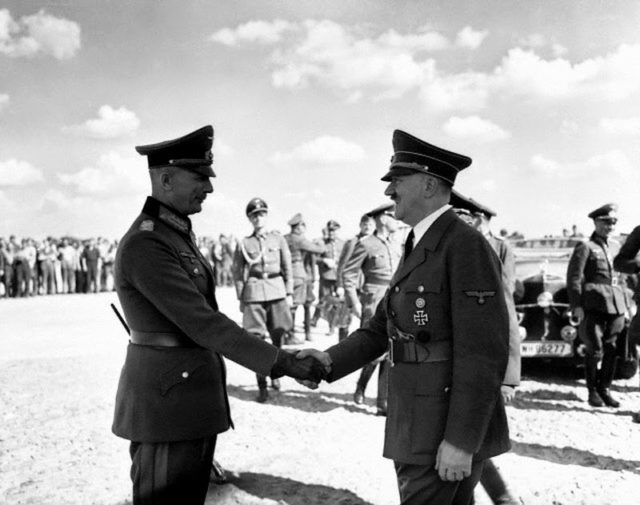
Adolf Hitler on 4 August 1941 makes one of his rare visits to an army group headquarters when he flies to visit Field Marshal Fedor von Bock at Borisov. Also in attendance are the senior Wehrmacht commanders of Army Group Center.
The anti-Nazi officer allegedly plotted to arrest Adolf Hitler upon arrival, but failed to do so as he had underestimated Hitler’s personal guards.
Hitler seems unsure of the future direction of the campaign, at least according to some in attendance. At these conferences with Hitler, the generals invariably choose one man to put forth their own point of view, and today that is Colonel-General Guderian. Guderian, who has led the advance toward Moscow with Panzer Group 2, later recalls that Hitler wants to take Leningrad first, but is undecided between Moscow and Ukraine:
“He seemed to incline toward the latter target for a number of reasons: first, Army Group South seemed to be laying the groundwork for victory in that area; secondly, he believed that the raw materials and agricultural produce of the Ukraine were necessary to Germany for the further prosecution of the war; and finally, he thought it essential that the Crimea, ‘that Soviet aircraft carrier operating against the Rumanian oilfields’ be neutralized.”
Based upon sheer conjecture buttressed by faulty staff work at army headquarters (OKH), Guderian opines that the Soviet Union is running out of manpower. Thus, Moscow should come next in order to force the Red Army to commit the last of its troops.
However, no firm decision is made. The impression gathered by those present is that General Hoth will take his Panzer Group 3 north to aid in the capture of Leningrad, while Guderian will take Panzer Group 2 south to help take Kyiv. These moves, however, await definite OKW orders. It is often Hitler’s tendency to leave those present at his conferences unclear about what he really wants even when he has very definite ideas about what that is.
Guderian decides to make the decision about future strategy himself rather than wait for formal orders. On the flight back to his headquarters, Guderian prepares plans for a continuation of the offensive toward Moscow using all of his troops. In this, he feels confident because all around him — von Bock, OKH Chief of Staff Franz Halder, Panzer Group 3 commander Hermann Hoth, and commander in chief of the army Field Marshal Walter von Brauchitsch — agree that Moscow should be the next objective. Everyone is sure that Hitler will come around to their point of view.
In the Far North sector, Group J of Finnish III Corps pursues the fleeing Soviets from the Sof’yanga that connects Top Lake with Pya Lake. The Soviets hope to make another stand at Kesten’ga in order to defend the vital Murmansk railway.
In the Army Group South sector, Kirovohrad falls to the Germans. Soviet 5th Army counterattacks the German 6th Army south of Kyiv but makes no progress. Soviet 9th and 18th armies are told to retreat behind the Bug River once they realize they cannot relieve the Uman pocket. Since this already is the situation, the 9th Army begins retreating toward Nikolayev and 18th toward Nikopol. The Germans (XIV Corps) already are across the Bug and heading south to cut off both armies.
German soldier Karl Fuchs sends a letter today to his father, who is serving elsewhere on the front. It reads in part:
“The pitiful hordes on the other side are nothing but felons who are driven by alcohol and the threat of pistols pointed at their heads. There is no troop morale and they are at best cannon fodder.”
and
“Having encountered these Bolshevik hordes and having seen how they live has made a lasting impression on me. Everyone, even the last doubter, knows today that the battle against these subhumans, who’ve been whipped into a frenzy by the Jews, was not only necessary but came in the nick of time.”
Supply problems are becoming an issue in the Wehrmacht. After the generals tell him of the supply situation at their meeting, Hitler agrees to allocate an entire month of war production to the Eastern Front. In terms of tanks, this means only 35 new machines and 400 tank engines (which must be replaced regularly). This does not keep up with wastage and ordinary wear and tear.
German bombers of KG4 drop 16 LMB mines in the Irben Strait and 16 LMB imines in the mouth of the river Triigi.
Soviet minesweeper T-201 Zariad hits a mine and sinks at Ristna beacon.
Having delivered its good at Archangel, Royal Navy minelayer Adventure departs, escorted by two Soviet destroyers.
Royal Navy submarine Tigris arrives at Polyarny, Russia in order to conduct patrols from there off the coast of northern Finland and Norway.
In a sign of goodwill to the Polish government-in-exile in London, the Soviets release General Władysław Anders from prison.
The Germans and Italians agree on terms under which the Italian expeditionary forces will operate on the Eastern Front.
The Kovno Ghetto at Slobodka is sealed. It is encircled with barbed wire and German guardhouses. There are 29,760 people in the Ghetto.
The Vichy government indicates that it will refuse military facilities to the Axis in North Africa.
An Axis supply convoy departs from Naples bound for Tripoli, while one also departs from Tripoli bound for Naples.
At Malta, Governor Dobbie announces that olive oil is going to be rationed. This sorely disappoints the Maltese people, who use a lot of olive oil in cooking.
After a long period of quiet, there is some action in East Africa. While the British and their local allies have evicted the Italians from the coast and most of their inland strongholds, Mussolini’s Italian forces do still control a few strong points in the mountains. One of these is Gondar, in the northern part of Abyssinia. Today, the South African Air Force swings into action and begins a daily bombing campaign that lasts until 6 August.
Winston Churchill departed on the battleship HMS Prince of Wales to Placentia Bay for the signing of the Atlantic Charter.
It is another day of light activity in northwestern Europe.
RAF Bomber Command, Day of 4 August 1941
12 Blenheims on a sweep off the Frisians. 6 recalled; others attacked fishing vessels which was the only shipping seen. No aircraft lost.
Royal Navy aircraft carrier HMS Victorious sends three Fulmar planes to attack Tromsø, Norway. One of the planes is shot down and the crew is captured.
A Luftwaffe Focke-Wulf Fw-200 bombs and sinks 4337-ton British freighter Tunisia in the mid-Atlantic south of Iceland and west of Ireland. Tunisia’s valuable cargo of manganese ore is lost. There are five survivors and 38 deaths.
The Luftwaffe strafes Royal Navy minesweeping whaler Sotra off Mersa Matruh. There is one death.
The Luftwaffe attacks Ismailia, Egypt.
U-126, commanded by Kapitänleutnant Ernst Bauer, sank fishing trawler Robert Max (172grt) with gunfire in 36-47N, 21-15W. At 2055 hours on 4 Aug 1941 the schooner Robert Max (Master Harry Thomasen) was stopped by two shots across her bow by U-126 near the Azores and was sunk two hours later by 17 rounds from the deck gun and gunfire after the crew was allowed to leave their ship in a lifeboat. They were questioned by the Germans, who offered cigarettes, gave them the course to San Miguel and wished good luck before leaving the area. The survivors reached the Azores after three days and were repatriated from Oporto to Grand Bank by the British schooners James and Stanley and Helen Forsey. The 172 ton Robert Max was carrying codfish and was headed for Oporto, Portugal.
Destroyers HMS Oribi and HMS Croome departed Scapa Flow at 0720 for Scrabster and returned to Scapa Flow at 1130 with personnel.
Battleship HMS Prince of Wales departed Scapa Flow at 1730 escorted by destroyers HMS Oribi, HMS Havelock, HMS Harvester, and HMS Hesperus, but Oribi returned to Scapa Flow that evening. The other destroyers were detached at 0030/5th in heavy weather and proceeded to Reykjavik. On the 6th, the battleship was met by Canadian destroyers HMCS Restigouche and HMCS Assiniboine and destroyer HMS Ripley, which came out from Iceland. Prince of Wales and her destroyer escort arrived at Placentia Bay on the 9th. In harbour at this time were American battleship USS Arkansas, heavy cruisers USS Augusta and USS Tuscaloosa, destroyers USS McDougal, USS Madison, USS Sampson, USS Winslow, USS Moffett, USS Belknap, USS Rhind, and USS Mayrant, Royal Navy destroyer HMS Reading, and American oiler USS Salinas. Restigouche, while refueling, touched ground and damaged her screws. She was repaired at St Johns and Halifax, completing on 9 October. The Atlantic Charter was signed on the 10th. Prince of Wales departed Placentia Bay on the 14th escorted by Ripley, Assiniboine, Saguenay, and Reading and the American Rhind and Mayrant. Ripley and Reading were detached on the 16th. Destroyers HMS Tartar, HMS Punjabi, and HMS Escapade departed Scapa Flow at 1530/11th and arrived at Hvalfjord at 2100/12th. The destroyers put to sea on the 14th to meet the battleship. At 0900/16th, the battleship arrived at Hvalfjord, escorted by Tartar, Punjabi, and Escapade. Churchill went on to Reykjavik on Assiniboine. Churchill addressed the crews of ships at Hvalfjord on this date. Included at Hvalfjord on the 16th were American battleship USS New Mexico, battleship HMS Ramillies, heavy cruisers HMS Shropshire and HMS Quincy, five destroyers, including HMS Churchill, five U.S. destroyers and destroyer depot ship HMS Hecla. Prince of Wales departed Hvalfjord at 2045/16th escorted by Tartar, Punjabi, and Escapade. On the 17th, when a submarine was reported off Cape Wrath, destroyers Eclipse and Oribi departed Scapa Flow to search for the submarine. The destroyers joined the battleship at midnight on the 17th. The battleship, escorted by the five destroyers, arrived at Scapa Flow at 0900/20th.
Former U.S. Coast Guard cutter, now RN escort ship HMS Banff was damaged in a collision with a Thames lighter in the Thames Estuary. She had just departed Tilbury, and returned following for repairs, which were completed on the 8th.
Submarines HMS Tigris and HMS Trident departed Holy Loch 26 July and 1 August, respectively and arrived at Polyarnoe on the 4th and 10 August. They were relieved by submarines HMS Sealion and HMS Seawolf, which departed Portsmouth on 16 and 25 October, respectively and arrived at Polyarnoe on 6 and 10 November. These two then returned to Home Waters in December, and were relieved by submarine HMS Sturgeon which departed Scapa Flow on 1 January and arrived on 11 January.
Steamer Tunisia (4337grt) was sunk by German bombing in 53-53N, 18-10W. Thirty eight crew of a crew of 43 were missing.
Force H and Force X arrived at Gibraltar.
On the 8th, destroyers HMS Cossack, HMS Maori, HMS Zulu, and HMS Lightning escorted battlecruiser HMS Renown and troopship Pasteur, carrying 15 officers and 157 ratings of damaged light cruiser HMS Manchester to the Clyde. Destroyers HMS Inglefield, HMS Impulsive, and HMS Eclipse departed Scapa Flow at 2000/11th to meet the battlecruiser at 1700/12th in 55-45N, 13W and escort her to Rosyth for refitting, arriving at 0945/14th. Inglefield was taken in hand for boiler cleaning. The Force H destroyers and the troopship arrived in the Clyde. Maori proceeded to London for refitting. The other two Tribal destroyers returned to the Mediterranean escorting convoy WS.11 which departed the Clyde on the 30th. Lightning returned to the Home Fleet.
Submarine HMS Unique arrived at Malta from patrol.
Light cruiser HMS Caledon departed Suez for Bombay where she was refitting from 18 August to 13 October.
Light cruiser HMS Carlisle departed Alexandria for Suez to provide anti-aircraft defense.
Light cruiser HMS Neptune, minelaying cruiser HMS Abdiel, and destroyers HMS Jackal and HMS Kipling departed Alexandria for Port Said for one serial of GUILLOTINE operation. The ships would then relieve light cruiser HMAS Hobart and destroyers at Haifa.
Destroyers HMS Jaguar and HMAS Nizam carried supplies to Tobruk.
Minesweeping whaler HMS Sotra (A/Lt J. M. Davies RCNVR) was attacked by German aircraft off Mersa Matruh. T/Skipper W. T. Allen RNR, was killed.
Corvette HMS Vervain broke down with boiler problems at 18-50N, 20-35W while on patrol duty. On the 5th, she was able to proceed on one boiler, but by mid-afternoon on the 8th, could not steam at all with both boilers defective. Corvette HMS Clover took her in tow for Freetown, arriving on the 9th.
Ocean boarding vessel HMS Cavina intercepted German steamer Frankfurt (5522grt) west of the Azores in 31-34N, 37-42W. The steamer scuttled herself to avoid capture, and 26 crew were rescued. A second boatload refused to be picked up and these men were lost. Calvina arrived at Gibraltar on the 11th.
President Roosevelt is on a “sea voyage vacation.” The White House sent to Congress his message urging ratification of an extension of the interstate oil compact.
The Senate agreed to vote at 1 PM tomorrow on the Taft amendment to the Military Service extension resolution; heard tributes to the late Senator Alva M. Lumpkin of South Carolina; received the President’s veto of the $250,000,000 defense highway construction bill and adjourned out of respect to the late Senator Lumpkin at 5:04 P. M., until noon tomorrow. A Judiciary Subcommittee approved the proposed equal rights constitutional amendment.
The House passed the tax bill after eliminating the mandatory joint income tax return by husbands and wives and adjourned at 5:03 PM, until noon tomorrow out of respect to the late Senator Lumpkin. The Rules Committee granted right of way to the service extension resolution; the Banking and Currency Committee considered price control legislation; the Rivers and Harbors Committee heard testimony for and against the St. Lawrence waterway project.
The U.S. State Department makes a formal commitment to Soviet Ambassador Konstantin Umansky to begin lend-lease shipments. Umansky calls the decision “an expression of confidence” in the survival of the Soviet Union — which is not a commonly held view at this time. The U.S. also announces that the American-Soviet Trade Agreement of 6 August 1937 has been extended to 6 August 1942. The U.S. decision reveals a shift in policy by President Roosevelt. In the first days after the Nazi invasion of Russia on 22 June, he was reluctant to commit supplies to Russia, as he was advised that the Red Army would only hold out for a few weeks.
President Roosevelt continues his “fishing trip” off the northeast coast. While that is what the White House has told reporters it is, in fact, Roosevelt has other plans. Aboard presidential yacht USS Potomac (AG-25), accompanied by USS Calypso (AG-35), Roosevelt sails today from Point Judith, Rhode Island to South Dartmouth, Massachusetts. There, Crown Prince Martha of Norway and her party board. There apparently is some fishing during the day, but that is not the point of the trip. After a day of fishing (“with some luck”) the Chief Executive personally takes the helm of a Chris-Craft motorboat and transports his guests back ashore. Then, after Martha returns to shore that night, Potomac, again accompanied by Calypso, shifts to Menemsha Bight, Vineyard Sound, Massachusetts, where they join heavy cruisers USS Augusta (CA-31) and USS Tuscaloosa (CA-37) and five destroyers.
British Prime Minister Winston Churchill boards battleship HMS Prince of Wales at Scapa Flow. It departs at 17:30 and proceeds across the Atlantic to Placentia Bay. With him is Harry Hopkins, returning from Moscow.
Senate set the stage late today for the first major test on the Army service extension resolution tomorrow. An agreement was reached to vote by 1 PM on the Taft amendment continuing the tenure of selective service trainees to a total of eighteen months, instead of two and one-half years as now proposed by the Administration. Leaders expressed doubt that more than thirty votes would be cast for the proposal, introduced by Senator Taft of Ohio, which also continues the tenure of National Guardsmen and reservists to two years, and provides for replacing selectees at the rate of 50,000 a month beginning in April, 1942. Senate passage of the resolution itself by tomorrow night, or Wednesday at the latest, was predicted by the leaders.
The stiffest tax bill in the nation’s history, designed to raise about $3,206,200,000 to finance the defense program, was passed by the house late today by an overwhelming majority after being stripped of a provision requiring married persons to file joint income tax returns. The measure, which now goes to the senate, would virtually triple the taxes of persons in the lower and middle income brackets and would net an additional $1,332,900,000 through surtaxes and more drastic excess profits taxes. It went through by the top-heavy rollcall vote of 369 to 30.
There is on foot a world movement for conquest by force, and for successful resistance to this resurgence of savagery and barbarism there is need for absolute unity among the American people, and among other free peoples who have not yet been conquered, Cordell Hull, Secretary of State, said today in the first official statement he has made since ill health forced him to relinquish official duties almost two months ago.
Higher food and clothing prices were sought today by the farm bloc in Congress. Chairman Steagall of the House Banking and Currency Committee, sponsor of the Administration’s price and rent-control bill, on which his committee is to hold hearings. announced that he would seek even greater benefits for farmers than is now provided in the measure.
The anti-Communist faction won a test vote over the party’s defenders at the opening today of the annual convention of the United Automobile Workers of America, C.I.O. The vote came over the demand by a minority of the credentials committee to seat the ten delegates of the Allis-Chalmers local of Milwaukee, the local which recently had a seventy-nine-day strike, seriously affecting defense production.
William Green, President of the American Federation of Labor, urged today that defense authorities plan conversion of plants to other purposes before issuing any more such sweeping orders as that last week which, closed down all raw silk processing operations.
Two Detroit tool and machine shops stripped of their precision instruments by gunmen believed to be saboteurs tonight received a deluge of replacement tools loaned by competitive shops lest $500,000 worth of defense work be delayed. Word spread quickly that Majestic Tool & Manufacturing Corp., and Central Machine Co., producers of machines and tools for defense plants, were robbed yesterday of approximately $1,500 worth of vitally-needed micrometers and other precision instruments. As company officials prepared for a shutdown of several weeks, pending arrival of replacements, loaned tools began pouring in from other plants throughout the country. “If this cooperation continues,” said President John V. Parker of Majestic, “by tomorrow morning we’ll have more tools than we had originally. It shows that America is a long ways from dead.”
The US 1st Marine Division begins amphibious maneuvers in conjunction with the U.S. Army 1st Division (the “Big Red One”) at New River, North Carolina. Aircraft escort ship Long Island (AVG-1) stands offshore and provides air operations during the maneuvers.
The Ryan Aeronautical Company NR-1 trainer plane takes its first flight. It is a low-wing monoplane with a metal fuselage, unlike most other trainers at this time. This is part of a huge expansion of the U.S. Navy training of pilots during this period of time. The Ryan NR-1 will equip NAS Jacksonville.
Mark Clark is appointed Assistant Chief of Staff (G-3) at US Army General Headquarters and promoted to Brigadier General.
Major League Baseball:
Jimmy Foxx celebrated his return to service today by clouting his sixteenth home run of the season, giving the Boston Red Sox a 7–6 victory over the Philadelphia Athletics in a series opener. Philadelphia scored five runs in the second inning, but the ailing first baseman capped a great Boston comeback by belting Bump Hadley’s first pitch in the ninth for the circuit.
In the 3rd inning, catcher Mickey Owens catches 3 foul flies, the first time in the Major League that feat’s been recorded. His Dodgers score 9 runs in the 6th and 7th to whip the Giants, 11–6. Ken O’Dea has a grand slam in the 7th for the Giants, and Babe Young hits his 13th homer, a solo shot in the fourth.
Ernie White, 24-year-old rookie ace of the pace-setting Cardinals, pitched his sixth victory in seventeen days today, turning back the weak-hitting Cubs for a 4–2 triumph. The fireball southpaw allowed sixth-place Chicago to score only in the fourth inning and nobody reached second base after that. Babe Dahlgren opened the fourth by drawing a walk with two out. Clyde McCullough singled and Lou Stringer drove in both with a long double to left field.
The world champion Reds today scored their second run in four games, but it was hardly enough to delay the fast-charging Pirates, who won, 4–1, on the three-hit pitching of Johnny Lanning.
The New York Yankees beat the Washington Senators, 7–5, on the strength of four triples. Towering three-base smashes by Charlie Keller, Phil Rizzuto, Joe DiMaggio and Buddy Rosar inflicted most of the damage in bringing about the retirement of the left-handed Kendall Chase (4–13).
Philadelphia Athletics 6, Boston Red Sox 7
New York Giants 6, Brooklyn Dodgers 11
St. Louis Cardinals 4, Chicago Cubs 2
Pittsburgh Pirates 4, Cincinnati Reds 1
New York Yankees 7, Washington Senators 5
Acting Secretary Sumner Welles meets with Japanese Minister Wakasugi in Washington. Welles says that the policy of the U.S. is peace in the Pacific and that it opposes all use of force there by others. He says that the Japanese have adopted an “attitude of aggression” toward other countries to establish military overlordship throughout the region. Wakasugi responds that the Japanese were isolated for centuries and only awoke from this isolation after other foreign powers had established their own imperialist dominions in the region. Welles further states that regional approaches to international relations, such as decisions confined only to Europe or only to the Pacific, were insufficient and only a “universal approach” could work.
Welles also mentions that he had received “reports” that Japan intended to move further south into Thailand. This would cause further problems in U.S./Japanese relations. He also states that the “basic principle of the future” would be free trade, with equal accessibility to raw materials by all countries.
The Japanese liner Tatsuta Maru departed San Francisco, California, United States with US$2,500,000 worth of raw silk and 85,589 gallons of oil, both of which were only allowed after Captain Toichi Takahata fought hard for them. This was due to the recently passed executive order to freeze Japanese assets in the United States. The Americans have made an exception to their sanctions against Japan to refuel the Tatsuta Maru in order for it to return to Japan.
Regular steamship service to the United States is suspended in Japan as of today.
The Japanese recall 16,975-ton liner Asama Maru, which has been on a trans-Pacific voyage. The ship, which is about 980 miles east of Honolulu, has been caught by the imposition of U.S. sanctions.
The Japanese are keeping a close eye on U.S. activities throughout the Pacific. Today, they learn that about 600 U.S. soldiers have arrived in Manila aboard transport USS President Coolidge.
Ambassador Nomura reports to Tokyo that anti-Japanese sentiment (as reflected in a published Gallup poll) is high and that the U.S. newspapers are in full support of the U.S. government position on Japan. In his cable to Tokyo, Nomura asks to be sent a “Foreign Office expert” who is familiar with “the Government’s high policy” because he does not know what the government truly wants.
Tokyo sends out a circular that covers proper procedures for the destruction of obsolete codes and the proper care of current codes.
Dow Jones Industrial Average: 128.17 (-0.04)
Born:
Cliff Nobles American soul singer (“The Horse”), in Grove Hill, Alabama (d. 2008).
Martin Jarvis, British actor (“Titanic”, “Wreck-It Ralph”), in Cheltenham, England, United Kingdom.
Quincey Daniels, American boxer (Olympic bronze medal, 1960), in San Diego, California.
Mel Tom, NFL defensive end (Philadelphia Eagles, Chicago Bears), in Honolulu, Hawaii (d. 2006).
Ted Strickland, American politician, Governor of Ohio (2007-2011), in Lucasville, Ohio.
Died:
Mihály Babits, 57, Hungarian poet, writer and translator.
Naval Construction:
The Royal Indian Navy Basset-class minesweeping trawler HMIS Amritsar (T 261) is laid down by the Garden Reach Shipbuilders & Engineers Ltd. (Calcutta, India).
The U.S. Navy Accentor-class coastal minesweeper USS Fearless (AMc-80) is laid down by W.A. Robinson Inc. (Ipswich, Massachusetts, U.S.A.).
The Royal Indian Navy Bathurst-class minesweeper-corvette HMIS Madras (J 237) is laid down by the Cockatoo Docks and Engineering Co. Ltd. (Sydney, New South Wales, Australia).
The Kriegsmarine (German Navy) Type IXC U-boat U-523 is laid down by Deutsche Werft AG, Hamburg (werk 338).
The U.S. Navy Cleveland-class light cruiser USS Vicksburg (CL-81) is laid down by the Newport News Shipbuilding and Dry Dock Co. (Newport News, Virginia, U.S.A.). After the loss of USS Houston (CA-30) in 1942, CL-81 is renamed USS Houston (CL-81) on 12 October 1942.
The Royal Navy MMS I-class motor minesweeper HMS MMS 26 (J 526) is commissioned.
The Royal Navy Bangor-class (Reciprocating-engined) minesweeper HMS Sidmouth (J 47) is commissioned. Her first commanding officer is Commander Thew Rust, RN.
The Royal Canadian Navy Bangor-class (VTE Reciprocating-engined) minesweeper HMCS Malpeque (J 148) is commissioned. Her first commanding officer is Lieutenant William Roland Stacey, RCNR.
 History Diaries