In the Far North sector, Group J (one regiment) of Finnish III Corps finally on 3 August 1941 smashes through fierce Soviet opposition at the Sof’yanga, an eight-mile-long channel connecting Pya Lake and Top Lake in Karelia. The Soviets are only pried out of their defenses due to a brilliant Finnish flanking move accomplishing by sending a battalion over the western tip of Top Lake to attack from behind the Soviet line. With this accomplished, the Finns can advance to Kesten’ga with the ultimate objective of cutting the Murmansk railway.
In the Army Group North sector, Soviet 325th Rifle Regiments is evacuated by sea from Litsa Bay.
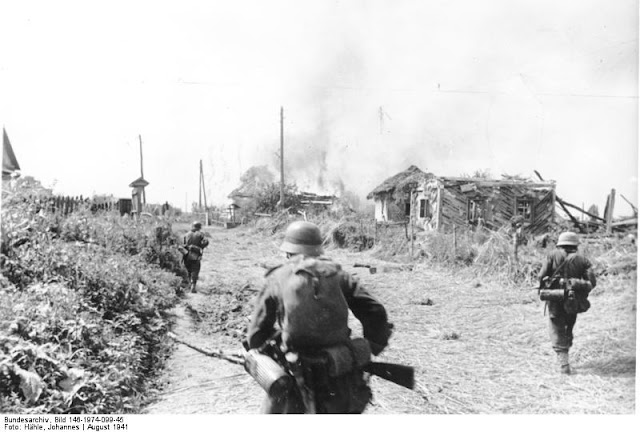
In the Army Group Center sector, General Guderian’s advance on Roslavl bears fruit when XXIV Corps (General Geyr von Schweppenburg) links up with 4th Army’s (General Feld Marshal Gunther Hans von Kluge) IX Corp. This forms the Roslavl Pocket, trapping about 38,000 Soviets who quickly become POWs. This junction wipes out Group Kachalov and much of Soviet 28th Army. The Soviets also lose about 35,000 in a pocket at Mogilev which 4th Army finally subdues.
In the Army Group South sector, the German 16th Panzer Division meets with the Hungarian Mechanized Corps (Gyorshadtest) at Pervomaisk to form a secondary encirclement around the Soviet forces trapped in a pocket at Uman. Portions of 20 Soviet divisions continue to resist within the pocket, but with increasing futility. About 103,000 Soviet soldiers are within the pocket and face bleak prospects of rescue from Soviet forces further east. Many Soviet officers are trapped within the pocket, including the commanders of 6th and 12th armies, four corps commanders, and 11 division commanders.
Romanian 4th Army (General Nicolae Ciuperca) crosses the Dniester River and continues advancing eastward. This shows Romanian leader Ion Antonescu’s willingness to aid Operation BARBAROSSA even in the conquest of lands that are not historically (at least arguably) Romanian.
The Luftwaffe bombs Moscow again. However, this attack is much smaller than previous attacks and can best be described as a nuisance raid.
Oblt. Kurt Sochatzy of III./JG 3 shoots down an IL-2 over Kyiv for his 38th — and last — victory. His own plane is disabled when a Soviet plane hits his Bf 109 and shears off its wing. Sochatzy successfully bails out and is taken a prisoner of war.
There are incidents in several places today. At Slobodka, Ukraine, the Germans fill a local synagogue with Jews and then set it on fire.
At Jelgavia, Latvia, SS Einsatz-Kommandos under Lieutenant Hamann murder 1,550 Jews.
At Chernivtsi, Romania, Einsatzgruppen arrest 1200 Jews and execute 682 of them.
At Mitau, Latvia, the Germans execute 1500 Jews.
At Stanislawów, Ukraine, the Germans round up professional Jews and execute several hundred of them.
Isi Brauman, who writes a diary that later is published, arrives at Auschwitz. He writes: “I am going to die. There is no doubt.” He received the diary from his mother for Hanukkah in 1940.
The Germans have spotted Convoy SL.81 southwest of Ireland and have assembled a large force to intercept it. Already eight U-boats are in the vicinity, and the Luftwaffe maintains observation as well. This leads to action even though the Germans don’t yet attack the convoy itself.
Royal Navy CAM (Catapult-Armed Merchantman) ship HMS Maplin uses its catapult to launch a modified Hawker Hurricane (called a “Hurricat”), which shoots down a Focke-Wulf Fw-200 Condor. This is the first success of a CAM ship. Volunteer pilot R.W.H. Everett of RAF No. 804 Squadron lands his plane near destroyer Wanderer, escorting Convoy SL-81, and is picked up after he struggles to get out of the aircraft before it quickly sinks.
Royal Navy destroyer HMS Wanderer and corvette Hydrangea, and Norwegian destroyer St. Albans team up to sink U-401 (Kptlt. Gero Zimmermann) southwest of Ireland. The depth charge attack kills all 45 men on the U-boat. U-401 sinks on its first patrol, with no successes to its credit.
Operation EF (the raid on Kirkenes and Petsamo) ends as Force K returns to Seidisfjord, then proceeds back to Scapa Flow.
Operation GUILLOTINE, the British reinforcement of Cyprus, continues as Royal Navy sloop Flamingo escorts transport Kevinbank to Famagusta.
Winston Churchill praises Malta in a telegram, stating in part:
“Now that the convoys have reached you safely with all the stores and reinforcements, I take occasion to congratulate you on the firm and steadfast manner in which you and your devoted garrison and citizens have maintained Malta inviolate against all attacks for more than a year and to express my confidence that with the help of God our cause will continue to prosper and that the contribution of Malta to the final victory will add a noble chapter to the famous story of the Island.”
Malta is now well-supplied, at least compared to its situation during 1940. That situation will change again next year.
British Prime Minister Winston Churchill travels north from London to board a ship that will take him across the Atlantic for a conference with President Roosevelt.
Clemens August Graf von Galen, Bishop of Münster, gives a sermon today — the third in a sequence during the summer of 1941 — in which he denounces the policies being followed by the Reich:
“ ‘Thou shalt not kill.’ God engraved this commandment on the souls of men long before any penal code… God has engraved these commandments in our hearts… They are the unchangeable and fundamental truths of our social life… Where in Germany and where, here, is obedience to the precepts of God? […] As for the first commandment, ‘Thou shalt not have strange gods before me,’ instead of the One, True, Eternal God, men have created at the dictates of their whim, their own gods to adore: Nature, the State, the Nation, or the Race.”
About euthanasia (German program Aktion T4) in particular he says:
“It is a terrible doctrine which seeks to justify the murder of innocent people and which allows the violent killing of invalids, cripples, the incurably ill, the old and the weak who are no longer able to work … once the principle that it is permissible to kill ‘unproductive’ humans has been admitted and applied then we must all pity ourselves when we, too, grow old and weak.”
Von Galen spends the remainder of his sermon denouncing the depredations of the current German regime against the Church and vulnerable people in society. He focuses on harsh euthanasia policies and calls it murder. If a regime can dispense with the Fifth Commandment, thou shalt not kill, no other commandment survives. Once you start down that path, he concludes, others could be at risk of similar policies — such as injured Wehrmacht soldiers.
Father Bernhard Lichtenberg, dean of St. Hedwig’s Cathedral in Berlin, also denounces the euthanasia program in a sermon today. However, his sermon does not receive as much publicity as Bishop von Galen’s does.
Copies of the sermon spread throughout the Reich, particularly the heavily Catholic southern regions such as Bavaria. This is considered a seminal moment in the German resistance, though it is not a direct call to action. The German authorities notice, of course, and restrict von Galen’s movements. Hitler later comments:
“The fact that I remain silent in public over Church affairs is not in the least misunderstood by the sly foxes of the Catholic Church, and I am quite sure that a man like Bishop von Galen knows full well that after the war I shall extract retribution to the last farthing.”
Despite menacing indications in the surviving German record as to von Galen’s likely fate, he survives the war, perhaps through an oversight (Hitler evens many old scores during the final months of the war, but not this one). Hitler does not harm him in part due to von Galen’s moral legitimacy that is recognized by many religious Germans who could be alienated. True to his principles, he then castigates the Allied occupation forces for their mistreatment of civilians. He also argues on behalf of certain imprisoned Wehrmacht officers at their trials. His life is cut short on 22 March 1946 by an appendix infection.
Von Galen is beatified (one step down from being a saint) by Pope Benedict XVI in 2005. The Catholic Church moves very deliberately in such matters and he may someday become a saint.
The weather across northwestern Europe is unsettled, with heavy cloud cover that impairs navigation and bombing accuracy.
RAF Bomber Command, Night of 3/4 August 1941
Frankfurt
39 Whitleys; weather conditions were poor. No aircraft lost.
Hannover
34 Wellingtons; the target was cloud-covered. 1 aircraft lost. 7 Whitleys to Calais docks. No losses.
Aircraft carrier HMS Furious, heavy cruiser HMS Suffolk, and destroyers HMS Intrepid, HMS Echo, and HMS Eclipse arrived at Seidisfjord at 1000 on completion of Operation EF. The ships went on to Scapa Flow after refueling. Furious, Echo and Eclipse arrived at 0830/5th. Intrepid, which had been separated in bad weather, proceeded to Loch Ewe to fuel and arrived at 1115. The destroyer later proceeded to Greenock.
Lieutenant Robert Everett RNVR of British No. 804 Squadron Fleet Air Arm became the first pilot launched from a CAM ship (HMS Maplin) to shoot down a German Focke-Wulf Condor aircraft which had sighted the Atlantic convoy SL.81 en route from Sierre Leone, British West Africa.
The Luftwaffe also sends some small raids against England during the night. Some bombs drop at Spittal near Berwick, damaging about a hundred houses and a church and destroying some ships and four houses.
After dark, a heavy Luftwaffe attack on Suez and surrounding areas causes great damage. The planes are Heinkel He 111s of II/KG.26.
The Luftwaffe (Heinkel He 111s of II/KG.26) bombs and sinks 1087-ton Belgian ship Escaut in Attika Bay, Suez. All three aboard perish.
The Luftwaffe (Heinkel He 111s of II/KG.26) bombs and sinks 5322-ton Belgian tanker Alexandre Andre about eight miles south of Suez. The ship is burned out and can only be used as a storage hulk for the remainder of the war.
The Luftwaffe (Heinkel He 111s of II/KG.26) bombs and damages 8120-ton British tanker Desmoulea at Suez. The ship has to be towed to Bombay for repairs.
21 British Maryland bombers attacked Axis positions at Tobruk, Libya while fighters swept nearby airfields.
The RAF bombs and sinks 216-ton Italian freighter Elisa off Benghazi.
Bf 100 fighters of ZG-26 attack Mersa Matruh and damage Royal Navy submarine chaser Sotra during the night.
U-401, commanded by Kapitänleutnant Gero Zimmermann, was sunk by convoy SL.81 escorts, destroyer HMS Wanderer (D 74), the Norwegian destroyer HNoMS St. Albans (I 15), and the corvette HMS Hydrangea (K 39), south of Iceland, in 50-27N, 19-50W. Destroyer HMS Campbeltown and corvettes HMS La Malouine, HMS Zinnia, HMS Campanula, HMS Bluebell, HMS Wallflower, HMS Carnation, and HMS Heliotrope were also escorting this convoy. All of the U-boat’s complement of 45 died. During its career the U-401 sank or damaged no ships.
Heavy cruiser HMS Berwick departed Rosyth for Scapa Flow and arrived later that day. Turbine problems had not yet been repaired and she was only capable of a maximum of 22.5 knots.
Destroyer HMS Quorn departed Scapa Flow at 1200 after a short period of practices for Rosyth.
Destroyers HMS Havelock, HMS Hesperus, and HMS Harvester arrived at Scapa Flow at 0815 from Reykjavik.
Destroyer HMS Anthony departed Scapa Flow for Scrabster at 1615 to embark special personnel, and arrived back later that evening.
Anti-aircraft ship HMS Alynbank departed Scapa Flow at 1800 and escorted convoy WN.61 to southward. On the 4th, she transferred to convoy EC.54 in the vicinity of Tod Head, and arrived at Scapa Flow at 0030/6th after parting from the convoy to the west of the Orkneys.
Minesweeper HMS Niger departed Scapa Flow at 0300 for Dundee to refit, arriving at 2100 for refitting which was completed on 28 September. She returned to Dundee on 6 October for further refitting which continued until 15 December.
Dutch submarine HNLMS O.21 unsuccessfully attacked a sailing vessel south of Sardinia.
Submarine HMS Utmost arrived at Malta from patrol.
Belgian motor vessel Escaut (1087grt) was sunk by German bombing 17.3 cables 232° from South Beacon Ships Head, Attika Bay, Suez. The Master and two crewmen were missing.
Belgian tanker Alexandre Andre (5322grt) was damaged by German bombing eight miles S of Suez.
Australian sloop HMAS Parramatta arrived at Port Said from Famagusta.
Sloop HMS Flamingo departed Port Said with motor transport ship Kevinbank for Famagusta in Serial S.12 of the GUILLOTINE operation. They arrived on the 5th.
Australian minesweeper HMAS Bathurst passed through the Suez Canal and proceeded to Alexandria for duty with the Mediterranean Fleet. Bathurst and HMAS Lismore had been retained at Suez to assist with the large liners of the US.11A convoy.
Tanker Desmoulea (8120grt) was damaged by German bombing at Suez off the west beacon, and towed to Bombay for repairs.
Italian steamer Elisa (216grt) was sunk by British bombing off Benghazi.
Destroyers HMS Wivern, HMS Wild Swan, and HMS Boreas departed Freetown at 0800 to proceed to Bathurst to refuel en route to Gibraltar.
CAM (Catapult-Armed Merchantman) ship HMS Maplin, which had left convoy OG.70 en route to convoy SL.81, scored the first success for a ship of this type when her Hurricane shot down a German FW 200 aircraft. LT (A) R. W. H. Everett RNVR was the pilot, and after his success, landed in the sea near destroyer HMS Wanderer of convoy SL.81 and was rescued.
Convoy WS.10 was formed at sea from ships departing Avonmouth on 30 July, Liverpool on 31 July, and the Clyde on the 2nd. It was composed of steamers Phemius, Diomed, Indian Prince, Indrapoera, Andes, Rangitiki, Orcades, Britannic, Highland Monarch, Manchester Port, Starthallan, Volendam, Cameronia, Reina Del Pacifico, Nea Hellas, Stirling Castle, Windsor Castle, Warwick Castle, and Nigerstroom. On the 6th, steamers Windsor Castle and Warwick Castle collided. Warwick Castle was detached to Halifax and escorted by armed merchant cruiser HMS Worcestershire. The convoy was escorted by armed merchant cruiser Worcestershire and destroyers HMS Gurkha, ORP Piorun, HNLMS Isaac Sweers, HMS Broadway, HMS Lance, and HMS Legion from 2 to 6 August. Anti-aircraft cruiser HMS Cairo and destroyers HMS Whitehall, HMS Witch, and HMS Winchelsea escorted the convoy from 2 to 5 August. Heavy cruiser HMS London escorted the convoy from 2 to 10 August. On the 10th, light cruiser HMS Edinburgh, which departed Gibraltar on the 8th, relieved the heavy cruiser and escorted the convoy until 17 August when it arrived at Freetown. The heavy cruiser proceeded to 40N, 30W to attempt to intercept an armed enemy merchant ship reported by civil aircraft. Destroyers HMS Wrestler and HMS Velox and corvette HMS Bergamot escorted the convoy from 14 to 17 August and corvette HMS Cyclamen escorted the convoy from 15 to 17 August. Destroyer HMS Jupiter was involved in the escort of the convoy at some time prior to the arrival at Freetown. The convoy arrived at Freetown on the 17th. The convoy departed on the 21st, escorted by light cruiser Edinburgh to 2 September when Britannic, Indrapoera, Reina Del Pacifico, Stirling Castle, Strathallan, Volendam, Windsor Castle, Nigerstroom , and Phemius arrived at Capetown. On 6 September, liners Orcades, Andes, Cameronia, Highland Patriot, Nea Hellas, Rangitiki, Diomed, Indian Prince, and Manchester Port arrived at Durban, escorted by heavy cruiser HMS Hawkins. On 6 September, liners Britannic, Stirling Castle, Windsor Castle, Volendam, Indrapoera, Strathallan, Nigerstroom, and Phemius departed Capetown escorted by armed merchant cruiser Carnarvon Castle. Liner Britannic was detached on 8 September to Durban to embark passengers from liner Cameronia. She rejoined with steamer Aronda departing Durban on 9 September with heavy cruiser Hawkins. On rendezvous, armed merchant cruiser HMS Carnarvon Castle was detached with Volendam, Indrapoera, Phemius, and Nigerstroom to Durban. Heavy cruiser Hawkins then escorted the convoy until 15 September in 3-25S, 51-12E, when light cruiser HMS Emerald took over the escort of the convoy. The convoy arrived at Bombay on 20 September. Steamers not departing Capetown on 6 September went forward to Aden in convoy CM.17.
Convoy OS.2 departed Liverpool. On the 4th, destroyers HMS Chelsea and HMS Wolverine joined the convoy and were detached on the 8th. Also joining on the 4th were sloop HMS Sandwich which was detached on the 19th, corvettes HMS Gentian, HMS Hibiscus, and HMS Myosotis which were detached on the 8th, and anti-submarine yacht HMS Philante which was detached on the 19th. French sloop Commandant Domine joined the convoy on the 4th and was detached on the 18th. On the 7th, destroyers HMS Viceroy and HMS Woolston joined the convoy and were detached on 9 and 10 August, respectively. On the 19th, destroyer HMS Brilliant and corvettes HMS Amaranthus, HMS Armeria, and HMS Woodruff joined the convoy and arrived at Freetown with the convoy on the 22nd.
On a highly secret mission, President Franklin Roosevelt boards a train from Washington, D.C. to New London, Connecticut. There, he boards the Presidential yacht USS Potomac (AG-25), which is attended by tender Calypso (AG-35). The ships sail to Point Judith, Rhode Island and stay there for the night. The White House informs the press corps that this is merely a fishing cruise. Ostensibly on vacation, Roosevelt was actually headed for the Atlantic Charter Conference with British Prime Minister Winston S. Churchill at Placentia Bay, Newfoundland.
AP Reports: “President Roosevelt put out to sea tonight for a carefree vacation on salt water. Aboard the White House yacht Potomac, he left the navy’s submarine base at New London, Connecticut, and began a voyage scheduled for a week or 10 days unless a serious turn in world events sends him back to Washington. For Mr. Roosevelt’s protection, the White House requested a “blackout” on news of the trip and reporters were not allowed to follow the president, as is customary, on an escort ship. The Potomac holds a commission in the navy, and the word was out that her movements were to be regarded as confidential, just as are those of other naval craft. Accompanying him was a pair of old fishing companions, Rear-Admiral Ross T. Mclntire and Major.-Gen. E. M. Watson.”
There is a dusk-to-dawn blackout along the east coast in order to conserve gasoline. This shuts down 100,000 service stations from 19:00 to 07:00 on the 4th. With a few exceptions the filling station owners of New York and the metropolitan area complied last night with the twelve-hour curfew on gasoline sales and the same was true of the rest of the Eastern seaboard.
The House of Representatives will get its one chance to revise the $3,529,200,000 tax bill tomorrow, and predictions were voiced on Capitol Hill today that the membership would override its Ways and Means Committee and knock out a provision requiring married couples to file joint income tax returns. Those who made the prediction, and they included Speaker Rayburn, Texas Democrat, based it on a last minute recommendation to the committee by President Roosevelt.
The Senate is expected to pass tomorrow or Tuesday the compromise resolution to extend the service of selectees, National Guardsmen and reserve officers to a maximum of thirty months. While it is more probable that the vote will come Tuesday, it is possible that it will be taken late tomorrow. Speedy passage is desired to impress Japan. In the move to extend the period of service the Army asked for authority to hold the men for the duration of the emergency, but the bill war modified by the Senate Military Affair Committee to make the period two and a half years.
A government-convened conference of automobile management, labor and government experts to formulate a program for preventing a threatened dislocation of the automobile industry due to defense requirements was advocated here today by R.J. Thomas, president of the United Automobile Workers of America, C.I.O.
A super brain trust designed to outthink any other nation is being organized in the United States. President Roosevelt has assigned Dr. Vannevar Bush, president of the Carnegie Institution of Washington, to direct the Office of Scientific Research and Development, which will put the nation’s brain power behind national defense. The men and women he is authorized to call on form an international scientific military division of more than 20,000, including experts in everything from weather forecasting to bacteriology, medicine, chemistry, physics and zoology. He has at his command the services of virtually every American scientist and the refugee group now teaching and studying in American universities. His agency has $10,000,000 set aside for the purpose.
Ten Los Angeles youths ranging in age from 15 to 21 years were booked by police tonight on suspicion of rioting. Captain L. P. Hale declared that 50 members of what he termed the Temple street gang had tried to take control of the Brooklyn and Boyle street corner and were attacked by the Clanton street gang, 100 strong. Knives, clubs, broken bottles and even pistols were being wielded, the officers said, as several cars of police arrived and put the youths to flight. Captain Hale said police were determined to break up the gangs of youthful hoodlums which he declared were turning in false fire alarms and molesting women.
Major League Baseball:
The Detroit Tigers swept a two-game series with the Boston Red Sox by winning today, 6–3, behind Hal Newhouser. Skipper Joe Cronin and Dom DiMaggio returned to the Boston line-up. Each made two hits. The veteran Charlie Gehringer was back in action for Detroit and hit a ninth-inning single.
Finding the Cubs the most hospitable group they have encountered since leaving Brooklyn, the Dodgers left tonight regretfully after winning, 10–2, to sweep the three-game series and run their victory streak to four games.
Braves pitchers Jim Tobin and Johnny Hutchings toss shutouts over the Reds, winning 5–0 and 3–0. Hutchings, sent to Boston by Cincinnati six weeks ago in a deal for Lloyd Waner, held his old team-mates to three scattered singles in the second and fanned four batters. Tobin pitched five-hit ball in the first game for his seventh victory in his last eight starts.
Browns knuckler Johnny Niggling gets Joe DiMaggio in 4 at bats to stop DiMaggio’s streak of 74 games in reaching base. DiMag is 0-for-8 on the afternoon, as the first place Yanks lose two to the Browns, 6–2 and 5–0. Niggling wins the opener and Harris allows 2 hits in the game 2 whitewash.
The first-division Philadelphia Athletics draw their largest crowd in history, 40,200 (30,613 paid) for a twinbill with the Indians. Another 15,000 are turned away. In game 1, Bob Feller finally wins his 20th, 6–3, allowing 3 hits and walking 7. In the nitecap, the A’s score a run in the 9th off Clint Brown to win, 4–3.
In a rarity, Ken Heintzelman starts both ends of a doubleheader against the Giants, as the Pirates sweep a pair in Pittsburgh, 5–4 and 10–5. Heintzelman gets neither win as the victories go to Dutch Dietz and Bob Klinger.
Morton Cooper and Lon Warneke scored identical 6–1 triumphs for the Cardinals in a double-header with last-place Philadelphia. Touched for only six hits in the first game, Cooper was deprived of a shutout by John Rizzo’s homer. For Warneke it was victory No. 13. Warneke yielded only five hits.
Ted Lyons, Chicago’s Sunday pitcher, set the Senators down with six hits today while the White Sox made eighteen to win, 9–0. It was Lyons’s tenth victory of the season and the 243d of his career. He struck out five Senators and allowed only one to reach third. Lyons didn’t issue a base on balls. Lyons and catcher Mike Tresh led the Chicago attack, each getting four hits. Outfielder Taft Wright contributed three, one a triple.
Detroit Tigers 6, Boston Red Sox 3
Brooklyn Dodgers 10, Chicago Cubs 2
Boston Braves 5, Cincinnati Reds 0
Boston Braves 3, Cincinnati Reds 0
St. Louis Browns 6, New York Yankees 2
St. Louis Browns 5, New York Yankees 0
Cleveland Indians 6, Philadelphia Athletics 3
Cleveland Indians 3, Philadelphia Athletics 4
New York Giants 4, Pittsburgh Pirates 5
New York Giants 4, Pittsburgh Pirates 10
Philadelphia Phillies 1, St. Louis Cardinals 6
Philadelphia Phillies 1, St. Louis Cardinals 6
Chicago White Sox 9, Washington Senators 0
Chinese Communist quarters in Shanghai hinted today that the Yenan Communist government was preparing for amicable relations with the Kuomintang [Nationalist party], especially in the post-war reconstruction period.
Japan moved ahead today with her expansion program for a “new order” in the South Pacific and the press, filled with caustic criticism of the United States and Britain, hinted that the next major move might be against Thailand.
The British have placed thousands of their finest troops, mainly tough Australians and the pick of the best Indian regiments, on the Malayan-Thai border in expectation of a showdown with the Japanese.
Born:
Martha Stewart, American businesswoman and television personality, in Jersey City, New Jersey.
Hage Geingob, 3rd President of Namibia, in Otjiwarongo, South-West Africa (d. 2024).
George Standing. Canadian NHL right wing (Minnesota North Stars), in Toronto, Ontario, Canada.
Naval Construction:
The Royal Canadian Navy Bangor-class (VTE Reciprocating-engined) minesweeper HMCS Quinte (J 166) is launched by the Burrard Dry Dock Co. Ltd. (Vancouver, British Columbia, Canada).
 History Diaries