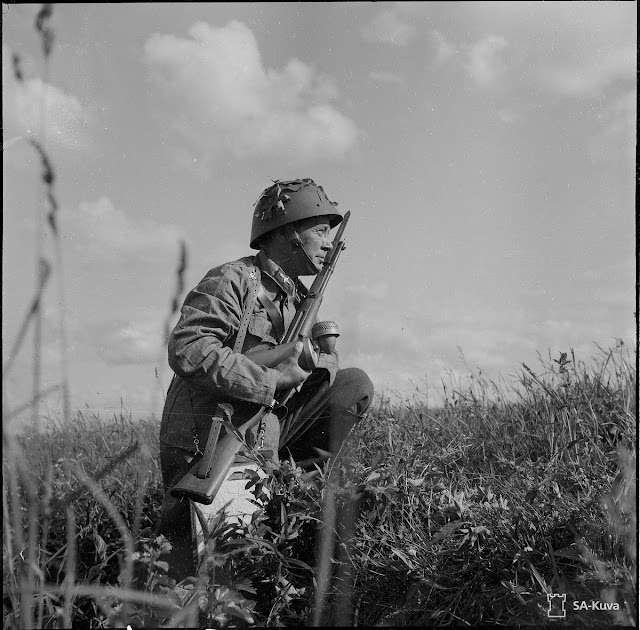
In the Far North sector on 1 August 1941, Finnish II Corps continues its new offensive toward Lake Ladoga. The defending Soviet 198th Motorized Division is in full retreat. The Finns have benefited from having captured a copy of Soviet plans for a counteroffensive. The first Finnish objective is the town of Lahdenpohja on the extreme northern shore of Lake Ladoga. Capturing it will cut the preferred retreat route for Soviet forces still holding out to the northwest and force them to fall back on Leningrad — if that route is not also cut by then.
The Germans are still determined to cut the Murmansk railway in the “waist” of the country despite the fact that its offensive has stalled east of Salla. The goal is Kandalaksha (Belomorje), which does not appear very far away on the map but requires crossing rough terrain full of positions favoring the defense. General von Falkenhorst is pressuring XXXVI Corps commander, General Hans Feige, to get moving. Feige takes a calculated risk and thins his front in order to make a flanking thrust east with the Finnish 6th Division in the south. As the Soviets withdraw, Feige plans to take all of the German 169th Division and create a pincer from the north. The plan depends upon the Soviets being caught by surprise and being leveraged out of their prepared defenses by the threatening Finnish flanking move.
In the Army Group North sector, the German 16th Army (Colonel-General Ernst Busch) continues attacking toward Staraya Russa south of Lake Ilmen.
In the Army Group Center sector, fierce fighting continues in the vicinity of the Smolensk pocket of trapped Soviet troops. The trapped Soviets bitterly defend Orsha and Vitebsk, while also continuing fierce counterattacks against the advanced Panzer Group 2 position at Yelnya. Soviet attacks along the northern edge of the Pripet Marshes are beaten off. German XXIV Armeekorps (General Geyr von Schweppenburg) advances from a bridgehead on the Sozh River and against the eastern flank of the trapped 28th Army and Group Kachalov. General Guderian’s Panzer Group 2 is attacking toward Roslavl.
In the Army Group South sector, the Germans are getting closer to encircling the massive Soviet troop concentration at Uman. Panzer Group 1 (General von Kleist) is advancing to meet advance elements of the 17th Field Army. A secondary meeting between the German 16th Panzer Division and Hungarian Mechanized Corps (Gyorshadtest) also is nearing completion. The Soviets are forbidden to retreat, and at least are buying time for the Stavka to form a defensive line on the far side of the Dnieper River.
Soviet General Kirponos launches a counterattack by the 5th Army against the flank of the German Sixth Army (General von Reichenau). The attack is centered around Malin south of the Pripet Marsh. The German line bends but does not break, while advances to the east continue at Dubossary on the far side of the Dniester and elsewhere.
German fighter squadron JG 54 gets its 1000th victory when Lt. Max-Hellmuth of 7./JG 54 downs a Russian DB-3 near Luga.
Soviet motor torpedo boats attack the German 1st torpedo boat flotilla off Cape Domesnes, Latvia. The Germans sink Soviet MTB TK-122. Soviet torpedo boat TK-74 sinks German minesweepers RA-53 and 55, though it is unclear if this is during the same engagement. The Soviets also lose torpedo boat No. 123 on this date.
Before dawn, Luftwaffe KG4 lays 38 LMB imines in the mouth of the Triigi River, while later the German 2nd S-Boat Flotilla lays 24 TMB mines off Dago Island and Muhu (Moon) Island.
The Red Air Force attacks Constanza, Romania, causing damage to harbor and oil facilities. This is the first use during the war of airplanes where bombers are modified to carry fighters and launch them near a target to extend their range. Tupolev TB-3 bombers are used to carry modified Polikarpov I-16 fighters. In this mission, two Zveno-SPB (a variant of the TB-3 aircraft), each carrying two I-16 fighter-bombers, destroy an Axis oil depot in Constanta County, Romania. All Soviet aircraft return to base safely.
This is the culmination of a decade-long Soviet preparation of such forces. While the operation concludes successfully, the use of such parasitic aircraft in an offensive role is never repeated by the Soviets, perhaps because it makes more sense just to have the bombers themselves bomb the targets.
German forces withstand strong Russian counterattacks north of the Pripet Marshes.
Britain broke off diplomatic relations with Finland for invading Russia. Just over a year earlier, Britain had supported the Finns against the Russians. Following the British raid on Petsamo and Kirkenes on 31 July, Finland completely severs relations with the UK and closes the British legation in Helsinki. The British do likewise. Finland previously had “paused” relations, but with some prospect of restoring them. The raid, however, ends that possibility despite the fact that the British achieved very little by it. From the Finnish perspective, the raid was completely unjustified, as it views the Continuation War as separate and apart from Operation Barbarossa. The West, however, views the Finnish Army as nothing but an arm of the Wehrmacht seeking world domination. The move pleases the Germans, who have been pressuring Finland to terminate relations with the UK.
Stalin appoints General Vasilevsky Head of the Operations Directorate for the General Staff. General Pavel Batov is appointed Deputy Commanding Officer of the 51st Army.
Having completed his talks with Stalin to set up lend-lease deliveries, President Roosevelt’s personal emissary, Harry Hopkins, departs from Moscow and heads back to the United Kingdom by air.
British Prime Minister Winston Churchill sends a message to Soviet Premier Joseph Stalin that is received today. This is one in a long line of such messages to which Stalin does not respond. This one states that “Following my personal intervention,” the UK is sending 10,000 tons of rubber by sea. This, Churchill adds, is in addition to 10,000 tons already on its way.
Reinhardt Heydrich informs Heinrich Himmler that “It may be safely assumed that in the future there will be no more Jews in the annexed eastern territories.”
At Kishinev, capitol of the province of Bessarabia, Rumania (today Chisinau, Republic of Moldova), Germans shoot dead over a thousand Jews and communists.
The Germans establish ghettos at Lviv and Bialystok. The Bialystok Ghetto, which is divided by the Biala River, quickly has a population of 50,000 people, and has two gates, with a third added later.
This month, the Germans drive the 3,000 Jews of the Banat region in Yugoslavia from their homes and take them to the Tasmajdan camp near Belgrade, where they are shot in the camp itself, and on the banks of the Danube, in daily executions.
Shmuel Verble, chairman of the Jewish Council (Judenrat) in the Ukrainian village of Kamien Koszyrski (Kamen-Koshirsk), volunteers for death after discovering an execution list with the names of 80 ghetto residents. Joining the 80 Jews being executed, he instructs his children: “Children, be good Jews. If you can, take revenge!”
In the five weeks since the German invasion, the number of Jews killed exceeds the total number killed in the previous eight years of Nazi rule.
The second wave of Alikianos executions were carried out on Crete. German General Alexander Andrae, the new commander-in-chief on Crete, approves of further repressive measures against the population of Crete in retaliation for its opposition to Operation Mercury in May. Accordingly, today the Germans conduct the second wave of executions at Alikianos, which previously saw dozens of civilians executed in June. The Germans gather 118 civilians at a bridge over the Keritis River near Alikianos, force them to dig their own graves, and then shoot them.
The dead are from Aliaknos (12) and nearby villages Fournes (Greek: Φουρνές), Skines (Σκηνές), Vatolakos (Βατόλακκος), Koufo (Κουφό), Prases (Πρασές), Karanou (Καράνου), Lakkoi (Λάκκοι), Orthouni (Ορθούνι), Nea Roumata (Νέα Ρούματα) and Hosti (Χωστή).
A monument commemorating this execution stands near the Keritis bridge.
Making even a short journey as a civilian in war-torn Germany is now fraught with every imaginable difficulty. Since the outbreak of war the entire transport system of the Reich has been geared towards the Wehrmacht and the armaments industry. Now shortages of spare parts and fuel have made cars a largely forgotten luxury, so that there are more commuters seeking fewer trains. In Breslau in June passenger demand is reported to have exceeded train capacity by 200 percent.
The German authorities have imposed a state of emergency in Norway to try and clamp down on native resistance to the occupation. Strikes have virtually crippled some regions and acts of sabotage by partisans aimed at Wehrmacht (Heer) installations and railways have also had a devastating effect. The Germans regard British radio propaganda as responsible for the resistance and they have confiscated 90 per cent of the population’s radios.
German Propaganda Minister Joseph Goebbels fabricated a quote from U.S. Secretary of War Henry Stimson suggesting that Stimson thought the British war situation was hopeless.
Around this time, Joachim Peiper returns from Heinrich Himmler’s personal staff to an informal position within the SS Division Leibstandarte SS Adolf Hitler (LSSAH). Peiper previously served with the LSSAH as a platoon leader during the Battle of France but returned to Himmler’s staff as his first adjutant thereafter. Throughout the war, Peiper alternates between the LSSAH and Himmler’s staff, often working on both at the same time. Officially, Peiper does not formally transfer to the LSSAH until October, but he appears to “free-lance” as an observer there with Himmler’s approval. Thus, he likely is lurking around the LSSAH during this time though not officially within the chain of command there.
The German 5th Light Division, serving with the Afrika Korps, is redesignated 21st Panzer Division.
Italian submarine Delfino shoots down an RAF Short Sunderland flying boat of No. 230 Squadron boat north of Bardia while the plane is dropping six depth charges at it. The Royal Navy sends out destroyers HMS Jackal, Jervis, Kingston, and Nizam to search for the submarine, but it escapes. This is the first time a submarine shoots down a flying boat. The Delfino picks up four survivors of the downed flying boat.
Operation STYLE, a Royal Navy convoy mission to Malta, continues. Before dawn, aircraft carrier Ark Royal launches nine Swordfish against Alghero airfield on Sardinia as a diversion. One of the Swordfish crashes while returning to the carrier, killing the 3-man crew and two men on the flight deck. The main body of the convoy continues toward Malta unmolested.
The RAF sends nine Blenheim bombers to attack German army vehicles at Sidi Omar. The RAF continues night attacks against the harbors at Benghazi and Derna.
Operation GUILLOTINE, the British reinforcement of Cyprus, continues with corvette HMS Hyacinth escorting transport Salamaua from Port Said to Famagusta.
The nightly supply run to Tobruk is by destroyers HMS Decoy and HMS Hero.
Royal Navy submarine HMS Thunderbolt departs from Gibraltar carrying a load of aviation fuel for Malta.
Denmark established diplomatic relationship with the Japanese-sponsored puppet state of Manchukuo.
Major Guy L. Prendergast was promoted Lt. Colonel and assumed command of the Long Range Desert Group. Prendergast was responsible for creating the air link while the LRDG was based at Kufra in southeastern Cyrenaica, Libya. Major Ralph A. Bagnold was promoted to full Colonel and returned to Cairo to join the staff at the Middle East Command headquarters. Prendergast oversaw command of the LRDG between until October 1943.
The Luftwaffe bombs and badly damages 4317-ton Royal Navy submarine HMS Trident in the Tyne. The entire crew has time to abandon ship and be rescued before Trident sinks on 2 August.
Operation FB, a Royal Navy attack on Spitsbergen, continues as oiler HMS Oligarch refuels the ships at Spitsbergen.
Operation EF, the Royal Navy raid on Petsamo and Kirkenes, is largely concluded. Aircraft carrier Furious and its support vessels depart the area for Scapa Flow, while carrier Victorious remains in the area roughly 40 miles northeast of Bear Island. Minelayer Adventure, detached from the force, arrives safely in Archangel carrying a cargo of parachute mines.
British freighter Kwaibo runs aground and is written off in the Calabar River, Nigeria.
British minelayer HMS Adventure arrived at Arkhangelsk, Russia and delivered a supply of naval mines.
Operations continue to be light after an extended period of poor flying weather. The RAF resumes Operation Channel Stop with a Circus attack by three Blenheim bombers with heavy fighter escort on shipping off Nieuport. The attack is unsuccessful and the RAF loses two bombers.
RAF Bomber Command, Day of 1 August 1941
3 Blenheims on the Channel Stop operation with fighter escort attacked ships off Nieuport but 2 Blenheims were lost.
RAF No. 133 Squadron becomes active. It is to be composed of volunteer American pilots and is one of the “Eagle” squadrons (the first two being Nos. 71 and 121 Squadrons). 133 Squadron actually is an old World War I squadron that was disbanded on 4 July 1918. The squadron becomes the third of the Eagle Squadrons. At first, it is based at RAF Coltishall but quickly moves to RAF Duxford.
The Spitfire PR.IV unarmed reconnaissance version enters service this month. Originally it is named Mk.VD; the ‘D’ indicating the new wing without guns but with leading edge fuel tanks.
Nine British Blenheim bombers escorted by Hurricane fighters attacked Axis vehicles at Sidi Omar, Libya.
At Malta, three RAF No. 82 Squadron Blenheim bombers attack Lampedusa. One is hit by anti-aircraft fire and crash-lands in the sea. Everyone survives.
Walter Grabmann was named the commanding officer of the Zerstörerschule 2 training unit based in Memmingen, Germany.
Uffz. Hugo Dahmer, of 1./JG 77 based in Norway, is awarded the Ritterkreuz.
A Caproni-Campini jet-propelled plane, conventional engine with ducted fan, is produced and test flown in Italy this month.
Joseph Stalin, satisfied with the progress of the rocket-powered fighter development project, issued an ordered in late July (and dated for 1 Aug 1941) for a prototype aircraft to be completed in a little more than a month.
The German B-Dienst naval intelligence service identifies the location of Convoy SL.81 and sends the information to the U-boat command in Paris. The Germans set up a U-boat picket line to intercept the convoy.
U-331 refueled from the German supply ship Thalia in Cadiz.
Heavy cruiser HMS Shropshire arrived at Akureyri from Denmark Strait patrol. Later that day, she departed for Hvalfjord, arriving on the 2nd.
Monitor HMS Erebus arrived at Scapa Flow, escorted by destroyer HMS Quorn.
Destroyer HMS Lively arrived at Scapa Flow from Greenock at 0900 to work up.
Minesweeper HMS Harrier arrived at Scapa Flow at 1400 to take the place of minesweeper Niger, which had developed defects.
Steamer Trident (4317grt) was badly damaged by German bombing four miles 208° from 20C Buoy, Tyne, but the entire crew was rescued. Trident sank on the 2nd.
Corvette HMS Hyacinth departed Port Said with motor transport ship Salamaua for Famagusta in Serial S.11 of the GUILLOTINE operation. They arrived on the 3rd.
Destroyers HMS Jervis, HMS Kingston, HMS Jackal, and HMAS Nizam departed Alexandria to sweep north of Bardia for a reported submarine. A flying boat cooperating in the search was shot down by the submarine Italian Delfino, but the destroyers had no contact. The destroyers arrived back at Alexandria on the 2nd.
Destroyers HMS Hero and HMS Decoy departed Alexandria on a supply run to Tobruk.
Submarine HMS Thunderbolt departed Gibraltar with aviation spirits for Malta, arriving on the 8th. After delivering the aviation spirits at Malta, the submarine departed on the 10th and arrived at Alexandria on the 18th.
Convoy HX.142 departed Halifax, escorted by destroyer HMCS Annapolis, armed merchant cruiser HMS Ausonia, and corvettes HMCS Collingwood and HMCS Rosthern. Corvette Rosthern was detached later that day. Corvettes HMCS Dauphin and HMCS Napanee joined on the 2nd and were detached later that day. Destroyer Annapolis was detached on the 3rd. Destroyer HMS Chesterfield and corvettes HMCS Hepatica, HMCS Trillium, and HMCS Windflower joined on the 4th, destroyer HMS Churchill and corvettes HMCS Arrowhead and HMCS Eyebright joined on the 5th, and corvette HMS Camillia joined on the 6th. Corvette Collingwood was detached on the 5th and the remaining escorts were detached on the 12th when relieved by destroyers HMS Beagle, HMS Boadicea, HMS Keppel, HMS Sabre, HMS Salisbury, HMS Shikari, and HMS Skate, corvettes HMS Heather, HMS Orchis, and HMS Snowdrop, minesweepers HMS Hazard, HMS Hebe, and HMS Seagull, and anti-submarine trawlers HMS Arab, HMS Ayrshire, and HMS Norwich City. Destroyers Keppel, Shikari, and Skate, the minesweepers, and the trawlers were detached on the 13th. On the 14th, destroyer Salisbury was detached, on the 15th, destroyer Sabre and corvette Orchis were detached, on the 16th, destroyer Beagle. On the 17th, corvette HMS Arabis joined and on the 18th, the convoy arrived at Liverpool with destroyer Boadicea and corvette Arabis.
Convoy SC.39 departed Sydney, CB , escorted by armed merchant cruiser HMS Maloja and corvettes HMCS Barrie and HMCS Chicoutimi. These three escorts were detached on the 4th. On the 4th, destroyer HMS Chesterfield and corvettes HMCS Buctouche, HMCS Hepatica, HMCS Trillium, and HMCS Windflower joined the convoy. Corvettes Hepatica and Trillium were detached on the 8th and remainder of the escorts were detached on the 12th, when relieved by destroyers HMS Keppel, HMS Lincoln, and HMS Shikari, corvettes HMS Alisma, HMS Dianella, HMCS Matapedia, and HMS Sunflower, minesweepers HMS Hazard and HMS Hebe, and anti-submarine trawlers HMS Man O’ War and HMS Northern Dawn. This escort group was detached on the 17th. Destroyers HMS Boadicea and HMS Sabre joined on the 18th. The convoy arrived at Liverpool on the 19th.
The United States announced an oil embargo against all aggressor states. U.S. President Franklin D. Roosevelt announced an embargo on the export of oil and aviation fuel from the United States except to Britain, the British Commonwealth countries, and countries of the Western Hemisphere. This action was aimed at Japan. President Roosevelt tonight clamped down an embargo which prevents absolutely the export of aviation gasoline and oil to Japan and which limits the shipment of other petroleum products to that empire. The order made no mention of Japan, whose move into southern French Indo-China has aroused the United States government. However, there was no mistaking the effect of the sweeping order on Nippon, which has been drawing upon the United States for a large part of the petroleum needed to keep its war machine moving.
The U.S. House of Representatives worked leisurely toward the end of general debate on the $3,629,200,000 tax bill today after hearing a proposal from the Democratic side that the assets of labor unions be subjected to taxation. Aside from this labor tax proposal, made by Representative Vinson, Georgia Democrat, and about which the house could do nothing under the rigid parliamentary procedure, the third and last day of oratory before next week’s final vote was marked by additional exchanges over a provision requiring Joint tax returns by married couples. Passage of the bill Monday was predicted after minor amendments.
President Roosevelt today applauded Russia’s struggle as magnificent and expressed belief it had surprised the Germans and thrown them off their stride. The Russian resistance, he said, “is magnificent and frankly better than any military expert in Germany thought it would be.” For emphasis, he authorized use of direct quotations, a permission only occasionally granted for his press conference statements.
Because the U.S. Navy “wants to get its money’s worth,” Pacific coast shipyards are no longer being considered for conversion contracts, an officer spokesman for the 13th Naval District Headquarters said today. Work of making over passenger ships and freighters into troop transports will be done in Atlantic coast yards because of lower labor costs there, the navy said. “So long as price differentials remain so glaring between eastern and western yards, the department’s policy is expected to remain unaltered,” the spokesman said. “The Navy Department has no intention of allocating conversion jobs to west coast yards so long as wage costs on conversion work are so extravagant as compared with those charged in the same yards on new construction.
Senator Alva M. Lumpkin of South Carolina died tonight, fourth member of the senate to die since the first of the year. The 65-year-old senator, a Democrat, was sworn in less than two weeks ago to succeed James M. Byrnes, who was appointed to the Supreme Court. Stricken with a gastric hemorrhage on Wednesday night, the senator had been unconscious almost constantly since then, his physician, Dr. J. H. Gibbes, said.
Administration Senate forces offered today to compromise legislation extending the service period of all army personnel by setting a limit of 18 months on the extra training, but Senator Wheeler, Montana Democrat, promptly demanded this be cut to six months. Senator Thomas, Utah Democrat, floor manager for the service bill, offered amendments late today embodying the compromise offer. Under the amendments, selectees, national guardsmen, reservists and regulars could be held in service a maximum of a year and a half beyond their allotted time. However, if Congress declared it to be In the interest of national defense, the president could lengthen the additional service indefinitely. When Thomas submitted the compromise, Wheeler, a leader of the opposition forces, told the Senate “while it would not be so bad to extend the time for a few months, it is very different to talk about 18 months, or a total period of two and a half years, for selectees and national guardsmen.”
Senator Gerald P. Nye of North Dakota gives a radio address from St. Louis in which he decries the “madness” of current US policy toward the current conflicts around the world. He argues that “any emergency confronting our country is immeasurably less than it was a year ago” due to increased US preparedness and “potential enemies growing weaker with every hour of war abroad.” He concludes that it is time for “freedom from foreign influence” and that the United States should not be “waiting for the cue that Churchill gives.”
The Office of Production Management ordered complete stoppage of all processing of raw silk, effective at midnight tomorrow, with the result that hosiery and silk manufacturing operations throughout the country must shut down and leave an estimated 175,000 workers idle. Priorities Director E. R. Stettinius Jr., ordered the “freezing” of every bale of raw silk In the nation’s mills and warehouses promptly after notification from the army and navy that the military requirements for silk in the next two years will approximately equal the total stocks in the country. The drastic step is the result of restrictions on trade with Japan, silk producing nation. The curbs on commerce were applied after Japan moved into southern Indo-China, an action which the United States government considered a threat to American interests and security.
The first mass-produced Jeep rolled off an assembly line at the Willy’s Overland factory in Toledo, Ohio. Almost 700,000 vehicles would be made by Willy and Ford by the end of the war.
Major General Jacob L. Devers is named by General Marshall as Chief of the Armored Force. Devers’ new headquarters is at For Knox, Kentucky. He replaces Major General Adna R. Chaffee, Jr., who is terminally ill with cancer. General Devers has the 1st Armored Division at Fort Polk, Louisiana, the 2nd Armored Division at Fort Knox, and an independent tank battalion at Fort George Meade, Maryland, the 70th Tank Battalion. Devers quickly takes up planning for a large-scale wargame called the Louisiana Maneuvers to begin later in August 1941.
Naval Operating Base, Trinidad, is established.
Transport USS West Point (AP-23) arrives at New York with American and Chinese passengers.
In the US, a microwave (AI-10) radar developed by the Radiation Laboratory and featuring a Plan Position Indicator (PPI) scope was given its initial airborne test in the Lockheed XJO-3 aircraft at the Boston, Massachusetts Airport. During the test flights, which continued through 16 October, scientists operated the radar and devised modifications. During the tests, surface vessels were detected at ranges up to 40 miles (64.4 km); radar-guided approaches against simulated enemy aircraft were achieved at ranges up to 3.5 miles (5.6 km).
“Parade” magazine devotes three full pages to a feature article describing the U.S. Army’s new vehicle, the “Truck, 1/4-ton, 4×4.” The magazine calls it “…the Army’s most intriguing new gadget.” The gadget is a “tiny truck which can do practically everything.” The new “gadget” is more commonly known as the “Jeep.”
Paramount releases “Kiss the Boys Goodbye,” a comedy directed by Victor Schertzinger based on a play by Clare Boothe Luce. While this sounds like a service film, in fact, it is loosely based on the search for the lead role in “Gone With The Wind” in 1939. Mary Martin stars as Cindy Lou Bethany, while Don Ameche and Oscar Levant play supporting roles.
Monogram Pictures releases “Bowery Blitzkrieg,” the latest (sixth) in the East Side Kids film franchise. As with the others in the series, it stars Leo Gorcey. This is Huntz Hall’s first East Side Kids film (“Introducing Huntz Hall”). Hall is a veteran of Universal’s Dead End Kids and Little Tough Guys series, which also feature former Dead End Kids, so he is a familiar face in this type of film even though technically this is his first film in the series. He appears as “Limpy,” though that changes to “Gimpy” in subsequent films in the series. Keye Luke also makes an appearance.
Universal releases “Too Many Blondes” starring Rudy Vallee, Helen Parrish, and Lon Chaney, Jr.
Producers Releasing Corporation releases “Gambling Daughters.” Starring Cecilia Parker, “Gambling Daughters” revolves around college girls forced to steal from their parents to feed their gambling addiction — until they take revenge upon the gamblers.
Major League Baseball:
Leo Durocher tossed his three newly acquired players into today’s game and their debuts were a mixture of success and failure as the Dodgers beat the Cubs, 5–4, in a free-hitting contest before a ladies’ day crowd of 20,947. Babe Dahlgren homered for Chicago.
Johnny Vander Meer, double no-hit star of the 1938 season, turned in a two-hit performance against the Braves today to give the Reds a 5–1 victory. It was the fourth triumph in a row for the world champions. Vander Meer struck out seven and walked three.
Lefty Gomez of the New York Yankees pitches a 9–0 shutout over the visiting St. Louis Browns despite walking 11 batters, the most ever issued in a shutout. He allows 5 hits and walks Roy Cullenbine 4 times. A Major League record-tying 15 Brownie base runners are left stranded, matching a mark done twice before in shutouts (May 22, 1913; July 29, 1931). Not until the Cardinals on May 24, 1994, will the mark be surpassed. The Browns will set a American League record this year, with 1334 left on base. Henrich leads the Yanks with 4 hits, including 2 homers. For Gomez, it is his 8th straight win.
The Giants today plunged deeper with their headlong dive. In the opening contest of a four-game series with Frankie Frisch’s Pirates at Forbes Field the Giants swallowed their sixth straight defeat, touching their season’s high in the manner made famous by Wrong Way Corrigan. The score was 6–3 and the losing pitcher was that grand old veteran, Carl Owen Hubbell.
Benny Warren’s eleventh-inning homer gave the lowly Phillies a 2–1 victory over the first-place Cardinals tonight and saved a well-earned decision for the veteran Si Johnson, who had shut the Redbirds out on two hits until the ninth inning.
Dutch Leonard, veteran knuckleballer, stopped the White Sox with an eight-hit performance today as the Senators won, 8–2. Leonard, scoring his eleventh victory of the season against ten defeats, blanked Chicago until the seventh. The Senators got to Thornton Lee for five runs and seven hits in five innings, then added five blows off Bill Dietrich in the last three frames.
Brooklyn Dodgers 5, Chicago Cubs 4
Boston Braves 1, Cincinnati Reds 5
St. Louis Browns 0, New York Yankees 9
New York Giants 3, Pittsburgh Pirates 6
Philadelphia Phillies 2, St. Louis Cardinals 1
Chicago White Sox 2, Washington Senators 8
The Japanese launch the “Three All” campaign (“Loot all, Kill all, Burn all”) against Communist Chinese troops in the Shansi-Chahar-Hopeh border area. This is a controversial campaign in the sense that widely varying estimates of the number of people killed have been put forth, from one million killed up to many multiples of that. It is undeniable that the Japanese kill large numbers of civilians while engaging in a “scorched earth” policy.
The Japanese also are attacking in Yunnan Province and further south.
In Chungking, American mercenary pilots hired to fly fighter and bomber missions for the Chinese Nationalists are to become official members of the Chinese armed forces on the orders of General Chiang Kai-shek. The 101 volunteers, nicknamed the Flying Tigers but officially designated the American Volunteer Group, are due here next month. All the pilots are retired officers of the U.S. Army and Navy Air Forces or serving officers who have been granted leave on “inactive status” and guaranteed no loss of seniority after their one-year contracts expire. They are being paid $750 a month each, plus a $500 bonus for every Japanese plane they shoot down. The Tigers will fly P-40 fighters, rejected as obsolete by Britain, financed by the U.S. under the recent $50 million lend-lease agreement between China and the USA. Their commander is Captain Claire L. Chennault, a 51-year-old Texan maverick compulsorily retired from the U.S. Army Air Corps in 1937 because of deafness. He came here shortly after to retrain Chinese pilots at the direct request of Madame Chiang Kai-Shek.
The Japanese began to occupy Saigon in French Indochina.
Japanese Foreign Minister Toyoda is negotiating with the Thai government to set up a funding mechanism for Japanese purchases of Thai goods despite the recent British fund-freezing of Japanese accounts. The two sides reach a tentative agreement today by which Thai currency laws would be revised to permit a large loan by Thailand to finance Japanese purchases. All that remains to be settled are the rate of interest and time limit on such a loan, and that is soon overcome. The 10,000,000 baht loan is finalized on 2 August.
Thailand officially recognizes the Japanese puppet state of Manchukuo.
Japanese Ambassador to Germany Oshima cables to Tokyo that a “reliable German source” has told him that Soviet casualties had reached 2.5 million men. The Germans also tell Oshima that the Wehrmacht already has reached Leningrad, but that can’t be revealed publicly until the city actually is taken. Furthermore, the Germans claim to have destroyed 10,000 Red Air Force planes. The Germans claim that negative reports about fighting in the USSR are due to Allied attempts to woo neutrals such as Turkey. The Hess flight to Scotland is explained away as a failed attempt to gain British assistance in the fight against communism in the Soviet Union.
The Germans clearly are feeding Oshima lies or at least exaggerations in an attempt to create the impression that the Soviet Union is closer to defeat than it actually is. For instance, the Wehrmacht is still far away from Leningrad and is not in the practice of “withholding” news of military achievements.
The Japanese Imperial Navy changes its operating code from B.6 to B.7 of JN.25. This requires U.S. Navy cryptographers to seek ways to break this new code, which they have difficulty doing.
The Japanese continue keeping a close eye on U.S. military activities throughout the Pacific. Today, the Manila embassy reports the arrival of U.S. liner President Coolidge.
The Japanese Foreign Office opens discussions with the U.S. State Department on ways to resume passenger service between the U.S. and Japan.
The Japanese Board of Information publishes an article in the Tokyo Gazette that justifies the recent Japanese advance into French Indochina. It calls the situation in the country “complicated and chaotic” and claims that the Nationalist government in Chungking had its own designs on Indochina. The French simply have come to recognize the “ring of hostile nations” surrounding Indochina which is “jeopardizing its self-preservation and defense.” The Japanese “reinforcement” of Indochina thus was “no more than an action calculated to remove the menace” posed by China and its allies Great Britain, the United States, and the Netherlands.
Hiroaki Abe became the commanding officer of Japanese Navy Cruiser Division 8.
The incomplete Imperial Japanese Navy battleship HIJMS Musashi departs Sasebo for Nagasaki towed by fleet oiler Shiretoko.
The Imperial Japanese Navy battleship HIJMS Kirishima departs Beppu and arrives at Saiki.
The Imperial Japanese Navy aircraft carriers HIJMS Soryu and HIJMS Hiryu (CARDIV 2) arrive at Samah.
Imperial Japanese Navy 6863-ton seaplane tender HIJMS Kimikawa Maru completes her conversion at Kure, Japan. It embarks six “Jake” reconnaissance floatplanes with two in reserve and is assigned to the Sasebo Naval District.
The RAAF No. 20 Squadron forms at Port Moresby, New Guinea. It is equipped with Catalina and Empire flying boats.
Lieutenant General Edward Puttick, commander of the 2nd New Zealand Division serving in Egypt, is chosen as the new Chief of the General Staff by Prime Minister Peter Fraser, who is visiting Puttick’s headquarters in Cairo. He cannot take up the position until he returns to New Zealand in September 1941.
U.S. Naval Air Station, Midway Island is established, Commander Cyril T. Simard in command.
Dow Jones Industrial Average: 128.22 (-0.57)
Born:
Ron Brown, American Politician (U.S. Secretary of Commerce, 1993-1996; Democratic Party Chairman, 1989-1993), in Washington, District of Columbia (d. 1996).
Michael A. Ledeen, American academic and political advisor who was involved in the Iran-contra scandal, in Los Angeles, California (d. 2025).
B.W. Cheeks, AFL halfback (Houston Oilers), in Hearne, Texas (d. 1973; shot by a woman during a quarrel in a bar).
Étienne Roda-Gil, French songwriter and screenwriter, in Septfonds, Tarn-et-Garonne, France (d. 2004).
Naval Construction:
The U.S. Navy SC-497-class (110-foot wooden hull) submarine chaser USS PC-511 (later SC-511) is laid down by the American Cruiser Co. (Detroit, Michigan, U.S.A.).
The U.S. Navy SC-497-class (110-foot wooden hull) submarine chaser USS PC-541 (later SC-541) is laid down by the Robinson Marine Construction. Co. (Benton Harbor, Michigan, U.S.A.).
The Kriegsmarine (German Navy) Type IXD2 U-boat U-198 is laid down by AG Weser, Bremen (werk 1044).
The Kriegsmarine (German Navy) Type VIIC U-boat U-226 is laid down by F. Krupp Germaniawerft AG, Kiel (werk 656).
The Kriegsmarine (German Navy) Type VIIC U-boat U-266 is laid down by Bremer Vulkan-Vegesacker Werft, Bremen-Vegesack (werk 31).
The U.S. Navy Oakland-class (modified Atlanta-class) light cruiser USS Reno (CL-96) is laid down by the Bethlehem Steel Corp., (San Francisco, California, U.S.A.).
The Royal Navy Fairmile B-class motor launch HMS ML 192 is commissioned.
The Royal Navy harbor defence motor launch HMS HDML 1002 is commissioned.
The Royal Navy harbor defence motor launch HMS HDML 1076 is commissioned.
The Royal Canadian Navy armed yacht HMCS Vencedor (Z 21, ex-Exmouth II) is commissioned.
The U.S. Navy Mackerel-class submarine USS Marlin (SS-205) is commissioned. Her first commanding officer is Lieutenant George Arthur Sharp, Jr., USN.
 History Diaries