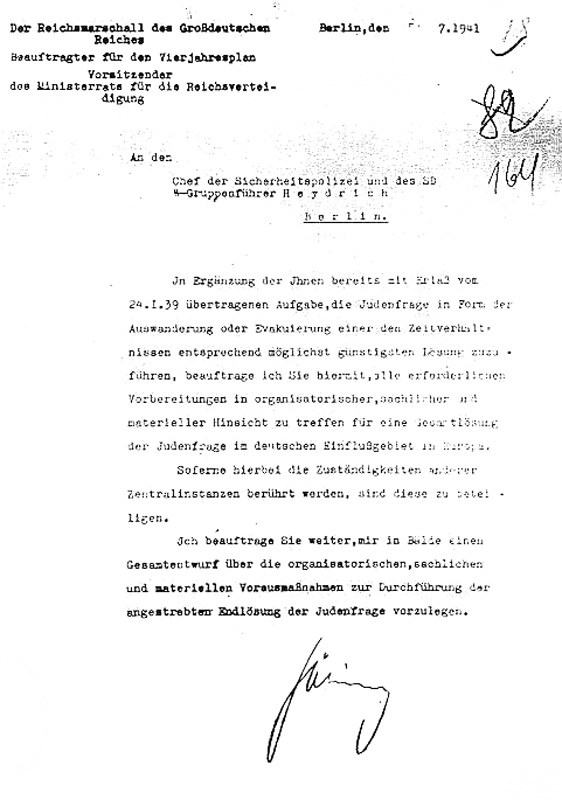
Reinhard Heydrich received instructions from Hermann Göring to prepare the implementation of the Final Solution to the Jewish question, Endlösung. Nazi plans to rid Europe of Jews took a step forward today, when Reinhardt Heydrich, the head of the RHSA (Reichssicherheitshaupamt [Reich Chief Security Office], which controls the police and Gestapo) received the following directive from Göring: “I commission you to carry out all organizational, material and financial preparations for a total solution of the Jewish question in the German sphere of influence in Europe. If the competency of other organizations is affected by this, these organizations are to participate. I further order you to submit to me as soon as possible a report showing the… measures already taken for the execution of the final solution of the Jewish question.” This order gives Heydrich full administrative power to set up a pan-European program, operated by Himmler’s SS, to dispose of the Jews. The nature of the program is still unfinalized, but some things are becoming clear. First, the thoroughness of Einsatzkommando massacres in occupied Russia in the last six weeks suggests that murder on a massive scale, rather than emigration, has become the “solution” to the “problem”. Secondly, recent discussions between Himmler and Rudolf Höss, the Aushwitz commandant, show that the order for that solution comes from Hitler himself. It looks as though the Auschwitz camp and one to be built at Majdanek, near Lublin, are to become the main centers for the operation.
Heydrich already has verbally instructed the SS to exterminate entire groups of people, including Jews, and even put it in writing. However, some later assume that Heydrich specifically asks Göring for this after-the-fact authorization letter. In colloquial terms, it is a “cover your butt” letter for Heydrich’s benefit.
As it works out, the letter is meaningless to Heydrich (who is assassinated in 1942) but provides a “smoking gun” against Göring at the Nuremberg Trials (who futilely claims that the letter is mistranslated and only refers to a “desired solution,” not a “final solution”). While things may have progressed as they did without this order, it provides legal cover for Heydrich to do whatever he wants to do — and Heydrich wants to do a lot where the Jews are concerned.
At the end of 14 days of continuous slaughter, Einsatzkommando groups have killed 10,000 Jews at Kishinev and 2,500 at Zhitomir. Immediately a region is occupied by German troops the Einsatzgruppen move in, gather together the local Jews, strip them of clothing and valuables and shoot them dead in a remote part of the countryside. The corpses are thrown into a shallow ditch. Local people especially in the Ukraine and Lithuania, join in mounting their own pogroms.
Einsatzcommando 3 reports executing 235 Jewish men, 16 Jewish women, and 5 non-Jews in the “Jäger Report.”
The Germans on 31 July 1941 capture and interrogate an unnamed Soviet General Staff officer who gives tantalizing hints that the Soviets may be in the process of abandoning Leningrad. He says that the Stavka is shifting troops from the Leningrad perimeter to south of Lake Ilmen to defend the approaches to Moscow. The Germans also notice heavy rail traffic between Moscow and Leningrad. General Halder hopefully notes in the OKH war diary a single word: “evacuation?”
Halder also notes something more troubling in the war diary. He writes that Field Marshal Walther von Brauchitsch, the head of the German Army (ObdH), is simply transcribing Hitler’s most recent Fuhrer directive directly into operational orders. Halder writes plaintively:
“Unfortunately I cannot induce ObdH to inject into this order the slightest overtone expressive of a will of his own. Its wording is dictated by an anxiety to avoid anything that could be suspected as opposition to his superior.”
This continues a constant refrain in Halder’s diary, that Hitler is tightening his grip on military operations and squeezing out all sense of direction aside from his own.
In the Far North sector, Finnish II Corps (Maj. Gen. Laatikainen) begins an offensive north of the Karelian Isthmus toward Lake Ladoga. One goal is to cut off the Soviet divisions that are northwest of the lake from their shortest withdrawal routes. The geographical target is the city of Viipuri (Vyborg), which Finland considers naturally its own possession and not Russian for historical reasons. The overall goal is the reconquest of the entire Karelian Isthmus. The defending Soviet 115th and 142nd Divisions have strong defensive positions and blunt the Finnish offensive.
In the Army Group North sector, German forces of the 16th Army secure the southwestern shore of Lake Ilmen. The Soviets counterattack from the direction of Toropets. General von Manstein’s troops continue in the direction of Luga. The Soviets are putting up a strong defense at Kholm, which is preventing the Germans from transferring troops further south.
Tallinn, the Estonian capital, has been surrounded by von Leeb’s Army Group North as he strikes for Leningrad. “Fast Heinz” Guderian’s tanks are approaching Moscow, Kiev is threatened by von Kleist and the Black Sea, the Romanian 4th Army is advancing on Odessa. The triumphal progress of the Wehrmacht is shown by the scale of Russian casualties — over a million in little more than a month of fighting, although the German casualties have been heavy too, over 100,000, more than in all its previous campaigns. Weaknesses are beginning to show in the German war machine. Some tanks are breaking down because their air filters cannot cope with the dust of the Russian steppes, and supply lines are stretched to breaking point. General Hopner, leading the Panzer thrust to Leningrad has been forced to delay his attempt to seize the city because he is short of shells. The scorched-earth policy is also denying the invaders the opportunity to live off the conquered lands.
In the Army Group Center sector, there are only local Soviet counterattacks. The Soviets are building fortifications all along their positions and evidently they intend to make a stand where they are. The Soviets continue attacking the German “lightning rod” position at Yelnya from all directions. The Germans, meanwhile, continue reducing the Smolensk pocket while the trapped Soviet forces such as Group Kachalov attempt to break out.
In the Army Group South sector, the German Sixth Army continues to sidestep the large Soviet troop concentration at Kyiv to the south. Panzer Group 1 (General von Kleist) is operating west of Pervomaisk and attempting to envelop Soviet forces of the 12th Army. Soviet attacks against the 11th Army begin to increase in intensity during the day. Progress is slow for the Germans all across this sector.
Soviet 43rd Army (Lieutenant General Ivan Zakharkin) becomes operational as part of General Georgy Zhukov’s new Reserve Front pursuant to a Stavka order dated 30 July 1941. Its mission is to defend the Desna River south of Yelnya on the line of Kholmets and Bogdanovo.
Having successfully transferred the 163rd Infantry Division in its entirety from Narvik, Norway to Finland on the railway line that runs across Swedish territory, the Germans ask for Swedish permission to transfer another division. The Swedes, who have been conflicted about the earlier decision, refuse.
Troops of the Spanish Blue Division are formally designated the Wehrmacht’s 250th Infantry Division. They assemble prior to their departure to the front and swear allegiance to Adolf Hitler. They are destined for the Army Group North sector.
Romanian leader Ion Antonescu formally accepted German leader Adolf Hitler’s request for Romanian troops to conquer and occupy the Ukrainian territory between Dniester and Bug Rivers.
The Bulgarian government annexes its portion of the former Yugoslavia.
Harry L. Hopkins, American lend-lease administrator, said tonight after a three-hour conference with Premier Josef Stalin concerning American aid to Russia that his short visit to Moscow had “added to my confidence that Hitler will lose.” Hopkins declined to add anything to his statement last night that he was offering Immediate American material aid to Russia, made after his first conference with Stalin.
In Operation FB, the Royal Navy arrives at Advent Fjord, Spitsbergen. There are no Germans there, but about 700 Norwegians. Other ships arrive at Gronfjord, where there are 1800 Russians.
Soviet destroyer Sokrushitelny meets British minelayer HMS Adventure near the Gorodetski lighthouse at the entrance to the White Sea in northern Russia. Adventure has been detached from Operation EF, the raid on Petsamo and Kirkenes.
General Ludwig Crüwell becomes commander of Afrika Corps while Lieutenant General Erwin Rommel is promoted to command of the new Panzerarmee Afrika. Panzer Army Africa is more the size of a corps than an army because it has only one infantry and two panzer divisions. While there are large Italian forces in North Africa, they remain under nominal Italian command. Crüwell is ill and does not take up his position until 15 September.
In Norway, Reichskommissar Josef Terboven issues a regulation that authorizes him to declare a civilian state of emergency. He does not do so at this time, however.
Force H covers a small convoy to Malta. Destroyers and aircraft from HMS Ark Royal attack Alghero in Sardinia.
Royal Navy submarine HMS Regent (Lt. Knox) surfaces and uses its deck guns to sink 160-ton Italian sailing ship Igea about seven miles northeast of Benghazi (or a similar distance from Carcura, Libya).
It is a quiet day on the air front in northwest Europe following several days of unsettled weather. The RAF sends four Blenheim bombers on a Roadstead sweep over St. Valery en Caux, and they return undamaged.
RAF Bomber Command, Day of 31 July 1941
4 Blenheims on an uneventful sweep off St-Valky.
Civilian air raid casualties this month in the United Kingdom were 900 people killed and 908 injured.
The Luftwaffe (KG4) drops 38 mines at the mouth of the Triigi River, Saaremaa, Estonia.
The Luftwaffe bombs Tobruk before dawn and are met with heavy anti-aircraft fire.
The Italians attack St Angelo, Malta with three BR-20 bombers. They cause some damage to military facilities there and injure three people. Three other BR-20 bombers attack the Grand Harbour area.
Soviet destroyer Sokrushitelny made rendezvous with British minelayer HMS Adventure near the Gorodetski lighthouse at the entrance to the White Sea in northern Russia.
Heavy cruiser HMS London and Dutch destroyer HNLMS Isaac Sweers, following working up exercises, departed Scapa Flow at 2200 for Greenock. The ships arrived at 1500 on 1 August to escort convoy WS.10.
Anti-aircraft ship HMS Curacoa departed Methil at 1600 and met convoy EC.52 off May Island. The convoy was escorted to Pentland Firth when the ship was detached at 0900 on 1 August and then proceeded to Scapa Flow.
British steam trawler Onward (209grt) was damaged by bombing and gunfire from a German aircraft twenty miles east of Nolso, Faroes.
French destroyer Triomphant departed Plymouth after refitting for the Pacific, via Panama. The destroyer arrived at St Johns on 6 August, Panama on 16 August, San Diego on 25 August; departing on 5 September, Honolulu on 15 September, and Papeete on 23 September. In the Pacific, the destroyer was used for escort duties between Australia and New Caledonia. She spent most of 1942 in Sydney in overhaul.
Submarine HMS Regent reported Italian steamer Igea (160grt) seven miles NW of Benghasi.
Ocean boarding vessel HMS Corinthian departed Gibraltar on Western Patrol.
German 3172-ton blockade runner Natal arrives at Gironde, France.
Destroyer HMS Vansittart intercepted Vichy French steamer Oued Grou (792grt), which had departed Ziguinchor on the 31st for Dakar, at 13-02N, 17-20W. Destroyer HMS Highlander was ordered to join Vansittart. On 1 August, destroyer HMS Velox relieved Highlander and took the steamer into Freetown. Highlander proceeded to Bathurst to refuel en route to Gibraltar. On 3 August, Vansittart was detached to proceed to Freetown. Velox and the steamer arrived at Freetown on 4 August, despite an attempt by the crew to scuttle the steamer.
Convoy ON.3 departed Liverpool, escorted by corvette HMS Veronica and anti-submarine trawler HMS St Elstan. Destroyers HMS Douglas, HMS Leamington, and HMS Skate and anti-submarine trawler HMS St Zeno joined on 1 August and corvettes HMS Mimosa and HMS Nasturtium on 4 August. The destroyers, corvette Veronica, and the trawlers were detached on 5 August. Destroyer HMS Columbia and corvette HMS Gladiolus joined on 5 August. Armed merchant cruiser HMS Ascania joined on 5 August and was detached on 8 August. The convoy was dispersed on 14 August and destroyer Columbia and corvettes Gladiolus, Mimosa, and Nasturtium were detached.
President Roosevelt appointed Vice President Wallace chairman of the new Economic Defense Board, sent to the Senate the nominations of Brigadier General Lewis B. Hershey to be director of Selective Service, and Lincoln MacVeagh to be Minister to Iceland, and conferred on price-control legislation with Marriner S. Eccles, governor of the Federal Reserve Bank, and Leon Henderson, head of the Office of Price Administration and Civilian Supply.
The Senate debated the bill for extension of compulsory military service, and adjourned at 5:17 PM until noon tomorrow. Conferees agreed on the $267,212,100 flood control authorization bill.
The House debated the tax bill, received the Celler bill to repeal the Neutrality Act, and adjourned at 5:07 PM until noon tomorrow.
The U.S. Economic Defense Board is created. Roosevelt explains the introduction of price controls to Congress, on the basis of controlling inflation and reducing the rise in domestic consumption. President Roosevelt elevated Vice President Wallace today to a key post in the defense organization when he created an Economic Defense Board and made the Vice President head of it.
President Roosevelt discussed today with Constantine A. Umansky, the Soviet Ambassador, and the Russian military mission now in this country the Russian military situation and United States aid to the Soviet Union. The chief of the mission, Lieutenant General Philip M. Golikov, who is deputy chief of staff of the Soviet Army, and his assistant, Engineer General Alexander Respin, wore uniforms of scarlet, blue and olive drab, with the Soviet hammer and sickle embossed in gold leaf on their visored caps. “I had the pleasure of presenting the deputy chief of our General Staff and his assistant to the President,” the Ambassador said. “They highly appreciated the warm and friendly reception they received from the President.” General Golikov said it was “extremely easy to discuss military questions with your President.” “One feels,” he added, “that President Roosevelt is well acquainted with all problems involved — that he is Commander in Chief not only by constitutional right but also by knowledge and by his deep understanding of the international political situation.”
Later in the day President Roosevelt touched upon the Russian situation during a conference with Viscount Halifax, the British Ambassador. “We discussed prospects in Russia,” the Ambassador said upon leaving the White House. “The Russian Army appears to be putting up an awfully good fight. It certainly looks that way.” The Soviet military mission is discussing at the State Department daily the placing of Soviet orders in this country. In this respect its mission parallels that of Harry L. Hopkins, Lend-Lease Coordinator to Moscow.
A night “blackout” for 100,000 gasoline service stations from Maine to Florida was proclaimed today by Secretary of Interior Ickes, effective Sunday, Aug. 3, to meet the predicted petroleum shortage in the east. Stations in the Atlantic seaboard slates would be closed from 7 p.m. to 7 a.m., seven days a week, under this action, until the oil emergency abates or other curtailment methods are adopted. This was the first step toward compulsory restrictions on the use of motor fuel, and Ickes, defense petroleum coordinator, warned other measures, including possible use of ration cards, might be necessary “unless this first action achieves results.”
A curb on installment selling, to be incorporated in a price-control bill, was explored by President Roosevelt today at a conference with Marriner S. Eccles, chairman of the Federal Reserve Board, and Leon Henderson, head of the Office of Price Administration and Civilian Supply. “Everything on the inflation front” was discussed, Mr. Eccles said. Mr. Henderson met with Representative Steagall, chairman of the Banking and Currency Committee, in a protracted session tonight in an effort to frame for introduction tomorrow the measure which was requested in yesterday’s Presidential message. There appeared to be some question as to how far the OPACS and the Federal Reserve Board might be able to go toward halting installment selling under existing powers.
Charges were made by Senator Wheeler in the Senate today that the motion picture industry was carrying on propaganda for war and he coupled this assertion with an attack on Wendell L. Willkie for alleged warlike activities. His speech was a feature of the second day of debate on the resolution to extend the military service of selectees, National Guardsmen and reserve officers “for the duration.” Going to the support of Senator Downey and his amendment to pay selectees a bonus of 330 a month for any time served beyond a year, Mr. Wheeler stretched what was supposed to be a few seconds’ interruption into a long speech. Before he finished, he had included not only the movie companies and Mr. Willkie, but also Secretaries Stimson and Knox, and William J. Donovan, Coordinator of Defense Information, in his indictment. Mr. Donovan, he charged, was now the head of the “American Gestapo.”
Asserting that the growing scarcity of scrap steel and pig iron was becoming more and more serious to the steel industry, which may not be able to maintain present rates of production unless new supplies are found, Eugene G. Grace, president of the Bethlehem Steel Corporation, said yesterday there was no use in building new steel plants until the problem has been solved.
The first Lockheed Ventura makes its maiden flight at Burbank, California. It is the first of 675 placed by the British Purchasing Commission and is designed to replace the Hudson. It is developed from the Lockheed Model 18 Lodestar transport. The British Purchasing Commission ordered 188 Venturas in February 1940 while the plane was still in the early stages of development.
The U.S. Army establishes the Military Police Corps.
Senator Knox has explained what happened when a U.S. destroyer dropped depth bombs off the coast of Greenland. One U.S. destroyer operating off Greenland heard the SOS of a steamer and proceeded to the location and picked up 60 of the survivors of the steamer… the operator of the listening equipment reported that he though he heard a submerged submarine. The captain immediately turned toward the direction indicated and dropped three depth charges. In doing this he very rightly exercised the right of self-preservation. There was no evidence that a submarine was there… the echo might have been received from a whale or large fish, or a cold current.
Complying with the request of Sidney Hillman, co-director of the Office of Production Management, Electrical Workers Union, Local 3, yesterday ordered 286 striking electricians employed at the navy yard in Brooklyn back to work.
USS Astoria arrived at Pearl Harbor, U.S. Territory of Hawaii.
The motion picture “Hold Back the Dawn” is released in the U.S. The film is directed by Mitchell Leisen and stars Charles Boyer, Olivia de Havilland, Paulette Goddard, Walter Abel and Rosemary DeCamp; Brian Donlevy and Veronica Lake appear in uncredited bit parts. This tear-jerker has Boyer as a Rumanian gigolo being rejected as he tries to enter the U.S. so he marries a spinsterish American (de Havilland). After entering the country, he plans to dump her and marry his girlfriend (Goddard) who got into the U.S. the same way. The film is nominated for six Academy Awards including Best Picture and Best Actress (de Havilland).
Major League Baseball:
In the first game of a twinbill, the Browns outlast the Red Sox 16–11, scoring 6 runs in the 9th. The game takes 3 hours and 11 minutes, the longest regulation American League game up to this time. Roy Cullenbine has 2 official at bats, but scores 5 runs and knocks in 5. He hits a grand slam as does Ted Williams for Boston. In game 2, the Sox win, 4–1, behind Rookie Tex Hughson’s six-hit pitching, in a game called after 7 ½ innings because of a thick mist covering the field.
The Phillies knocked Charley Root out of the box in the three-run second inning today and beat the Cubs, 7–2, to earn an even break in the four-game series. The Phils made thirteen hits off Root, Jack Mooty and Vance Page. Johnny Podgajny held Chicago to six, three in the seventh inning, when the Bruins scored their runs. They made only one hit until the sixth inning.
The world champion Reds tried their hardest to present to New York’s hapless standard bearers in the National League the finale of a three-game visit. Four large errors helped the Giants to three runs. They had a three-run lead in the third inning, but they blew this ordinarily comfortable margin, gave Bill McKechnie’s band three unearned runs and, pained and weary, saw the Reds gallop to a 6-5 victory in a ninth-inning uprising.
The New York Yankees swept a doubleheader from the Detroit Tigers, but they had to work a little longer to win the opener. Detroit tied the score in the ninth. So the Bronx Bombers had to go thirteen innings before Charlie Keller hammered out a three-run homer for a rousing 6–3 victory. The first engagement lasted so long that darkness halted the nightcap in the eighth frame. In this game Spud Chandler held the Tigers firmly in check, pitching a four-hit shut-out and winning, 5–0. The chief shot in this affair was a screaming homer by Joe DiMaggio in the second inning, his twenty-fifth. Chandler needed no more margin than the Yankee Clipper gave him, but the Bombers picked up a few extra tallies just to be on the safe side.
Paced by Benny McCoy’s fourth-inning home run with the bases full, the Athletics routed the White Sox, 9–2, today to supplant Chicago in fourth place. This marked the first time in ten seasons Philadelphia has been in the first division of the American League so late in the season. For the real McCoy, this is his last Major League season and he’ll spend the next four in the Navy.
The Braves scored seven runs in the eighth and ninth innings today but failed to catch the Pirates, who won by 9–8. The last contest in the three-game series ended with Boston’s tying run left on second. Sixteen hits gave Pittsburgh all its runs in the first six innings.
Smarting from their futile performances in two games in St. Louis, the Dodgers today burst out in a rash of extra base hits, beat the Cardinals, 9–5, and left later for Chicago again only two games back of the National League leaders. Dolph Camilli, Lew Riggs, and Jimmy Wasdell hit home runs. Wasdell’s blow, which came in the fourth with two aboard, was the decisive wallop, since it gave Brooklyn a 7–3 lead. Terry Moore hit a round-tripper off Freddy Fitzsimmons in the seventh with none on base for the last St. Louis counter.
The scheduled game between the Cleveland Indians and the Senators at Washington was postponed due to wet grounds. The game will be made up as part of a doubleheader on September 11.
St. Louis Browns 16, Boston Red Sox 11
St. Louis Browns 1, Boston Red Sox 4
Philadelphia Phillies 7, Chicago Cubs 2
New York Giants 5, Cincinnati Reds 6
Detroit Tigers 3, New York Yankees 6
Detroit Tigers 0, New York Yankees 5
Chicago White Sox 2, Philadelphia Athletics 9
Boston Braves 8, Pittsburgh Pirates 9
Brooklyn Dodgers 9, St. Louis Cardinals 5
Canadian Prime Minister W. L. Mackenzie King told a delegation representing strikers of the Hamilton National Steel Car Corp. plant today no consideration can be given to representations by employees while a strike is in progress in any government-controlled plant. After hearing from Mackenzie King, the delegation tonight sent word to Hamilton recommending that the Steel Workers’ Organizing committee call off the strike. The plant, engaged in munitions work, employs about 2,800 persons.
The Ecuadorian–Peruvian War ended in a cease-fire. After several days of discussion during which military operations continued, the two sides agree to a ceasefire in their border war. As a last military movement in the war, Peruvian troops arrive at Puerto Bolivar by ship and continue to operate against Ecuadorian troops in the Amazonian jungle.
In a speech before the General Mobilization Inquiry Commission, which met yesterday to consider imperial ordinances for increasing Japan’s self-sufficiency, Premier Prince Fumimaro Konoe said that, with the hostilities between Germany and Russia, the European war had reached a new turning point and that its ultimate result could not be easily predicted.
Foreign Minister Vice Admiral Teijiro Toyoda offered apologies and expressed regret today to United States Ambassador Joseph C. Grew for the bombing of the United States gunboat Tutuila at Chungking, China. Grew and Toyoda talked at the foreign office for 20 minutes. Sumner Welles, acting secretary of state, announced tonight the United States had accepted official apologies of the Japanese government on the bombing of the USS. Tutuila at Chungking, China, that the incident was regarded as closed. The Japanese government assured the United States that the previous day’s bombing of the U.S. Navy Gunboat Tutuila (PR 4) at Chungking, China, was “an accident ‘pure and simple.”
Effective today, US exports of aviation motor fuels and lubricants and No. 1 heavy melting iron and steel scrap to Japan are put on the restricted list pursuant to the Export Control Act signed on 2 July 1940.
Imperial Japanese Navy CruDiv 7 (Mogami, Mikuma, Kumano and Suzuya) departs Saigon.
U.S. Army Chief of Staff George Marshall issues public statement that it was now U.S. policy to defend the Philippines and that Philippine defense was to take the “highest priority”.
The U.S. Asiatic Fleet and U.S. Army Harbor Defense Command close Manila harbor by mining. Henceforth, civilian shipping requires escort through the minefields by Asiatic Fleet vessels or by U.S. Army Mine Planters assigned to the Harbor Defense Command.
Dow Jones Industrial Average: 128.79 (-0.16)
Born:
Gerry Philbin, AFL-NFL defensive end (All-time All-AFL Team; AFL Champions and Super Bowl II champions-Jets; AFL All-star, 1968, 1969; New York Jets, Philadelphia Eagles), in Pawtucket, Rhode Island (d. 2025).
Art Graham, AFL split end (Boston Patriots), in Somerville, Massachusetts.
Paul Andrea, Canadian NHL right wing (New York Rangers, Pittsburgh Penguins, California Golden Seals, Buffalo Sabres; WHA: Cleveland Crusaders), in North Sydney, Nova Scotia.
Amarsinh Chaudhary, politician, in Surat, Gujarat, British India (d. 2004).
Naval Construction:
The U.S. Navy Fulton-class submarine tender USS Orion (AS-18) is laid down by the Moore Dry Dock Co. (Oakland, California, U.S.A.).
The Royal Navy LST (Mk 1)-class tank landing ship HMS Thruster (F 131) is laid down by Harland & Wolff (Belfast, Northern Ireland).
The Royal Navy YMS-1-class auxiliary motor minesweeper HMS BYMS 2016 (J 816) is laid down by the Dachel-Carter Shipbuilding Corp. (Benton Harbor, Michigan, U.S.A.).
The U.S. Navy Accentor-class coastal minesweeper USS Memorable (AMc-89) is laid down by the F. L. Fulton Shipyard (Antioch, California, U.S.A.).
The U.S. Navy Adroit-class minesweeper USS Adroit (AM-82) is laid down by the Commercial Iron Works (Portland, Oregon, U.S.A.).
The Kriegsmarine (German Navy) Type VIIC U-boat U-711 is laid down by H C Stülcken Sohn, Hamburg (werk 777).
The U.S. Navy Gleaves-class destroyers USS Duncan (DD-485) and USS Lansdowne (DD-486) are laid down by the Federal Shipbuilding & Drydock Co. (Kearny, New York, U.S.A.).
The U.S. Navy Fletcher-class destroyer USS Pringle (DD-477) is laid down by the Charleston Navy Yard (Charleston, South Carolina, U.S.A.).
The U.S. Navy Bogue-class escort aircraft carrier USS St. George (CVE-17) is laid down by the Ingalls Shipbuilding Corp. (Pascagoula, Mississippi, U.S.A.). She is transferred to the Royal Navy under lend-lease on completion and commissions as the “Attacker-class” HMS Pursuer (D 73).
The Kriegsmarine (German Navy) Type IXC U-boat U-172 is launched by AG Weser, Bremen (werk 1012).
The U.S. Navy submarine tender USS Griffin (AS-13), lead ship of her class of 2, is commissioned. Her first commanding officer is Commander Stanley Dexter Jupp, USN.
The Nihon Kaigun (Imperial Japanese Navy) No.13-class submarine chaser HIJMS Ch-17 is commissioned.
The Nihon Kaigun (Imperial Japanese Navy) No.13-class submarine chaser HIJMS Ch-18 is commissioned.
The Kriegsmarine (German Navy) Type VIIC U-boat U-581 is commissioned. Her first commanding officer is Kapitänleutnant Werner Pfeifer.
The Вое́нно-морско́й флот СССР (ВМФ) (Soviet Navy) “S” (Stalinec)-class (2nd group, Type IX-modified) submarine S-13 is commissioned.
The Royal Navy Flower-class corvette HMS Pentstemon (K 61) is commissioned. Her first commanding officer is Lieutenant Commander (retired) John Byron, RNR.
The Royal Canadian Navy Flower-class corvette HMCS Battleford (K 165) is commissioned. Her first commanding officer is T/Lieutenant Roland Joel Roberts, RCNR.
The Royal Navy Flower-class corvette HMS Monkshood (K 207) is commissioned. Her first commanding officer is Lieutenant Commander James Edward Rickards Wilford, RNR.
For the month of July 1941, German U-boats sank 18 ships (total of 61,676 tons) and damaged 3 more ships (total of 18,845 tons).
Royal Navy hopes are high as this month ends that they are over the worst in their battle with the U-boats. Losses to Allied shipping are now running at under one-fifth of the peak rate of 688,000 tons suffered in April. There has been a steady improvement, thanks to more escorts and better support at the Iceland base, with the U.S. now helping out as well as Canada. And the Germans have had less air support since the Russian front opened.
But the worst is in fact not over yet. The second Happy Time is coming for the Kriegsmarine, and some of the most painful convoy battles of the war.
Overall, Allied shipping losses drop sharply in July 1941, from 389,316 tons in June to 109,276 tons in July. This undoubtedly is due to the diversion of German resources toward the Soviet Union. Allied losses are down sharply in every category, such as losses by U-boat down from 310,143 tons in June to 94,209 tons in July.
The silver lining for the Kriegsmarine is that they do not lose any U-boats during July after losing four in June. For its part, the Axis loses 12 ships of 47,055 tons in the Mediterranean. Admiral Doenitz has a fleet of 65 U-boats in operation during the month of July 1941.
 History Diaries