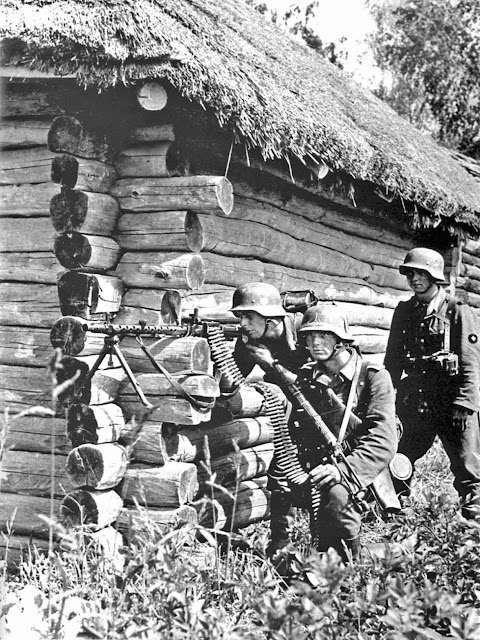
SS Battalion Kurt “Panzer” Meyer greets the dawn of 29 July 1941 in an unnamed battlefield that has been “hot” all night long. Reflecting an increasingly gloomy outlook by ordinary soldiers, he later recalls:
“I wanted to scream, to curse the whole insanity of war, but I tumbled into the next hole and returned the fire of a Russian who was lying behind a bush not fifty meters away on the other side of the road. Glancing at the prostrate, clawing humanity around me, the bloody fields of Verdun appeared before me in my thoughts.”
Meyer notes that the Soviets have left, but there are dead bodies from both sides strewn all about.
In the Far North sector, the German 36 Corps (General Hans Feige) once again attempts to break Soviet resistance east of Salla to continue the advance on the vital Murmansk railway. As did the attempt on the 27, this one completely fails. The fruitless attacks have been extremely costly in terms of lives lost on both sides, with the Germans taking 5000 casualties in the last month in this sector alone. After this, General Nikolaus von Falkenhorst in Army Group Norway accepts the inevitable and calls off further attacks until the situation changes.
In the Army Group North sector, the German 16th Army attacks in the direction of Velikiye Luki while the 18th Army continues clearing out Estonia.
In the Army Group Center sector, German forces encircling parts of three trapped armies in the Smolensk area withstand strong Soviet attempts to open the pocket. Soviet 30th Army counterattacks in the northern part of the pocket, but is stopped by General Hoth’s 3rd Panzer Group. Soviet 4th Army attacks General Guderian’s Panzer Group 2 in the Yelnya area. At 19:00, General Timoshenko at Western Front orders 20th Army (General Kurochkin) to retake Smolensk. Kurochkin dutifully complies, but the attack fails and the Soviet troops withdraw with heavy casualties. A local counterattack by General Rokossovsky’s 101st Tank Division using KV tanks does recapture Iartsevo temporarily. A mighty battle of men and machines is under way along a 190-mile front stretching northeastward beyond Smolensk where the Russians are trying again and again but without success to pinch off a Nazi panzer-driven wedge, German dispatches reported early today. Beobachter said the battle of battles was raging between the towns of Mogilev and Vyazma which are 190 miles apart, and to a depth of 90 miles.
In the Army Group South sector, General Ewald von Kleist sends XVIII Motorized Corps of his Panzer Group I toward Pervomaisk. Meanwhile, the German 6th Army attacks directly toward Kyiv, but, facing heavy resistance, sidestep to the south of the city to envelop the defenders. The Soviets have 1.5 million men in the vicinity of Uman, but they are slowly being compressed into a smaller and smaller area.
Stalin demotes General Georgi Zhukov from the position of chief for the General Staff, for advising a tactical surrender at Kiev, replacing him with Marshal Boris Shaposhnikov.
Zhukov takes command of newly forming Reserve Front and prepares for counterattacks against German 2nd Panzer Group around Yelnya.
Eremenko relieved of command of Soviet Western Front.
Army Bishop Rarkowski issues a pastoral letter to the German armed forces describing Germany as “the savior and champion of Europe.” We know, he added, that this war against Russia is waged by us as “a European Crusade,” a task similar to that fulfilled in earlier times by the Teutonic knights.
Photographs of the Russian composer Dmitri Shostakovich as a firefighter were taken in Leningrad. The photographs were published around the world as a symbol of Soviet determination.
The first 300 Norwegian volunteers for the “Legion Norwegen” arrive in Kiel, Germany and are sent to Fallingbostel Training Camp.
General der Flakartillerie Ludwig Karl Hermann von Schröder perishes in an air crash near Hohenlychen (north of Berlin). At the time of his death, he is the military commander of Serbia and section commander of the Schutzstaffel (SS). Previously, Schröder served in the German navy as a Vice-Admiral, then transferred to the Luftwaffe in 1937 when it was rapidly expanding and drawing officers from the other branches of the Wehrmacht. General von Schröder is perhaps most notorious for instituting the practice of forcing Jews and Gypsies in Serbia to identify themselves by wearing a yellow armband, along with various other repressive measures against them such as the registration of Jewish assets. These practices rapidly spread throughout the Reich and lead to the infamous Yellow Star of David badge.
Axis occupation troops in the Belgrade vicinity execute 122 men purportedly for being in the Resistance — they just so happen also to be Communists and Jews.
Germans at a mental hospital at Lodz, Poland take 40 patients out to a forest and execute them.
At Auschwitz, ten prisoners disappear from the camp. SS-Hauptsturmführer Karl Fritzsch, the deputy camp commander, decides to pick 10 men to be starved to death in an underground bunker to discourage further escape attempts. Fellow inmate Catholic priest Maximilian Maria Kolbe, is not selected. However, noticing that one of the men so selected is in despair, Kolbe steps forward to take the man’s place and ultimately perishes on 14 August 1941. Kolbe will be canonized for this act by Pope John Paul II on 10 October 1982.
Einsatzcommando 3 executes 257 men, 254 of them Jewish, in Raseiniai (according to the Jäger Report).
Beginning on July 29, 1941 and continuing throughout the summer of 1941, the Germans murdered about 8,000 Jews from Šiauliai, Lithuania, and the Šiauliai region in the Kužiai forest. 125 Jews from Linkuva were also murdered there along with ethnic Lithuanian and Russian members of the Communist Party and the Communist Youth.
There are still small groups of British soldiers on Crete despite the complete success of Operation Mercury. They have been supported by Greek villagers and evade capture by hiding out in caves which were prepared as air raid shelters prior to the invasion. Today, 78 of these troops (67 British and 11 Greek) are picked up by submarine HMS Thrasher and taken to Alexandria, two months after the island fell to the Germans.
British Middle East Commander Claude Auchinleck and his RAF commander, Air Marshal Tedder, arrive in London by air for consultations about future operations, and the upcoming offensive in Western Desert.
An Italian bomber spots Royal Navy submarine HMS Olympus a few miles from Cavoli Light, southeastern Sardinia. A near miss damages the Olympus. The submarine is leaking and cannot submerge, but it makes it back to Gibraltar after a harrowing journey of several days.
Luftwaffe Junkers Ju 87 Stukas of I,/STG 1 and accompanying Italian Stukas of No 239 Squadron bomb and sink 372-ton British landing craft LCT-8 and Lighter A-8 east of Bardia. Some sources place this incident on the 28th.
Royal Navy destroyer HMS Hotspur and Australian destroyer HMAS Vendetta load weary Australian troops at Tobruk before dawn and take them to Mersa Matruh for rest and recuperation.
An Axis convoy of three large troopships (Neptunia, Oceania, and Marco Polo) departs from Tripoli bound for Naples. It is escorted by five destroyers and a torpedo boat. Another return of four freighters also departs with a four-destroyer escort. Another, third, convoy of only one freighter, 6343-ton Francesco Barbaro, also departs from Tripoli. Generally, transports can steam faster than ordinary freighters, and not all freighters can proceed at the same speed, thus the desirability of having small convoys of different speeds rather than one large (and slow for all) convoy. Faster convoys are usually considered safer than slower ones, so faster ship masters greatly prefer traveling with other fast ships rather than slowing down for slower freighters.
An Axis supply convoy of three Italian ships and one German freighter departs from Naples bound for Tripoli.
At Malta, the garrison receives a personal note of congratulations from the Chief of the Imperial General Staff in London for frustrating the Italian motorboat attack on the 26th. The War Office asks for further details of the action, perhaps because Italian radio in Rome is touting it as an excellent feat of arms by the Regia Marina despite the absolute failure of its mission.
British Prime Minister Winston Churchill makes a speech before the House of Commons. The majority of his speech concerns munitions production, which he assures the House is in good order despite rumors to the contrary. He emphasizes that war production has been dispersed, noting, “I can give instances of dispersion of twenty, thirty or forty sub-centers.” He winds up with a reassuring summary of the war situation, noting that “German air superiority has been broken” and that the Battle of the Atlantic is “moving progressively in our favor.”
British merchant seaman David Hay was awarded an Albert Medal for his daring rescue of a fellow sailor from shark-infested waters during the journey between Liverpool, England, United Kingdom and Takoradi, British Gold Coast.
Operation EF, the British raid on Kirkenes and Petsamo, continues steaming toward its destination. Since there is daylight 24 hours a day at the higher latitudes, the Royal Navy armada steaming from Iceland is easy to spot, and indeed the Germans do spot it today far from the coast. A Kriegsmarine destroyer force (Richard Beitzen, Friedrich Eckholdt, Karl Galster and Hermann Schoemann) is conducting a sweep near the Kara Straits when it receives word that a massive British fleet including aircraft carriers is nearby. The destroyers quickly hurry back to port. The British plan their raid for the early hours of 30 July and complete their refueling today.
Force A of British Operation FB, a raid on Spitsbergen, Norway, departs from Seidlsfjord, Iceland.
German raider Orion (Schiff 36, FKpt. Weyher), operating midway between Africa and South America due east of Puerto Rico, captures 5792-ton British freighter Chaucer. The crew survives and become prisoners of war. The sinking is a miserable affair for the German crew because they have to fire the extraordinary number of ten torpedoes, but five miss (perhaps with internal guidance issues) and five fail to detonate. Frustrated, Weyher finally has the men man the deck gun and sink the Chaucer with gunfire. Faulty torpedoes have plagued the U-boat since the start of the war.
The weather continues to be poor over northwest Europe, with heavy cloud cover. It begins clearing up during the night, but there are no operations today.
RAF No. 81 Squadron reforms as a Hurricane-equipped fighter squadron. It is designated for transfer to the Soviet Union aboard an aircraft carrier in September 1941.
The German U-boat fleet is still shadowing British Convoy OG.69. However, U-331 (Kptlt. Hans-Diedrich von Tiesenhausen), on its first patrol out of Kiel, is spotted by the British escorts and subjected to a depth charge attack, preventing an attack. There are no other attacks today.
Sub Lt C. Wheatley, Midshipman L. E. W. Byam, and Leading Airman G. Curwen were lost when their Albacore of 832 Squadron crashed west of Kintyre.
British steamer Adam’s Beck (2816grt) was badly damaged by German bombing one mile 235° from 20C Buoy, Tyne. One crew was missing on the steamer. The steamer sank on the 30th.
German destroyers Karl Galster, Hermann Schoemann, Friedrich Eckholdt, and Richard Beitzen swept towards Yugor and Kara Straits. However, the sweep was abandoned when the British carrier force was reported.
German steamer Bernhard (1890grt) was lost in a collision with Swedish steamer Frode (1535grt) near Norderney.
German steamer Leontes (338grt) was lost on a mine near Windau.
British supply ship Breconshire, escorted by corvettes HMS Wallflower, HMS Zinnia, HMS Hydrangea, HMS Campanula, and HMS Bluebell departed Gibraltar for Liverpool.
Submarine HMS Clyde arrived at Gibraltar from patrol in the Atlantic.
Submarine HMS Talisman departed Gibraltar for Malta with stores.
Submarine HMS Thrasher arrived at Alexandria with seventy eight men from Crete which had been in hiding since the island fell.
Submarine HMS Olympus was damaged by near misses from an Italian bomber 3½ miles 107° Cavoli Light,. The submarine sustained considerable damage to her battery and many fittings were damaged causing leaks. Submarine Olympus arrived back at Gibraltar on 2 August.
British steamer Chaucer (5792grt) was captured at 16-46N, 38-01W by German raider Orion. The entire crew was made prisoners of war.
Sub Lt T. P. J. Heatley RNR, was lost overboard from destroyer HMS Thracian.
President Roosevelt met with Democratic leaders from the capitol in the usual legislative conference. His callers included Sumner Welles, acting Secretary of State; Senor C. E. Alfaro, the Ecuadorean Ambassador, and Dr. Don H. V. La Fornte, special envoy of Ecuador; William Green, president of the A. F. of L., and Marriner S. Eccles, chairman of the Federal Reserve Board.
The Senate passed the bill ordering government loan cotton and wheat withheld from the market during the emergency, received a bill to give to the Coast Guard control of movements of shipping in United States territorial waters, received the report of Secretary Knox and Admiral Stark on activities of the Navy’s Atlantic Patrol, confirmed the nomination of Anthony J. Drexel Biddle Jr. as Minister to the Yugoslav government in exile: confirmed the nomination of Matthew McGuire as a justice of the Federal district court for the District of Columbia and recessed at 5:51 PM until noon tomorrow.
The House returned Selective Service Act amendments to conference, rejecting the property-seizure amendment, and adjourned at 2:10 PM until noon tomorrow. The Military Affairs Committee agreed tentatively on a resolution declaring the national welfare imperiled; the Rivers and Harbors Committee heard further opposition to the St. Lawrence waterway project.
President Roosevelt at his press conference today was not prepared to discuss the Far East. He would not comment on British Prime Minister Winston Churchill’s assertion that the United States was moving to the verge of war. He had not read the statement, he explained. Asked what he thought about the Japanese move into French Indo-China, Mr. Roosevelt brushed the question aside with the remark that it was a very current matter, thus implying that he should not discuss it informally.
A wave of revolt in congress today balked plans for quick action on the $3,529,000,000 tax bill, threatened to throw administration crop controls awry, and apparently killed legislation permitting the president to take over factories in which production stoppages impede the defense program. The defense tax bill, biggest revenue measure, was scheduled to come up in the house for debate today, but Democratic leaders suddenly postponed debate until later in the week because they feared the chamber would refuse to ratify procedure drastically limiting amendments.
Secretary of War Henry L. Stimson tonight apologized to Senator Burton K. Wheeler, Montana Democrat, for inferring last week that the isolationist leader intentionally circularized soldiers in training with postal cards opposing war. Stimson said at the same time that an inquiry at post offices at large cantonments revealed not only that “at least several hundred” of the circulars had reached men in training but that “organized attempts” were being made “to arouse disloyalty on the part of the soldiers in the cantonments towards the training plans of their officers.”
President Roosevelt and the State Department hastened today to repudiate a suggestion by Senator Clark, Idaho Democrat, that the United States “take over control” of Latin America and Canada, perhaps by setting up puppet governments. The president, at his press conference, expressed hope that none of the United States’ good friends in Latin America would take Clark seriously. Sumner Welles, acting secretary of state, strongly defended the “good neighbor policy,” which Clark had described as a failure, and said that Clark’s suggestion for taking over the countries was “unbelievable.”
The United States kept Japan completely in the dark tonight on the future of oil and other exports from this country while retaining full freedom to act against any Japanese ships which come into American ports. President Roosevelt, adopting a cautious attitude on the Far East, refused at his press conference to indicate how rigidly economic sanctions would be applied against Japan. He said the Japanese move Into French Indo-China, which the United States government denounced last week, was still a very current matter and that it was best not to discuss the question of an oil embargo or other export control restrictions. Asked whether he thought the situation in the Pacific had become more serious than that in the Atlantic from an American point of view, the president said he would not make comparisons. At the State Department, acting Secretary Sumner Welles said the government’s policy under present conditions was to permit normal procedure with regard to facilitating clearance of Japanese ships from American ports.
The United States issued its first list of blocked nationals. Persons on this list were considered to be engaging in subversive or anti-American activities. They are barred from entry to the United States for engaging in activities deemed subversive and anti-American.
Work on six defense projects in the Navy Yard in Brooklyn was halted when 8,000 electricians, members of Electrical Workers Union, Local 3, A. F. of L., began a general strike yesterday morning. One thousand construction jobs involving hundreds of millions of dollars were tied up throughout the city. The Navy Yard projects, involving a projected expenditure of $70,000,000, were brought to a standstill when 236 electricians employed by private contractors responded to the strike call. Eight hundred other building craftsmen at work on these jobs had to be laid off as a consequence and it was feared that thousands more would be forced into idleness if the strike should continue. Fifty electricians working directly for the government were ordered back to the yard by the union. Union officials made it clear that while the strike call did not directly affect defense work, they could not prevent men from quitting defense projects performed by private contractors. At the Navy Yard work halted on a sixteen-story storehouse, two super-drydocks, a shop extension, a subassembly shop and a receiving barracks.
Rationing of oil products along the Atlantic seaboard, which would affect consumers from Maine to Florida, is under consideration by the Office of Petroleum Coordinator, it was learned yesterday, and may be started within the next two weeks. At first, it was understood, the plan will be almost entirely on a voluntary basis, but after the Labor Day holiday a drastic rationing scheme that may reduce the amount of gasoline some motorists may buy to as little as five gallons a week may be put into effect. The whole matter of rationing oil supplies has been under consideration for the last few weeks by the marketing committee appointed by Secretary Ickes, petroleum coordinator. This committee, which is expected to have the plan ready for submission to Secretary Ickes within ten days, is determining the degree of rationing that will be necessary as a result of the anticipated reduction of oil supplies by 50 percent on the Atlantic coast as the result of the diversion of tankers to the British war effort.
The U.S. Secretary of the Navy approves the installation of a Radar Plot aboard aircraft carriers as “the brain of the organization” protecting the fleet from air attack. The first installation is planned for the island structure of USS Wasp (CV-7).
USAF General Lewis H. Brereton takes command of the Third Air Force at MacDill Field, Florida.
British actor James Stephenson passes away from a heart attack in Pacific Palisades, California. His career began in 1937 at age 48, an unusual age at which to become a film star, and especially so because he had little previous acting experience. Stephenson’s roles included parts in “Beau Geste” (1939), “The Sea Hawk” (1940), and “Shining Victory” (1940). Stephenson earns one Academy Award nomination for “The Letter” (1940). He is interred in Glendale’s Forest Lawn Memorial Park.
Silent film actor Charles Murray, who appeared in 283 films between 1912 and 1938, passes away in Los Angeles at the age of 69. Murray appeared in the first ‘The Wizard of Oz” in 1925. He has a star on the Hollywood Walk of Fame at 1725 Vine Street.
Major League Baseball:
The Browns continued their jinx over the Red Sox today, taking the first game of the present series, 3 to 2, behind the six-hit pitching of Johnny Niggeling. It was his third triumph of the season over Boston. Ted Williams hit his 20th homer of the year for the Sox.
At Wrigley, Swish Nicholson applies the coup de gras with an 8th inning grand slam, as the Cubs top the last-place Phillies, 12–4. It is Nicholson’s 2nd grand slam of the year. The Cubs bombarded five pitchers with fourteen hits.
The New York Giants 4, blew a 4-run lead to drop the opener of a three-game series to the champion Reds, 7–4, for their sixth defeat in seven contests on the road and their seventh setback in their last eight starts. The temperature was a “cool” 102 degrees in the shaded press box atop the grandstand roof as the battle started. Two thermometers verified this fact. Nobody knows what it was on the sun-washed field, but the heat claimed Bob Carpenter and Gabby Hartnett in a torrid fifth inning during which Cincinnati got five runs.
Walking may tie a lost art, but not to the Tigers. Five of them strolled in the seventh inning at Yankee Stadium today, and forced in the two runs that broke a 3-all deadlock and Detroit marched off with a 6–3 victory over the Yankees.
Jimmy Dykes, who usually is one of the principals, acted as peacemaker today in a fight that broke out between southpaw Edgar Smith of the White Sox and Al Simmons of the Athletics after Smith had shut out the Athletics with four hits, 1–0.
Rain scored a timely assist today as the Pirates polished off the Braves, 5–3, for the Bucs’ tenth victory in their last eleven games. Halted briefly by a shower, the game finally was washed out in the eighth after Frank Demaree’s single and a walk to Carvel Rowellhad placed the tying runs on the bases for the Braves with only one out.
In the most extended exhibition, of futility either team has displayed this season the Cardinals and Dodgers played twelve innings to a 7–7 tie this afternoon and evening, the struggle being ended by darkness.
Lefty Al Smith hurled Cleveland to a 5–1 victory over Washington today to give the Indians’ fading pennant hopes a much-needed stimulus. Smith kept nine Senator hits well-scattered.
St. Louis Browns 3, Boston Red Sox 2
Philadelphia Phillies 4, Chicago Cubs 12
New York Giants 4, Cincinnati Reds 7
Detroit Tigers 6, New York Yankees 3
Chicago White Sox 1, Philadelphia Athletics 0
Boston Braves 3, Pittsburgh Pirates 5
Brooklyn Dodgers 7, St. Louis Cardinals 7
Cleveland Indians 5, Washington Senators 1
The Arvida strike ended when the Canadian government amended the Defence of Canada Regulations to allow the Minister of National Defence to call out troops to deal with labour disputes without requiring permission from municipal or provincial authorities. A subsequent royal commission concluded that while the strike was illegal, it was caused by workers’ frustrations over salaries and working conditions rather than subversives as Munitions and Supply Minister C. D. Howe had claimed.
After a tentative ceasefire, Peruvian forces renew advance into Ecuadorian territory. Although both sides are under intense pressure from the United States and neighbors to end their border war, ceasefire negotiations remain incomplete. Thus, Peru orders its military to continue advancing into Ecuador.
The U.S. State Department issues a stinging denunciation of the Japanese occupation of southern French Indochina, noting that it obviously is “for the purpose of further and more obvious movements of conquest in adjacent areas.” It goes on to note that these actions “jeopardize the procurement by the United States of essential materials … for the normal economy of this country….” Of course, the Japanese at this point aren not too concerned about what the Americans want, considering that the Roosevelt Administration has slapped extremely tough sanctions on Japan that are virtually forcing it to seek out new sources of supply in the south.
Japan and Vichy France pledged “military co-operation” for joint defense of French Indochina. Japanese occupy southern French Indochina with French permission. A mutual defense agreement regarding Indochina was signed in Tokyo between Japanese and Vichy French representatives. The agreement read in part: “Recognizing in consequence that should the security of French Indochina be menaced, Japan would have reason to consider the general tranquility in East Asia and its own security endangered.”
Japan froze Dutch assets. This action was made in retaliation to the Dutch freezing Japanese assets the previous day. Koh Ishii, Japanese cabinet Bureau of Information spokesman, announced today that Japan has frozen the assets of the Netherlands and the Netherlands East Indies.
The Japanese took ownership of the naval base at Cam Ranh Bay in French Indochina. Japanese warships and troop transports entered Cam Ranh Bay today, reports reaching Saigon said, as the Japanese occupation of southern Indo-China went into high gear. This activity followed the occupation yesterday of the Tourane (later called Ðà Nang) and Nhatrang bases, on the east coast.
The Imperial Japanese Navy aircraft carrier HIJMS Akagi departs Yokosuka for Ariake Bay. Henceforth she is operating between Kagoshima and Ariake Bay.
Imperial Japanese Navy heavy cruiser HIJMS Ashigara arrives at Saigon.
After a conference with President Manuel L. Quezon, Lieut. Gen. Douglas MacArthur announced today a general plan for the integration of the armed forces of the Philippines into the United States Army forces in the Far East.
Manila, alarmed by the Far East crisis, took steps today to provide air-raid shelters and planned its first practice evacuation of civilians.
Joseph Rochefort reported to U.S. Navy Admiral Husband Kimmel that the Japanese fleet detected outside of Japanese home waters were heading back to Japan, thus there was no immediate threat of an aggressive Japanese response to Franklin Roosevelt’s decision to freeze Japanese assets.
Dow Jones Industrial Average: 129.19 (-0.87)
Born:
David Warner, English actor (“Masada”; “Star Trek VI”; “Time Bandits”), in Manchester, England, United Kingdom (d. 2022).
Jennifer Dunn, American politician, in Seattle, Washington (d. 2007).
Died:
James Stephenson, 52, British actor (“The Letter”; “Espionage Agent”; “Nancy Drew”).
Charles Murray, 69, American silent film actor (First “The Wizard of Oz” in 1925).
Naval Construction:
The U.S. Navy SC-497-class (110-foot wooden hull) submarine chaser USS PC-526 (later SC-526) is laid down by the Mathis Yacht Building Co. (Camden, New Jersey, U.S.A.).
The Royal Navy LCT (Mk 2)-class landing craft, tank HMS LCT 121 is launched by Tees-Side Bridge (Middlesbrough, U.K.).
The Royal Navy Hill-class ASW trawler HMS Buster (T 219) is launched by Cook, Welton & Gemmill (Beverley, U.K.); completed by Holmes.
The Royal Navy LCT (Mk 2)-class landing craft, tank HMS LCT 143 is commissioned.
The Royal Navy Fairmile C-class motor gun boat HMS MGB 322 is commissioned.
The Royal Navy “U”-class (Third Group) submarine HMS Ultimatum (P 34) is commissioned. Her first commanding officer is Lieutenant Peter Robert Helfrich Harrison, DSC, RN.

