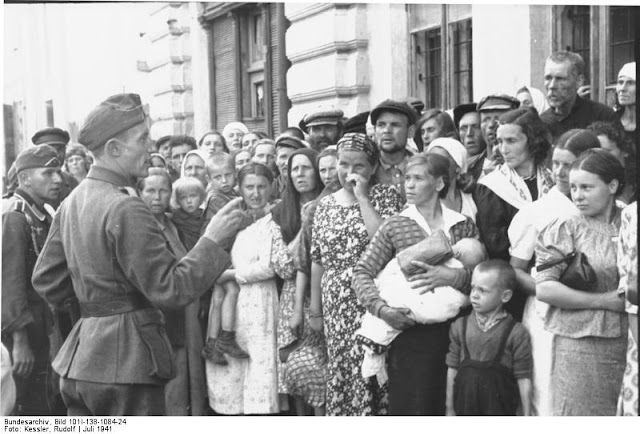
Not many of these women will survive the war, sadly.
Hitler’s Army adjutant writes: “During a short stroll after the situation conference, F. [Führer] spoke with Schm. and myself about further developments in the east. It was on account of these that he was not sleeping at night, since he was uncertain about many things. Within his breast two souls wrestled: the political-strategic, and the economic.
“Politically he would say that the two principal suppurating boils had to be got rid of: Leningrad and Moscow. That would be the heaviest blow for the Russian people and the Communist Party. Goring had assured him that it could be done by the Luftwaffe alone, but since Dunkirk he [Hitler] had become a little skeptical. Economically speaking there were quite different objectives.
“Whereas Moscow was a big industrial center, the south was more important, where oil, wheat, more or less everything was located necessary to keep the country going. A land where milk and honey flowed.
“One thing at least was absolutely required, and that was a proper concentration of forces. To use Panzers in fighting to demolish cities, that was a sin against the spirit. They had to operate in the open areas of the south. He had already started to hear the cries of those from whom they had been stripped; but that was neither here nor there.”
— At the Heart of the Reich: The Secret Diary of Hitler’s Army Adjutant, Major Gerhard Engel, 2005.
Hitler’s generals, however, do not all agree with his economic reasoning. At least some think that taking Moscow would deliver a devastating psychological blow to the Soviet state, regardless of any economic considerations. In fact, some don’t just think that but are covertly acting upon their own — and not Hitler’s — priorities. Of course, they also would achieve renown by being the conquerors of Moscow.
The German forces make only minimal advances today because Hitler has ordered the consolidation of the massive gains already made. While not welcomed by the commanders at the front, this pause provides a chance for the mechanics to work on vehicles and the infantry to catch up to the leading panzers.
In the Army Group North sector, advance Wehrmacht units of Panzer Group 4 take Kingisepp, 138 kilometers (86 miles) southwest of Leningrad and 40 km (25 miles) south of the Gulf of Finland. The Soviets are preparing to make a stand on the Luga River.
The Finnish forces in the Repola sector near the lower ‘waist” of Finland have destroyed a Russian artillery regiment and routed an infantry regiment by a pincers movement, it was officially announced early today. Spoils captured by the Finns were declared to have included 37 big guns, 13 mortars, 2 anti-tank guns, 6 anti-aircraft guns, 13 tractors, 50 transport trucks, 17 field kitchens, 200 horses and a quantity of heavy infantry arms.
Finland severed diplomatic relations with the United Kingdom. Finnish Foreign Minister Witting informs the British Ambassador Sir Gordon Vereker that Finland has to ‘interrupt’ her diplomatic relations with United Kingdom.
In the Army Group Center sector, the Germans have closed a large pocket around Soviet troops in the vicinity of Smolensk and now are attempting to subdue it. A large group of trapped Soviet forces, led by the 20th Army, prepares to attempt a breakout.
In the Army Group South sector, the Stavka orders Marshal Budenny (Budyonny), in command of 1.5 million men of Southern and Southwestern Fronts, to focus on preventing the Germans from establishing any bridgeheads across the Dneiper. In effect, the Stavka tries to freeze the front and further orders that retreats are only permissible in an easterly direction. The Soviet troops still have an open road to retreat to the southeast, but now they cannot do that.
The Germans, meanwhile, continue compressing the huge concentration of Soviet troops in the Uman area into a smaller and smaller area. The two Soviet Fronts have their headquarters in the town of Podvisokoye (Подвысокое). The Germans continue struggling to close the pocket, with Panzer Group 1 (von Kleist) pushing toward advance units of 17th Field Army (Karl-Heinrich von Stulpnagel) and 16th Panzer Division heading toward the Hungarian Mechanized Corps.
The Stavka issues Stavka Directive No. 00549, “Concerning Measures to Regulate the Employment of Artillery in the Defense.” The general thrust of this directive is to employ massed artillery to weaken sections of the German line prior to counterattacks. While this is eminently reasonable and a staple of tactical doctrine, it is symptomatic of the state of the Red Army that the leadership thinks it necessary to issue such basic instruction.
On 28 July, an order was given from Stalin to the Southwestern and Southern Fronts to stop the Germans from crossing the Dnieper and to retreat only in the Eastern direction. Stavka and the Southern Front’s command staff mistakenly assumed that the Germans were striving to reach the crossing of the Dnieper between Kiev and Cherkasy for a further offensive toward Donbass, and underestimated the danger of encirclement for the 6th and 12th armies. As a result, an opportunity to avoid the danger of encirclement by retreating in the Southeastern direction was lost. The effect of the closing Axis forces was to slowly force the concentration of the two Soviet Armies in an ever reduced area, with the combined HQs of the armies located in the town of Podvisokoye. Remnants of 20 divisions from the 6th Army and the 12th Army were ultimately trapped.
Joseph Stalin, following a British suggestion, has written President Ismet Inonu of Turkey assuring him that Soviet Russia has no Intention of seizing control of the Dardanelles, Turkish gateway between the Mediterranean and Black Seas, it was learned tonight on, the highest authority.
Soviet Premier Joseph Stalin receives a message from British Prime Minister Winston Churchill. This continues a pattern in their correspondence in which Churchill sends a stream of messages and Stalin rarely responds (he is said to be “too busy running the war,” but this does not seem to hinder Churchill). Churchill comments that President Roosevelt’s crony, Harry Hopkins, has left to visit the Soviet Union (by air, though that is not mentioned) and “You will be advised of his arrival through the proper channels.” Hopkins is heading for Archangel. As usual, Stalin does not respond.
The Red Air Force bombs and sinks 315-ton German freighter Elbing III near Liepāja, Latvia.
The Red Air Force bombs and sinks German minesweeper R-169 near Libau.
German 3rd S-boat Flotilla is operating off Osel when it sinks 253-ton Latvian icebreaker Lashplesis near Saaremaa (Oesel/Ösel), Estonia.
German patrol boat V.309/Martin Donandt hits a mine and sinks off Libau. The mine was laid by Soviet minesweeper T-204/Fugas.
A special commission created on Heinrich Himmler’s orders arrived at Auschwitz Concentration Camp to select prisoners within the framework of the “Euthanasia Program” for the incurably ill, extended in 1940 to Jews and in the middle of 1941 to prisoners of concentration camps. The 573 selected, most were sick Polish prisoners from Block 15, were told that they were to be transferred to other camps for easier work because of their conditions. At last moment, two German criminals Johann Siegruth and Ernst Krankemann were added to the list. The 575 were sent to Sonnenstein Castle under the supervision of Franz Hössler and were killed by carbon monoxide poisoning in a gas chamber disguised as a shower room. This apparently is the first use of such shower rooms, which quickly become stained blue due to the residue from the gas used.
At Drogobych, Ukraine, locals riot and kill an unknown number of Jews with their bare hands and whatever weapons are handy. Bodies of the dead and dying are thrown in the street.
Operation CHESS, which began on 27 July, concludes. Second Lieutenant Philip Pinckney leads 17 men of No. 12 Commando to a landing from two landing craft. Much about this operation is obscure. Even the landing area is uncertain. According to some sources it occurs about two miles from the River Slack near Ambleteuse, Pas-de-Calais, France, while other sources claim it is further south at Fécamp. The landing force arrives at about 01:30 and occupies empty ground for an hour or two, then departs the way it arrived. There are one or two deaths from unknown causes — sources vary — but, apparently, they are not due to enemy action. Cdr. Sir Geoffrey Congreve Bt DSO, the Commando’s Senior Landing Officer, is said to have perished during this raid, and perhaps a Lt. J. Templeton RNR and an unidentified rating, but details on the rather uneventful Operation CHESS are hard to come by.
The ships of Operation EF, the projected raid on Kirkenes and Petsamo, continue steaming toward their destination in northern Norway. The operation’s destroyers refuel from fleet oiler RFA Black Ranger near the Russian Kola coast.
Royal Navy submarine HMS Utmost torpedoes and sinks 1466-ton Italian freighter Federico C. off Intavolata, western Calabria.
Dutch submarine O-21 torpedoes and sinks 747-ton Italian freighter Monteponi ten miles north of Cape Comino, Sardinia.
Royal Navy submarine HMS Upholder spots an Axis convoy heading from Tripoli to Naples off Cape St. Vito. It torpedoes and sinks Italian light cruiser Garibaldi. The cruiser makes it to Palermo, Sicily at daybreak on the 29th and is under repair until November 1941.
The Luftwaffe bombs and sinks Royal Navy lighter A-8 off Bardia. There are 8 deaths. Another lighter, A-14, is nearby but escapes.
The Regia Aeronautica bombs and damages Royal Navy submarine HMS Olympus off Cavoli Light in the Tyrrhenian Sea. The submarine manages to make it back to Gibraltar.
The nightly run to Tobruk is made by destroyers HMS Hotspur and HMAS Vendetta. Early on the 29th, the ships take off some Australian troops — many of whom are exhausted from spending months isolated in the port with inadequate supplies and Axis shelling — and take them to Mersa Matruh.
Operation GUILLOTINE, the Royal Navy reinforcement of Cyprus, continues as corvette HMS Hyacinth escorts transport Kevinbank to Famagusta.
The Vichy French Petain government agrees to manufacture Luftwaffe aircraft in France.
Weather continues to be poor over northwest Europe. The cloudy conditions make it difficult for bombers to find a particular city, let alone targets of value within them.
RAF Bomber Command, Day of 28 July 1941
6 Blenheims to Yainville were recalled.
RAF Bomber Command, Night of 28/29 July 1941
42 Hampdens minelaying in the Baltic; 1 lost.
The RAF launches raids from Malta on Sicily that destroy 36 Axis aircraft. The commanding officer of the Regia Aeronautica, General Federigi, perishes in aerial combat over Malta.
An RAF night fighter unit begins operation at Malta. It is led by Group Captain George Powell-Shedden and based at Ta Qali.
The Luftwaffe attacks the Suez Canal during the night.
Hauptmann (Captain) Walter Oesau leaves III./JG 3 to take the position of Kommodore of JG 2. Hptm. Werner Andres replaces Oesau as Gruppenkommandeur of III Gruppe JG 3. Lt. Max-Hellmuth Ostermann of 7./JG 54 downs a Russian I-18.
A U-boat wolf pack continues to stalk Convoy OG.69 northwest of Cape Finisterre. Attacks continue throughout the day, and it is a confusing affair, with different U-boat captains claiming the same kills.
Early on the 28th, submarine U-68 claimed torpedoing a corvette.
U-561, commanded by Oberleutnant zur See Robert Bartels, sank British steamer Wrotham (1884grt) in 43N, 17W. At 0424 hours on 28 July 1941, U-561 fired three torpedoes at the convoy OG.69 west of Cape Finisterre and observed a hit and flames on a large tanker, a hit on a freighter that sank in 30 seconds and thought that they hit a third ship in the convoy. However, only the Wrotham (Master James Gordon Davies) was hit and sunk. The master, 22 crew members and three gunners were picked up by HMS Fleur de Lys (K 122) (Lt A. Collins) and HMS Rhododendron (K 78) (SubLt R.H. Towersey) and landed at Gibraltar. The 1,884-ton Wrotham was carrying ballast and was headed for Huelva, Spain.
U-203, commanded by Kapitänleutnant Rolf Mützelburg, sank Swedish steamer Norita (1516grt) in 40-10N, 15-30W and British steamer Lapland in 40-36N, 15-30W.
Between 2127 and 2128 hours on 28 July 1941, U-203 fired four torpedoes on merchants and a destroyer in convoy OG.69 northwest of Cape Finisterre and had to dive after the attack. Mützelburg interpreted the heard detonations and sinking noises and reported three ships sunk and a destroyer probably damaged. In fact, only the Norita and Lapland were hit and sunk. Two crewmen were lost on the steamer NORITA. 18 men survived. The 1,516-ton Norita was carrying coke and general cargo and was headed for Huelva, Spain.
The master, 22 crew members and three gunners from the Lapland (Master James Stuart Brown) were picked up by HMS Rhododendron (K 78) (LtCdr W.N.H. Faichney, DSO, RNR) and landed at Gibraltar on the 31st. The 1,330-ton Lapland was carrying tinplate and general cargo and was headed for Lisbon, Portugal.
Soviet submarine ShCh-307 sank U-144 in the Gulf of Finland. The entire crew of twenty eight was lost in the submarine.
Submarine HMS Utmost sank Italian steamer Federico (1466grt) in 39-28N, 15-52-30E off western Calabria.
Submarine HMS Olympus made an unsuccessful attack on a steamer in 40-40N, 9-50E.
Dutch submarine HNLMS O.21 sank Italian steamer Monteponi (747grt) in 39-51N, 13-46E, ten miles north of Cape Comino.
Heavy cruiser HMS Shropshire departed Hvalfjord for patrol duties on Denmark Strait patrol.
Anti-aircraft ship HMS Alynbank departed Scapa Flow at 1000 and escorted convoy WN.58 from the Pentland Firth. On meeting convoy EC.51 during the morning of 29 July, the ship transferred to that convoy. Detaching the convoy in Pentland Firth, ship Alynbank arrived at Scapa Flow at 1800 on the 29th.
In Operation CHESS, a patrol from an assault landing craft was landed near Fecamp at 0154. T/Lt (E) J. Templeton RNR, and one rating were killed. The landing craft was able to retire and met the covering force of motor launches 10 miles SE of Dover.
P/T/A/Sub Lt (A) R. W. Langshaw RNVR, was killed when his Hurricane of 759 Squadron crashed between Maiden Newton and Cerne Abbas.
British fishing trawler Strathlochy (212grt) was sunk by German bombing 180 miles northwest of Rora Head, Orkneys.
German steamer Elbing III (315grt) was sunk near Libau by Soviet bombing.
Lighter A.8 (Sub Lt R. M. Wright RNVR) was sunk off Bardia by German bombing. Wright and seven ratings were lost. Lighter A.14 in company was able to escape.
Submarine HMS Olympus was damaged by Italian bombing off Cavoli Light in the Tyrrhenian Sea. After emergency repairs, the submarine was able to return to Gibraltar.
Destroyer HMS Jervis departed Haifa and joined light cruiser HMS Neptune, minelaying cruisers HMS Abdiel and HMS Latona, and destroyer HMS Jaguar to return to Alexandria. These ships were relieved by light cruiser HMAS Hobart and destroyers HMS Kandahar and HMS Kimberley at Haifa. The Neptune group arrived at Alexandria on the 29th.
Corvette HMS Hyacinth was detached from the escort of damaged destroyer HMS Isis off Port Said. The corvette escorted motor transport ship Kevinbank in serial S.9 of the Guillotine Operation to Famagusta, arriving on the 30th. The corvette returned to Port Said on the 30th.
Destroyer HMS Hotspur and Australian destroyer HMAS Vendetta departed Alexandria for Tobruk. The destroyers loaded troops at Tobruk early on the 29th and proceeded to Mersa Matruh where they arrived at 0900 on the 29th. On the 30th, the destroyers departed for Alexandria. At 2215, a submarine contact was obtained. Destroyer Hotspur attacked the contact and destroyer Vendetta continued to Alexandria, arriving on the 31st.
Dutch submarine HNLMS O.24 departed Gibraltar to patrol in the Gulf of Genoa and Tyrrhenian Sea.
Submarine HMS Upright arrived at Malta from patrol.
Submarine HMS Urge arrived at Malta from patrol.
Destroyer HMS Highlander rescued Norwegian steamer Lidvard (4785grt) at 12-35N, 17-52E at 0500 on the 28th. The steamer had escaped from Dakar during the night of 26/27 August. French auxiliary patrol vessel Edith Germaine intercepted the steamer on the 27th. Destroyer Highlander was soon joined by destroyer HMS Boreas. Light cruisers Gloire and Georges Leygues, submarine Acteon, and naval aircraft were at sea in an attempt to return the steamer to Dakar. The steamer was escorted to Freetown by destroyers Highlander and Boreas and arrived on the 29th.
A convoy of steamers Ernesto (7272grt), Castelverde (6666grt), Aquitania (4971grt), Nita (6813grt), and Nirvo (5164grt) and gunboat Palmaiola departed Tripoli on the 27th escorted by destroyers Folgore, Saetta, Fucliere, and Alpino. Light cruisers Garibaldi and Montecuccoli and destroyers Granatiere and Bersagliere provided cover for the convoy. Destroyer Fulmine joined the convoy escort at 1815 on the 28th. Light cruiser Garibaldi was torpedoed by Submarine HMS Upholder off Cape St Vito in 38-04N, 11-57E at 1955 on the 28th. Destroyers Fucliere and Alpino joined the damaged cruiser at 2020. The light cruiser arrived at Palermo at 0630 on the 29th. She was under repair for four months to repair the damage. Torpedo boat Sirtori joined the convoy escort on the 29th. The convoy arrived at Naples on the 30th.
Convoy HG.69 departed Gibraltar escorted by sloop HMS Bideford and anti-submarine trawler HMS Stella Carina. The convoy was joined on the 29th by destroyers HMS Beverley and HMS Duncan, corvette HMS Coreopsis, HMS Jonquil, and HMS Spiraea, and submarine HMS Severn. Destroyer Beverly refueled at Ponta Delgada on 3 August and then rejoined the convoy. Destroyer Duncan was detached on 2 August and returned to Gibraltar. On 5 August, submarine Severn and corvettes Coreopsis, Jonquil, and Spiraea were detached; the corvettes to convoy OG.70. On 6 August, trawler Stella Carina was detached to convoy OG.70 and ocean boarding vessel HMS Hilary joined the convoy. Destroyers HMS Legion and ORP Piorun joined the convoy on 7 August and destroyers HMS Chelsea and HMS Wolverine and corvettes HMS Gentian, HMS Hibiscus, HMS Myosotis, and HMS Periwinkle joined on 8 August. Destroyers Beverley, Legion, and Piorun were detached on 9 August to Londonderry. The convoy arrived at Liverpool on 11 August.
President Roosevelt cut short his weekend tonight. On reaching Washington tomorrow he will confer with Congressional and Cabinet leaders on pending legislation, the proposed price control measure and the Far Eastern situation. He will see Vice President Wallace, Senator Barkley, Democratic leader; Speaker Rayburn and Representative McCormack, majority leader. Sumner Welles, Acting Secretary of State; Secretaries Knox and Stimson are expected to be summoned to the White House. The President will probably hear from them data on the extent to which the new Japanese aggression, threatening areas of vital interest to our national welfare, has altered the attitude of Congress toward the service extension resolution. Its speedy passage, together with removal of restrictions upon overseas service, is greatly desired by persons close to the President. It is assumed that the President, although he has not said so since his original requests to Congress, still desires removal of foreign service restrictions, as well as prompt action on the extension resolution.
Administration leaders in the Senate today deferred until Thursday consideration of legislation extending the active military service of selectees, National Guardsmen and Reserve officers, hoping thereby to marshal forces for the quickest possible action in the end. While an informal check showed two-to-one sentiment for the bill and a competent source predicted certain and swift adoption, with not more than thirty votes in opposition, the possibility of a bitter contest was seen by some in the introduction by Senator Taft of a bill which would extend the duty of Selective Service trainees from one year to sixteen months. When Senator Taft made his proposal originally, he asked for the criticism of the War Department. General George C. Marshall, Chief of Staff of the Army, rejected it last week as not meeting present needs, and now that the Senator persists in its consideration by Congress, the belief grows that he will make a strong fight to have it adopted. Under Senator Taft’s plan the maximum number of selectees who might be in service at any one time would be raised from 900,000 as provided in present law, and the maximum enlisted personnel of the Army would be increased to 800,000. The plan would provide that after February, 1942, selectees should be mustered out of service at the rate of 75,000 a month and replaced with new inductions at the same rate.
In an impassioned “statement of facts” which was applauded by many in the galleries and not challenged in three hours of debate, Senator Wheeler asserted today that Secretary Stimson’s “near treason” charge was “a deliberately cunning” attempt to create “the utterly false and spurious impression” that he had encouraged American soldiers to resist any attempt to keep them in service over a year. Rising on a point of personal privilege to answer Mr. Stimson’s charge that the circulation of antiwar postcards to soldiers comes “very near the line of subversive activity against the United States, if not treason,” the Montana Democrat said the attack was part “of a well-organized and carefully planned ‘smear campaign’ by warmongers to silence opposition to war to terrify the American people into submission, to make them accept participation in a foreign war.” Mr. Wheeler was supported mainly by the non-interventionist bloc of the Senate, but of the thirteen members who spoke during the debate, only the majority leader, Senator Barkley, and Senator O’Mahoney, Democrat, of Wyoming, ventured to criticize Mr. Wheeler, and even they made it clear they were not attempting to justify Secretary Stimson’s attack.
Secretary Knox asserted in a speech tonight that “if the time ever comes when we Americans are unwilling to fight to preserve the freedoms we have inherited, those freedoms will be destroyed and taken from us by a stronger breed of men.”
The First Supplemental Defense Appropriation Bill, carrying $8,063,238,478, was passed today by the House and sent to the Senate. Its passage was delayed from last Thursday because of objection by Representative Merlin P. Hull, Progressive, of Wisconsin, to the inclusion of an item of $35,000,000 for a War Department Building just across the Potomac River, which will house its 40,000 workers and will be the largest office building in the world.
An authoritative forecast of more and higher taxes including a general sales tax and lower personal income tax exemptions was made today as the way was cleared for house consideration of the $3,529,200,000 tax bill tomorrow under procedure drastically curbing amendments. Answering criticism that the bill should provide for broadening the present income tax base so as to make more persons tax conscious, Chairman Doughton, North Carolina Democrat, of the House Ways and Means Committee reminded members of the rules committee that another revenue measure probably would be necessary next year. “It will doubtless be necessary,” he said, “to lower the exemptions and impose a general consumption tax. We’re not at the end of this tax road yet.”
Speaker Rayburn disclosed today that price control legislation would be introduced this week and other well-informed sources hinted that, in addition to applying to industrial products, it would contain a compromise provision for control of farm prices. . The speaker told his press conference the measure had been revised satisfactorily and indicated he believed its enactment should be expedited. “We’re liable to wake up some morning and find a lot of runaway prices,” he explained. Rayburn declined to discuss details of the measure, but it was learned from usually well-posted sources that it would provide for regulation of prices on agricultural committees as long as they were not fixed below “parity.”
The United States informed Japan tonight that prompt clearance would be granted Japanese ships from American ports. This action apparently assured that Japanese vessels now waiting off the west coast for clarification of the United States’ “freezing” order would proceed into port. Among these is the big Japanese liner Tatuta Maru with a large number of American passengers aboard.
The aircraft carrier USS Wasp (CV-7) gets underway from Norfolk, Virginia, carrying the air echelon of the USAAF’s 33d Pursuit Squadron (Interceptor). USS Wasp, escorted by the heavy cruiser USS Vincennes (CA-44) and two destroyers, is carrying 30 P-40Cs and three PT-17 trainers. She will join Task Force 16 enroute to Iceland where the USAAF aircraft will be flown off.
The joint U.S. Army and U.S. Marine Corps unit Task Force 18, attached to the U.S. Atlantic Fleet under Major General Holland M. Smith, was redesignated the 1st Joint Training Force.
Major League Baseball:
No games were scheduled today.
Uniformed Canadian soldiers from army trade schools in Hamilton, Ontario, who said they were acting on their own initiative and under orders from no one, marched to the plant of the National Steel Car Company tonight and began breaking up picket lines an hour after a strike at the plant had been called.
The Japanese Imperial Air Force attacks Sichuan Province with 108 aircraft. The Chinese put up only seven fighters in opposition, and lose three planes. Chinese Lieutenant Gao Chunchou (I-153 no. P-7237) is shot down.
The Chinese Government spokesman yesterday issued a formal statement expressing gratification for the “prompt and energetic” measures taken by the United States and the British Empire to counter the new Japanese moves in French Indo-China.
Japanese troops began occupying southern French Indochina. The crisis in the Far East worsened today when 30,000 Japanese troops entered French Indochina. The build-up includes elements of the Japanese navy, which have sailed into Cam Ranh Bay, and aircraft which are flying into Saigon. Japanese troops have also begun disembarking in Cambodia where 8,000 men will be within striking range of Siam. The Japanese thrust has come soon after a conference in Tokyo on 2 July decided on a southward advance rather than the attack on Russia which the Germans wanted. Malaya is now seriously threatened from Indochina, which is providing the Japanese with a naval base within 750-miles of Singapore and airfields within 300 miles of northern Malaya. The Japanese move has isolated the Philippines and menaces the oil-rich Dutch East Indies. The Vichy regime has given the Japanese a free hand in Indochina on the pretext that it was threatened by British and Gaullist plots. The U.S. and Britain have reacted quickly. All Japanese assets in the United States have been frozen, with an embargo on the supply of oil, steel and other strategic materials to Japan. Britain and the Dutch East Indies followed suit and Japan, faced with economic strangulation, has either to yield to western demands or go to war.
The first advance party of General Clare Chennault’s American Volunteer Group (AVG, or Flying Tigers) arrive by ship at Rangoon, Burma.
Japanese assets in the Dutch East Indies were frozen and its oil deals cancelled. Reuters, British news agency, reported today from Batavia that the Netherlands East Indies officially announced suspension of foreign exchange transactions with Japan. The announcement, Reuters declared, said all exports .to Japan, Manchoukuo, China and French Indo-China would require special licenses in the future.
Japan froze American assets in retaliation of a similar action committed by the U.S. on 26 July 1941. The Japanese retaliate for the freezing of Japanese assets in the United States by doing the same to U.S. assets in Japan. This is more of a symbolic move than anything else, as there aren’t many US assets in Japan.
Imperial Japanese Navy oiler Otowasan arrives at San Pedro, California to take on a load of oil. However, due to the embargo placed on oil exports to Japan begun on the 26th, it is refused service and must return to Japan only with ballast.
The possibility that Japan will attack the United States and Britain before these two powers have time to reorganize their defenses in the Far East is suggested today by Virginio Gayda, who points out that in this way Tokyo would steal a march on its potential enemies, as Germany did in Norway, Greece and Russia.
[Ed: And commit national seppuku, of course.]
Dow Jones Industrial Average: 130.06 (+1.36)
Born:
Peter Cullen, Canadian voice actor (‘Optimus Prime’ — “Transformers” movies), in Montreal, Quebec, Canada.
Riccardo Muti, Italian conductor (Philadelphia Orchestra, 1980-1992; La Scala, 1986-2005; Chicago Symphony 2010-2023), in Naples, Kingdom of Italy.
Rabbi Hershel Schachter, leading American Orthodox rabbi, in Scranton, Pennsylvania.
Lane Howell, NFL tackle and defensive tackle (New York Giants, Philadelphia Eagles), in Forndale, Louisiana (d. 2018).
Ed Scrutchins, AFL defensive end (Houston Oilers), in Americus, Georgia.
Naval Construction:
The Royal Navy Bangor-class (Turbine-engined) minesweeper HMS Greenock (J 182) is laid down by the Blyth Shipbuilding & Drydock Co. Ltd. (Blyth, U.K.); completed by Whites M.E. She is transferred to the Royal Indian Navy on completion and commissions as HMIS Baluchistan (J 182).
The Royal Navy Fish-class ASW trawler HMS Whiting (T 232) is laid down by Cochrane & Sons Shipbuilders Ltd. (Selby, U.K.); completed by Holmes.
The SC-497-class (110-foot wooden hull) submarine chaser USS PC-540 (later SC-540) is laid down by the Robinson Marine Construction. Co. (Benton Harbor, Michigan, U.S.A.).
The Kriegsmarine (German Navy) Type VIIC U-boats U-625 and U-626 are laid down by Blohm & Voss, Hamburg (werk 601 and 602).
The Royal Navy Hunt-class (Type III) escort destroyer HMS Wensleydale (L 86) is laid down by Yarrow Shipbuilders Ltd. (Scotstoun, Scotland).
The Royal Navy Isles-class minesweeping trawler HMS Foula (T 203) is launched down by Cochrane & Sons Shipbuilders Ltd. (Selby, U.K.); completed by Amos & Smith.
The U.S. Navy Accentor-class coastal minesweeper USS Turaco (AMc-55) is launched by the Snow Shipyards, Inc., Rockland, Maine.
The Royal Navy Flower-class corvette HMS Tamarisk (K 216) is launched by Fleming & Ferguson Ltd. (Paisley, Scotland). Transferred to the Royal Hellenic Navy in November 1943 and renamed RHS Tompazis (K 216).
The U.S. Navy Gleaves-class destroyer USS Corry (DD-463) is launched by the Charleston Navy Yard (Charleston, South Carolina, U.S.A.).
The Royal Navy Fairmile B-class motor launch HMS ML 269 is commissioned.
The Royal Navy Isles-class minesweeping trawler HMS Inchcolm (T 18) is commissioned. Her first commander is Skipper William Martin, RNR.
The Royal Navy MMS I-class motor minesweeper HMS MMS 41 (J 541) is commissioned.
The Royal Navy British Power Boat 70-foot motor gun boat HMS MGB 19 is commissioned.
The Sjøforsvaret (Royal Norwegian Navy) Thornycroft 75-foot motor torpedo boat HNoMS MTB 56 is commissioned.
Les Forces Navales Françaises Libres (Free French Naval Forces) Flower-class corvette Renoncule (K 117) is commissioned.

