Soviet marines on four MO-class patrol boats land on the island of Bengtskär early on 26 July 1941. Their mission is to blow up the lighthouse situated on the skerry that provides a commanding view of the seas west of the Soviet-occupied port of Hanko in southern Finland. The small Finnish garrison of forty-one men, including four lighthouse keepers, repelled the first Russian attack. Overwhelmed by a vastly superior enemy force, the brave defenders took refuge in the upper floors of the lighthouse. From there the struggle continued under the command of Lieutenant Fred Luther who was twice wounded during the fight. From a distance of ten kilometers, batteries emplaced on the neighboring island of Örö and Granholmen shelled the Soviet patrol boats and the enemy soldiers hiding in the rock crevasses on the island. The small group of defending Finnish soldiers, armed with one small artillery piece, are on the skerry and hold out long enough for Finnish gunboats Uusimaa and Hämeenmaa to intervene. The shore battle quickly turns into a naval one. Uusimaa sinks Soviet patrol boat PK-238 (or MO-239 or MO-306), which decides the battle. Fighter bombers of the Finnish air force overflew the island and attacked the invaders. At dawn a force of Finnish Commandos from the nearby island of Hitis landed and joined the struggle to repel the Soviet force and relieve Lieutenant Luther and his brave defenders. After a hard and bloody battle, the small Finnish garrison emerged victorious. A total of 29 Soviet sailors from the PK-238 are taken as prisoners, 13 after swimming to the island, and about 20 sailors perish. The Soviet landing party, stranded, surrenders. Rather than being taken captive, many Soviet marines commit suicide with hand grenades. Total Soviet losses are unclear, as the Finns report about 60 Soviets killed in total, but the Soviets claim only 31 dead, with 24 captured. The Finns lose 16 men on land and 4 at sea. The Battle of Bengtskär is a Finnish victory that is good for morale but means little in the long run. For the Finns it was a bittersweet victory. During the day of July 27, a Russian warplane overflew the island and dropped a bomb. It struck the living quarters, demolishing the upper and middle roofs, and killing seven of the Finnish defense force.
The Germans are eager to assume that the Soviets already are defeated. General Halder notes in the OKH war diary, “The mass of the operationally effective Russian Army has been destroyed.” That is not, of course, the truth, and, in fact, the Wehrmacht is stalled on many of its fronts in the USSR at the moment.
In the Far North sector, the German 36 Corps prepares to renew its stalled offensive east of Salla, where the front has been stopped at the village of Kayraly for weeks. Among other reasons for getting the offensive restarted by General Nikolaus von Falkenhorst is the fact that the Finnish forces further south in the Karelian forests have been advancing while the Wehrmacht has not — which does not look good for the Germans. In Karelia, Finnish troops reach Lake Onega.
In the Army Group North sector, the Red Army activates the 34th Army south of Lake Ilmen. Heavy fighting continues in the area as the panzers in the spearhead wait for infantry to close up and form a secure front.
In the Army Group Center sector, the Wehrmacht continues to subdue the three Soviet armies trapped in the Mogilev pocket. Mogilev itself is taken today, but Soviet resistance outside the town continues. German Second Army slowly advances against desperate Soviet resistance. Among the scorched-earth activities of the Soviet troops is their destruction of the local brewery to withhold the taste of victory from the German soldiers.
Field Marshal Fedor von Bock removes General Guderian’s Panzer Group 2 from its subordination to Field Marshal Günther von Kluge’s 4th Army. This has been one of von Bock’s less successful attempts to increase cooperation by putting one large formation under the control of another, nearby formation of roughly equal stature. Guderian’s 18th Panzer Division is engaged in a fierce battle 25 miles east of Smolensk as it attempts to put more territory between the Soviets trapped to the rear and any Red Army units that could potentially rescue them. Morale is low, as reported by the division diary, which notes:
“The men are indifferent and apathetic, are partly suffering from crying fits, and are not to be cheered by this or that phrase. Food is being taken only in disproportionately small quantities.”
Quite an unexpected description of a “victorious army.” Of course, the Soviets are no better off, but there is no question that the Wehrmacht spearheads are getting ground down from constant combat.
In the Army Group South sector, the Germans and Romanians capture Olgopol in the Vinnytsia district. The Romanians attach Olgopol to their province of Transnistria.
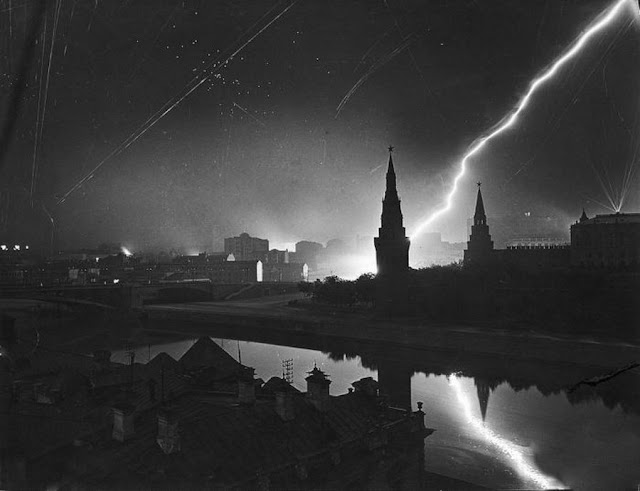
The Luftwaffe bombs Moscow again for the fourth time in a week. Bombs fall near the Kremlin. The Luftwaffe only sends 50 bombers over the city, half the number as on the previous attack. Kapitan Konstantin Titenkov shoots down a German bomber for the fourth time in four air raids, earning him the Order of Lenin and a Gold Star signifying that he is a Hero of the Soviet Union.
Finnish (or German) shore-based artillery hits and sinks 1375-ton Soviet freighter Metallist at Soviet-occupied Hango in Southern Finland.
Soviet torpedo boats attack the German 2nd R-Boat Flotilla in the Irben Strait. They sink German minesweeper R.169.
The German 3rd S-Boat Flotilla attacks Soviet shipping north of Riga, without result.
The Soviet Red Air Force attacks and sinks German minesweeper R-169 in the port of Vindova. There are 11 deaths and 12 crew wounded.
Soviet submarine K-3 lays mines off Bornholm.
Capture of a Soviet bunker on the east bank of the Dniester River and destruction of 1,086 tanks by a German panzer corps in the Ukraine were reported by the official news agency DNB today even while difficulties of the Nazi drive to the east were emphasized. The Dniester fortification, its exact location unspecified, was declared to have fallen before a coordinated attack by Luftwaffe bombers and infantry. German war reports again emphasized bad weather, difficulties of terrain and “localized Russian resistance” as the fifth week of the war lagged to a close. Particularly on the south front, where for days the Germans have said they are approaching Kiev, capital of’ the Ukraine, the conditions of the roads and weather were reported as hindering factors.
First group of the Dutch Volunteer Legion departs from Den Haag Central train station in The Hague for the Eastern Front to fight on the side of Germany.
British Prime Minister Winston Churchill sends a message to Soviet Premier Joseph Stalin (received today) promising to send 200 P-40 Tomahawk fighters, woolens, 2-3 million ankle boots, and “during the present year large quantities of rubber, tin, wool and woolen clothes, jute, lead, and shellac.” He adds that, where Great Britain cannot supply Soviet requirements, “we are discussing matters with the U.S.A.”
It is the Sabbath for Jews, and that results in conflicts for many who are required by the German occupiers to work today. Just as one example, in Lithuania, Telsiai Yeshivah student Dov Ber Nahamkin is executed today when he refuses to work. There are, of course, others.
The local Judenrat announces that the Bialystok Ghetto is to be set up beginning today and extending through early August 1941. It is in the newly formed Bezirk Bialystok district within occupied Poland. It will house about 50,000 Jews. Jews have five days to get into the Ghetto, located in an area immediately north of Kosciuszko Square. The Germans compel the Jews to construct a 2.5 meter-high wooden fence around the ghetto, topped with barbed wire.
At Lvov, local Ukrainians seize thousands of Jews and beat to death a large number estimated at 2,000+ between 25-27 July. The Ukrainians harbor a grudge based upon the 1926 murder of antisemitic leader Simon Petliura by Shalom Schwarzbard, a Jew.
Germans take over Stanisławów County in prewar Poland from the Hungarian army, who took it from the Soviets on 2 July. The Germans immediately compel the establishment of a Judenrat, to be headed by Israel Seibald.
A Lithuanian report dated 26 July 1941 counts the number of Jews living in Marcinkonys. This includes 50 under the age of 6. They will all be exterminated over the coming years.
At Kelme, Lithuania, 485 Jews are killed. This incident is commemorated with a memorial plaque. A total of 2000 Jews are killed in Kelme during July (according to the United States Holocaust Institute).
3,800 Lithuanian Jews were killed during a pogrom in Kovno (Kaunas), Lithuania.
In Vilna, the Germans begin kidnapping Jewish men for forced labor, ultimately killing many of them. The Jewish men so taken are lined up, and Poles who hold a grudge against one of them has merely to identify him as a Bolshevik to determine his fate. Once so identified, the Jewish man is put in a group of dozens of men which is taken to the marketplace, told to lie face-down in the street, and shot. Those who are not identified as Bolsheviks are put in wagons and sent to work.
There is an attitude of lawlessness in Vilna where treatment of Jews is concerned, with Germans and Lithuanians feeling free to break into Jewish homes and plunder them without legal retribution. According to today’s report of the Einsatzgruppen:
“The antagonism between the Poles and the Lithuanians continues in the Vilna area… However, the Germans’ measures, especially those against the Jews, have met with general consent.”
As this shows, one of the tricks the Germans use to enforce their policies in the occupied eastern territories is to exploit latent grudges by one group of people against another.
The Germans arrest the Vilna Judenrat and hold its members as hostages. They demanded five million rubles for their release, of which two million must be found by tomorrow morning. Failure to pay will mean their execution. As the news spreads through the ghetto, the Jewish community is trying desperately to raise the money to save their lives. Men are donating watches and women jewelry.
Kazimierz Władysław Bartel, former Prime Minister of Poland, is killed on orders of Heinrich Himmler at dawn. The event is surrounded in mystery, but apparently, Bartel refuses a “request” to lead a puppet government for the Germans and is shot near Piaski Janowski in the same manner as those used in the murder of Polish professors from Lwów.
During the night, Hitler engages in random ruminations with his cronies as he is wont to do. Tonight, his subject is royalty:
“Monarchy is doomed. The people needs a point upon which everybody’s thoughts converge, an idol. A people that possesses a sovereign of the stature of Frederick the Great can think itself happy; but if he’s just an average monarch, it’s better to have a republic.”
In a sense, Hitler here predicts the age of celebrity that sprouts later in the 20th Century.
Werner Mölders was presented Diamonds to his Knight’s Cross by Adolf Hitler.
Six Italian E-boats escorted by MC.200 fighters attempted to attack shipping in Valletta’s Grand Harbour at Malta. An audacious Italian attempt to infiltrate Malta’s Grand Harbour in order to sink British shipping fails. The plan depends upon removing anti-submarine netting from the Saint Elmo Bridge. The Italians set charges and do remove the netting — but the charge also causes the bridge holding the netting to collapse and block the entrance. The fiasco traps the Italians, who are fired upon by harbor guns at Elmo and Ricasoli, and those who survive soon surrender. There are 18 Italian prisoners/deaths. The incident provides fine entertainment for Maltese citizens watching from the nearby shore.
Italian torpedo boats MAS-451 and 452 are bombed and damaged, sunk or captured off Malta, apparently as part of the operation to infiltrate Grand Harbour. The Hurricane fighters of Nos. 126 and 185 Squadrons were scrambled and set about the E-boats, sinking four and causing the other two to surrender.
Commander Ernesto Forza took over command of 10th MAS Flotilla at La Spezia, Italy, which was in actuality a special forces unit for the Italian Navy.
Operation GUILLOTINE, the British reinforcement of Cyprus, continues. Royal Navy sloop Flamingo escorts transport Salamaua from Port Said to Famagusta.
The Italians raise destroyer Leone Pancaldo. It was sunk by the RAF on 10 July 1940 in Augusta Harbor during an attack by Swordfish of No. 813 Squadron launched from HMS Eagle. The Italians return it to service.
Convoy MG-1, the part of Operation SUBSTANCE in which empty freighters from Malta depart, arrives in Gibraltar.
Operation EF, the planned strike on Kirkenes, continues. British Force F, having refueled at Seidisfjord, Iceland, leaves for northern Norway. Force A departs from Scapa Flow (Operation FB).
People are flocking to ‘Target for Tonight’, a new, authentic kind of war film made by Harry Watt and the film-makers of the Crown Film Unit (formed from the pre-war GPO film unit). The film is an understated, unemotional account of an RAF bombing mission over Germany by a Wellington bomber code-named “F for Freddie”. The “actors” are real aircrew from Mildenhall airfield, in Suffolk, performing their real-life roles. After bombing the target in heavy flak, the plane is hit and has to limp home in dense fog. It is piloted by Squadron-Leader Pickard.
British notice of denunciation of commercial agreements with Japan and freezing of Japanese assets.
The British ships HMS Cattistock, HMS Mendip and HMS Quorn bombard Dieppe as part of continuing Operation GIDEON.
La Cagoule terrorists kill former French Minister René Marx Dormoy 51, by planting a bomb in his house. Dormoy, as Minister of Interior in November 1937, imprisoned 70 Cagoulards. The Cagoule terrorists work both sides of the war, some siding with the Petain Vichy Regime and others defecting to the Resistance or Charles de Gaulle’s Free French. Dormoy opposed Petain and is under house arrest at the time of his death. The Dormoy killing doesn’t appear related to partisan operations, since Dormoy is a critic of the Vichy government, but simply is an act of pure revenge.
In Lisbon, U.S. transport USS West Point (AP-23, formerly liner SS America) embarks American and Chinese diplomats and their families who have been expelled from Germany and Italy. Some other U.S. refugees also are taken on board, including 21 US passengers who were on Egyptian ship SS Zamzam when sunk by German raider Atlantis on 17 April 1941.
RAF Bomber Command, Day of 26 July 1941
2 Fortresses to Hamburg encountered thunderstorms and icing. 1 of the Fortresses bombed Emden. There were no losses.
Roderick Carr was named the commanding officer of No. 4 Group RAF.
The Luftwaffe bombs Alexandria during the night.
Convoy OS.1, escorted by destroyers HMS Walker, HMS Vanoc, HMS Volunteer, HMS Sardonyx, HMS Scimitar, and HMS Bath and corvettes HMS Bluebell and HMS Hydrangea, was attacked by U-141.
U-141, commanded by Oberleutnant zur See Philipp Schüler, sank British steamer Botwey (5106grt) in 55-42N, 9-53W, sixty miles north of Tory Island. At 0328 hours on 26 July 1941, U-141 attacked the convoy OS.1 365 miles 270° from Bloody Foreland and Schüler thought that he had scored one hit on each of three ships. The first vessel was seen being abandoned, the second exploded and the third, which had four masts, was seen to develop a heavy list. In fact, the Botwey was sunk and the Atlantic City was damaged. The master, 48 crew members and four gunners from Botwey (Master Ebenezer Gordon) were picked up by the British rescue ship Copeland (Master J. McKellar, OBE) and landed at Greenock on 28 July. The 5,106-ton Botwey was carrying ballast and was headed for Port Sulphur, Louisiana.
U-141 also damaged British steamer Atlantic City (5133grt) was damaged in 55-42N, 9-58W. At 0328 hours on 26 July 1941, U-141 attacked the convoy OS.1 365 miles 270° from Bloody Foreland and Schüler thought that he had scored one hit on each of three ships. The first vessel was seen being abandoned, the second exploded and the third, which had four masts, was seen to develop a heavy list. In fact, the Botwey was sunk and the damaged Atlantic City was abandoned, but later reboarded and salvaged. The Atlantic City managed to reach the Clyde, was repaired and returned to service in November 1941. The 5,133-ton Atlantic City was carrying general cargo, government stores, and coal and was bound for Alexandria, Egypt.
A Luftwaffe Focke-Wulf FW-200 Condor spots Convoy OG.69 at sea west of France and directs U-boats to its path.
U-109 (Kptlt. Heinrich Bleichrodt), on its sixth patrol out of Lorient, sneaks into Cadiz Harbor during the night and refuels from an “interned” German tanker before resuming its patrol west of Gibraltar.
Italian submarine Barbarigo sank British tanker Horn Shell (8272grt) in 33-23N, 22-18W. Seventeen crewmen were lost on the steamer. The survivors were picked up by Portuguese trawler Maria Leonor. On 19 August, the trawler was intercepted off Cape Juby by destroyer HMS Avon Vale and the survivors were removed.
Anti-aircraft ship HMS Curacoa departed Scapa Flow at 0900 and escorted convoy WN.57 from Pentland Firth until meeting convoy EC.50.
Destroyers HMS Broke and HMS Verity, escorting convoy SL.80, collided near Londonderry. Destroyer Broke sustained damage to her bow. Temporary repairs were done at Liverpool. Permanent repairs were done at the Hebburn on Tyne yard from 11 August to 12 September. Destroyer Verity sustained extensive damage below the waterline. The destroyer was repaired at Belfast from 28 July to 21 September.
Leading Airman F. Andrew of 1 SFTS Netheravon was killed when his Hind crashed east of Shrewton LG. Leading Airman G. Ryalls was also killed in the aircraft.
German torpedo boat T.3 claimed sinking a Soviet destroyer (Tsiklon?) in a surface action in the Baltic.
New Zealand Division light cruiser HMS Leander departed Alexandria for Port Said and New Zealand after being relieved by light cruiser HMS Neptune. The light cruiser departed Suez on the 31st to return to New Zealand.
Sloop HMS Flamingo departed Port Said with motor transport ship Salamaua for Famagusta in serial S.8 of the GUILLOTINE operation. The sloop arrived at Famagusta on the 28th and departed the same day.
Convoy ON.1 departed Liverpool, escorted by sloop HMS Stork. The sloop was detached the next day when the convoy was joined by destroyers HMS Malcolm, HMS Sardonyx, HMS Scimitar, and HMS Watchman and corvettes HMS Verbena and HMS Violet, and anti-submarine trawlers HMS Northern Pride, HMS Northern Spray, and HMS Northern Wave. Destroyers Sardonyx and Scimitar were detached on the 30th and the remainder of the escort on the 31st when relieved by destroyers HMS Burwell and HMS Richmond and corvettes HMCS Cobalt and HMS Polyanthus. Destroyer Burwell was detached on 1 August. The remainder of the escort remained until the convoy was dispersed on 9 August.
U.S. President Franklin D. Roosevelt issued Executive Order 8832 that froze Japanese and Chinese assets. The order explained that in order “…to prevent the use of the financial facilities of the United States in trade between Japan and the United States in ways harmful to national defense and American interests, to prevent the liquidation in the United States of assets obtained by duress or conquest, and to curb subversive activities in the United States.” and that “At the specific request of Generalissimo Chiang Kai-shek, and for the purpose of helping the Chinese Government . . . with a view to strengthening the foreign trade and exchange position of the Chinese Government.” Today the British treasury and Dutch governments also announced similar restrictions on all orders affecting Japanese holdings in Britain and the Dominions. By request of the Chinese government, the freeze is also applied to Chinese assets in order to thwart Japanese attempts to abuse its position as the occupier of key Chinese financial centers. At a stroke, Japan has lost 88% of its oil imports and most of its supply of wheat, cotton, zinc, iron ore, bauxite and manganese. Its two biggest export markets, for GBP55 million worth of silk to the U.S. and GBP40 million worth of cotton cloth to Britain, have disappeared. Japan hit back by freezing U.S. and British assets in Japan. These are believed to be small.
Although the Department of State was entirely noncommittal concerning the possibilities of an embargo on sales of oil and gasoline to Japan, responsible government circles believe that such sales will be sharply curtailed under the new licensing system that went into effect last night simultaneously with the freezing of Japanese credits in this country.
Laying a $3,529,200,000 tax increase bill formally before the house, the ways and means committee today acknowledged its unprecedented burden on the people but said there was convincing evidence it would be borne cheerfully in the light of the nation’s defense efforts. The committee majority declared the “risk to life and property from an inadequate preparedness would make even a much heavier burden attractive by comparison.”
The Senate Military Affairs Committee rejected today the Administration’s request for a Congressional declaration of a national emergency, but approved a resolution declaring that “the national interest is imperiled” and authorizing President Roosevelt to extend indefinitely the service of all selectees, National Guardsmen and members of the regular and reserve components of the Army. In a five-hour executive session attended by only eight of the seventeen members, the committee reversed its decision, reached in principle yesterday,’ to declare a national emergency, and decided, with only one dissenting vote, to introduce, perhaps next Wednesday, a simple joint resolution which would amend the Selective Training and Service Act of 1940 without removing the ban on sending selectees out of the Western Hemisphere.
Since Nazi Germany began its invasion of Soviet Russia last month, there has been a complete reversal of the Communist party line in the U.S. regarding the war, which has made itself felt not only in the pronouncements of the Communist party of America itself, but also in those of various organizations that have been called Communist “front” or “transmission belt” groups. Instead of being an “imperialist” war, as it was denounced by such organizations during the period of the Soviet-Nazi “non-aggression” pact, which gave the signal for Hitler to launch the war, in the eyes of these groups the war has now become a life-and-death struggle between fascism and democracy. No longer do organizations of
this character denounce President Roosevelt as a “war-monger,” oppose his foreign policy of aid to Britain and all-out national defense, advocate complete “neutrality” or pass resolutions upholding strikes in defense industries. Instead, they have reverted to their former “line” of a “united front,” a “popular front” or a “people’s front” of all “democratic” forces in the country against Hitler and fascism, and for aid not only to Soviet Russia but to Great Britain.
[Ed: Sickening faithless hypocrites. Communists. But I repeat myself…]
Albert Einstein, an American citizen since 1940, writes a letter to Eleanor Roosevelt asking her to intercede with her husband the President on behalf of European Jewry. Einstein wants the State Department to reverse policies that prevent refugee status from being granted to Europeans suffering from “Fascist cruelty.” He wants to right this “grave injustice.” Eleanor writes a note on the bottom promising to talk to Franklin about it.
Two inches of snow fell on the Cascade Mountains today and baffled Oregonians asked, “What next?” A week ago the state simmered in unprecedented heat with temperatures above 100 degrees six days in a row.
Defense agencies today froze all stocks of raw silk, limited the future processing of “thrown silk” to levels prevailing during the last week, asked suspension of all trading in silk futures on the Commodity Exchange, and announced that silk prices would be fixed in the next few days at approximately $3.04 per pound, the level prevailing on last Monday.
After conferring in London only the day before yesterday with United States Ambassador John G. Winant and with Harry L. Hopkins, President Roosevelt’s personal representative, two high Soviet military officers, Lieutenant General Philip Golikov and Engineer General Alexander Repin arrived at Washington National Airport shortly after noon today.
The transport USS West Point (AP-23), at Lisbon, Portugal, embarked American and Chinese consular staffs from Germany, German-occupied countries, and Italy, and set sail for the United States. On June 19 Germany and Italy requested the withdrawal of United States consular staffs from territories under their control by July 15 in response to the U.S. requesting the withdrawal of the German and Italian consular staffs on June 16.
In addition, West Point embarks the 21 American ambulance drivers who had been passengers on board the Egyptian steamship Zamzam when she had been sunk by German auxiliary cruiser Atlantis on 17 April (see 1 August). [The other three members of the detachment were accounted for as follows: (1) Commander of the BAAC field unit, Francis J. ‘Frank’ Vicovari of New York remained aboard the Atlantis due to the extent of his shrapnel injuries during the attack of April 17th (There had been 9 passengers wounded in the attack — 3, who were serious, including Frank remained aboard Atlantis, the other passengers and crew transferred aboard the NDL freighter Dresden. The other wounded American died of his injuries several days later and was buried-at-sea. A British doctor was also wounded and transferred to the Dutch flagged prizeship Silva Plana in September, arriving Bordeaux in November). Frank would not return to the United States until released in the 2nd of 3 such operations under the RAMP (Returned Allied Military Personnel) scheme. Frank was exchanged for (2) German archeologists, detained in the United States. This 2nd exchange took place in Lisbon, Portugal during March of 1944 (1st Goteburg, Sweden October 42; 3rd Seville, Spain, May 44). Frank had been held in the Marlag und Milag du Nord internment camp near Bremen, Germany since his arrival and transfer from the French port of St. Nazaire on Christmas Eve, 1941. (2) The other 2 members of the BAAC team, David Stewart and Tom Greenough had escaped from a German transport train while the guards watching over the 21 drivers slept. After several days they walked safely across the border into unoccupied France. After meeting with Free-French officials, they were granted passage to Lisbon and arrived in the USA just 5-days ahead of the other 21 members of the BAAC.]
Admiral Husband Kimmel, responding to the war alert issued from Washington, orders long-range air patrols from Oahu to search for Imperial Japanese Navy ships.
Major League Baseball:
The Red Sox defeated the Indians, 4–3, today as Dick Newsome, Boston’s amazing rookie pitcher, kept nine hits scattered and deprived Bob Feller of his twentieth victory of the season. Newsome chalked up his 12th win of the year.
With a chance to clamber back into the first division of the National League, the Giants spent today at Wrigley Field threatening to do a lot of things to Claude Passeau and his fellow Chicago Cubs. However, they finished the day doing nothing but submitting to their fourth defeat in their last five starts, losing today, 5–3.
The Reds trundled out some of their rusty medium-range artillery today to batter down the last-place Phillies, 6–2, and returned to third place in the National League. Four doubles, two by Ernie Lombardi, and nine singles flattened four Phil pitchers as Jim Turner coasted to an easy victory. EveryRed starter except Jim Gleeson got at least one safety.
The Yankees roll over the White Sox, 11–3, collecting 14 hits. But Sox reliever Johnny Hallett strikes out Joe DiMaggio in the 6th, the first K for Joe since June 8. Tommy Henrich homers for New York, Bill Dickey triples, and Charlie Keller and DiMaggio contribute doubles as the Yankees win their eighth in a row.
The Tigers snapped their eight-game losing streak with a 4–2 triumph today over the Athletics, who tossed away a chance to gain a virtual tie with Chicago for fourth place. It was the first defeat in six games for Philadelphia.
Pittsburgh’s Debs Garms sets the Major League record for consecutive pinch hits with his 7th in a row, hitting a homer in a 3–2 loss to Brooklyn. It is the veteran’s last home run, though he will play till 1945. Garms tied the Major League mark set by Hornsby with a pinch hit yesterday in a doubleheader sweep of the Dodgers. Luke Hamlin gets the win for Brooklyn today, but two innings of stellar relief by Kirby Higbe preserve the victory.
The Cardinals Ernie White wins his 4th game in 5 days, a 20th century Major League record, stopping the Braves, 9–2. His other wins, all in relief, were over the Giants on July 22, 23, and 24, also a record.
Scoring three runs in the ninth, the Browns defeated the Senators, 6–5, today in the American League “cellar series.” Jake Early’s seventh homer of the season in the eighth frame gave Washington a 4–3 lead. Hits by Chet Laabs and Joe Grace, two Washington errors and an outfield fly scored three Browns in the ninth. The Senators counted once in their half on two walks, a fly and a fielder’s choice.
Cleveland Indians 3, Boston Red Sox 4
New York Giants 3, Chicago Cubs 5
Philadelphia Phillies 2, Cincinnati Reds 6
Chicago White Sox 3, New York Yankees 11
Detroit Tigers 4, Philadelphia Athletics 2
Brooklyn Dodgers 3, Pittsburgh Pirates 2
Boston Braves 2, St. Louis Cardinals 9
St. Louis Browns 6, Washington Senators 5
Frustrated by the need for provincial approval to deploy troops to end the Arvida strike, Canadian Munitions and Supply Minister C. D. Howe submitted his resignation to Prime Minister King. At a subsequent cabinet meeting Howe agreed to withdraw his resignation on the condition that he be granted powers to deal with such emergency situations.
After strong diplomatic pressure exerted by their neighbors, the group of the United States, Ecuador, and Peru declare a truce in their border war.
New moves against Japan’s wartime economy, were under study in Washington tonight, following this country’s action in freezing all Japanese assets in American-owned territory, Officials complacently received word Japan had retaliated immediately by freezing American funds in the island kingdom. They had expected such action by Tokyo and it had been discounted in advance. With interest they learned England had announced the abrogation of all commercial treaties with Japan and saw in it new evidence the British empire and the United States were approaching the Japanese problem in complete cooperation.
Britain followed the United States in imposing economic sanctions on Japan and freezing all Japanese assets in areas under their control. Britain and the Dutch East Indies freeze all Japanese assets. The British government issues a “notice of denunciation” of all commercial agreements with Japan. In conjunction with the similar US actions today, his causes Japan to lose about 75% of its overseas trade, most of its wheat imports, and 88% of its imported oil. Many other strategic items such as iron ore, bauxite, and manganese also are denied to Japan. Japan has three years of oil supplies stored, but that is at peacetime consumption levels — and a war would cut into stockpiles quickly. Japan retaliated by freezing all U.S. and British assets in return.
British Ambassador Sir Robert Leslie Craigie visited the Japanese foreign office today and it was reported without official confirmation that he informed Foreign Minister Teijiro Toyoda his government was suspending all commercial treaties with Japan.
The Japanese learn that Britain has muscled in on their economic arrangements with Thailand whereby Thailand would meet the Japanese economic need for rubber. The British have agreed to supply Thailand with petroleum in exchange for large quantities of rubber, tin, and other strategic materials. It is a complicated situation because having British oil flowing into Thailand actually works to Japan’s benefit due to the economic sanctions imposed on Japan. Tokyo cannot meet ally Thailand’s oil needs itself, and some of that oil might find its way to Japan eventually. Tokyo finally decides to not interfere with the Anglo/Thai agreement because Thailand can still supply Japan with some rubber for the time being — and eventually, any Thai agreements with Great Britain won’t be a problem.
The economic warfare of frozen funds left the luxury liner Tatuta Maru still idling on the high seas tonight, with nearly 100 American citizens and scores of other passengers wondering just what the future has in store. There was no confirmation of reports the ship was heading for Mexico or that the U. S. navy or coast guard would take off the passengers at sea if it failed to come within territorial waters. The N.Y.K. line said it had received no word from its 17,600-ton craft since yesterday when it radioed it would be in the San Francisco harbor at 5 a.m. The ship originally was due Thursday, but hove to with 44 other America-bound Japanese ships after the United States strongly denounced the Nippon move in Indo-China. Most sources here believed the Tokyo government was waiting for assurance that neither the $15,000,000 ship nor its $2,500,000 cargo of silk would be detained before issuing orders for the craft to dock.
Douglas MacArthur was appointed to command U.S. forces in the Far East. U.S. Army Forces, Far East was organized and the Philippine military forces were called into service with U.S. Army. U.S. Army recalled Douglas MacArthur to active service as the commander of units in the Far East; Philippine troops already under MacArthur’s command were integrated into the U.S. Army:
Marshall to MacArthur:
EFFECTIVE THIS DATE THERE IS HEREBY CONSTITUTED A COMMAND DESIGNATED AS THE UNITED STATES ARMY FORCES IN THE FAR EAST STOP THIS COMMAND WILL INCLUDE THE PHILIPPINE DEPARTMENT COMMA FORCES OF THE GOVERNMENT OF THE COMMONWEALTH OF THE PHILIPPINES CALLED INTO THE SERVICE OF THE ARMED FORCES OF THE UNITED STATES FOR THE PERIOD OF THE EXISTING EMERGENCY COMMA AND SUCH OTHER FORCES AS MAY BE ASSIGNED TO IT STOP HEADQUARTERS UNITED STATES ARMY FORCES IN THE FAR EAST WILL BE ESTABLISHED IN MANILA COMMA PHILIPPINE ISLANDS STOP YOU ARE HEREBY DESIGNATED AS COMMANDING GENERAL COMMA UNITED STATES ARMY FORCES IN THE FAR EAST STOP YOU ARE ALSO DESIGNATED AS THE GENERAL OFFICER UNITED STATES ARMY REFERRED TO IN A MILITARY ORDER CALLING INTO THE SERVICE OF THE ARMED FORCES OF THE UNITED STATES THE ORGANIZED FORCES OF THE GOVERNMENT OF THE COMMONWEALTH OF THE PHILIPPINES DATED JULY 26 COMMA 1941 STOP ORDERS CALLING YOU TO ACTIVE DUTY ARE BEING ISSUED EFFECTIVE JULY 26 COMMA 1941 STOP REPORT ASSUMPTION OF COMMAND BY RADIO END.
Marshall to Grunert:
THE PRESIDENT HAS ISSUED A MILITARY ORDER THIS DATE CALLING INTO THE SERVICE OF THE ARMED FORCES OF THE UNITED STATES FOR THE PERIOD OF THE EXISTING EMERGENCY ALL OF THE ORGANIZED MILITARY FORCES OF THE GOVERNMENT OF THE COMMONWEALTH OF THE PHILIPPINES STOP.
The U.S. Army promotes MacArthur to Lieutenant General and commander of U.S. Army Forces in the Far East (USAFFE). As a condition of his return to service, MacArthur demands and receives a US $50 stipend per soldier serving in the Philippine National Army. This is not a unique arrangement, but MacArthur’s aide Dwight D. Eisenhower refuses his similar stipend.
The U.S. Army Philippine Department has 22,000 troops in total, including 12,000 Philippine Scouts. Major General Jonathan M. Wainwright commands the Philippine Division, which has the majority of the soldiers. However, the troop strength is deceptive, because the US Congress has been parsimonious in supplying weapons and supplies to the Philippines and other Pacific outposts.
U.S. Navy Admiral Husband Kimmel ordered long range air patrols to be conducted from various Pacific Ocean bases in case Japan reacted aggressively against U.S. President Franklin Roosevelt’s executive order to freeze Japanese assets.
Dow Jones Industrial Average: 128.7 (+0.64)
Born:
Mike Taliaferro, AFL-NFL quarterback (AFL All-Star, 1969; New York Jets, Boston Patriots, Buffalo Bills), in Houston, Texas.
Dave Cahill, NFL defensive tackle (Philadelphia Eagles, Los Angeles Rams, Atlanta Falcons), in Stanley, Wisconsin (d. 2012).
Carroll Sembera, MLB pitcher (Houston Astros, Montreal Expos), in Shiner, Texas (d. 2005).
Brenton Wood [Alfred Smith], American pop and soul singer-songwriter (“Gimme Little Sign”, “The Oogum Boogum Song”, “Catch You on the Rebound”), in Shreveport, Louisiana (d. 2025).
Darlene Love [Wright], American session and pop singer (“He’s a Rebel”; “Christmas (Baby Please Come Home)”; The Blossoms), in Los Angeles, California.
Died:
Henri Lebesgue, 66, French mathematician.
Naval Construction:
The Royal Navy YMS-1-class auxiliary motor minesweeper HMS BYMS 2019 (J 819) is laid down by the Bellingham Iron Works, Inc. (Bellingham, Washington, U.S.A.).
The Royal Navy LCT (Mk 2)-class landing craft, tank HMS LCT 145 is laid down by Stockton Construction (Thornaby, U.K.).
The U.S. Navy 77-foot Elco patrol motor torpedo boat USS PT-59 is laid down by the Electric Boat Co., Elco Works, Bayonne, New Jersey.
The U.S. Navy Aloe-class net tender USS Buckeye (YN-8; later AN-13) is launched by the Commercial Iron Works (Portland, Oregon, U.S.A.).
The U.S. Navy Accentor-class coastal minesweeper USS Governor (AMc-82) is launched by the Camden Shipbuilding and Marine Railway Co. (Camden, Maine, U.S.A.).
The Kriegsmarine (German Navy) Type VIIC U-boat U-251 is launched by Bremer Vulkan-Vegesacker Werft, Bremen-Vegesack (werk 16).
The Kriegsmarine (German Navy) Type VIIC U-boat U-437 is launched by F Schichau GmbH, Danzig (werk 1479).
The Royal Australian Navy Bathurst-class minesweeper-corvette HMAS Deloraine (J 232) is launched by the Morts Dock & Enginering Co. Ltd. (Sydney, New South Wales, Australia).
The Royal Navy Flower-class corvette HMS Rockrose (K 51) is launched by Charles Hill & Sons Ltd. (Bristol, U.K.); completed by Richardson, Westgarth & Clark .
The Royal Canadian Navy Flower-class corvette HMCS Weyburn (K 173) is launched by the Port Arthur Shipbuilding Co. (Port Arthur, Ontario, Canada).
The Regia Marina (Royal Italian Navy) Capitani Romani-class light cruiser (flotilla leader) Giulio Germanico is launched by Navalmeccanica (Castellammare di Stabia, Italy). She is completed postwar by the Italian Navy as the San Marco in 1956.
The U.S. Navy Atlanta-class light cruiser USS San Diego (CL-53) is launched by the Bethlehem Shipbuilding Corp. (Quincy, Massachusetts, U.S.A.).
The U.S. Navy Aloe-class net tender USS Chestnut (YN-6; later AN-11) is placed in service, with officer-at-large Lieutenant (j.g.) R. D. Abernathy, USNR.
The Royal Navy anti-aircraft ship HMS Ulster Queen (F 118) is commissioned. Her first commanding officer is A/Captain Donald Scott McGrath, RN.
The U.S. Navy 77-foot Elco patrol motor torpedo boat USS PT-43 is completed and placed in service and assigned to Motor Torpedo Boat Squadron One (PTRon 1).
The Kriegsmarine (German Navy) Type XB U-boat U-116 is commissioned. Her first commanding officer is Korvettenkapitän Werner von Schmidt.
The Kriegsmarine (German Navy) Type VIIC U-boat U-134 is commissioned. Her first commanding officer is Kapitänleutnant Rudolf Schendel.

