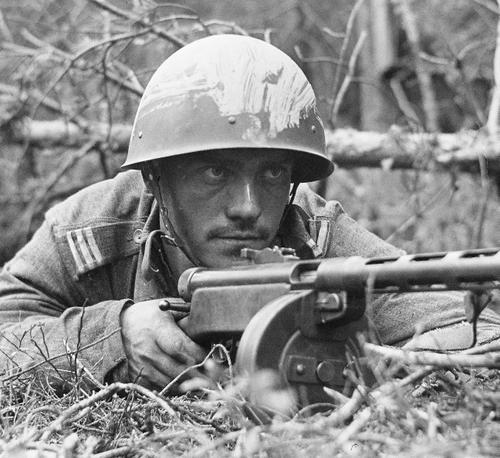
After the massive Wehrmacht gains of the first month of Operation Barbarossa, the front has quieted down on 25 July 1941. The Germans need time to consolidate their rear by eliminating bypassed pockets of Soviet troops, while the Soviet need to rebuild their shattered armies.
In the Far North sector, Finnish forces alone continue to move forward. Finnish 7th Division of VII Corps takes the village of Ruskeala, a key road junction north of Sortavala and Lake Ladoga. The Soviets at Sortavala (northernmost part of Lake Ladoga) have brought in the 168th Rifle Division and 198th Motorized Division and are preparing to launch a counterattack northeast toward the Jänisjoki River. The Finns, however, come into possession of a copy of the Soviet plans and adjust their forces accordingly.
Meanwhile, Finnish Fifth Division (Colonel Lagus) of VI Corps is digging in along the tiny Tuulemaa River (Reka Tuloksa) on the eastern shore of Lake Ladoga. Finnish Commander-in-Chief Marshal Mannerheim has decided against carrying the offensive farther into the traditionally Russian territory. Some Finnish troops are refusing to go further because a continued advance is certain to provoke the Soviets and Finland’s war aims are simply to recover traditionally Finnish territory — which now has been accomplished in this region.
The Finns recently occupied the island of Bengtskär, which is west of the Soviet-occupied port of Hanko in southern Finland. Today, the Soviets send the 60th Border Guards (Lt. P. Kurilov and Commissar A.I. Rumjantsev) on small boats to occupy it. The Finns have only about 30 men and one artillery piece on the small island, which provides a handy observation point at the mouth of the Gulf of Finland.
In the Army Group North sector, the German 18th Army (Colonel General Georg von Kuchler) attacks the Soviet 8th Army in the Pärnu Bay region of Estonia. The Soviets give ground.
In the Army Group Center sector, the Soviet attacks on the exposed Panzer Group 2 bridgehead at Yelnya continue.
In the Army Group South sector, Panzer Group 1 (General Paul Ludwig Ewald von Kleist) engages in a tank battle with no fewer than six Soviet mechanized corps under the capable Soviet General Mikhail Kirponos. The battle continues throughout the day without any clear winner. A sprawling tank battle, the largest of the war up to that point, swayed backwards and forwards across the steppes for four days, before superior German tactical handling and communications, plus their use of 88-mm guns, won the day. Kiponos was forced to retreat eastward towards Kiev.
Elsewhere, Soviet Southwestern Front is in full retreat toward Uman and the Dneipr River.
He 111 bombers of German Luftwaffe II./KG 4 were briefed for a night bombing mission over Moscow, Russia, but at the last minute they were ordered to mine the waters off Saaremaa island (German: Ösel) off Gulf of Riga, Estonia.
He 111 bombers of German Luftwaffe I./KG 55 attacked Soviet anti-aircraft positions at Dorogobush, Smolensk Oblast, Russia. One bomber was shot down.
Staffelkapitän of 7./JG 5 Oblt. Theodor Weissenberger shoots down two Russian lend-lease Airacobras and three Pe-2 bombers. Thus, he becomes an “ace in a day” — though he already is an ace.
AP Reports: Germany’s political leaders watched the Far East intently today, accusing the United States of “imperialistic aspirations” there, while the high command’s only announcements on the Russian war front again spoke of operations proceeding “according to plan” against stiff resistance in some areas. Although the official war bulletin was general, it reported that large number of prisoners and war material are being captured daily.”
Russia’s official spokesman, Solomon A. Lozovski, charged at a special press conference yesterday that Germany is planning a surprise attack on Turkey, the Tass agency said today. Lozovski showed correspondents documents purportedly captured from the 52nd German chemical regiment which was “routed” west of Sitna, revealing “secret schemes” and maps of European Turkey which he said proved Germany’s “fantastic aggressive plans” concerning Turkey. The spokesman said Russia would give Turkey a detailed statement of the German plans revealed by the captured documents.
The Wehrmacht officially designates the Spanish Volunteer Division that is to serve on the Eastern Front as the 250th Infantry Division. It is known colloquially as the “Blue Division” (Azul) because the only difference between its uniforms and German uniforms is the dark blue Falangist shirt that its troops wear. The Blue Division is composed largely of recent graduates of the Spanish military academies and has extremely high morale. The Germans intend to put it into the line in the Army Group North sector.
A naval battle develops in the Irben Strait when Russian torpedo boats attack the German 2nd R-Boat Flotilla. During the confusion, German minesweepers R.53 and R.63 strike mines which damage the ships, but they both make port.
Werner Mölders traveled to the Wolf’s Lair at Rastenburg, East Prussia, Germany and met with Adolf Hitler, Wilhelm Keitel, and Hermann Göring. The Luftwaffe has banned Mölders from flying due to his propaganda value to the war effort. After this, he will fly a desk in Berlin in the Air Ministry. During Mölders’ visit, Hitler awards him the Diamonds that he earned on 15 July 1941.
The occupied Baltic States become Der Reichskommissar für das Ostland. The first administrator is Hinrich Lohse, previously Gauleiter of Schleswig-Holstein. The region is subdivided into the “National Director” (Reichskomissar) in Estonia, a “General Director” in Latvia and a “General Adviser” in Lithuania. Overall command of the administration of the East officially rests with Alfred Rosenberg, but in practice, the SS, the Wehrmacht, the labor service, and even the Post Office control almost everything that matters.
According to some sources, the Soviets attempt peace negotiations with the Reich using Bulgaria as an intermediary. Very little is known about this incident if it happens at all.
Reichsführer-SS Heinrich Himmler issues orders that greatly expand the scope of persecutions, though that may not be their original intent. Himmler directs the creation of auxiliary police formations (Schutzmannschaften) which are to be composed of “Ukrainians, the inhabitants of the Baltic States and Belorussians.” These formations are destined to become the backbone of police manpower in the Baltic states. The original purpose of the Schutzmannschaften is debatable, with some later concluding that they are intended solely to provide security personnel for the process of feeding the Wehrmacht off local crops. Indeed, the order is issued in response to an OKW request for more security personnel. There is no question, however, that the Schutmannschaften units eventually participate in genocide against Jews.
Einsatzcommando 3 executes 103 Jews in Marjampole (Jäger Report).
Italian reconnaissance has discovered that Convoy GM1 — part of British Operation SUBSTANCE — has arrived in Malta’s Grand Harbour. It is not difficult to see, because Grand Harbour now is packed with shipping busily unloading. While previous attacks on the British ships have had some results, Operation SUBSTANCE is an undeniable British success.
The Italians, however, still feel that they can wrest a victory for themselves out of the jaws of defeat. The Italian fast naval auxiliary Diana departed from Augusta in Sicily carrying eight EMBs (one-man explosive motor boats.) Joining her were two fast motor torpedo boats each towing a two-man submersible called maiale (“pigs”.) The plan was to have the “pigs” breach the outer defenses of the Grand Harbor, allowing the EMBs to reach the defenseless merchant ships inside the port and sink them. A diversionary air raid would be carried out to cover the approach of the small boats. One group of “frogmen” would blow up a hindrance net suspended from a bridge to all the MTLs access to the harbor. The MTL pilots would race down the huge harbor and aim their exploding boats at ships before ejecting themselves over their sterns. The plan almost worked, except that one of the Italians, Major Tesei, blew up the bridge and himself, blocking access to the MTLs, which found themselves helpless, floodlit by harbor searchlights. The attack was picked up by British radar and all the Italian vessels were sunk by shore artillery.
HMS Edinburgh was attacked by a German torpedo bomber at Malta; the torpedo missed.
Royal Navy submarine HMS Tetrarch torpedoes and sinks Italian Regia Marina patrol boat B-247 (formerly trawler Maria Immacolata) off Gaidero Island.
Admiral Raeder confers with Hitler and informs him that the Kriegsmarine will send a flotilla of S-boats to the Mediterranean as soon as the Baltic is cleared of Soviet shipping. Hitler is pleased because General Rommel has been agitating for more naval support. The S-boats can transit south using the Rhine-Rhone Canal, but the size of the locks on the canal means that only the smaller S-boats (under 35 meters) can be used. Raeder hopes that this preemptive offer will prevent Hitler from later asking for the transfer of U-boats to the Mediterranean, which would be a very risky proposition because they would have to transit the Strait of Gibraltar that is heavily guarded by the Royal Navy.
During his nightly conversations with cronies late into the night, Hitler predicts:
“England and America will one day have a war with one another, which will be waged with the greatest hatred imaginable. One of the two countries will have to disappear. “
Hitler also thinks that Romania should give up its industry and become a granary for the Reich. He believes that Romania has become “contaminated by Bolshevism” and needs to be cleansed by eliminating the proletariat by going back to nature.
Benito Mussolini appoints General Alessandro Pirzio Biroli, former governor of Asmara, with complete civil and military powers in Montenegro in order to suppress the uprising there. Birzoli believes that extreme force must be used to suppress the 13 July Uprising, which is still growing.
The German-controlled radio announced that the Vichy government had decided to deport all British subjects from its territory.
Members of the sizeable British expatriate community on the Cote d’Azur were told to leave a month ago. Many of them are elderly and cut off from their incomes by the speed of the French collapse last year. Nov Vichy has decided to deport British subjects from France and “to regulate the position of Britons in France”. In part, the decision reflects increasing German pressure on the Vichy rulers. “After getting rid of the Free French parasites and the enemies of France as well as of the communists and the Jews,” Paris radio said, “it is now the turn of the British.” The decision also reflects the bitter anti-British resentment of Admiral Darlan, the Vichy vice-premier, over what the radio called “the numberless British aggression” against Dakar, Syria and the French fleet.
The Royal Navy ships of Operation EF, an ambitious projected raid on Kirkenes and Petsamo, reaches Seidis Fjord in Iceland to refuel. Destroyer HMS Achates hits a mine off Iceland and is towed back to Scapa Flow by destroyer Anthony. There are 65 deaths in the explosion. Achates is under repair in the Tyne until 13 March 1942.
Royal Navy destroyers HMS Cattistock, HMS Mendip, and HMS Quorn depart from Portsmouth late in the day for Operation GIDEON. This is a bombardment of Dieppe. The weather is foul, and the ships can only let loose a few rounds before being forced to return to port.
Italian submarine Barbarigo surfaces and uses its deck gun to sink 5141-ton British freighter Macon several hundred miles south of the Azores. There are 28 deaths and 21 survivors.
Quintin Brand was appointed the commanding officer of the No. 20 (Training) Group.
The Archbishop of Canterbury, William Temple endorses the British-Soviet Pact. He says: “It may seem strange to combine the alliance with Russia with the claim that we are contending for Christian civilization, but such misgivings are really misplaced, for the one, first, and essential aim of the whole widespread struggle is the overthrow of the tyranny of evil embodied in the rulers of Germany and all who are engaged in the cause must needs be our allies.”
The British documentary “Target for Tonight,” a low-key account of the crew of a Wellington bomber going on a mission over Germany, is realeased. Directed by Harry Watt, “Target for Tonight” is shot by the Royal Air Force Film Unit at RAF Mildenhall. All names and facts about RAF operations that could be of use to the Germans are altered. The film wins the Academy Award for “Best Documentary” in 1942.
RAF Bomber Command, Night of 25/26 July 1941
Hannover
30 Hampdens and 25 Whitleys; bombing, results were not observed. 4 Whitleys and 1 Hampden lost.
Hamburg
43 Wellingtons; 2 lost. Fires in the city and shipyards were claimed. Hamburg reports 4 large fires, 1 person killed and 6 injured with no particularly remarkable incidents.
Minor Operations: 7 Stirlings and 2 Halifaxes to Berlin of which 2 Stirlings and 1 Halifax were lost. 2 Wellingtons to Emden.
Total losses for this night 10 aircraft out of 109 dispatched (9.2 percent).
The final reconnaissance photographs that will be used in the 18 August 1941 Butt Report (Butt is a member of the War Cabinet) are taken today. The Butt Report will show that RAF bombing accuracy is very poor, noting “[o]f those aircraft recorded as attacking their target, only one in three got within five miles” of the intended targets.
Two Fulmars of RAF No. 807 Squadron are shot down southwest of Sardinia, with only one crew rescued and the other crew perishing. A Swordfish of 815 Squadron crashes due to mechanical issues 45 miles west of Cape Komakiti, Cyprus, with its crew perishing.
Heavy cruiser HMS Shropshire departed Scapa Flow for Hvalfjord and Denmark Strait patrol. The cruiser arrived at Hvalfjord on the 27th.
Destroyers HMS Mendip, HMS Quorn, and HMS Cattistock departed Portsmouth at 2100 to bombard Dieppe in operation GIDEON. A brief bombardment was carried out early on the 26th, but the rest of the operation was cancelled due to weather.
Italian submarine Barbarigo sank British steamer Macon (5135grt) in 32-48N, 26-12W. Twenty crew members and one passenger were saved from the steamer. Twenty five were missing from the steamer. Two crewmen died in the ship’s boat and one was killed.
British Rear Admiral, Mediterranean Aircraft Carriers, hoisted his flag in HMS Grebe.
Italian sloop Diana and motor torpedo boats MAS.451 and MAS.452 departed Augusta. Sloop Diana carried one large motorboat leader, eight explosive boats, and towed another motorboat. The MASs each towed one explosive SLC boat each. The next day, these forces attempted to attack the SUBSTANCE convoy in Malta, but British air attacks destroyed all but Diana which was able to return to base. The Italian boats blew up the harbor boom, but no other damage was done. Three officers and fifteen ratings were captured.
Submarine HMS Tetrarch sank Italian patrol vessel B 247 (trawler Maria Immancolata) off Gaidero Island. The submarine reported an unsuccessful attack on a German ship.
A Swordfish of 815 Squadron was lost 44 miles west of Cape Kormakiti, Cyprus, when the airframe and engine parted. Sub Lt D. A. Wise and Sub Lt A. H. Cann were killed.
German steamer Erlangen (6101grt) scuttled herself when she was intercepted by light cruiser HMS Newcastle southeast of River Plate.
An executive order by President Roosevelt froze Japanese assets in the United States. At Chiang Kai-shek’s request, the order was extended to Chinese assets as well. President Roosevelt struck back tonight against Japan for her push into French Indo-China by clamping a sweeping control over all economic intercourse between the United States and Japan, including cash, oil, ships, silk and other assets. Canada and Great Britain quickly followed President Roosevelt’s lead by announcing separate parallel action freezing the assets of Japanese nationals in their countries.
President Roosevelt today expressed disapproval of the action of Senator Wheeler, Montana Democrat, arch-foe of the administration’s foreign policy, in mailing post cards to men in the army asking they actively oppose involvement in the war. At a press conference in his home at Hyde Park, the chief executive referred to editorials In the New York Herald Tribune and New York Times captioned “On Dangerous Ground” and “Mr. Wheeler Goes Too Far.” The captions, he said, covered the situation. For months, Wheeler on one side, and the president and his aides on the other, have engaged in a running battle in which harsh words have become commonplace.
Agreement in principle on a declaration of national emergency as a basis for holding selectees, National Guardsmen and reserve officers under arms beyond the statutory training period of one year, and for that only, was reached today by the Senate Military Affairs Committee.
Senate non-interventionists will seek to write into pending legislation extending indefinitely the service of selectees, national guardsmen and reservists a prohibition against sending them outside the western hemisphere, Senator Wheeler announced today. Such a ban now exists in the selective service act. But non-interventionists fear that It could be circumvented through language in the war department’s draft of the extended service resolution now under consideration by senate and house military affairs committees.
Senator Wheeler, currently engaged in a blazing feud with President Roosevelt over foreign policy, tonight approved the order freezing Japanese and Chinese assets in the United States. “I think the president did the right thing,” he said. “You may say for me that I agree with him for the first time.”
U.S. Secretary of War Henry L. Stimson requested that U.S. President Franklin D. Roosevelt issue orders calling the military forces of the Commonwealth into active service for the United States. Stimson explained, “All practical steps should be taken to increase the defensive strength of the Philippine Islands.”
Reports come over the radio that “five bombing planes made for England have crashed at different places in Ohio. All these accidents have taken place within 24 hours.”
War and Naval Departments send a message to the Pacific commanders advising them that Roosevelt was going to close the Panama Canal to Japanese shipping and would freeze all Japanese assets in the US, and those of banks situated in Japanese occupied China. These commanders were advised to “guard against possible eventualities”…
Incomplete Text Of July 25, 1941, Message (CNO Admiral Stark on his own behalf and for COS to overseas naval commanders and to be forwarded to Army commanders):
YOU ARE ADVISED THAT AT 1400 GCT JULY 26 UNITED STATES WILL IMPOSE ECONOMIC SANCTIONS AGAINST JAPAN STOP IT IS EXPECTED THESE SANCTIONS WILL EMBARGO ALL TRADE BETWEEN JAPAN AND THE UNITED STATES SUBJECT TO MODIFICATION THROUGH A LICENSING SYSTEM FOR CERTAIN MATERIAL STOP IT IS ANTICIPATED THAT EXPORT LICENSES WILL BE GRANTED FOR CERTAIN GRADES OF PETROLEUM PRODUCTIONS COMMA COTTON AND POSSIBLY SOME OTHER MATERIALS AND THAT IMPORT LICENSES MAY BE GRANTED FOR RAW SILK STOP JAPANESE ASSETS AND FUND (sic) IN THE UNITED STATES WILL BE FROZEN EXCEPT THAT THEY MAY BE MOVED IF LICENSES ARE GRANTED FOR SUCH MOVEMENT STOP (missing section) CNO AND COS DO NOT ANTICIPATE IMMEDIATE HOSTILE REACTION BY JAPAN THROUGH THE USE OF MILITARY MEANS BUT YOU ARE FURNISHED THIS INFORMATION IN ORDER THAT YOU MAY TAKE APPROPRIATE PRECAUTIONARY MEASURES AGAINST POSSIBLE EVENTUALITIES STOP (rest of message missing).
Ten Republicans on the house ways and means committee tonight endorsed the “general objective” of the new $3,529,200,000 tax bill, but accused the new deal of “irresponsible spendthrift policies” and demanded a mandatory cut In non-defense spending. In a minority report, they urged President Roosevelt take formal action to stress the need for reducing unnecessary expenditures, and also declared there was “much room for economy” in some phases of the huge defense program itself. “We particularly have in mind,” they said, “the extravagance in the construction of cantonments, which has been so rampant as to constitute a national scandal.”
Navy food and Consolidated bombers were commended today by Wendell Willkie who, after eating fried halibut with 5,690 recruits at the San Diego naval training station, remarked “I’d like to make this my regular boarding place.” After an Inspection of the Consolidated Aircraft Corp., the Republican leader now campaigning for national unity, told newsmen: “It is plants like this that will beat Hitler.” Because of adverse flying weather, Willkie arranged to return to Los Angeles by automobile.
Bureau of Ordnance issues first Navy “E” certificates (for excellence) for industry.
Joseph Stilwell takes command of III Corps at the Presidio at Monterey, California.
U.S. Navy Task Group TG.2.7 returns to Bermuda after a patrol, while battleship USS New Mexico departs from Hampton Roads on a patrol.
The motion picture “Blossoms In the Dust” is released in the U.S. The film, directed by Mervyn LeRoy, stars Greer Garson, Walter Pidgeon and Marsha Hunt. This tear-jerker, set in Texas, has Garson opening an orphanage and fighting to get equal rights for illegitimate kids. The film is nominated for four Academy Awards including Best Picture and Best Actress (Garson); it wins one technical award.
Major League Baseball:
Forty-one-year-old Lefty Grove wins his 300th game as the Boston Red Sox defeat the Cleveland Indians 10–6 before a Fenway Ladies Day crowd of 16,000. The score is tied 6–6 when Williams cracks a 2-run homer to put the Sox ahead. Jim Tabor contributes 2 homers, and Foxx adds a 2-run triple. The loser is Al Milnar in relief of Mel Harder. Grove throws 120 pitches and loses 8 pounds in the effort. The lefthander gave up 12 hits beating the Indians. In 17 years in major league ball, he accumulated a 300-141 record. He will make 6 more starts, but this will be his last career win.
Four runs followed an error by Babe Dahlgren at Wrigley Field today and put the Giants back on the victory path. The error by the former Yankee first baseman, which came in a first-inning hammering of the left-handed Vern Olsen, paved the way for a triumph over the Cubs that was measured by 5–2 and gave Colonel Bill Terry’s team its first victory in five games.
Rookie Tommy Hughes of the Philadelphia Phillies again proved too skillful for the Cincinnati Reds today, adding a 4–3 decision to the shutout he gave the defending world champions the last time they met.
The Yankees flattened Edgar Smith of the Chicago White Sox for five runs in the fourth inning, the last three riding home on Tommy Henrich’s eighteenth homer of the campaign. Four innings later Charlie Keller clubbed Pete Appleton for his No. 25 homer with two colleagues aboard the bases, and those two outbursts more than sufficed to win, 8–0, behind Spud Chandler’s brilliant three-hit pitching. The result made even more decisive the runaway the Yanks are making of the American League race. The Yankees now are eleven games ahead of the second-place Indians. The victory was the Yanks’ seventh in a row, their tenth in their last eleven games and twenty-fourth in their last twenty-six.
The fast-stepping Athletics moved within one game of the American League first division today by pounding out fifteen hits for an 11–5 victory over Detroit.
The Pirates beat the Dodgers in a doubleheader, 8–4 and 8–2, and made their “lost” column total more than the first-place Cards’ for the first time in weeks. Whit Wyatt, making his fourth consecutive start toward his fourteenth victory, was knocked out in the eighth inning of the opener and charged with his eighth setback. Curt Davis, who had won five straight, was treated roughly in the afterpiece, getting his exit cue as early as the third frame.
The Boston Braves shelled two Cardinal pitchers from the mound with a double-barreled attack in the first two innings and defeated the league leaders, 8–0, tonight as Jim Tobin hurled three-hit ball. The Cards hold a one-game lead over the Dodgers.
St. Louis and Washington, current swappers of seventh and eighth places in the American League standings, tangled again today and St. Louis won, 5–3, behind the effective seven-hit hurling of Elden Auker.
Cleveland Indians 6, Boston Red Sox 10
New York Giants 5, Chicago Cubs 2
Philadelphia Phillies 4, Cincinnati Reds 3
Chicago White Sox 0, New York Yankees 8
Detroit Tigers 5, Philadelphia Athletics 11
Brooklyn Dodgers 4, Pittsburgh Pirates 8
Brooklyn Dodgers 2, Pittsburgh Pirates 8
Boston Braves 8, St. Louis Cardinals 0
St. Louis Browns 5, Washington Senators 3
Peru announced tonight its acceptance of a proposal by Foreign Minister Enrique Ruiz Gulnazu of Argentina for the pacification of the River Zarumilla frontier zone, scene of Peruvian-Ecuadorian hostilities. The announcement, however, re-Iterated that Peru was not responsible for the present hostilities.
The risk of war in the Far East escalated today with the surrender by the Petain regime of its military bases in Indochina to Japan. Britain and America have both denounced the French surrender. By gaining access to airfields in western Indochina, Japan can now launch more frequent bombing raids against the Burma Road. Occupation of Indochina’s east coast ports constitutes a threat to the Philippines (800 miles) and Singapore (750 miles).
The Japanese foreign office organ, which only yesterday was urging that Japan assume protection of French Indo-China, dropped that subject today as if it were already settled and directed its attention in strongly similar vein toward the little kingdom of Thailand. The organ, the English-language Japan Times & Advertiser, accused Britain of attempting to “disrupt the good relationship which has developed between Japan and Thailand” and declared Thailand needed external support and internal consolidation against such a threat.
Operation “FU” — The occupation of Southern French Indochina. A total of 39 Imperial Japanese Army and Imperial Japanese Navy troopships depart Hainan Island for Saigon, escorted by aircraft from aircraft carriers HIJMS Hiryu and HIJMS Soryu. That same day, heavy cruiser HIJMS Ashigara departs Samah.
Imperial Japanese Navy CruDiv 7 (HIJMS Mogami, HIJMS Mikuma, HIJMS Kumano and HIJMS Suzuya) departs Samah, Hainan Island, China with an army convoy, possibly covered by cruiser HIJMS Ashigara and CarDiv 2’s aircraft carriers HIJMS Hiryu and HIJMS Soryu, bound for Saigon.
Upon learning of the decision by the U.S. to impose sanctions on Japan, the Japanese decide that these will be only the first step in a determined U.S. campaign against them. The Embassy at Manila, which is the center of Japanese spying operations throughout the Pacific, warns that the U.S. next will impose a total export embargo on all war-related materials, including oil, from the United States to Japan.
The Japanese Imperial Navy reforms the Fifth Fleet, which was disbanded in 1939. Its new commander is Vice Admiral Hosogaya Boshiro. Its area of responsibility is the North Pacific.
N. Y. K. Japanese shipping line officials announced tonight the liner Tatuta Maru, hovering off San Francisco with a $2,500,000 cargo of silk and more than 100 Americans among her passengers, would not dock early tomorrow morning, as previously announced. Before the U.S. president’s order freezing Japanese assets was made public, the N.Y.K. office here received definite word from the big ship she would be in at 5 a.m. and the announcement gave rise to speculation a special arrangement had been made through the U.S. State Department to avoid seizure of the ship.
Lieutenant Commander Otoji Nakamura became the commanding officer of I-68.
Soviet 1035-ton freighter Kazak Poyarkov sinks between Vladivostok and the Perouse Strait. While the cause is officially unknown, several Soviet ships have been lost there recently due to friendly minefields.
German raider Komet parts ways from supply ship Anneliese Essberger and heads toward the Galapagos Islands.
Dow Jones Industrial Average: 128.06 (-0.53)
Born:
Emmett Till, African-American lynching victim in Mississippi at 14, in Chicago, Illinois (d. 1955). [Two men, Roy Bryant and J. W. Milam are tried for the murder but found not guilty. They both later admit to murdering Till but cannot be prosecuted due to the Double Jeopardy Clause. In part due to publicity about the Till case, Congress passes the first Civil Rights Act since Reconstruction in 1957.]
Nate Thurmond, NBA center (Hall of Fame, inducted 1985; NBA All-Star, 1965-1968, 1970, 1973, 1974; San Francisco-Golden State Warriors, Chicago Bulls, Cleveland Cavaliers), in Akron, Ohio (d. 2016).
Manny Charlton, rock guitarist for Nazareth, in La Línea, Andalusia, Spain (d. 2022).
Donna Theodore, American stage and screen actress (“Shenandoah”; “Face of Fear”), and cabaret singer (“A Date with Judy-the Garland Years”), in Pleasanton, California (d. 2024).
Died:
Allan Forrest, 55, American silent film actor.
Naval Construction:
The Nihon Kaigun (Imperial Japanese Navy) Akizuki-class destroyer HIJMS Hatsuzuki (初月, “New Moon (in Autumn)”) is laid down by the Maizuru Naval Arsenal (Maizuru, Kyoto Prefecture, Japan).
The U.S. Navy Nihoa-class yard ferryboat (wooden hull) Nihoa (YFB-17) is launched by the Pearl Harbor Navy Yard (Pearl Harbor, Hawaii). Nihoa was completed and present during the Japanese attack on Pearl Harbor, 7 December 1941.
The Nihon Kaigun (Imperial Japanese Navy) seaplane tender HIJMS Akitsushima (秋津洲, “Isle of the Dragonfly” [referring to Japan or Honshu]), sole ship of her class, is launched by the Kawasaki Shipbuilding Corporation Kōbe Shipyard (Kōbe, Japan).
The U.S. Navy SC-497-class submarine chaser USS PC-508 (later SC-508) is launched by the Mathis Yacht Building Co. (Camden, New Jersey, U.S.A.)
The Royal Navy Flower-class corvette HMS Thyme (K 210) is launched by the Smiths Dock Co., Ltd. (South Bank-on-Tees, U.K.).
The Royal Canadian Navy Flower-class corvette HMCS Dundas (K 229) is launched by the Victoria Machinery Depot Co. Ltd. (Victoria. British Columbia, Canada).
The Royal Navy Hunt-class (Type II) escort destroyer HMS Hursley (L 84) is launched by Swan Hunter and Wigham Richardson Ltd. (Wallsend-on-Tyne, U.K.); Wallsend. She is later transferred to the Royal Hellenic Navy on 2 November 1943 and renamed RHS Kriti (L 84).
The U.S. Navy Benson-class destroyers USS Bristol (DD-453) and USS Ellyson (DD-454) is launched by the Federal Shipbuilding & Drydock Co. (Kearny, New York, U.S.A.). Bristol is lost in October 1943. Ellyson is later converted to a high speed minesweeper, DMS-19, in 1944.
The U.S. Navy Aloe-class net tender Boxwood (YN-3; later AN-8) is commissioned. Her first commanding officer is Lieutenant Robert W. Nordstrom, USNR.
Les Forces Navales Françaises Libres (Free French Naval Forces) Fairmile B-class motor launch ML 267 is commissioned.
The Royal Navy British Power Boat 63-foot-class motor anti-submarine boat MA/SB 29 is commissioned.
The Royal Navy Fairmile C-class motor gun boat MGB 330 is commissioned.
The U.S. Navy 77-foot Elco patrol motor torpedo boat USS PT-42 is completed and attached to Motor Torpedo Boat Squadron Two (MTBRon 2).
The Вое́нно-морско́й флот СССР (ВМФ) (Soviet Navy) “S” (Stalinec)-class (2nd group, Type IX-modified) submarine S-55 is commissioned. Her first commanding officer is Captain 3rd rank Lev M. Sushkin.

