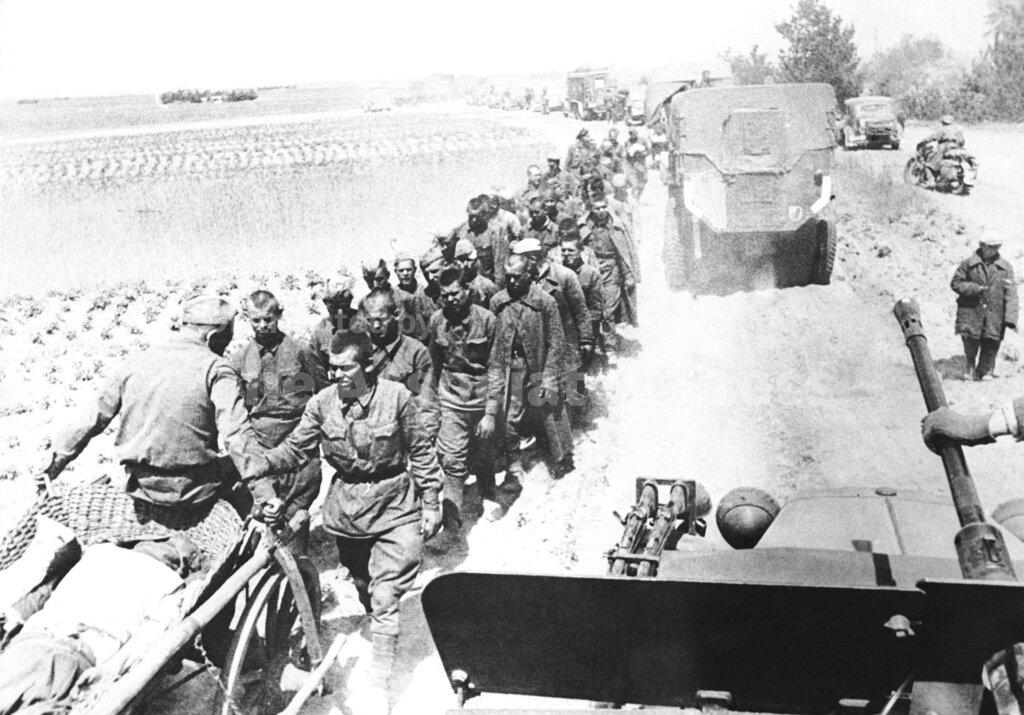
Far behind the front on 23 July 1941, at the Brest Fortress (which, contrary to legend, fell to the Wehrmacht in June 1941 and not July), there is a sudden commotion. The Germans are startled because the battle to subdue the fortress ended in June and all of the army divisions have long since moved east. However, it turns out that not everybody got carted away to the POW camps. Soviet Major Pyotr Gavrilov, later decorated as a Hero of the Soviet Union, hid out past the surrender along with some comrades. They have written some inscriptions on the fortress walls, such as:
I’m dying but I won’t surrender. Farewell, Motherland. 20.VII.41 [20 July 1941].
The details aren’t precise – some say there was a shoot-out today and that Gavrilov won’t be captured until the 24th – but it’s clear that he and/or others managed to elude the occupying Germans until now. By some accounts, the last Soviet soldier isn’t eliminated until 8 August, when Adolf Hitler himself visits the castle. The incident is part of the Soviet lore of World War II, accurate or not.
In the Far North sector, Finnish troops of VI Corps reach the 1939 border south of Salmi on the east shore of Lake Ladoga – and stop. Everybody knows where the old border was, and the troops wait for Marshal Mannerheim to make a decision whether to cross it. Some of the troops themselves don’t want to cross the border and actually invade Russia proper, because the Continuation Was has been touted as a way to regain historically Finnish lands, not as one of conquest. About 2000 troops mutiny and say they won’t cross it without a direct order from Mannerheim.
On the Finnish island of Bengtskär, the initial small detachment of Finnish troops sent to keep an eye on the nearby Soviet-occupied port of Hanko and the mouth of the Gulf of Finland receive some reinforcements. They are joined by a 2 mm Madsen cannon manned by a crew of three. While not much, it is more than anyone else has in the area.
In the Army Group North sector, General Hoepner’s Panzer Group 4 attacks the Luga Line southwest of Leningrad. The Soviets, who have just executed General Pavlov on the 22nd, relieve General Pyadyshev from command of the Luga Operational Group.
In the Army Group Center sector, Soviet 20th Army (Lt. General Pavel Kurochkin) counterattacks at Smolensk. A new Soviet unit, Central Front, is organized under Colonel-General F. I. Kuznetsov. The Central Front incorporates 21st and 13th Armies. This takes away some of General Timoshenko’s forces at Western Front.
In the Army Group South sector, the Romanian 17th Marine Infantry Battalion occupies Tatarbunary north of the Danube Delta (about 100 km southwest of Odessa and near the Sasyk Lagoon). Shore artillery sinks Soviet river gunboat Narova. The Soviets counterattack at Monastyrishche.
In Moscow, two nights of heavy Luftwaffe attacks (no attack tonight) have led to some hard decisions by the leadership. The families of VIPs – which means Communist Party bosses and top military figures – are evacuated to the east, the first of many to head to Samarkand and similar safe spots. The Red Army general staff headquarters is transferred to the Byelorosskaya subway station because, as General S.M. Shtemenko recalls, bombs have dropped nearby during both raids. Work is begun on adapting the Kirovskaya subway station as a more permanent military headquarters. General Shtemenko, the Soviet chief of operations, reports that bombs were frequently dropped near his offices at night, and that consequently the Red Army general staff headquarters was always shifted to the Byelorosskaya subway station in the evening so that the Soviet officers could get on with their work in peace. Later the general staff are moved to the Kirovskaya subway station, which had been specially remodeled for the purpose.
Soviet Commissar Nikolai Moskvin writes in his diary, “What am I to say to the boys? We keep retreating.” Moskvin is no shrinking violet – he already has shot the first deserters from his unit.
The German News Bureau announced: “The initial reports about the air assault on Moscow reveal that the German air crews who reached Moscow in the second assault wave, could see the sea of flame in the Russian capital while they were still almost 85 miles from Moscow. One of the pilots reports that the conflagrations were as huge and wide-reaching as those he had already viewed in Manchester or Sheffield. He spoke of the strong air defense and said that the incessant muzzle flashes from the anti-aircraft artillery could be observed amidst the houses even after they had begun to burn.”
The Wehrmacht high command in its daily communique mentioned no specific points on the Russian front, but in general terms stated that “in the course of attempts to break the ring and help enclosed troops, the enemy everywhere suffered extraordinarily sanguinary lasses.” “In the Ukraine,” said the communique, “German, Rumanian, Hungarian and Slovak troops continued the pursuit untiringly. On other parts of the eastern front enveloping and annihilation of small and big Soviet groups continue.”
The defending forces on the Finnish island of Bengtskär are reinforced by a 20 mm Madsen cannon with a crew of three.
Operation EF, a raid on Kirkenes and Petsamo, begins today when two carriers (HMS Furious and Victorious), two cruisers (Devonshire (flagship of Rear Admiral Wake-Walker) and Suffolk), and six destroyers (Escapade, Active, Anthony, Achates, Antelope and Intrepid) leave Scapa Flow for Seidis Fjord in Iceland. The raid is supposed to be a surprise attack, but somebody apparently forgot that during the summer months, it is daylight around the clock in the far north and a fleet of ships is easy to spot.
An supplement to Führer Directive 33 is issued:
The Chief of the High Command of the Armed Forces.
The Führer ‘s Headquarters, 23rd July, 1941.
14 copies
Supplement to Directive No. 33
After a report by Commander In Chief Army, The Leader on 22nd July issued the following orders to amplify and extend Directive 33.
- Southern Part of the Eastern Front:
The enemy forces which are still west of the Dnieper River must be decisively defeated and dispersed. As soon as the state of operations and of supplies allows, 1st and 2nd Armored Groups will be concentrated under command of 4th Tank Army and, with the support of Infantry and Mounted Divisions, will occupy the Kharkov industrial area and thrust forward across the Don River to Caucasia.
The bulk of the Infantry Divisions will then occupy the Ukraine, the Crimea, and the area of Central Russia up to the Don River. The security of the area immediately southwest of the Bug River is to be left to the Romanian Army.
- Central Part of the Eastern Front:
After mopping up operations around Smolensk and on the southern flank, Army Group Centre, whose infantry formations drawn from both its Armies are strong enough for the purpose, will defeat such enemy forces as remain between Smolensk and Moscow, by an advance on the left flank if possible. It will then capture Moscow.
3rd Armored Group will come under temporary command of Army Group North to secure its right flank and to surround the enemy in the Leningrad area.
For the further task of thrusting forward to the Volga River, the mobile forces of 3rd Armored Group will probably be once more available.
- Northern Part of the Eastern Front:
The subordination to it of 3rd Armored Group will enable Army Group North to employ strong forces of infantry for an attack in the direction of Leningrad, and to avoid expending its mobile forces in frontal attacks over difficult terrain.
Enemy forces still in action in Estonia will be destroyed. Their embarkation and withdrawal across the Narva River towards Leningrad will be prevented.
3rd Armored Group is to be returned to Army Group Centre on the completion of its task.
- The High Command Of The Army will plan further operations so that large parts of Army Group North, including 4th Armored Group and some of the infantry formations of Army Group South, may be moved back to Germany as soon as the situation allows.
3rd Armored Group will be rendered fully operational by drawing upon 4th Armored Group for equipment and personnel. 1st and 2nd Armored Groups will, if necessary, supply themselves by merging units.
- The orders given for Navy and Airforce in Directive 33 remain valid.
In addition they are to ease the situation of the Mountain Corps: the Navy, by the determined employment of its forces in the Arctic Ocean (now reinforced); the Airforce, by the transfer of several dive bomber groups to the Finnish theatre once the fighting around Smolensk is over. This will also reduce the temptation for England to intervene in the fighting along the Arctic coast.
- The troops available for securing the conquered eastern territories will, in view of the size of this area, be sufficient for their duties only if the occupying power meets resistance, not by legal punishment of the guilty, but by striking such terror into the population that it loses all will to resist.
The Commanders concerned are to be held responsible, together with the troops at their disposal, for quiet conditions in their areas. They will contrive to maintain order, not by requesting reinforcements, but by employing suitably draconian methods.
[Signed]
Keitel.
OKW Chief General Keitel signs an order which provides that legal punishments are inadequate in the Soviet Union. Thus, troops must use terror tactics to gain control over the population. This order will support the counts against Keitel during the Nuremberg trials.
The Operation SUBSTANCE convoy was attacked by Italian aircraft off the coast of Algeria near Bone. The convoy consisted of seven transports escorted by six destroyers and covered by the aircraft carrier HMS Ark Royal (91), the battleship HMS Nelson (28), the battlecruiser HMS Renown (72) and the battleship HMS Nelson (28) along with accompanying cruisers and destroyers. The destroyer HMS Fearless (H 67) was sunk by a torpedo and the light cruiser HMS Manchester (15) was damaged and had to return to Gibraltar. The 11,000-ton troop transport Sydney Star was torpedoed by an Italian MAS boat and crippled, but the destroyer HMAS Nestor (G 02) assisted her to a safe arrival in Malta.
Scharnhorst was detected by British RAF Coastal Command aircraft at La Pallice, La Rochelle, France by the results of a photo reconnaissance flight at 0915 hours. Around noontime, RAF reconnaissance reports eagerly desired news. Kriegsmarine heavy cruiser Scharnhorst, which is known to have left Brest despite German attempts to conceal its departure by substituting in its spot a tanker with camouflage netting, has been located. The ship is in La Pallice. The RAF has been planning a major raid on Brest for today, but this information scrambles its plans. The attack on Brest for the evening is scrapped, and a new target is laid in: La Pallice. Instead of the massive raid contemplated for Brest, though, this is a minor affair with only six Stirling bombers sent to attack the port in the evening. One bomber fails to return, and no hits are made.
The Inter-Parliamentary union and the British council have invited a “representative party” of United States senators and representatives to visit Britain and study wartime conditions.
There is an air-raid alert at 02:00 in Belfast which sends an estimated 30,000 people fleeing out of the city in a mad panic. There is no raid.
Free French leader Charles de Gaulle remains highly put out about not being included in the treaty that ended the conflict in the Levant. The British already have made concessions to mollify him, but de Gaulle wants more. To placate him some more, the British agree to change the terms of the Armistice so that the Free French are permitted to recruit amongst the captured Vichy French before they are taken back to France. This results in about 6,000 Vichy French soldiers deciding to join de Gaulle’s forces. The Free French also get to use all captured Vichy French military equipment, which generally is of high quality.
A British No. 44 Squadron Hampden bomber, returning from to Waddington, Lincolnshire, England, United Kingdom from a minelaying sortie, crashed into the staff residence of Lincoln Girls High School on Lindum Hill in the nearby city of Lincoln. The crew of four was all killed immediately as was the senior French mistress who died trying to escape from the burning building. Four other members of staff were injured and exploding ammunition peppered the surrounding area, seriously hampering the work of the fire and rescue teams.
RAF Bomber Command, Day of 23 July 1941
17 Blenheims on coastal operations; ships were attacked and set on fire but 6 Blenheims were lost. 12 further Blenheims on raids to Northern France; no losses.
There was an important development on this day in the continuing bombing campaign against the three German warships — Scharnhorst, Gneisenau and Prinz Eugen — sheltering in Brest. The Scharnhorst had not been hit in any recent bombing and the Germans had moved her stealthily to La Pallice, a small port more than 200 miles further south. A large tanker covered with camouflage netting was left in the Scharnhorst’s old berth at Bred. Scharnhorst was spotted by reconnaissance aircraft at La Pallice on 23 July. It was important to attack this powerful ship at once in case she was preparing for another Atlantic shipping foray. A formation of 6 Stirlings made the first attack on the evening of this day. 1 Stirling was shot down by German fighters.
RAF Bomber Command, Night of 23/24 July 1941
Mannheim
51 Wellingtons; haze obscured the target. No aircraft lost. Mannheim reports only 17 high-explosive bombs and an unknown number of incendiary bombs, the only damage recorded being to a water main, broken glass and roof tiles in 12 houses, and crops damaged in some fields of cereals and tobacco. The only casualties recorded are 3 people killed in a village some distance from Mannheim.
Frankfurt
33 Hampdens; visibility was poor. 1 aircraft lost.
La Pallice
30 Whitleys, Bomb bursts were seen in the dock area. No losses.
Minor Operations: 8 Wellingtons to Le Havre and Ostend, 1 Hampden minelaying in the Frisians, 3 O.T.U. sorties. No losses.
A Hudson aircraft, while on convoy escort duty, shot down a German aircraft 107 miles west-southwest of Achill Head, Achill Island, Ireland; the German crew was later rescued and interrogated.
Douglas Bader shot down a German Bf 109 aircraft.
New Luftwaffe pilot Wilhelm-Ferdinand “Wutz” Galland, brother of Adolf Galland, gets his first victory. RAF ace Douglas Bader downs a Bf 109, though he only claims a “damaged” victim because he doesn’t see it crash (other RAF pilots do).
For Operation EF, a British force departed Scapa Flow at 2345 on the 23rd with heavy cruisers HMS Devonshire (Flag Wake Walker) and HMS Suffolk, aircraft carriers HMS Victorious and HMS Furious, and destroyers HMS Escapade, HMS Active, HMS Anthony, HMS Achates, HMS Antelope, and HMS Intrepid. The force arrived at Seidisfjord on the 25th. Minelaying cruiser HMS Adventure departed Scapa Flow on the 23rd for Seidisfjord and arrived on the 24th. Destroyers HMS Eclipse and HMS Echo with oiler RFA Black Ranger for this operation had departed for Seidisfjord on the 22nd and arrived on the 24th. Minesweepers HMS Niger, HMS Salamander, and HMS Halcyon arrived at Scapa Flow on the 23rd en route to Iceland. Destroyer Achates struck a British mine of minefield SN.69 in 64-11N, 13-00W at 0300 on the 25th and badly damaged in Seidisfjord. The destroyer lost 65 ratings. The destroyer was towed by destroyer Anthony into Seidisfjord. Destroyer Achates was towed by tug Assurance, escorted by destroyer Antelope to the Faroes. Destroyer Tartar escorted the tow on to the Tyne. Destroyer Achates was under repair in the Tyne from 3 September to 13 March 1942.
Destroyers HMS Inglefield and HMS Icarus departed Scapa Flow at 1230 on the 25th and relieved destroyer HMS Eclipse and HMS Echo which joined the Main Force to replace destroyers HMS Achates and HMS Antelope. Minesweepers HMS Halcyon and HMS Salamander departed Scapa Flow on the 28th and were sent to Seidisfjord to provide anti-submarine protection. The minesweepers arrived on the 31st. The British force departed Seidisfjord on the 26th for operation EF. Aircraft carrier HMS Victorious launched an air strike of twenty Albacore torpedo bombers of 827 Squadron (Lt Cdr J. A. Stewart-Moore) and 828 Squadron (Lt Cdr D. E. Langmore) and nine Fulmar fighters of 809 Squadron (Lt Cdr V. C. Grenfell) on the Kirkenes on the 30th. Three additional Fulmars flew as protection for the carrier. Minelayer Bremse and other German ships were at Kirkenes. Some damage was done to piers and oil tanks and steamer Rottver was damaged, but six Albacores of 827 Squadron and five Albacores of 828 Squadron and two Fulmar fighters of 809 Squadron were shot down by German gunners. Killed were A/Leading Airman L. E. Barrow in a Fulmar of 809 Squadron (Sub Lt (A) R. S. Miller, his pilot, was captured), pilot Lt M. G. McKendick, observer P/T/Midshipman (A) E. A. Mills RNVR, and A/Leading Airman F. Sharples in an Albacore of 827 Squadron, pilot T/Lt (A) E. E. Hughes-Williams RNVR, observer Sub Lt (A) J. J. R. Davies, and A/Leading Airman A. Fox and pilot T/Sub Lt (A) D. R. McKay RNVR, observer T/Sub Lt (A) J. G. Paton RNVR, and T/Leading Airman D. W. Corner in Albacores of 828 Squadron were killed. Pilot Lt (A) T. E. Blacklock RNVR, and observer Lt (A) A. T. Easton, and pilot Lt (A) R. S. Miller from the Fulmars of 809 Squadron were captured. Captured were pilot Lt A. Turnbull RNVR, Observer Lt H. K. Serjeant, A/Leading Airman J. W. James of one Albacore of 827 Squadron, Pilot Lt H. F. Bond, Observer Lt H. H. Bracken, and A/Leading Airman E. Lancaster of another Albacore of 827 Squadron, Pilot Sub Lt P. J. Greenslade RNVR, Observer Sub Lt W. W. Parsons RNVR, A/Leading Airman H. Pickup of another Albacore of 827 Squadron, Pilot Sub Lt (A) J. F. Olsen and Observer Sub Lt (A) A. J. Bulford RNVR, were captured and A/Leading Airman H. J. Wade was killed in another Albacore of 827 Squadron, Pilot Lt (A) L. E. R. Bellairs and Observer T/Lt (A) D. M. Lubbock RNVR, of another Albacore of 828 Squadron were captured; their crewman A/Leading Airman C. F. Beer was killed, in another Albacore of 828 Squadron Pilot Sub Lt (A)C. V. Howard, Observer Sub Lt (A) G. L. Turner RNVR, andT/Leading Airman D. E. Polmeer were captured, in another Albacore of 828 Squadron Pilot Lt (A) R. Ross-Taylor, Observer Sub Lt (A) S. Clayton RNVR,T/A/Leading Airman L. W. Miles were captured, In another Albacore of 827 Squadron, Pilot Sub Lt (A) D. Myles RNVR, Observer Sub Lt A. P. Keep, and A/Leading Airman H. C. Griffin were captured. In Albacores of 827 Squadron one damaged, but was able to return to aircraft carrier HMS Victorious with its crew of Sub Lt R. J. Grant-Sturgis, Sub Lt W. A. Davies, and Naval Airman G. Dixon not wounded; another returned damaged to the carrier with its crew of Lt J. C. Reed, Lt Cdr J. A. Stewart-Moore, and Petty Officer H. J. Lambert; on arriving back at the carrier, an Albacore with Sub Lt R. B. Park and Sub Lt O. G. W. Hutchinson, A/Leading Airman E. P. Fabien was found to have been killed; another was damaged by flak, but its crew of Sub Lt R. S. Meakin, Sub Lt Scott, and Leading Airman F. Ward were not wounded; another with Lt J. N. Ball, Lt B. J. Prendergast, and Petty Officer A. E. Sweet returned to the carrier the only Albacore undamaged; another returned to the carrier damaged with Lt J. S. Bailey, Lt L. C. Williams, and TAGC. T. Roberts. In 828 Squadron, an Albacore with Lt R. L. Williamson, Lt F. Bedford, and Leading Airman F. A. J. Smith returned damaged to the carrier; another with Lt Cdr D. E. Langmore, Lt E. A. Greenwood, and A/Petty Officer Smith returned safely as did another Albacore of the Squadron which was damaged by flak, but returning safely with Sub Lt R. D. Head, Lt G. M. Haynes, RAN, and Leading Airman J. Madeley. Fulmars with Lt Cdr V. C. Grenfell, Lt H. D. Mathews, Lt H. E. Yates RNR, T/Lt (A) D. A. Van Epps, Sub Lt D. G. Carlisle, SARNVR, A/Sub Lt P. R. J. Gilbert, T/Sub Lt (A) J. B. Ganner RNVR,T/Lt K. J. Robertson, Lt J. Cooper, T/Sub Lt (A) R. C. Wood RNVR, and T/A/Sub Lt (A) A. E. R. Wilkinson returned to the carrier safely.
Aircraft carrier HMS Furious launched an air strike of nine Swordfish of 812 Squadron (Lt Cdr W. E. Waters), nine Albacore torpedo bombers of 817 Squadron (Lt Cdr D. Sanderson), and six Fulmar fighters of 800 Squadron (Lt Cdr J. A. D. Wroughton DSC) on Petsamo on the 30th. Four Sea Hurricanes of 880A Flight (Lt Cdr F. E. C. Judd) were flown off as protection for the aircraft carrier. Some damage was done to the piers by the torpedo bombers. One Albacore torpedo plane of 817 Squadron with Lt (A) L. H. Lee RNVR, which was slightly wounded, Sub Lt (A) G. Gorrie, and Leading Airman N. Train were shot down and came ashore at Murmansk and two Fulmar fighters of 800 Squadron with Sub Lt (A) F. J. G. Gallichan and Petty Officer Airman J. F. Black and P/T/Sub Lt (A) E. S. Burke RNVR, Leading Airman J. Beardsley were shot down and their crews lost. From 817 Squadron, the following aircraft safely returned to Furious: Lt L. E. D. Walthall, Lt Cdr W. E. Waters (Squadron CO), and Petty Officer (A) A. G. Brown; Sub Lt P. McJ. Wilkinson, Sub Lt (A) L. C. Plummer, and Leading Airman E. Kerridge; Sub Lt (A) R. P. Cross RNVR, and Leading Airman E. A. Cowan; Lt R. S. Baker-Falkner, Sub Lt (A) P. H. Phillips RNVR, and Petty Officer (A) D. V. Gill; Sub Lt (A) F. L. Jones RNVR, Sub Lt (A) K. Hyde RNVR, and Leading Airman A. F. Whitehouse; Sub Lt (A) E. L. Heath and Leading Airman G. E. Cowsill; Lt (A) J. H. D. Maughan, Sub Lt (A) G. F. Wild RNVR, and Leading Airman P. J. Nicholas; Lt C. J. K. Kindell, Sub Lt L. A. Edwards, and Leading Airman J. Stewart, and Sub Lt (A) J. D. Sinclair RNVR, Sub Lt (A) K. A. Hovington RNVR, and Leading Airman S. W. Lock. On the 31st, aircraft carrier Furious was sent back to Scapa Flow because of a fuel shortage. Five Albacore aircraft of 817 Squadron were transferred to aircraft carrier HMS Victorious before her departure. During the air strikes, cruiser minelayer HMS Adventure, escorted by destroyer HMS Anthony, which departed Seidisfjord on the 26th, was passed to Russia. The minelayer was detached at 0300 on the 30th and proceeded unescorted to Archangel with mines in Operation EF. Destroyer HMS Anthony, which returned to embark part of the crew of damaged destroyer HMS Achates, departed Seidisfjord early on the 31st and arrived at Scapa Flow at 2300. The minelayer arrived at Archangel on 1 August. After unloading, minelayer Adventure departed on 4 August for Loch Alsh, arriving on 11 August. From 10 to 15 September, these mines were laid by Soviet destroyers of the 1st Destroyer Division Gremyashschi, Gromki, Gozny, and Sokrushitelny in the area of Fisherman’s Peninsula. On 4 August, aircraft carrier HMS Victorious launched three Fulmar fighter planes to reconnoiter near at Tromso. The fighters attacked two armed trawlers and one fighter was lost. Pilot Lt H. D. Mathew of the 809 Squadron was killed and observer T/Sub Lt (A) R. A. Burroughs RNVR, was captured.
Polish destroyer ORP Kujawiak departed Scapa Flow at 2100 for Plymouth on completion of working up exercises.
Destroyer HMS Garth was damaged by the near miss of a German air bomb in the North Sea. The destroyer spent no time out of action.
German auxiliary patrol boat Vp.1508 (whaler Rau III, 354grt) was sunk by a motor torpedo boat southwest of Boulogne.
British steamer barge Omfleet (130grt) was sunk on a mine in Alexandra Dock, Hull. There were no casualties on the barge.
British sailing vessels Adamant (80grt) and Soavita (80grt) were damaged on mines at Alexandra Dock, Hull. Both vessels sank, but were salved. Italian submarine Bagnolini made two attacks on convoy OG.68, claiming sinking one steamer and damaging another. No confirmation of damage is available.
German fishing vessel Nordmark (462grt) was lost on a mine in the Irben Straits.
Aircraft carrier HMS Formidable departed Alexandria for repairs in the United States. The aircraft carrier passed through the Suez Canal the next day. Arriving at Norfolk, Virginia on 26 August, aircraft carrier Formidable was under repair until 12 December.
Destroyer HMS Hero was damaged by bombing in Tobruk harbor during the night of 22/23 July. The destroyer received temporary repairs at Mersa Matruh.
Submarine HMS P.33, on patrol near Pantelleria, was damaged by Italian depth charges, but was able to continue patrol.
Submarine HMS Olympus unsuccessfully attacked a liner off Naples.
Lt P. R. E. Woods was killed when his Martlet of 805 Squadron ditched in the sea one mile north of Ma’aten Bagush.
German steamer Tirpitz (7970grt) was sunk on a mine near Cape del Arma.
British troopship Erinpura departed Madras for Penang with personnel, escorted by light cruiser HMS Mauritius to 10N, 92-35E. The light cruiser was relieved by light cruiser HMS Danae. The steamer arrived at Penang on the 27th.
In Washington today, President Roosevelt’s callers included H. A. Millis, chairman of the NLRB; Frederic A. Delano, chairman of the National Resources Planning Board; Keith Morgan, chairman of the President’s birthday ball committee; Alfred E. Smith and Vice President Wallace.
The Senate was in recess. The defense investigation committee heard Leon Henderson and Marriner S. Eccles; the Military Affairs Committee continued hearings on extension of compulsory military service.
The House passed the $244,268,500 authorization for expansion of naval shore facilities, passed the bill establishing a scale of pay increases for postal employees and adjourned at 3:02 PM until noon tomorrow. The Ways and Means Committee completed drafting the tax bill; the Military Affairs Committee heard General George C. Marshall urge extension of compulsory military service.
U.S. Undersecretary of State Summer Welles told the Japanese Ambassador to the United States Admiral Nomura Kichisaburo that there was no basis for pursuing further the conversations between Japan and the United States. “…the United States could only assume that the occupation of Indochina by Japan constituted notice to the United States that the Japanese Government intended to pursue a policy of force and of conquest, and, second, that in the light of these acts on the part of Japan, the United States, with regard to its own safety in the light of its own preparations for self-defense, must assume that the Japanese Government was taking the last step before proceeding upon a policy of totalitarian expansion in the South Seas and of conquest in the South Seas through the seizure of additional territories in that region.”
President Roosevelt approves Secret plan JB 355. This is a proposal to establish a force of 500 Lockheed Hudson bombers in China to be organized as “The Second American Volunteer Group” under Clare Chennault’s command. The planes would be manned by US crews and strike industrial targets in Japanese cities such as Tokyo, Osaka, and Nagasaki. The aim is “destruction of Japanese factories in order to cripple munitions and essential articles for the maintenance of economic structure in Japan.” As with Chennault’s “First” American Volunteer Group, the unit would be funded through a dummy corporation and the Americans involved given fake papers.
Army Chief of Staff General George Marshall is not a fan of the plan, warning that it inevitably would lead to war with Japan and would not fool anybody about who was behind the bombings anyway. Secretary of War Henry Stimson also opposes the plan. White House adviser Lauchlin Bernard Currie, however, strongly supports the plan.
Secret Plan JB 355 never takes place despite its approval because the Japanese attack Pearl Harbor before it can be implemented.
In Washington D.C., Wendell Willkie (the defeated Republican candidate at the 1940 Presidential election) urged America to give unlimited aid to Britain.
The steepest tax bill in the nation’s history, a $3,529,200,000 measure hiking income, corporation and excise levies and taxing commercial radio broadcasts and billboards for the first time, was approved finally tonight by the House Ways and Means Committee. It will go to the house for consideration and undoubted passage next week under strict parliamentary procedure barring any amendments except such as the committee may approve. Unlimited changes may be made, however when the measure reaches the senate.
A prediction that the House Military Affairs Committee would approve a Congressional resolution proclaiming a national emergency was made today’ by Chairman May after the committee had heard General George C. Marshall, Chief of Staff, describe in secret session the danger, to the United States and Western Hemisphere in the present international situation. Marshall was reported tonight to have told the House Military Committee three South American nations are faced with possible Nazi uprisings. Committee members, who declined to permit their names to be used, quoted Marshall to that effect. The general had appeared before the committee at a closed session to argue for the pending proposal to extend the term of service of draftees, national guardsmen and reserves.
The Office of Production Management approved today proposals to increase pig iron capacity by 6,508,950 tons, the largest expansion in the history of the industry. OPM officials also stated that they were “exploring” the possibility of increasing steel ingot capacity by 15,000,000 tons. William S. Knudsen, Director General of the OPM, recommended to Jesse Jones, Secretary of Commerce and Federal Loan Administrator, that the government provide the money for the additional tonnage which was “urgently required because present and prospective demand for pig iron was far in excess of capacity and the demand for scrap iron was also in excess of the available supply.”
Wendell Willkie told a mass meeting for national unity tonight the United States probably would be involved In war regardless of the position it took on developing international affairs. The real issue now, he said, “is whether we are going to live in the future as free men, or whether the attack of the totalitarian powers is to destroy our prospect of freedom and force us, In desperation, to undertake another form of government.” Asserting that critics of the defense program were right in saying that it was in danger and that Washington was “in confusion,” Willkie called on the American people tonight to urge their representatives in Congress “to make the wheels go around, and to make them, go around faster than anybody thought they could go around.”
The Navy aircraft program, which has ordinarily the highest priority rating in the defense program, suffered a temporary setback when emphasis swung to the four-engined bombers now going into production for this country and Great Britain, Secretary Knox revealed today.
The War Department releases its Basic Field Manual and Soldier’s Handbook.
William S. Knudsen, director general of the Office of Production Management, stated today that the production of training planes and pursuit ships was coming along “all right,” that makers of naval patrol planes were meeting a “fair schedule,” but that “lots of work remains to be done” to bring the output of heavy bombers up to expectations.
Lease agreements totaling $21,504,756 with seven concerns to provide facilities for the repair and conversion of naval vessels were announced today by the Federal Loan Agency.
William S. Knudsen, OPM director general, Governor Van Waggoner of Michigan and R. J. Thomas, president of the United Automobile Workers of America, C.I.O., warned today that an arbitrary, sudden cut of 50 percent in the rate of automobile production would throw thousands of auto makers out of work. They considered the task of providing defense work for displaced employees. The Industry-Labor Committee was told that the War and Navy Departments and the OPM had agreed to expedite “all possible defense work” for the industry but was cautioned that speed in planning was essential since shortages of basic materials, such as steel, copper, zinc and aluminum, would soon cut down production of automobiles, even if a formal curtailment order in excess of 20 percent were not issued by the Federal Government.
Preparations were nearly ready today for the consecration Friday of Monsignor James J. Sweeney as the first Catholic bishop of Honolulu. High church dignitaries from all sections of the United States arrived today to participate in the solemn rites.
Dick Wakefield, University of Michigan star, plays his first pro game, going 0-for–4 with 3 strikeouts for Winston Salem. Wakefield was signed by the Tigers for $52,000 and a car. He’ll get into seven Major League games in 1941, hitting just .143.
Major League Baseball:
The “Williams shift” is used for the first time (as noted by Bill Nowlin) when White Sox manager Jimmy Dykes overshifts for the Boston slugger. Williams goes 2-for–5 with a double to left field, as the visiting White Sox win, 10–4. Thorny (Lefty) Lee kept twelve Red Sox hits well scattered today while hurling his eleventh victory for the White Sox.
Dick Errickson pitched the Braves to a seven-hit 6–1 victory over the Cubs today to even their series at one game each. The Braves settled the issue with a five-hit four-run assault on Starting Pitcher Vance Page in the fifth frame. Boston collected a total of twelve hits off Page, Larry French and Paul Erickson, Max West getting three singles.
After 11 straight wins, Elmer Riddle loses to the Dodgers, 5–4. The Reds give Elmer a 4-run lead, off Higbe, but he fails to hold it as the Dodgers rally for three in the 8th. Frank McCormick is beaned by Higbe and taken off the field on a stretcher. McCormick has played 349 straight games.
The New York Yankees defeated the Cleveland Indians, 3–2, before 10,728 delighted spectators at Yankee Stadium yesterday for their fifth straight victory and the three Yankee runs resulted from homers by the two prize pupils of Joe McCarthy’s Clouting Circus. Joe DiMaggio jolted his twenty-second round-tripper deep into the left-field stands to open the fourth inning. Buddy Rosar walked and Charley Keller cracked his twenty-third into the right-field pews. That was the ball game as the Yanks wrenched another series away from the Indians in administering to them their eleventh setback in fifteen engagements.
The Philadelphia Athletics nosed out the St. Louis Browns, 5–4, tonight with the aid of Frankie Hayes’s homer in the sixth with one on base. John Berardino hit a home run for St. Louis with one aboard in the seventh.
With the bases filled, Vince DiMaggio’s fourth-inning double was the deciding blow tonight as the Pittsburgh Pirates defeated Philadelphia, 5–2, and moved to within one game of the fourth-place New York Giants.
The St. Louis Cardinals beat the New York Giants, 5–4, scoring a run in the bottom of the 12th inning on Estel Crabtree’s single off reliever Carl Hubbell. The Giants had scored twice in the ninth to tie it at 4–4.
Dutch Leonard scattered Detroit’s nine hits tonight, while Washington bunched its blows off Buck Newsom to defeat the Tigers, 6–1 before a crowd of 17,000. It was the Senators’ second straight victory over the 1940 American League champions.
Chicago White Sox 10, Boston Red Sox 4
Boston Braves 6, Chicago Cubs 1
Brooklyn Dodgers 5, Cincinnati Reds 4
Cleveland Indians 2, New York Yankees 3
St. Louis Browns 4, Philadelphia Athletics 5
Philadelphia Phillies 2, Pittsburgh Pirates 5
New York Giants 4, St. Louis Cardinals 5
Detroit Tigers 1, Washington Senators 6
Fighting broke out on the border of Ecuador and Peru early today. Ecuadorean troops repelled a surprise attack by Peruvians that began at 2 AM and lasted half an hour at Rancho Chico and Alto Matapalo, according to an official bulletin. Fighting started at 6 AM at Huaquillas and spread to Balsito and Chacras. Peruvian planes were said to have machine gunned the coast guard vessel Atahualpa on the Zarumilla River and also fired on Chacras and Huaquillas. Ecuadorean troops are reported to be occupying Peruvian positions in Huaquilla, Reinforcements are being rushed to the border.
Japan has demanded the right to take military measures in French Indo-China, it was admitted tonight in an authorized declaration circulated by the French Telemondial news agency. Persistently denying the Japanese had delivered an ultimatum to the Vichy regime or to its officials in Indo-China, the French clung to the assertion the Japanese had made their demand because of alleged military developments along the British colonial and Chinese frontiers of Indo-China, which Japan has guaranteed to defend. Previously it had been stated by French officialdom France and Japan were negotiating for what was described as Japanese protection of French Indo-China against a threat of British occupation. France, it was explained, is negotiating only for “temporary military measures.” Japanese occupation of strategic air and naval bases in French Indo-China appeared imminent tonight, if not actually underway.
Pursuant to the recent agreement permitting the Japanese to establish bases in French Indochina, 9,000-ton IJN repair ship HIJMS Akashi arrives at southern Indochina. Admiral Decoux makes the best of a bad situation and is conciliatory to Japanese demands. Heavy cruiser HIJMS Ashigara also is on its way.
Vichy France has accepted “in principle” Japanese demands for virtually complete military control of French Indo-China to prevent that rich Asiatic colony from falling under British domination, it was said in France tonight. Some details remain to be worked out before a formal agreement is initialed, it was said. Meanwhile conversations are being continued and there will be further conferences tomorrow. An official spokesman said Japan demanded additional bases in Indo-China “as a temporary military measure to defend Indo-China against a combination of followers of General Charles de Gaulle [leader of the Free French movement] and British and Chinese.”
A series of Japanese actions, foreshadowing major Japanese military activities in Southern Asia within the next day or two, was revealed by Admiral Yang Hsuan-chieng, head of the intelligence section of the Chinese National Military Council, at a special press conference in Chungking yesterday. Admiral Yang said Chinese dispatches from Vichy, France, on Monday reported that Japan had demanded the use of the Indo-China naval base at Cam Rahn Bay and the right to land troops at Saigon, and station garrisons and establish air bases in Southern Indo-China. Indicating that Japan was preparing to use force if necessary, Admiral Yang said his dispatches reported that a Japanese naval squadron of seven heavy warships, three airplane carriers and fifty-five destroyers passed Kyushu Island yesterday, headed southward, while thirty transports loaded with troops had been seen sailing southward near Hong Kong over the weekend.
Though British foreign policy continues to cling to the notion that what Japan does in the Far East will be determined by what happens in Europe, Foreign Secretary Anthony Eden today found significance in the Japanese press campaign, against Britain.
Singapore and other British Pacific outposts were reported tonight to have been “forewarned and forearmed” with new R.A.F. contingents to meet a Far-Eastern climax, expected here to arise within twenty-four hours from Japanese demands on French Indo-China.
Well-informed financiers in London have received an intimation that preparations are under way to freeze Japanese assets in the United States and Britain. It was not revealed whether the measure would be applied in any case or as an eventual reprisal against Japan because of her southward move in Indo-China.
The United States is upset about the Japanese occupation of French Indochina. Acting Secretary of State Summer Welles tells Japanese Ambassador Nomura that the U.S. may discontinue any further talks aimed at resolving issues between the two nations.
New Japanese Foreign Minister Toyoda cables Ambassador Nomura admitting that he has “not as yet determined upon a definite policy [toward the United States] because of the fact that I have not been in office very long.” He notes that “our occupation of French Indo-China was unavoidable” and that the decision was made before he took office.
Dow Jones Industrial Average: 129.16 (-0.42)
Born:
Sergio Mattarella, 12th President of Italy (2015-), in Palermo, Sicily, Italy.
Pierre Agostini, French experimental physicist (2023 Nobel Prize for Physics for attosecond pulses of light), in Tunis, French Tunisia.
Richie Evans, American auto racer (9 x NASCAR Modified Champion 1973, 1978-1985), in Westernville, New York (d. 1985)/
Died:
José Quiñones Gonzales, 27, Peruvian military aviator (killed in action in the Ecuadorian–Peruvian war).
Naval Construction:
The U.S. Navy YMS-1-class auxiliary motor minesweeper USS YMS-23 is laid down by the Greenport Basin and Construction Co. (Greenport, Long Island, New York, U.S.A.).
The Royal Navy YMS-1-class auxiliary motor minesweeper HMS BYMS 2018 (J 818) is laid down by the Bellingham Iron Works, Inc. (Bellingham, Washington, U.S.A.).
The Royal Navy Isles-class minesweeping trawler HMS Skye (T 163) is laid down by Henry Robb Ltd. (Leith, U.K.); completed by Whites M.E.
The U.S. Navy Auk-class minesweeper USS Broadbill (AM-58) is laid down by the Defoe Boat and Marine Works. (Bay City, Michigan, U.S.A.).
The U.S. Navy Barnegat-class small seaplane tenders USS Absecon (AVP-23) and USS Chincoteague (AVP-24) are laid down by the Lake Washington Shipyard (Houghton, Washington, U.S.A.).
The Royal Navy Hunt-class (Type II) escort destroyer HMS Bedale (L 26) is launched by Hawthorn Leslie & Co. (Hebburn-on-Tyne, U.K.). Loaned to the Polish Navy before completion as ORP Slazak on 30 April 1942.
The Royal Navy Hunt-class (Type III) escort destroyer HMS Bleasdale (L 50) is launched by Vickers Armstrong (Newcastle-on-Tyne, U.K.): Parsons.
The Kriegsmarine (German Navy) Type VIIC U-boats U-587 and U-588 are launched by Blohm & Voss, Hamburg (werk 563 and 564).
The U.S. Navy 77-foot Elco patrol motor torpedo boat USS PT-41 is completed and placed in service with Motor Torpedo Boat Squadron One (MTBRon 1).
The Royal Australian Navy Bathurst-class minesweeper-corvette HMAS Mildura (J 207) is commissioned. Her first commanding officer is T/Lieutenant George Ewart Vaughan Owen, RANR(S).
Les Forces Navales Françaises Libres (Free French Naval Forces) corvette Aconit (K 58) is commissioned. Her first commanding officer is Lieutenant de vaisseau Levasseur.

