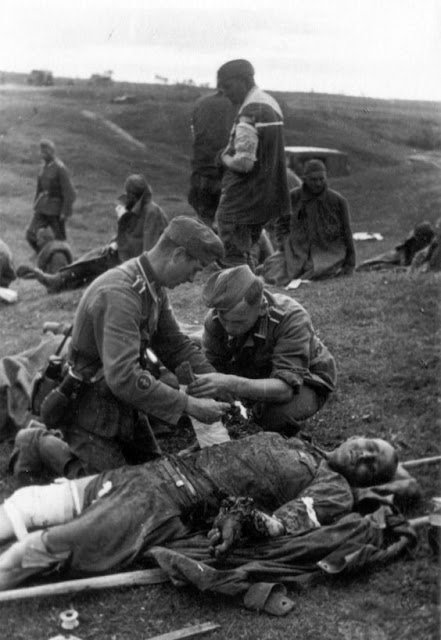
It is now, on 22 July 1941, exactly one month since the beginning of Operation Barbarossa, and the advance is going exactly according to German plans. That is to say, it is proceeding according to Hitler’s plans, but the German generals have different plans than the Führer. Specifically, the German generals see a clear path forward to Moscow and wish to capture the Soviet capital as soon as possible. Hitler, however, is more interested in destroying Soviet armies in the field and taking the objectives on the wings of the advance — Leningrad, and Kyiv. The Wehrmacht is strong, but not strong enough to take all three at once. Adding to the tension, the army high command (OKH) increasingly feels that Hitler is intruding into operational decisions that are best left to military professionals like Generals Halder and Brauchitsch. Thus, while on the surface everything looks ideal for the German advance, just below the surface major issues are about to burst into the open.
Field Marshal Fedor von Bock, who would lead the advance on Moscow as commander of Army Group Center, notes in his war diary (Tagebuchnotizen Osten I) the following:
Brauchitsch (Wehrmacht commander) called and said the Führer has ordered that all further advance of the armor to the east is no longer a matter of discussion.
One might think that this would settle the issue of an advance on Moscow once and for all. But, it does not, as German generals exhibit a surprising degree of independence (some might call it subversion) against the wishes of the Führer. Note that many histories claim that the Germans had to stop for supply reasons or so forth — but they didn’t. This was a Hitler order.
All that said, this may be the high point of the German advance into the Soviet Union in terms of matching reality to the objectives. The Wehrmacht has occupied some 700,000 square miles of Soviet territory and has large Soviet formations close to collapse at Kyiv. The German panzer spearheads are intact (if worn down), but the Soviets always seem to have more troops to feed into the grinder. A critical phase of the offensive is at hand because it is vital for the Germans to destroy the Red Army before the weather turns, and the pace of the advance must be sustained to accomplish that.
In the Far North sector, Finnish VI Corps advances 23 km southeast past Salmi along the eastern shore of Lake Ladoga to take the tiny village of Manssila. The Soviet defense is hampered by the troops’ unfamiliarity with the area, its remoteness, and extreme German pressure on the main front. The Finns now are approaching the 1939 border, and Marshal Mannerheim, the Finnish commander, has a decision to make as to whether to invade pre-war Russia or settle for his purported war aims of simply recovering territory on which Finland has a historical claim. Nobody knows what Mannerheim’s decision will be, but he only has another day or two to make it. Meanwhile, Finnish VII Corps on the western shore of Lake Ladoga finally has cleared a pocket of Soviet troops along the Jänisjoki River and can continue toward Leningrad. Further north, at Salla and on the Litsa River, the German/Finnish advances are completely stalled.
In the Army Group North sector, German Panzer Group 4 reaches Lake Ilmen to the south of Leningrad. The panzers stop here to do maintenance and wait for the infantry to close up with their advanced position.
In the Army Group Center sector, the Germans continue to subdue the Mogilev and Smolensk pockets. General Hoth’s Panzer Group 3 recovers its units that have been assisting with the encirclement and prepares for further action to the east. The panzer spearhead at Yelnya consolidated its bridgehead.
In the Army Group South sector, Field Marshal Rundstedt’s armies continue making progress toward encircling the large Soviet forces at Uman.
In the evening, the Luftwaffe mounts another raid against Moscow with 115 bombers to follow-up the successful raid of the 21st. The Germans report losing 2-5 bombers, which jibes with normal loss totals during night attacks on London, while the Soviets claim to shoot down 15. Damage again is light-moderate — from experience in London, the Luftwaffe now should know that single air raids on large metropolitan areas have barely any minor noticeable impact.
In a sign of a situation that is becoming a problem for the Wehrmacht, Major General W. Nehring’s 18th Panzer Division receives 30 new Panzer Mark III’s and IV’s. Despite this reinforcement, the division now is only at 20 percent of its authorized strength. This is becoming the norm for German panzer divisions.
Reinhard Heydrich, who apparently does not have enough to do as the chief of the Reich Main Security Office and boss of the Gestapo, likes to dabble in flying Luftwaffe combat missions — perhaps to justify on the battlefield his Iron Cross First Class and Frontflugspange (Front Pilot Badge) in silver. Heydrich is not a particularly good pilot (he began the war as an occasional turret gunner and, after training as a pilot, crashed on take-off on 31 May 1940, injuring himself). However, Heydrich has the clout to fly with front-line squadrons such as JG 27 anyway. Today, over Yamil, his Bf 109 is hit by Soviet anti-aircraft fire. Heydrich manages to barely make it back to German lines, evading a Soviet patrol, but this is his last such mission. Hitler forbids Heydrich from flying in combat any more because his capture would be a devastating security breach and propaganda victory for the Allies — and likely very bad for Heydrich’s health. It is not known how many combat missions Heydrich has flown altogether, but according to Ballantine Books’ Illustrated History of the Violent Century (1973), Heydrich flew 97 missions in a Bf-110 twin-engine fighter. He likely flew many more missions, but how many is unknown.
AP Reports: The Axis armies pause in their advance, having conquered 700,000 square miles of Russian territory. For the fourth day in succession Hitler’s headquarters could point to no new breach in the Stalin line, no new strategic river crossing or rail-and-road junction captured to justify its assertion that Soviet frontier defenses had been torn apart and the red army been isolated into “disconnected groups.” In effect, the German reports confirm Moscow’s statement that there has been no important strategic change in the battle areas since the Nazis pushed forward to the Smolensk region.
Moscow: The Soviet Information Bureau reported: “Yesterday evening Moscow experienced its first air attack of the war. The sirens sounded at 10:00 P.M. after lookout men had reported more than 200 German bombers flying toward Moscow. Soviet night interceptor planes and antiaircraft batteries went into action and succeeded in forcing the bulk of the attackers to turn back before reaching the capital. Only isolated German-Fascist aircraft succeeded in breaking through and released a number of bombs that destroyed dwellings or set them on fire, but no military targets were hit. There were several dead and injured. Night interceptors and anti-aircraft guns destroyed 17 German aircraft.”
The German News Bureau in Berlin, Germany reported to the public that the Soviet capital of Moscow had been attacked by German bombers for the first time during the previous night; the aircraft were launched from captured airfields within a few hundred miles from the city. Meanwhile, the German High Command announced that the bombing of Moscow was done in retaliation for Soviet bombings on Bucharest, Romania and Helsinki, Finland.
The Wehrmacht High Command announced: “The breakthrough operations of the German Wehrmacht and its allies have broken the Soviet defensive front into disconnected groups. Despite tenacious local resistance and dogged counter-attacks, any unified conduct by the enemy is no longer discernible. Operations to smash and annihilate the individual Soviet armed forces groups, are continuing without let-up along the entire Eastern Front. Last night the Luftwaffe attacked Moscow for the first time in retaliation for the Bolshevik air raids on the open capital cities of our allies, Bucharest and Helsinki. Strong German bomber formations with good ground visibility made relay bombing raids on military installations in the Soviet Russian communications and munitions centre in Moscow. Direct bomb hits started countless conflagrations and wide-spreading fires in the Kremlin district and around the Moskva river bend. High ranking Soviet headquarters buildings and government offices have been destroyed or badly hit, as have supply factories.”
As usual with Berlin announcements, the reality is somewhat less dramatic than the OKW communique would suggest. The Soviet forces have been retreating, but now in some areas have reached defensible lines. The Red Army remains intact despite its savage beating in the first month of the campaign, and there is plenty of evidence of “unified conduct.” As for the Nietzschean rhetoric about the effects of the Moscow air raid, the Soviet government buildings were barely touched — perhaps because they were not the targets in the first place. Instead, railways, airfields, and major factories were the targets, and those did receive moderate damage.
In captivity at the Lefortovo Prison in Moscow, Russia, General of the Army Dimitry Pavlov explained that out of the 600 artillery fortifications on the western border, only 169 of them actually had guns inside, and other similar facts explained why he could not counterattack the German forces as Joseph Stalin had ordered. Regardless, he was found guilty and was executed before the end of the day. General Pavlov has his property confiscated, is deprived of all rank and is shot at the Lefortovo Prison in Moscow by the NKVD. He is convicted of “failure to perform his duties” and blamed for losing the early battles on Western Front along the frontier, up to the battle of Minsk. Pavlov (along with other Soviet generals) is rehabilitated in 1956 for “lack of evidence.” Pavlov’s deputy, Lieutenant General Ivan Boldin, is much luckier — he has been wandering behind enemy lines and, once he makes it back to the Soviet Union, will be acclaimed a hero.
The commander of the 4th Army, Major General A. A. Korobkov also is shot today. Many other Western Front generals are shot in the days to come, including the Chief of Staff, Major General B. E. Klimovskikh; the chief of the communications corps, Major General A.T. Grigoriev; the Chief of Artillery, Lieutenant General of Artillery A. Klich; and Air Force Deputy Chief of the Western Front (who, after the suicide of Major General Aviation I. I. Kopets, was, nominally at least, Chief of the Air Force of the Western Front), and Major General Aviation A. I. Tayursky. The commander of the 14th Mechanized Corps, Major General Stepan Oborin, is under arrest and will be shot on 16 October 1941.
The Soviet NKGB was merged into the NKVD.
Israel Fisanovich was made the commanding officer of Soviet Navy submarine M-172.
Colonel Ruben Lagus, the commander of the 5th Division, is nominated as the first recipient of the new decoration, the Mannerheim Cross (2nd class) for operations in Karelia.
Heinrich Himmler brings his family to Dachau for the day. His wife Margarete and daughter Gudrun spend the day walking through the gardens and enjoying a guided tour. Gudrun notes in her diary:
“Today, we went to Dachau. We saw everything we could. We saw the gardening work. We saw the pear trees. We saw all the pictures painted by the prisoners. Marvelous. And afterward, we had a lot to eat. It was very nice.”
Pictures show them in their “Sunday best” walking in areas bereft of prisoners.
Vichy France requires all Jews to register their businesses and authorizes the confiscation of unlawful businesses (this is called “Aryanization of Jewish assets”). The purpose of this is to exclude Jews from commerce. One way around this is for Jews to find a Gentile to serve as a “front” — if they can find one. Sometimes that works, sometimes it doesn’t, and when it does the “fronts” sometimes take advantage of the situation. In practice, this new law makes a lot of successful French Jews have their businesses expropriated and become unemployed.
The only footage that exists of the girl Anne Frank was taken, while observing a girlfriend on the day of her wedding. It was taken on Merwedeplain 37, south Amsterdam. Holland.
Hitler is touring the front. During the night, when he likes to expound on random topics with his closest cronies, he says:
“The Englishman is superior to the German in one respect — that of pride. Only the man who knows how to give orders has pride.”
To Hitler, this is a high compliment. Later, he goes a bit further about his attitude toward the British:
“For the English, the ideal existence was represented in the society of the Victorian age. At that time England had at her Service the countless millions of her colonial Empire, together with her own thirty-five million inhabitants. On top of that, a million bourgeois — and, to crown the lot, thousands of gentlefolk who, without trouble to themselves, reaped the fruit of other people’s toil. For this ruling caste, Germany’s appearance on the scene was a disaster. As soon as we started our economic ascent, England’s doom was sealed. It is quite certain that in future England’s Empire won’t be able to exist without the support of Germany.
“I believe that the end of this war will mark the beginning of a durable friendship with England. But first, we must give her the K.O. [knockout] — for only so can we live at peace with her, and the Englishman can only respect someone who has first knocked him out.”
Unfiltered statements such as this appear to confirm that Hitler has very mixed feelings about the British, which may inform some of his military/diplomatic decisions. Hitler adds further that he’s “met a lot of Englishmen and Englishwomen whom I respect.” He does not, however, like those with whom he has had “deceptive dealings.”
Back in the Reich, Alfred Rosenberg, five days after being appointed as Reich Minister for the Occupied Eastern Territories, Alfred Rosenberg films an address for the weekly propaganda newsreel (Wochenschau). He states that he sees the purpose of his appointment as being to secure “the welfare and public order for the peoples of the East coming under German administration.” It is debatable whether Rosenberg at this time knows his true role in the East — to ruthlessly exploit the people and resources there to the sole benefit of the Reich. However, with that statement, Rosenberg is simply parroting the exact language of the 17 July 1941 decree appointing him.
According to Italian Foreign Minister Count Galeazzo Ciano’s diary, Italian leader Benito Mussolini has ordered the Regia Aeronautica to conduct mock air raids on Rome, one for every real raid on Naples, to “keep people sharp” and remind them that there’s a war on. One takes place today, and the public reaction to such “practice” — which includes live anti-aircraft fire against Italian planes — is decidedly negative.
Adolf Hitler sent an armored train equipped with anti-aircraft weapons to Benito Mussolini as a birthday present.
Italian Count Galeazzo Ciano noted in his diary that Benito Mussolini had staged a mock air raid over Rome, Italy on this date, with anti-aircraft positions firing. The purpose of this production was to give the citizens the impression that a serious war was going on.
Having had a wild adventure in occupied Europe since the fall of France, including crossing occupied Europe and being arrested by the Spanish, then escaping, Dutch fighter pilot Colonel Remy Van Lierde arrives in England. He is interrogated by MI5 at the London Reception Centre and cleared for duty with the RAF.
Deposed Iraqi leader Rashid Ali arrives in Germany after a roundabout escape via Afghanistan.
In Cairo, Lyttleton makes several concessions to de Gaulle. General Dentz and several Vichy French officers should be segregated, if necessary, in Palestine; that the British government should not intervene in political and administrative affairs in Syria; and that it would ‘protect the historical interests of the French in Syria.’ de Gaulle proposes a new application of the armistice convention. He also suggests that the British should limit themselves to ‘the military operations against the common enemy.’ Lyttleton agrees on behalf of the British.
Italian scouts report Operation SUBSTANCE, a British relief convoy to Malta. However, the Italian naval staff decides that this is just another routine Royal Navy aircraft ferrying mission to Malta that will be gone before surface ships can arrive. So, the Italian Navy’s (Regia Marina) surface fleet remains in port.
Italian submarine Diaspro fired four torpedoes on HMS Ark Royal and HMAS Nestor escorting the Operation SUBSTANCE convoy in the Mediterranean Sea; all torpedoes missed. 8 SM79s torpedo bombers and 15 bombers (SM79 and Cant Z1007) took off from Sardinia, Italy to attack the same convoy, but they would fail to locate any of the ships.
At Malta, the RAF Inspector General, Air Chief Marshal Sir Edgar Ludlow-Hewitt, and staff complete their stopover and proceed to the Middle East.
Royal Navy submarine HMS Tetrarch uses its deck gun to bombard the port of Karlovassi on the Greek island of Samos. The submarine claims to damage a number of caiques in the harbor, which are used by the Germans for communications between islands.
In the morning, the Kriegsmarine transfers battlecruiser Scharnhorst (just returned to duty from repairs) from Brest to La Pallice. The ship is in good shape and steams across the Bay of Biscay at a swift 30 knots, arriving on the 23rd. With Scharnhorst, Gneisenau, and Prinz Eugen all in Brest harbor, they simply present too tempting a target to ignore — the RAF pilots refer to them collectively as the “Brest Bomb Target Flotilla.” The Gneisenau and Prinz Eugen, however, remain in dry dock due to bomb damage, so they must stay put. The RAF, in fact, is planning a major air raid on Brest for the 23rd to destroy the ships, so this unexpected move throws a spanner in the works — but the British quickly learn what is going on and alter their plans accordingly.
The Royal Navy also responds to the German redeployment of Scharnhorst, and its response just after noontime shows how hair-trigger sensitive Whitehall is to the Kriegsmarine’s capital ships. The Admiralty brings battleship HMS King George V, aircraft carrier Victorious, heavy cruisers Devonshire, Shropshire, and Suffolk, light cruisers Aurora and Nigeria, and destroyers Achates, Active, Antelope, Anthony, Escapade, Icarus, Intrepid, Punjabi and Tartar to one hour’s readiness. All this is done for a routine passage of one German ship between ports. The majority of the ships remain on high alert for 24 hours, until the Scharnhorst is spotted by the RAF at La Pallice at 12:26 on the 23rd.
In the far North, four German destroyers (Friedrich Eckholdt, Hermann Schoemann, Karl Galster, and Richard Beitzen) conduct a patrol east of Murmansk along the Kola coast. They sink Soviet survey ship Meridian between Iokanga and Teriberka in Murmansk Oblast. This is a route used by ships heading to Archangel (Arkhangelsk). The Red Air Force attacks the German ships, but they make it back to port.
RAF Bomber Command, Day of 22 July 1941
6 Blenheims to Le Trait shipyards and 6 on a sweep off the French coast. No Blenheim losses.
RAF Bomber Command, Night of 22/23 July 1941
Frankfurt
63 aircraft — 34 Hampdens, 16 Whitleys, 13 Wellingtons. No losses.
Mannheim
29 Wellingtons. No losses.
Minor Operations: 19 Wellingtons and Whitleys to Dunkirk, 5 Hampdens minelaying off Brest, 5 O.T.U. sorties. No losses.
The Luftwaffe attacks Tobruk harbor after dark and damages Royal Navy destroyer HMS Hero. She makes it to Mersa Matruh for repairs.
The Luftwaffe also attacks the Suez Canal during the night.
At 1247 on the 22nd on reports that German battlecruiser Scharnhorst had departed Brest, Battleship HMS King George V, heavy cruiser HMS Shropshire, light cruisers HMS Nigeria and HMS Aurora, and destroyers HMS Tartar, HMS Punjabi, HMS Icarus, HMS Intrepid, HMS Escapade, and HMS Achates were brought to one hour’s notice. At 1616 heavy cruisers HMS Devonshire and HMS Suffolk were brought to one hour’s notice. At 1829 aircraft carrier HMS Victorious and destroyers HMS Inglefield, HMS Antelope, HMS Active, and HMS Anthony were brought to one hour’s notice. Aircraft carrier HMS Furious reverted to normal notice at 1756 to allow urgent maintenance to be carried out. At 1720, heavy cruisers HMS Devonshire and HMS Suffolk and light cruiser HMS Aurora reverted to normal notice for the same reason. At 1226 on the 23rd, the ships returned to normal notice when the battleship was located at La Pallice.
Destroyers HMS Eclipse and HMS Echo departed Scapa Flow at 0300 escorting tanker RFA Black Ranger to Seidisfjord.
Destroyer HMS Croome departed Scapa Flow at 0715 carrying Admiral Commanding 10th Cruiser Squadron and his staff to Rosyth where they arrived at 1500 to embark in light cruiser HMS Kenya.
Anti-aircraft ship HMS Curacoa departed Scapa Flow at 0630 and met convoy WN.55 in Pentland Firth. On meeting convoy EC.48 at 2200, the ship transferred to that convoy and provided cover northward. At 1520 on the 23rd, after this escort duty, the ship arrived at Scapa Flow.
Minelayer HMS Teviotbank, escorted by survey ship Scott, laid minefield SN.21B of the Northern Barrage.
German destroyers Karl Galster, Hermann Schoemann, Friedrich Eckholdt, and Richard Beitzen departed the Kirkenes. The destroyers sank Soviet surveying ship Meridian on the 22nd between Iokanga and Teriberka. The German destroyers arrived back on the 24th.
Yugoslavian torpedo boats Durmitor and Kajmaklan departed Haifa to return to Alexandria.
Anti-submarine trawler HMS Stella Carina departed Gibraltar escorting British tanker Hornshell to the west. The trawler would then join Panamanian tanker Norvinn arriving. Trawler Copinsay departed Gibraltar later on the 22nd to join trawler Stella Carina. On the 26th, tanker Norvinn, arriving from Trinidad, escorted by trawlers Stella Carina and Copinsay, arrived at Gibraltar.
Submarine HMS Tetrarch shelled Karlovassi and claimed damaging a number of caiques in harbor.
Submarine HMS Urge unsuccessfully attacked a small convoy off Palermo.
Greek submarine RHS Glaukos sank a caique with artillery off Castelorizzo.
Light cruiser HMS Dunedin captured Vichy French steamer Ville de Rouen (5383grt) east of Natal at 19-32S, 11-12W. The ship was taken to East London, South Africa, arriving on 4 August.
Convoy HX.140 departed Halifax, escorted by armed merchant cruiser HMS Ascania and corvettes HMCS Bittersweet and HMCS Fennel. The convoy was joined on the 23rd by corvettes HMCS Chicoutimi and HMCS Matapedia, which were detached later that day. On the 24th, escorted ship HMS Walney and corvette HMCS Buctouche joined. Escort ship Walney was detached the next day. On the 25th, destroyers HMS Ramsey and HMS Columbia, corvettes HMS Candytuft, HMS Gladiolus, HMS Mimosa, and HMS Nasturtium, minesweeper HMS Speedwell, and anti-submarine trawlers HMS Northern Spray and HMS Northern Wave joined. Corvette Buctouche was detached on the 26th, corvette Nasturtium on the 27th, and minesweeper Speedwell on the 28th. Destroyer Columbia was detached on 1 August, and armed merchant cruiser Ascania and corvettes Bittersweet, Candytuft, Fennel, Gladiolus, and Mimosa were detached on the 2nd. Destroyers HMS Malcolm, HMS Sardonyx, HMS Scimitar, and HMS Watchman, corvettes HMS Aubretia, HMS Heartsease, HMS Nigella, HMS Verbena, and HMS Violet joined on 2 August. Destroyer HMS Amazon joined on 3 August. The destroyers were detached on 5 August and the corvettes arrived with the convoy at Liverpool on 6 August.
Convoy SC.38 departed Sydney, CB, escorted by armed merchant cruiser HMS Chitral and corvettes HMCS Barrie, HMCS Dauphin, and HMCS Napanee. The corvettes were detached on the 25th. Destroyer HMS Columbia and corvettes HMS Gladiolus, HMS Mimosa, and HMS Nasturtium joined on the 25th. Corvette Nasturtium was detached on the 27th, destroyer Columbia on 1 August, and armed merchant cruiser Chitral and corvettes Gladiolus and Mimosa on 2 August. Destroyer ORP Burza, corvettes HMS Aubretia, HMS Heartsease, and HMS Nigella, and minesweeper HMS Britomart joined on 2 August. Destroyers HMS Amazon and HMS Georgetown joined on 3 August. Corvettes Aubretia and Nigella were detached on the 8th, destroyers Amazon and Georgetown and corvette Heartsease on the 7th. On 7 August, anti-submarine trawlers HMS Daneman and HMS Notts County joined and escorted the convoy into Liverpool on 8 August.
Today in Washington, President Roosevelt conferred on foreign developments with Senators Walter F. George and Tom Connally and Sumner Welles, Acting Secretary of State. His other callers included Bernard Baruch, Secretary Stimson and Governor Burnet Maybank of South Carolina, who presented his State’s new Senator, Alva M. Lumpkin. The usual press conference was held.
The Senate approved the bill providing $585,000,000 for shipbuilding, repair and ordnance facilities. approved the bill authorizing a protection force for naval shore establishments and recessed at 2:54 PM until noon Thursday.
The House approved the bill to permit denial of licenses to subversive radio operators, completed Congressional action on the oil pipeline bill, and adjourned at 12:55 PM until noon tomorrow.
United States was believed ready tonight to impose stern economic restrictions upon Japan as word reached high government authorities that Japan would move into Indo-China, if she had not already done so. Official sources here withheld comment upon London dispatches that complete accord had been attained between the British and the United States Governments on steps to be taken if Japan occupies Southern Indo-China. One official, however, said that it would be “silly” for him to deny it, adding that confirmation would be equally silly. It was evident that in executive quarters President Roosevelt was regarded as the source from which information as to steps to be taken in the Far Eastern situation should come and nothing emanated from the White House beyond Mr. Roosevelt’s general comments at his press conference.
The British and United States Governments have reached agreement on the steps they will take if Japan invades Southern Indo-China, it is understood in reliable quarters in London, according to the United Press. The decision on parallel action was said to have followed the receipt of information that Japan would invade Southern Indo-China tomorrow or Friday.
Spurred by reports of new aggressive moves by Japan in the Far East and the belief of competent authorities that the Axis is planning another thrust westward in Europe, Administration spokesmen put a “rush” order today on legislation to retain selectees, National Guardsmen and reservists in the Army for the duration of the emergency. More than that, most of those backing President Roosevelt’s foreign policy were increasingly determined to put Congress on record as declaring a state of emergency, so that provisions for keeping the soldiers in camp would be put automatically into force, and that the country as a whole would be more fully awakened to the gravity of the situation. The House Military Affairs Committee will begin hearings tomorrow on service-extension legislation, particularly on an emergency declaration which Chairman May said he would introduce. General George C. Marshall, Chief of Staff of the Army, is scheduled as the first witness before the committee.
A spokesman for a group of more than 50 members of congress opposing United States intervention in the European war told reporters tonight that the group had agreed to “oppose in every way any possible declaration by congress of a national emergency.” The views of the group, which has held a series of meetings as a “non-interventionist committee,” were given to reporters by Senator Taft, Ohio Republican, vice-chairman.
In a move which Senator Norris called the first step toward “establishing a gestapo in this country,” the Senate today passed, 41–14, a bill authorizing the Secretary of the Navy to establish a secret detective force to investigate any existing or threatened espionage or sabotage in United States naval establishments. The bill, which authorizes the expenditure of $1,000,000 a year on the secret force, was returned to the House for concurrence in Senate amendments. Beginning a statement before crowded galleries with the request that the press treat it as confidential, Senator Walsh, chairman of the Naval Affairs Committee, read in support of the bill what he called secret Navy reports given to the committee by Secretary Knox last month. The Secretary reported widespread activities by Communist and Fascist agents in this country. Senator Walsh declared that the Navy suspected 400 persons at the Mare Island Navy Yard in California of being saboteurs and produced evidence of three cases of sabotage in recent months.
President Roosevelt today indirectly criticized senators who disclose vital defense information soon after Senator Walsh, Massachusetts Democrat, read in the senate a “confidential” naval report on suspected sabotage at naval shore stations. When Walsh, chairman of the affairs committee, read the report the senate quickly passed, 41 to 14, legislation authorizing creation of a special navy plant protection force to guard against sabotage and espionage. The president told his press conference that the question of disclosing secret information on the floors of congress is worth thinking about. He did not indicate whether he referred to Walsh’s reading of the navy report or again was criticizing Senator Wheeler, Montana Democrat, who recently disclosed the imminence of United States occupation of Iceland.
Immediate construction of a $70,000,000 pipeline system to carry 250,000 barrels of crude oil daily from the East Texas fields to the Eastern seaboard was urged upon the oil industry today by Harold L. Ickes, the Petroleum Coordinator, just after Congress completed action on the bill authorizing Federal aid for private pipeline building.
An international mechanism that will serve as an “adequate instrumentality” for restoring law and order and assuring enduring peace after the close of the present war was proposed by Sumner Welles, Acting Secretary of State, in an address today at the dedication of the new wing of the Norwegian Legation.
The Ways and Means Committee voted decisively today against the administration’s request to eliminate one of the alternative methods for computing corporation excess profits taxes and added a new exemption for corporations which invest new capital.
Wendell L. Willkie today told a meeting sponsored by the United China Relief committee that he saw in relief to China “the maintenance of one outpost of freedom for the United States.” The former Republican presidential candidate urged his listeners to draw a lesson in unity and unification of widely scattered elements from’ the struggle in the Orient. “We are engaged presently,” he said, “in a debate to determine the course of American history. I ask that we maintain tolerance and good will so that whatever the decision may be, we may remain united.”
New Deal project Kingsley Dam is dedicated. Located on the east side of Lake McConaughy in central Keith County, Nebraska, it remains in use. The Kingsley Dam uses water stored in Lake McConaughy. It began to fill quickly and irrigation water was delivered later in 1941. The project as a whole was officially completed in 1943. As of 2018, Kingsley Dam is still the second largest hydraulic fill dam in the world.
Major League Baseball:
Home runs by Ted Williams, Jimmy Foxx and Jim Tabor accounted for five tallies today as the Boston Red Sox defeated the Chicago White Sox, 6–2, in the first game of the series. The homers were off Johnny Rigney, who went the distance for Chicago. This hard clouting trio has been responsible for all ten circuit drives that Rigney has yielded to Boston this season. Williams got his eighteenth homer as he led off in the second inning with a drive over the Chicago bullpen in right center. Foxx followed him with his fifteenth, a line drive into the centerfield bleachers. Bobby Doerr walked and scored the third run on Frank Pytlak’s double.
The Cubs, home from a disastrous Eastern trip, celebrated their return to Wrigley Field with a 16-hit, 13–2 slaughter of the Braves today. Bill Nicholson drove in three runs and scored three on a double and his eighteenth homer of the season. The start of the game was delayed almost an hour by a heavy rain. Women were admitted free on presentation of aluminum-ware for the defense program.
Brooklyn’s Luke (Hot Potato) Hamlin had a shut-out going into the ninth inning, but ten minutes later the Reds had chased all their runs across to win, 5–4, and a Cincinnati ladies’ day crowd of 18,532 was in a state bordering on hysteria. The Dodgers were in something of a state, too, when they learned later that the Cards had won to tie them for first place. A pinch triple by Chuck Aleno, batting for Harry Craft with the bases filled, tied the count and Bucky Walters sent a scoring fly to Pete Reiser that brought home the winning run.
The Bronx Express roared into the Stadium yesterday, and before the awed gaze of 45,227 fans rolled right over Bobby Feller, who attempted to flag it down. The Yankee toppled the Indians, 4–3, in a tense, exciting battle and thus stretched their league lead to eight games, a new high for the season. Feller, trying for his 20th win this season, was outpitched today by Atlee Donald (5–2), who allowed just six hits.
Exploding five hits for all of their runs in the second inning, the Athletics opened their home stand today with a 4–1 victory over the Browns. Dick Siebert’s triple off the right-field wall was the big blow of the Philadelphia uprising against Bob Harris. Bob Johnson opened the inning with a single and scored on Siebert’s clout. Sam Chapman’s single sent Siebert across the plate.
The Pirates opened a home stand today by nosing out the Phillies, 4–3, in a game which developed into a tight pitchers’ battle after starting out as a free-swinging contest. Bob Klinger got the win in relief.
In the 2nd inning, with one out and first base open, the Cards intentionally walk the Giants Dick Bartell to get to Billy Jurges. The hot Jurges, with 9 hits in his last 9 official at-bats, pops out. In his next 2 at bats, Jurges has a homer and double, but the Giants lose, 7–6, as the Cardinals bat around in the 4th inning and score six runs.
The Senators clubbed out eleven hits and turned in some fancy fielding feats to defeat the Tigers, 5–4, today as Sid Hudson proved effective in the pinches while giving up eight blows. Paul Trout yielded four runs and eight hits in six innings and was charged with the loss. Archie McKain relieved him.
Chicago White Sox 2, Boston Red Sox 6
Boston Braves 2, Chicago Cubs 13
Brooklyn Dodgers 4, Cincinnati Reds 5
Cleveland Indians 3, New York Yankees 4
St. Louis Browns 1, Philadelphia Athletics 4
Philadelphia Phillies 3, Pittsburgh Pirates 4
New York Giants 6, St. Louis Cardinals 7
Detroit Tigers 4, Washington Senators 5
India’s Viceroy Lord Linlithgow made a proposal on 8 August 1940 called the “August Offer” which sought the expansion of the Executive Council to include more Indian citizens. This was initially rejected by the opposition groups, but Sir Tej Bahadur Sapru of the Liberal Party finally has decided to accept the offer. Today, Lord Linlithgow announces a reconstituted Executive Council with more Indians than Britons.
Included in the reform is a new 30-member National Defence Council that will coordinate defense efforts throughout India — efforts which heretofore have been hampered by several different layers of government, including vestigial princely states. However, the internal politicking continues, and Muhammad Ali Jinnah, leader of the All-India Muslim League, is upset that the composition, though primarily Indian, is not 50% Muslim as he has demanded. He also is upset that he has not been the one to choose the Muslim members. Accordingly, he orders all of his AIML followers to boycott the Viceroy’s Executive Council and National Defence Council.
The last of eight Japanese cargo ships that have been transiting the Panama Canal, one per day since 16 July, makes the trip. The Japanese have been fearful that the US might search and/or seize the ships, but in fact, the danger was different than they expected. The ship makes it through just in time — the U.S. authorities temporarily close the canal for “maintenance work” after it is safely in the Pacific.
The Japanese Foreign Ministry puts a stop to secret attempts to negotiate trade deals with Mexico that evade the U.S./Mexican prohibition against trade with Japan. Thus, they decide to terminate a deal already negotiated which would have sent 7,000 boxes of rayon to Mexico in exchange for Mexican goods. The reason apparently is that the Japanese are fearful that they will wind up shipping the rayon, but not get anything in return, and they would have no legal recourse since it is an illegal transaction.
Japanese Foreign Minister Teijiro Toyoda, who had replaced Yosuke Matsuoka only four days prior, reaffirmed Japan’s alliance with Germany and Italy; meanwhile, he attempted to stabilize the deteriorating relations with the United States. Reassuring Germany and Italy, who are perturbed by the recent Cabinet changes, Foreign Minister Toyoda has told the German and Italian Ambassadors that Japan continues to uphold the spirit and the aim of the Axis alliance as the basis of her foreign policy and that there will be no change in the principles of that policy.
At the urgent request of Vice Admiral Teijiro Toyoda, Foreign Minister and Minister of Overseas Affairs, Kumataro Honda, ranking Japanese diplomat, who resigned as Ambassador to Nanking when Yosuke Matsuoka left the Foreign Ministry, has withdrawn his resignation and will return to his post around August 10.
Reports that Free French adherents of General Charles de Gaulle are preparing to stage a coup to seize control of French Indo-China were widely circulated by Japanese agencies here today and gave rise to speculation in British and American quarters that important events might be impending in the French colony. The de Gaullist movement, according to the Japanese reports, has strong British and Chinese support and is led by associates of General Georges Catroux, former Governor General of Indo-China, who was ousted by Vichy after the French-German armistice was signed and supplanted by the present Governor General, Vice Admiral Jean Decoux.
Japan and Vichy France agreed to a mutual defense pact.
12,000 houses were flooded in Tokyo after nearly two weeks of heavy rain.
Service on all major railway lines in and out of Tokyo was suspended today following a typhoon which left thousands in Japan homeless and 35 dead. The typhoon missed Tokyo itself but the capital had its greatest rain fall for 60 years. Some 76,000 houses in Tokyo were estimated to have been flooded.
Imperial Japanese Navy CruDiv 7 (HIJMS Mogami, HIJMS Mikuma, HIJMS Kumano and HIJMS Suzuya) arrives at Samah, Hainan Island, China.
While Holland is occupied by the Germans, the Dutch East Indies remain undisturbed. The military remains strong there. Today, it begins conscription throughout the territory.
Dow Jones Industrial Average: 129.58 (+0.07)
Born:
George Clinton, American funk-rock singer, songwriter, producer and bandleader (Parliament — “Funkadelic”), in Kannapolis, North Carolina.
Ron Turcotte, Canadian jockey (United States Triple Crown, 1973, Secretariat; 6 x American Classic Race wins), and spinal injury research advocate, in Drummond, New Brunswick, Canada (d. 2025).
Rich Jackson, AFL-NFL defensive end and linebacker (AFL All-Star, 1968, 1969; Pro Bowl, 1970; Oakland Raiders, Denver Broncos, Cleveland Browns), in New Orleans, Louisiana.
Bart Zeller, MLB catcher (St. Louis Cardinals), in Chicago Heights, Illinois.
Susie Maxwell Berning, American golfer (U.S. Women’s Open, 1968, 1972-1973, Western Open, 1965), in Pasadena, California (d. 2024).
Vaughn Bodē, underground cartoonist and creator of Cheech Wizard, in Utica, New York (d. 1975).
Died:
Dmitry Pavlov, 43, Soviet general (executed by the Soviets for losing the Battle of Białystok–Minsk).
Naval Construction:
The U.S. Navy YMS-1-class auxiliary motor minesweepers USS YMS-101 and USS YMS-103 are laid down by Astoria Marine Construction Co. (Astoria, Oregon, U.S.A.).
The U.S. Navy YMS-1-class auxiliary motor minesweepers USS YMS-66, USS YMS-67, USS YMS-68, USS YMS-69, USS YMS-70, USS YMS-71, USS YMS-72, USS YMS-73, USS YMS-74, and USS YMS-75 are laid down by the Weaver Shipyards (Orange, Texas, U.S.A.).
The Royal Navy Bangor-class (Reciprocating-engined) minesweepers HMS Lantan (J 208) and HMS Lyemun (J 209) are laid down by Hongkong & Whampoa (Hongkong).
The U.S. Navy PC-461-class (173-foot steel hull) submarine chaser USS PC-462 is laid down by George Lawley & Sons Inc. (Neponset, Massachusetts, U.S.A.).
The U.S. Navy PC-461-class (173-foot steel hull) submarine chaser USS PC-551 is laid down by the Leatham D. Smith Shipbuilding Co. (Sturgeon Bay, Wisconsin, U.S.A.).
The U.S. Navy 77-foot Elco patrol motor torpedo boat USS PT-58 is laid down by the Electric Launch Company Ltd. (Elco), (Bayonne, New Jersey, U.S.A.).
The Kriegsmarine (German Navy) Type VIIC U-boat U-450 is laid down by F Schichau GmbH, Danzig (werk 1521).
The U.S. Navy Gleaves-class destroyer USS Harding (DD-625) is laid down by the Seattle-Tacoma Shipbuilding Corp. (Seattle, Washington, U.S.A.). She is later converted to high speed minesweeper, DMS-28, in 1944.
The Royal Navy Bangor-class (Turbine-engined) minesweeper HMS Ardrossan (J 131) is launched by Blyth Shipbuilding & Drydock Co. Ltd. (Blyth, U.K.); completed by Whites M.E..
The Kriegsmarine (German Navy) Type XB U-boat U-117 is launched by F. Krupp Germaniawerft AG, Kiel (werk 616).
The Kriegsmarine (German Navy) Type IXC U-boat U-171 is launched by AG Weser, Bremen (werk 1011).
The Royal Navy Flower-class corvette HMS Fritillary (K 199) is launched by Harland & Wolff Ltd. (Belfast, Northern Ireland).
The Royal Navy Hunt-class (Type II) escort destroyer HMS Cowdray (L 52) is launched by the Scotts Shipbuilding & Engineering Co. (Greenock, Scotland).
The U.S. Navy transport ship USS Kent (AP-28) [ex-SS Santa Teresa] is commissioned. Her first commanding officer is Lieutenant Commander Percy Shawbaker, Hogarth USN.
The U.S. Navy transport ship USS St. Mihiel (AP-32) [ex-USAT St. Mihiel] is commissioned. Her first commanding officer is Commander Edward Brian Rodgers, USN.
The U.S. Navy transport ship USS Republic (AP-33) [ex-SS President Grant] is commissioned. Her first commanding officer is Commander G. Clark, USN.
The U.S. Navy 77-foot Elco patrol motor torpedo boat USS PT-40 is completed and placed into service with Motor Torpedo Boat Squadron Two (MTBRon 2).
The Royal Canadian Navy Flower-class corvette HMCS Brandon (K 149) is commissioned. Her first commanding officer is Lieutenant John Caldecott Littler, RCNR.

