The Air War Comes to Moscow
Hitler, apparently bored at the Wolfschanze in East Prussia, decides to visit the headquarters of Army Group North on 21 July 1941. After completing some diplomatic tasks, he boards his transport and flies to a small airport at Malnava in eastern Latvia. He then drives in his open Mercedes car to visit with Field Marshal Wilhelm Ritter von Leeb, whose headquarters is in the manor house Malnava.
Hitler expresses his complete disinterest in capturing Moscow. As recorded in the OKW war diary:
“In this regard it could then happen that 2. Panzergruppe turns to the south so that for the thrust on Moscow only infantry armies of Heeresgruppe Mitte remain. This eventuality does not worry the Führer because Moscow is for him only a geographical term.”
Needless to say, an infantry advance on Moscow without the customary panzer spearhead would at best be extremely slow and at worst be impossible.
Hitler meets with Slavko Kvaternik, Ustasha co-founder and leader of the NDH military, at the Wolfshanze Führer Headquarters in East Prussia. Foreign Minister Joachim Ribbentrop and OKW head Wilhelm Keitel also attend the meeting. The Propaganda Ministry films the welcoming ceremony for the newsreels.
As he often does, Hitler sits at his dinner table with his cronies late into the night expounding on his various theories and philosophies. He says of Benito Mussolini:
“I must say, I always enjoy meeting the Duce. He’s a great personality… The march on Rome, in 1922, was one of the turning-points of history… If Mussolini had been outdistanced by Marxism, I don’t know whether we could have succeeded in holding out. At that period National Socialism was a very fragile growth.”
After further rambling about the glories of Italian architecture, he concludes, “My dearest wish would be to be able to wander about in Italy as an unknown painter.”
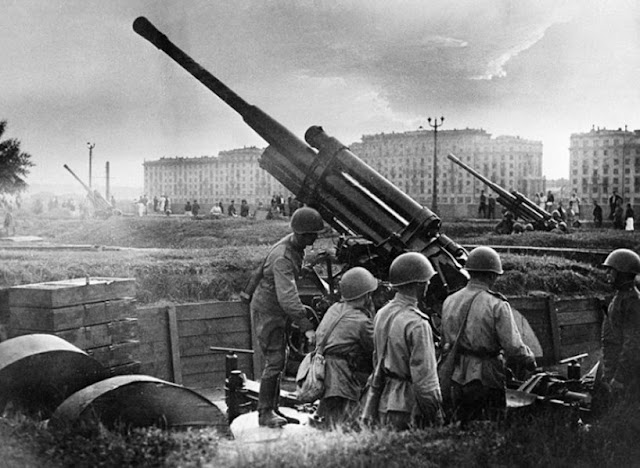
To mark the one-month anniversary of Operation BARBAROSSA, the Luftwaffe begins a “Moscow Blitz.” After dark, Heinkel He 111 pathfinders of KGr.100 and KGr.26 take off from an airfield near Smolensk to form the vanguard of a 127-plane force that drops 104 metric tons of bombs. The bombers come in successive waves that last a total of six hours. Anti-aircraft fire is heavy under the control of Soviet commander of Moscow air defense Major General M.S. Gromadin, so the bombs are scattered across the city. Some incendiaries land on the roof of the British Embassy but are put out quickly by embassy staff and the Moscow fire brigade. The Soviets apparently have been forewarned about the raid and thus are well-prepared. However, the Red Air Force barely makes an appearance, revealing the weakness of Soviet night-fighter defenses. Moscow had strong anti-aircraft defenses, the city was protected by 170 fighters, and the citizens were able to take shelter in the newly completed underground railway stations, but German air crews reported the presence of very few Soviet fighters after sunset. On the next day the Soviets would report the downing of 22 German bombers, but German records only showed 6 bombers failing to return.
In the Far North sector, Finnish VI Corps captures Salmi on the eastern shore of Lake Ladoga from Soviet 452nd Motorized Infantry Regiment. While not a particularly large town, it is an important landmark in the endless Karelian forests. The 1939 border is just beyond Salmi, and the Finns continue advancing forward toward the Svir River far to the southeast — but nobody knows what Mannerheim will do once the Finns reach the old border.
In the Army Group North sector, Hitler visits the army group headquarters and prepares to tour the front.
In the Army Group Center sector, General Guderian’s Panzer Group 2 has trapped a large force of Soviet soldiers at Mogilev. The 4th Panzer Division (Major General W. von Langermann) takes about 2,000 prisoners, but he doesn’t have enough infantry to capture the remaining 8-10,000 men, who escape.
The Soviets transferred additional troops from newly formed armies into the region around Smolensk, namely the 29th, 30th, 28th, and 24th Armies. These newly built formations would, immediately upon arrival, start a heavy counter-attack against the German forces around the Smolensk area from 21 July on. This put a heavy strain on the overextended Panzer forces, which had to cover a large area around the perimeter. However, poor coordination and logistics on the part of the Soviets allowed the Germans to successfully defend against these offensive efforts, while continuing to close the encirclement. The Soviet attacks would last until 30 July, when the Germans finally repelled the last of them.
In the Army Group South sector, the Germans take Vinnitsa (Vinnytsia) as several armies near forming a pocket around a huge Soviet troop concentration near Uman. Some 17,000 of the original Jewish population of Vinnitsa of 34,000 remain and persecutions begin virtually immediately. General von Kleist’s panzers bear in on Uman and Tarashche. XLVIII Panzer Corps (General der Panzertruppe Werner Kempf) takes Monastyrishche.
The Soviet command’s day communique reported a continuation of heavy action In the Polotsk-Nevel-Smolensk salient before Moscow and in the Novograd Volynski area fronting Kiev in the Ukraine. Unofficially, the Russians declared that Smolensk, the strategic city at the red center only 230 miles short of Moscow, still was in their hands, thus disputing last week’s German announcements that it had been captured.
Soviet Premier Joseph Stalin receives British Prime Minister Winston Churchill’s reply to his request for an immediate western front in Northwest Europe. Churchill promises to do “Anything sensible and effective that we can do to help.” However, he says that Great Britain is unable to invade at this time. Churchill says the RAF is “studying” sending some fighter squadrons to Murmansk.
The Stavka appoints Shaposhnikov as chief of staff of Western Front, under Semyon Timoshenko.
The Germans imprison Ukrainian nationalist leader Stefan Bandera.
Soviet submarine M-94 of the Baltic Fleet is sunk by U-140 near Ristna Lighthouse off Dago Island. U-140 (Oblt. Hans-Jürgen Hellriegel), a training boat, suddenly finds itself within sight of 206-ton Soviet submarine M-94. Off Ristna Lighthouse at Dago Island, U-140 sinks the submarine. There are 8 deaths and 11 survivors, who are picked up by Soviet submarine M-98. The incident is not purely by accident, as the U-boat command has ordered the U-boat far out into the Baltic in order to use the training mission as a quasi-patrol. This is U-140’s final victory of the war; it has sunk three ships totaling 13,204 tons and one submarine of 206 tons. It now returns to its training duties.
Finnish ships conduct minelaying operations.
The Majdanek Concentration Camp near Lublin, Poland became operational.
Romanian soldiers force all of the Jews in Ozarintsy into the town synagogue. After a few hours, they take 43 Jewish men into the Polish cemetery and execute them.
At the village of Felitsianovka near Vinnytsia, the Germans execute 21 Jews.
The Germans take 12 Jews in Chernevtsy near Vinnytsia to the machine and tractor station and execute them.
An SS unit enters Sudilkov and takes all of the town’s Jews from their homes to the ghetto of Shepetovka. From there, the Germans take some to the forest on the road to Klementovichi and execute them.
At Minsk, the Germans order 45 Jews to dig a pit and then get in it. They then order Russian prisoners to bury them alive. After the 30 Russians refuse, they are forced into the pit also and everyone in the pit is shot, then buried.
Free French leader Charles de Gaulle travels from his headquarters in western Africa to Cairo in order to meet with British Secretary of State for the Middle East Oliver Lyttelton. De Gaulle is completely out of sorts, sleep-deprived and furious at what he considers to be calculated slights against him personally and the Free French war effort. He hands Lyttelton a peremptory note:
“Free France, that is to say France, is no longer willing to entrust to the British military command the duty of exercising command over the French troops in the Middle East. General de Gaulle and the French Empire Defence Council are resuming full and entire disposal of all the French forces of the Levant as from 24 July 1941, at midday.”
Lyttelton rightly objects that this demand is an ultimatum that breaks the Anglo/Free French alliance. De Gaulle responds that the British can take it any way that they like. However, at dinner, after he has gotten some rest, de Gaulle settles for various concessions that salve his injured pride. These include recognition of France’s historic position within the Levant, use of Vichy French equipment (much of which is quite good), and the right to recruit Vichy French soldiers. General Dentz, who retains control over his Vichy troops, however, is not fond of de Gaulle and keeps defections to de Gaulle down to 6,000 men.
Operation SUBSTANCE, a well-defended convoy (Convoy GM.1), gets in high gear when a seven-ship convoy escorted by Force H and a large force borrowed from the British Home Fleet proceeds past Gibraltar directly towards Malta. The ships in the convoy do not know their (extremely dangerous) destination until destroyers shoot lines onto them bearing messages to their masters. The convoy gets off to a rocky start when troopship HMT Leinster runs aground while departing Gibraltar and must be left behind.
The Italian navy learns of Royal Navy activity in the western Mediterranean. However, the Regia Marina concludes that this is nothing but another case of a Royal Navy aircraft carrier launching planes to Malta and decides to keep its ships in port.
Greek submarine RHS Glaukos (Lt. Commander Zepos) uses its deck gun to sink 21-ton Italian freighter San Nicola four miles northwest of Rhodes.
The men of Royal Navy submarine HMS Taku engage in some derring-do by landing a small party in Benghazi Harbor. The commandos attach timed explosive charges to a ship and then escape safely.
Operation GUILLOTINE, a British troop movement from Egypt to Cyprus, continues. Royal Navy corvette HMS Peony departs Port Said with 1712-ton Dutch freighter Trajanus heading for Famagusta. Royal Navy sloop Flamingo departs Alexandria for Port Said in order to escort another transport, HMT Kevinbank, from there to Famagusta.
An Axis convoy departs Naples bound for Tripoli. It includes 5479-ton freighter Maddalena Odero, 6003-ton freighter Nicolo Odero, 6476-ton freighter Caffaro, and 8203-ton freighter Preussen. Royal Navy submarine Olympus spots the ships and attacks but misses.
At Malta, the Inspector General of the Royal Air Force, Sir Edgar Ludlow-Hewitt, visit the base at Kalafrana.
Hugh Dalton informed Winston Churchill that his Special Operations Executive was now ready to support covert operations in German-occupied Europe. To take advantage of the new “V for Victory” campaign launched over the BBC on the 19th, British Minister for Economic Warfare Hugh Dalton proposes instigating widespread revolts on the Continent. It is time, he writes, to “set in motion… schemes for full-scale revolution in Europe.” Dalton proposes using the Special Operations Executive for the task.
In fact, one area of occupied Europe already is in revolt. In Montenegro, partisan rebels have occupied a wide swathe of territory. General Cavallero, the Commander-in-Chief of the Italian Army Group in Albania, has ordered General Alessandro Pirzio Biroli to suppress the uprising “at whatever cost.”
The German raider Orion rounded Cape Horn and entered the Atlantic Ocean.
RAF Bomber Command, Day of 21 July 1941
13 Blenheims on coastal sweeps and shallow raids into France. No losses.
RAF Bomber Command, Night of 21/22 July 1941
Frankfurt
37 Wellingtons and 34 Hampdens on the first large raid against this target. No aircraft lost. Frankfurt does not record this as a significant raid, merely mentioning ‘bomb explosions’ in its records, but Darmstadt, 15 miles away, suffered 15 buildings hit and 16 people killed.
Mannheim
36 Wellingtons and 8 Halifaxes; the centre of the town as the aiming point. 1 Wellington lost. Mannheim reports only 4 high-explosive bombs — of which 1 was a dud — and 17 flares or incendiary bombs in the city and in nearby Ludwigshafen. 3 of the bombs fell in a Flak position but damage and casualties are not recorded.
Minor Operations: 6 Wellingtons to Cherbourg, 2 Hampdens minelaying in the Frisians, 1 O.T.U. sortie. No losses.
Oblt. Johannes Seifert of 3./JG 26 shoots down a Spitfire fighter southwest of Ypres and a Stirling bomber of RAF No. 15 Squadron over the English Channel.
U-140, commanded by Oberleutnant zur See Hans-Jürgen Hellriegel, sank the 161-ton Soviet submarine M-94 by torpedoes in the Baltic Sea in 58-51N, 22-00E. The survivors were rescued by M98 operating nearby off Hiiumaa Island, Estonia. At 0655 hours on 21 July 1941, M-94 (SrLt Nikolay V. D’yakov) was hit by one torpedo from U-140 and sank, while the U-boat attacked a second submarine at 0706 hours with another torpedo, but missed. The second submarine was M-98 which rescued the commander and two survivors with a rubber dingy shortly afterwards. They had been on the conning tower when the torpedo hit and thought that the men inside were dead, but the submarine sank in shallow waters lying on its stern at an angle of 60°. This made it possible for eight men to leave through the main hatch and were brought ashore by a launch.
U-109 (Kptlt. Heinrich Bleichrodt), on its second patrol, refuels from German supply ship “Thalia,” which is “interned” in the Spanish port of Cadiz. The Kriegsmarine actually has such tankers at three Spanish ports, which extend the range of U-boat missions and thus effectively increase the number of boats that can be kept on patrol.
Italian submarine Torelli sank Norwegian tanker Ida Knudsen (8913grt) in 34-34N, 13-14W. Five crewmen were missing on the tanker. Fourteen survivors were picked up by Portuguese trawler Altair (341grt) and landed at Las Palmas.
Destroyer HMS Ashanti was recommissioned on the Tyne after larger repairs. She was able to depart the Tyne for Scapa Flow until 30 August, but defects required she call at Rosyth en route. The destroyer finally arrived at Scapa Flow to work up on 7 September.
Minelaying cruiser HMS Adventure arrived at Scapa Flow, en route to Archangel.
Anti-aircraft ship HMS Palomares arrived at Scapa Flow at 1300 to carry out working up exercises.
German steamers Hans Christopherson (1599grt) was sunk on a mine off Terschelling.
Submarine HMS Thunderbolt, which had departed St Johns on the 8th, arrived at Gibraltar for duty in the Mediterranean.
Convoy OB.349 departed Liverpool, escorted by destroyers HMS Keppel and HMS Shikari, corvettes HMS Alisma, FS Alysse, HMS Dianella, HMS Freesia, and HMS Sunflower, and anti-submarine trawlers HMS Northern Dawn and HMS Wellard. Destroyer HMS Venomous joined on the 22nd. On the 26th, this group was detached. On the 26th, destroyers HMS Broadwater and HMCS St Laurent, armed merchant cruiser HMS Circassia, and corvettes HMCS Rimouski and HMCS Spikenard joined. The convoy was dispersed on 1 August. This was the last of the OB. series. Beginning on the 26th, the ON. convoy series began with ON.1 departing Liverpool.
Canadian troop convoy TC.12 departed Halifax with liners Duchess of York (20,021grt), Empress of Canada (21,517grt), Orion (23,371grt), Strathmore (23,428grt), and Strathnaver (22,283grt). Destroyers HMCS Assiniboine and HMS Buxton were escorting from convoy from 21 to 23 July. Destroyers HMS Havelock, HMS Hesperus, HMS Columbia, and HMCS Restigouche escorted the convoy from 21 to 26 July. Battleship HMS Malaya escorted the convoy from 21 to 27 July. Destroyers HMS Harvester and HMS Ripley escorted the convoy from 23 to 26 July. Destroyer HMS Gurkha, HMS Lance, HMS Legion, ORP Piorun, HMS Salisbury, HMS Vanquisher, and HMS Winchelsea escorted the convoy from 26 to 29 July. Destroyers HMS Croome, HMS Heythrop, and HNLMS Isaac Sweers departed Scapa Flow at 0600 on the 27th and were with the convoy on the 27th. The destroyers took battleship Malaya to Scapa Flow, where they arrived at noon on the 28th. Anti-aircraft cruiser HMS Cairo escorted the convoy from 27 to 29 July. The convoy safely arrived on the 29th.
The Operation SUBSTANCE convoy (convoy GM.1) for Malta of steamers Sydney Star, City of Pretoria, Port Chalmers, Deucalion, Durham, and Melbourne Star, escorted by battleship HMS Nelson, light cruiser HMS Edinburgh, cruiser minelayer HMS Manxman, and destroyers HMAS Nestor, HMS Lightning, HMS Farndale, HMS Avon Vale, and HMS Eridge passed Gibraltar in the Mediterranean at 0145. Light cruisers HMS Manchester and HMS Arethusa, troopship Leinster, and destroyers HMS Cossack, HMS Sikh, and HMS Maori departed Gibraltar at 0200. Troopship Leinster ran aground departing Gibraltar and was left behind. Fleet oiler RFA Brown Ranger, escorted by destroyer HMS Beverley, proceeded at 0200 to sea to refuel destroyers during the operation. The two arrived back at Gibraltar on the 23rd. They sailed again on the 25th on the same mission, but were recalled later that day. At 0300, battlecruiser HMS Renown, aircraft carrier HMS Ark Royal, light cruiser HMS Hermione, destroyers HMS Faulknor, HMS Fearless, HMS Firedrake, HMS Forester, HMS Foxhound, HMS Foresight, HMS Fury, and HMS Duncan departed Gibraltar. Battleship Nelson and light cruisers Arethusa, Edinburgh, and Manchester were on temporary loan from the Home Fleet. Eight British and Dutch submarines were at sea to intercept the Italian Fleet should it attempt to intervene with the passage of the convoy. Submarines HMS Olympus in the Tyrrhenian Sea and HMS P.32 off Cagliari and Dutch submarine HNLMS O.21 in the Tyrrhenian Sea operated from Gibraltar and HMS Unique off southern entrance to the Straits of Messina, HMS Upholder north of Marittimo, HMS Upright off southern approaches to the Straits of Messina, HMS Urge off Palermo, and HMS Utmost north of Messina operated from Malta.
On the 22nd, the Mediterranean Fleet sortied from Alexandria at 2100. Battleships HMS Queen Elizabeth and HMS Valiant, light cruisers HMS Naiad, HMS Phoebe, HMS Neptune, and HMAS Hobart, minelaying cruisers HMS Abdiel and HMS Latona, and destroyers HMS Jackal, HMAS Nizam, HMS Kipling, HMS Kimberley, HMS Griffin, HMS Hasty, and HMS Havock operated to the west of Crete. Light cruisers HMS Ajax and HMS Leander with destroyers HMS Jervis, HMS Jaguar, HMS Kandahar, and HMS Kingston departed Haifa and rendezvoused with the Main Fleet off Alexandria at 0600 on the 23rd. Anti-aircraft ship HMS Carlisle joined the Fleet at daylight on the 23rd. At dark on the 23rd, the Fleet turned backed eastward and light cruiser Neptune, minelaying cruiser Abdiel, and destroyer Kimberley were detached on serial S.4 of the GUILLOTINE operation. They departed Port Said on the 24th. The troops were delivered on the 24th and the ships arrived back at Port Said on the 25th. On the 24th, light cruiser Leander and destroyer Jaguar departed the Fleet for Port Said where they arrived on the 25th. The Main Body of the Mediterranean Fleet arrived back at Alexandria on the 25th. Light cruiser Leander and destroyer Jaguar embarked troops for Famagusta and departed on the 25th on Serial S.6 with minelaying cruiser Latona, arriving during the night of 25/26 July. Minelaying cruiser Latona was damaged in a collision with destroyer Jaguar while berthing at Famagusta, but was able to depart with the destroyer on the 26th for Haifa. Light cruiser Leander arrived at Alexandria on the 26th. Light cruiser Neptune, minelaying cruiser Abdiel, and destroyer Kimberley departed Port Said for Famagusta on serial S.7 of the GUILLOTINE operation on the 26th. The troops were landed during the night of 26/27 July. On completion, the ships proceeded to Haifa.
Submarines HMS Regent and HMS Perseus on the 24th created the impression by means of radio signals that the battleships were still at sea and that the SUBSTANCE convoy was a through convoy. Italian submarine Diaspro attacked the SUBSTANCE convoy and narrowly missed Australian destroyer HMAS Nestor, escorting aircraft carrier HMS Ark Royal, in 38-10N, 5-30E near Bougie. In air attacks, light cruiser HMS Manchester was struck by an aerial torpedo. Paymaster Cdr W. D. Stranack, A/Paymaster Sub Lt C. D. Ballard, Paymaster Midshipman J. D. Pooley, and twenty three ratings were lost in the cruiser. P/T/Surgeon T. McG. Watt RNVR, was wounded. The cruiser returned to Gibraltar, escorted by destroyer HMS Avon Vale, with three out of four engines inoperative. Before arriving at Gibraltar, destroyers HMS Vidette and HMS Vimy joined the screen. Destroyer HMS Wishart later sailed and relieved destroyer Avon Vale. Tug St Day departed Gibraltar to assist. They arrived at Gibraltar shortly before midnight on the 25th. Motor launches ML.130, ML.126, ML.168, ML.121, and ML.129 departed Gibraltar to sweep ahead of the cruiser and provide additional escort. Later, tugs Rollicker and St Omar with ML 173, and ML.169 departed to join the cruiser. Cruiser Manchester, after temporary repairs at Gibraltar, sailed on 17 September for the Philadelphia Navy Yard where she was under repair from 23 September to 15 February 1942.
Destroyer HMS Fearless was torpedoed by an aerial torpedo north of Bone and was later scuttled by destroyer HMS Forester in 37-40N, 8-20E. The destroyer had Lt R. A. Nares, RCNVR, and seventeen ratings missing and twenty injured crew, of which nine died of wounds. Destroyer HMS Firedrake was damaged by bombing on the 23rd and was under tow for thirty seven hours back to Gibraltar by destroyer HMS Eridge and escorted by destroyer HMS Avon Vale, which was sent back to join after being relieved from the cruiser HMS Manchester escort. Destroyer HMS Sikh joined en route. Destroyer Firedrake arrived at Gibraltar, under her own power at the end, on the 27th, escorted by destroyers Avon Vale and Eridge. The destroyer was under repair for six months, including four months at Boston Navy Yard from 23 September to 18 January 1942.
Destroyer HMS Foxhound was damaged by a near miss of bombing on the 23rd, but spent no time out of action. On the 24th, Italian motor torpedo boats MAS.532 and MAS.533 attacked the SUBSTANCE convoy. These boats were undamaged, despite claims by light cruisers HMS Edinburgh, destroyer HMS Cossack, and minelayer HMS Manxman that they each sank an MAS. boat. MAS.533 torpedoed steamer Sydney Star. The steamer fell out of the convoy and destroyer HMAS Nestor and later light cruiser HMS Hermione were detailed to protect the steamer and escort it to Malta, without further incident, arriving on the 24th. The steamer was drydocked at Malta on 18 August. Light cruisers Edinburgh and HMS Arethusa, cruiser minelayer Manxman, and destroyers Cossack, HMS Maori, HMS Sikh, HMAS Nestor, and HMS Farndale escorted the convoy into Malta on the 24th. The remainder of Force H returned to Gibraltar.
Convoy MG.1 of steamers Settler, Thermoplylae, Amerika, Talabot, Hoegh Hood, Svennor, and supply ship Breconshire with destroyer HMS Encounter was brought out from Malta, departing at 0500 on the 23rd. Steamer Svennor hit the breakwater leaving harbor and had to be docked. She was able to depart the next day. Corvette HMS Gloxinia assisted in the escort of the convoy during the first day, then returned to Malta. Destroyer HMS Farndale had to remain at Malta with condenser problems. Tanker Hoegh Hood (9351grt) was damaged by bombing on the 24th, but was able to continue. P/T/Sub Lt (A) K. G. Grant RNVR, and his gunner Leading Airman H. McLeod in a Fulmar of 807 Squadron and Lt A. J. Kindersley and his gunner Petty Officer (A) F. A. Barnes in a Fulmar of 808 Squadron were lost on the 25th when they were shot down 120 miles SW of Sardinia. T/A/Sub Lt (A) R. C. Cockburn RNVR, and Petty Officer Airman W. /E. Cuttriss of 808 Squadron were also shot down but picked up by destroyer HMAS Nestor. Supply ship Breconshire and steamer Talabot, escorted by destroyer Encounter arrived at Gibraltar on the 26th. Destroyer Forester with steamers Amerika and Thermopylae arrived later in the day. Steamer Settler and Hoegh Hood arrived at Gibraltar on the 27th and Norwegian tanker Svennor arrived on the 28th. Force H and the supporting cruisers arrived back at Gibraltar on the 27th.
On 13 September, light cruiser HMS Manchester and destroyer HMS Firedrake in company departed Gibraltar for repairs in the United States, via England. They were escorted by destroyer HMS Heythrop as far as 25W. The Italian Fleet did not sail. Battleships Littorio, Veneto, and Duilo at Taranto, heavy cruisers Trieste, Bolzano, and Gorizia at Messina, and light cruisers Garibaldi, Montecuccoli, Di Giussano, and Da Barbiano at Palermo were brought to notice, but the intention of the British forces was discovered too late.
Destroyer HMS Ilex, after temporary repairs at Port Said, passed through the Suez Canal for repairs at Durban. The destroyer arrived at Aden on the 24th. She remained there until 15 September when she departed for Durban. Engine problems required further temporary repairs at Mombasa and the destroyer did not arrive at Durban until November.
Corvette HMS Peony departed Port Said with Dutch steamer Trajanus (1712grt) in Operation GUILLOTINE. This movement, S.2C, of the Operation arrived at Famagusta on the 23rd.
Sloop HMS Flamingo departed Alexandria for Port Said for a GUILLOTINE escort in serial S.3. The sloop departed Port Said on the 22nd escorting motor transport ship Kevinbank for Famagusta, arriving on the 24th.
Submarine HMS Parthian departed Alexandria for Malta and the United Kingdom for refitting.
A German-Italian convoy of steamers Maddalena Odero (5479grt), Nicolo Odero (6003grt), Caffaro (6476grt), and Preussen (8203grt) departed Naples for Tripoli escorted by destroyers Folgore, Euro, Saetta, and Fulmine. The convoy was later joined by destroyers Alpino and Fucliere. On the 22nd, German steamer Preussen was sunk by Swordfish of 830 Squadron 30 miles SE of Pantelleria. Torpedo boat Pallade joined the convoy from Tripoli. Italian tanker Brarena (6996grt) departed Palermo on the 21st, escorted by destroyer Fucliere, to join the convoy. The tanker was sunk on the 22nd by Swordfish of 830 Squadron. Destroyer Folgore from another convoy assisted Fucliere.
Submarine HMS Taku sent a landing party into Benghazi harbor and attached explosive charges to one of the ships in harbor.
Submarine HMS Olympus unsuccessfully attacked a convoy of two steamers and one escort off Naples.
Greek submarine RHS Glaukos sank Italian steamer San Nicola (21grt)(?) NW of Rhodes with gunfire.
In Washington today, President Roosevelt sent a message to Congress asking that it authorize the continued service in the Army of selectees, National Guardsmen and Reserve officers. He nominated Guy Mason to the Board of Commissioners of the District of Columbia, and Thomas Wilson to be U. S. Commissioner to India.
The Senate passed the property requisitioning bill, approved the conference report on the oil pipeline construction bill, received a resolution for Congressional declaration of a national emergency, and recessed at 4:50 PM until noon tomorrow.
The House adopted the bill authorizing a $287,000,000 defense highway construction program, passed the bill revising excess wheat marketing quotas and adjourned at 5:05 PM until noon tomorrow. The Ways and Means Committee approved the tax bill provision requiring joint returns by husband and wife.
U.S. President Franklin D. Roosevelt asked Congress to declare a full or limited national emergency as a means of retaining more members of reserve components of the U.S. Armed Forces, including the National Guard. Roosevelt asked the U.S. Congress to extend the draft period from one year to 30 months and to make similar increases in the terms of service for the National Guard.
Before a demonstrative audience which repeatedly had to be warned to keep quiet or get out of the galleries, the Senate today greeted President Roosevelt’s message with a stormy debate which produced three alternative plans for extending the service of men in the armed forces. The first plan, introduced by Senator A. B. Chandler, Democrat, of Kentucky, followed the Administration line of asking Congress to empower the President to extend the service of the men by declaring that the national safety is imperiled. The second, by Senator Burton K. Wheeler, Democrat, of Montana, proposed that selectees and National Guardsmen be allowed to volunteer to remain in service. The third, backed by Senator Robert A. Taft, Republican, of Ohio, recommended a limited extension to give the Administration time to work out a plan of rotating the present selectees with new classes. The debate was started by Senator Chandler, who interrupted his discussion of the Draft Property Bill to tell the Senate that his young sons had more liberty in the movement of their tin soldiers than General George C. Marshall, the Army Chief of Staff, had in the movement of the men who were charged with defending the Western hemisphere.
Legislation granting the president powers to requisition private property “to promote the national defense and to overcome shortages” was approved by the senate after a stormy session today. The proposal, passed on a voice vote and sent to the house, would authorize the chief executive to draft military and naval materials, machinery, tools or materials necessary for the manufacture of such articles. The president could requisition private property only in the event of “immediate and impending” need in the defense program and then could invoke the draft powers only after having exhausted all other efforts to obtain the necessary equipment. Compensation for the seized articles would be fixed by the president on a “just and fair” basis, and owners would be permitted to buy them back at the end of the defense needs.
Brushing aside protests that it was penalizing marriage, the House Ways and Means Committee voted today to stand pat on an earlier decision to require married couples to file joint income tax returns. In nine states which have community property tax laws, couples are permitted to file separate income tax returns and, in many cases, they thus reduce their federal income taxation. The committee voted several weeks ago to plug that loophole, and estimated that about $300,000,000 additional revenue would be raised thereby.
Alabama and Tennessee official clocks were moved forward an hour today to bring those States under central daylight saving time by proclamation of their Governors. Mississippi clocks will be advanced an hour on July 31 and those in North and South Carolina on Aug. 1. to bring those States under daylight saving time to aid national defense, as President Roosevelt requested.
P. D. Houston, Nashville, Tennessee, president of the American Bankers association, asserted after a White House call today that in his opinion some inflation was inevitable. Houston hoped, however, there would be “no wild orgy of spending as in the recent past” on the part of the public.
The United States begins a national aluminum salvage drive. In response to the call for aluminum scrap, pots and pans and percolators poured forth in such quantities from the kitchens of America today that Washington officials in charge of the campaign predicted the 20,000,000-pound quota would be topped.
Eleanor Roosevelt writes in her “My Day” column about National Youth Administration leader Aubrey Wills Williams and the dedication of a new National Youth Administration training center that she attended a few days ago. Williams champions civil rights for African-Americans and uses his NYA position to provide vocational training and educational opportunities for disadvantaged youth.
Major League Baseball:
It was getaway day at Ebbets Field yesterday and it probably was just as well. The loyal Flatbush fans couldn’t take much more of the brand of ball their favorites played as they lost to Lefty Ken Heintzelman and the Pirates, 8–3. Stranding eight runners, five in scoring position, the Dodgers were hardly a match for Frankie Frisch’s Corsairs, who, opposed by Newell Kimball, Vito Tamulis, Mace Brown and Kemp Wicker, got eleven blows, including homers by Elbie Fletcher and Vince DiMaggio and a triple by Arky Vaughan. The losers reached Heintzelman for ten blows, a few of which were lucky, but when hits would have meant runs the Dodger bats suddenly became silent.
Pittsburgh Pirates 8, Brooklyn Dodgers 3
Sumner Welles, Acting Secretary of State, announced today that the United States had assured Bolivia of full assistance if her ousting of Ernst Wendler, the German Minister, resulted in an international incident, and had informed the La Paz Government that the Minister would not be permitted to come to this country.
Thomas M. Wilson of Tennessee, veteran, Foreign Service officer and at present Consul General at Calcutta, was nominated by President Roosevelt today to be United States Commissioner to India, with the rank of Minister.
Administration officials said today that the United States was seeking to make peace between Generalissimo Chiang Kai-shek and Chinese Communist forces, so as to prevent American aid to China from being used in a civil war. These officials said civil peace was one of the major missions of Owen Lattimore, who arrived in Chungking from America last week to act as political adviser to General Chiang. Mr. Lattimore, who has great prestige in the Orient, was hired by the Chungking Government on the recommendation of President Roosevelt, who conferred with him before he left. Officials here are apprehensive that the clashes between General Chiang’s Kuomintang coalition and the Communists will lead to a serious disintegration of Chinese resistance to the Japanese. Mr. Lattimore’s first task, it was reported, will .e to seek a formula which will guarantee that neither faction will use arms against the other.
The Vichy government gave the Japanese permission to occupy military bases in French Indochina. This is the Red Line which makes war in the Pacific inevitable. Vice-Premier Darlan accepts the Japanese request for basing rights in French Indochina. He comments that France has no choice in the matter, and plaintively asks the Japanese to recognize French sovereignty and to not molest French troops or evict them from their posts.
This confirms Japanese military dominance in Southeast Asia, with only the British bases in Singapore and Hong Kong, the Dutch in the East Indies, and the Americans in the Philippines and Guam to dispute it. The tentative protocol as drafted by the French provides that the use of facilities by the Japanese could not, under any circumstances, have the character of military occupation. Japanese forces are not to exceed 25,000 men.
Having reported his assumption of the Premiership for the third time to the Imperial Ancestors at the grand shrines of Ise, Prince Fumimaro Konoe returned to Tokyo last night. He is now scheduled to clarify the policies of his new Cabinet in an interview and a radio speech tomorrow.
Hiroaki Abe was transferred out of Japanese Navy Destroyer Squadron 6.
The Royal Australian Navy establishes the Naval Auxiliary Patrol. It uses peacetime pleasure cruisers that become known as “nappies.”
Australian troops (Robin Force) arrive at New Caledonia with 3rd Independent Company and two six-inch guns.
Dow Jones Industrial Average: 129.51 (+1.53)
Born:
Jim Bates, American politician (Rep-D-California, 1983-1991), first to be censured for sexual harassment, in Denver, Colorado.
Ken Cory, American actor (“The Candidate”; “Without A Trace”), in Hanover, Pennsylvania (d. 1993).
Gary Waslewski, MLB pitcher (Boston Red Sox, St. Louis Cardinals, Montreal Expos, New York Yankees, Oakland A’s), in Meriden, Connecticut.
Nelson Mathews, MLB outfielder (Chicago Cubs, Kansas City A’s), in Columbia, Illinois.
Doreen Porter (later Doreen Porter-Shann), New Zealand sprinter (Olympics, 1964) and artist, in Auckland, New Zealand.
Naval Construction:
The Royal Navy Isles-class minesweeping trawler HMS Coll (T 207) is laid down by the Ardrossan Dockyard (Ardrossan, Scotland); completed by Plenty.
The Royal Navy Algerine-class (Turbine-engined) minesweepers HMS Circe (J 214) and HMS Cadmus (J 230) are laid down by Harland & Wolff Ltd. (Belfast, Northern Ireland).
The U.S. Navy Auk-class minesweepers USS Token (AM-126), USS Tumult (AM-127), and USS Velocity (AM-128) are laid down by the Gulf Shipbuilding Corp. (Chickasaw, Alabama, U.S.A.).
The U.S. Navy Gato-class submarine USS Gunnel (SS-253) is laid down by the Electric Boat Co. (Groton, Connecticut, U.S.A.).
The U.S. Navy Fletcher-class destroyers USS Evans (DD-552) and USS John D. Henley (DD-553) are laid down by the Gulf Shipbuilding Corp. (Chickasaw, Alabama, U.S.A.).
The Royal Navy Bangor-class (VTE Reciprocating-engined) minesweeper HMS Guysborough (J 52) is launched by the North Vancouver Ship Repairs Ltd. (Vancouver, British Columbia, Canada). She is transferred to the Royal Canadian Navy on completion and commissions as HMCS Guysborough (J 52).
The U.S. Navy SC-497-class (110-foot wooden hull) submarine chaser PC-498 (later SC-498) is launched by the Westergard Boat Works Inc. (Rockport, Texas, U.S.A.).
Les Forces Navales Françaises Libres (Free French Naval Forces) Fairmile B-class motor launch St. Ives is commissioned.
The Royal Navy harbor defence motor launch HMS HDML 1050 is commissioned.
The Royal Navy White 73-foot-class motor torpedo boat HMS MTB 48 is commissioned.
The U.S. Navy 77-foot Elco patrol motor torpedo boat USS PT-39 is commissioned.

