Adolf Hitler, who by and large allowed his generals to run matter during the victorious campaigns in western Europe, is taking an increasing interest in daily troop operations on 19 July 1941. This process is still just beginning, but already commanders such as OKH operations boss General Franz Halder are growing weary of orders that they consider to be amateurish. However, at this stage, many of Hitler’s orders contribute to successful operations.
In the Far North sector, Finnish Group F (part of 3rd Division) completes a successful 64 km (40 miles) advance over rugged terrain by wiping out several Soviet units on the Vyonitsa River. It now can continue advancing toward its objective of Ukhta (aka Kalevala, on Yeldanka Lake aka Ozero Verkhnyaya Yeldanka). General Dietl’s Army of Norway (AOK Norwegen) now decides to shift troops (units of SS Nord Division) south from the stalled offensive near Salla and have them support the Finnish advance. The Soviets also decide to send reinforcements to the area.
In the Army Group North sector, the panzers of Panzer Group 4 continue blasting through Soviet lines towards Leningrad. The Luftwaffe attacks rail lines in an attempt to isolate Leningrad from Moscow. The Germans are continuing their thrust towards Leningrad in the face of increasing Russian resistance. There was heavy fighting yesterday near Lake Peipus where the German infantry has still not been able to break through in support of its advance tank units. A Soviet communique claims that Red Army troops surrounded and destroyed enemy mechanized units between Pskov and Porkov, 180 miles south-west of Leningrad.
Leningrad is now under attack from three directions: the Finns are approaching from the north and north-east, on both sides of Lake Ladoga, while the Germans are attacking through Estonia and the Luftwaffe are mounting heavy raids on the city and the rail link with Moscow.
In the Army Group Center sector, Hitler orders General Guderian’s Panzer Group 2 south. Hitler wants to ensure the brewing victory at Kiev, where hundreds of thousands of Soviet troops appear vulnerable to being surrounded, and open the way forward to Field Marshal Rundstedt’s army group. General Guderian, reflecting a broad consensus within the upper levels of the Wehrmacht, protests that it makes more sense to continue east towards Moscow. OKW confirms Hitler’s order and Guderian grudgingly heads south. Hitler also orders General Hoth’s Panzer Group 3 to head north to help with the attack on Leningrad (it captures Velikiye Luki during the day). This leaves Field Marshal von Bock’s Army Group Center without its spearhead. Hitler never has considered Moscow to be a priority target and this decision conclusively proves that.
In the Army Group South sector, Soviet General Eremenko takes over at Soviet Western Front.
Joseph Stalin demoted Semyon Timoshenko as People’s Commissar for Defense of the Soviet Union and assumed command himself. Joseph Stalin declared himself the Soviet Defense Commissar (NKO).
Viktor Abakumov officially assumed the role as the head of UOO of the Soviet NKVD. The UOO (Управление Особых Отделов, or Directorate of Special Departments) was the central military counterintelligence agency of the Soviet Union from 1941 to 1943. Formed by the NKVD in July 1941, its primary mission was to prevent espionage, treason, and mass desertion among retreating Red Army troops during World War II. The agency was notorious for enforcing discipline through intimidation, terror, and the use of barrier troops (blocking detachments) to shoot soldiers attempting to retreat. In April 1943, the UOO was transformed into the legendary counterintelligence organization known as SMERSH (СМЕРШ, an acronym for “Death to Spies”) and transferred back to the Defense and Navy Commissariats.
General Olof Thörnell, commander of Swedish forces, suggested that for political and strategic reasons that Sweden contribute to the defeat of the Soviet Union against Finland.
Winston Churchill decided to share military intelligence gained by deciphering the German Enigma-encoded messages with the Soviets, but the Soviets would not be told how the intelligence was gained; instead, they were told that the intelligence was gained through a spies in Berlin.
Soviet destroyers Serdity and Steregushchi attempt to intercept a German convoy off Daugavgrīva (German: Dünamünde; Polish: Dynemunt; Russian: Усть-Двинск or Ust`-Dvinsk). They fail to make contact, but the Luftwaffe spots them and attacks. The German planes badly damage Serdity, which its crew scuttles on the 22nd.
Soviet submarine L-3 torpedoes and sinks Finnish vessel Cisil.
Adolf Hitler ordered that American shipping were not to be attacked by German forces in order to keep the United States from fully entering the war.
Hitler’s decision to send Guderian south led to victory in the Battle of Kiev on September 25th which destroyed the Soviet southwestern front. 665,000 Soviet soldiers were taken prisoner, 884 tanks and 3,018 artillery pieces were taken. Rundstedt was now able to move into the Ukraine, the Crimea and the Donets Basin with additional major losses in men and material for the Soviets. Hitler and the German military leaders felt that now the move on Moscow could be made despite the late start on October 2nd. They expected to seize Moscow and deliver the knockout blow to the Soviet Union before the winter weather set in.
Their expectations would not be met.
Hitler issues Führer Directive 33:
The Führer And Supreme Commander Of The Armed Forces.
The Führer’s Headquarters, 19th July, 1941.
13 copies
Directive No. 33 — Continuation of the War in the East
- The second series of battles in the East has ended, along the whole front, with the breach of the Stalin Line and the deep thrust of the armored forces. In the area of Army Group Centre, mopping up of the strong enemy forces which still remain between the motorized formations will still require considerable time.
The northern flank of Army Group South is restricted in its freedom of movement and effectiveness by the fortress of Kiev and the Russian 5th Army in its rear.
- The aim of the next operations must be to prevent any further sizeable enemy forces from withdrawing into the depths of Russia, and to wipe them out.
Plans will be made for this as follows:
(a) Southeastern Front:
The most important object is, by concentric attacks, to destroy the enemy 12th and 6th Armies while they are still west of the Dnieper River. The main Romanian forces will support these operations in the south.
The enemy 5th Army can also be quickly and decisively defeated and annihilated by cooperation between forces on the south flank of Army Group Centre and the northern flank of Army Group South.
While Infantry Divisions of Army Group Centre move southward, other forces, chiefly motorized, after carrying out the tasks assigned to them, securing their lines of communication, and providing cover in the direction of Moscow, will advance southeastwards in order to cut off the withdrawal of enemy forces which have crossed to the further bank of the Dnieper River, to prevent their withdrawal deeper into Russia, and to destroy them.
(b) Central Part Of The Eastern Front:
After the destruction of the many pockets of enemy troops which have been surrounded and the establishment of lines of communication, Army Group Centre, while continuing to advance to Moscow with infantry formations, will use these motorized units which are not employed in the rear of the Dnieper River line to cut communications between Moscow and Leningrad, and so cover the right flank of the advance on Leningrad by Army Group North.
(c) Northern Part Of The Eastern Front:
The advance on Leningrad will be resumed only when 18th Army has made contact with 4th Armored Group and the extensive flank in the east is adequately protected by 16th Army. At the same time Army Group North must endeavor to prevent Russian forces still in action in Estonia from withdrawing to Leningrad.
Early capture of the Baltic Islands, which might be used as bases by the Soviet Navy, is desirable.
(d) Finnish Front:
It remains the task of the main Finnish forces, reinforced by most of 163rd Division, to attack the enemy opposing them, with the main weight of attack east of Lake Ladoga and, later, in conjunction with Army Group North, to destroy them.
The object of the attack under the direction of XXXVI Corps and the Mountain Corps remains as already directed, except that stronger support from the air cannot be expected for the moment and operations may therefore have to be temporarily delayed.
- The task of the Airforce is, in particular, as forces become available from the Central Front, to support operations on the Southeastern Front at their most important point by bringing air and antiaircraft units into action, and, if necessary, by early reinforcement or regrouping.
The attack on Moscow by the bomber forces Of 2nd Air Fleet, temporarily reinforced by bomber forces from the west, will be carried out as soon as possible as reprisal for Russian attacks on Bucharest and Helsinki.
- The Navy will continue to ensure the free passage of seaborne traffic, especially of supplies for the land forces, as far as enemy activity at sea and in the air allows. Further, with the increasing threat to enemy bases, appropriate steps are to be taken to prevent the escape of enemy ships to Swedish ports, where they would be interned.
As naval forces in the Baltic Sea become free, motor torpedo boats and minesweepers — one flotilla of each to start with — will be transferred to the Mediterranean.
To support German operations in Finland, which might be hampered by the arrival of enemy reinforcements by sea, a few submarines will be transferred to the Arctic Ocean.
- All three branches of the Armed Forces in the west and north will bear in mind the possibility of British attacks on the Channel Islands and the Norwegian coast. Plans must be made for the quick transfer of air forces from the west to all parts of Norway.
[Signed] Adolf Hitler.
In small groups, 5,000 Jews have been shot dead, hundreds daily for the past couple of weeks, and thrown into pits at Ponar, outside Vilna.
Einsatzcommando 3 of Einsatzgruppe A execute 27 people at Kaunas Seventh Fort: 17 Jewish men, 2 Jewish women, and 7 non-Jews.
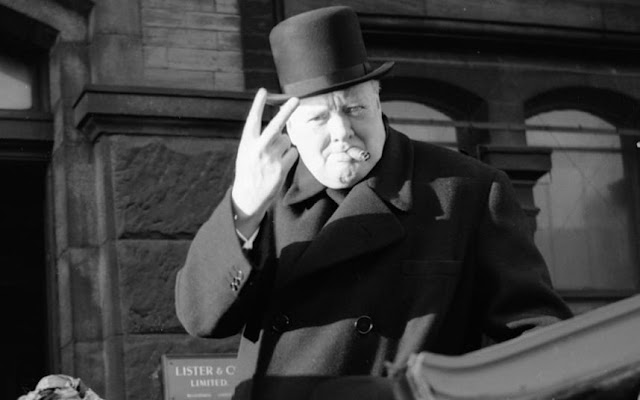
A “Colonel Britton” broadcasts at midnight to the peoples of Occupied Europe. This broadcast begins the “V for Victory” propaganda campaign that is one of the most successful propaganda efforts ever:
“Events are taking place that are of great significance in this war. The importance of these events will probably not be realized for a long time, and, in fact, the events themselves are not likely to be noticed. But it’s in connection with them that I asked you a week ago to start a “V” campaign — V’s in sight and sound — which would work up to a climax tomorrow, July 20. Now I want to tell you what should be your contribution to making July 20 one of the milestones in the war.
“July 20 is the date of Europe’s mobilization against the Germans. Tomorrow the V Army — Europe’s invisible army of many millions — will come into being. You’re listening to me now in your home. Thousands and thousands of others are listening too.
“The mobilization will begin at midnight 24 hours from now, and it will continue throughout the day. You are eligible to join the V Army, and I ask you to join.”
He concludes that “In a few minutes there will be millions of new ‘Vs’ on walls and doors and pavements all over Europe.”
Colonel Britton is the pseudonym of Douglas Ritchie, a 36-year-old Assistant News Editor at the BBC. The BBC has foreshadowed this campaign by prefacing its programs with the Morse Code for “V” (…- — -) for some time. To give proper credit, the instigator for the “V” campaign was a Belgian refugee named Victor de Laveleye, who made short-wave broadcasts from London to his native Belgium in early 1941 asking Belgians to chalk the letter V (for victoire) in public places as a sign of confidence in eventual Allied victory. Ritchie’s broadcasts expand the idea to all of Occupied Europe.
Operation SUBSTANCE, a supply convoy to Malta, effectively begins when Royal Navy submarine HMS Upholder departs Malta. The ships of Convoy WS 9C (Winston Special), which left the British Isles on 13 July, are still at sea approaching Gibraltar. The Royal Navy begins feigning an operation in the eastern Mediterranean by engaging in heavy radio traffic in that area. The Royal Navy intends to deploy eight submarines off Italian naval bases to attack any Italian ships that leave port to intercept the convoy, one of which is Upholder. The Substance operation is bringing everything from ammunition and vehicles to mail and food, and its success is critical to Malta’s ability to hold out.
Germany and Switzerland sign a new trade agreement. Trade relations with neutral countries such as Switzerland and Turkey are a key way that the Reich attempts to circumvent the Allied blockade.
The uprising in Montenegro that began on 13 July continues. The partisans remain on the offensive and are planning to take over several more Montenegran towns.
Minelaying cruiser Abdiel and destroyer HMS Decoy make the increasingly hazardous nightly run to Tobruk from Alexandria without incident.
Captured (by German armed merchant cruiser Atlantis on 10 Nov 1940) Norwegian tanker Ole Jacob arrived at Bordeaux, France, carrying aviation fuel and the captured crew of tanks Ole Jacob and Teddy.
Submarine HMS Umpire collided with a trawler off Kent, England, United Kingdom during her sea trials, sinking in 60 feet of water; 22 men were lost.
Attacked and badly damaged by the Luftwaffe on 1 July 1941 off the coast of Spain, Royal Navy armed boarding vessel HMS Malvernian is finally sunk by the Royal Navy as a hazard to navigation. Its crew, however, is still at sea — one lifeboat with 32 aboard only makes it to Corunna on 21 July, and another with 25 aboard to Vigo on 22 July. 107 other survivors have been taken POW.
German submarine U-66 sank transport Holmside northeast of Cape Verde islands at 1042 hours; 21 were killed, 16 survived.
Italo Gariboldi stepped down as the Governor-General of Italian Libya, succeeded by Ettore Bastico.
RAF Bomber Command, Day of 19 July 1941
21 Blenheims on coastal sweeps from Belgium to the Frisians. 11 British Blenheim bombers attacked an 8-ship German convoy escorted by 6 anti-aircraft ships off the Hague, Netherlands, sinking four of the transports and damaging another. 2 aircraft lost. 3 Stirlings on an escorted Circus raid to Lille power-station; 1 Stirling lost.
RAF Bomber Command, Night of 19/20 July 1941
Hannover
49 aircraft — 20 Whitleys, 17 Wellingtons, 12 Hampdens — with the main railway station as aiming point. 1 ‘Wellington and 1 Whitley lost.
35 Hampdens on minelaying operation in mouths of the Elbe and Weser rivers. No losses.
Oberst Werner Mölders of JG 51, the top ace in the war and of all-time at this point, is appointed to the newly created position of General der Jägdflieger (General of Fighters). Oblt. Friedrich Beckh replaces him in charge of JG 51.
Luftwaffe Lieutenant Walter Nowotny of III./JG 54 shoots down his first enemy planes, three Polikarpov I-153 biplanes. His own aircraft is damaged and he bails out over the Gulf of Riga.
Luftwaffe losses are mounting. Total planes lost now stand at 1,284.
During the night, the Luftwaffe raids Alexandria and Malta while the RAF raids Tripoli and Benghazi.
U-66, commanded by Korvettenkapitän Richard Zapp, sank British steamer Holmside (3433grt) at 19N, 21-30W. At 1042 hours on 19 July 1941 the Holmside (Master Norman Caulfield), dispersed from convoy OG.67, was hit by three torpedoes from U-66 and sank within 15 minutes northeast of the Cape Verde Islands. During a first attack the ship had been missed with two stern and two bow torpedoes between 0316 and 0323 hours. 18 crew members and three gunners were lost. The master, 13 crew members and two gunners were picked up by the Portuguese steam merchant Sete Cidades and landed at Lisbon on 1 August. The 3,433-ton Holmside was carrying ballast and was headed for Pepel, Sierra Leone.
Submarine HMS Umpire (Lt Cdr M. R. G. Wingfield), which departed Sheerness on the 17th in convoy EC.47, was sunk in an accidental collision in 53-09N, 1-08E off the Wash with anti-submarine trawler Peter Hendriks (266grt), which was in the escort of convoy FS 544. Lt P. C. M. Banister DSC, Sub Lt S. A. G. Godden, and fourteen ratings were lost on the submarine. Wingfield, T/Lt E. P. Young RNVR, and fourteen ratings were rescued by the trawler.
Battleship HMS Prince of Wales and destroyers HMS Active, HMS Achates, and HMS Icarus departed Rosyth for Scapa Flow, arriving at 1930.
Submarine HMS Tuna attacked German tanker Benno (former Norwegian Ole Jacob), escorted by minesweepers M.18, M.25, M.27, and M.30, sixty miles west of the Gironde. The submarine claimed hits on a steamer and a destroyer, but no ships were damaged.
Battleships HMS Valiant and HMS Queen Elizabeth, light cruiser HMS Phoebe, minelaying cruiser HMS Latona, and destroyers HMS Jackal, HMAS Nizam, HMS Hasty, HMS Kipling, and HMS Havock arrived at Alexandria after exercises.
Minelaying cruiser HMS Abdiel and destroyer HMS Decoy departed Alexandria to carry supplies to Tobruk. The supplies were delivered and both ships arrived back at Alexandria on the 20th.
British cruiser minelayer HMS Manxman, which had been with convoy WS.9C, arrived at Gibraltar at 0530 on the 19th. The cruiser’s arrival had been delayed one and a half hours by fog.
French troopship Pasteur arrived at Gibraltar, escorted by destroyers HMS Lightning, HMAS Nestor, HMS Avon Vale, HMS Farndale, and HMS Eridge.
Submarine HMS Unbeaten arrived at Malta from patrol.
Submarine HMS Upholder departed Malta at 2200 for Operation SUBSTANCE.
Destroyer HMS Beverley with convoy HG.68 intercepted French steamer Isac, which had departed Bordeaux on the 14th for Casablanca and Dakar, in 35-12N, 9-12W. The steamer was escorted towards Gibraltar by the destroyer until relieved by a tug that afternoon. Destroyer Beverley arrived at Gibraltar on the 20th. The tug and French ship arrived at Gibraltar on the 21st.
Soviet destroyers Serdity and Steregushchi attempted to attack a German convoy off Dunamunde. No contact was made. Destroyer Serdity was badly damaged by German bombing off Oesel and scuttled on the 22nd.
President Roosevelt dictated today a tentative draft of his message to congress recommending that the service period of draftees, national guardsmen and reserves be prolonged and set aside the entire week-end for the completion of the A congress already deeply embroiled in controversy over the issue will receive it on Tuesday or later, scarcely 10 days before the Aug, deadline, beyond which General George C. Marshall, the U.S. Army Chief of Staff, has said enactment of the legislation could not be postponed with safety.
U.S. President Franklin D. Roosevelt appoints the Fair Employment Practice Committee (FEPC).
Owners of tankers registered under the American flag have been asked by the United States Government to turn over 100 additional vessels to the British war effort. A conference on this request is to be held tomorrow afternoon at 3 o’clock in the Washington office of Harold L. Ickes, Secretary of the Interior and petroleum coordinator. According to information here, the government does not plan to ask for the diversion of the 100 tankers at this time but at the meeting tomorrow details are expected to be perfected for the transfer of the first twenty-five. In the event that all 100 tankers are diverted to the British war effort, together with the fifty already in that service, the United States tanker fleet will be reduced by about 50 percent.
Rationing of motor fuel will be necessary before Winter in sixteen Atlantic Coast States unless there is an immediate voluntary reduction of consumption, said Secretary Ickes, petroleum coordinator, in a statement today. The recommendations were sent to the Governors of the sixteen States to whom Mr. Ickes had previously appealed for aid in reducing gasoline consumption, and the hope was expressed that they would renew their efforts now that the danger of rationing was apparent. The recommendations also went to the commissioners of the District of Columbia, to all the oil companies operating in the Atlantic States and to other agencies.
Leon Henderson, Administrator of the Office of Price Administration and Civilian Supply, tentatively today ordered reductions up to 50 percent in the production of automobiles, light trucks, domestic mechanical refrigerators and mechanical household laundry equipment during the next twelve months, but said there would be no occasion for an increase in retail prices. The Office of Production Management has already ordered a 20 percent “initial” reduction in automobile production and has a joint industry-labor committee at work on the problem of further reductions as quickly as men and productive facilities can be shifted into defense work. It was reported in high defense quarters that Mr. Henderson’s action, denounced privately as “arbitrary,” would result in a showdown before President Roosevelt on the conflicting and overlapping functions of OPM and OPACS. An undercover struggle has been going on for several weeks on various defense problems which also touch civilian industries.
United States Senator from North Dakota Gerald P. Nye gives a speech over the NBC Red Network in which he expresses his isolationist sentiments. Nye says that there is no reason to “go hunting” for a war. He begins his speech:
“It may seem ages ago that America was quite unanimous, and vociferous, in its cry of “Never Again,” meaning there would be no toleration of effort to move our country into another European. But it was really only two years ago when memories of our last experience in Europe were still sufficiently clear to let us see what folly it would be to let ourselves be taken again into the wringer across the Atlantic.”
He warns against allowing the military and President Roosevelt to “ignore the restrictions written by Congress as to where our boys shall and shall not be sent, without a declaration of war by Congress.”
Senator Wheeler contended today that President Roosevelt was basing his foreign policy on the advice of “a motley crew” consisting of Secretaries Knox, Stimson and Ickes, Harry Hopkins, lease-lend coordinator, and Felix Frankfurter, an associate justice of the Supreme Court.
Although details of the Administration’s price-control legislation are not complete, a Congressional source said today that leaders had ruled against including wages among the items which would be subject to regulation by the President through the office of price control.
Revolting against John L. Lewis’s leadership of Labor’s Nonpartisan League, the State executive committee of the New Jersey unit of the league voted in Newark today to formulate its own policies until “steps are taken to democratically set up a governing body and a constitution” for the national organization.
A steadily increasing volume of American food, now aggregating more than $500,000 a day, is leaving United States ports for Great Britain, authoritative Agriculture Department sources disclosed tonight.
The first U.S. Army flying school for black cadets is dedicated in Tuskegee, Alabama. The first 13 pilots were inducted into the segregated Civilian Pilot Training Program at the Tuskegee Institute in Alabama. These were the first of the famous Tuskegee Airmen.
The U.S. Navy received instructions to provide escorts for ships of any nationality sailing to and from Iceland.
The U. S. Atlantic Fleet formed Task Force 1 for the protection of the American forces in Iceland and support for convoys bound there.
The aircraft carrier USS Wasp (CV-7) flew a cargo of P-40 fighters to Iceland.
Jasper and jinx first appeared as Tom and Jerry in “The Midnight Snack.”
“Arizona Bound” is released. Directed by Spencer Gordon Bennet and starring Buck Jones and Tim McCoy, it follows the adventures of a retired Federal Marshal who takes a job driving a stagecoach full of gold and is accused of stealing it after it is robbed.
Major League Baseball:
The Boston Braves withstood a seventeen-hit barrage while making thirteen safe blows on their own account today to bring an abrupt halt to the surge of the second place St. Louis Cardinals, defeating the pennant contenders, 10–6. St. Louis thus lost a half-game to the idle Dodgers, whose lead now is two and a half contests. Alva Javery went the distance to get his sixth win for the Braves.
The Athletics held the White Sox to four hits in each game of a double-header today, but won only the nightcap, 3–1. They lost the opener, 4–2, when the Chicagoans scored four runs in the eighth inning on two passes, two errors and one hit.
At Cleveland, Jimmy Bloodworth hits a grand slam for the Senators, but the Indians still edge Washington, 9–8. The Indians opened a five-run lead in the second, cued by Jeff Heath’s home run.
Behind Spud Chandler’s pitching, the Yankees ran their steamroller right over Bobo Newsom to win the opener, 9–3, while Charlie Keller gave the opposition an additional jolt by ramming his twenty-first homer of the year into the upper right-field stands. Then in the nightcap, with Charlie Ruffing manning the controls, the Yanks riddled the Tigers again, 6–2, and though Big Red required a little help from Johnny Murphy in the eighth inning he nevertheless received credit for the victory, his eleventh of the year and eighth in a row. The two victories, gained while the Indians were winning once, put the Yanks six and a half games in front of the second-place Clevelanders.
The St. Louis Browns take two from the visiting Boston Red Sox, 9–3 and 4–3. George McQuinn hits for the cycle in game 1 for St. Louis. Johnny Allen pitched the opening victory and Elden Auker edged past a ninth inning threat to win the nightcap. St. Louis now has won five of its last six games.
The scheduled game between the Chicago Cubs and the Giants at New York was postponed due to rain. The game will be made up as part of a doubleheader on August 18.
The scheduled game between the Pittsburgh Pirates and the Dodgers at Brooklyn was postponed due to rain. The game will be made up as part of a doubleheader on August 19.
The scheduled doubleheader between the Cincinnati Reds and the Phillies at Philadelphia was postponed due to rain. One game will be made up as part of a doubleheader on September 17.
St. Louis Cardinals 6, Boston Braves 10
Philadelphia Athletics 2, Chicago White Sox 4
Philadelphia Athletics 3, Chicago White Sox 1
Washington Senators 8, Cleveland Indians 9
New York Yankees 9, Detroit Tigers 3
New York Yankees 6, Detroit Tigers 2
Boston Red Sox 3, St. Louis Browns 9
Boston Red Sox 3, St. Louis Browns 4
A supposed German plot to overthrow the Bolivian government is exposed and suppressed. On 18 July 1941, Douglas Jenkins, the U.S. minister in La Paz, gave Bolivian Ostria Gutierrez a photocopy of a letter from the Bolivian military attaché in Berlin, Major Elias Belmonte, to the German Minister in La Paz, Ernst Wendler. The letter states in part:
“…the time is approaching to carry out our coup to liberate my poor country from a weak government of completely capitalist inclinations.”
The letter is damning, proposing that a pro-German coup take place in mid-July. Today, after taking a day to review the letter, the government of General Penaranda declares a state of siege and decides to expel Wendler from the country. Within a week, the army dismisses Belmonte for “treason.” The Bolivian government also uses the letter as a pretext to jail the leaders of, and to otherwise suppress the opposition Movimiento Nacionalista Revolucionario (MNR) party.
There is some scholarly debate about the Belmonte/Wendler letter. There is a very good likelihood that the letter was a complete fabrication by British military intelligence at Station M, a clever instance of Black Ops using the clueless U.S. government as the middleman. This is similar to the supposed letters from Mahatma Gandhi to Adolf Hitler that some historians propose are clever British forgeries (though there is no proof of that). There is no other evidence, aside from the letter, that the Germans had any intentions to launch a coup in Bolivia.
The fighting on the frontier of Ecuador and Peru, deep in the jungles of the coast region, is growing and is likely to increase steadily unless stopped by the mutual cooperation of Ecuador and Peru and the friendly interest of other States of the Americas.
In Afghanistan, two German Abwehr agents are identified as attempting to enter India. Afghan police arrest one and kill the other.
Owen Lattimore arrives in Chungking as a military advisor.
The threat of a new crisis in the relations between the Communists and the Kuomintang [Nationalist party] was seen today in the National Military Council’s charges that Communist Eighth Route Army units had attacked Central Government troops at two places in Southeast Shansi Province and at three places in Shantung.
The Japanese have been considering what to do about American Presbyterian missionaries in Korea. Up to this date, the Japanese have demanded that the missionaries leave Korea, who are accused of distributing dangerous literature. Having now concluded from discussions with the church representatives that they are not going to leave Korea, Ambassador Nomura recommends that a conference be held with the missionaries and otherwise dropped as a gesture of goodwill.
The Japanese demand more access to bases in southern Indochina.
General Marshall informs Grunert that his supplies are now being calculated on a war reserve sufficient for 50,000 men for six months less the supplies necessary for 30,000 Philippine Army troops for the same time (allocations for the Philippine Army were much lower than for the U.S. soldiers).
Fijian ship Viti departed Suva, Fiji for Gilbert and Ellice Islands with 37 New Zealand military servicemen aboard; she was to drop off small reconnaissance parties on many of the atolls and small islands to act as lookouts, or “coastwatchers”, to watch for German surface raiders.
Dow Jones Industrial Average: 127.98 (+0.29)
Born:
Jennifer Dunn, American politician (U.S. Representative from Washington, 1993-2005), in Seattle, Washington (d. 2007).
Jerry Huckaby, American politician (U.S. Representative from Louisiana, 1977-93), in Hodge, Jackson Parish Louisiana.
Neelie Kroes, Dutch politician (European Commissioner, 2004-2014), in Rotterdam, Netherlands.
Natalia Bessmertnova, Soviet ballerina (Bolshoi, Lenin Prize, 1970), in Moscow, Russian SFSR, Soviet Union (d. 2008).
Carole Jordan, British astrophysicist and the first female president of the Royal Astronomical Society (1994-1996), in Pinner, England, United Kingdom (d. 2026).
Phil Upchurch, American jazz, soul, blues, and session guitarist (“You Can’t Sit Down”; Chess Records), in Chicago, Illinois (d. 2025).
Naval Construction:
The Royal Indian Navy Basset-class minesweeping trawler HMIS Rampur (T 12) is laid down by Burn & Co. (Calcutta, India).
The U.S. Navy Auk-class minesweeper USS Swallow (AM-65) is laid down by the General Engineering and Dry Dock Co. (Alameda, California, U.S.A.).
The Royal Indian Navy Bathurst-class minesweeper-corvette HMIS Bombay (J 249) is laid down by the Morts Dock & Enginering Co. Ltd. (Sydney, New South Wales, Australia)
The U.S. Navy Gleaves-class destroyer USS Baldwin (DD-624) is laid down by the Seattle-Tacoma Shipbuilding Corp. (Seattle, Washington, U.S.A.).
The Royal Navy MMS I-class motor minesweeper HMS MMS 61 (J 561) is launched by the Macduff Engineering & Shipbuilding Co. (Macduff, Scotland, U.K.).
The U.S. Navy Accentor-class coastal minesweeper USS Aggressor (AMc-64) is launched by the Greenport Basin and Construction Co. (Greenport, Long Island, New York, U.S.A.).
Les Forces Navales Françaises Libres (Free French Naval Forces) Fairmile B-class motor launch St. Alain is commissioned.
The Royal Navy Fairmile B-class motor launch HMS ML 281 is commissioned.
The Royal Navy Isles-class minesweeping trawler HMS Burra (T 158) is commissioned. Her first commanding officer is T/Lieutenant Charles Burston Rosenthal, RNVR.
The Royal Navy MMS I-class motor minesweeper HMS MMS 25 (J 525) is commissioned. Her first commanding officer is T/Lieutenant H Lamberton, RNVR.
The Kriegsmarine (German Navy) Type IXC U-boat U-153 is commissioned. Her first commanding officer is Korvettenkapitän Wilfried Reichmann.
The Kriegsmarine (German Navy) Type VIIC U-boat U-375 is commissioned. Her first commanding officer is Kapitänleutnant Jürgen Könenkamp.

