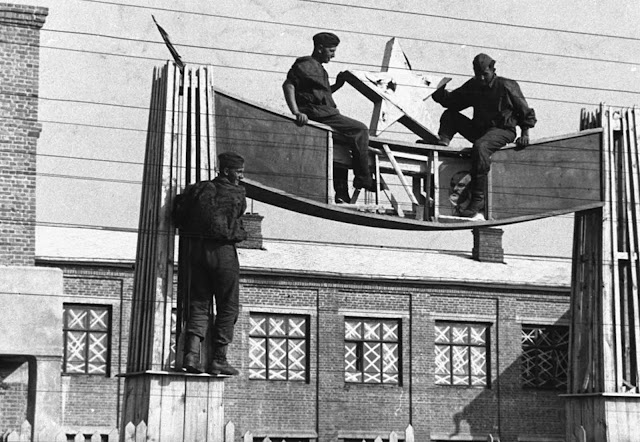
In the Far North sector on 18 July 1941, the Finnish Army of Karelia continues clearing out Soviet resistance around the northern part of Lake Ladoga and the Jänisjoki River. German 163rd Infantry Division battles towards the road junction of Suvilahti (Suojärvi or Suoyarvi) in Ladoga Karelia to the northeast of Lake Ladoga (140 kilometers (87 mi) northwest of Petrozavodsk), a tiny border town which suffered badly during the Winter War and will again. The difficulty of pinpointing battles in that region exemplifies the anonymity of warfare in the endless forests of the region which have few points of reference.
In the Army Group North sector, General Erich von Manstein’s LVI Army Corps withstands a determined Soviet counterattack by Soviet 11th Army and 27th Army, with part of Manstein’s force escaping from encirclement. The German 8th Panzer Division is mauled, and Manstein’s force loses a large portion of its striking power.
The left wing of a German thrust moving in a great arc on Moscow has reached Polotsk, a center of earlier fighting, Moscow acknowledged early today, while the Nazis themselves were claiming a sharp continuing advance at the red center. This disclosure ‘was made by the Soviet command in an early morning communique reporting violent battles in the region of Nevel beyond Polotsk as well as in the Smolensk vicinity on the direct route to Moscow itself and in the Pskov-Porkhov area before Leningrad. The red war bulletin said plainly that the losses of the Russian defenders, as well as those of the Nazis, were great. Too, for the first time in days, the Soviet general staff made no claim that its lines were generally holding.
In the Army Group Center sector, Panzer Groups 2 and 3 continue moving toward each other east of Smolensk. Today, they advance to within 16 km (9.9 miles) of each other. The laggard is General Hoth’s Panzer Group 3, which is struggling with the swampy terrain that has been swollen due to recent rains. Soviet resistance also has strengthened, as the Kremlin now realizes the danger — the Soviets have hundreds of thousands of troops around Smolensk — and are pulling troops out of the closing pocket and placing them in a position to hold the jaws of the trap open. Under newly appointed General Konstantin Rokossovsky, the motley collection of Soviet defenders manage to slow Hoth’s advancing 7th Panzer Division to a crawl and keep the trap from closing.
In the Army Group South sector, the German 17th Army crosses the Bug River near Vinnytsia. German 11th Army attacks in the direction of Sorokin, while German 6th Army batters against Soviet 37th Army in front of Kyiv.
General Keitel’s youngest son, Hans-Georg Keitel, perishes in a field hospital after being badly wounded on July 17th.
At the Wolfschanze in Rastenburg, Hitler meets with veterans of Operation MERCURY.
During the night, Hitler rambles about various topics, including Soviet Premier Joseph Stalin, as recorded in Hugh Trevor-Roper’s “Hitler’s Table Talk”:
“Stalin is one of the most extraordinary figures in world history. He began as a small clerk, and he has never stopped being a clerk. Stalin owes nothing to rhetoric. He governs from his office, thanks to a bureaucracy that obeys his every nod and gesture. It’s striking that Russian propaganda, in the criticisms it makes of us, always holds itself within certain limits. Stalin, that cunning Caucasian, is apparently quite ready to abandon European Russia, if he thinks that a failure to solve her problems would cause him to lose everything. Let nobody think Stalin might reconquer Europe from the Urals! It is as if I were installed in Slovakia, and could set out from there to reconquer the Reich. This is the catastrophe that will cause the loss of the Soviet Empire.”
Hitler’s line about Stalin being a clerk foreshadows a somewhat similar line in “Apocalypse Now.”
Soviet Premier Joseph Stalin writes to Winston Churchill, responding to two prior notes from the latter. Stalin remarks that the Red Army is “strained” and admits that the Soviet troops were placed too far forward (which some attribute to Stalin’s own offensive plans). He then brings up one of his favorite themes of the war, writing:
“It seems to me, furthermore, that the military position of the Soviet Union, and by the same token that of Great Britain, would improve substantially if a front were established against Hitler in the West (Northern France) and the North (the Arctic).
“A front in the North of France, besides diverting Hitler’s forces from the East, would make impossible invasion of Britain by Hitler. Establishment of this front would be popular both with the British Army and with the population of Southern England. I am aware of the difficulty of establishing such a front, but it seems to me that, notwithstanding the difficulties, it should be done, not only for the sake of our common cause, but also in Britain’s own interest. The best time to open this front is now, seeing that Hitler’s forces have been switched to the East and that he has not yet been able to consolidate the positions he has taken in the East.”
Churchill is happy to help, but he has economic aid to the USSR more in mind right now rather than military assistance.
The first acknowledged reports concerning the mass killings of Jews in the East begin reaching England.
Einsatzcommando 3 (Karl Jäger) of Einsatzgruppe A, attached to Army Group North, executes 39 Jewish men and 14 Jewish women at Marjampole.
A group of 30 White Russians who refused to shovel earth over 45 Jews who had been tied together and thrown into a large pit are executed by the SS. All 75 are left dead in the pit.
The Nazi SS drowns 40 Jews in the Dvina River, Belorussia.
The British government recognizes the Czech government-in-exile (formally the Czechoslovak National Liberation Committee) led by President Edvard Benes and Prime Minister Jan Šrámek. It appoints an ambassador to conduct business with Benes and Sramek. A friendship and mutual assistance agreement between the Czechs and the Soviets was signed in London.
A “Free Czechoslovakian” army is to be formed in the Soviet Union. The Czech government-in-exile signs an agreement in London with the Soviet government. It provides that the two “countries” will exchange ambassadors and that the Czechs will form an army in the USSR. Of course, the Czechs no longer have a country (it is now called the Reich’s Province of Bohemia and Moravia), but there are enough Czechs in exile to give the London Czech government some influence. Czech President Edvard Beneš (he claims to have only “resigned” in 1938 under duress, making the act null and void) harbors illusions of eventually forming a true alliance with the USSR in a post-war world.
The Twin Pimples raid ended in British victory. The Twin Pimples Raid takes place at Tobruk. The 43 soldiers of No. 8 Commando, who have infiltrated behind Italian lines, lie undercover and wait for a diversionary attack by 18th Cavalry. While this occurs and the Italians are preoccupied, the Commandos stealthily advance toward the two hills (the “Twin Pimples”) overlooking the Tobruk perimeter that are their objective.
When the Commandos get within about 30 yards/meters, they are challenged. Rather than respond, the Commandos open fire and charge ahead. There is a four-minute fire-fight. The Australian engineers following the Commandos plant explosive charges on Italian artillery pieces and an ammunition dump. Then, the entire force heads back toward the Tobruk perimeter. On the way, Italian artillery opens up and one Commando is killed (Corporal John Edward Trestrail later dies of his wounds) and four others wounded. The raid is considered a success, but No. 8 Commando is disbanded soon after this because the high command thinks the Commando can be employed better elsewhere.
Australian morale at Tobruk is plummeting. It is hot, the Axis artillery can reach much of the Allied territory, there are flies everywhere, and food and water supplies require effort to obtain. General Blamey requests relief of the Australian units holding besieged Tobruk.
The nightly supply run to Tobruk is made by destroyers Hero and Hotspur. They make it there and back without incident.
At Malta, two Blenheim bombers attack a power station in Tripoli. They hit the target, but one of the bombers is shot down by defending fighters. Another five RAF bombers attack Palermo Harbor. Malta reports to Whitehall that Axis bombs have destroyed a fuel tank, causing the loss of ten tons of fuel.
Operation GUILLOTINE begins. This is a Royal Navy movement of troops and supplies from Haifa and Port Said to Famagusta, Cyprus. The first ship to go is 6676-ton Australian freighter Salamaua, escorted by sloop HMS Parramatta. The Luftwaffe and Regia Aeronautica notice and begin attacking Cyprus today.
Luftwaffe Generalmajor Theo Osterkamp becomes Fliegerführer Afrika.
Finland established diplomatic relationship with the Japanese-sponsored puppet state of Manchukuo.
The Orthodox Bishop of Dresden, Germany completed his two-day visit of the Oflag IV-C prisoners of war camp at Colditz Castle and departed.
Communist member of the Politburo Milovan Đilas establishes the Command of People’s Liberation Troops of Montenegro, placing Boka, and Sandžak under his own command. Dilas accepts the help of those former Yugoslav Army officers that are willing to fight under communist control.
In a speech, Franco declares the Allies have lost the war. However, he continues to quietly hedge his bets by staying out of it.
Harry L. Hopkins, supervisor of the United States Lend-Lease program, paused today in the midst of a hurried series of meetings and conferences, that had included attendance at one Cabinet meeting, within a few hours of his arrival, to explain the primary reason for his visit. He declares U.S. shipbuilding in 1942 will yield 6 million tons, much of it to aid Britain.
The weather over northwest Europe remains unsettled, disrupting air operations. RAF Bomber Command sends a handful of Stirling bombers to raid Holland and Germany, but they turn back and one is lost. In another action, three Blenheim bombers undertake Operation Channel Stop and attack shipping off Gravelines. While they damage some ships, including a tanker, none of the planes returns, so the RAF loses four bombers on the day without achieving much.
RAF Fighter Command sends a Roadstead Mission to Dunkirk.
The Luftwaffe sends a large raid of 108 planes against Hull and other targets in Yorkshire, Lincolnshire. The attack lasts for about two hours and starts 160 fires, with four becoming serious. There are 111 killed, 108 seriously wounded, and 3500 people are left homeless.
RAF Bomber Command, Day of 18 July 1941
5 Stirlings on cloud-cover raids to Holland and Germany turned back; 1 aircraft was lost in the sea. 3 Blenheims operating the Channel Stop attacked ships near Gravelines and scored hits but all 3 aircraft were shot down. Losses on this day were thus 50 percent.
The Luftwaffe bombs and damages 7046-ton British freighter Pilar de Larrinaga several hundred miles west of Northern Ireland. There are four deaths. The Pilar De Larrinaga makes it to Belfast Lough in tow.
Luftwaffe pilot Fritz Fliegel, who has been mentioned twice in the prestigious Wehrmachtbericht, is killed in his Focke-Wulf FW-200 C-3 “F8+AB” (Werknummer 0043—factory number) while attacking Convoy OB-346. Fliegel’s five-man crew also perishes. This occurs during the attack on freighter Pilar de Larrinaga when the gunners on the freighter score a lucky hit that tears off the plane’s starboard wing.
The RAF puts ASV radar equipment on a PBY Catalina and a couple of PBM Mariner planes.
Battlecruiser HMS Repulse, escorted by destroyers HMS Icarus, HMS Active, and HMS Achates departed Scapa Flow for Rosyth where the ships arrived at 0730 on the 19th.
Heavy cruiser HMS London departed Gibraltar to return to Scapa Flow, where she arrived on the 23rd.
Destroyer HMS Bedouin departed Scapa Flow at 0700 for refitting in the Humber. The destroyer arrived at 0630 on the 19th.
Destroyer HMS Anthony arrived at Scapa Flow at 1230 from Rosyth on the completion of her refitting.
British steamer Pilar de Larrinaga (7046grt) was damaged by German bombing in 54-23N, 16-53W. Four crewmen were killed on the steamer. The steamer was towed to Belfast Lough.
Battleships HMS Valiant and HMS Queen Elizabeth, light cruiser HMS Phoebe, and destroyers HMS Jackal, HMAS Nizam, HMS Hasty, HMS Kipling, and HMS Havock departed Alexandria for exercises. Minelaying cruisers HMS Abdiel and HMS Latona had departed Alexandria the prior day for further exercises.
Australian light cruiser HMAS Perth, after having been relieved by Australian light cruiser HMAS Hobart, departed Alexandria to return to Australia. Before departing the Mediterranean Fleet, light cruiser Perth had a quadruple pom pom removed and a catapult, previously carried in light cruiser HMS Ajax, mounted at Port Said on the 19th. The light cruiser passed through the Suez Canal on the 20th. Light cruiser Perth was refitting and repairing defects at Sydney from 11 August to 30 October.
In Operation GUILLOTINE, beginning on this date and into August, troops and supplies were moved from Port Said and Haifa to Famagusta in cruisers, minelaying cruisers HMS Abdiel and HMS Latona, and destroyers. Australian steamer Salamaua (6676grt), carrying an anti-aircraft battery and RAF 80 Squadron, proceeded to Famagusta from Port Said, escorted by sloop HMAS Parramatta in serial S.1 of this operation. The ships arrived at Famagusta on the 21st.
Destroyers HMS Hero and HMS Hotspur carried supplies to Tobruk. They arrived back at Alexandria on the 18th.
Heavy cruiser HMS London departed Gibraltar to return to Scapa Flow, arriving on the 23rd.
Destroyer HMS Vidette departed Gibraltar to join British tanker British Honour and escort her to Gibraltar, arriving on the 21st.
Corvette HMS Geranium arrived at Gibraltar, escorting British oiler Hornshell.
Convoy HG.68 departed Gibraltar, escorted by destroyers HMS Beverley and HMS Wishart, sloop HMS Scarborough, submarine HMS Clyde, anti-submarine trawlers HMS Lady Hogarth, HMS Lady Shirley, and HMS Leyland. Captured French trawler Grouin Du Cou in the convoy was forced to return to Gibraltar on the 22nd when she could not keep up with the convoy. On the 24th, captured French trawler L’Orage returned to Gibraltar with boiler defects. Corvettes HMS Fleur de Lys and HMS Geranium departed Gibraltar on the 19th and joined the convoy at sea. Destroyer Beverley was detached on the 19th with captured French ship Isac. On the 22nd, submarine Clyde, corvette Fleur de Lys, and destroyer Wishart were detached, the submarine and destroyer going to convoy OG.68. Corvettes HMS Clover and HMS Vervain joined on the 23rd. Trawlers Lady Hogarth and Lady Shirley were detached on the 25th. On the 27th, corvettes HMS Alisma, HMS Dianella, HMS Kingcup, and HMS Sunflower joined the convoy. Destroyers HMS Bath, HMS Vanoc, and HMS Walker, catapult ship HMS Ariguani, and corvettes HMS Carnation, HMS Heliotrope, HMS La Malouine, and HMS Mallow joined on the 28th. Corvettes Clover and Vervain were detached on the 28th. On the 29th, corvettes Carnation and La Malouine were detached. Corvette Geranium was detached on the 31st for refitting in the UK. The convoy arrived at Liverpool on 2 August.
President Roosevelt today swept away any lingering doubts that, at whatever cost, the government intends to keep the sea lanes to Iceland. At the same time, he disclosed that he would throw his prestige formally and fully behind proposals for extending the service of draftees, national guardsmen and reserves.
Frank Murphy, Associate Justice of the United States Supreme Court, discussed Far Eastern affairs with President Roosevelt at a White House luncheon today at which, it was said, the probability of an early Japanese thrust into Indo-China or Siberia was considered.
The president also confirmed that the United States is building bases in Brazil for this country’s air force and intimated that similar construction is underway in other South American countries. He said he could not be specific without revealing information vital to western hemisphere defense, but suggested that reporters could write that bases are being built at other strategic points.
The blacklist against 1,800 Latin-American firms and individuals believed to be acting in the interest of Germany and Italy will be extended in a few weeks or months to entities of the same character in countries outside the Western Hemisphere, except in the British Commonwealth of Nations, under a procedure announced today by Dean Acheson, Assistant Secretary of State.
An agreement between the War and Justice Departments gave the Justice Department responsibility for controlling enemy aliens in the continental United States in the event of war. Before the attack on Pearl Harbor on December 7, 1941 both the Justice Department, primarily through the Federal Bureau of Investigation, and the armed services closely scrutinized the records of prospective enemy aliens and compiled lists of those against whom there were grounds for suspicion of disloyalty.
The House committee investigating problems of migratory labor was informed by Corrington Gill, assistant commissioner of the Works Progress Administration, that, despite the nation’s defense production program, 5,000,000 persons will remain unemployed this year.
Economists of the Office of Production Management estimate that by April the United States will be out-producing Germany in airplanes and tanks, Senator Downey of California told the Senate Military Affairs Committee in secret session this week.
Dr. Robert C. Weaver, chief of the branch of Negro employment and training of the Office of Production Management, complained that preferential treatment was being given to white labor. He charged that employers holding national defense contracts had refused to employ available Negro labor. In his evidence, he also complained of, “some instances of discrimination against Jews and workers of Russian and German parentage.”
City officials tonight estimated damage at a fire and explosion at the Sinclair-Prairie Oil Co, in Seminole, Oklahoma, at $50,000. One unidentified woman was dead and four hurt. Firemen expected to search the ruins of several company houses for possible victims as soon as the fire is under control. The fire started from a break in a gasoline line. Seminole firemen were fighting the blaze when a tank exploded. Three firemen were injured slightly and their truck was damaged. Witnesses said five other explosions followed.
Representatives of automobile dealers from the twelve States of the Northeastern region were told yesterday by L.C. Cargile, president of the National Automobile Dealers Association, that they face the most serious crisis their business has ever known.
In contrast to the violence Thursday in Bendix, New Jersey, when police had to use tear-gas bombs and revolvers to disperse strikers, 300 employees of Air Associates, Inc., passed peacefully a C.I.O. picket line as they returned to their work today on defense orders for the Army and Navy.
Casper Appel, Los Angeles electrician, asked a judge for a divorce from Jacqueline Appel on the grounds she clouted him in the face with an alarm clock and then said: “I’ve been told that you had a face that would stop a clock, and I wanted to prove it!” Appel also charged that she closed a folding bed in which he was sleeping and kept him imprisoned upside down so long that blood ran out of his nose. Another allegation was that she threw his clothes out in the rain on a chilly morning and then locked him outside when he went to retrieve them. Mrs. Appel countered with a charge that her husband once beat her and broke her nose. P.S.: They have a daughter named Joy.
The motion picture “The Shepherd of the Hills,” based on Harold Bell Wright’s novel, is released in the U.S. Directed by Henry Hathaway, the film stars John Wayne, Harry Carey, Beulah Bondi, Majorie Main and Ward Bond. Young Wayne, an Ozark Mountain moonshiner, hates the father who deserted him and left his mother to die. Then a stranger (Carey) arrives and begins to positively affect the mountain people.
Major League Baseball:
The St. Louis Cardinals downed the Brooklyn Dodgers, 6–1. The St. Louis triumph was easier than even the score indicates. Ernie White, at the moment the only southpaw in the league to have beaten Brooklyn twice, didn’t allow a hit after the fourth inning and permitted only two Dodgers to reach first base thereafter, both on passes.
Frank Frisch’s strategy went awry today and enabled the Braves to rally for a 4–3 triumph over the Pirates after they had dropped the first contest of a double-header, 5–1. Going into the ninth inning of the nightcap, the Pirates led, 3–2, having overcome a one-run Boston advantage in the seventh, but Joe Sullivan, former Braves hurler, was weakening. He started by walking a pinch hitter, Al Montgomery. Phil Masi ran for Montgomery and went to third on Max West’s single to center.
The White Sox top Boston, 4–3, in 10 innings. Lefty Grove, trying for his 300th win, goes all the way to take the loss. It was anybody’s game until Lou Finney erred to let in the decisive tally. Grove walked Bill Knickerbocker after two were out in the tenth. Luke Appling drove a long fly to right field and the ball sailed through Finney’s hands, allowing Knickerbocker to score easily.
The day after Joe DiMaggio’s 56 consecutive game hitting streak ended, the New York Yankees again play the Cleveland Indians and DiMaggio begins a new hitting streak by getting a single and a double off Indians’ ace pitcher Bobby Feller in a 2–1 loss; he goes on to hit in 16 consecutive games before being stopped, giving him hits in 72 of 73 games. When the season ended, DiMaggio had a .357 average, a .643 slugging average, 193 hits, 43 doubles, 11 triples, 30 home runs and a league-leading 125 RBIs. He struck out just 13 times in 541 at-bats. Years later, DiMaggio said, “Stopping that streak at 56 games cost me thousands of dollars. If I had gone to 57, Heinz (ketchup) and their 57 varieties would have paid me US$10,000 (US$117,647 in year 2000 dollars) to start an ad campaign and I might have been their spokesman for years.” Yankee catcher and Hall of Famer Bill Dickey said of DiMaggio, “He gave the most consistent performance under pressure I have ever seen.”
Emil (Dutch) Leonard limited the Tigers to six hits today as the Senators won, 8–1. Rain halted the game at the end of the eighth inning. Rain delayed the start an hour and fifteen minutes, but the show went on at the insistence of 9,000 ladies’ day guests. Rudy York’s eighteenth homer in the fourth inning produced the Detroit run. Washington hammered Johnny Gorsica and Archie McKain for sixteen hits, including doubles by Leonard, George Case and Jake Early.
Bob Johnson’s ninth-inning home run today gave the Athletics a 6–5 victory over the Browns. When the ninth began the Browns led, 4 to 2, and seemed assured of their fourth straight victory, a record the 1941 St. Louis club had never attained. But Denny Galehouse weakened, Wally Moses walked, Benny McCoy singled and then came Johnson’s homer, his eighteenth of the year.
St. Louis Cardinals 6, Brooklyn Dodgers 1
Pittsburgh Pirates 5, Boston Braves 1
Pittsburgh Pirates 3, Boston Braves 4
Boston Red Sox 3, Chicago White Sox 4
New York Yankees 1, Cleveland Indians 2
Washington Senators 8, Detroit Tigers 1
Philadelphia Athletics 6, St. Louis Browns 5
In Canada, Canadian corvette HMCS Algoma arrived at Montreal, Quebec, and corvette HMCS Shediac arrived at Quebec City, Quebec.
Aircraft production in Canada in the three-month period between April 1 and June 30 was 10 times greater than the entire 1939 output, Munitions Minister C. D. Howe announced today.
The United States blacklist, published here today, landed as a bombshell and was accepted favorably by Brazilian firms, with, ill humor by Germans and with wrath by two American citizens included in it.
Over 35,000 pro-Japanese soldiers attack the Chinese New Fourth Army’s stronghold in Kiangsu.
Prince Fumimaro Konoe retained his office as he was named the 39th Prime Minister of Japan. All cabinet members of the Japanese government with the exception of pro-Hitler Foreign Minister Matsuoka Yosuke that resigned the previous day were asked to join the new cabinet. Matsuoka has alienated the military which really runs the government through his advocacy of closer ties to the Reich and the importance of attacking the USSR to the north rather than the British and Dutch to the south. Matsuoka is replaced as Foreign Minister by Vice Admiral Teijirō Toyoda, a careerist, and reliable yes-man.
Japan’s new Cabinet, formed today under the premiership of Prince Fumimaro Konoe, is so little changed in essential make-up and political coloring from, the preceding Konoye Cabinet that the ostensible shift in government is believed in Washington to have been made only to clear Japan from responsibilities toward Russia and toward Germany and Italy.
Viscount Halifax, British Ambassador to the United States said today that while he saw no reason why there should be a clash between Japan and the western democracies, no one should think that Britain, preoccupied with war in Europe, will allow her rights in other parts of the world to be set aside.
The Japanese have been keeping tabs on US movements throughout the Pacific. Today, the Japanese Consul (one of his staff is a trained spy) in Manila reports that one light cruiser was undergoing repairs, while four destroyers departed from the harbor and six submarines entered it.
Vice-Admiral Sir Guy Royle, KCB, CMG, becomes Australian First Naval Member and Chief of Naval Staff.
Dow Jones Industrial Average: 127.69 (+0.55)
Born:
Martha Reeves, American pop and R&B singer (Martha & the Vandellas — “Dancing in the Street”, “Heat Wave”, “Jimmie Mack”), in Eufaula, Alabama.
Lonnie Mack [McIntosh], American blues-rock guitarist, and singer-songwriter (“Baby What’s Wrong”), in West Harrison, Indiana (d. 2016).
Naval Construction:
The Royal Navy Bar-class boom defense vessel HMS Barbrake (Z 173) is laid down by W. Simons & Co. Ltd. (Renfrew, Scotland).
The U.S. Navy YMS-1-class auxiliary motor minesweeper USS YMS-87 is laid down by the Al Larson Boat Shop Inc. (Terminal Island,California, U.S.A.).
The U.S. Navy 77-foot Elco patrol motor torpedo boat USS PT-57 is laid down by the Electric Launch Company Ltd. (Elco), (Bayonne, New Jersey, U.S.A.).
The Royal Navy River-class frigate HMS Spey (K 246) is laid down by Smiths Dock Co., Ltd. (South Bank-on-Tees, U.K.).
The U.S. Navy 77-foot Elco patrol motor torpedo boat USS PT-43 is launched by the Electric Launch Company Ltd. (Elco), (Bayonne, New Jersey, U.S.A.).
The Kriegsmarine (German Navy) Type VIIC U-boat U-703 is launched by H C Stülcken Sohn, Hamburg (werk 762).
The Royal Navy Fairmile B-class motor launch HMS ML 255 is commissioned.
The Royal Navy MMS I-class motor minesweeper HMS MMS 42 (J 542) is commissioned.
The U.S. Navy 77-foot Elco patrol motor torpedo boat USS PT-37 is completed.
The U.S. Navy 77-foot Elco patrol motor torpedo boat USS PT-38 is completed.
The U.S. Navy Pocomoke-class seaplane tender USS Pocomoke (AV-9) [ex-SS Exchequer] is commissioned. Her commanding officer is Commander Thomas Lamison Sprague, USN.
The Вое́нно-морско́й флот СССР (ВМФ) (Soviet Navy) Project 7U-class (Storozhevoy-class) destroyer Skory (Скорый, “Fast”) is commissioned.
 History Diaries