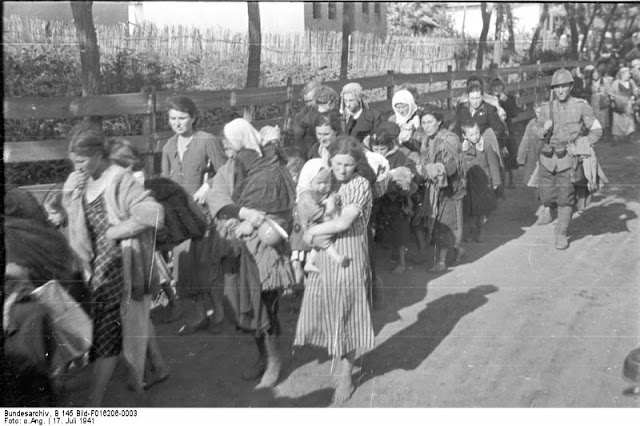
The biggest news on the Eastern Front on 17 July 1941 is the successful German encirclement of large numbers of Soviet forces (elements of 20 divisions) at Uman. About 300,000 Soviet troops are captured. Subduing this large number of combatants is a very successful achievement of the Wehrmacht, but it also proves to be a major distraction during the advance eastward.
In the Far North sector, Finnish General Talvela continues pushing his VI Corps forces into Karelia along the east coast of Lake Ladoga. The Soviet respond by sending reinforcements to the threatened area. On the west coast of the lake, Soviet defenses have been giving Finnish VII Corps more trouble, but today the Finns finally reach the Jänisjoki River. They have surrounded Soviet formations, just as they did during the Winter War, and now spend some time subduing them.
In the Army Group North sector, the Soviet 11th Army and 27th Army counterattack the Germans and slow them down.
In the Army Group Center sector, the German forces continue battling Soviet troops in the suburbs of Smolensk (they already control the center). The German Panzer Groups 2 and 3 have virtually surrounded the city (their pincers are still dozens of miles apart), but they do not have the infantry in place to seal a perimeter. Thus, Soviet troops continue to retreat through German lines and through the gap. General Hoth’s Panzer Group 3 attacks in the direction of Velikiye Luki.
In the Army Group South sector, the German XI Army Corps (Infantry General (General der Infanterie) Joachim von Kortzfleisch) crosses the Dneipr River. Romanian Third Army crosses the Dniester River, and Romanian Fourth Army continues heading toward Odessa. The Germans complete an encirclement at Uman, trapping roughly 300,000 Soviet troops. Further south, troops of the Romanian 3rd Army reached the Dniester River, captured a row of bunkers on the far bank, and repulsed a series of Soviet counterattacks.
The Soviet 3rd NKO Directorate was merged back into the NKVD, becoming NKVD’s Special Departments Director (UOO). Viktor Abakumov was named UOO’s chief and Solomon Milshtein was named the deputy.
The Political Commissars were re-introduced into the Soviet Army and Soviet Navy organizational structures.
General Giovanni Meese takes command of the Italian expeditionary force in the Soviet Union.
The volunteer Blue Division entrains for the Reich, following their commander, Munos Grandes. There are 18,694 men, and 70% of them are from the regular army. Most of the remainder are veterans of the Spanish Civil War, looking for a new battlefront. The entire cadet corps of Spain’s leading military academy is on the trains, along with 3,000 students from the University of Madrid. The men arrive in Grafenwöhr, Bavaria to train, receiving German uniforms (save for the Falangist dark blue shirts which give the division its name).
The Wehrmacht plans to deploy the unit, categorized as the 250th Infantry Division, in the Army Group North sector. It is an irreverent lot, with men of all ranks disdaining military protocol, but the Spaniards have excellent morale and believe themselves unbeatable.
Reinhard Heydrich issues guidelines for prisoner-of-war camps. He orders the SS “Einsatzkommandos of the Security Police and the Security Service” to exterminate entire classes of Soviet people:
“This includes all important Party and State functionaries and especially so-called professional revolutionaries, all People’s Commissioners of the Red Army, leading personalities of the state, all members of Russian intelligence services, and all Jews and other people who are known to be agitators or fanatical communists.”
Heydrich is not acting alone; he has coordinated his guidelines with General Keitel’s OKW, which previously issued orders absolving German soldiers from war crimes on the Eastern Front and mandating the execution of commissars. However, this order goes further, as he states that “all Jews” in the POW camps are to be separated out and executed.
The actual impact of this order is debatable because there is ample evidence that large-scale liquidations of these groups already have been in progress throughout Operation Barbarossa. However, if there is one single order that energizes and encapsulates the Reich’s killing machine against “politically intolerant elements,” this is it. Previous extermination orders have been only verbal or vague about the treatment of Jews, but this order puts in writing with the full backing of the Reich government the practice of not only abusing Jews but exterminating all male Jews of military service age. It is but a short step from this order to the extermination camps.
At Vilnius, the Einsatzkommando 9 (EK 9, a sub-group of Einsatzgruppe B) continues its liquidations of Jews. It has been shooting about 500 Jews a day int he Panefiai Forest. These will continue for the next two days, and the total number of Jewish men shot will total about 5,000. A unit of EK 9 also is in the process of shooting 527 Jewish men in the Belorussian town of Ashmiany.
At Kishinev in the Ukraine, Einsatzgruppen D begins the first “five-figure” massacre of Jews. More than 12,250 are killed between July 17 and 31.
Alfred Rosenberg officially takes over as the person in charge of exploiting newly captured lands in the East. From the Nuremberg judgment against Rosenberg:
“With his appointment as Reich Minister for Occupied Eastern Territories on 17th July, 1941, Rosenberg became the supreme authority for those areas. He helped to formulate the policies of Germanisation, exploitation, forced labour, extermination of Jews and opponents of Hitler’s rule, and he set up the administration which carried them out.”
Hitler, in his 16 July meeting with Rosenberg (and others), made clear that he expected ruthless exploitation. Rosenberg complies.
Heinz Guderian was awarded Oak Leaves to his Knight’s Cross of the Iron Cross. His troops have been the spearhead of the entire Wehrmacht toward Moscow, having taken Minsk and Smolensk, and he is at the height of his success on the battlefield.
General Wilhelm Keitel’s son Hans-Georg Keitel is mortally wounded on the Eastern Front by a Red Air Force attack. He perishes in a field hospital on 18 July.
General der Flieger Wolfram Freiherr von Richthofen, commander of VIII Fliegerkorps, receives the 26th Eichenlaub.
Lieutenant General Walter Keiner receives the Knight’s Cross of the Iron Cross as Generalleutnant and commander of 62. Infanterie-Division.
The Twin Pimples raid by British Commandos during the Siege of Tobruk began. This is a Commando raid to take two hills held by Italian troops that dominate a section of the Tobruk perimeter. Three officers and forty men of No. 8 Commando leave Allied lines and infiltrate Italian lines undetected at 23:00. They remain under cover until the early morning hours of 18 July.
The Italian Navy introduced a new cipher. The Regia Marina introduced a new cipher, so the Royal Navy had no preventive information about the planned cruise of Colleoni and Bande Nere.
On the fifth anniversary of the “National Uprising” (Alzamiento Nacional), Francisco Franco gives a speech to his fascist party’s National Council in Madrid. It is perhaps his most bellicose speech of World War II, and it surprises a lot of people, including his own Foreign Minister (and brother-in-law), Serrano Suner.
Everybody in the diplomatic corps is present for the afternoon speech, including the United States ambassador, Alexander W. Weddell. Franco makes clear his belief that the Reich is on the march to victory, accuses the British of maintaining an “inhuman blockade of a continent,” excoriates the U.S. for not selling food to Spain (a claim of dubious truthfulness), and warns the United States of getting involved in the European conflict:
“No one is more authorized than ourselves to say that Europe has no ambition in America. A contest between the two continents is an impossible thing. It would mean only a long war at sea without results; fabulous business for a few and unsuspected miseries for many; prodigious losses of ships and goods; a war of submarines and high-speed vessels striking blows at the hitherto peaceful commerce of the world.”
He then goes further and adds that “the American coasts are in danger from the attacks of the European powers.” He concludes:
“The war was badly planned and the Allies have lost it… What is proposed is a new between the continents which by prolonging their agony will give them an appearance of life and in the face of this we who love America feel the anxiety of the moment and pray that the evil of which we have a foreboding may not reach them.”
Exactly what Franco intends to accomplish with this speech is unclear. However, he gives no indication that he is about to declare war on anybody, and thus, in light of the pro-German tone of the speech, it can be viewed as a continuation of his strategy of placating Hitler while keeping his own distance from the war itself.
President Roosevelt’s closest collaborator, and lend-lease administrator, Harry L. Hopkins, arrived in London today and a short time later was closeted with the inner war cabinet in a discussion of Britain’s most urgent needs and her most confidential war secrets. Hopkins, visiting Britain for the second time within a few months, was the first non-ally ever to sit in a meeting of the war cabinet and the first non-British official to attend such a session since the now-imprisoned Edouard Daladier came here as premier of wartime France.
The Oflag IV-C prisoners of war camp at Colditz Castle in Germany hosted a visit from the Orthodox Bishop of Dresden, Germany.
The Italian Navy, Regia Marina, introduces a new cipher that for the time being leaves the British Ultra cryptographers at Bletchley Park baffled.
The uprising in Montenegro continues. Captain Pavle Đurišić leads a successful attack of communist insurgents on Berane. The Italians, caught by surprise, continue assembling forces for a counterattack.
Virginia Woolf’s final novel “Between the Acts” was published posthumously. Woolf drowned herself on 28 March 1941 shortly after finishing the novel.
James Lacey shot down a German He 59 seaplane. The Luftwaffe uses the planes for rescue operations, but due to various “incidents” during the Battle of Britain flowing from British Air Ministry Bulletin 1254 making them fair targets, the Germans now fly them armed and camouflaged, usually with fighter escort.
RAF Bomber Command, Night of 17/18 July 1941
Cologne
50 Wellingtons and 25 Hampdens; claimed to have caused many fires. No aircraft lost. Cologne reports only 68 bombs of all types, no serious damage and no casualties.
5 Wellingtons sent to Rotterdam were unable to locate the target and 1 was shot down in England by an Intruder.
After sundown, German bombers attacked Hull, Yorkshire, England, United Kingdom. 160 fires displaced 3,500 people and several factories were damaged. 111 were killed and 108 were seriously injured.
The Luftwaffe (Junkers Ju 87 aircraft of Lehrgeschwader 1) bombs and badly damages Royal Navy landing craft tank HMS LCT 10 off Sidi Barani. It is taken under tow, but sinks.
RAF No. 830 Squadron based on Malta raids Tripoli and damages 6212-ton Italian tanker Panuco. Unable to unload its cargo due to damage, it heads back to Palermo, then Naples for repairs.
The Luftwaffe raids Tobruk.
At Malta, there is a minor bombing raid before dawn on Fort St. Angelo. Around 11:30, an air battle surrounding an Italian reconnaissance SM-79 leads to two Italian Macchi 200 fighter losses and one Hawker Hurricane loss.
Oberleutnant Hans Kolbow, Staffelkapitän 6./JG 51, is shot down by Soviet Flak south of Stara Bychow. He manages to exit the aircraft, but his parachute does not have time to open and he perishes. He has 27 victories, 13 on the Western Front. He will win the Ritterkreuz posthumously on 27 July.
Destroyer HMS Winchester departed Scapa Flow at 0500 after working up for Rosyth. En route, the destroyer joined convoy WN.53 as additional escort.
Destroyer HMS Oribi arrived at Scapa Flow at 0630 from Greenock to work up.
Destroyer HMS Heythrop departed Scapa Flow at 1000 escorting British tankers War Sudra (5627grt) and Daxhound (1128grt). At 1700, trawler HMS Northern Sky with steamer Lochgarry (1627grt) was met in position 270 Noup Head 24 miles. The force proceeded to Skofenfjord in the Faroes. They arrived at 1630 on the 18th. The destroyer and War Sudra proceeded on to Seidisfjord, where they arrived at 1600 on the 20th. The destroyer departed Seidisfjord at 0730 on the 21st and proceeded to Skaalefjord, arriving at 0800 on the 22nd. At 1330 on the 22nd, destroyer Heythrop, tankers Daxhound and War Pindari, and anti-submarine trawler HMS Lord Austin departed Skaalefjord. The destroyer arrived at Scapa Flow at 2000 on the 23rd; the other ships having been detached to Kirkwall.
Destroyer HMS Escapade arrived at Scapa Flow at 2000 from the Tyne on the completion of her refitting.
Polish destroyer ORP Burza arrived at Scapa Flow escorting oiler RFA Black Ranger. The destroyer later left to return to the Western Approaches.
Anti-aircraft ship HMS Alynbank departed Scapa Flow at 0500 to provide anti-aircraft protection for convoy WN.53 from Pentland Firth until south of Buchan Ness, where she transferred to convoy EC.46. At 2000 on the 18th off Cape Wrath the ship transferred to convoy WN.54. During the morning of 20 July, the ship transferred to convoy EC.47. On arrival in Pentland Firth, the ship departed the convoy and arrived at Scapa Flow at 0200 on the 21st.
Submarine HMS Thrasher damaged French fishing trawler Virgo Fidelis (129grt) off San Sebastian. The trawler was run aground a total loss.
British fishing steam trawler Ben Glamair (198grt) was lost to an unknown cause near Dunstanburgh.
British drifter Fertile Vale (91grt) was sunk in a collision off the River Tay.
British steamer Emerald Queen (481grt) was damaged by German bombing in 54-39N, 0-48W. The steamer, carrying Admiralty Stores and ammunition, was towed to Hartlepool.
Italian submarine Malaspina sank British steamer Guelma (4402grt) in 30-44N, 17-33W. The entire crew was rescued by Submarine HMS Thunderbolt on the 17th.
Light cruiser HMS Neptune arrived at Suez after repairs. The light cruiser passed through the Canal and at Port Said disembarked her catapult to make room for anti-aircraft weapons. Cruiser NEPTUNE then proceeded to Alexandria, arriving on the 19th.
Australian sloop HMAS Parramatta departed Alexandria for Port Said for escort duties.
Italian tanker Panuco (6212grt) was damaged at Tripoli by British aerial torpedo attack of three Swordfish of 830 Squadron from Malta. The tanker was unable to unload her cargo. Tanker Panuco departed Tripoli on the 19th with her cargo still aboard, escorted by torpedo boats Centauro and Montanari. The tanker arrived at Palermo on the 22nd.
Submarine HMS Talisman arrived at Gibraltar from Halifax.
Submarine HMS P.32 departed Gibraltar to patrol to support Operation SUBSTANCE, and then proceeded to Malta.
Submarine HMS Utmost departed Malta for Operation SUBSTANCE.
Convoy OB.348 departed Liverpool, escorted by destroyers HMS Douglas and HMS Skate, corvette HMS Anemone, minesweeper HMS Leda, and anti-submarine trawlers HMS St Elstan and HMS St Zeno. Destroyer HMS Leamington and corvette HMS Abelia joined on the 22nd. These escorts were detached on the 22nd. On the 22nd, destroyers HMS Reading and HMS Saguenay and corvettes HMS Dianthus, HMS Honeysuckle, and HMCS Snowberry joined. The escorts were detached off Halifax on the 30th. The convoy arrived at Halifax on the 31st.
President Roosevelt held an unscheduled conference late today with Secretary of the Navy Frank Knox and other naval chieftains, causing speculation that important foreign policy moves are impending in the Pacific, Atlantic or both. The conference followed one with Acting Secretary of State Sumner Welles. The naval conferees, in addition to Knox, were Admiral Harold R. Stark, Chief of Naval Operations, Rear Admiral Ernest King, Commander of the Atlantic Fleet, and Rear Admiral Richard K. Turner, Chief of the Navy War Plans Division.
U.S. President Franklin Roosevelt and Secretary of State Cordell Hull met with Japanese Ambassador Kichisaburo Nomura in Washington DC, United States in an attempt to open negotiations between the two countries regarding peace in the Pacific region.
President Roosevelt enacted Proclamation 2497, which blacklisted 1,800 Latin American firms for aiding Germany or Italy. President Roosevelt issued a proclamation today making official a list of 1,800 Latin-American firms and individuals believed to be acting in the interest of Germany or Italy. The list, containing the names of many internationally known firms, was made public. The proclamation, which was regarded as putting on an all-out basis the economic efforts of the United States to clear Latin-American republics of American-financed Axis propaganda and of Axis trade ties, contained as its most potent provision an extension to all the blacklisted entities of the President’s order of June 14 freezing the assets of any Continental European nation, or national thereof, situated in the United States. This broad extension of the freezing order at once severs the ties through which known Axis agents in Latin America have received financial aid in dollars from United States sources.
Appealing to congress to declare an unlimited national emergency before August 1, General George C. Marshall, the U.S. Army Chief of Staff, said today that Spain, Portugal and Africa might become the next target of axis aggression. “Each move,” he added, “leaves the axis forces more and more ready for another move.”
General Marshall approved Leonard Gerow’s recommendation to re-activate Douglas MacArthur from the retired list and plans regarding the Philippine Army; Marshall forwarded Gerow’s proposals to U.S. Secretary of War Henry Stimson for further review and implementation.
The Senate Military Committee gave unanimous approval today to a defense property seizure bill shorn of many features which aroused a storm of controversy on its submission to congress more than a month ago. In reporting the measure to the senate for consideration next week, the committee eliminated provisions which would have permitted the president to requisition “any property he deemed necessary for national defense.
The House of Representatives passed on a voice vote and sent to the senate today legislation to authorize a $585,000,000 program of additional shipbuilding, ship repair and naval ordnance facilities. Chairman Vinson, Georgia Democrat, of the House Naval Committee, told the House that failure to pass the measure “will slow down our cruiser, battleship and airplane program.” Representative Vinson, chairman of the Naval Affairs Committee, said the expansion was necessary to maintain the present rate of two-ocean navy construction, the Maritime Commission’s construction program and commitments under the lease-lend program. As of July 11, Navy yards had under construction 129 combatant, auxiliary, district and patrol vessels, and private yards had 856 of these categories under way, making a total of 985. Vessels being converted to Navy use in Navy yards numbered fourteen, and in private yards, thirty-one, a total of forty-five. In all, 1,030 ships are involved in the program.
Trim, erect selective service trainees, drawing numbered pink capsules from the famous old goldfish bowl, tonight determined the order in which some 750,000 other young Americans, just turned 21, will be subject to call into the nation’s growing army. A trainee inducted into the Army under the first lottery which, started selective service in October drew from the “goldfish bowl” tonight the first number in the second lottery held to determine the order in which 750,000 21-year-old men will be subject to conscription. Washington dignitaries drew a few numbers, of course, but the draftees started the job when Secretary of the Navy Knox yielded first place in the line to them, and they carried it through to a snappy and efficient conclusion.
Differences between Charles A. Lindbergh and the Roosevelt administration flared again today when the flier, in a letter to President Roosevelt, declared he had no connection with any foreign government and that he had a right to an apology from Secretary of the Interior Ickes, a constant Lindbergh critic. “I will willingly open my files to your investigation,” Lindbergh said. “I will willingly appear in person before any committee you appoint, and there is no question regarding my activities now, or at any time in the past, that I will not be glad to answer.”
Wendell L. Willkie, commenting on Charles A. Lindbergh’s request for a Presidential investigation of charges made against him by Secretary of the Interior Ickes, called upon the national administration. to drop attacks upon individual citizens in the name of national unity.
High ranking officers here expressed surprise today at a report from Washington that Companies I and L of the 174th Infantry, a Western New York regiment, had sent telegrams to Senator Burton K. Wheeler protesting the proposed extension of the National Guard’s year of service.
The 1,000th Lockheed bomber for Britain took off for England today with 30,000 aircraft workers cheering it on and Viscount Halifax, British Ambassador to the United States, and his wife bidding it godspeed.
A squadron of PBY Catalinas (VP 72) concluded its operations out of Reykjavik, Iceland, from the seaplane tender USS Goldsborough (AVD 5).
In a 16-inning 1–1 tie, Hooks Iott of Paragould (Northeast Arkansas ) fans 30 against Newport. His 229 strikeouts in 143 innings will earn him a call up to the Browns in September.
Major League Baseball:
At Chicago, the other DiMaggio — Dom — cracks a triple and home run to lead the Red Sox to a 7–4 win over the White Sox. Another streak is stopped as starter Thornton Lee is lifted after 16 straight complete games this year for Chicago. Herb Newsome is the winner.
Joe DiMaggio’s major league record hitting streak ended at 56 games when he failed to get a base hit against the Cleveland Indians. In a night game before 67,468 fans at Cleveland’s Memorial Stadium, he was held hitless by two Cleveland Indian pitchers, Al Smith and Jim Bagby. DiMaggio faced Smith 3 times; twice he hit the ball down the third base line but the Indians’ third baseman, Ken Keltner, snagged the ball and threw DiMaggio out at first base. DiMaggio was also walked by Smith. In the eighth inning, with bases loaded and 1 out, DiMaggio faced Bagby and hit into a double play. DiMaggio’s streak began on 15 May when he hit a single against the Chicago White Sox; during the 56-game streak, he batted .408 and hit 16 doubles, 4 triples and 15 home runs. (A little known fact is that DiMaggio had a 61-game hitting streak when he played for the San Francisco Seals in the Triple A Pacific Coast League.) DiMaggio does, however, get a walk and continues his on-base streak, which eventually reaches 74 consecutive games and also sets a record (eclipsed by Ted Williams’ 84-game on-base streak in 1949). The Yankees still win today, 4–3, for their 17th win in 18 games to stretch their lead to 7 games.
Among other little-known facts about DiMaggio’s streak is that, after this streak-ending game, DiMaggio immediately embarks upon another 17-game hitting streak. During his 56-game streak, DiMaggio batted .408 with 15 home runs and 55 runs batted in, with the Yankees going 41-13-2 during the streak. For the season DiMaggio is batting .375 before the streak ends, but he trails Boston Red Sox center fielder Ted Williams, who is lurking near .400. Also during the streak, the Yankees went from 5 1/2 games behind the Cleveland Browns to 1st place by 6 games in the American League.
Oh, and one last fact about the streak: the way that it ended cost DiMaggio $10,000. This is because the Heinz Corporation had promised that amount to DiMaggio if he got to 57 games so that he could endorse their Heinz 57 products. However, if you count the 1941 All-Star game held at Briggs Stadium in Detroit, where DiMaggio went 1-4, he actually did hit in 57 consecutive games.
At Detroit, Bobo Newsom stops another hitting streak — Cecil Travis’s 24 gamer — and stops the Senators, 7–1. Sid Hudson is pounded for the loss. Hudson, hit hard by the National League All-Stars in his last appearance at Briggs Stadium, had little more success today as the Tigers belted fourteen hits.
The Reds unbeaten Elmer Liddle (11–0) gives up 10 hits to the Giants, but wins his 11th straight, 5–4. A botched throw on an easy double-play ball by Giants starter Bill Lohrman leads to three unearned Cincinnati runs in the first, and the Giants can never quite catch up. The Reds are in 4th place, 12 games behind Brooklyn.
Rain halted the game between the Cubs and Phillies today in the seventh inning with the score tied at 2–2.
Harlond Clift’s single with the bases full and one out in the ninth inning gave the Browns a 4–3 victory over the Athletics tonight. Although outhit, 10 to 8, the Browns reached Lester McCrabb for four timely extra-base blows, including Roy Cullenbine’s triple, which drove in two runs in the fifth after two were out.
The scheduled game between the Pittsburgh Pirates and the Braves at Boston was postponed due to rain. The game will be made up as part of a doubleheader on August 24.
Boston Red Sox 7, Chicago White Sox 4
New York Yankees 4, Cleveland Indians 3
Washington Senators 1, Detroit Tigers 7
Cincinnati Reds 5, New York Giants 4
Chicago Cubs 2, Philadelphia Phillies 2
Philadelphia Athletics 3, St. Louis Browns 4
HMCS Grizzly was assigned to Prince Rupert, British Columbia, Canada to serve as a stationary defensive vessel.
A communique reported today Peruvian troops were turned back by Ecuadorean forces after attempting to cross a river in the La Dellcia sector.
On the recommendation of a meeting of elder statesmen, attended by all former Premiers except Prince Fuminaro Konoe and Baron Kiichiro Hiranuma, Emperor Hirohito today again commanded Prince Konoye to form a new Cabinet to replace the second Konoe Cabinet, which resigned Wednesday night. Prince Konoe accepted, and, though he asked for time in carrying out the command, the Japanese press expects a new Cabinet to be installed some time today. The first man Prince Konoe consulted after seeing Marquis Koichi Kido, Lord Keeper of the Privy Seal, who is charged with recommending new Premiers to the throne, was Baron Hiranuma, Minister of Home Affairs, at the latter’s private residence. After that he received at his own private residence War Minister Eiki Tojo and Navy Minister Koshiro Oikawa. Kumataro Honda, Japan’s ranking diplomat and Ambassador to Nanking, who recently put through his policy of strengthening of the Nanking regime and who was to sail for China today, postponed his departure indefinitely. His main concern at present is believed to be China, as is Prince Konoe’s. The “China incident” started under the first Konoe Cabinet, and the Prince is pledged to see the nation through to a settlement of this emergency. The main effort of the third Konoe Cabinet is expected to be directed toward settlement of these hostilities along the lines that recently became apparent.
The resignation of the Japanese Cabinet has cleared the way for new aggressive Japanese moves in the Far East, in the opinion of Chungking officials today. Many believe an early attack on Russia will result, others that a southward advance, perhaps in conjunction with an invasion of Siberia, is to be expected. The initial assumption that the Cabinet changes would bring in a strongly pro-Axis, aggression-minded government was modified somewhat today when Prince Fumimaro Konoe was called to form a new government, but the feeling remains that the new Cabinet will be more openly military than the former. Government circles here maintain that the recent Japanese imperial conference decided upon a policy of continued collaboration with the Axis and that the new government will probably have the purpose of more effectively implementing such a policy.
The concern felt in Washington over the implications of future Japanese policy arising out of the Cabinet crisis in Tokyo was manifested today in a conference that President Roosevelt held with Sumner Welles, Acting Secretary of State, to discuss the situation and study latest reports from Joseph C. Grew, the United States Ambassador to Tokyo.
General Tomoyuki Yamashita takes command of the Kwantung Defense Army in Manchuria.
Yasunori Yoshioka was named the Chief of Staff of the Japanese 44th Army, also known as the Kwangtung Defense Army, based in Xinjing, northeastern China.
The Imperial Japanese Navy battleships HIJMS Kirishima, HIJMS Hyuga and HIJMS Hiei arrived at Komatsujima, Kyushu from Ariake Bay, Kyushu.
Dow Jones Industrial Average: 127.14 (-0.69)
Born:
Daryle Lamonica, American football quarterback (AFL champions-Bills, 1964, 1965, Raiders, 1967 [lost Super Bowl II]; AFL All-Star, 1965, 1967, 1969; Pro Bowl, 1970, 1972; AFL MVP, 1967, 1969; Buffalo Bills, Oakland Raiders), in Fresno, California (d. 2022).
Morimichi Takagi, Japanese second baseman and manager (Japanese Hall of Fame; NPB All-Star 1966, 1967, 1973, 1979; Nagoya Chunichi Dragons), in Gifu City, Japan (d. 2020).
Naval Construction:
The Kriegsmarine (German Navy) Type XIV U-boats U-487, U-488, U-489, and U-490 are ordered from F. Krupp Germaniawerft AG, Kiel (werk 556–559).
The Royal Navy YMS-1-class auxiliary motor minesweeper HMS BYMS 2015 (J 815) is laid down by the Dachel-Carter Shipbuilding Corp. (Benton Harbor, Michigan, U.S.A.).
The Royal Navy Round Table-class minesweeping trawler HMS Sir Lancelot (T 228) is laid down by J. Lewis & Sons Ltd. (Aberdeen, Scotland).
The Royal Indian Navy Basset-class minesweeping trawler HMIS Cuttack (T 251) is laid down by Burn & Co. (Calcutta, India).
The Kriegsmarine (German Navy) Type VIIC U-boat U-449 is laid down by F Schichau GmbH, Danzig (werk 1520).
The U.S. Navy fleet tug USS Tuscarora (AT-77) is launched by the Levingston Shipbuilding Co. (Orange, Texas, U.S.A.).
The Вое́нно-морско́й флот СССР (ВМФ) (Soviet Navy) “M” (Malyutka)-class (4th group, Type XV) submarines M-200 and M-201 are launched by Sudomekh (Leningrad, U.S.S.R.) / Yard 196.
The Вое́нно-морско́й флот СССР (ВМФ) (Soviet Navy) “S” (Stalinec)-class (2nd group, Type IX-modified) submarine S-35 is launched by Marti Yard (Nikolayev, U.S.S.R.) / Yard 198.
Les Forces Navales Françaises Libres (Free French Naval Forces) Fairmile B-class motor launch ML 268 is commissioned.
The Royal Navy Isles-class minesweeping trawler HMS Ronaldsay (T 149) is commissioned. Her first commanding officer is T/Lieutenant William George Lock, RNR.
The Kriegsmarine (German Navy) Type VIIC U-boat U-579 is commissioned. Her first commanding officer is Kapitänleutnant Dietrich Lohmannn.
The Royal Navy Flower-class corvette HMS Narcissus (K 74) is commissioned. Her first commanding officer is Lieutenant William George Howe Bolton, RNR.
The U.S. Navy Gleaves-class destroyer USS Ingraham (DD-444) is commissioned. Her first commanding officer is William McCall Haynsworth, Jr., USN.

