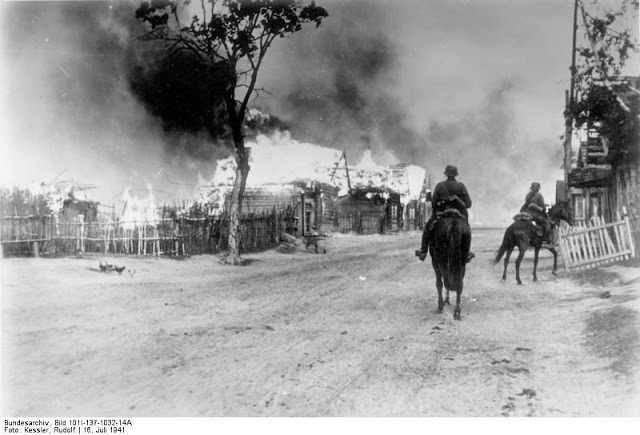
The Germans continue their giant pincer movement at Uman on 16 July 1941. This involves several Wehrmacht armies heading for a meeting behind a huge Soviet troop concentration. Soviet Marshal Budyonny is determined to hold Kyiv and views assembling a mass of men in a relatively confined space as the best way to do that. The Germans also are forming a giant pincer at Smolensk further north. There are so many armies swirling about that another German encirclement here or there is not only not decisive, it is almost perfunctory.
General Halder hopefully notes in his war diary that “the enemy is softening” and “here, it seems he has nothing left in the rear.” However, in fact, the Soviets always have plenty left in the rear to replace any troops the Germans take prisoner.
In the Far North sector, the 1st Jaeger Brigade of Finnish VI Corps reaches the northern shores of Lake Ladoga at Koirinoja on the eastern side of the lake. This divides the defending Soviet 7th Army, which also is defending against the Finnish VII Corps advance toward the western side of the lake. The Stavka grows concerned and begins calling in reinforcements from elsewhere along the Finnish Front. The Finns begin redeploying their forces, sending Finnish 1st Division forward to cover the eastern flank of the advance and also sending forward Finnish 17th Division (which had been left guarding the Soviet base at Hanko). German 163rd Infantry Division, the one that had traveled across Sweden by rail at the outbreak of the war, joins the attack as well. By the standards of the Finnish Front, this is a dramatic expansion of strength. The next objective is the railroad junction of Suvilahti.
Farther north, Axis Operation ARCTIC FOX is stalled at the village of Kayraly just beyond the road junction of Salla. General Hans Feige, commander of German XXXVI Corps, is hesitant about continuing the advance, so General Nikolaus von Falkenhorst, in command of Army of Norway, pays him a visit. Falkenhorst convinces Feige to resume the advance, but Feige wins substantial time to regroup and the offensive remains dormant for the time being. The Soviets land an additional battalion of soldiers in the Bay of Litsa, reinforcing the defense of Murmansk.
In the Army Group North sector, a Soviet counterattack against LVI Army Korps (General Erich von Manstein) makes some progress. The 8th Panzer Division (Major General Erich Brandenburger) takes the brunt of the attacks on the Shelon River. A large part of its difficulties arises from the speed of its advance, as it has outrun its infantry — something that Hitler has been worried about. Manstein sends the 3rd Infantry Division (Lt. General Curt Jahn) to rescue it, and the Soviets decimate it as well. The Luftwaffe supplies the German troops by air as the slower Wehrmacht troops approach from the southwest.
In the Army Group Center sector, the Soviet 16th Army hurls counterattacks against the German 29th Motorized Division and 17th Panzer Division in Smolensk. Bitter house-to-house fighting takes place in the suburbs while the Germans slowly expand their grip on the heart of the city.
In the Army Group South sector, the Battle of Uman continues. General Ewald von Kleist’s 1st Panzer Group continues to split the defending Soviet Southwestern and Southern Fronts, taking Koziatyn. General Eugen Ritter von Schobert’s 11th Field Army, meanwhile, advances north from the Romanian border, and General Karl-Heinrich von Stülpnagel’s 17th Field Army advances to the south of Uman. The movement of all these armies gradually tightens the noose around the trapped Soviet defenders. Soviet Marshal Budyonny is under orders to stay where he is in order to shield Kyiv, and he does. Romanian troops take Kishinev.
In an embarrassing incident for the Soviet Union, Soviet Premier Joseph Stalin’s son, artillery regiment Lieutenant Yakov Iosifovich Jugashvili (aka Yakov Dzhugashvili), is captured by the Wehrmacht. He is the eldest of Stalin’s four children, the son of his first wife, Kato Svanidze. Yakov winds up in a POW camp near Borisov (Barysaw), and one of the other prisoners “outs” him. The Germans publicize the capture in order to use him for propaganda purposes.
Stalin, according to his daughter Svetlana Alliluyeva, believes that Yakov has voluntarily surrendered at the behest of his wife, Yulia. Stalin is so sure of this that, as soon as he hears of the incident, he orders Yulia imprisoned and “interrogated” (which in the USSR of the 1940s usually means some element of torture and mistreatment).
There actually is some evidence that Yakov surrendered voluntarily because a letter written by his brigade commissar alleges that he willingly put on civilian clothes in an attempt to escape from a pocket, but then chose to stay behind and be caught anyway. Since Yakov is caught in civilian clothes, the Germans technically have the right to shoot him — but the Germans shoot anyone they like anyway (pursuant to Keitel’s pre-war orders), so they don’t need any special reason to do so. Instead, the Germans keep Yakov alive in hopes of using him as a bargaining chip, shuttling him between several POW camps before sending him to the Sachsenhausen concentration camp. Yakov does not get along with the British prisoners and slips into a deep depression.
What happens to him there is not exactly known, but he does not survive the war. There are various theories and “interpretations” of the story. It is believed, pursuant to captured German documents, that Yakov is shot by a guard for disobeying orders. However, other variants of the story have him voluntarily throwing himself on the electrified wire surrounding the camp or getting into arguments with the British prisoners and then making some kind of disturbance.
In a rare incident, Soviet battleship Oktyabrskaya Revolutsiya and cruiser Kirov, with Red Air Force support, bombard the German-held port of Riga. This is another example of the Germans’ occasionally shaky grip on the Baltic being exposed.
During the Battle of Smolensk, the city of Smolensk itself fell to the Germans. A large pocket of about 300,000 Soviet forces surrender in the Smolensk area and after heavy city fighting Smolensk fell to Army Group Center.
A pledge that, even if disaster befell in the west, the Red armies would retire behind the Ural Mountains and fight on from the vast, remote spaces of Asiatic Russia was made today by Russian Ambassador Ivan Maisky in London.
In another twist in a very long road of the power of commissars, every Soviet command once again is provided with both a military and a political commander of equal responsibility. These commissars have no military training, but they have a lot of opinions and their own channels to Moscow. If the military commander does not do what they say or acts “improperly,” the commissars and will denounce them. This gives the commissars outsized power and influence over military commanders, who ignore them at their peril.
Commissar of State Security 3rd Rank (19.07.1941) (the equivalent rank of Lieutenant General) Mikheev Anatoly Nikolaevich, head of the political side of the Kyiv Military District, provides an excellent example of how this works today when he accuses NKO Commissar/Marshal Semyon Timoshenko of treason. Mikheev points out the obvious, that Timoshenko had connections with General Pavlov and other executed “traitors,” though his real motivations in making the charge may have nothing to do with that. Stalin begins to look at Timoshenko a bit differently and eventually takes away his title of NKO Commissar. However, Timoshenko remains in good standing, more or less, and gradually satisfies Stalin’s suspicions.
Adolf Hitler, Hermann Göring, Alfred Rosenberg, Wilhelm Keitel, Hans Lammers and Martin Bormann met at Hitler’s headquarters to discuss German occupation policy. Alfred Rosenberg’s appointment as the Reich Minister for Occupied Eastern Territories was confirmed by Adolf Hitler during a conference at Hitler’s headquarters in East Prussia, Germany. In that conference, which was led by Hitler, Hitler provided his vision of the future of Eastern Europe in which the Baltic States were to be incorporated into Germany, Crimea to be populated with ethnic Germans, Caucasus to be a German concession, and Leningrad given to Finland. The final aims of the attack on the Soviet Union were formulated at a conference attended by German Chancellor Adolf Hitler, Reichsmarschall Hermann W. Göring, Nazi Party Minister Martin Bormann, and Reich Minister for the Occupied Eastern Territories Albert Rosenberg. “There can be no talk of the creation of a military power west of the Urals, even if we should have to fight 100 years to achieve this… All the Baltic regions must become part of the Reich. The Crimea and adjoining regions (North of the Crimea) must likewise be incorporated into the Reich. The region of the Volga as well as the Baku district must likewise be incorporated into the Reich. The Finns want Eastern Karelia. However, in view of the large deposits of nickel, the Kola peninsula must be ceded to Germany.”
Germany reversed a prior decree by allowing those who were 50% Jewish and those who were married to women who were 50% Jewish to serve in the military.
Miep Gies gets married. Gies is one of the Dutch citizens who will hide Anne Frank and her family and four other Jews in an annex in Amsterdam. This marriage gives Gies Dutch citizenship and prevents her deportation back to the Reich where she is a citizen.
The partisan uprising Montenegro — the “13 July Uprising” — continues. Insurgents in Virpazar use some small boats to trade some injured Italian soldiers for food and medicine in Scutari.
Charles de Gaulle protested the Armistice of Saint Jean D’Acre between the United Kingdom and Vichy France for it made no mention of the Free French. General Charles de Gaulle, leader of the Free French, is startled at his headquarters in Brazzaville when he receives a copy of the Treaty of Saint-Jean D’Acre that ended the war in the Levant. He cannot believe that it makes no mention of the Free French at all. In a fit of pique, he repudiates it. However, he quickly is brought to his senses and ultimately channels his anger into advocating for the self-determination of the peoples of Lebanon and Syria — something the British already have decided to do.
Captain J.A.V. Morse is named Naval Officer in Charge of Syrian ports with his headquarters at Beirut.
Vichy General Weygand becomes governor-general of Algeria.
A law in Vichy France limited Jews to only 2 percent of lawyers admitted to the bar.
After hearing some intelligence reports of Swedish ships at Göteburg loading steel for trade with Great Britain, the Germans warn Sweden not to permit any ships to head there or face invasion.
President Roosevelt’s personal emissary Harry Hopkins arrives by air in London.
General Wladyslaw Sikorski was presented with the Standard of the Polish Air Force at RAF Swinderby in England, United Kingdom. Smuggled out of Poland, via Stockholm in Sweden, the Standard would subsequently be held by each Polish Squadron in the United Kingdom during the war years.
An Italian convoy of three ships departs from Taranto bound for Tripoli.
RAF Bomber Command, Day of 16 July 1941
Rotterdam
36 Blenheims in low-level attacks on shipping in the docks. Dutch reports later told of 22 ships being damaged in this raid. 4 Blenheims were shot down by the intense Flak. 5 further Blenheims carried out sweeps off the Dutch coast without loss.
RAF Bomber Command, Night of 16/17 July 1941
Hamburg
107 aircraft — 51 Wellingtons, 32 Hampdens, 24 Whitleys — encountered bad visibility. 52 aircraft reported bombing in the general area of Hamburg; 52 aircraft bombed alternative targets. 3 Wellingtons and 1 Hampden lost. Hamburg reports 4 fires — none large, no major damage area, only 1 person injured but 154 bombed out.
Minor Operations: 9 aircraft to Boulogne but the target was cloud-covered and only 3 aircraft bombed, 5 Hampdens minelaying in the Frisians, 6 O.T.U. sorties. No losses.
The Luftwaffe’s nine-victory ace Kurt Sauer of JG 53 becomes a prisoner.
The Luftwaffe raids the Suez Canal with 24 bombers during the night and also raids Tobruk in conjunction with the Regia Aeronautica. The RAF raids Tripoli and Benghazi.
Destroyer HMS Wells departed Scapa Flow after her practices exercises at 1400 for Loch Alsh where she arrived at 2130.
Motor gun boats MGB.90 and MGB.92 were destroyed by fire in Portland Harbor.
P/T/Midshipman (A) R. L. Waddy RNVR, was killed when his Swordfish of 767 Squadron crashed near Arbroath during exercises.
British steamer Elizabete (2039grt) was damaged by German bombing halfway between 20C Buoy and T.2 Buoy, off the Tyne. The steamer returned to the Tyne.
Anti-aircraft cruiser HMS Carlisle, carrying a base party, minesweepers HMS Harrow, HMS Moy, and HMS Lydiard from Haifa, and corvette HMS Salvia and motor launch ML.1032 from Famagusta arrived at Beirut. Captain J. A. V. Morse was named Naval Officer in Charge of Syrian ports with his headquarters at Beirut. Corvette HMS Hyacinth with LL sweeper HMS Fellowship departed Alexandria for Famagusta. Destroyer HMS Jaguar departed Alexandria with a petrol tanker of convoy LE 25 for Beirut. Destroyer HMS Kandahar departed Alexandria for Port Said to join the remainder of convoy LE 25. Kandahar departed Port Said with the two ships of LE 25 on the 17th. Anti-aircraft cruiser HMS Coventry departed Alexandria at noon on the 17th to meet Beirut convoy LE 25 off Port Said. The convoy was covered by light cruiser HMS Ajax and two destroyers. Convoy LE 25 arrived at Beirut on the 17th. Cruiser Coventry relieved anti-aircraft cruiser HMS Carlisle which sailed for Alexandria, arriving on the 19th.
Destroyer HMS Jervis departed Alexandria for Haifa to operate with British forces there. On destroyer Jervis’s arrival at Haifa on the 17th, destroyers HMS Jackal, HMAS Nizam, and HMS Hasty departed Haifa for Alexandria.
Italian troopships Marco Polo (12,272grt), Neptunia (19,475grt), and Oceania (19,507grt) departed Taranto for Tripoli escorted by destroyers Geniere, Gioberti, Lanciere, and Oriani and torpedo boat Centauro. Distant cover was provided by heavy cruisers Trieste and Bolzano and destroyers Ascari, Carabiniere, and Corazziere. On the 18th, Submarine HMS Unbeaten unsuccessfully attacked troopship Oceania. The convoy arrived at Tripoli on the 18th.
Submarine HMS Unbeaten reported damaged a large tanker twenty three miles south, southwest of Messina.
Italian submarine Nereide claimed damage on Greek submarine RHS Triton in torpedo and artillery attacks in 37-25N, 25-52E.
Destroyers HMS Avon Vale, HMS Eridge, and HMS Farndale departed Gibraltar to meet light cruiser HMS Manchester, troopship Pasteur, and destroyers HMS Lightning and HMAS Nestor, arriving from the UK.
Submarine HMS Olympus and Dutch submarine HNLMS O.21 departed Gibraltar to patrol in the Tyrrhenian Sea to support Operation SUBSTANCE.
Convoy OB.347 departed Liverpool, escorted by destroyers HMS Beagle and HMS Boadicea, corvettes HMS Heather, HMS Orchis, and HMS Picotee, minesweeper HMS Sharpshooter, and anti-submarine trawlers HMS Arab, HMS Ayrshire, HMS Lady Madeleine, and HMS Norwich City. Destroyers HMS Roxborough and HMS Salisbury joined on the 18th. These escorts were detached on the 22nd. On the 22nd, destroyer HMS Burnham and corvettes HMCS Agassiz, HMS Celandine, HMCS Mayflower, and HMCS Wetaskiwin joined. The convoy was dispersed on the 31st.
Convoy HX.139 departed Halifax, escorted by corvettes HMCS Bittersweet, HMCS Fennel, and HMCS Pictou, and armed merchant cruiser HMS Ranpura. Corvettes Bittersweet and Fennel were detached later that day. On the 17th, corvettes HMCS Dauphin and HMCS Napanee joined and were detached later the next day. On the 18th, escort ships HMS Sennen and HMS Totland joined, on the 19th, sloop HMS Fleetwood, and on the 20th, corvette HMS Chambly. Destroyers HMS Keppel, HMS Lincoln, HMS Shikari, and HMS Venomous and minesweeper HMS Hebe joined. Armed merchant cruiser Ranpura and corvette Chambly were detached on the 26th. Corvette Pictou was detached on the 28th, the two escort ships on the 29th, and destroyers Keppel, Lincoln, and Shikari and sloop Fleetwood were detached on the 30th. The convoy arrived at Liverpool on the 31st with destroyer Venomous.
A movement developed in the Senate Military Affairs Committee today to have Congress extend the service of selectees by passing a simple resolution declaring that the national interest would be imperiled if they left the Army at the end of their year’s training. This movement, started by Senators who declined to be identified with it, is likely to find expression during discussion of two War Department bills in Military Affairs Committee hearings which with General start tomorrow, George C. Marshall, Chief of Staff, as the first witness. The two bills on tomorrow’s program would extend the service of selectees, National Guardsmen and members of the Regular Army until after the national emergency. The Senators who are supporting the resolution method argue that there is no necessity for the Administration to bring in these new bills, since the language of the Selective Service Act provided an casy way for Congress to take the steps now recommended by General Marshall and supported by President Roosevelt.
Secretary Knox issued an order today that the 37,647 enlisted naval reservists now on active duty be held in service for the duration of the national emergency. His order also prohibits reservists now on duty from resigning even though their four-year enlistments expire.
Eight hundred carefully guarded capsules were tossed about on a canvas today to insure a thorough mixing of the numbers for tomorrow night’s second draft drawing in Washington which will determine the order in which 750,000 young men are called up to qualify for military training.
The Senate Military Committee called on the War and Navy Departments and the Office of Emergency Management today to draft an acceptable property seizure bill after a version sponsored by the White House had been termed “too broad” by Chairman Reynolds, North Carolina Democrat, and others. Reynolds told reporters that a new draft of the bill, submitted to the committee by Wayne Coy, a White House assistant representing the management office, had aroused considerable opposition at a lengthy closed session of the committee this morning.
Price-fixing legislation designed to control the cost of the defense program and prevent a possibly ruinous spiral of inflation was placed on the agenda for this session of Congress today. Congressional leaders said, after a long conference in the office of Vice President Wallace, that bills fixing commodity prices on a nation-wide basis for the national emergency probably would be introduced in both houses next week. They indicated, however, that control of wages would not be attempted through these bills, and that authority over rents probably would be left, for the present, with local governments.
A defense power expansion program involving the expenditure of up to $470,000,000 annually for the duration of the emergency will be started immediately, Leland Olds, chairman of the Federal Power Commission, said today after conferring with President Roosevelt on the power situation. The program, involving the booking of the full capacity of electrical generator plants for the emergency period, was predicated upon estimates that when defense expenditures in 1943 are running at the rate of $3,000,000,000 per month, or an annual rate of $36,000,000,000, the defense power load will be about 20,000,000 kilowatts, which is about four times the present estimated defense load. The plans provide for immediate contracting for capacity output of all generator-building companies in the United States, at a cost estimated to run from $150,000,000 to $200,000,000 a year; an investment in steam stations, not including generators, estimated at from $75,000,000 to $100,000,000 a year; investment of about $170,000,000 annually for additional hydroelectric projects, not including generator costs; creation of a Reconstruction Finance Corporation subsidiary to provide funds for the purchase of all generator-building capacity not booked by private or municipal power companies, and “a series of river basin projects calling for installation of approximately 1,000,000 kilowatts a year” to be constructed by the Corps of Engineers, the Bureau of Reclamation, and regional power authorities.
The Office of Production Management reported today that it faced “an urgent problem” in supplying enough fabricated aluminum parts on time for defense production in the next six months. A joint statement by William S. Knudsen, OPM director general, and Sidney Hillman, associate director, set forth that a recent release of the National Association of Manufacturers tended to carry “the false implication” that there was no problem involved in the supply of sufficient quantities of aluminum for defense work. “Any statement, which directly or by implication, gives the impression that the supply of aluminum for military requirements does not present a critical problem, is not in accord with the facts and can only result in harm to the defense program,” Mr. Knudsen and Mr. Hillman asserted.
New York District Attorney Thomas E. Dewey, aided by 100 detectives and uniformed patrolmen and fifty attache’s of his office, early yesterday morning brought into the open a “long-range” investigation of general racketeering that he charged was hampering national defense efforts in this port.
Despite the nation’s defense production program, 5,000,000 persons will remain unemployed this year, Corrington Gill, assistant commissioner of the Works Progress Administration, said today. Testifying before the House special committee investigating problems of migratory labor, Mr. Gill said that the WPA would employ only 1,000,000 of the total unemployed and added that “there is no possibility of a general labor shortage.”
100°F (38°C); highest temperature ever recorded in Seattle, Washington.
Full-scale wind-tunnel tests of A-1 “power-driven controllable bomb” conducted at Langley Field.
U.S. Navy heavy cruiser USS Astoria departed Mare Island Naval Shipyard, California.
U.S. Navy Task Group 2.7, comprised of the light cruisers USS Philadelphia (CL-41) and USS Savannah (CL-42) and destroyers USS Meredith (DD-434) and USS Gwin (DD-433), departed Bermuda for a 3,415-mile neutrality patrol that would conclude there on July 25.
U.S. Navy transport USS West Point embarked 137 Italian and 327 German citizens off Staten Island, New York, United States and set sail for Lisbon, Portugal at 1455 hours. The transport USS West Point (AP-23) (former U.S. passenger liner America) set sail from New York City with German and Italian consular officials and their families, bound for Lisbon, Portugal. The British government had granted the USS West Point safe-conduct for the voyage. On June 16 the United States had requested the withdrawal of German and Italian consular staffs from the United States by July 10.
Major League Baseball:
Playing before 32,265 rabid Flatbush fans who had crowded into the stands exuding confidence in the ability of their heroes to win this important game, the Dodgers let them down with a dull thud by blowing a 4-run lead and losing to the Cardinals, 7–4. This cut the Brooklyn margin to three games and made tomorrow’s series finale with St. Louis even more important.
The Pittsburgh Pirates found five Boston Braves pitchers for fifteen hits today to win the second game of a double-header, 13–5, after dropping the opener, 4–1. The first game gave Jim Tobin his fourth straight victory and he became the first of the Braves’ pitchers to chalk up six triumphs this season. The Braves had things pretty much their own way during the first five innings of the nightcap and were leading the Pirates by the comfortable margin of 5–1 at the start of the sixth, when Pittsburgh made three runs.
Cecil (Tex) Hughson, turning in his third straight victory since the Boston Red Sox recalled him from Louisville recently, held the Chicago White Sox to four hits today to shade Buck Ross, 2–1, in a hurlers’ duel settled in the ninth inning.
The New York Yankees travel from Chicago to Cleveland, Ohio, to play the Cleveland Indians in League Park. Yankee centerfielder Joe DiMaggio extends his hitting streak to 56 consecutive games by going 3-for-4 against Cleveland pitchers Al Milnar and Joe Krakauskas, as the Yankees rout the tribe, 10–3. Charlie Keller hits his 20th homer. While not known on this day, this is the last game of DiMaggio’s 56-game hitting streak This record is never broken, and never even approached.
The New York Giants score four in the first inning and hold on to beat the Cincinnati Reds, 7–4. Youthful Bob Carpenter was credited with his seventh success as against a single defeat, but he was none too steady at any time and needed some sparkling play afield as well as help from Hal Schumacher. The bespectacled freshman hurler was nicked for eleven hits in six and two-third innings and Schumie for two more. The Giants gathered ten off Bucky Walters and none off Junior Thompson in the last frame.
The Cubs dropped the Phillies deeper in last place tonight with a 9-to-5 victory. The veteran pitcher, Charley Root, who started for Chicago, helped with a homer as did Catcher Clyde McCullough, who connected with two on in the third inning.
Chet Laabs has a record-tying 4 long hits — 2 homers, a triple and double — to pace the St. Louis Browns to an 11–2 win over the Philadelphia Athletics. Bob Muncrief is the winner.
The scheduled game between the Washington Senators and the Tigers at Detroit was postponed due to rain. The game will be made up as part of a doubleheader on August 21.
St. Louis Cardinals 7, Brooklyn Dodgers 4
Pittsburgh Pirates 1, Boston Braves 4
Pittsburgh Pirates 13, Boston Braves 5
Boston Red Sox 2, Chicago White Sox 1
New York Yankees 10, Cleveland Indians 3
Cincinnati Reds 4, New York Giants 7
Chicago Cubs 9, Philadelphia Phillies 5
Philadelphia Athletics 2, St. Louis Browns 11
Movements of Japanese troops in China Tuesday increased the belief in Chinese Government circles that Japan would soon take new aggressive military or political action in some part or parts of the Far East. Opinion is divided over where the Japanese will strike.
The Imperial Headquarters-Cabinet Liaison Conference has decided to attack south, rather than north toward Vladivostok, Russa as the Germans want. Foreign minister Matsuoka, however, greatly favors the northern strategy and drops some hints to both the Soviets and the Americans that it will join the attack on the USSR. The Soviet ambassador is startled and demands assurances that the recently signed non-aggression pact between the two countries will be honored. This causes a rift within the Japanese government, and Prince Fumimaro Konoe resigns to form a new cabinet — without Matsuoka. The ironic thing about this sequence of events is that Matsuoka’s strategy has a lot to offer — more than drawing the United States into the war, at least.
Japanese Prime Minister Prince Konoe Fumimaro and his cabinet resigned. To end the policy deadlock between Japanese leaders in view of the world situation the second Cabinet of Prince Fumimaro Konoe resigned tonight after a year’s tenure.
Emperor Hirohito summoned former Premier Admiral Mitsumasa Yonai to conference today in an attempt to find a successor to Premier Prince Fumimaro Konoe, whose government resigned in a body. There were reports that the army and navy would dominate the new government.
The Imperial Japanese Navy heavy cruisers HIJMS Mogami, HIJMS Mikuma, HIJMS Kumano and HIJMS Suzuya (CruDiv 7) depart Kure.
Imperial Japanese Navy Cardiv 2 (aircraft carriers HIJMS Soryu and HIJMS Hiryu) arrive at Samah. Elements of Cardiv 2’s air groups are flown off to operate from land bases during the Indo-Chinese landings to follow.
U.S. Army General Leonard Gerow recommended General George Marshall to activate the Philippine Army and to provide it additional funding. He also recommended that Douglas MacArthur to be asked to return from the retired list as the commander in chief in the Philippine Islands.
Chief of Staff General Marshall instructs General “Hap” Arnold, commander of the US Army Air Force, to send reinforcements to the Philippines, including B-17 bombers.
The United States Navy, on orders from Washington, began at dawn today to mine the entrances to Manila Bay and neighboring Subic Bay, both vital areas for the defense of Manila and the Philippines.
Dow Jones Industrial Average: 127.83 (-0.36)
Born:
Willis Crenshaw, NFL fullback (St. Louis Cardinals, Denver Broncos), in St. Louis, Missouri.
Ken Herock, AFL tight end and linebacker (AFL champions-Raiders, 1967 [lost Super Bowl II]; Oakland Raiders, Cincinnati Bengals, Boston Patriots), in Munhall, Pennsylvania.
George Young, Baron Young of Cookham, British minister of housing & planning, in Oxford, England, United Kingdom.
Hans Wiegel, politician, in Amsterdam, Netherlands (d. 2025).
Peter Minshall, Carnival Artist, in Georgetown, Guyana.
Naval Construction:
The Royal Navy Bar-class boom defense vessel HMS Bardolf (Z 171) is laid down by Blyth Shipbuilding & Drydock Co. Ltd. (Blyth, U.K.).
The Royal Navy Bar-class boom defense vessel HMS Barfoss (Z 200) is laid down by W. Simons & Co. Ltd. (Renfrew, Scotland).
The Royal Navy YMS-1-class auxiliary motor minesweeper HMS BYMS 2017 (J 817) is laid down by the Bellingham Iron Works, Inc. (Bellingham, Washington, U.S.A.).
The U.S. Navy YMS-1-class auxiliary motor minesweepers USS YMS-50 and USS YMS-51 are laid down by the Wheeler Shipbuilding Corp. (Whitestone, Long Island, New York, U.S.A.).
The U.S. Navy YMS-1-class auxiliary motor minesweeper USS YMS-81 is laid down by the Stadium Yacht Basin (Cleveland, Ohio, U.S.A.).
The U.S. Navy 77-foot Elco patrol motor torpedo boat USS PT-43 is launched by the Electric Launch Company Ltd. (Elco), (Bayonne, New Jersey, U.S.A.).
The Kriegsmarine (German Navy) Type VIIC U-boat U-408 is launched by Danziger Werft AG, Danzig (werk 109).
The Royal Navy harbor defence motor launch HMS HDML 1065 is commissioned.
The U.S. Navy Cimarron-class fleet oiler USS Suwannee (AO-33) is commissioned. Her first commanding officer is Commander Joseph Robert Lannom, USN. She is converted in 1942 to a Sangamon-class escort aircraft carrier, as USS Suwannee (AVG/ACV/CVE-27).
The U.S. Navy Goldcrest-class minesweeper USS Chaffinch (AM-81) [ex-fishing trawler Trimont] is commissioned. Her first commanding officer is Lieutenant Edward Fluhr, USNR.
The U.S. Navy coastal patrol yacht USS Truant (PYc-14) is commissioned. Her first commanding officer is Lieutenant Commander Isaac R. Boothby, DM, USNR.
The U.S. Navy 77-foot Elco patrol motor torpedo boat USS PT-35 is commissioned.
The Kriegsmarine (German Navy) Type VIIC U-boat U-701 is commissioned. Her first commanding officer is Kapitänleutnant Horst Degen.
Les Forces Navales Françaises Libres (Free French Naval Forces) Flower-class corvette FFL Lobelia (K 05) is commissioned.

