Demonstrating that the Wehrmacht’s striking power remains intact on 15 July 1941 despite weeks of unrelieved wear and tear and Soviet counterattacks, Generals Hoth and Guderian brush aside Soviet opposition at Smolensk. Ultimately, the Germans encircle about 300,000 Soviet troops in the Smolensk–Orsha pocket. It is an unalloyed victory and one of the great triumphs of Operation Barbarossa.
Just south of Finland, Soviet commandos invade the small Finnish island of Morgonland. The island is important to the Soviets because properly garrisoned, it could restrict access to their port of Hanko on the Finnish mainland, which is still holding out. The Finns only have five lightly armed men on Morgonland, and they are captured and sent to Kazakstan. One survives to see Finland again.
In the Far North sector, Finnish VI Corps advances toward Lake Ladoga from the northeast and continues clearing resistance on the eastern shore of the Jänisjärvi Lake (north of Lake Ladoga). The defending Soviet 7th Army opposing VI Corps is outnumbered and over-matched and struggles to maintain a front north of Lake Ladoga. However, Finnish VII Corps has been having much more trouble advancing parallel to VI Corps on the western shore of Jänisjärvi Lake, and only today does it run up against the main Soviet fortifications. The Finns hope that both Corps will be able to round the lake and meet to the south of it and surround the remaining Soviet defenders, but the two Finnish Corps are operating completely independently and must both overcome their respective opponents for that to happen. An advance to Lake Ladoga also would split the Soviet defenders.
In the Army Group North sector, Soviet 11th Army counterattacks against German 4th Panzer Group in the Lake Ilmen region. The Soviet forces are ravaged, but buy time for Soviet forces further back to build fortifications. In Leningrad, citizens begin building tank traps and other fortifications.
In the Army Group Center sector, the German 29th Motorized Division (General Walter von Bolternstern) of 47 Panzer Korps, supported by 17th Panzer Division, reach the outskirts of Smolensk by 04:00 and take the heart of the city by dark. Soviet 16th Army remains in the suburbs and launches counterattacks, which results in house-to-house fighting. This is a rarity so far during Operation BARBAROSSA, as the panzers so far have been able to stick to the roads and follow them east toward Moscow. German 7th Panzer Division and 20th Panzer Division bypass Smolensk and reach Yartsevo, to the city’s east. Isolating the Soviet forces around Smolensk is more significant in the long run than actually taking the city, and to do both in the same day is a phenomenal achievement. General Hoth’s 3rd Panzer Group takes Nevel.
In the Army Group South sector, the Battle of Uman begins when General Ewald von Kleist’s 1st Panzerarmee separates the two Soviet sectors of the front south of Kyiv and north of Vinnytsia by capturing Berdychiv. General Karl-Heinrich von Stülpnagel’s 17th Field Army advances to the south of Uman and General Eugen Ritter von Schobert’s 11th Field Army advances northward from the Romanian border. The plan is to encircle large Soviet formations in the vicinity of Kyiv, but the Soviets wrongly interpret the moves as part of an advance to the Dniepr between Kyiv and Cherkasy and further to the east. Romanian troops advance toward Kishinev.
German 228th Regiment cleared four Stalin Line bunkers and crossed the Ljadowa River, a tributary of the Dniester River, in Ukraine.
Soviet Zhytomyr-class river monitor Vinnytsia is operating in the Berezina River when it is hit by German field artillery. The master runs the ship aground to avoid sinking, then the crew later scuttles on the 16th to avoid capture.
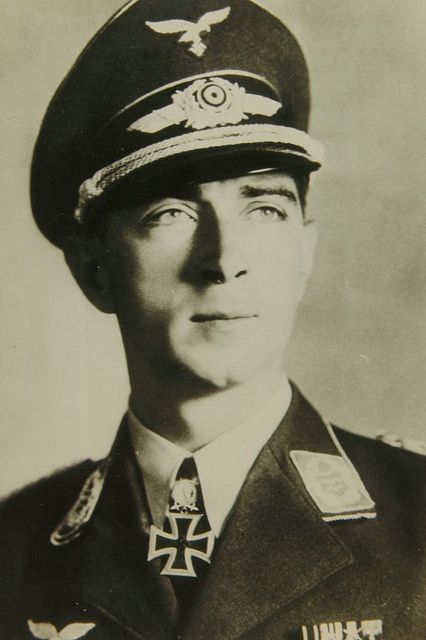
Luftwaffe ace Werner Mölders files his 100th and 101st victory claims. He celebrates by making a victory roll over his JG 51 airfield. Mölders will receive the Knight’s Cross of the Iron Cross with Oak Leaves, Swords and Diamonds (Ritterkreuz des Eisernen Kreuzes mit Eichenlaub, Schwertern und Brillanten) for reaching the “C” mark.
Hartwig von Ludwiger is awarded the Knight’s Cross of the Iron Cross on 15 July 1941 as Oberstleutnant and commander of Infanterie-Regiment 83 of the 28th Infantry Division for bravery in the vicinity of Smolensk.
Prime Minister Winston Churchill brushed away all weasel words and all talk of “association” and bluntly announced to the House of Commons today that the recent agreement between Britain and Russia “is, of course, an alliance and the Russian people are now our allies.”
ShCh-401 attacked German auxiliary submarine chasers UJ 177 and UJ 178 off Kiberg, Norway with a torpedo; the torpedo missed.
There is a mass execution of Jews at Bălţi, Moldova. This is part of a targeted campaign against Jews instituted by the government of Prime Minister Ion Antonescu. The order to murder some of the Jews of Bessarabia and Bukovina was given by the Romanian leader Antonescu. To carry out the mission he appointed the gendarmerie, under the command of the ministry of the interior, as well as the army civil administration, known as “Pretoria.” General Ion Topor, “Supreme Commander of the Pretoria” and commander of the gendarmerie units in the liberated territories, was given clear orders regarding how to treat Jews, communists and Soviet officials found in Romanian territory: send all the pro-communist Romanians and Ukrainians across the Dniester River, and exterminate all the “minoritari” (a colloquial word for Jews) in the same category.
The Romanian policy was carried out in Bălţi by Capitan Ion Gradu, Major Fălescu, military police chief, Dimitrie Agape, head of the police Moria Filipescu and detective agent Vassili Sprinciglo. Gradu brought the Jews of Bălţi to a camp set up in the Răuţel Forest, 12 km from the town. There they were imprisoned in extremely crowded conditions, in dilapidated buildings surrounded by a barbed wire fence and armed soldiers. Disease and hunger rapidly spread, and many died. They were not allowed to buy food from the farmers nearby. The mayor of Bălţi, Judge Artseliano, sent the exiled Jews daily sacks of corn flour, oil and vegetables.
Erwin Rommel was officially declared the commanding officer of Panzergruppe Afrika.
British troops at noon today began full occupation of Syria and Lebanon under the terms of the agreement signed yesterday at Acre, Palestine, by General Sir Henry Maitland Wilson for the British and General Joseph de Verdillac for the Vichy military authorities.
Honoring Charles de Gaulle’s previous proclamation that the Allies had invaded the Vichy-held French Mandate of Syria and the Lebanon as liberators rather than conquerors, the British who had accepted the Vichy surrender on the previous day handed control of the territory to the locals. When they invaded a month ago General de Gaulle said in a broadcast: “I come to end the mandatory regime and to proclaim you free and independent.” Thus Syria and Lebanon — to strong Vichy protests — join Eritrea in being offered self-determination.
The revolt in Montenegro against Italian occupation authorities continues to grow. Two units of 80 insurgents (from Ljubotinj and Upper Ceklin) ambush a convoy of trucks transporting Italian II Border guard battalion from Podgorica.
Italian forces are sent to relieve Cetinje, which is besieged by the insurgents. After eight hours of battle, the insurgents are victorious and kill 70–80 Italian soldiers and officers, wound 260, and capture the remaining 440 Italians.
At Virpazar, rebels capture several small boats. They intend to use them to trade with Italian authorities in Scutari.
The MAUD Committee in London approves its final report on nuclear research and disbands (“Maud” does not stand for anything and is not an acronym; it actually is just taken from a cryptic comment made by Niels Bohr in a telegram from occupied Europe about his children’s nanny, named Maud Ray Kent). The MAUD Committee is a secret unit of the Air Ministry tasked with discussing the feasibility of atomic weapons.
While they are still only a theoretical concept, atomic bombs are described in great detail and with precise accuracy in the MAUD report. The report includes a concrete proposal for building atomic weapons, including cost estimates and how long the project could take. It states in part:
“We have now reached the conclusion that it will be possible to make an effective uranium bomb which, containing some 25 lb of active material, would be equivalent as regards destructive effect to 1,800 tons of T.N.T. and would also release large quantities of radioactive substance, which would make places near to where the bomb exploded dangerous to human life for a long period.”
Vannevar Bush has reviewed drafts of the report but awaits the receipt of an official final copy before taking any action.
Inigo Campioni was appointed governor of the Italian Aegean Islands, also known as the Italian Dodecanese.
Throughout the war, working on the front lines is extremely hazardous for German war correspondents and photographers. Today, two men in this capacity perish, namely, Max Kretzer, 87, German writer; and Walter Ruttmann, 53, German film director.
The British government begins requiring import permits for all cargo passing through English ports. Any cargo without a permit is subject to seizure. This is of concern to the Japanese (as revealed by Magic intercepts), who don’t like their activities scrutinized.
RAF Bomber Command, Night of 15/16 July 1941
Duisburg
38 Wellingtons; bombing was difficult because of cloud and Flak. 4 aircraft lost.
Werner Mölders claimed his 100th and 101st victories over the Soviet Union. He was awarded Diamonds to his Knight’s Cross for achieving 100 victories, which was to be presented later by Adolf Hitler personally.
The Luftwaffe attacks two Royal Navy lighters A.10 and A.11) while they are sailing to Tobruk. The planes badly damage A.10 east of Tobruk and later sinks while in tow. There is one death and three wounded in A.10 and one wounded in A.11.
The Regia Aeronautica raids Malta several times after dark, but the bombs are dropped virtually at random. There are a few wounded soldiers. A Maryland reconnaissance plane fails to return from a mission and the crew of three deaths. Also, a crewman on a Blenheim that is attacking a Tripoli convoy perishes when hit by anti-aircraft fire.
The Red Air Force bombs and sinks Romanian Navy minelayer NMS Aurora at the mouth of the Sulina branch of the Danube, the easternmost part of Romania.
Ocean boarding vessel HMS Lady Somers (Cdr G. L. Dunbar RD RNR) was sunk by Italian submarine Morosini in 37-12N, 20-32W. Corvette HMS Spiraea of convoy OG.67 was ordered to her position to assist. The entire crew of one hundred and thirty eight was picked up by Spanish steamer Campeche (6382grt). Sloop HMS Bideford and anti-submarine trawlers HMS Loch Oskaig and HMS Imperialist were ordered to intercept the steamer and take off the survivors due to the difficulty in obtaining the release of seamen from Spain. The survivors were landed by the Spanish ship at Lisbon. They arrived back at Gibraltar on the 18th in British steamer Procris (1033grt).
Anti-aircraft ship HMS Curacoa departed Methil and joined convoy EC.45 off May Island. The ship left the convoy in Pentland Firth and arrived at Scapa Flow at 1900. Ship Curacoa departed at 2030 to rejoin a portion of the convoy which had proceeded north of the Orkneys.
Minelayer HMS Teviotbank, escorted by destroyer HMS Castleton and survey ship HMS Scott, laid minefield SN.21 A of the Northern Barrage.
Landing ship Prince Philippe (2938grt) was sunk in a collision with steamer Empire Wave (7463grt) off west of Scotland. T/Sub Lt (E) F. G. Moncur RNR, died of injuries sustained in the collision.
British steamer Farfield (468grt) was sunk by German bombing five miles 250° from South Stack. One naval rating was saved, but the crew of eight was lost.
The German 3rd Motor Torpedo Boat Flotilla of S.54, S.47, S.58, and S.57 attacked a Soviet destroyer in the Bay of Riga without success.
New Zealand Division light cruiser HMS Leander departed Alexandria to reinforce the British forces at Haifa.
Submarine HMS Unbeaten sank Italian patrol vessel Nettuno off Mara Zuag Roads. The submarine reported sinking a second patrol vessel.
Submarine HMS Taku sank Italian patrol vessel Vincenzo Padre (270grt) east, SE of Ras Auegia.
Lighters A.10 (Sub Lt J. D. Thom RNVR) and A.11, en route to Tobruk, were attacked by German dive bombers in 32-15N, 25-26E. A.10 was hit and abandoned, after attempts to take her in tow by A.11 failed. One rating was killed and three ratings were wounded in lighter A.10. T/A/Sub Lt W. G. Jenkins RNVR, was wounded in A 11.
Destroyers HMS Firedrake, HMS Vidette, HMS Vimy, and HMS Beverley, motor Launch 126 of the 3rd Motor Launch Flotilla, and the 9th Motor Launch Flotilla of Motor launches 169, 170, 172, 173, 174, 175, and 176 arrived at Gibraltar. Destroyer Firedrake departed later that day and joined the 8th Destroyer Flotilla en route to join convoy WS.9C.
Convoy SL.81 departed Freetown escorted by armed merchant cruisers HMS Cape Sable to 8 August and HMS Moreton Bay to 2 August, destroyer HMS Wrestler to 23 July, and corvettes HMS Clematis, HMS Cyclamen, HMS Mignonette, and HMS Woodruff to 23 July. On the 30th, corvettes HMS Carnation to 6 August, HMS Heliotrope to 8 August, and HMS Mallow to 4 August joined. Destroyers HMS Campbeltown, HNoMS St Albans, and HMS Wanderer to 8 August, catapult ship HMS Maplin to 7 August, and corvettes HMS Bluebell, HMS Campanula, HMS Hydrangea to 5 August, HMS La Malouine to 6 August, HMS Wallflower to 8 August, and HMS Zinnia to 8 August joined on 3 August. On 3 August, a Hurricane from Maplin shot down a Fw.200 in 50-33N, 19-40W. Pilot Lt R. W. H. Everett then bailed out and was picked up by a dingy from the catapult ship. The convoy arrived at Liverpool on 8 August.
In Washington today, President Roosevelt signed the Ship Warrants Act authorizing shipping priorities; promoted Daniel W. Tracy to be Assistant Secretary of Labor; promoted Alfred T. Nester of New York to the rank of Consul General; asked Congress for national or regional daylight saving and conferred with Treasury, budget and House leaders on the new tax bill. His callers included Viscount Halifax, the British Ambassador; Sidney Hillman, Associate Director. General of OPM, Leon Henderson and Wayne Coy. He held his usual afternoon press conference.
The Senate approved the bill for retirement of unfit Army officers; confirmed the renomination of Garland S. Ferguson as a Federal Trade Commissioner; approved the oil pipeline bill; heard Senator Wheeler oppose the Administration’s war policies; received a bill authorizing a glider training program and recessed at 5:14 PM until noon Thursday. The committee investigating the defense program heard Robert P. Patterson, Assistant Secretary of War; the Naval Affairs Committee approved the bill authorizing $585,000,000 for ship building, repair and ordnance facilities.
The House defeated a resolution for a special investigation of transferring non-defense agencies from Washington; received the War Department’s request for bills lifting restrictions on compulsory Army service and adjourned at 4:06 PM until noon tomorrow. The Rules Committee approved the defense highway bili for immediate consideration; the Military Affairs Committee heard General George C. Marshall, Chief of Staff, urge passage of the bill to permit retirement of unfit Army officers; the special committee investigating defense labor migration heard Sidney Hillman, Associate Director General of OPM, and William Green, president of the A. F. of L.
With simple emphasis, President Roosevelt said today that the controversy over extending the training period of draftees involved essentially the question whether the army should be permitted to disintegrate in times such as these. If the selectees, national guards men and reserves who were called up for one year of service are discharged at the end of that time, he said, two-thirds of the army will be gone. It would have to be replaced by an equivalent proportion of untrained men, he continued, adding that this was why the situation was so serious.
High Administration sources disclosed tonight that Harry Hopkins, supervisor of the Lend-Lease program and one of President Roosevelt’s closest advisers on aid-to-Britain, had left for London. Mr. Hopkins returned from England in February after a special trip to survey the war situation as the President’s personal representative. White House sources refused to comment on his latest assignment, but it was understood that Mr. Hopkins held no secret mission and had gone back for another first-hand check-up on war developments abroad. The exact date Mr. Hopkins left this country was not disclosed. One source said it was “several days ago” and that he presumably had flown.
Senator Glass called today for immediate repeal of the Neutrality Act to re-establish freedom of the seas for United States shipping and show Hitler that “we are not afraid” of him.
In a surprise move that may alter the living habits of millions of Americans, President Roosevelt asked congress today for authority to order a far-flung extension of daylight saving time. Under the plan, which is designed to conserve electricity for defense production, he could order clocks throughout the country, or in any part of the country, to be turned as much as two hours forward for the whole year or any part of the year.
Senator Wheeler, Montana Democrat, said in the senate today that Englishmen who “come over here and ridicule” congress should be told to “go home and mind their own business.” He expressed this view after reading to the Senate an interview with Josiah Wedgewood, a member of the British parliament, in which the Englishman was quoted as saying, “Tell Wheeler to go soak his head.” “Think of the gall, think of the insolence of a member of the British parliament coming over here and ridiculing the congress of the United States.” Wheeler added that if a member of Congress had done the same thing in England he would be “run out of the country just as this man Wedgewood ought to be run out of the United States.”
President Roosevelt expressed the view today that there would be need of a tax bill each year during the defense emergency to adjust revenues to expenditures. He made this statement at his press conference after a meeting with Chairman Doughton of North Carolina and Representative Cooper of Tennessee, of the Ways and Means Committee of the House, and Secretary Morgenthau and Assistant Secretary Sullivan of the Treasury. Mr. Roosevelt said the conference did not explore a proposal to draft a tax bill which would yield more than $3,500,000,000 in revenue, the present goal. When asked if consideration was being given to increased defense expenditures, he said that a new tax bill would have to be drafted next Winter to raise more revenue and that in times like these a now tax bill might have to be drafted each year.
A proposed congressional measure to require husband and wife to file joint income tax reports is unfair to married women with small separate income, the California state chamber of commerce claimed today. “A married woman whose net taxable income is $1,000 and whose husband’s is $4,000, would be confronted with an increase in her income tax of 100 per cent,” the chamber said. “The mandatory joint return automatically throws her $1,000 Income into the surtax brackets, providing her husband’s taxable income is $4,000 or more, and her tax bill would jump from $44 to $88.”
Thirty-three persons were indicted in Brooklyn yesterday on charges of cooperating with the German Government to violate the espionage laws of this country. One defendant pleaded guilty yesterday. The others will be arraigned in Federal Court on Friday and the trial has been tentatively set for September. On the first count in the indictment thirty-one defendants were accused of having acted as agents for a foreign government without registering. The second count charged that the thirty-three defendants had conspired to transmit information to a foreign power. The indictment, one of the longest handed up in a Federal Court, contained thirty-nine pages. Thirty-one overt acts were listed in the first count of the indictment and thirty-four in the second count. In addition to listing the defendants, the indictment named others as conspirators in all parts of the world and specifically named “the Government of the German Reich” as party to the conspiracy.
While a Coast Guard plane hovered watchfully overhead, the Navy transport West Point pulled out of her berth at Pier 61, North River, in New York at 5:32 PM today on the first stage of her voyage to Lisbon, with a passenger list made up of 450 Germans and Italians leaving this country, in compliance with orders of the State Department.
British researchers Howard Florey and Normon Heatley arrived at the Northern Regional Research Laboratory in Peoria, Illinois with freeze dried mold cultures and information that would lead to the mass production of Penicillin.
Possibility of a further cut in automobile production beyond the 20 percent reduction ordered by the government, effective August 1, was intimated today as prominent figures in the automotive world conferred with Leon Henderson, administrator of the Office of Price Administration and Civilian Supply.
The U.S. Navy Operating Base Argentia in Newfoundland was officially commissioned. The base would be an important transfer station for the Allies traversing the northern Atlantic Ocean.
The U.S. Marine Corps activated the Marine Detachment at the American Embassy in London, England, United Kingdom.
American Cruiser Division 7 (Rear Admiral H. Kent Hewitt) with light cruisers USS Philadelphia, USS Brooklyn, USS Savannah, and USS Nashville relieved heavy cruisers USS Wichita, USS Quincy, and USS Vincennes from Central Atlantic Neutrality Patrol.
Pitching for the Paragould Browns in the Northeast Arkansas League (Class D), Hooks Iott pitches 16 innings against Newport, the eventual league champs, and strikes out 30 batters. Hooks’ total is an organized ball record. Hooks struck out 22 Jonesboro batters on June 26 and 25 batters earlier to break Burley (sic) Grimes’ 1937 league mark.
Major League Baseball:
Brooklyn manhandled the Chicago Cubs, 7–0 and 8–4, and made it four out of five for the series. A crowd of 33,247 looked on while the pennant-chasing Dodgers continued to fatten up at the expense of Jimmy Wilson’s outfit. For a time it even appeared that the Cubs had stopped fretting about winning a game and wondered when they would score a run. Curt Davis blanked them with four hits in the opener and it was not until the fourth inning of the nightcap that they broke through against Luke Hamlin. Until then the visitors had gone twenty-two consecutive innings without a tally against the Dodgers, who increased their lead over the second-place Cardinals to four games.
Johnny Vander Meer struck out eleven Braves today while gaining his fourth shut-out of the season, 3–0, and his eighth triumph for the Reds. The steadily improving southpaw, who turned in one of his two consecutive no-hitters against Boston as a freshman in 1938, gave only four hits, one a triple by ‘Bama Rowell.
The New York Yankees and Chicago White Sox play the final game of a three-game series at Comiskey Park in Chicago, Illinois. The Yankees win, 5–4. Yankee centerfielder Joe DiMaggio goes 2-for-4 against White Sox pitcher Eddie Smith and extends his hitting streak to 55 consecutive games. Buddy Rosar’s triple with the bases loaded in the third wins it for New York.
Pitcher Joe Dobson, who couldn’t quite make the grade as a regular with the Indians proved today they made a mistake in trading him last Winter. The right hander limited his former mates to four hits-three singles and Hal Trosky’s pinch double -to send them down to a 6–2 defeat and give the Red Sox one victory in the four-game series. Dobson passed six batters, but he fanned nine.
The Tigers climbed within striking distance of fourth place today by defeating the Athletics, 3–2, on Barney McCosky’s first home run of the season. Rookie Luman Harris of the Athletics was charged with his first defeat against two victories.
The Giants were stricken with an acute case of butter-fingers at the Polo Grounds yesterday as four errors gave the Pirates the four runs they needed for a 5–1 victory. Max Butcher held the Giants to seven hits and got the win.
The second-place Cardinals and the last-place Phillies battled tooth-and-nail for sixteen innings today before the Redbirds eked out a 3–2 victory on Jimmy Brown’s long fly with the bases full in the sixteenth.
Chicago Cubs 0, Brooklyn Dodgers 7
Chicago Cubs 4, Brooklyn Dodgers 8
Cincinnati Reds 3, Boston Braves 0
New York Yankees 5, Chicago White Sox 4
Boston Red Sox 6, Cleveland Indians 2
Philadelphia Athletics 2, Detroit Tigers 3
Pittsburgh Pirates 5, New York Giants 1
St. Louis Cardinals 3, Philadelphia Phillies 2
Admiral Jean Decoux, Governor General of French Indo-China, announced in Saigon today that Japanese demands for further concessions in Indo-China had been received. Admiral Decoux denied Japanese press charges that French Indo-China was failing to execute the terms of her agreement with Japan and that she was persecuting pro-Japanese Annamese [natives of Indo-China]. “Indo-China will do nothing to trouble the situation in the Southern Pacific,” he said. “Because of the geographical position of Hong Kong and Singapore, Indo-China will continue its trade relations with these points, exchanging vital merchandise.”
Although the British offer to negotiate with the Chinese Government on the surrender of extraterritoriality is gratifying to Chinese circles, the move on the part of London occasioned no surprise in either Chinese Embassy or American State Department circles today.
The Imperial Japanese Navy aircraft carrier HIJMS Akagi returns to Yokosuka for maintenance and repairs.
Having finally been supplied with Prestone antifreeze for their P-35As in the Philippines, the pilots of the 3rd and 20th Pursuit Squadrons finally complete their qualifications on the fighter.
The Japanese are keeping a close eye on U.S. military activity all across the Pacific. Today, the Japanese Embassy in the Philippines reports to Tokyo about the status of construction at the Cavite military base due to an electricity outage caused by bad weather.
There is a very quiet economic war in progress between the United States and Japan even though the guns remain silent. This explodes today in an unexpected direction: Mexico.
Mexico and the US sign an agreement today instituting an embargo of Mexican exports outside the Americas. This obviously is directed at Japan, given that Japan relies heavily on Mexican mercury and other items.
Yoshiaki Miura, Japanese Minister in Mexico City and who also happens to be the head of the Japanese Intelligence Network in Mexico and Central America, calls a meeting of local Japanese businessmen to discuss the situation. They decide to test the Mexican position by requesting approval to export goods already under contract to Japan. Miura decides that, if Mexico refuses to approve the exports, Japan, in turn, will take steps against Mexico. These include stopping the export from Japan to Mexico of rayon, which Mexico greatly needs (it has no other source of supply). Japan also would refuse the use of Japanese shipping to Mexico.
The upshot is that Minister Miura has his agents successfully work a deal with Mexico’s Economic Minister: Japan will trade 20,000 cases of rayon for 8,000 bottles of Mexican mercury despite the embargo. Miura sends the proposed deal to Tokyo for approval.
Dow Jones Industrial Average: 128.19 (+0.3)
Born:
Archie Clark, NBA point guard and shooting guard (NBA All-Star, 1968, 1972; Los Angeles Lakers, Philadelphia 76ers, Baltimore-Capital Bullets, Seattle SuperSonics, Detroit Pistons), in Conway, Arkansas.
Bob Jencks, NFL kicker and tight end (NFL Champions-Bears, 1963; Chicago Bears, Washington Redskins), in Columbus, Ohio (d. 2010).
John Sisk, NFL defensive back (Chicago Bears), in Milwaukee, Wisconsin.
Geoffrey Burgon, British jazz trumpeter, and film, television and concert composer (City Adventures), in Hampshire, England, United Kingdom (d. 2010)
Died:
Max Kretzer, 87, German writer.
Walter Ruttmann, 53, German film director (died of wounds sustained on the front line as a war photographer).
Naval Construction:
The U.S. Navy YMS-1-class auxiliary motor minesweeper YMS-100 is laid down by the Astoria Marine Construction Co. (Astoria, Oregon, U.S.A.).
The U.S. Navy YMS-1-class auxiliary motor minesweeper YMS-119 is laid down by the Harbor Boat Building Co. (Terminal Island, California, U.S.A.).
The U.S. Navy SC-497-class (110-foot wooden hull) submarine chaser PC-520 (later SC-520) is laid down by the Vineyard Shipbuilding Co. (Milford, Delaware, U.S.A.).
The U.S. Navy 77-foot Elco patrol motor torpedo boat USS PT-56 is laid down by the Electric Launch Company Ltd. (Elco), (Bayonne, New Jersey, U.S.A.).
The Kriegsmarine (German Navy) Type VIIC U-boats U-223 and U-224 are laid down by F. Krupp Germaniawerft AG, Kiel (werk 653 and 654).
The Kriegsmarine (German Navy) Type VIIC U-boats U-623 and U-624 are laid down by Blohm & Voss, Hamburg (werk 599 and 600).
The Royal Canadian Navy Tribal-class destroyer HMCS Huron (G 24) is laid down by Vickers Armstrong (Newcastle-on-Tyne, U.K.); completed by Parsons.
The U.S. Navy Oakland-class (modified Atlanta-class) light (anti-aircraft) cruiser USS Oakland (CL-95) is laid down by the Bethlehem Steel Corp., (San Francisco, California, U.S.A.).
The U.S. Navy Essex-class aircraft carrier USS Cabot (CV-16) is laid down by the Bethlehem Shipbuilding Corp. (Quincy, Massachusetts, U.S.A.). After the loss of CV-2 at the Battle of the Coral Sea in 1942, this ship is renamed USS Lexington on June 16, 1942 to carry forward the name of that ship (becoming the fifth ship to bear that name); the name Cabot is given to another (Independence-class light) carrier (CVL-28).
The U.S. Navy Aloe-class net tender USS Chinquapin (YN-12; later AN-17) is launched by the General Engineering and Dry Dock Co. (Alameda, California, U.S.A.).
The Kriegsmarine (German Navy) Type IXC U-boat U-507 is launched by Deutsche Werft AG, Hamburg (werk 303).
The Вое́нно-морско́й флот СССР (ВМФ) (Soviet Navy) “M” (Malyutka)-class (4th group, Type XV) submarine M-202 is launched by Sudomekh (Leningrad, U.S.S.R.) / Yard 196.
The Royal Navy 70-foot Elco motor gun boat HMS MGB 82 is commissioned.
The Royal Navy 70-foot Elco motor gun boat HMS MGB 83 is commissioned.
The Royal Navy 70-foot Elco motor gun boat HMS MGB 84 is commissioned.
The Royal Navy 70-foot Elco motor gun boat HMS MGB 85 is commissioned.
The Nihon Kaigun (Imperial Japanese Navy) Type B1 submarine (I-15-class) HIJMS I-21 is commissioned. Her first commanding officer is Commander Irie Tatsushi.
The Nihon Kaigun (Imperial Japanese Navy) Kagerō-class destroyer HIJMS Maikaze (舞風, “Dancing Wind”)
The Nihon Kaigun (Imperial Japanese Navy) Katori-class light cruiser HIJMS Kashii (香椎 練習巡洋艦; “Kashii training cruiser”) is commissioned. Her first commanding officer is Captain Iwabuchi Sanji.

