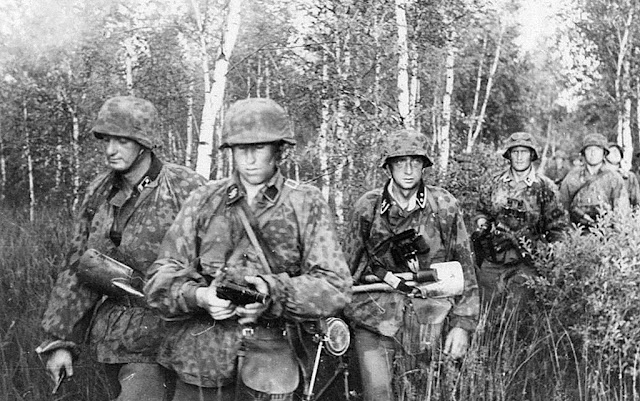
The Minsk and Vitebsk pockets that were surrounded by Army Group Center are declared officially eliminated. At least 300,000 prisoners have been taken and more than 40 divisions have been eliminated from the Soviet Order of Battle. The 2nd and 3rd Panzer Groups have encircled them at Vitebsk and Pskov forming the 4th Panzer Army. It has now crossed the Dnieper and Dvina Rivers advancing to encircle Smolensk.
The German main effort in the Soviet Union remains on track on 9 July 1941. Already, the panzers are closing on Leningrad and Kyiv, though a bit of work remains before Moscow comes into sight. With three months of good campaigning weather left, there seems little reason why Operation BARBAROSSA shouldn’t be completed by early fall and end in a decisive German victory.
In the Far North sector, the German Operation ARCTIC FOX grinds forward only a little bit further, as 169th Infantry Division of XXXVI Corps pushes from Salla to Kayral. However, the geography (lakes and woodland) favors the defense, and it gets no further against the Soviet 14th Army for the time being. In fact, the three Soviet divisions there push the German troops back before setting up a strong perimeter anchored by lakes on either side.
Further north, General Dietl’s Army of Norway is stopped at the Litsa River, too. Further south, the Finns plan an attack to begin July 10th on the Karelian Isthmus against Soviet 7th and 23rd Armies. The Finns re-occupy Morgonland, establishing an observation and artillery direction post with a party of five men under the command of Lieutenant Per-Erik Ahlblad. VI Corps (Major General Talvela) starts its attack this evening, slightly before the rest of Karelian Army. The aim is to capture certain positions before the Army main attack next day. Because of stiff Russian resistance VI Corps (5th and 11th Divs) fail to capture these positions in time.
In the Army Group North sector, the Germans are about 150 miles from Leningrad with the fall of Pskov to the 36th Infantry Division (Lieutenant General Otto Ottenbacher).
In the Army Group Center sector, the 20th Panzer Division of General Hoth’s 3rd Panzer Group takes Vitebsk as Soviet counterattacks peter out. Hoth’s panzers and General Guderian’s 2nd Panzer Group are poised to close a pincer around Smolensk. Behind the front, the army group completes the destruction of the pockets of enemy troops near Bialystok. An estimated 300,000 Soviet prisoners are taken and about 40 Soviet divisions destroyed (Soviet divisions are generally much smaller than Allied or German divisions)..
In the Army Group South sector, the Germans cross the Dneipr River. The 13th Panzer Division, part of Panzer Group 1, takes Zhitomir (Zhytomyr).
The Luftwaffe remains supreme in the skies. The German JG 3, led by Luftwaffe Major Günther Lützow, shoots down all 27 bombers of a Soviet attack on its own airfield. The Germans suffer no losses. Hptm. Hans “Gockel” von Hahn, Gruppenkommandeur I./JG 3, receives the Ritterkreuz for 24 victories.
In a naval action known simply as the Action of 9 July 1941, Romanian torpedo boat NMS Năluca combines with motor torpedo boats Viscolul and Vijelia to sink Soviet Shchuka-class submarine Shch-206 near Mangalia.
The Germans in Lviv arrest Yaroslav Stetsko, recently proclaimed leader of the independent Ukrainian state by Stepan Bandera’s faction of Ukrainian National Movement.
The head of Gosplan, the young economist Nikolai Voznesensky, was given responsibility for drafting a new war production plan for the whole Soviet economy.
Bălţi (Romania) is occupied by German and Romanian troops. This begins a pogrom that eventually wipes out the Jewish population of the city, estimated at around 14,000 people.
Trawniki Concentration Camp in the Lublin District of the General Government begins operation as a holding pen for refugees, Soviet civilians, and Soviet officials that the Security Police and SD have designated as either potential collaborators or dangerous persons. Today, 676 inmates are imprisoned there.
The first Roma arrive at Auschwitz-Birkenau. Gypsies are destined to become the third-largest group of deportees to Auschwitz, after Jews and Poles.
In the early morning hours, the Australian 2/2nd Pioneer Battalion, with units of the 6th Divisional Cavalry Regiment, marches into Damour. By 04:00, Australians are driving completely through the town and soon secure it from the few Vichy French troops who haven’t slipped out. The road north to Beirut is now clear. British artillery already is in position to fire on Beirut.
Behind the scenes, Vichy French commander General Henri Dentz is pursuing an armistice. He sees the Allies closing in on Beirut from both the south, through Damour, and from the east, via Aleppo. In addition, today the British take Homs in the north.
Despite his superiority in troops, Dentz cannot get supplies from France due to Royal Navy control of the eastern Mediterranean and the French have little hope of holding out for long. He sends destroyers Guepard, Valmy, and Vaquelin on a desperate mission to Salonika, Greece to embark reinforcements that have made their way there from France with German approval. On their way back, however, the RAF spots them a few hundred miles off the Syrian coast. Rather than lose the ships, the French order the ships to Toulon. This leaves no major French warships in the Levant.
The Turks intern several French ships in the port of Iskanderum.
French submarine Caiman manages to get away and heads for Bizerte.
Lieutenant R. N. Brabner, just back from Crete, spoke in the House of Commons: “In Greece, Crete, Libya, and Syria there has been an almost chronic lack of the most important war materials. It sounds incredible, but when we were at Malemi (the aerodome at Canea, capital of Crete) we rarely were in a position to put more than two aircraft into the air for a continuous patrol during daylight hours.” He then told the House that “705 to 80% of our tanks broke down before they saw the enemy.”
At Tobruk, British positions are bombarded by Axis aircraft and artillery. There is a flurry of activity at Tobruk, where the Germans bombard the defending Australians with artillery and air attacks. During the attacks, the Royal Navy ships in the harbor scatter, and two destroyers, HMS Decoy and HMAS Stuart, are damaged by near misses as they try to leave for open water. The ships make it Alexandria but require repair.
Royal Navy submarine HMS Cachalot departs from Gibraltar for Malta on a supply mission.
After Franklin Roosevelt announced that American troops were to relieve British troops in the occupation of Iceland. Adolf Hitler responded by publicly noting that it was a clear act of aggression against Germany; however, when Erich Raeder asked Hitler whether it was time for the German Navy to deliberately attack American vessels, Hitler still rejected the request.
A strongly worded note asking that the Italian Government take measures to permit United States nationals to leave Italy in the same way that Italians are allowed to leave the United States was presented to the Foreign Ministry in Rome this morning by George Wadsworth, Counselor of the United States Embassy.
Prime Minister Winston Churchill makes a speech in the House of Commons regarding the occupation of Iceland by US troops on 7 July. He notes:
“The military occupation of Iceland by the forces of the United States is an event of first-rate political and strategic importance; in fact, it is one of the most important things that has happened since the war began.”
While this may be a bit hyperbolic, Churchill notes that the occupation means that the US will not only send Great Britain whatever supplies it requires, “but also to make sure we get them.” This reveals Churchill’s true and enduring fear of World War II, that the Germans will be able to prevail if they can isolate Great Britain and prevent ships from reaching it.
A brief discussion was held in the British House of Commons about the arrangement by the Nazis for P. G. Wodehouse to give weekly radio broadcasts from Germany to the United States. Foreign Affairs Secretary Anthony Eden said he would take into consideration the suggestion from Geoffrey Mander “to bring to the attention of Mr. Wodehouse and others the grave peril in which they place themselves by playing the Nazi game during the war.”
The British Ultra team at Bletchley Park cracks a German code being used by the Luftwaffe in the Soviet Union. The Allies now can read German transmissions almost in real time using the Enigma machine.
Dutch-American Physicist Abraham Pais is awarded his Ph.D in the Netherlands five days before a Nazi deadline banning Jews from receiving degrees.
The British Air Ministry instructed Bomber Command to concentrate its efforts against the German transportation system and breaking the morale of the civilian population. At about 0130 hours, British bombers attacked Münster, Germany; the reading room of the state archive, warehouse of the state theater, the post office at the Domplatz, and the eastern wall of the cathedral were destroyed.
A British report noted that, for the week ending at 0600 hours on 9 July 1941, an estimated 78 people were killed by German bombing while an estimated 67 people had been seriously injured.
RAF Fighter Command sends a Circus mission to Mazingarbe power station, while RAF Coastal Command sends 15 planes on coastal sweeps.
Douglas Bader claimed one probable German aircraft shot down and another damaged.
RAF Bomber Command, Day of 9 July 1941
15 Blenheims on uneventful sweep off the Frisians. 3 Stirlings to Mazingarbe; 1 lost.
RAF Bomber Command, Night of 9/10 July 1941
Aachen
82 aircraft — 39 Hampdens, 27 Whitleys, 16 Wellingtons — on general area attack. 1 Hampden and 1 Whitley lost. This was the first large raid on Aachen and the town was heavily bombed with many hits in the central areas. Property damage is listed as follows: 91 commercial premises hit of which 19 were destroyed; 1,698 houses (possibly housing units’ in apartment blocks) destroyed or seriously damaged; the cathedral, the town hall and 2 hospitals were seriously damaged and 2 other churches were hit. Personnel casualties: 60 killed, 85 civilians and 21 air-raid workers injured, 3,450 people bombed out.
Osnabrück
57 Wellingtons; 2 lost. Crews report ‘Bursts in target area; several fires’, but local reports show that no bombs fell in Osnabrück, only a few in two nearby villages — Holte and Georgsmarienhutte — with 1 person killed and 1 injured.
1 Wellington bombed Le Havre and returned safely.
RAF Bomber Command mounts several operations today despite some marginal weather conditions. It attacks Naples with 9 Wellington bombers based on Malta, but only 6 make it to the target due to bad weather. The ones that drop their bombs hit the Gare Centrale (main railway station) and some warehouses. Seven Blenheim bombers make a dawn attack on Tripoli Harbor, but four are shot down. Hawker Hurricanes of RAF No. 185 Squadron attack the floatplane base at Syracuse, damaging a total of a dozen seaplanes and floatplanes.
The Luftwaffe attacks Alexandria with 23 planes.
Soviet aircraft engineers met to compile a report on their rocket-powered fighter development, which was to be forwarded to Joseph Stalin.
U-98, commanded by Kapitänleutnant Robert Gysae, sank British steamer Designer (5945grt) in 42-59N, 31-40W. At 0155 hours on 9 July 1941 the unescorted Designer (Master Donald Archibald McCallum), dispersed on 6 July from convoy OB.341 in 48°30N/26°30W, was hit in the foreship by one of two torpedoes from U-98 and sank after six minutes north-northwest of the Azores. The master, 61 crew members and four gunners were lost. On 10 July, ten crew members (lascars) and one gunner in one lifeboat were picked up by the Portuguese sailing ship Souta Princesca and landed at Leixoes. The 5,945-ton Designer was carrying military stores and mail and was headed for Capetown, South Africa.
U-98 later sank British steamer Inverness (4897grt) in 42-46N, 32-45W. At 0528 hours on 9 July 1941 the Inverness (Master James Maxwell Henderson), dispersed on 6 July in 48°30N/26°30W from convoy OB.341, was torpedoed by U-98 north-northwest of the Azores. The ship broke in two and sank after a coup de grâce was fired at 0544 hours. Six crew members were lost. The master, 31 crew members and five gunners landed at Corvo Island, Azores. The 4,897-ton Inverness was carrying military stores and was headed for the Middle East.
Minelayers HMS Agamemnon, HMS Menetheus, and HMS Port Quebec, escorted by destroyers HMS Castleton, HMS Wells, and HMS Heythrop, laid minefield SN.67A of the Northern Barrage. On the 8th, light cruiser HMS Nigeria and later on the same day battlecruiser HMS Repulse departed Scapa Flow to cover the operation. At 1130 on the 10th, destroyer Heythrop was detached and after collecting mails at Loch Alsh proceeded to Scapa Flow, where she arrived at 2030. Cruiser Nigeria arrived back at Scapa Flow on the 10th.
Heavy cruiser HMS Suffolk arrived at Hvalfjord after Denmark Strait patrol. After refueling, the cruiser departed for Scapa Flow, where she arrived on the 11th.
Heavy cruiser HMS Devonshire departed Scapa Flow for Hvalfjord. En route, she intercepted Panamanian steamer St-Cergue (4260grt) in 63-28N, 7-55W and sent her to Skopenfjord under armed guard. The cruiser arrived on the 10th at Hvalfjord. The cruiser arrived back at Scapa Flow on the 15th.
Light cruisers HMS Aurora, HMS Arethusa, and HMS Manchester departed Scapa Flow for the Clyde to escort convoy WS.9C. The cruisers arrived on the 10th. Light cruiser Aurora was replaced in the operation by cruiser minelayer HMS Manxman. The cruiser arrived back at Scapa Flow on the 13th.
A German submarine was reported by British aircraft in 60-36N, 3-20W. Polish destroyer ORP Krakowiak and destroyer HMS Echo departed Scapa Flow at 2100 to search for the submarine. The Polish destroyer was later relieved by Destroyer HMS Winchester, which departed Scapa Flow at 1200 on the 10th. The Polish destroyer arrived at Scapa Flow at 0030 on the 11th. The search was unsuccessful. Destroyers Echo and Winchester arrived at Scapa Flow at 0840 on the 11th.
British steam vessel Blue Mermaid (97grt) was lost on a mine, eight miles 185° from Clacton in 51-39-01N, 1-08-05E. Two crewmen were lost on the vessel.
German minelayers Tannenberg, Preussen, and Hansestadt Danzig, returning from Finland to Swinemunde, were sunk on the Swedish mine barrage east of Oland.
The Soviet 2nd Destroyer Division with destroyers Tashkent, Bodry, Boiki, Besposchchadny, and Bezuprechny operated in the Fidonisi area in the Black Sea on a shipping sweep, but did not make contact.
Leaving Tobruk Harbor, Destroyer HMS Decoy and Australian destroyer HMAS Stuart was damaged by near misses from German bombing. Both destroyers required repair on their return to Alexandria. Destroyer HMS Hero replaced destroyer Decoy in the Tobruk operations.
Destroyer HMAS Napier departed Alexandria for Port Said to complete repairs on her turbines.
Submarine HMS Cachalot departed Alexandria on a supply run to Malta, where she safely arrived on the 16th.
Submarine HMS Torbay sank German steamers LVI and LV and damaged L 12 with artillery and scuttling charges east of Kithera.
French destroyers Guepard, Valmy, and Vauquelin departed Tripoli, Syria, for Salonika to pick up troops transported there by rail from France. These destroyers were able to get within two hundred miles of Syria when they were located by British aircraft. The French destroyers were ordered to retire to Toulon, putting an end to the naval phase of the Syria operations. French sloop Elan, auxiliary tanker L’Adour (4500grt), small tanker Cyrus (405grt), patrol vessels Djebel Samin, Jean Mic, and Massalia, minesweepers Avocette and Lecid, tugs Marius, Chambrum, and Marseillaise, and trawler La Vaillante were interned at Iskanderun, Turkey. Submarine Caiman proceeded to Bizerte. On 18 September, the last of the interned ships had been moved, under Turkish escort, to Mersin and Erdek.
President Roosevelt’s callers in Washington today included Mayor La Guardia, Harold D. Smith, Director of the Budget, and Wendell L. Willkie.
The Senate was in recess. The Defense Investigation Committee heard a report on the naval shipbuilding program. The Military Affairs Committee approved a bill to authorize retirement of unfit Army officers. The Foreign Relations Committee deferred consideration of the bill to supply food to German-occupied Europe.
The House considered amendments to the Selective Service Act. It received a resolution for investigation of British trade with South America, completed Congressional action on the bill authorizing appointment of vice admirals and adjourned at 5:38 PM until 11 AM tomorrow. The Rivers and Harbors Committee heard Mayor La Guardia support the St. Lawrence Seaway project and a Military Affairs subcommittee continued hearings on lobbying on War Department contracts.
President Roosevelt asks the Secretaries of War and Navy to prepare an estimate of the overall production requirements required to win a coming war in both the Atlantic and Pacific Oceans.
Secretary Knox strongly indicated today that American naval vessels patrolling the Atlantic had been ordered to shoot if necessary to insure the safety of communications between the United States and all strategic outposts. At the same time, Wendell L. Willkie, last year’s Republican presidential nominee, vigorously endorsing the American occupation of Iceland, advocated the establishment of American military bases in Northern Ireland and Scotland.
Advocates of legislation to give the president broad powers to cope with defense strikes won a preliminary test of strength today as the House began consideration of the measure, which also would defer men of 28 or older from the draft. Opponents of the bill’s labor provisions sought to have them considered separately from the deferment section, which has evoked no opposition, on the theory that their prospects for passage would thus be diminished. But the House, by a roll call vote of 217 to 148, decided to take up the bill in its original form. In a rousing debate over the rights of labor, opponents of the measure shouted that it would destroy the right to strike while others argued that strikers would be denied only the “special privilege of using a lead pipe” to impose their will on other workers.
Wendell L. Willkie called on President Roosevelt at the White House today and asserted later that he had assured Mr. Roosevelt of the fullest support from himself and the “overwhelming” number of the Republican rank and file in the occupation of Iceland and any other steps the Administration might deem necessary to deliver the most effective material aid to Great Britain and her allies. “There is no use,” Mr. Willkie said, “in just giving lip service to Britain.” Not only did Mr. Willkie support the American occupation of Iceland, but he declared, following the conference, that he favored the establishment of American military bases in Northern Ireland and Scotland. In this he emphasized that he was speaking on his own responsibility. Mr. Willkie and the President had lunch together at the White House. A general discussion of the international situation apparently was what the President had in mind when he invited his former rival to talk with him. Mr. Willkie scouted reports that the President had asked him to accept a post in the defense program.
Colonel William J. Donovan, who traveled widely through Europe as special observer for President Roosevelt before Germany over-ran the Balkan countries, will soon be named to a post as Coordinator of Intelligence Information gathered by government agencies.
President Roosevelt announced today he had accepted the resignation of Leon Henderson as Securities and Exchange Commissioner to allow him to devote all his time to his duties as Administrator of the Office of Price Administration and Civilian Supply.
Defense commitments of the Reconstruction Finance Corporation and its subsidiaries have reached a new peak of $2,819,000,000, Jesse H. Jones, Federal Loan Administrator, stated this afternoon.
The Military Affairs Committee of the Senate today unanimously approved a bill to authorize the War Department to purge the Army of officers whose records demonstrate that their services will not be useful in the present defense effort. The bill, recommended by Robert P. Patterson, Under-Secretary of War, provides for the establishment of a board of not fewer than five general officers to pass upon the efficiency of officers.
Congressional investigation of Lieutenant General Ben Lear for his “mass discipline” of some of his soldiers who whistled at girls in shorts on a Memphis golf course was threatened by a House member today. Representative Kilday of Texas said that he had telegraphed to General Lear that his disciplinary order against men of his Second Army command while on maneuvers gave “strong evidence of your personal displeasure and desire for revenge rather than disciplinary action.”
An Atlanta speech by Senator Wheeler of Montana was postponed indefinitely today pending a show-down with city officials on the use of the Municipal Auditorium.
By an all-out program of substitution in an emergency, the United States could reduce its tin consumption by three-fourths and supply the remaining fourth entirely by imports from Bolivia, a committee of the National Academy of Science reported today to the Office of Production Management.
The U.S. Congress authorized the funding of $14,990,000 for the construction of Marine Corps Air Station Cherry Point over 32 square-kilometers of land in North Carolina, United States.
Royal Navy battleship HMS Malaya leaves New York Harbor under the command of Captain Cuthbert Coppinger after repairs at the Brooklyn Navy Yard. The Malaya was torpedoed twice by U-106 on 20 March 1941 about 250 miles northwest of the Cape Verde Islands. Today, she heads out for trials, with her next port of call Halifax, Nova Scotia. There, Malaya will provide protection for a fast convoy. Malaya is nearing the end of her useful service life because she did not undergo an extensive reconstruction during the inter-war years like her sister ships HMS Queen Elizabeth, Warspite, and Valiant.
Any pitchers here? In a Arizona-Texas League game, the Tucson Cowboys beat the Bisbee Bees, 30–15, collecting 31 hits. Tucson won yesterday’s match by a score of 16–14.
Major League Baseball: No games today, as the All-Star Break ends.
Argentina, Brazil and the United States have made a proposal to Ecuador and Peru calculated to stop hostilities in their border warfare and to point the way to a permanent settlement of their boundary dispute.
U.S. Navy Task Force 5, under Purnell, sails to southern Philippine waters in preparation for war.
Dow Jones Industrial Average: 127.63 (-0.01)
Born:
Don McPherson, American R&B singer (The Main Ingredient — “Everybody Plays the Fool”), in Indianapolis, Indiana (d. 1971, from leukemia).
James Scott, English filmmaker (Strike it Rich), in Wells, England, United Kingdom.
Scotty Baesler, American politician (Rep-D-Kentucky 1993-1999), in Lexington, Kentucky.
Takehide Nakatani, Japanese lightweight judoka (Olympic gold medal, 1964), in Hiroshima, Japan.
Tom Black, NBA center (Seattle SuperSonics, Cincinnati Royals), in La Crosse, Wisconsin (d. 2017).
Robert J. Frankel, horse trainer, in Brooklyn, New York, New York (d. 2009).
Naval Construction:
The Royal Navy LCT (Mk 2)-class landing craft, tank HMS LCT 134 is laid down by Stockton Construction (Thornaby, U.K.).
The U.S. Navy Auk-class minesweeper USS Skylark (AM-63) is laid down by the General Engineering and Dry Dock Co. (Alameda, California, U.S.A.).
The Kriegsmarine (German Navy) Type IXC U-boat U-522 is laid down by Deutsche Werft AG, Hamburg (werk 337).
The U.S. Navy Cleveland-class light cruiser USS Biloxi (CL-80) is laid down by the Newport News Shipbuilding and Dry Dock Co. (Newport News, Virginia, U.S.A.).
The Royal Navy Bar-class boom defence vessel HMS Barstoke (Z 32) is launched by W. Simons & Co. Ltd. (Renfrew, Scotland).
The Royal Navy Bar-class boom defence vessel HMS Barclose (Z 174) is launched by Blyth Shipbuilding & Drydock Co. Ltd. (Blyth, U.K.).
The U.S. Navy Lassen-class ammunition ship USS Shasta (AE-6) is launched by the Tampa Shipbuilding Company (Tampa, Florida, U.S.A.).
The Royal Navy Hill-class ASW trawler HMS Birdlip (T 218) is launched by Cook, Welton & Gemmill (Beverley, U.K.); completed by Holmes.
The Royal Navy “U”-class (Third Group) submarine HMS P-38 is launched by Vickers Armstrong (Barrow-in-Furness, U.K.).
The Kriegsmarine (German Navy) Type VIIC U-boat U-585 is launched by Blohm & Voss, Hamburg (werk 561).
The U.S. Navy Gato-class submarine USS Flying Fish (SS-229) is launched by the Portsmouth Navy Yard (Kittery, Maine, U.S.A.).
The Royal Navy harbor defence motor launch HMS HDML 1046 is commissioned.
The Royal Navy British Power Boat 63-foot-class motor anti-submarine boat HMS MA/SB 28 is commissioned.
The Royal Navy Fairmile C-class motor gun boat HMS MGB 321 is commissioned.
The Kriegsmarine (German Navy) Type 1936A destroyer Z29 is commissioned. Her first commanding officer is Korvettenkapitän (Lieutenant Commander) Curt Rechel.
The Вое́нно-морско́й флот СССР (ВМФ) (Soviet Navy) Project 7U-class (Storozhevoy-class) destroyer Statny (Статный, “Stately”) is commissioned.

