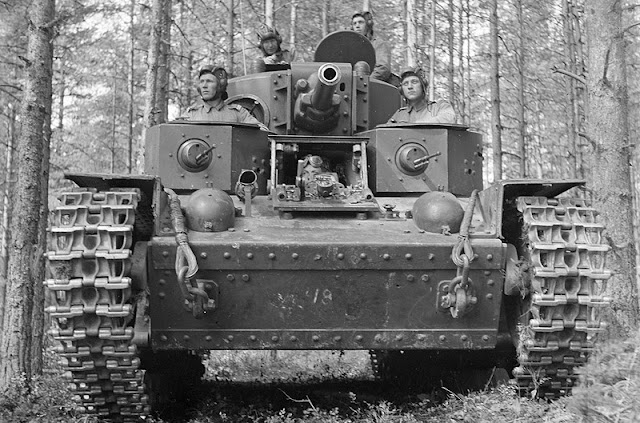
In the Far North sector, Operation Arctic Fox produces its first significant success when German XXXVI Corps takes Salla on 8 July 1941. The Soviet 122nd Rifle Division retreats and is closely followed by the Germans and Finnish 6th Division. The fighting is bitter, and the Soviets lose 50 tanks and most of their artillery. SS Division Nord pursues Soviet 122nd Rifle Division toward Lampela, while the German 169th Division advances toward Kayraly. Finnish 6th Division continues its left-hook maneuver and tries to get behind the Soviets retreating toward Kayraly and Lape Apa.
In the Army Group North sector, the Germans of General Reinhardt’s 41st Panzer Korps, 4th Panzer Group (Colonel General Erich Hoeppner) reach Pskov. The city sustains extensive damages, including the medieval citadel. This is the first major penetration of the Stalin Line. A little to the north, General Dietl’s Army of Norway is stopped after establishing a bridgehead over the Litsa River, well short of its objective of Murmansk.
In the Army Group Center sector, tank ace Otto Carius is in the lead tank of the 20th Panzer Division (General Hoth’s Panzer Group 3) at Ulla on the Dvina River when his Czech-built 38(t) tank is hit. The Russian 47-mm antitank round penetrates the front armor, smashes Carius’ teeth and amputates the left arm of the radio operator. After being patched up, Carius hitchhikes to the front, now on the outskirts of Vitebsk (from Carius’ “Tigers in the Mud”), and rejoins his unit.
In the Army Group South sector, German Panzer Group 1 and Sixth Army meet a Soviet counterattack at Kishinev by Soviet 5th Army. The Germans simply reorient their advance slightly to the north.
OKW operations chief Franz Halder briefs Hitler on the progress of the war in the Soviet Union. It is an encouraging briefing in which Halder claims that the Wehrmacht has pretty much destroyed 89 of 164 known Soviet rifle divisions (which is a vast overstatement). However, Halder insists that more power is needed on the eastern front, so Hitler releases 70 Mark IIIs, 15 Mark IVs, and the remaining Czech tanks from the OKW reserve. Management and use of reserves will be a huge topic of disagreement between the OKH (army command) and OKW (overall military command) throughout the war.
Rationing of basic foodstuff begins in Moscow, Leningrad and other major Soviet Union cities.
A Soviet military mission arrived in London, England, United Kingdom.
Winston Churchill’s first personal message to Soviet Premier Joseph Stalin arrives in Moscow. Churchill boasts about RAF Bomber Command’s attacks on Germany and promises, “The longer the war lasts the more help we can give.”
A crowd singing the “Internationale,” hymn of world communism, welcomed a Russian military mission to London Many clenched fists were thrust up in the Communist salute, cheers rang out and a girl rushed forward with a big bouquet for the leader of the mission, Lieutenant General Golikov, deputy chief of the Soviet general staff, as the party left its train. The Russians came in reciprocation for a large mission of British army, navy and air force officers and economic experts which flew to Moscow with British Ambassador Sir Stafford Cripps a few days ago.
Jews in the Baltic States were forced to wear the Star of David.
Director of the Reich Main Security Office Reinhard Heydrich announced that all Jews were to be regarded as partisans, and gave the order for all male Jews between the ages of 15 and 45 to be shot.
Australian 2/3rd Battalion and 2/5th Battalion of 7th Division cut the road from Damour north to Beirut. In addition, in the south, 2/2nd Pioneer Battalion and units of 6th Divisional Cavalry Regiment march north along the coast road.
Vichy General Henri Dentz, the commander of French forces in the Levant, has seen enough. Even though Damour itself still holds out, the Australian advance around Damour has made the defense of Beirut problematic. Dentz quietly seeks terms for peace.
The new France will weigh the value as well as the number of ballots that are cast, Chief of State Marshal Petain declared today in an address of guidance to the committee which he has named to write a new constitution. He thus indicated his desire to do away with universal male suffrage in the state he envisages, one which he said must be “authoritarian and hierarchic.” The main problem, he said, is to “replace a ‘sovereign people’ exercising absolute rights in total irresponsibility, with a people whose rights derive from their duties.” He defined the people he wants as a hierarchy of families, professions and communities which must in turn produce a “hierarchy of men who are selected by service rendered to the community, of whom a small number will advise, a few command and, at the top, the chiefs who will govern.” In the past, he said, authority came from sheer numbers; in the future, it must come from the “natural groups without which there is neither people, state, nor nation.”
Yugoslavia was dissolved by the Axis into separate parts. Yugoslavia’s neighbors receive “a little something:”
Italy obtains: Dalmatian coast and some related islands, part of Slovenia, and rule over an expanded Croatia (“Great Croatia”) as an “independent kingdom” via new king the Duke of Savoy;
Hungary: the Backa and Baranya triangle;
Germany: Serbian and Banat administration via puppet government, plus garrisons the remainder of Slovenia;
Bulgaria: part of Macedonia;
Albania: the remainder of Macedonia;
Montenegro: independence.
The benefits of this carve-up to the recipients are few. However, they reflect long-held national desires for expansion into areas of “historic interest” and nationalism.
Italian troops bear the brunt of occupation duty in the Balkans, including most of mainland Greece (the Germans occupy the remainder of mainland Greece and the islands of Lesbos, Chios, Samos, Melos, and Crete). Bulgaria, which is of little help on the main front, occupies eastern Macedonia and part of western Thrace.
Hitler approves all this because divvying up an area of no interest to him binds his satellites closer to Germany. On a more practical level, it also removes the need for Wehrmacht troops to police the populace, and already the partisans are stirring. Romania has been promised extensive new holdings in the east, some of which already have been conquered.
German clothing authorities put an end today to the question of whether women look well in slacks by forbidding their manufacture. Many German women had taken to slacks during the severe winter of 1939-1940.
American journalist Richard C. Hottelet was released from German custody in a prisoner exchange after spending almost four months in a Berlin jail on suspicion of espionage. Arrested on espionage charges on 15 March 1941, Hottelet is a member of the so-called Murrow Boys, U.S. war correspondents recruited by CBS on-air reporter Edward R. Murrow. Hottelet soon heads for Lisbon, where he can catch a flight to London.
The Albert Medal was gazetted for Cadet David George Montagu Hay (1921-79), RNR, who left a life raft of the sinking SS Euryiochus to rescue another officer, as sharks swam all around.
P G Wodehouse could be prosecuted after the war for making his broadcasts from Berlin, which are being recorded as evidence. Mr Eden told the Commons yesterday that “the government has seen with regret the report that he has lent his services to the German propaganda machine.”
After sundown, German bombers conducted a light attack on Great Yarmouth, Norfolk, England, United Kingdom.
RAF Fighter Command sends Circus missions to attack the Lens power station (13 fighter squadrons, one bomber lost) and Lille (19 fighter squadrons, 7 losses). The RAF also sends a sweep over northern France.
RAF Bomber Command, Day of 8 July 1941
11 Blenheims on coastal sweep off Denmark and to targets in Northern France; 1 aircraft lost.
90 Squadron made the first raid of the war using Boeing Fortresses (American B-17s) when 3 aircraft of this type were sent to bomb Wilhelmshaven. 2 aircraft were able to bomb; all returned safely. Wilhelmshaven reports accurate bombing of the dock area and of a post office which was completely destroyed. 14 people were killed and 25 injured. The three B-17s fly individual sorties (one has to abort to a secondary target) rather than together as a formation.
The RAF is unhappy with the results and makes clear that future bombing runs are to be conducted as formations rather than individually. The crews complain of various shortcomings of the bombers, including difficulties using the Norden bombsight and inadequate defensive armament.
RAF Bomber Command, Night of 8/9 July 1941
Hamm
45 Hampdens and 28 Whitleys; only 31 aircraft were able to bomb in the target area. 4 Whitleys and 3 Hampdens lost.
Münster
51 Wellingtons; 1 lost. Large fires were claimed in the railway-station area. Miinster recorded 15 people killed.
Bielefeld
33 Wellingtons to attack a power-station. No losses.
Merseburg
13 Halifaxes and 1 Stirling to the Leuna oil plant 1 Halifax lost.
Luftwaffe ace (7 victories) Walter Margstein of JG 53 is killed in action.
At Malta, the Italian Regia Aeronautica sends bombing missions against various points. An RAF Hurricane shoots down an Italian BR-20 “Stork” medium bomber south of the island.
Australian destroyer HMAS Nestor departed Scapa Flow at 0900 to join destroyer HMS Jupiter at Greenock prior to proceeding to the Mediterranean. The destroyer arrived at Greenock at 0400 on the 9th.
Anti-aircraft ship HMS Curacoa departed Scapa Flow at 1200 to meet convoy EC.42 south of Duncansby Head to provide anti-aircraft protection. At 2300, the ship transferred to convoy WN.50 east of Cape Wrath and escorted it to Methil where they arrived at 0730 on the 10th.
Lt Cdr A. J. Tillard, Lt R. H. Furlong, and Lt Cdr W. Thompson were killed when their Walrus of 778 Squadron crashed off Arbroath.
German fishing vessel Jan Hubert (460grt) was sunk in a collision in southwest Norway.
Ocean boarding vessel HMS Marsdale arrived at Gibraltar from Western Patrol.
Submarine HMS Torbay sank German steamers LXIV and LI east of Kithera with artillery.
Dutch submarine HNLMS O.21 arrived at Gibraltar from patrol.
Submarine HMS Upholder arrived at Malta from patrol.
Convoy HG.67 departed Gibraltar, escorted by sloop HMS Deptford, destroyers HMS Foxhound and HMS Avon Vale, corvettes HMS Jonquil, HMS Petunia, and HMS Spiraea, catapult ship HMS Maplin, and Dutch submarine HNLMS O.24. Captured French steamer Cap Cantin proceeded to the UK in this convoy. Destroyer HMS Farndale and corvette HMS Coreopsis departed Gibraltar on the 9th and overtook the convoy. Destroyers Avon Vale and Farndale were detached on the 12th. Early on the 13th, destroyer Avon Vale sighted a submarine on the surface in 35-20N, 16-35W near the convoy. The destroyer, joined by destroyer Farndale searched for the submarine without success. On the 14th, the corvettes, less Petunia, and the submarine were detached to convoy OG.67. On the 14th, the convoy merged with convoy SL.79. On the 19th, destroyers HMS Campbeltown, HNoMS St Albans, and HMS Wanderer joined the convoy. The convoy arrived at Liverpool on the 24th.
In Washington today, President Roosevelt’s callers included Justice Frank Murphy, Sidney Hillman of the OPM, Philip Murray of the C. I. O., and Bernard Baruch. He held the usual Tuesday afternoon press conference. In the morning James F. Byrnes took the oath of office as a Justice of the Supreme Court in the White House.
The Senate was in recess. The Appropriations Committee reported favorably a House bill appropriating $40,000,000 for TVA expansion.
The House heard tributes to the late Representative Stephen Bolles of Wisconsin, and adjourned in respect to him at 1:30, until noon tomorrow. The Rivers and Harbors Committee heard Army engineers testify in favor of the St. Lawrence Seaway.
United States naval forces arrived in Reykjavik, Iceland, amid a display of excitement and hearty welcomes. The first signs of the convoy’s appearance were noted from a tall church steeple by watchers who relayed the news to persons gathered in the streets. Icelanders asked one another, “Can these be Americans?” The new arrivals saw the country at its best. Faxa bay was smooth under a lazy breeze, while soft summer showers occasionally obscured the mountains. Soon the sun routed the remaining clouds and the full beauty of the land was disclosed. British soldiers stood near the harbor and stared at the anchoring fleet. “What is all this?” was a common query. It soon was dispelled by announcements in the Iceland press of the armed protection assumed by the United States. The British soldiers, who have stood guard here for more than a year without military action, welcomed the Americans, whose carefree manner impressed the civilian crowds.
Senator Wheeler, Montana Democrat, asserted today that the administration had arranged United States occupation of Iceland because it wanted “to get us into a shooting war” and realized that it had to have “a hell of a series of incidents to get this congress to declare war.”
President Roosevelt made it clear today that the uncertain line separating the eastern and western hemisphere would not be considered the eastern boundary of American defense activities. In a press conference statement which followed the American occupation of Iceland, the president said there were points beyond that line which might become of terrible importance to this country. He had stopped, he said, trying to determine just where the line ran. He also endorsed the army’s recommendation that it be permitted to keep national guardsmen and selectees on active duty longer than the year now authorized. The chief executive met reporters toward the close of a day which had seen the White House, through his secretary, Stephen T. Early, reprove Senator Wheeler, Montana Democrat, for saying last week he had information that Iceland would be taken over by this country. Early took the position that Wheeler had disclosed military information and, at his press conference, Mr. Roosevelt said he thought the case spoke for itself.
William S. Knudsen, head of the Office of Production Management, predicted tonight that the United States would reach the halfway mark in its armaments schedule by January. From then on industry should be turning out guns, airplanes, tanks and the thousands of other supplies needed for defense at a smooth and steadily increasing rate, he said.
The total authorized defense program from June 11, 1940, to June 30, 1941, was $46,914,000,000, of which, up to June 15, $20,960,000,000 had been contracted for, and $6,556,000,000 had been expended, the Office for Emergency Management said today.
Congressional sources disclosed today that they expected President Roosevelt within the next few days to ask for additional defense funds, possibly as much as $5,000,000,000 or $6,000,000,000. While no breakdown has been given to the House Appropriations Committee by the Bureau of the Budget, it was said the funds would be used to increase the Army from 1,418,000 men to 1,750,000, and to procure equipment for an Army of 3,000,000 men. In addition, some of the money would go to the lease-lend program, it was said. The decision to increase the size of the Army and to provide equipment for additional men was said to have been taken by Mr. Roosevelt and Army chiefs in the light of conditions abroad. The present plan is to provide equipment for 2,000,000 men.The program would provide for retention of the National Guard in service beyond the year for which the members were originally called to duty, it was said. Plans for new equipment would put emphasis on tanks, anti-aircraft guns and antitank guns. It was said that part of the fund might be used to build warships. It was understood that destroyers, light cruisers and a large number of small craft, such as mosquito boats, would be constructed.
The first nationwide survey completed since the outbreak of the Russo-German war indicates that American public sentiment in favor of convoys has remained virtually stable with a slight increase, but that the number of voters for entering a shooting war now has declined.
President Roosevelt was reported tonight to have told legislative leaders that he is opposed to compulsory arbitration of labor disputes and to the May bill authorizing the use of the armed forces to break strikes in defense industries. Both the American Federation of Labor and the Congress of Industrial Organizations are opposed to the May bill, which is a revised version of the Connally amendments to the Selective Service Act already passed by the Senate. The provisions dealing with government seizure of struck plants and authorizing the use of troops “to afford protection to all persons engaged in the operation of such plant or industry who voluntarily desire to-work,” are appended to a measure deferring men over 28 years old from military training. Philip Murray, president of the C.I.O., discussed the May bill and other pending legislation with President Roosevelt today and asked the Chief Executive to make plain to his House and Senate leaders his opposition to the legislative proposals which the C.I.O. regards as anti-labor measures. Mr. Murray is friendly to the Rooseveit Administration, having supported the President for a third term while his predecessor, John L. Lewis, bolted to the support of Wendell L. Willkie.
While not technically a part of the U.S. military, in substance it is an extension of the U.S. Army Air Force. Today, pilots and staff of the American Volunteer Group (actually employed by a shell company) depart San Francisco for the Far East aboard Java Pacific liner “Jaegerfontein.”
In Memphis, Tennessee, Army Major General Benjamin Lear, Commander of U.S. Second Army, happens to observe some of his troops whistling at women passers-by while driving by. Lear makes all 350 men in the convoy walk the remaining 15 miles (24 km) to their destination. The troops’ commander, Major General Ralph E. Truman (cousin of Harry), attempts to get Lear “retired” but fails. From this point forward, the rank and file call him “Yoo-hoo Lear.”
John D. Rockefeller, Jr. makes a speech to the Selective Service Parents and Neighbors Committee of the United Service Organizations that is broadcast over radio station WMGA in New York. He lists “the things that make life most worth living,” which are all beliefs. These are:
“the supreme worth of the individual;”
“Every right implies a responsibility; every opportunity, an obligation, every possession, a duty;”
“the law was made for man and not man for the law;”
“the dignity of labor;”
“thrift;”
“Truth and justice;”
“sacredness of a promise;”
“the rendering of useful service;”
“an all-wise and all-loving God;”
“love;”
Rockefeller urges everyone to support the United Service Organizations to create a new world that recognizes “the brotherhood of man.”
USS Arizona (BB-39) arrived at Pearl Harbor, U.S. Territory of Hawaii.
Patrol Wing 8 (Commander John D. Price) is established at Norfolk, Virginia.
Warren Spahn, 19, pitches his 4th shutout in a row as Evansville (Three I) edges Madison, 1–0.
Major League Baseball:
The ninth annual Baseball All-Star Game pitting the American League All-Stars against the National League All-Stars is played in 52,000-seat Briggs Stadium in Detroit, Michigan. The American League is the home team. The starting pitchers are the Brooklyn Dodgers Whit Wyatt for the National League and Cleveland Indians’ Bob “Rapid Robert” Feller. Going into the bottom of the ninth inning, the National League is leading 5–3; four of the National League’s runs came on two home runs by Pittsburgh Pirates’ shortstop Arky Vaughan with one on each time. Vaughan is the first player to homer twice in the classic. The National League scores one run in the ninth making it 5–4. With two outs in the bottom of the ninth, Boston Red Sox left fielder Ted Williams delivers a clutch walk-off home run with two on giving the win to the American League 7–5. Joe DiMaggio, on first base, actually scores the winning run. Williams later comments that the walk-off home run “remains to this day the most thrilling hit of my life.”
Heavy cruiser HMS Cornwall collided with the wharf at Durban. The cruiser’s stem was buckled.
There is a Japanese air raid on Chungking, the Nationalist capital. The British Embassy, already damaged in previous attacks, is destroyed during the raid.
Japanese Foreign Minister Matsuoka Yosuko gave a statement to the American Ambassador to Japan Joseph Grew. In the statement Matsuoka told the United States that the prevention of the European war from spreading to the regions of Greater East Asia and preservation of peace in the Pacific area had always been the sincere and genuine desire of the Japanese Government. The Japanese also stated that the Japanese Government had not so far considered the possibility of joining the hostilities against the Soviet Union.
The United States’ dispatch of naval forces to occupy Iceland “is de facto participation in the war,” the nationalist Japanese newspaper Kokumin said today. The stationing of American naval forces in Iceland to replace the British is regarded in Japanese political and military circles as a decisive step through which the United States entered hostilities so a clash between Germany and the United States is expected soon, Domei, the semi-official Japanese news agency, reported today.
The Imperial Japanese Navy aircraft carrier HIJMS Kaga departed Yokosuka, Japan.
Dow Jones Industrial Average: 127.64 (+1.48)
Born:
Ken Sanders, MLB pitcher (Kansas City-Oakland A’s, Boston Red Sox, Milwaukee Brewers, Cleveland Indians, California Angels, New York Mets, Kansas City Royals), in St. Louis, Missouri.
Gary Kroll, MLB pitcher (Philadelphia Phillies, New York Mets, Houston Astros, Cleveland Indians), in Culver City, California.
Died:
Philippe Gaubert, 62, French flautist, conductor (Paris Opéra, 1919-41), composer, and teacher (Paris Conservatoire), dies of a stroke.
Naval Construction:
The U.S. Navy Kennebec class oiler USS Neosho (AO-48) is laid down by the Bethlehem Steel Corp. (Sparrows Point, Maryland, U.S.A.).
The U.S. Navy YMS-1-class auxiliary motor minesweeper USS YMS-22 is laid down by the Greenport Basin and Construction Co. (Greenport, Long Island, New York, U.S.A.).
The Royal Navy LCT (Mk 2)-class landing crafts, tank HMS LCT 111 and HMS LCT 112 are launched by the Cammell Laird Shipyard (Birkenhead, U.K.).
The Royal Navy LCT (Mk 2)-class landing craft, tank HMS LCT 132 is launched by Stockton Construction (Thornaby, U.K.).
The U.S. Navy 77-foot Elco patrol motor torpedo boat USS PT-41 is launched by the Electric Launch Company Ltd. (Elco), (Bayonne, New Jersey, U.S.A.).
The Kriegsmarine (German Navy) Type VIIC U-boat U-656 is launched by Howaldtswerke Hamburg AG, Hamburg (werk 805).
The Marinha do Brasil (Brazilian Navy) Marcilio Dias class destroyer Greenhalgh (M 3) is launched by Arsenal de Marinha do Rio de Janeiro (Ilha das Cobras, Rio de Janeiro, Brazil).
The Royal Navy Bar-class boom defense vessel HMS Baronia (Z 87) is commissioned.
The Royal Navy Isles-class minesweeping trawler HMS Hoy (T 114) is commissioned. Her first commanding officer is T/Lieutenant Stanley Leith Friend, RNVR.
The U.S. Navy Accentor-class coastal minesweeper USS Marabout (AMc-50) is commissioned.
The Royal Navy White 73 foot-type motor torpedo boat HMS MTB 47 is commissioned.
The U.S. Navy 77-foot Elco patrol motor torpedo boat USS PT-31 is completed and placed into service with Motor Torpedo Boat Squadron One (PTRon 1).
The Royal Canadian Navy Flower-class corvette HMCS Shediac (K 110) is commissioned. Her first commanding officer is T/Lieutenant John Oswald Every-Clayton, RCNR.
The Kriegsmarine (German Navy) Type VIIB U-boat U-86 is commissioned. Her first commanding officer is Oberleutnant zur See Walter Schug.
The Kriegsmarine (German Navy) Type IXC U-boat U-161 is commissioned. Her first commanding officer is Kapitänleutnant Hans-Ludwig Witt.

