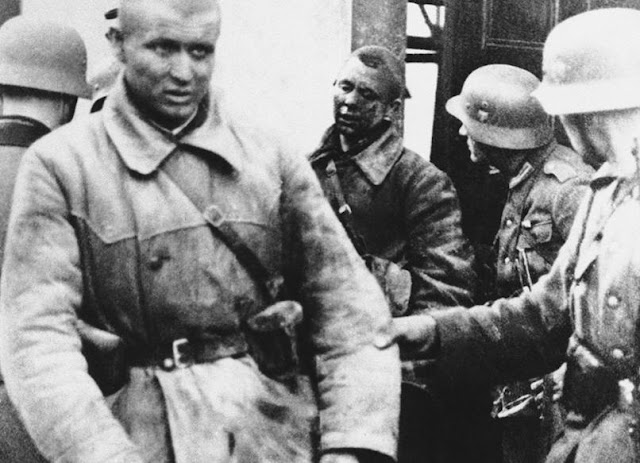
[Ed: These men face a grim future. Of the approximately 3.35 million Soviet prisoners of war captured by Germany in 1941, roughly 60 percent (about 2 million men) died in captivity by February 1942.]
Stalin continues tinkering with his command apparatus on 7 July 1941. While he can be brutal with even his closest associates, he also tends to favor the same small group of cronies during times of crisis. He appoints Kliment Voroshilov commander of the Northwestern Direction (equivalent to a German Army Group, it controls several fronts). He also takes Semyon Timoshenko’s titles of Stavka Chairman and Defense Commissar and sends him to command the Central and Western Fronts. Semyon Budyonny (Budenny), an old cavalryman whose only discernible talent is making Stalin laugh when they are getting drunk, is sent to command the Southern Front. Notable from his absence in these appointments is Georgy Zhukov, who remains Stalin’s top troubleshooter. The Soviet Union now has military commands that directly mirror the three German army groups.
In the Far North sector, Operation ARCTIC FOX — the attack toward the Murmansk railway — is going well for the Germans again. With the assistance of a flank attack by Finnish 6th Division, the German regular 169th Division and the SS-Infantry Kampfgruppe Nord, supplemented by some members of 163rd Infantry Division brought up from southern Finland, hammer back the Soviet 14th Army. The Soviets are making a stand in Salla, but the momentum again is with the Axis troops.
Operation PLATINUM FOX, further north, is going worse for the Germans. The 3rd Mountain Division has established a small bridgehead on the Litsa River, but the Army of Norway commander General Dietl is unable to expand it. Dietl requests more troops to resume the advance, but OKW refuses.
On the left flank of Karelian Army Group Oinonen (Major General Oinonen) crosses the border near Ilomantsi to capture better starting positions for the coming main attack. The attack is soon stopped by stiff Soviet resistance.
In the Army Group North sector, the German 4th Panzer Group (Hoepner) captures Pskov. The Germans continue beating off a Soviet counterattack at a bridgehead at Ostrov.
In the Army Group Center sector, the German 20th Panzer Division crosses the Western Dvina River (Daugava River). This poses a threat to the rear of the Soviet Polotsk Fortified Region. In addition, the 20th Motorized Division crosses the Ulla River.
The panzer divisions are still carrying the advance, but they are wearing down. The 10th Panzer Division reports that it is at 80% of its establishment, but the 3rd and 18th Panzer Divisions are down to 35%. Other units report readiness levels in between those levels.
In Army Group South, the German 13th Panzer Division takes Berdychiv in the Zhytomyr Oblast. The SS quickly follows the troops and establishes a Jewish ghetto for the 20-40,000 Jews there. While Field Marshal Rundstedt’s troops are quickly approaching Kyiv, the Soviets are massing troops there to deny Hitler a quick prestige victory.
Fifth Panzer Division, still in the Balkans from Operation Marita, is told to prepare to move to the Eastern Front. While many historians like to claim that the German Balkans campaign delayed Operation BARBAROSSA, the reality is that the units there actually served as the Wehrmacht’s main (and practically only) reserve early in the war. In general, having reserve units is considered a good thing in military circles, but this is one of the few times during the war against the USSR that Germany actually has a substantial reserve it can draw upon. The USSR, on the other hand, almost always has a large reserve.
Jürgen Stroop was assigned to the infantry regiment of German 3rd SS Division Totenkopf.
Former Soviet People’s Commissar for the Foreign Affairs of the Soviet Union Maxim Litvinov (who was replaced on 3 May 1939 because he was Jewish and Stalin didn’t want to offend Hitler) makes a radio broadcast to England from Moscow. Speaking in English, Litvinov urges cooperation between Great Britain and the USSR. This is exactly what Winston Churchill wishes as well. Stalin, however, doesn’t just want vague expressions of solidarity — he wants concrete agreements that will tie the Allies together.
Winston Churchill sent a letter to Stalin saying that there was “genuine admiration” in Britain for the “bravery and tenacity of the soldiers and the people” of the Soviet Union. Churchill also pledged, “We shall do everything to help you that time, geography and our growing resources allow.” Stalin was unimpressed by the vagueness of the letter and responded by asking for a formal agreement, since he wanted to ensure that Britain would not stand aside while Germany and the Soviet Union destroyed each other.
Einsatzkommandos begin the systematic slaughter of Lithuanian Jews. One of the tasks of these killing squads was the recruitment of local anti-Semites, whether Lithuanians, Ukrainians, or Latvians, who could help them to round up, terrorize and destroy each Jewish community, however small. The Nazis execute 5,000 Jews in and around Kovono, Lithuania over the course of a week.
The Germans require Jews in Lithuania to wear Yellow Stars of David badges.
Australian troops outflanked French positions at Damour, Lebanon. Having established two bridgeheads across the Damour River, the Australian 7th Division begins to exploit them. Before dawn, one Australian bridgehead (the 2/3rd Battalion and the 2/5th Battalion, along with two companies of the 2/14th Battalion) moves north toward El Boum. The other bridgehead (the remainder of the 2/14th) mounts a flank attack on Damour from the east. The attack from the first bridgehead continues forward toward the critical coast road north of Damour, whose capture would compel the surrender of Vichy French forces in the town.
Everyone on both sides understands that the fall of Damour would decide the war because nothing else stands between the Australians and Beirut. General Henri Dentz, the Vichy French commander, keeping a very close eye on the battle to see if he can continue his unexpectedly vigorous defense of the Levant.
Offshore, Royal Navy motor torpedo boat MTB 68 embarks on a daring raid into Beirut Harbor. It drops depth charges next to two merchant ships.
General Archibald Wavell, former British Middle East Commander, departs from Cairo. He is flying to Habbaniya, Iraq and then to India to take up his new role as Commander-in-Chief, India. Claude Auchinleck now has Wavell’s old job, the two have switched positions.
Occupied Yugoslavia was carved up between Germany, Italy, Hungary, and Bulgaria, with Croatia becoming an independent state.
The Uprising in Serbia began when Žikica Jovanović Španac urged a crowd in the village of Bela Crkva to resistance, then shot two policemen and escaped. An uprising breaks out in the Bela Crkva, Serbia. Known as the Uprising in Serbia, it begins when communist Žikica Jovanović Španac shows up with over a dozen associates and makes a speech during the traditional Ivanjdan midsummer village fair. Španac then shoots and kills two local gendarmes for emphasis and escapes into the nearby hills.
An uprising has been planned by monarchist Yugoslav Army Colonel Dragoljub Mihailović, but this incident is independent of his forces. Mihailović and his followers only reluctantly join the revolt later in the summer. The communists chose western Serbia as the beginning point because of its mountainous terrain and dense forests. Serbia also, unlike Croatia, has a history of supporting England. Word spreads quickly throughout the region of the uprising.
Another uprising in Yugoslavia, this one in eastern Herzegovina, is suppressed. This uprising began on 23 June 1941 and has simmered ever since. Today, the uprising finally is suppressed and the Independent State of Croatia (Croatian: Nezavisna Država Hrvatska, NDH) regains control of all key points.
Nazi-inspired anti-Bolshevik campaigns start in France and Belgium.
The French create the Legion of French Volunteers against Bolshevism (“Legion des Volontaires Francais contre le Bolchevisme”).
Iceland, coerced by the United Kingdom, allowed the United States to oversee the defense of the island. U.S. 1st Marine Brigade arrived later on the same day and began to relieve the British garrison. The U.S. 1st Marine Brigade arrived in Iceland and relieved the British garrison there. President Roosevelt sent Congress a message explaining that the United States could not allow Germany to occupy Iceland because it would constitute a threat to Greenland, to shipping in the North Atlantic and to the steady flow of munitions to Britain which Congress had already freely approved as a matter of broad policy.
Greek King George arrives in South Africa with his family aboard a Royal Navy warship.
After sundown, German bombers attacked Southampton, England, United Kingdom.
RAF Bomber Command, Day of 7 July 1941
20 Blenheims on coastal sweeps. Aircraft of 105 and 139 Squadrons made an attack on a convoy off Holland and hit 2 ships but lost 3 aircraft. 8 Stirlings made escorted raids to Northern France without loss.
Operational Statistics, 12/13 March to 7 July 1941 (117 days/nights)
Number of days with operations: 106 Number of nights with operations: 87 Number of daylight sorties: 2,189, from which 87 aircraft (4.0 percent) were lost Number of night sorties: 10,532, from which 234 aircraft (2.2 percent) were lost Total sorties: 12,721, from which 321 aircraft (2.5 percent) were lost Approximate bomb tonnage in period: 11,849 tons Averages per 24-hour period: 108.8 sorties, 27 aircraft lost, 101.3 tons of bombs dropped
RAF Bomber Command, Night of 7/8 July 1941
Cologne
114 Wellingtons; 3 lost. Crews reported perfect weather and good bombing. Cologne reports its heaviest raid in 1941 with much damage in the centre and in the eastern areas of the city. There were 300 individual damage locations with 174 fires of which 62 were classed as large. The Maria Himmelfahrt church was burnt out, 3 railway lines were completely cut. 138 dwellings were destroyed and 7 industrial buildings badly damaged. Personnel casualties were: 45 killed, 114 injured and 5,450 bombed out.
Osnabrück
54 Whitleys and 18 Wellingtons; 3 Whitleys lost. Good bombing of railway yards claimed. Osnabrück reports bombing in the south-western suburbs with no casualties and 3 buildings damaged but no mention of railway damage.
Münster
49 Wellingtons; 3 lost. The only report from Miinster says many bombs in the town and 9 people killed.
München-Gladbach (Mönchengladbach)
40 Hampdens; 2 lost.
Minor Operations: 14 Halifaxes and 3 Stirlings to Frankfurt, 5 Wellingtons to Boulogne, 4 O.T.U. sorties. 1 Halifax lost.
Total effort for the night: 301 sorties, 12 aircraft (4.0 percent) lost.
Luftwaffe ace Joseph “Pips” Priller files claims for two Spitfires. They are his 32nd and 33rd victories.
Sergeant J. A. Ward, a New Zealand second pilot in a 75 Squadron Wellington, was awarded the Victoria Cross for an action on this night. His aircraft was damaged by a night-fighter attack while returning from Minster and a fire broke out near the starboard engine. Sergeant Ward climbed out on to the wing, making holes in the canvas covering of the geodetic framework of the aircraft to obtain hand- and footholds. He was able to beat out sufficient of the fire to enable the Wellington to return to England. As he later recalls:
“The wind kept lifting me off the wing. Once it slapped me back on to the fuselage again, but I managed to hang on. The slipstream from the engine made things worse. It was like being in a terrific gale, only much worse than any gale I’ve ever known in my life.”
The Italians send a stream of nuisance raids to Malta. One bomber overflies the island and then returns from the south to drop its bombs — whether by plan or simply getting lost is unknown, but it gets away.
The RAF sends a fighter sweep over Bardia.
Aircraft carrier HMS Argus completed her refit at the Clyde. The aircraft carrier was allocated for deck landing training duties.
The Flag of the Rear Admiral Commanding 10th Cruiser Squadron was temporarily transferred to base ship HMS Dunluce Castle. On the 10th, the flag returned to light cruiser HMS Nigeria.
Destroyer HMS Heythrop departed Scapa Flow for Loch Alsh where she arrived at 1800.
Convoy OB.344 departed Liverpool, escorted by destroyers HMS Hesperus, HMS Sarondyx, HMS St Francis, and HMS Watchman, catapult ship HMS Ariguani, and escort ships HMS Sennen, HMS Totland, and HMS Walney. The catapult ship and destroyer Sardonyx were detached on the 11th. The remainder of this section was detached on the 16th. Destroyers HMCS Assiniboine and HMCS Ottawa joined on the 15th and were detached on the 17th when the convoy was dispersed.
Submarine HMS Sealion, in operations off Ushant, sank French fishing trawlers Gustav Jeanne (39grt) and Gustav Eugene (120grt) on the 7th. On the 8th, the submarine sank Christus Regnat (28grt) and on the 9th, St Pierre D’Alcantara (329grt).
Polish submarine ORP Sokol unsuccessfully attacked a large transport in 46-41N, 20-30W.
Admiralty hired drifter Lord St Vincent (115grt, Skipper J. S. Alexander RNR) was sunk by mining off North East Gunfleet Buoy in the Thames Estuary. One rating was killed and one rating died of wounds in the drifter.
Norwegian tanker Ferncourt (9918grt) was damaged by German bombing in 51-50N, 5-29-30W. Two gunners were lost on the tanker. The tanker returned to Milford Haven and was docked at Swansea.
A Fulmar of 804 Squadron was launched from catapult ship HMS Pegasus to intercept a German FW 200 bomber. The bomber was not located and the Fulmar proceeded towards Algergove in bad visibility. Sub Lt T. R. V. Parke and Leading Airman E. F. Miller were killed when the aircraft crashed into Kerran Hill, near Southend, Kintyre.
A Dominie aircraft of 782 Squadron crashed ferrying passengers between Hatston and Donibristle. Petty Officer W. C. Jones, 1st Officer M. E. J. Dobson WRNS, Lt F. P. Tennyson of HMS Excellent, and passengers 2nd Lt J. L. Day RA, Mr. C. W. Young of Vickers Armstrong, and Mr. T. McCabe were all killed.
German fishing vessel Neuenfelde (193grt) was sunk on a mine near Kolberg.
After a minelaying raid on Haifa, Light cruisers HMS Naiad and HMS Phoebe and destroyers HMS Jackal, HMS Hotspur, HMAS Nizam, and HMS Havock remained at sea off the harbor. Anti-aircraft ship Carlisle had to be towed clear of a suspected mine dropped near her.
During the night of 7/8 July, motor torpedo boat MTB.68 entered Beirut harbor twice and dropped depth charges along two merchant ships along the mole.
Italian light cruisers Attendolo and Duca D’Aosta of the 7th Cruiser Squadron and Bande Nere and Di Giussano of the 4th Cruiser Squadron with destroyers Pigafetta, Pessagno, Da Recco, Da Mosta, Da Verazzano, Maestrale, Grecale, and Scirocco laid mines in the Sicilian Channel.
Destroyer HMS Avon Vale arrived at Gibraltar towing in a Catalina aircraft which has forced landed in the sea west of Gibraltar.
Destroyer HMS Eridge reported sighting a U-boat in 34-46N, 9-47W. A Catalina aircraft was ordered to assist. Destroyers Eridge and HMS Farndale, which had departed convoy OG.66, searched until the following day without result.
In Washington today, President Roosevelt announced that United States naval forces had occupied Iceland. He sent the renomination of Garland S. Ferguson as a member of the Federal Trade Commission to the Senate. His callers included Senators White of Maine and Hill of Alabama; J. M. Keynes, British economist; Viscount Halifax, the British Ambassador, and Secretaries Morgenthau and Knox.
The Senate confirmed the nomination of Robert H. Jackson to the Supreme Court, completed Congressional action on the shipping priorities and naval public works bills and recessed at 3:30 PM until noon Thursday. An appropriations subcommittee approved a bill providing $40,000,000 for TVA expansion.
The House completed Congressional action on the bill authorizing construction of thirteen Coast Guard vessels, approved the conference report on the shipping priorities bill, approved the bill increasing some pensions for veterans, received the Navy’s request for $585,000,000 to expand construction and repair facilities and adjourned at 2:34 PM until noon tomorrow.
U.S. Marines landed at Reykjavik, Iceland. The landing force was designated Task Force 19 (Rear Admiral David McDougal LeBreton) and had departed Argentia on the 1st. Battleships USS New York (BB-34, Le Breton) and USS Arkansas (BB-33). Light cruisers USS Brooklyn (CL-40) and USS Nashville (CL-43). Inner Screen: Destroyer Squadron 7, Destroyer USS Plunkett (DD-431). Destroyer Division 13, Destroyers USS Niblack (DD-424), USS Benson (DD-421), USS Gleaves (DD-423), and USS Mayo (DD-422). Destroyer Division 14, Destroyers USS Charles F. Hughes (DD-428), USS Lansdale (DD-426), USS Hilary P. Jones (DD-427). Outer Screen: Destroyer Division 60, Destroyers USS Ellis (DD-154), USS Bernadou (DD-153), USS Upshur (DD-144), USS Lea (DD-118), and USS Buck (DD-420). Transport Force: Transports USS William P. Biddle (AP-15), USS Fuller (AP-14), USS Heywood (AP-12), USS Orizaba (AP-24), USS Arcturus (AK-18), USS Hamul (AK-30), USS Salamonie (AO-26), and tug USS Cherokee (AT-66). Following disembarkation, the Task Force departed Iceland on the 12th and arrived at Argentia on the 19th.
U.S. President Franklin D. Roosevelt informed the U.S. Congress of the occupation of Iceland. “In accordance with the understanding so reached, forces of the United States Navy have today arrived in Iceland in order to supplement, and eventually to replace, the British forces which have until now been stationed in Iceland in order to insure the adequate defense of that country…The United States cannot permit the occupation by Germany of strategic outposts in the Atlantic to be used as air or naval bases for eventual attack against the Western Hemisphere. We have no desire to see any change in the present sovereignty of those regions. Assurance that such outposts in our defense-frontier remain in friendly hands is the very foundation of our national security and of the national security of every one of the independent nations of the New World.” The Navy is ordered to take all steps necessary to maintain communications between the United States and Iceland.
The Icelandic government under Prime Minister Herman Jonasson has given grudging support and basically accepts occupation by a foreign power as inevitable under the circumstances. The U.S. explicitly recognized Icelandic sovereignty and promises to evacuate once the war is over.
In conjunction with this move, the United States extends its security zone east to cover Iceland. From this point forward, the United States assumes responsibility for protecting all convoys containing U.S. ships until they are past Iceland.
There is a major anti-war protest in New York City. Protestors carry large signs saying “Arm Britain and Prolong the War,” “Stay out of Europe’s War”; “Hitler has not attacked us, why attack Hitler?” “Stay out of South America, of Europe, of War”; “Lend-Lease Lose-Lives”; “Hitler has not attacked us, why attack Hitler?”; “Why Not Peace with Hitler?”; “Europe for Europeans. America for Americans”; “The Only Fight Worth Fighting is the Fight for Peace”; “Fight the Draft, Conscription in Tyranny”; “No Loans to England. No Arms to Anyone”; “American Union for Organization Against War”; “The Army and Navy are Hotbeds for Fascism”; “Protest Any Extension for Army Service” and similar slogans.
General Robert E. Wood charged tonight that the occupation of Iceland by U. S. troops was a move “to edge us into the war,” and he enjoined the administration to decide now “either to go into war as an active ally of England or to stay out.” He said the America First committee, of which he is national chairman and spokesman, was “unalterably opposed” to this nation’s involvement in war. He recommended that “we advise England to make a negotiated peace.” Referring to President Roosevelt’s announcement of the occupation of Iceland, Wood said “this seizure can be considered as another step to edge us into the war, not for defense.”
A message, either direct from the White House or from the War Department, is expected to be sent to Capitol Hill immediately requesting amendments to the Selective Service Act to permit the retention of trainees beyond their one year of training, and to permit their use in any part of the world deemed necessary for the defense of the United States.
Expressing profound regret over the fresh outbreak of border fighting between Peru and Ecuador, Sumner Welles, acting secretary of state, said today the United States and all other American republics were anxious to be of service in halting the strife. Welles told a press conference, however, that until complete reports from the two countries were at hand, he could not say whether the United States would formally renew a tender of good offices to arbitrate the century-old frontier dispute.
President Roosevelt’s seventh appointee to the U.S. Supreme Court, Robert H. Jackson, was confirmed by the Senate today after Senator Tydings, Maryland Democrat, had sharply criticized the 49-year-old attorney-general in an attempt to block approval. The nomination of Jackson, who came to Washington from Jamestown, N. Y., in the early days of the new deal, was confirmed on a voice vote, with Tydings dissenting.
Paul V. McNutt said today that “for eight years our institutions have been the butt of a war waged against us by totalitarian power” and that Japan would have to “shoulder the full consequences” of supporting the axis. McNutt, federal security administrator and former high commissioner of the Philippines, addressed the Washington Chinese colony in exercises commemorating the fourth anniversary of the Sino-Japanese conflict. “Our Industrial plants have been the scenes of espionage,” he said.
A sharp attack by John L. Lewis on President Roosevelt’s Administration and Sidney Hillman, OPM associate director general, today brought from. Jacob Potofsky, acting president of Mr. Hillman’s union, the Amalgamated Clothing Workers, a charge that Mr. Lewis was “playing politics” in the national emergency and creating disunity within the C.I.O.
The U.S. Marine Corps established the 1st Marine Aircraft Wing at Quantico, Virginia, United States under Lieutenant Colonel Louis E. Woods.
The USAAF orders 150 model NA-91 P-51 aircraft (the USAAF soon redesignates their aircraft as A-36 Apaches and uses them briefly for ground attack) intended for the RAF under Lend-Lease as Mustang Mk. IAs. These aircraft retained the Allison V-1710-39 engine.
Major League Baseball: No games today (it’s the all-star break.)
On the fourth anniversary of the outbreak of the Second Sino-Japanese War, Chiang Kai-shek sent a message to friendly nations asking for “close co-operation with one another” to fight the Axis because “the war in the Far East is no longer to be viewed as merely a conflict between two nations, for the European and Asiatic Wars have now become closely interrelated. Scarcely a single country remains unaffected because this predatory group of powers excludes no country from the scope of its design to dominate the world by force..”
Chiang makes a far-sighted prediction:
“It is my privilege to declare that the Chinese people in condemning the Japanese are not only with unity of purpose of putting an end to Japanese aggression but also are thinking of contributing to a new world order of the future, to the civilization and prosperity of mankind.”
It is a heady time: leaders on both sides of the conflict are dreaming of their own New World Orders that they will establish after the war. However, only one vision can come true, and imposing yours requires winning the war at hand.
Chinese guerrillas observed the fourth anniversary of the Japanese-Chinese war today by attacking the Shanghai-Hanchow railroad within the Shanghai city limits, dynamiting a large section of track.
The British War Cabinet continues debating how to defend the Far East. Foreign Secretary Anthony Eden prefers an aggressive stance, which would include renouncing the trade treaty with Japan and beefing up the British military presence in Malaya and Dutch Timor and Ambon. However, Winston Churchill prefers to remain low-key in the Pacific Theater for the time being.
General Seishiro Itagaki was named the commanding officer of the Japanese Chosen Army in occupied Korea, relieving Kotaro Nakamura.
The Imperial Japanese Navy light aircraft carrier Ryujo departs Yokosuka for Inland Sea.
Prestone coolant arrives at Luzon. The previously delivered P-40B’s are now flyable.
Denouncing Japan as “now a distant temporizing partner of the Axis thuggery,” Paul V. McNutt, Federal Security Administrator and former High Commissioner to the Philippines, declared this morning that “the time has come to act” in the Pacific.
Dow Jones Industrial Average: 126.16 (+1.98)
Born:
Michael Howard, British politician (Leader of the Conservative Party and of the Opposition, 2003-2005), in Swansea, Wales, United Kingdom.
Bill Oddie, musician, ornithologist and member of The Goodies comedy troupe, in Rochdale, England, United Kingdom.
Jim Rodford, English rock bassist (Argent, 1969-76; The Kinks, 1978-96; Zombies, 2004-18), born in St Albans, Hertfordshire, England, United Kingdom (d. 2018).
John Bramlett, AFL-NFL linebacker (AFL All-star, 1966, 1967; Denver Broncos, Miami Dolphins, Boston Patriots, Atlanta Falcons), in Memphis, Tennessee (d. 2014).
Chuck Walton, NFL guard (Detroit Lions), in Shattuck, Oklahoma.
Naval Construction:
The U.S. Navy destroyer tender USS Cascade (AD-16) is laid down by the Western Pipe & Steel Co. (San Francisco, California, U.S.A.).
The U.S. Navy 77-foot Elco patrol motor torpedo boat USS PT-54 is laid down by the Electric Launch Company Ltd. (Elco), (Bayonne, New Jersey, U.S.A.).
The Kriegsmarine (German Navy) Type VIIC U-boat U-339 is laid down by Nordseewerke, Emden (werk 211).
The U.S. Navy Aloe-class net tender USS Teak (YN-30; later AN-35) is launched by the John H. Mathias Co. (Camden, New Jersey, U.S.A.).
The Royal Indian Navy Basset-class minesweeping trawler HMIS Travancore (T 312) is launched by Garden Reach Shipbuilders & Engineers Ltd. (Calcutta, India).
The Royal New Zealand Navy minesweeping trawler HMNZS Kiwi (T 102), lead ship of her class of 3, is launched by Henry Robb Ltd. (Leith, U.K.); completed by G. Plenty Ltd. (Newbury, U.K.).
The U.S. Navy 77-foot Elco patrol motor torpedo boat USS PT-40 is launched by the Electric Launch Company Ltd. (Elco), (Bayonne, New Jersey, U.S.A.).
The Вое́нно-морско́й флот СССР (ВМФ) (Soviet Navy) “M” (Malyutka)-class (4th group, Type XV) submarine M-203 is launched by Sudomekh (Leningrad, U.S.S.R.) / Yard 196.
The Royal Navy Flower-class corvette HMS Campion (K 108) is commissioned. Her first commanding officer is Lieutenant Commander Arthur Johnson, RNVR.

