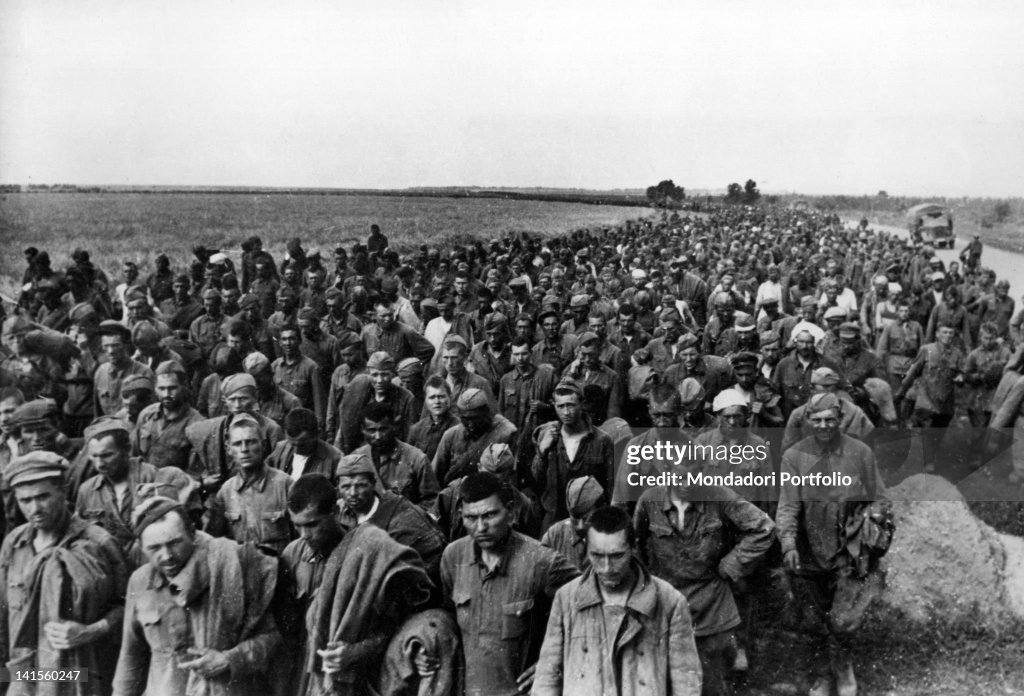
The First Battle of Smolensk began on the Eastern Front.
It is a time of great frustration for the Soviet forces. This manifests itself in failed attacks, suicidal counterattacks, and generals shot by the NKVD. The only things that slow the Germans as of 6 July 1941 are their own caution and occasional weather events such as the rains still lingering over much of the battlefront.
In the Far North sector, the German advance toward Murmansk makes some progress across the Litsa River. However, Soviet defenses are firming as reinforcements arrive.
The Finns decide to re-occupy the island of Morgonland and a lone lieutenant, Fred Luther, is landed for a two-day reconnaissance.
While waiting for the main attack by Lieutenant General Heinrichs’s Karelian Army to begin, Colonel Heiskanen’s 11th Div. (VI Corps) attacks near Vartsile to gain better starting positions for the coming main attack.
Further south, the Axis Operation ARCTIC FOX Operation resumes. The German XXXVI Corps has called up infantry from southern Finland and asked the Finnish 6th Division to disrupt the Soviet defenses at Salla. This does the trick and the Soviet 14th Army (122nd Rifle Division, the 104th Rifle Division, and the 1st Tank Division) is forced to retreat back into Salla itself. The Germans actually break into Salla briefly, but the Soviets quickly push them out again. As elsewhere on the Eastern Front, the Luftwaffe plays a key role in the Heer’s success, with Luftflotte 5 helping to break up the Soviet concentrations. This, of course, is the old Blitzkrieg formula.
What this incident at Salla illustrates above all is that the Soviet strength lies in direct confrontations, while German strength lies in tactics and maneuverability and airpower. These are lessons the German leadership sometimes has a hard time remembering but when applied, lead to the Reich’s greatest successes in the USSR.
In the Army Group North sector, the motorized units establish a line from Lake Peipus to Reval to Parun. The Soviets counterattack and make some gains.
In the Army Group Center sector, the Soviet 7th and 5th Mechanized Corps of the Soviet 20th Army (Lieutenant-General P.A. Kurochkin) attack with about 700-1,500 tanks near Lepel. While this is an impressive number of vehicles, only a small fraction are types that give the German panzers trouble. The Germans of General Hoth’s 3rd Panzer Group are prepared — Hitler has reined the panzers in recently — and the Soviet armored vehicles are mauled. German 7th Panzer Division — Erwin Rommel’s old formation — illustrates the power of the defensive and virtually wipes out the two Soviet formations. This is known as the First Battle of Smolensk.
In the Army Group South sector, the Germans attack in the north with 1st Panzer Group and Sixth Army and in the south with the German 17th Army and Romanian 3rd Army. The northern prong of the advance approaches Zhytomyr, while the southern prong takes Khotyn Fortress on the Dniestr River.
Romanian troops occupy Chernovsky and are welcomed by the local population.
Guerrilla warfare in Russia’s enemy-occupied territory was reported tonight to be seriously impeding the German war effort and compelling the assignment of thousands more troops behind the lines.
Despite occasional Red Air Force successes, overall the Luftwaffe dominates the skies. Today, for instance, JG 54 intercepts a formation of 73 Soviet bombers attacking the German bridgehead at Ostrov. The Luftwaffe pilots claim 65 Soviet bombers shot down, and ace Max-Hellmuth Ostermann claims his 19th and 20th victories.
This German superiority in the air has led to frustration on the Soviet side. Some Soviet pilots resort to ramming Luftwaffe planes. Amazingly, some Soviet pilots not only survive the dangerous encounters but manage to return to base. However, the Luftwaffe remains much stronger than the Red Air Force despite steady losses.
Soviet submarine ShCh-206 of the Black Sea Fleet is mined and sunk off either Shabler Cape or Sulina.
Kovno: Lithuanian militiamen, on German orders, kill 2,514 Jews. The occupying German authorities in Kaunas/Kovno, Lithuania institute a pogrom that ultimately claims thousands of lives. The killings by Einsatzgruppen occur at the Seventh Fort, where Jewish residents have been imprisoned.
The Military Collegium of the Soviet NKVD sentenced four teenagers to death for being the son and nephews of Nestor Lakoba, political enemy of Lavrentiy Beria (already killed in December 1936).
“Die Tat,” a Swiss newspaper, reports on a Soviet massacre of innocent prisoners at Lemberg. It states that:
“…this massacre is one of the most dreadful and ruthless massacres ever heard of in the history of the world. In the police prison 20 prisoners were crowded together in each of the smallest cells; they were then shot through the spy-holes. 2,000 to 2,500 persons were murdered in this way.”
The Germans already know about this incident. They have forced Jewish residents of Lemberg to dig up the corpses from a prison yard and rebury them elsewhere. This incident becomes controversial because of post-war Soviet claims that the Lemberg massacre was carried out by the Ukrainian “Nightingale” Legion, a special formation organized by the Wehrmacht.
The Battle of Damour commences when 7th Australian Division attacks in the early morning hours. Crossing the Damour River, the Australians establish bridgeheads at El Atiqa and El Boum after a day of hard fighting. Both sides realize that Damour, on the coast south of Beirut, is the key to that city, and Beirut is the key to the entire campaign.
As it has for several days now, the Royal Navy parks a large force led by light cruisers Ajax and Perth off Damour. The ships bombard Vichy French positions in aid of the Australian attack.
Australian Lieutenant Roden Cutler receives the Victoria Cross for heroism for actions today. He clears some enemy positions, then, wounded, is forced to lie in the open for 26 hours before being rescued. Cutler loses his leg due to the ordeal.
Royal Navy submarine HMS Triumph, operating near Benghazi, torpedoes and sinks 607-ton Italian freighter Ninfea and an escorting gunboat, Dante de Lutti. The Triumph sustains some damage from an Italian shore battery and is forced to abort further operations and return to Malta.
General Pietro Gazzera, the Governor of Galla-Sidama and the new acting Viceroy and Governor-General of the AOI, surrenders to Free Belgian forces under Major-General Auguste Gilliaert. With Gazzera, 2,944 Italian, 1,535 African and 2,000 local troops (bande) formally surrender. The native troops quickly change sides. In all, ten Italian generals surrender.
British Prime Minister sends a message to Soviet Premier Joseph Stalin expressing a hope that they can cooperate in the fight against Germany. Unlike U.S. President Roosevelt, Stalin is not particularly chatty with cables and does not typically respond quickly.
Japan takes over the protection of Italy’s Embassy in Moscow.
According to a 1947 OSS/CIA document, today the Gestapo arrests Jerzy Kuncewicz, a former intelligence officer of the Polish General Staff, and an associate in Berlin as spies. Kuncewicz has been in communication with the Polish Resistance in Warsaw and Japanese spies. Under Gestapo interrogation, Kuncewicz reveals that the Japanese military attaché, Brigadier General Banzai, is in control of a vast spy network in Europe that is spying on everyone. The Gestapo concludes that the Japanese network “works against the Reich,” though to what purpose is left unsaid. Kuncewicz’s group, meanwhile, has been sending information to London. The report concludes that the Gestapo believes that further investigation could prove that the Japanese are working with the Polish resistance and the Vatican to undermine the Reich.
A pastoral letter of German bishops is read out in all Catholic Churches in Germany. It recognizes that euthanasia is taking place within Reich mental asylums, but absolves Catholics from resisting these exterminations because it is impossible to fight the government. This does not sit well with some pastors, as, even beyond the moral crisis such killings create, they also violate sections of Reich penal law.
London has its sunniest day this century, 15 hours and 48 minutes of sunshine.
The Luftwaffe bombs and damages 3658-ton freighter North Devon off Sheringham. There are five deaths. The North Devon is towed to Immingham. One of the deaths is Reginald Hamilton Earnshaw. Earnshaw, 14, is officially declared the youngest known British service casualty of WWII by the Commonwealth War Graves Commission on February 5, 2010, which would have been his 83rd birthday. Earnshaw served as a cabin boy and lied about his age to get hired.
German raiders Atlantis and Orion have been meeting north of the island of Tristan da Cunha in the South Atlantic. Today, Atlantis heads east to the South Pacific while the Orion heads west toward South America.
After sundown, German bombers conducted a light attack on Great Yarmouth, Norfolk, England, United Kingdom.
Douglas Bader shot down a German Bf 109 aircraft.
RAF Bomber Command, Day of 6 July 1941
21 Blenheims on coastal sweeps; 2 lost. 9 Stirlings, escorted by fighters, to Le Trait shipyards and Lille without loss.
RAF Bomber Command, Night of 6/7 July 1941
Brest
88 Hampdens and 21 Wellingtons; smoke-screens concealed the warships. 1 Hampden and 1 Wellington lost.
Münster
47 Wellingtons; 2 lost. Crews claimed many fires in the target area but Mtinster reports only 30 incendiary bombs in the town and no casualties.
Dortmund
31 Whitleys and 15 Wellingtons. 2 Whitleys lost. Haze was present over the target but fires were claimed. Minor Operations: 5 Wellingtons to Rotterdam and 2 to Emden, 6 O.T.U. sorties. No losses. Total effort for the night: 215 sorties, 6 aircraft (2.8 percent) lost.
At Malta, Italian bombers attack the Paola dockyards. It is a heavy raid lasting for four hours and killing 15 and wounding 14 people. There also are scattered raids on Marsa and other locations.
Convoy OB.343 departed Liverpool, escorted by destroyers HMS Sabre, HMS Shikari, and HMS Venomous, corvettes HMS Clarkia, HMS Dianella, and HMS Kingcup, and anti-submarine trawlers HMS Lady Elsa, HMS Man O’ War, HMS Northern Dawn, and HMS Wellard. This group, less corvette Clarkia, was detached on the 12th. On the 12th destroyer HMS Harvester, armed merchant cruiser HMS Ausonia, and corvettes HMCS Hepatica, HMCS Primrose, HMCS Trillium, HMS Tulip, and HMCS Windflower joined. The convoy was dispersed on the 20th.
P/T/A/Sub Lt (A) T. Duncan RNVR, and Air Mechanic B. E. Randle were killed when their Fulmar of 759 Squadron crashed near Ilchester.
British steam trawler Westfield (140grt) was sunk by German bombing off St Govens Head, near Lundy Island.
Swedish steamer Birgitta 91363grt) was damaged by German bombing in 53-05N, 1-19E. The steamer was towed to Great Yarmouth.
British steamer North Devon (3658grt) was damaged by German bombing in 53-03N, 1-38E, off Sheringham. Five crewmen were killed on the steamer. The steamer was towed to Immingham.
Light cruisers HMS Ajax and HMAS Perth, anti-aircraft cruiser HMS Carlisle, and destroyers HMS Jackal, HMS Kingston, HMAS Nizam, HMS Griffin, HMS Havock, and HMS Hotspur (one of these destroyers were absent from the bombardment) bombarded Damur in support of army operations. A night sweep was conducted by light cruisers HMS Naiad and HMS Phoebe and destroyers HMS Kimberley and HMS Hasty.
Submarine HMS Triumph sank Italian steamer Ninfea (607grt) and escorting gunboat de Lutti off Benghazi. In the encounter, submarine Triumph was hit by an Italian shore battery shell and was forced to return to Malta with damage to her forward torpedo tubes.
Dutch submarine HNLMS O.21 departed Gibraltar for patrol off Finisterre.
Submarine HMS P.33 arrived at Malta from Gibraltar.
A Catalina aircraft sighted a submarine on the surface in 37-34N, 12-22W. Destroyers HMS Fearless and HMS Forester with convoy OG.66 were ordered to that position, but did not make contact.
Convoy HX.137 departed Halifax, escorted by armed merchant cruiser HMS Circassia and corvettes HMS Dianthus, HMCS Snowberry, and HMCS Spikenard. Convoy BHX.137 departed Bermuda on the 4th escorted by ocean escort armed merchant cruiser HMS Cheshire. The convoy rendezvoused with HX.137 on the 10th and the armed merchant cruiser was detached. Corvettes HMS Barrie and HMS Matapedia joined on the 7th and were detached on the 8th. On the 9th, destroyers HMS Reading and HMS Salisbury, armed merchant cruiser HMS Cheshire, and corvette HMS Honeysuckle joined the escort. Corvette Honeysuckle and armed merchant cruiser Cheshire was detached on the 10th. The escort was detached when relieved by destroyers HMS Amazon, HMS Bulldog, ORP Burza, and HMS Georgetown, corvettes HMS Aubretia and HMS Nigella, and anti-submarine trawlers HMS Daneman and HMS St Apollo. Destroyer Amazon was detached later that day and the rest of the escort, less corvette Aubretia on 21 August. Corvette Aubretia arrived with the convoy at Liverpool on the 22nd.
British troopship Ellegna departed Madras for Penang with personnel and lorries, escorted by heavy cruiser HMAS Canberra to 10N, 92E. Light cruiser HMS Danae relieved the heavy cruiser. They arrived at Penang on the 10th.
The German commerce raiders Atlantis and Orion ended their rendezvoused with each other north of the island of Tristan da Cunha in the South Atlantic Ocean. The Atlantis headed for the South Pacific Ocean and the Orion headed west towards the coast of South America.
President Roosevelt cables British Prime Minister Winston Churchill with “will advise you” on Churchill’s request that the U.S. and Great Britain form a joint committee on tank development. Churchill is concerned about German tank superiority and realizes that larger and more powerful tanks are required, but the U.S. at this time does not have any heavy tanks in its arsenal.
The flow of Lend-Lease munitions to Egypt to reinforce Britain’s defense of the Middle East was reported authoritatively today to have reached almost a ship a day. Officials familiar with administration of the $7,000,000,000 lend lease fund said that between 20 and 25 ships a month were being dispatched by way of either the Atlantic or Pacific routes to the Red sea. The manner in which shipments have been accelerated after a slow start tended to relieve the pessimism of some American military experts over British chances of holding on in the Mediterranean.
A high ranking Catholic prelate expressed the view today that President Roosevelt, as commander-in-chief of the army, rather than congress should decide whether and when the United States should enter the war against Germany. Bishop Joseph P. Hurley, of the diocese of St. Augustine, Fla., said in an address broadcast over C.B.S. that this country’s relation to the European conflict was no longer diplomatic or political, but had entered the “zone of strategy.” Therefore, he reasoned, the problem of strategy should be left to the commander-in-chief “who alone, in constant, loyal communication with congress and in consultation with his military and naval advisers, is capable of bringing us safely through the dangers which encompass us.”
An associate of Chairman Dies, Texas Democrat, said today that the house committee investigating un-American activities would open hearings in about two weeks into Japanese and German espionage activities in the United States. “Most of the Japanese activity is concentrated,” he added, “on the west coast.”
The U.S. Commerce Department called attention today to a real bottleneck of potential concern to millions of parched patriots. The dry facts are, the department said in a report on the alcoholic beverage situation, that “rationing of limited supplies of cork has introduced a new factor in beverage distribution,” particularly since “no suitable substitute for cork for bottle caps and stoppers is at present in production.”
Creation of machinery to enforce compliance with priority orders which are held vital to the success of the national defense program was announced today by E.R. Stettinius Jr., Director of Priorities of the Office of Production Management.
Operators of bituminous coal mines in the Southern Appalachian area signed a new two-year collective bargaining contract today with the C.I.O.’s United Mine Workers of America and thereby averted a strike of 150,000 miners which had been set for Tuesday.
United States Ambassador to Japan Joseph Grew gave Ushiba Tomohiko, Private Secretary of Japanese Prime Minister Prince Konoe Fumimaro a formal statement. The note included the following: “Should Japan enter upon a course of military aggression and conquest it stands to reason that such action would render illusory the cherished hope of the American Government, which it understood was shared by the Japanese Government, that peace in the Pacific area, far from being further upset, might now indeed be strengthened and made more secure. It is the earnest hope of the Government of the United States that the reports of Japan’s decision to enter upon hostilities against the Soviet Union are not based upon fact, and an assurance to that effect from His Excellency the Prime Minister of Japan would be deeply appreciated by the Government of the United States.”
The New York Times has an article, “Imagery For Profit,” by R.W. Stewart. It discusses the use of Television for advertising. The article notes that only New York NBC station WNBT is equipped to show advertisements but that many other stations across the country would like to “ass soon as possible, some within thirty days.” It notes that the first paid ad was for the Bulova Watch Company, which paid $4 for the privilege. The ad was a test pattern that resembles a clock face and remained on the air for a full minute as the second-hand traversed a minute.
The New York Times reports on page 20 that an outbreak of sunspots is affecting transatlantic radio communication and distorting compasses.
The transport USS Munargo (AP-20) and U.S. Army transport USAT Chateau Thierry arrived at Tunugdliarfik Fjord, Greenland, to disembark men and unload equipment to establish an air base there.
The first ever television advertisement airs. It is an ad for Bulova watches.
Major League Baseball:
Dizzy Dean resigns as coach of the Cubs to take a broadcasting job with the Cardinals.
With Manager Joe Cronin sitting it out, the Red Sox gave airtight support and timely hitting to two of their rookie pitchers today to sweep a double-header from the Senators, 6–2 and 4–3, before 25,000. Boston clinched the opener for Heber (Dick) Newsome in the first inning when Jimmy Foxx blasted out his twelfth homer of the season after Dom DiMaggio had doubled and Lou Finney had worked Kendall Chase for a pass. Newsome held the Senators to five hits while gaining his eighth triumph. Cecil (Tex) Hughson, recently recalled from Louisville by Boston, got off to a wobbly start in the nightcap, but settled down after George Case and Rog Cramer blasted him for doubles and Cecil Travis singled.
With the Ebbets Field season’s record crowd of 32,355 roaring fans on hand to see the first home twin bill of the campaign, the Dodgers yesterday took the opener from the Boston Braves, 5–2, but had to call it a day at the end of the seventh in the afterpiece with the score 4–4.
Ted Lyons wins his 8th of the year and 241st overall as the White Sox defeat the Indians, 9–4. The White Sox score four runs in the first inning to knock Al Milnar off the mound and cruiser to victory.
Elmer Riddle (9–0), righthander, remained in the van of the National League pitching parade by blanking the Cardinals today, 3–0, to score his ninth straight victory for the Reds. Lon Warneke is the loser.
The New York Yankees baseball team plays a doubleheader against the Philadelphia Athletics before 60,948 fans in Yankee Stadium in New York City. Before the game, a plaque of Lou Gehrig, who died on 2 June, is added to Monument Park in centerfield. In the first game, Yankee centerfielder Joe DiMaggio goes 4-for-5 against A’s pitchers Johnny Babich and Bump Hadley, as the Yankees win, 8–4. In the second game, DiMaggio goes 2-for-4 against Jack Knott, and New York wins again, 3–1. DiMaggio’s hitting streak now stands at 48 consecutive games. DiMaggio now is hitting .357 for the season, still well behind league leader Ted Williams at .405.
It appeared for a time today as if the Giants had made the trip to Shibe Park just for the ride. That they could beat the Phillies was not too much of a question after the fourth inning. It was the weather that bothered the New Yorkers. In the end, though, the Giants managed to outlast the Phillies, if not the elements, for the second game had to be postponed. Rain started in the second inning, caused a twelve-minute delay and never stopped in the rest of the game. However, the clubs somehow succeeded in squeezing in an official ball game before Umpire Babe Pinelli mercifully ceased hostilities at the start of the ninth inning. At that point the count was 7–3 in New York’s favor. Thus King Carl Hubbell, on the firing line for the first time in two weeks, scored his fifth straight triumph and his seventh of the year.
The scheduled second game between the New York Giants and the Phillies at Philadelphia was postponed due to wet grounds. The game will be made up as part of a doubleheader on September 23.
The Pirates swept a double-header with the Cubs today, 2–1 and 13–4. The second game was shortened to eight innings because of Pennsylvania’s Sunday law. Pitcher Rip Sewell and First Baseman Elbie Fletcher were the stars of the opener. Sewell limited Chicago to four hits. Fletcher struck two homers to the right-field stands on his first two trips to the plate. He narrowly missed a third when his liner hit the wall at the 400-foot mark and fell to the field for a double. The homers Were his sixth and seventh of the season.
The Browns rallied to score a 5–3 victory in the second game of a double-header today after the Tigers had gone on a six-run rampage in the fifth frame to win the opener, 7–5. The Browns scored two runs off Dizzy Trout in the sixth inning of the nightcap and he gave way to Buck Newsom. Trying for his seventh victory, Newsom had been removed for a pinch hitter in the fifth inning of the first game after giving St. Louis a three-run advantage.
Washington Senators 2, Boston Red Sox 6
Washington Senators 3, Boston Red Sox 4
Boston Braves 2, Brooklyn Dodgers 5
Boston Braves 4, Brooklyn Dodgers 4
Cleveland Indians 4, Chicago White Sox 9
St. Louis Cardinals 0, Cincinnati Reds 3
Philadelphia Athletics 4, New York Yankees 8
Philadelphia Athletics 1, New York Yankees 3
New York Giants 7, Philadelphia Phillies 3
Chicago Cubs 1, Pittsburgh Pirates 2
Chicago Cubs 4, Pittsburgh Pirates 13
Detroit Tigers 7, St. Louis Browns 5
Detroit Tigers 3, St. Louis Browns 5
The long-festering grievances about the Ecuador/Peru border led to the outbreak of hostilities on the 5th, and today things get hotter. While exactly how the war started is hotly disputed, there is no question that Peru quickly gains the upper hand. While a small party of Ecuadorian soldiers crossed the border on the first day of the war, today the Peruvian soldiers eject them and turn the tables. Peruvian paratroopers take Matapalo Island, which Ecuador seized in 1938. The Peruvian air force is active, attacking Ecuadorian border posts along the Zarumilla River. Meanwhile, mediators from neighboring Brazil and Argentina, along with US representatives, quickly try to broker a settlement. The government of Ecuador blamed the attack on Peru, declared it represented “an aggression of political character” and an “attack prepared from the military viewpoint,” and ordered Ecuador’s army into the fight.
Russia has given assurance to China that the hostilities with Germany will not necessitate a stop-page of Soviet military supplies for China, official Chinese sources revealed today. It was said that the Russians had advised the Chinese that they would continue to fill current Chinese orders and had indicated a readiness to consider new contracts.
As a symbol of the objective of the “China incident,” the fourth anniversary of whose outbreak is being observed throughout the Japanese Empire today, and presumably in line with the fundamental decision of the Imperial Conference, the Japanese Government has formed the “Great Japan-East Asia Construction League” under the presidency of Premier Prince Fumimaro Konoe.
U.S. Ambassador Joseph Grew warns Japan against offensive actions by delivering a letter directly to Mr. Tomohiko Ushiba, Private Secretary of the Japanese Prime Minister (Prince Konoe):
“Should Japan enter upon a course of military aggression and conquest it stands to reason that such action would render illusory the cherished hope of the American Government, which it understood was shared by the Japanese Government, that peace in the Pacific area, far from being further upset, might now indeed be strengthened and made more secure. It is the earnest hope of the Government of the United States that the reports of Japan’s decision to enter upon hostilities against the Soviet Union are not based upon fact, and an assurance to that effect from His Excellency the Prime Minister of Japan would be deeply appreciated by the Government of the United States.”
In fact, the Japanese have decided not to attack the Soviet Union. Unknown to the Americans, they have other targets in mind.
The Imperial Japanese battleships HIJMS Ise and HIJMS Hyuga depart Yokohama and arrive at Kisarazu across Tokyo Bay.
Born:
Harold Leighton Weller, conductor and music educator, in Dayton, Ohio.
Gordon ‘Butch’ Stewart, Jamaican businessman and founder of Sandals Resorts International, in Kingston, Jamaica (d. 2021).
Naval Construction:
The Royal Navy Fish-class ASW trawler HMS Bonito (T 231) is laid down by Cochrane & Sons Shipbuilders Ltd. (Selby, U.K.); completed by Holmes.
The Royal Canadian Navy Bangor-class (Diesel-engined) minesweeper HMCS Melville (J 263) is launched by Davie Shipbuilding and Repairing Co. Ltd. (Lauzon, Quebec, Canada).
The Royal Navy Fairmile C-class motor gun boat HMS MGB 318 is commissioned.
The Royal Canadian Navy “Town”-class [U.S. Wickes-class] destroyer HMCS Hamilton (I 24) [ex-HMS Hamilton; ex-USS Kalk (DD-170)] is commissioned. Her first commanding officer in Canadian service is A/Lieutenant Commander Norman Vincent Clark, RCNR.

