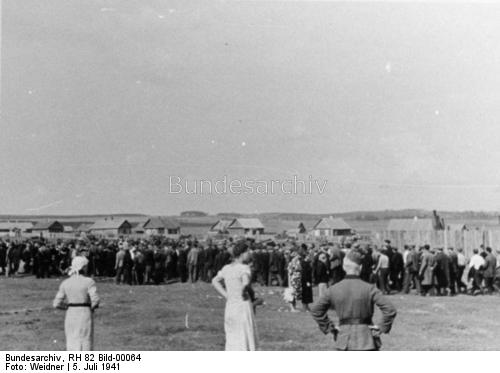
The German Sixth Army breaks through the Stalin line near Lviv (Lwow). The Soviet defense line west of Zhitomir is breached by the German 6th Army. German 1st Panzer Group drove toward Zhitomir and Berdichev, Ukraine. To the north, east of Minsk, the German advance reaches the Dnepr River. On the same day, Romanian 3rd Army captured Chernivtsi, Ukraine.
Rainstorms continue all along the center of the German advance on 5 July 1941. The roads turn to muddy ponds and vehicular traffic slows to a crawl. While both sides are affected equally by the conditions, a fact that should never be forgotten when reviewing the campaign in the Soviet Union, the weather favors the defense for the time being.
Despite the weather and everything the Soviets can throw at them, though, the Germans remain on schedule to end the war before the winter. OKH boss General Franz Halder notes in his war diary that “The entire front is advancing in accordance with our intentions.”
In the Far North sector, it is a quiet day. On the Litsa River sector, General Dietl’s Army of Norway is trying to expand a small bridgehead across the river but has little success. The Soviets land a naval battalion along the coast to distract the Germans.
Further south, Operation ARCTIC FOX, the projected advance to the Murmansk railway line via Salla, is stalled as the Germans bring up troops from the south. Luftflotte 5 is standing by to assist a major eastward push on the 6th. There are some minor Finnish probing attacks that capture Repola. In Karelia, the Finns also make some minor attacks to improve their starting positions for later actions.
General Halder allows himself some rare strategic criticism in his war diary about the Army of Norway Operations. He comments about the “dubiousness of this entire Murmansk operation, which serves only political ends and is open to gravest exposure from the operational point of view.”
In the Army Group North sector, General Hoepner’s panzers are eliminating pockets of resistance while the German infantry closes up. The Germans are now approaching Lake Peipus, Reval, and Parun. The front is getting very close to Leningrad already. In desperation, the Soviets counterattack between Ostrov and Pskov and stall the German advance.
In the Army Group Center sector, the Soviets are preparing a riposte by V and VII Mechanized Corps of the 20th Army. They plan to attack the German 39th and 47th Panzer Corps. The Germans are blissfully unaware, but so far they have been able to handle everything the Soviets can throw at them. On the right flank, General Model’s panzer division maintains its bridgehead at Rogachev. In the central axis of advance between the Beresina and Dneipr Rivers, General Guderian’s 2nd Panzer Group makes little headway. On the left flank, General Hoth’s 3rd Panzer Group takes a second bridgehead at Ulla.
In the Army Group South sector, the Soviets are retreating. OKW chief General Franz Halder writes in his diary that “Our troops have more or less lost contact with the enemy on the front of Seventeenth and Sixth Armies.” The Soviets are preparing for the defense of Kyiv, where they propose to make a stand. The Romanians take Chernivtsi.
The Ukrainian National Movement under Andriy Melnyk requests permission from Germany to form a military unit to aid Operation Barbarossa. Hitler, however, is dead set against arming any “conquered” peoples and denies the request. The Germans arrest rival Ukrainian nationalist leader Stepan Bandera and bring him to Berlin for interrogation.
The Soviet Special Group (later 4th NKVD Directorate) was formed, initially with 5,000 members, with the goal of terrorizing the enemy rear areas. The actual intention is for this special group to prevent Soviet troops from retreating.
Hitler’s adjutant at Rastenburg says that the murder of thousands of Russian Jews by SS Einsatzgruppen [action squads] or by local militia is part of a “necessary mopping-up operation.”
General Claude J. E. Auchinleck took over as Commander-in-Chief, Middle East from General Archibald P. Wavell. Wavell was sacked by British Prime Minister Winston Churchill on June 21, 1941 after the failure of Operation BATTLEAXE to relieve Tobruk.
The Australian 21st Brigade, which has been battling up the coast, prepares to launch the Battle of Damour. After dark, troops move forward to positions along the Damour River, which must be crossed in order to continue heading north to Beirut. Both sides understand that Beirut is the key to the campaign and that its defense is essential to Vichy French prospects. The attack is scheduled for the early morning hours of 6 July.
Royal Navy light cruiser HMS Ajax and HMAS Perth, anti-aircraft cruiser Carlisle and accompanying destroyers bombard Damour during the day in preparation for the Australian offensive. They return at night to patrol the coast.
Italian General Pietro Gazzera, the Governor of Galla-Sidama, continues to hold out with a large body of troops at Kulkaber (Culqualber), Abyssinia. His situation is hopeless, and he seeks peace terms.
According to “Hitler’s Table Talk,” Hitler discusses plans to make the Crimea the “German Riviera.” He plans to create autobahns from Germany to the Crimea because “Better than the railway, which has something impersonal about it, it’s the road that will bring people together.”
A 49-year-old Communist who organized groups of his fellow Yugoslav’s to fight Franco in the Spanish Civil War today issued a call to his country “to rise like one man in this battle against the invaders and hirelings.” Josip Broz, alias “Tito”, has recruited many partisans from the Yugoslavs who have fled to the mountains to escape forced labor under the Germans.
Polish government-in-exile leader Sikorski meets with Soviet Ambassador Maisky to discuss re-establishing diplomatic relations.
British Foreign Secretary Anthony Eden officially ruled out any chance of negotiations with Germany.
Oliver Lyttelton takes up his new post of British Minister in the Middle East.
British troopship HMT Anselm, carrying RAF personnel to Africa, was torpedoed by U-96 in the Atlantic Ocean with the loss of 254 of the 1,316 aboard. RAF Volunteer Reserve Herbert Cecil Pugh would later be awarded a posthumous George Cross in 1947 for tending to the wounded, helping with life rafts, and finally asking to be lowered into the flooding hold to be with his comrades who could not escape.
The Luftwaffe sends a night raid against Great Yarmouth, Norfolk.
First flight is made of the Spitfire Mk. VI. This is the high-altitude version of the Mk. V with a pressure cabin. The pilot still has to wear an oxygen mask. The Mk.VI has elongated pointed wingtips and a four-bladed propeller. Only 100 will be built.
RAF Bomber Command, Day of 5 July 1941
14 Blenheims on coastal sweeps off the Frisians and Holland, 3 Stirlings, escorted by fighters, to Lille and Abbeville. No losses.
RAF Bomber Command, Night of 5/6 July 1941
Münster
65 Wellingtons and 29 Whitleys; 1 Whitley lost. Crews reported a successful raid in good visibility and only light defences from this target, which had not been attacked for 5 months. Münster reports 21 people killed but no other details. The attack came between about 0050 hours and 0250 hours local time with 396 500-pound bombs, 50 250-pound bombs, and almost 6,000 4-pound incendiary bombs. The railway station was the intended main target. German authorities at Münster estimated 240 high explosive bombs and 3,000 incendiary bombs were dropped. 21 were killed and several fires were started. It was the first time Münster was subjected to large scale bombing.
Osnabrück
39 Hampdens; good bombing reported. 3 aircraft were lost.
Bielefeld
33 Wellingtons; good bombing reported, including the gasworks, believed to have blown up. No aircraft losses. Minor Operations: 13 Halifaxes and 3 Stirlings to Magdeburg, 14 Wellingtons to Rotterdam, 7 Hampdens minelaying in the Frisians, 5 O.T.U. sorties. No losses. Total effort for the night 208 sorties, 3 aircraft (1.4 percent) lost.
Ofw. Wilhelm Beier of 3./NJG 2 downs two bombers, a Wellington and a Blenheim for his seventh and eighth victories.
The RAF bombs Palermo, Sicily.
The Luftwaffe bombs Alexandria (15 bombers) and Tobruk.
The Italians bomb Hamrun, Malta after dark. There are 14-20 deaths, with 19 injured. Six houses are destroyed and water mains are damaged. In air battles, both sides lose planes.
Heavy cruiser HMS Shropshire, carrying 60 prisoners of war, arrived at Scapa Flow from the East Indies to join the Home Fleet.
For Operation DN, Light cruiser HMS Nigeria, anti-aircraft cruiser HMS Curacoa, and destroyers HMS Bedouin, HMS Punjabi, HMS Tartar, and HMS Eclipse departed Scapa Flow at 0630 to strike German shipping near Stadtlandet. The force was sighted by German aircraft on 5/6 July. The ships then returned to Scapa Flow, arriving at 1300 on the 8th.
Destroyer HMS Jupiter departed Scapa Flow at 1700 for Greenock to carry out minor repairs prior to joining Western Approaches. The destroyer was to have been in the escort for convoy WS.9C, but repairs required longer than expected. Destroyer HMS Lightning replaced her in the convoy escort.
Dutch destroyer HNLMS Isaac Sweers arrived at Scapa Flow at 1900 from Greenock to carry out working up exercises.
Anti-aircraft ship HMS Alynbank departed Methil at 1130 to cover convoy EC.41 from May Island to Pentland Firth. The ship arrived at Scapa Flow at 1100 on the 8th after leaving convoy EC.41.
Italian submarine Michele Bianchi was sunk by Submarine HMS Tigris in 45N, 04W in Biscay. There were no survivors from the Italian submarine.
Auxiliary minesweeper HMS Snaefell (A/T/Lt Cdr F. Brett RNR) was sunk by German bombing in 54-51N, 1-27W. Brett was lost in the minesweeper. T/Sub Lt F. Greenwood RNVR, and T/Lt A. R. D. Morgan RNVR, were wounded.
Destroyer HMS Holderness struck a mine in the North Sea. The damage required twenty six days to repair.
Submarines HMS Traveller and HMS Trooper, building at the Scotts yard at Greenock, were damaged by German bombing. The submarines were damaged again on the 8th by bombing.
British steamer Fowey Rose (470grt) was sunk by German bombing in 51-51N, 5-28W. Eight crewmen were missing on the steamer.
U-96, commanded by Kapitänleutnant Heinrich Lehmann-Willenbrock, attacked a group of ships composed of surveying ship HMS Challenger, and British steamer Anselm (5954grt), carrying troops and RAF personnel for Takoradi, escorted by corvettes HMS Starwort, HMS Lavender, and HMS Petunia. These ships had departed the Clyde on 30 June for Freetown. Corvette Petunia had departed Londonderry on 30 June. The submarine sank steamer Anselm in 44-25N, 28-35W. In the morning of 5 July 1941, U-96 was pursuing a convoy contact report from a Condor aircraft through fog about 300 miles north of the Azores when the she came upon a curious formation of six vessels: the British survey vessel HMS Challenger (J 98) (Cdr W.C. Jenks, OBE, RN), leading the troopship Anselm (Master Andrew Elliott), the armed merchant cruiser HMS Cathay (F 05) (A/Capt C.M. Merewether, RN) and three corvettes, HMS Petunia (K 79) (LtCdr G.V. Legassick, RNR), HMS Lavender (K 60) (LtCdr J. Whayman, RNR) and HMS Starwort (K 20) (LtCdr N.W. Duck, RD, RN) which were deployed to port, starboard and astern of the troopship. At 0829 hours, U-96 fired a salvo of four torpedoes and thought that she had scored hits on the AMC and a yacht (the survey ship). However, two torpedoes hit the Anselm, sinking her within 22 minutes, but that was time enough for the crew to launch all but one of the lifeboats. Nonetheless, four crew members and 250 of the service personnel on board were lost. The three corvettes immediately started a counter-attack on the U-boat but the sonar of HMS Starwort was out of commission, so HMS Petunia and HMS Lavender which had firm contacts, delivered the attack. The first corvette launched six depth charges and the latter twenty. Then the attack carried the corvettes close to the survivors in the water, so the depth charging had to be broken off, but they had damaged U-96 so badly that she had to abort her patrol. In the meantime the master, 93 crew members, three gunners and 965 service personnel were picked up by the survey ship (including 60 men from the water) and the third corvette. The survivors were later transferred to the Cathay and landed at Freetown. The 5,954 ton Anselm was carrying RAF and military personnel and was headed for Freetown, Sierra Leone. The U-96 suffered enough damage in the counterattack by the Anselm’s escorts that it had to abort its patrol and return to port for repairs.
Anti-submarine trawler HMS Northern Foam sighted a German submarine on the surface in 62-20N, 15-37E. The submarine escaped at high speed on the surface. Anti-submarine trawlers HMS Northern Princess and HMS Northern Sky joined the hunt, but the submarine was not recontacted.
Latvian steamer Rasma (3204grt) was damaged on a mine laid by Finnish submarine Vesihiisi on 23 June north of Ekholm. The steamer was beached to avoid sinking, but was sunk by German motor torpedo boats S.26 and S.28 on the 10th.
Swedish steamer Stig Gorthon (2241grt) was sunk on a mine off Borkum. The entire crew was rescued.
British steamer Bencruachen (5920grt) was sunk ona mine 9.8 cables 297° from Mex High Light. Three crewmen were lost on the steamer. Motor yacht Wyreema (31grt) was lost when the steamer was sunk.
Light cruisers HMS Ajax and HMAS Perth, anti-aircraft cruiser HMS Carlisle, and destroyers HMS Jackal, HMS Kingston, HMAS Nizam, HMS Griffin, HMS Havock, and HMS Hotspur, with air support, bombarded Damur. A night sweep was conducted by light cruiser Perth, anti-aircraft cruiser Carlisle, and destroyers Nizam and Havock.
Submarine HMS Torbay sank Italian submarine Jantina south of Melos in 37-309N, 25-00E.
Submarine HMS Clyde returned to Gibraltar after Operation VIGOROUS.
Rested by more than a week in the relaxing atmosphere of his Hyde Park home, President Roosevelt returned today to Washington and an immediate checkup on the situation of the nation’s defenses. A few minutes after his arrival, he was closeted with his immediate advisors on defense production and foreign relations. Anions’ his conferees were Sumner Welles, the acting secretary of state, who gave him a report on foreign affairs, including the expulsion of American consuls from Nazi-dominated Denmark; and General George C. Marshall, the army chief of staff, who on Thursday urged that restrictions be relaxed to permit the army to send draftees outside the western hemisphere. They and Henry L. Stimson, the secretary of war, James V. Forrestal, the acting secretary of the navy, and Rear Admiral Royal E. Ingersoll, assistant chief of naval operations, consulted with the chief executive for more than two hours.
A far-reaching plan for Federal control of prices and rents as a means for holding down the cost of the defense program and preventing an uncontrollable spiral of inflation is nearing maturity in the administrative arm of the government and is expected to be submitted to Congress in the next few days. Worked out by Leon Henderson, Price Control Administrator, and other defense experts, with the advice of B. M. Baruch, chairman of the War Industries Board in 1918, as the answer to their own demands for a general price-control law, the plan now awaits a decision by President Roosevelt on legislative policy. Persons who know of its provisions, and are conversant, too, with Congress and its ways, say that the scheme is so extensive in character and possible ramifications that it may be under consideration on Capitol Hill for weeks or months, and may need the full force of the Administration’s influence to shove it through in time to be of maximum benefit.
Senator Wheeler in a speech in Rochester, New York tonight asserted that “war mongers” in President Roosevelt’s Cabinet were “attempting to incite the American people to war by the practice of deception.” “They are not giving the people the facts-they dare not give the people the facts,” he declared. “They have kept secret the reports madc by Joseph P. Kennedy, former Ambassador to Britain. They have kept secret the report made by W. R. Davis, the oil man who contributed thousands to the Democratic campaign of 1936. “They dare not make public Mr. Bullitt’s reports to the State Department. They dare not take the people into their confidence and give them the facts upon the economic, political and military conditions of England and Europe.”
Brigadier General Cortlandt Parker, in command, believes the Fifth division, United States army, is better trained than the famed First division was at the start of the World war. The Fifth is one of the new, heavily motorized, triangular divisions of the streamlined army, and drew praise from war department observers in Tennessee maneuvers recently completed.
The armored force at Fort Knox, completing its first year, has taken its place as one of the country’s most formidable fighting units. It was created by a special War Department order last July 10. As the war in Europe has spread, the power of all-mechanized fighting divisions to strike quickly and effectively over all types of terrain has been tested and proved, and the United States now is rapidly forming a counterpart of the German panzer divisions.
A strike of 1,100 convict workers at the federal penitentiary has halted manufacture of shoes and brushes for the army. There has been no disorder. The work stoppage began July 3 with a sit-down strike in protest against an increase in the prison work week from 39 to 41 hours. The strikers also are demanding increased pay, double time for all hours above 38 a week and additional good behavior time to apply on their sentence.
Defense expenditures will probably rise to $1,000,000,000 a month next Fall, in contrast to the present rate of $800,000,000 a month, Harold D. Smith, Director of the Budget, predicted today.
The United States has arranged to send the members of the German and Italian consular and other agencies to Lisbon on the USS West Point, the former liner America, recently converted into a naval transport.
A special meeting of negotiators for the United Mine Workers of America and the Southern Coal Operators Association, aimed at averting a strike of 150,000 miners called for Tuesday in the Southern Appalachian soft coal field, was postponed until tomorrow. Some of the operators had not arrived for the session scheduled for this afternoon.
Destroyer Charles F. Hughes (DD-428) rescues 14 survivors (including four American Red Cross nurses) from the sunken Norwegian steamship Vigrid, which had been torpedoed while straggling from convoy HX 133 by German submarine U-371 on 24 June, at 58°58’N, 36°35’W.
U.S. Ambassador to the United Kingdom John Winant reports on 11 July 1941 that of the 27 American Red Cross nurses who were travelling to serve in England; 9 had arrived safely, 10 had been rescued (4 in serious condition) and 8 were missing.
United States officials joined Polish patriots today in paying homage to Ignace Jan Paderewski, famous pianist and first statesman of the republic of Poland, as he was interred at Arlington National Cemetery.
U.S. Navy transport USS Munango and USAT Chateau Thierry arrive at Tungugdliarfik Fjord to begin construction of an airbase at Narsarssuak, Greenland.
Warner Bros. releases “Kisses for Breakfast,” starring Dennis Morgan and Jane Wyatt. This is a comedy about bigamy, which comes about because Morgan’s character gets a case of amnesia.
Major League Baseball:
Behind Charlie Wagner’s seven-hit pitching, the Red Sox whitewashed the Senators, 5–0, today, collecting all their runs off starting pitcher Emil (Dutch) Leonard in the first five innings. Jimmy Foxx singled and doubled to account for 3 RBIs.
Homers by Whitlow Wyatt and Dolph Camilli enabled the Dodgers to top the Braves, 2-1. Wyatt also held the Braves to just three hits. The Dodgers are two games in front in the National League pennant race.
Although outhit 12-to-7, the Indians beat the White Sox, 5–3. Gerald Walker’s double and Gene Desautels’s single, coupled with a walk and a long fly, produced two runs after Chicago had tied the score in the seventh. Walker had singled two runs across with the bases full in the first and Desautels had made it 3-0 by doubling home another in the seventh. White Sox manager is tossed because of remarks to the umps and he will be suspended indefinitely tomorrow by the American League president.
The Cards manage only 4 hits off the Reds Johnny Vander Meer in losing their 4th straight, 2–1. Vandy ties a Major League mark with 3 assists in the 4th inning, throwing out Slaughter, Marion, and Mancuso.
The New York Yankees begin a three-game baseball series against the Philadelphia Athletics in Yankee Stadium in New York City, and win, 10–5. Joe DiMaggio hits a home run going 1-for-4 against A’s pitcher Phil Marchildon and extending his hitting streak to 46-games. Charles Keller adds his 18th and 19th homers as the Yankees beat the A’s, 10–5. Red Rolfe wins his 6th in a row.
At Forbes Field, Bucs pitcher Joe Sullivan overcomes a 7th inning grand slam by Dom Dallesandro and beats the Cubs, 9–6. Elbie Fletcher hit two doubles to drive in three runs for the Pirates.
The Browns had their annual “day” at Sportsman’s Park today and finally got something to cheer about. The St. Louis club swept a twin bill for the first time this season, beating the Tigers, 9–3 and 10–1. The Browns slammed thirty-one hits during the afternoon, having one big inning in each game. Johnny Allen pitched his first victory of the season in the opener. He has lost four games. Allen not only was effective in the pinches while allowing ten hits but drove in . three runs with two singles and scored a couple. Elden Auker, the Browns’ submarine ball pitcher, coasted through the nightcap.
The scheduled game between the New York Giants and the Phillies at Philadelphia was postponed due to wet grounds. The game will be made up as part of a doubleheader on August 17.
Washington Senators 0, Boston Red Sox 5
Boston Braves 1, Brooklyn Dodgers 2
Cleveland Indians 5, Chicago White Sox 3
St. Louis Cardinals 1, Cincinnati Reds 2
Philadelphia Athletics 5, New York Yankees 10
Chicago Cubs 6, Pittsburgh Pirates 9
Detroit Tigers 3, St. Louis Browns 9
Detroit Tigers 1, St. Louis Browns 10
The Ecuadorian–Peruvian War began. The long-standing dispute stems from Ecuador’s claim that its territory extends beyond the Andes Mountain Range to the Amazon River. How the war starts is hotly disputed, but some witnesses claim that Ecuadorian troops invade Peruvian territory in the Zarumilla province. Other witnesses claim that Peru invaded Ecuador due to a series of incidents along the border that the Peruvian government took to be provocations.
In any event, a small party of Ecuadorian troops quickly takes the Peruvian town of Aguas Verdes. Other Ecuadorian troops soon follow, and then the Peruvian government sends its own troops. The Peruvian troops quickly eject the Ecuadorian troops from their territory. Fighting soon spreads all along the border, and the Peruvian military has an early advantage due to the presence of more troops and advances into Ecuador’s El Oro province.
The other American countries have no patience for any border wars during this time of international crisis. Brazil, Argentina, and the U.S. quickly arrange a cease-fire.
Japanese Vice Admiral Hidehiko Ukita succeeded Vice Admiral Teruhisa Komatsu as the commanding officer of the Ryojun Military Port (previously known as Port Arthur; now Lushunkou, Liaoning Province, China), Kwantung Leased Territory in northeastern China.
Future Tokyo Rose propagandist Iva Toguri arrives in Tokyo to visit relatives. She will be stuck there when war breaks out.
Dow Jones Industrial Average: 124.18 (+0.14)
Born:
John Johnson, NFL defensive tackle (NFL champions-Bears, 1963; Chicago Bears, New York Giants), in Gary, Indiana (d. 2025).
Roy Shivers, NFL running back (St. Louis Cardinals), in Halley, Arkansas.
Garry Kilworth, British science fiction and fantasy and historical author (“The Electric Kid”), in York, England, United Kingdom.
Barbara Frischmuth, Austrian writer, in Altaussee, Salzkammergut, Austria.
Naval Construction:
The U.S. Navy YMS-1-class auxiliary motor minesweeper YMS-15 is laid down by the Rice Brothers Corp. (East Boothbay, Maine, U.S.A.).
The Kriegsmarine (German Navy) Type IXD2 U-boat U-197 is laid down by AG Weser, Bremen (werk 1043).
The U.S. Navy Benson-class destroyer USS Frazier (DD-607) is laid down by the Bethlehem Shipbuilding Corp. (San Francisco, California, U.S.A.).
The Royal Navy Bar-class boom defense vessel HMS Barova (Z 94) is launched by Charles Hill & Sons (Bristol, U.K.).
The Royal Australian Navy Bathurst-class minesweeper-corvette HMAS Wollongong (J 172) is launched by the Cockatoo Docks and Engineering Co. Ltd. (Sydney, New South Wales, Australia).
The Royal Australian Navy Bathurst-class minesweeper-corvette HMAS Cairns (J 183) is launched by Walkers Ltd. (Maryborough, Queensland, Australia).
The Kriegsmarine (German Navy) Type VIIC U-boat U-136 is launched by Bremer Vulkan-Vegesacker Werft, Bremen-Vegesack (werk 15).
The Kriegsmarine (German Navy) Type VIIC U-boat U-355 is launched by Flensburger Schiffsbau-Ges, Flensburg (werk 474).
The Kriegsmarine (German Navy) Type VIIC U-boat U-754 is launched by Kriegsmarinewerft (KMW), Wilhelmshaven (werk 137).
The Royal Canadian Navy Flower-class corvette HMCS Drumheller (K 167) is launched by the Collingwood Shipyards Ltd. (Collingwood, Ontario, Canada).
The Royal Navy MMS I-class motor minesweeper HMS MMS 36 (J 536) is commissioned. Her first commanding officer is T/Lieutenant James Addison, RNVR.
The Royal Navy Thornycroft 75 foot-type motor torpedo boat HMS MTB 55 is commissioned.
The U.S. Navy 77-foot Elco patrol motor torpedo boat USS PT-30 is completed.
The Kriegsmarine (German Navy) Type VIIC U-boat U-133 is commissioned. Her first commanding officer is Oberleutnant zur See Hermann Hesse.
The Kriegsmarine (German Navy) Type VIIC U-boat U-208 is commissioned. Her first commanding officer is Oberleutnant zur See Alfred Schlieper.
The Kriegsmarine (German Navy) Type VIIC U-boat U-654 is commissioned. Her first commanding officer is Korvettenkapitän Hans-Joachim Hesse.
The Вое́нно-морско́й флот СССР (ВМФ) (Soviet Navy) “M” (Malyutka)-class (3rd group, Type XII) submarine M-111 is commissioned.
The Вое́нно-морско́й флот СССР (ВМФ) (Soviet Navy) “M” (Malyutka)-class (3rd group, Type XII) submarine M-112 is commissioned.
The Вое́нно-морско́й флот СССР (ВМФ) (Soviet Navy) “M” (Malyutka)-class (3rd group, Type XII) submarine M-113 is commissioned.
The Royal Navy “O”-class destroyer HMS Oribi (G 66) is commissioned. Her first commanding officer is Lieutenant Commander John Edwin Home McBeath, DSO, RN.

