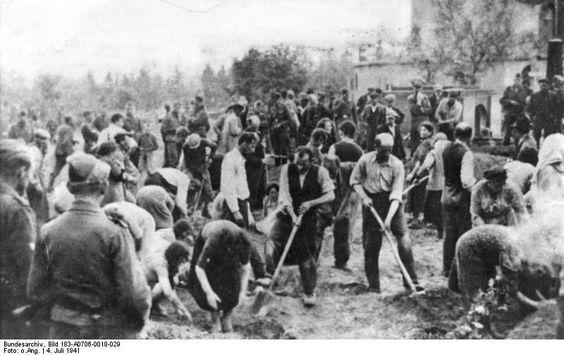
The German advance slows on 4 July 1941 due to recent rains that make the roads muddy. This problem with the roads is only a foretaste of serious difficulties the Wehrmacht will have in the Soviet Union with muddy roads throughout the war.
General Halder notes in his war diary that the panzers are outrunning the infantry, something Hitler already has tried to prevent by temporarily halting the panzers. Halder notes that “special measures will be necessary to bridge the gap.” Overall, though, Halder notes that “on the whole, we discern distinct withdrawal movements, covered by armored counter-thrusts.” He concludes optimistically that:
“The situation supports the assumption that the enemy does not have sufficient forces left for a sustained defense of the line running from the old Russo-Estonian frontier along Dvina and Dniepr to the south. This theory is borne out also by a Russian order, intercepted yesterday, to the effect that the Dvina river will be held only by groups concentrated at the crossings.”
In the Far North sector, Operation ARCTIC FOX, the joint German/Finnish operation toward Salla and ultimately the Murmansk railway, has stalled. The problem is that the Germans do not have sufficient forces at the point of attack just west of Salla. Army of Norway commander General Dietl moves some troops up from 163rd Infantry Division in Southern Finland (the division controversially moved across Sweden on the railway line) and asks the Finns to make a flank attack to restart the offensive. This will take a couple of days, and until then, the operation is on hold.
In the Army Group North sector, advance units of General Erich Hoeppner’s 4th Panzer Group reach the vicinity of Ostrov. This marks the pre-1939 Russian frontier. A little further south the panzers meet strong opposition, but Army Group commander Field Marshal von Leeb brings up infantry in trucks and sustains the advance. The Germans captured Ostrov in northern Russia. Ostrov fell to the German 41st Panzer Corps of Army Group North. The Germans were now less than 200 miles from their goal of Leningrad.
In the Army Group Center sector, the 19th Panzer Division of General Guderian’s 2nd Panzer Group reaches the Western Dvina River at Rogachev. Guderian’s men immediately seize a bridgehead from Soviet 51st Rifle Corps of 22nd Army. The Germans quickly move the 18th Motorized Division into the bridgehead. A little further north, General Hoth’s 3rd Panzer Group crosses the Beresina River. Hoth reports to OKW that he is down to 50% of combat strength.
The Soviets are taking advantage of the stormy weather which hit on 2 July to plan a counterattack along the main Moscow road. To do this, they mass troops in the vicinity of Smolensk. However, this will take them a couple of more days.
Field Marshal Fedor von Bock, commander of Army Group Center, moves his headquarters to Baranovichi. General Günther von Kluge, whom von Bock has put in command of Hoth’s and Guderian’s panzer groups, moves his headquarters to Minsk.
In the Army Group South sector, the panzers reach Buchach, Ukraine and take it without opposition after the Soviets abandon it. The Hungarian 3rd and 4th Armies reach the northern rim of the Carpathian Mountains. The Soviet forces are retreating to the east within the Pripet Marshes. Heavy fighting breaks out in the Mogilev-Podolski area.
The Soviet NKVD arrested Colonel General Dimitry Pavlov for not attacking German forces as Joseph Stalin had ordered. He faces the death penalty for failing to stop the German invasion. Stalin’s idiocy before the invasion is, of course, ignored.
Following a close escape on 3 July from one Finnish submarine, the Vetehinen, Soviet freighter Viborg (Vyborg) sees its luck run out. Finnish submarine Vesikko torpedoes and sinks Viborg east of Gogland Island. There is one death.
Lithuanian militiamen kill 463 Jews in Kovno (Kaunas), Lithuania.
Riga’s main synagogue is destroyed. There are many people trapped inside the structure who perish.
Einsatzkommando 9 (a unit of Einsatzgruppen B) in partnership with Lithuanians, begins shooting Jews in the pits of Ponary, a holiday destination before the war that is 10 km (6 miles) from Vilna. In addition, Germans arrive at the Synagogue on Zydowska (Zydu) Street in Vilna and demand that the Shamash (beadle), Haim Meir Gordon, form a governing group. This is the birth of the “First Judenrat,” which is established on 24 July.
In one of many similar incidents all along the front, Soviet Army deserters ransack Jewish homes in Buchach after the Red Army retreats and before the Wehrmacht marches in later in the day. Joining them are various local people looking to take advantage of a temporary period of lawlessness. Many Jews lock themselves in their homes and welcome the arrival of the German troops as restoring order. Locals quickly sense the mood of the new occupiers and resume their depredations against the Jews, sometimes robbing them and kidnapping them as slaves.
At Tarnopol, German and local Ukrainian forces begin a pogrom against Jews. The Germans begin shooting at Jews in the street and invading Jewish homes. The reason for this incident appears, from local accounts, to be related to German anger at Soviet executions of prisoners at the Tarnopol prison — presumably including German POWs. The occupiers force Jews to dig up the courtyard of the prison in search of corpses and then carry them out for burial elsewhere.
At the Polish city of Lwów, several units composed of the SS, police and field gendarmerie under the command of SS officers arrest professors of the higher academic institutions at their homes. The SS men don’t make distinctions and simply arrest all men over 18 in the homes (many adult children live with their parents). According to the sole survivor, Professor Groër, the arrested people are taken to the Abrahamowicz dormitory and told to stand against a wall for over an hour. The victims are taken to a cellar and shot one by one. When it is Groër’s turn, he is asked why he, of German descent, did not leave the town when the Soviets (Bolsheviks) took over in 1939. He replies that he considers himself Polish and, in any event, the Soviets would not have allowed him to leave due to his university position. The only reasons Groër is spared are that he is married to a titled English woman, which for some reason impresses the executioners, and also has prewar contacts within the SS. This incident is a good example of Holocaust executions that are not based on the victims being Jewish.
The Australians plan a major attack for the 5th on Damour, which is a Vichy French administrative center. This town on the coast and the associated Damour River is the last major obstacle for the Australian advance north toward Beirut.
To the northeast, General Slim’s Indian troops prepare to advance west from Deir ez-Zor. Their next objective is Raqqa, a road junction to the northwest on the road to Aleppo.
Off the coast, light cruisers Naiad and Ajax lead a destroyer force to shell Vichy French positions.
With the Italian surrender at Amba Alagi, all that remains for the Allies in East Africa is clearing up. Yesterday General Gazzera surrendered his divisions at Sidamo to a Free Belgian force. The alternative to the Belgians was the Ethiopian “Patriots”, led by Major Orde Wingate, who reputedly wears a purse made from the scrotum of a dead Italian. A few Italian divisions remain around Gondar in the north-west, and in the far west, and the rains — which make all roads impassable — will give them a few months life, but they present no strategic threat to anyone.
At a Central committee meeting of the Yugoslav Communist Party Josip Broz Tito was named Military Commander and issued a call for a resistance movement and a communist revolution in Yugoslavia. Meanwhile, the Chetniks, a completely separate Yugoslavian partisan group led by monarchist Draža Mihailović, attacks a police station in Serbia.
Orde Wingate, recently demoted and removed from his dismantled Gideon Force command in Abyssinia, attempts suicide by stabbing himself in the neck. The authorities decide to repatriate him to England. The incident may be attributed to side effects of Atabrine that Wingate is taking to combat a bout of malaria. Wingate’s military career is not destroyed, however, because he has personal support from highly placed individuals within the British government.
From today only one ton a month of coal, coke or any other type of solid fuel can be supplied for domestic use in the UK. Even that amount is not guaranteed to be available. Coal production has fallen because of the call-up of young miners. Ernest Bevin, the Minister of Labour, has appealed for 50,000 ex-miners to return to the pits, without success; he is now ordering ex-miners to register for recall. The new restriction of supply affects all households, hotels, flats, clubs and offices, and is intended to save fuel for industry.
British Communist Party decided to stop campaigning for peace; instead, they supported the national war effort.
Howard Florey and Norman Heatley meet for the first time and successfully recreate penicillin 11 days later.
The Luftwaffe sends 75 aircraft on scattered missions over Great Britain after dark.
Douglas Bader collided with a German Bf 109E fighter during a dogfight; the German fighter was scored as a probable kill.
RAF Bomber Command, Day of 4 July 1941
32 Blenheims on various operations. 12 aircraft carried out a determined low-level raid on Bremen despite the lack of any cloud cover; 4 of them were shot down. For his leadership on this raid, Wing Commander Hughie Edwards, the Australian commander of 105 Squadron, was awarded the Victoria Cross. His bomber had been hit 20 times. The raid is very nearly a disaster for the RAF. Every plane is damaged, and four fail to return. This adds to the growing body of evidence that daylight bomber raids, long since abandoned on the western front by the Luftwaffe, are too costly to be profitable. Other targets attacked by the Blenheims were Norderney and Choques power-station. Total Blenheim losses on this clay were 6 aircraft.
RAF Bomber Command, Night of 4/5 July 1941
Brest
65 Wellingtons and 23 Whitleys; smoke-screens prevented accurate bombing of warship targets. 1 Whitley lost.
Lorient
25 Hampdens and 22 Wellingtons; hits were claimed on the U-boat base in perfect visibility. No aircraft lost.
Minor Operations: 4 aircraft to Cherbourg, 2 each to Cologne and Dortmund, 1 each to Düsseldorf and Hambom, 5 Hampdens minelaying in the Frisians, 2 O.T.U. sorties. The 2 Hampdens sent to Dortmund were lost.
While flying a MiG-3 fighter Lieutenant-Colonel Stepan Suprun, commanding officer of Soviet Naval Air Unit 401 IAP, was shot down by a German Fw 200 aircraft.
The RAF spots Vichy French auxiliary cruiser St. Didier off Adalia, Turkey. The St. Didier is disguised as a Turkish merchant ship. The RAF planes proceed to sink the St. Didier.
The Luftwaffe attacks Tobruk.
The RAF based in Malta sends five Wellington bombers to raid Tripoli, causing some damage.
It is a quiet day on Malta, with no air raid alarms. Royal Navy submarine HMS Osiris arrives and offloads 70 tons of bulk petrol in Marsaxlokk. Submarine Utmost also makes port after its patrol.
U-123, commanded by Kapitänleutnant Reinhard Hardegen, sank British steamer Auditor (5444grt) at 25-33N, 28-23W. At 0355 hours on 4 July 1941 the Auditor (Master Edwin Bennett), dispersed on 28 June in 48°17N/20°40W from convoy OB.337, was hit by one torpedo from U-123 and sank about 600 miles northwest of the Cape Verde Islands. One gunner was lost. The master and 50 crew members landed at St. Michael Island, Azores and 20 crew members and four gunners landed at Taffalal Bay, San Antonio Island, Cape Verde Islands and were brought to Bathurst by HMS Gorleston (Y 92) (Cdr R.W. Keymer, RN). The 5,444 ton Auditor was carrying general cargo and 10 aircraft and was headed for Beira, Mozambique.
Destroyer HMS Eskimo departed Scapa Flow for Sheerness and refitting at London. The destroyer arrived at Sheerness at 1800 on the 8th. Her refit was completed in September.
Minelayer HMS Plover, escorted by destroyer HMS Hambledon, laid minefield BS 67, off the east coast of England.
British trawler Akranes (T/Lt W. A. C. Harvey RNVR) was sunk by German bombing off Bridlington Bay. There were no casualties on the steamer.
British steamer Balfron (362grt) was sunk by German bombing 3½ miles 38° from Ravescar. Four crewmen were missing on the steamer.
British steamer Lunan (363grt) was sunk on a mine in 51-26-48N, 3-10-24W. Five crewmen of a crew of six were lost.
Motor vessel Goldfinch (454grt) was damaged by a mine ten miles 273° from St Bees Head, Solway Firth. The vessel was towed to Whitehaven.
British troopship Cameronia arrived at Gibraltar from Freetown. Light cruiser HMS Hermione from raider hunting and destroyers HMS Lance and HMS Legion from convoy OG.66 escort arrived at Gibraltar. Aircraft carrier HMS Furious and troopships Scythia and Cameronia departed Gibraltar for the Clyde, escorted by light cruiser Hermione and destroyers Lance, Legion, HMS Wishart, and HMS Fury. Light cruiser HMS Edinburgh relieved light cruiser Hermione after being detached from convoy WS.9B 3 July. Light cruiser Hermione proceeded to patrol duties. Destroyer HMS Faulknor was detached from convoy OG.66 on the 5th to join aircraft carrier Furious. Destroyer Wishart departed the escort on the 8th to refuel at Ponta Delgada and then return to Gibraltar. On the 9th, aircraft carrier Furious rendezvoused with battleship HMS Royal Sovereign and light cruiser Edinburgh was detached. Light cruisers Edinburgh and Hermione arrived at Gibraltar on the 10th. Destroyers Faulknor and Fury arrived back at Gibraltar on the 14th. Aircraft carrier Furious was bombed by three German Focke Wulf aircraft in 36-28N, 10-51W on the 5th, but was not damaged. The aircraft carrier arrived in the Clyde on the 12th with battleship Royal Sovereign, steamers Scythia and Cameronia, carrying 188 prisoners of war, and destroyers ORP Piorun, Lance, and Legion.
Submarine HMS Severn arrived at Gibraltar from patrol in the Tyrrhenian Sea.
Submarine HMS Urge arrived at Malta from patrol.
Anti-submarine whaler HMS Gos 3 departed Gibraltar for Freetown.
Light cruisers HMS Naiad and HMS Ajax with destroyers HMS Jackal, HMAS Nizam, HMS Kimberley, and HMS Havock shelled French positions on the Syrian coast.
Ocean boarding vessel HMS Cavina intercepted German steamer Frankfurt (5522grt), which had departed Rio de Janiero on 26 June, in 31-34N, 37-42W. Steamer Frankfurt scuttled herself. The vessel rescued twenty six survivors from the steamer. Some twenty crew members were missing.
Submarine HMS Torbay sank two caiques with troops and stores with artillery off Doro Channel, Nigeria.
Convoy OG.67 departed Liverpool escorted by destroyers HMS Chelsea and HMS Verity, sloop HMS Bideford, corvettes HMS Arbutus, HMS Begonia, HMS Convolvulus, HMS Jasmine, HMS Larkspur, and HMS Rhododendron, ocean boarding vessel HMS Lady Somers. The ocean boarding vessel was detached that evening. On the 5th, catapult ship HMS Pegasus and corvette HMS Pimpernel joined the escort. On the 9th, the destroyers and corvettes Arbutus, Begonia, Convolvulus, Jasmine, and Pimpernel, and the catapult ship were detached. Corvettes HMS Coreopsis from Gibraltar and HMS Jonquil and HMS Spiraea from convoy HG.67 joined the escort on the 14th. Corvette Spiraea was detached on the 15th to assist ocean boarding vessel Lady Somers, which had been torpedoed. The convoy arrived at Gibraltar on the 20th, escorted by sloop Bideford, anti-submarine trawler HMS Arctic Ranger, corvettes Jonquil and Coreopsis, Dutch submarine HNLMS O.24, and naval trawlers HMS Copinsay and HMS Arran.
U.S. President Franklin D. Roosevelt made an Independence Day broadcast warning that “the United States will never survive as a happy and fertile oasis of liberty surrounded by a cruel desert of dictatorship. And so it is that when we repeat the great pledge to our country and to our flag, it must be our deep conviction that we pledge as well our work, our will, and, if it be necessary, our very lives..”
In an unprecedented Independence Day ceremony, President Roosevelt told his fellow Americans today that they must pledge lives as well as allegiance to country and flag because the fundamental principles for which their forefathers fought in 1776 were “being struck down abroad and definitely they are threatened here.” Millions of Americans, commemorating the holiday as they pleased at beaches, ball parks, picnic groves and homes paused solemnly at 4 p.m. (1 p.m. P.S.T.), and heard the admonition of their chief executive. Then, led by Chief Justice Harlan Fiske Stone, people and president spoke as one “I pledge allegiance to the flag of the United States of America and to the republic for which it stands, one nation indivisible, with liberty and justice for all.”
Failed Presidential candidate Wendell L. Willkie also gives a speech over the NBC radio network. He urges free trade and a form of globalism:
“We must see to it that the trade areas of the world are enlarged, that artificial barriers between men are removed, so that there will be a constantly rising standard of living for all men who work, in which men of all races and creeds and religions and nations can live in peace and harmony, in which the just fruits of enterprise will find their just fulfillment, in which children may look forward to a constantly better world, free of hatred and bitterness and narrow isolationism and of economic degradation.”
He concludes his speech by hopefully predicting the end of tyranny before the next fourth of July.
When this country adopted its Declaration of Independence, it set up ideals which will always be a threat to dictators everywhere, because these ideals will always be a standing incitement to suppressed peoples everywhere to overthrow their masters, Robert H. Jackson, Attorney General, declared in an Independence Day address here today.
Full negotiating committees for the C.I.O. United Mine Workers and southern soft coal operators were summoned to a meeting in Washington today and both sides indicated they hoped to avert a threatened walkout of 150,000 miners. President John L. Lewis of the mine union and L. Ebersole Gaines, spokesman for the producers, joined in a statement that negotiations were making progress. Hopes for heading off the strike, scheduled for Tuesday, thus brightened. The southern producers have agreed to abandon their old 40-cents-a-day wage differential and the sole remaining issues are minor.
Fourth of July celebrations by soldiers at Fort Richardson, near Anchorage, Alaska, were suddenly interrupted yesterday by an “alert” order which sent every man on the post to battle stations. The Alaska defense command, in an official statement, said the alert order was a routine training maneuver to which no special significance should be attached. The unusual activity, however, caused rumors of declared or impending war to circulate through Anchorage all during the Fourth celebration.
Picturesque cavalry charges, with horsemen brandishing sabers, may figure in communiques from the Russian front, but have no part in American Army tactics, it was said at Fort Lewis, Washington today by officers of the 115th Cavalry (mechanized).
PBY Catalinas (VP 72) began operations based on the seaplane tender USS Goldsborough (AVD-5), out of Reykjavik, Iceland, covering the movement of marines to Iceland. These are in anticipation of the upcoming occupation of Iceland by U.S. Marines to replace British troops. The Marines already are at sea, having left Argentia at dawn on 2 July. They are due to arrive at Reykjavik by 7 July. The Icelandic government is not thrilled at being occupied, but the prime minister reluctantly has cabled President Roosevelt that it is “in the best interest of Iceland.”
U.S. Marines arrived at Iceland for occupation duties, freeing British troops for war efforts elsewhere.
“Manpower” a drama directed by Raoul Walsh, is released. It stars Edward G. Robinson, Marlene Dietrich, George Raft, Alan Hale, Frank McHugh, Eve Arden, Barton MacLane and Ward Bond; Diana Barrymore and Faye Emerson have uncredited bit parts. Robinson and Raft are members of a power company road gang who meet Dietrich in a clip joint and then she comes between them.
“Moon Over Miami,” a musical directed by Walter Lang, is released. It stars Don Ameche, Betty Grable, Robert Cummings, Jack Haley, Carole Landis, Charlotte Greenwood and Jack Haley. Grable and Landis are gold diggers from Texas who arrive in Miami looking for rich husbands.
Paramount film “Caught in the Draft” is also released. It stars Bob Hope and Dorothy Lamour, both taking a break from the “Road” films with Bing Crosby. Capitalizing on the war situation, the comedy featured Hope as a movie star who wants to evade the draft by getting married, but winds up with a colonel’s daughter — and in the army. The film goes out of its way to make the military seem lenient and understanding in order to aid the war effort. The film opens at the Paramount in New York and becomes only the second film in the theater’s 15-year history to run for five weeks.
Major League Baseball:
The New York Yankees wish to honor the recently deceases Lou Gehrig by unveiling a monument in Memorial Park, directly behind center field, today. He is the second player to be so honored. Gehrig is not buried there — his grave is in Kensico Cemetery in Valhalla, New York — but this is considered “his place” by many fans. Unfortunately, today’s doubleheader against the Senators is rained out, so the date of the unveiling is moved to 6 July. Rainchecks for today’s rained-out games become prized collector’s items because they bear the Iron Horse’s picture.
In front of 6,013 in Boston, the Philadelphia Phillies’ Manuel Salvo breaks his 10-game loss streak, beating the Braves, 4–3. Jim Tobin allows 2 hits in shutting out the Phillies in game 2, 2–0, with both hits by Merrill May.
At Chicago, the Cubs took both ends of a doubleheader with the Cardinals today, 6–5, and 5–2, to drop the St. Louis team one game behind the Dodgers, who were idle because of rain. The Cards and Brooklyn had been tied for first place in the National League standing. The Cubs came from behind twice in the first game to win with an eight-hit attack, compared to the Cardinals’ thirteen safe blows.
Vince DiMaggio converted one fat fourth-inning pitch by Monte Pearson into a home-run skyrocket today to give Pittsburgh a 6–4 victory after Cincinnati had taken the opener, 6–0, behind Bucky Walters’s six-hit hurling.
With a crowd of 34,219 on hand in Cleveland, the Indians don’t disappoint, winning the opener in dramatic fashion when Jeff Heath steals home to win, 9-8. (as noted by Jan Larson). The Tribe score 5 runs in the 9th, three on homer by Ken Keltner. The Indians win the second game, 3–2, in 7 innings to move 2 games in back of the idle Yankees.
The Chicago White Sox prevented the champion Detroit Tigers from getting into the American League’s first division at the traditional holiday milestone by dividing a double bill today before 40,068 spectators. Lefty Thornton Lee pitched five-hit ball to win the opener, 3–2. Then Rip Radcliff drove in five runs as Detroit capitalized on a ten-hit attack to take the nightcap, 10–6.
The scheduled doubleheader between the New York Giants and the Dodgers at Brooklyn was postponed due to rain. The games will be made up as part of doubleheaders on August 12 and September 7.
The scheduled doubleheader between the Washington Senators and the Yankees at New York was postponed due to rain. The games will be made up as part of doubleheaders on August 14 and September 26.
The scheduled doubleheader between the Boston Red Sox and the Athletics at Philadelphia was postponed due to rain. One game will be made up as part of a doubleheader on August 14.
Philadelphia Phillies 3, Boston Braves 4
Philadelphia Phillies 0, Boston Braves 2
St. Louis Cardinals 5, Chicago Cubs 6
St. Louis Cardinals 2, Chicago Cubs 5
Pittsburgh Pirates 0, Cincinnati Reds 6
Pittsburgh Pirates 6, Cincinnati Reds 4
St. Louis Browns 8, Cleveland Indians 9
St. Louis Browns 2, Cleveland Indians 3
Chicago White Sox 3, Detroit Tigers 2
Chicago White Sox 6, Detroit Tigers 10
Heavy cruiser HMS Exeter arrived at Aden. The cruiser operated from Aden from 4 July until the end of September 1941 when she docked at Colombo.
Dutch steamer Sibajak departed Durban with 800 personnel from convoy WS.8X. The steamer was escorted by light cruiser HMS Colombo to 5-20S, 50E, where the escort was relieved by light cruiser HMS Mauritius. Light cruiser Mauritius escorted to 4-25N, 86-50E where she was relieved by light cruiser HMS Durban. The steamer arrived at Singapore on the 19th.
Japan is considering an extension of the limits of her territorial waters which, in effect, would cut off Vladivostok, Russia’s big Pacific port, from normal contact with the rest of the world and hamper shipments of United States material to the Soviet Union.
The Japanese decide that they will link their espionage agents in the United States into a network that funnels its spy information south through the Mexican Embassy and its Ambassador Miura. In order to avoid US scrutiny, the Japanese intended to be the conduits of such information flows are to be reduced from official status to civilian status so that they can move across the border without incident.
The United States neutrality patrol has withheld temporarily the clearance of the freighter Noshima Maru with a cargo of 6,000 tons of Philippine chrome ore destined for the United States via Japanese ports, pending developments in Japan’s sudden move recalling vessels carrying cargo bound for the United States.
Born:
Digger Phelps [Richard Phelps], American college basketball coach (Notre Dame Fighting Irish; 1971-91) and analyst on ESPN (1993-2014), in Beacon, New York.
Brian Willson, American peace activist, in New York, New York.
Jay Carty, NBA power forward (Los Angeles Lakers), in West Plains, Missouri (d. 2017).
Died:
Antoni Łomnicki, 60, Polish mathematician (killed in the Massacre of Lviv professors).
Naval Construction:
The U.S. Navy SC-497-class (110-foot wooden hull) submarine chaser USS PC-497 (later SC-497) is launched by the Westergard Boat Works Inc. (Rockport, Texas, U.S.A.).
The Royal Canadian Navy Bangor-class (VTE Reciprocating-engined) minesweeper HMCS Cowichan (J 146) is commissioned. Her first commander is T/Lieutenant John Richard Kidston, RCNVR.

