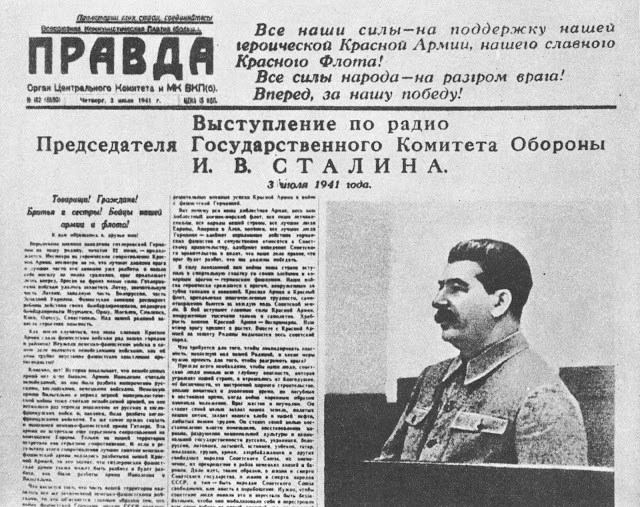
On 3 July 1941, after disappearing from public view for ten days, Soviet Premier Joseph Stalin gives a radio speech. It is a remarkable event in the history of the Soviet Union. It is one of the most dramatic and influential speeches of the 20th Century because it produces results that change the history of the world. As British newsman Alexander Werth writes, for the first time Stalin speaks to the country as if his listeners are his friends. Listeners can hear the clink of Stalin’s glass as he takes occasional sips and marvel at his very thick Georgian accent. It is as if Stalin is sitting at the table with you, explaining the tragedy that has befallen the country and asking personally for your help.
The gist of the speech is that the entire Soviet Union must engage in total war. On a tactical level, Stalin advocates that his “brothers” and “sisters” adopt “Guerilla tactics.” He admonishes “We must not leave … a single kilogram of grain or a single liter of petrol to the enemy.” He summarizes the strategic situation quite honestly, one of the few times the Soviet government gives a clear picture of the situation throughout the war:
“Hitler’s troops have succeeded in capturing Lithuania, a considerable part of Latvia, the western part of White Russia, a part of the western Ukraine. The Fascist air force is extending the range of the operations of its bombers and is bombing Murmansk, Orsha, Mogilev, Smolensk, Kiev, Odessa, Sevastopol.”
However, the speech touches on themes that go far beyond the tactical or even strategic.
“Thus the issue is one of life or death for the Soviet state, for the peoples of the Union of Soviet Socialist Republics; the issue is whether the peoples of the Soviet Union shall remain free or fall into slavery. The Soviet people must realize this and abandon all heedlessness; they must mobilize themselves and reorganize all their work on new, war-time lines, when there can be no mercy to the enemy.”
Stalin concludes with a populist call to “the people” — unheard of in the Soviet state to date:
“The State Committee of Defense has entered in its functions and calls upon all our people to rally around the party of Lenin-Stalin and around the Soviet government so as self-denyingly to support the Red Army and Navy, demolish the enemy and secure victory. All our forces for support of our heroic Red Army and our glorious Red Navy. All the forces of the people—for the demolition of the enemy! Forward, to our victory!”
The results of Joseph Stalin’s speech will become clear as we continue our review of the days of World War II.
Fuel is of special importance in this scorched-earth policy, for the German supply lines are becoming over-stretched and the thirsty tanks and aircraft must rely to a large extent on captured fuel. The burning of houses is not important at the moment, for the weather is hot and fine, but if this campaign extends into the bitter Russian winter then the lack of shelter will hit the Germans as hard as it did Napoleon’s men. Stalin has demanded a great deal from the people of the Soviet Union. Some of them will not obey him — in some areas the invading Germans have been welcomed with bread and salt — but others will do anything for Holy Mother Russia if not for communism.
In the Far North sector, General Dietl’s Army of Norway 3rd Mountain Division establishes a bridgehead across the Litsa River on the way to Murmansk in Operation Silver Fox. The Soviets quickly send reinforcements to the area and stop any further German penetration. Further south, the Operation Arctic Fox advance toward Salla bogs down, largely due to the inexperience of the German SS-Infantry Kampfgruppe Nord division. The Germans call for reinforcements from southern Finland and ask the Finns to mount a flank attack on the Soviet defenders to free up their front, but this will take several days to organize.
In the Army Group North sector, Field Marshall von Leeb’s troops continue attacking the Stalin Line with 4th Panzer Group. The Soviet defenders manage to hold their positions through great sacrifices.
On the Army Group Center Front, the panzers of General Walter Model’s 3rd Panzer Division of Panzer Group 2 reach the Dneipr River at Rogachev southeast of Minsk despite determined Soviet counterattacks. There is some confusion on the German side, with local commanders determined to move forward while Hitler’s 29 June “stop” order technically remains in place. Field Marshal von Bock supports Generals Guderian and Hoth against Army Commander von Brauchitsch, and the panzers continue eastward past Minsk.
Behind the front, General Hoth’s 3rd Panzer Group helps infantry troops to subdue the large Soviet Bialystok pocket west of Minsk. Ultimately, 290,000 Soviet troops and 2500 tanks surrender.
Soviet Colonel Yakov Grigorevich Kreizer, commander of the elite 1st Moscow Motor Rifle Division, attacks the bridgehead established by General Guderian’s 2nd Panzer Group at Borisov (near Lipki). The attack is spotted before it arrives by Luftwaffe reconnaissance. The attack is sharp and vicious but fails. Guderian’s 18th Panzer Division in the bridgehead is aided in planning its defense by intercepts of Soviet communications made “in the clear” — not in code — and also by Luftwaffe reconnaissance. The Soviets have a success of sorts, getting the remnants of 4th and 13th Armies across the Dneipr, but all of the Soviet armies are battered an no longer worthy of the name. Marshal Timoshenko orders the 21st Army forward to hold the river line, which the Germans are unable to cross before nightfall.
In the Army Group South sector, the main action is in Soviet Moldavia, where Romanian 3rd and 4th Armies and German 11th Army continue their offensive. The Soviets attempt some counterattacks, but they barely slow the Germans.
Wilhelm Pruller writes in his diary, published after the war as “Diary of a German Soldier,” about the general German tactics used at this stage of the war. The panzers use the road network to push east, “Without securing the land lying to the right and left of the road.” This means that uncounted numbers of Soviet troops are left behind the Wehrmacht spearheads hidden in gullies and forests. Pruller’s unit is in Kamionka. Early in the morning, Pruller’s unit encounters and wipes out a force of Russian cavalry hiding in a ravine by using artillery. Later, a Soviet tank (apparently a KV) drives alone into town from the north carrying a large party of Soviet soldiers armed with pistols. The tankers are just trying to make it back to Soviet lines, but they have to get through the German-held town. The tank makes it through Kamionka and across a bridge almost to safety before German artillery finally destroys it. The Germans find that some of the soldiers on the tank were women — they all were burned alive.
Colonel General Franz Halder, echoing the opinion of most German commanders wrote in his diary, “It is thus probably no overstatement to say that the Russian campaign has been won in the space of two weeks.”
After violent fighting against Soviet tanks, General Nehring’s 18th Panzer Division reported the existence if a new kind of Soviet tank, quite different in appearance from the all the known types, which seemed very advanced and was indestructible by German antitank guns.
All men aged 16-60 and women aged 18-50 are mobilized, with very few exceptions.
Werner Mölders was presented Swords to his Knight’s Cross by Adolf Hitler.
Soviet Naval Air unit 402 IAL, based at Idritsa in Russia and commanded by Lieutenant-Colonel P. Stefanovsky, went into action with its new MiG-3 fighters and destroyed six enemy aircraft, followed by a similar number on the next day. The unit’s primary task was close support and low level fighter reconnaissance, and its pilots had orders to avoid combat if possible. The unit’s adjutant, Major K. A. Gruzdev however was an aerobatic champion and soon devised a tactic to bring the enemy to battle. This involved making a steep spiral climb to between 15,000 and 18,000 feet where the MiG-3 fighters enjoyed a performance advantage over the German fighters. The German pilots almost always followed the climb, believing they were chasing a novice pilot, only to realize their mistake when Gruzdev suddenly stall-turned and shot them down. By the end of the year this talented pilot had no less than nineteen confirmed victories top, his credit.
Latvian auxiliary police organized by Einsatzkommandos 1a and 2 plunder Jewish homes, and two other Latvian groups carried out pogroms, killing 400 Jews and destroying synagogues.
In Tallinn, Estonia, the Soviet NKVD shoots prominent politician Friedrich Akel. The Soviets imprisoned Akel in October 1940 but apparently preferred to shoot him rather than evacuate him with the rest of the retreating Soviet population. His wife Adele Karoline Tenz already has been deported.
Romanian dictator Ion Antonescu lectures his staff at the Ministry of Internal Affairs: “We find ourselves at the broadest and most favorable moment for a complete ethnic unshackling, for a national revival and for the cleansing of our people of all those elements alien to its spirit.”
William Slim of Iraq Command outflanked Vichy French troops at Deir ez-Zor, Syria. Deir el Zor in Syria fell to elements of the 10th Indian Division. The main action in Syria switches today from Palmyra, which fell to the British on 2 July, to northeastern Syria. General William “Bill” Slim of Iraq Command controls 10th Indian Infantry Division plus the 2/8th Gurkha Rifles from 20th Indian Infantry Brigade. Based in Haditha, its goal is to advance westward toward Aleppo, and Slim’s forces so far have not met much opposition.
The 2/10th Gurkha Rifles attacks Deir ez-Zor from the south-west at 09:00. They take the garrison by surprise and seize important bridges intact. Other Gurkha Rifles then advance from the southeast and clear the town against heavy Vichy French air attacks. By 15:30, Deir ez-Zor is in British hands, with the British capturing booty of five aircraft, nine guns, and 50 trucks. However, the defending Syrian troops hurriedly take off their uniforms and blend into the civilian population, evading capture. Only about 100 prisoners are taken.
Vichy France sends more aerial reinforcements for Syria from Tunis. They take the northern route via Brindisi, Italy, and Athens. Today, the last French aerial reinforcements for Syria — 21 Dewoitine D.520 fighters of No. 3 Squadron, 2nd Fighter Grup (GD II/3) — land at Rhodes, their last stop before entering the battle zone.
The Italian garrison at Debra Tabor in Abyssinia surrenders. In addition, Free Belgian troops under the command of Major-General Auguste Gilliaert surround General Pietro Gazzera’s army of about 7000 men at Saio in the south Ethiopian Highlands. The Belgians also attack Dembidollo in Galla-Sidamo.
Off the Libyan coast east of Tobruk, Italian submarine Malachite spots light cruiser HMS Phoebe making a sweep in the company of light cruiser HMAS Perth and three destroyers. Malachite fires a torpedo, but misses.
British submarine HMS Osiris makes it to Malta with 70 tons of bulk petrol.
Noel Coward brought a pre-war touch back to the West End with last night’s opening of his latest play, “Blithe Spirit,” at the Piccadilly Theatre. Described by its author as “an improbable farce”, it contains no references to the war whatsoever. The play stars Kay Hammond, Cecil Parker and Margaret Rutherford.
Denmark requested the withdrawal of United States consular staffs by July 15, 1941. Expanding the recent “Consulate War” between the US, Germany, and Italy, Denmark leaps into the fray by demanding that the US evacuate its consular staff by 15 July. In general, these expulsions are a bad thing for the Allies, as the US consulates behind the Reich lines can provide valuable intelligence to Great Britain.
The Luftwaffe makes a rare daylight raid on Great Britain, attacking Land’s End in southwestern England. The attack fails, however, when the bombs fail to explode. Many British observers conclude that the Luftwaffe has so many defective bombs because slave laborers in German factories are secretly sabotaging their ordnance.
During the day, RAF Fighter Command conducts two Circus missions to Hazebrouck. The RAF loses two Spitfires in the first mission and four in the second to JG 2 and JG 26, most near St. Omer.
During the night, RAF Bomber Command attacks Essen (90 bombers) and Bremen (68). Bombing accuracy is terrible, and the entire area around Essen is hit (including Bochum, Dortmund, Duisburg, Hagen, and Wuppertal). During the RAF night raids, at 01:00, Luftwaffe night fighter pilot Oblt. Reinhold Knacke of 2./NJG 1 destroys a British Whitley bomber and a Hampden bomber.
The Handley-Page Halifax Mk II makes its first flight, it is armed with a two-gun dorsal turret and equipped with more powerful engines.
The first Bell P-39C Airacobras supplied to the RAF under Lend-lease arrive at RAF Colerne. They will serve with RAF No. 601 Squadron. RAF pilots, however, take an immediate dislike to the planes once they find that the rate of climb and performance at altitude is lacking.
RAF Bomber Command, Day of 3 July 1941
12 Blenheims on a Circus operation to Hazebrouck. 1 Blenheim lost.
RAF Bomber Command, Night of 3/4 July 1941
Essen
61 Wellingtons and 29 Whitleys to Essen, attacking the Krupps armaments works and railway targets. 2 Wellingtons and 2 Whitleys lost. Returning crews reported that bombing was difficult because of thick cloud. Essen reports only light housing damage with 2 people injured, but many bombs fell in the towns of Bochum, Dortmund, Duisburg, Hagen and Wuppertal as well as in other places.
Bremen
39 Hampdens and 29 Wellingtons. Good bombing was claimed despite cloud and haze. 2 Wellingtons and 1 Hampden lost
5 Wellingtons were sent to bomb Gilze-Rijen airfield. No losses.
Luftwaffe Major Wilhelm Balthasar, Kommodore of JG 2, is shot down and killed. He had 47 victories. His replacement is Oblt. Walter Oesau.
U-69, commanded by Kapitänleutnant Jost Metzler, sank British steamer Robert L. Holt (2918grt) at 24-15N, 20-00W. At 0436 hours on 3 July 1941, U-69 began a gun duel with the armed Robert L. Holt (Master John Alexander Kendall) northwest of the Canary Islands. She had been the ship of commodore Vice-Admiral N.A. Wodehouse, CB, RN from the dispersed convoy OB.337, who was lost with the steamer. The ship sank at 0650 hours after the U-boat had fired 102 high explosive rounds and 34 incendiary rounds from the deck gun, 220 rounds from the 20mm gun and 400 rounds with the MG34. The master, the commodore, 41 crew members, eight gunners and five naval staff members were lost. The 2,918 ton Robert L. Holt was carrying ballast and was headed for Warri, Nigeria.
Finnish submarine Vetehinen attacked Soviet steamer Viborg (4100grt) with gunfire north of Stenskaar. The steamer escaped, but was sunk by the next day by Finnish submarine Vesikko in 60-08N, 27-32E.
Destroyers HMS Inglefield and HMS Achates departed Greenock at 1400 escorting battlecruiser HMS Repulse to Scapa Flow, where they arrived at 1000 on the 4th.
British drifter Receptive (86grt) was sunk on a mine in 51-20-50N, 0-54-35E. T/Lt R. H. A. Remington RNVR, was lost in the drifter.
Auxiliary ship HMS Rosme (82grt) was sunk on a mine in 51-34-12N, 1-03E.
Light cruisers HMS Ajax (Rawlings) and HMS Phoebe with destroyers HMS Jackal and HMAS Nizam departed Alexandria at 0100 on the 3rd arrived off Syria later that day.
Submarine HMS Upholder sank Italian steamer Laura Cosulich (5870grt) in 37-55N, 15-44E, east of Calabria.
Light cruiser HMS Phoebe, Australian light cruiser HMAS Perth, and destroyers HMS Kingston, HMS Hotspur, and HMS Griffin swept off the Syrian coast. Italian submarine Malachite attacked Light cruiser Phoebe in 32-25N, 24-40E, without success.
En route to Tobruk, Australian destroyer HMAS Stuart sighted a submarine on the surface off Mersa Matruh. Destroyer HMS Defender hunted the submarine without success, while destroyers Stuart and HMAS Vendetta continued to Tobruk.
Submarine HMS Osiris arrived at Malta with seventy tons of bulk petrol.
Submarine HMS Utmost arrived at Malta from patrol.
Corvette HMS Coreopsis and anti-submarine trawlers HMS Lady Hogarth and HMS Lady Shirley departed Gibraltar to join convoy OG.66. On joining, they relieved destroyers HMS Lance and HMS Legion which proceeded to Gibraltar.
Convoy SL.80 departed Freetown escorted by armed merchant cruisers HMS Esperance Bay to 22 July and HMS Canton to 7 July, destroyer HMS Highlander to 8 July, corvettes HMS Amaranthus and HMS Bergamot to 11 July, anti-submarine yacht HMS Surprise to 9 July, and anti-submarine trawler HMS Canna to 11 July. On the 23rd, destroyers HMS Broke and HMS Wolverine to 29 July and HMS Verity to 26 July after a collision with destroyer Broke and corvettes HMS Hibiscus and HMS Periwinkle to 29 July, joined the convoy. The convoy arrived at Liverpool on the 29th.
The Senate in Washington received a message from President Roosevelt advocating curtailment of flood control work, heard Senator Clark of Missouri attack Secretary Knox for his statements favoring active participation of the United States Navy in the Battle of the Atlantic and recessed at 12:32 PM until noon on Monday.
The House heard Representative Case of South Dakota advocate coordination of national defense agencies under a single head and adjourned at 12:59 PM until noon on Monday. The Rivers and Harbors Committee heard witnesses advocate completion of the St. Lawrence seaway project.
President Roosevelt signed the $1,030,000,000 second deficiency bill today but issued a statement noting that under the terms of the measure, employes of the Farm Security Administration, Department of Agriculture, could not be brought under the Civil Service as war made possible for other employes by the Ramspeck Act.
From Maine to California and from the Great Lakes to the Rio Grande, citizens throughout the country will pause for a few minutes today, on the 165th anniversary of the Declaration of Independence, to join with President Roosevelt and Chief Justice Stone in a simple and solemn Independence Day observance unprecedented in the nation’s history.
An urgent recommendation for repeal of laws restricting service of National Guardsmen and trainees to the Western Hemisphere or United States possessions was made today by General George C. Marshall, Chief of Staff, in a semi-annual report to the Secretary of War. The limitations, he said, have “hamstrung” the development of the Army as an effective defensive force. General Marshall requested repeal of other statutes limiting the service of reserve officers, National Guardsmen and trainees to one year. The Army wishes to rotate trainees, he emphasized, but where they are attached to highly trained special forces it cannot easily afford to replace them. Both changes, he said, are vital to the security of the nation.
General Marshall’s request for the removal of restrictions on the time of service and the field of operations of the trainee army of the United States was sharply criticized today by non-interventionist Senators. While most New Deal followers at the Capitol declined. to comment on the general’s proposals, Senator Wheeler, a leader of the non-interventionists, condemned the suggestion and told reporters he was “reliably informed” that “American troops will embark for Iceland to take over that island.” He mentioned a specific date this month when, according to what he said was his information, these troops would embark. The War Department had no comment to make about this statement and the British Embassy declined to say anything about a report that the British had made a specific request for the United States to send troops to Iceland to relieve the British troops now occupying that island. .
Few of the United States’ 130,000,000 people will be able to escape the impact of the $3,504,400,000 defense tax bill recommended by the House Ways and Means Committee. Even persons who do not earn enough to be liable for the increased income taxes will feel the effects of the unprecedented measure as a result of levies upon many of the commodities they use in their daily lives. Practically everybody but children use matches, and they would be taxed two cents a thousand and for the children there’s a 5 percent manufacturers’ excise tax on candy and chewing gum and a one-sixth cent per bottle levy on soft drinks.
Secretary Morgenthau announced today a new tax-payment plan permitting taxpayers to meet the heavy 1942 payments through systematic savings over a period of months. The plan, designed to cover personal and corporation taxes, which will be required under the national defense program, calls for the purchase by the taxpayer of tax-anticipation notes, which will be put on sale August 1.
Harold L. Ickes, speaking as the Petroleum Coordinator, said today that within a day or two he would ask State and city highway patrolmen to make “a few judicious arrests” of drivers of automobiles which waste gasoline and oil. Such arrests, which would be made under local speed, safety and anti-smoke ordinances would, Mr. Ickes believes, teach a salutary lesson in driving fuel-wasting “jack rabbit starters” and oil-burning cars off the roads. “The shortage may become acute by September,” he stated. “In spite of all that can be done East Coast stocks are dwindling rapidly. There is great necessity that persons in the Atlantic Coast States immediately begin the practice of conservation measures. Every one should make four gallons of gasoline do what five gallons did before.”
Eleanor Roosevelt publishes a column with the United Feature Syndicate, Inc. entitled “My Day, July 3, 1941.” In her column, she simply describes her thoughts during the day and philosophizes about “modern life.” Among her thoughts today are the plight of “underprivileged youngsters,” including “above all, our young Negro people,” whom she feels are not getting enough recreation. She encourages people to send soldiers “packages of small luxuries, and even of necessities.”
Conservation, substitution, and simplification of design must be applied on an unprecedented scale to practically every commodity to free vital supplies for the defense program, according to Robert E. McConnell, chief of the conservation section of the Office of Production Management.
Representatives of the Southern soft coal operators and the United Mine Workers of America resumed negotiations in a surprise move today and the indications were that an agreement would be reached tomorrow, averting a second strike in Southern coal fields.
An organized group of almost half the milk producers in the New York milkshed announced last night its intention of joining 23,000 members of the Dairy Farmers Union, in the three-day-old strike that has continued to cut down the city’s milk supply, provided the groups can reach a joint agreement.
Major League Baseball:
Hurling five-hit ball, Al Javery registered his fifth victory of the season today as the Boston Braves defeated the Phillies, 4–1, in the series opener. Two of the hits off the young Boston pitcher came in the eighth, when the Phillies got their run. Bob Bragan walked and Merrill May and pinch-hitter Chuck Klein came through with singles.
The Cardinals’ defense cracked today and the Cubs scored two unearned runs behind Claude Passeau’s five-hit pitching to win, 2–1. Chicago scored in the fourth inning. Johnny Hopp dropped Clyde McCullough’s fly ball in left field. Bill Nicholson sent the burly catcher to third and McCullough counted on an infield out.
At Philadelphia, the Red Sox win, 5–2, over the A’s as Lefty Grove scatters 10 hits to win. For Lefty (6–2), it is his 299th win. One more triumph for Grove and he will be the twelfth pitcher in major league history to hit the coveted 300 mark. Jim Tabor’s three-run double in the first inning gave Grove a comfortable lead and Ted Williams’s two-run homer in the eighth sewed up the ball game. It was Williams’ 16th homer of the season.
The scheduled game between the Cincinnati Reds and the Pirates at Pittsburgh was postponed due to rain. The game will be made up as part of a doubleheader on September 5.
Philadelphia Phillies 1, Boston Braves 4
St. Louis Cardinals 1, Chicago Cubs 2
Boston Red Sox 5, Philadelphia Athletics 2
The United States in effect served notice on Japan today that this country would be vitally concerned by spread of the European war to the Pacific and expects the Tokyo government to take no action detrimental to peace in that area. Sumner Welles, acting secretary of state, in answer to questions as to Japan’s attitude toward the Russian-German conflict, said at a press conference that the United States government naturally hoped that the course to be pursued by Japan would make for the maintenance of peace in the Pacific, Welles indicated that the United States had no official information on the policy just approved by a Japanese Imperial conference. Tokyo announced only that a course had been decided upon which would be kept a secret until disclosed by action.
The Customs Bureau announced tonight that henceforth all departing Japanese vessels would be inspected to prevent any evasion of the export control system, a move interpreted in shipping circles as apparently intended to counteract the possible effects of Japan’s requisitioning such ships.
U.S. Army Chief of Staff George C. Marshall informs General Grunert in the Philippines that no further manpower or supplies would be sent.
Dow Jones Industrial Average: 124.04 (+0.46)
Born:
Gloria Rachel Bloom [Gloria Allred], American feminist and civil rights attorney, in Philadelphia, Pennsylvania.
Liamine Zeroual, President of Algeria (1994-1999), in Batna, Algeria (d. 2026).
Casey Cox, MLB pitcher (Washington Senators-Texas Rangers, New York Yankees), in Long Beach, California (d. 2023).
Willie Porter, ABA power forward (ABA champions-Pipers, 1968; Oakland Oaks, Pittsburgh-Minnesota Pipers, Houston Mavericks), in Winston-Salem, North Carolina (d. 1992, of an apparent heart attack).
Wylie Walker Vale, American endocrinologist who discovered the stress hormone, in Houston, Texas (d. 2012).
Adoor Gopalakrishnan, filmmaker, in Pallickal, Adoor, British India.
Died:
Friedrich Akel, 69, Estonian diplomat (executed).
Otto Lancelle, 56, first German general killed in action in the invasion of the Soviet Union.
Naval Construction:
The U.S. Navy YMS-1-class auxiliary motor minesweeper USS YMS-126 is laid down by the J. M. Martinac Shipbuilding Corp. (Tacoma, Washington, U.S.A.).
The U.S. Navy SC-497-class (110-foot wooden hull) submarine chaser USS PC-525 (later SC-525) is laid down by the Mathis Yacht Building Co. (Camden, New Jersey, U.S.A.).
The Kriegsmarine (German Navy) Type VIIC U-boat U-265 is laid down by Bremer Vulkan-Vegesacker Werft, Bremen-Vegesack (werk 30).
The Kriegsmarine (German Navy) Type IXC U-boat U-521 is laid down by Deutsche Werft AG, Hamburg (werk 336).
The U.S. Navy Aloe-class net tender USS Eucalyptus (YN-11; later AN-16) is launched by General Engineering and Dry Dock Co. (Alameda, California, U.S.A.).
The Royal Navy LCT (Mk 2)-class landing craft, tank HMS LCT 113 is launched by William Hamilton & Co. (Port Glasgow, Scotland)
The Royal Navy Fairmile B-class motor launch HMS ML 244 is commissioned.
The Royal Navy Fairmile B-class motor launch HMS ML 259 is commissioned.
The Royal Navy harbor defence motor launch HMS HDML 1064 is commissioned.
The U.S. Navy Cimarron-class oiler USS Chemung (AO-30) is commissioned. Her first commanding officer is Commander Francis Thomas Spellman, USN
The Royal Navy anti-aircraft ship HMS Pozarica is commissioned. Her commanding officer is A/Captain (retired) Edward Douglas Wyndham Lawford, RN.
The U.S. Navy Barnegat-class small seaplane tender USS Barnegat (AVP-10) is commissioned. Her first commanding officer is Commander Felix Locke Baker, USN.
The U.S. Navy Barnegat-class small seaplane tender USS Biscayne (AVP-11) is commissioned. Her first commanding officer is Lieutenant Commander Carleton Cole Champion, Jr., USN.
The Royal Navy Bangor-class (Turbine-engined) minesweeper HMS Rothesay (J 19) is commissioned. Her first commanding officer is Commander Alaster Angus Martin, DSC, RD, RNR.
The Royal Navy Vosper 70 foot-class motor torpedo boat HMS MTB 219 is commissioned.
The U.S. Navy 77-foot Elco patrol motor torpedo boat USS PT-30 is completed and placed in service with Motor Torpedo Boat Squadron Two (PTRon 2).
The Kriegsmarine (German Navy) Type VIIC U-boat U-577 is commissioned. Her first commanding officer is Kapitänleutnant Herbert Schauenburg.

