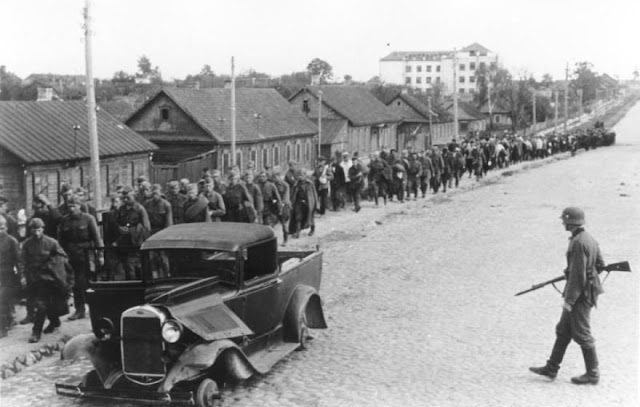
The front is moving rapidly eastward on 2 July 1941, and the reference points have to adjust along with it. For the first time, the Dniepr River looms in the calculations of both sides. Hitler’s 29 June “stop” order is withdrawn, so the major Reich goals of Leningrad, Moscow, and Kyiv again send the panzers forward as if they were magnets drawn to a scrapyard. Heavy rains affect roads, and the armored reconnaissance detachment of the German 7th Panzer Division under General Baron von Funck reported that it had been forced to halt its drive “because the prescribed roads have been reduced by heavy rainfall to an untrafficable swamp.”
In the Far North sector, the Germans have been rebuffed by strong Soviet defenses at the base of the Rybachy peninsula during Operation Silver Fox. So, General Dietl in the command of Army of Norway has shifted troops from there to the advance east toward the Litsa River. These new additions enable the Germans to fight through fierce Soviet resistance to the Litsa. However, going is slow and Soviet reinforcements are gradually stiffening the defense.
Operation ARCTIC FOX, the advance by German and Finnish troops toward Salla and ultimately the Murmansk railway line, bogs down. The Soviets counterattack SS Nord Division during daylight and stop the SS men cold. In a pattern of very uneven performance by SS units that recurs throughout the war, the SS staff panics and loses control. The troops, leaderless, flee to the rear. However, the XXXVI Corps staff finally regains control of the troops before a serious problem develops. The Army of Norway staff decides it needs to reinforce the advance with regular army troops.
In the Army Group North sector, the panzers of the 4th Panzer Group attack the Stalin Line. The leading panzers are halfway to Leningrad and still gaining ground at a rapid clip.
In the Army Group Center sector, new Western Front commander Marshal Timoshenko is under orders from the Stavka to defend the Western Dvina River-Dniepr River line. In the north, General Hoth’s 3rd Panzer Group faces rainy weather and makes only a little ground to the outskirts of Polotsk. In the center, General Guderian’s 2nd Panzer Group (18th Panzer Division) takes Borisov from the remnants of the 13th Army and the Borisov Tank School. Guderian’s tankers capture a key road bridge intact despite Soviet General Eremenko’s personal orders to destroy it.
In the southern part of the central sector, the SS Motorized Division “Das Reich” also captures a bridgehead across the Berezina when it takes Pogost, but the German XXIV Motorized Corps has less luck. The Soviet 4th Army’s Rifle Divisions are overwhelmed there, but they manage to destroy bridges at the Berezina, Ola, Dobosna and Drut Rivers.
In the Army Group South sector, Romanian 3rd and 4th Armies march with the German 11th Army into Soviet Moldavia. This is Operation MÜNCHEN. The Soviet Southern Front counterattacks, but are beaten off. Their objectives are the Prut and then the Dniester Rivers.
Future Luftwaffe ace Oblt. Gerhard Barkhorn of 6./JG 52 files his first victory claim. Heinz Bär of JG 51, who has 27 victories, is awarded the Ritterkreuz and promoted to Lieutenant.
Marshal Semyon Konstantinovich Timoshenko is appointed western front commander. Stalin is frustrated with the conduct of the war so far, so today he makes some more major changes. He appoints old hand Semyon Konstantinovich Timoshenko, Marshal of the Soviet Union and People’s Commissar for Defence, to command the Western Front, with Eremenko and Marshal Semyon Budyonny (aka Budenny, the commander of the Group of Reserve Armies) as his deputies. This is the command that defends the approaches to Moscow, which already is coming into view as a battleground following the fall of Minsk.
Stalin also moves five armies, 16th Army, 19th Army, 20th Army, 21st Army and 22nd Army, from Budyonny’s reserve forces and moves them up to the Smolensk region. Continuing his purge of army commanders that he sees as lacking, Stalin orders the arrest of 4th Army commander Lieutenant General Aleksander Andreevich Korobkov. Along with General of the Army Pavlov, disgraced former head of Western Front, Korobkov is charged with numerous offenses and faces the death sentence, and a finding of guilt is always a foregone conclusion in the USSR under Stalin.
Advancing Wehrmacht troops discover 153 bodies of German Infantry Regiment 35 in a clover field near the town of Broniki in western Ukraine. This is the Broniki Massacre. The soldiers note that the bodies “have been slaughtered in a bestial manner and were mutilated.” A few members of the slaughtered group are found and provide evidence to a Wehrmacht investigation. The surviving prisoners describe how the Soviets forced them to undress and then took them to a field and shot everyone. They also reveal that the Soviets used hand grenades and bayonets to murder prisoners. The German investigation reveals similar incidents happening elsewhere along the front; apparently, the Soviets choose not to take prisoners.
Director of the Reich Main Security Office Reinhard Heydrich communicated to his SS and police leaders that the Einsatzgruppen (mobile death squads) were to execute all senior and middle ranking Comintern officials, all senior and middle ranking members of the central, provincial, and district committees of the Communist Party, extremist and radical Communist Party members, people’s commissars, and Jews in party and government posts. Instructions were also given to execute “other radical elements including saboteurs, propagandists, snipers, assassins, and agitators.” Heydrich instructed that any pogroms spontaneously initiated by the occupants of conquered regions were to be quietly encouraged.
The arrival of SS Einsatzkommando 9 in Vilnius (Lithuania, within Reichskommissariat Ostland) began the Ponary massacre, the systematic murder of up to 100,000 Jews and others over the following three years, many by Ypatingasis būrys and other Lithuanian collaborators. It is named for the place where many of the executions take place, the railway station of Ponary (Paneriai) near Vilnius, Lithuania. The bulk of the people executed are Jews, with a few Poles and about 8,000 Soviet POWs.
The local police in Riga, Latvia was organized by a German commander to murder 400 Jews and burn down all Riga’s synagogues.
Riots broke out in Lvov, Ukraine against racist laws.
Vichy forces surrendered to the Allied troops of Habforce at Palmyra in Syria. Following the loss of Sukhna to the Arab legion, the Vichy French in Palmyra fear being outflanked. So, after a lengthy and hard-fought battle in which they have held their own, the French surrender during the night of 2 July. Habforce now has an open road west to Homs 40 miles to the west and, ultimately, the coast near Beirut.
Off the coast, Australian light cruiser HMAS Perth and light cruiser HMS Naiad, along with escorting destroyers, shell the French positions at Damur. During this operation, the RAF mistakenly attacks the Perth, but miss.
The siege of Tobruk continues. On both sides, there is occasional shelling, but overall the enemy is boredom rather than military action. For the Australians in Tobruk, water is a key concern. Nobody can shave, and occasional expeditions to watering holes after dark are a must. The heat is overbearing, and flies are everywhere.
Royal Navy submarine HMS Torbay torpedoes and sinks 2933-ton Italian freighter Citta Di Tripoli north of Kea Island.
Debra Tabor: A force of 4,500 Italians and levies besieged by Ethiopian patriots surrender to a British force of one squadron and one company.
While in the dock at Brest, France, Prinz Eugen was hit by a bomb during an Allied air raid.
French Lieutenant Pierre Mairesse Lebrun, a prisoner of war at Oflag IV-C at Colditz Castle, Germany, escaped the camp by leaping the wire fence and scaling outer brick wall. He would eventually successfully make it to Switzerland.
Noël Coward’s “Blithe Spirit” premieres in London
The British Military Application of Uranium Detonation (MAUD) Committee assigned the responsibility of writing its final draft of the report of its findings on the development of atomic weapons to James Chadwick. The MAUD Committee (apparently the initials stand for nothing, though some ascribe them to the British Military Application of Uranium Detonation) is a collection of top Allied scientists. Their mission is to determine the feasibility of using nuclear technology to create a bomb. Today, they have a meeting to discuss the committee’s final report.
The committee decides to divide its lengthy MAUD Report into two separate reports: a lengthy “Use of Uranium for a Bomb”; and a shorter “Use of Uranium as a Source of Power.” The former report states in its opening paragraph:
“We have now reached the conclusion that it will be possible to make an effective uranium bomb which, containing some 25 lb of active material, would be equivalent as regards destructive effect to 1,800 tons of TNT and would also release large quantities of radioactive substances which would make places near to where the bomb exploded dangerous to human life for a long period.”
The report creates a strong rationale for the formation of the Manhattan Project that develops the first atomic bombs. Its influence is widespread, leading directly to nuclear weapons programs not only in the United States but also in the United Kingdom and the Soviet Union (through copies obtained by spies).
The RAF sends a Circus mission (Bristol Blenheim bombers with a heavy fighter escort) against the railway yards and airfield at Lille. The raid is notable because the escorting fighters include the American-volunteer “Eagle Squadron” (RAF No. 71 Squadron of No. 11 Group, based at RAF North Weald). American William J. Hall becomes the first Eagle Squadron pilot to become a POW when he is shot down, and perhaps the first American serviceman to enter a POW camp during World War II.
RAF Bomber Command, Day of 2 July 1941
12 Blenheims on a Circus operation to Lille power-station. 2 Blenheims lost.
RAF Bomber Command, Night of 2/3 July 1941
Bremen
67 aircraft — 57 Wellingtons, 6 Stirlings, 4 Halifaxes. Cloud and haze were encountered but good fires were claimed. 1 Wellington lost.
Cologne
33 Whitleys and 9 Wellingtons; haze covered the target. Cologne records only 20 incendiary bombs in the city and no casualties. 1 Wellington lost.
Duisburg
39 Hampdens; only 18 claimed to have bombed Duisburg. 2 aircraft lost.
Minor Operations: 6 Wellingtons to Cherbourg, 7 O.T.U. sorties. No losses.
While flying against a formation of British Blenheim bombers, Adolf Galland’s fighter was damaged by 20-millimeter shells fired by an escorting British Spitfire fighter. Though injured, his life was saved by a recently-installed armor plating in the cockpit.
Douglas Bader was awarded the Bar to his Distinguished Service Order. Later on the same day, he claimed one Bf 109 fighter destroyed and another damaged.
Swordfish of RAF No. 830 Squadron and Wellington bombers raid Tripoli after dark. The Swordfish lay mines at the harbor entrance and damage 1724-ton German freighter Sparta and 2517-ton Italian freighter Eritrea. In addition, the Wellingtons start several fires and damage some smaller vessels.
Vichy French aircraft bomb the Royal Navy port of Haifa.
Light cruiser HMS Manchester departed Hvalfjord for Scapa Flow, where she arrived on the 3rd.
Destroyer HMS Icarus arrived at Ardrossan at 0600 to effect repairs to her propellers, having taken passage from Iceland in convoy HX.133.
Destroyers HMS Intrepid, HMS Active, and HMS Antelope departed Greenock for Loch Ewe to refuel, then escort convoy OB.341A to the westward until relieved by escort vessels from Iceland. Destroyer Active, with defective machinery, departed Loch Ewe at 2200 on the 3rd for Scapa Flow. She had been withdrawn from the escort duty. The destroyer arrived at Scapa Flow at 0730 on the 4th. Destroyers Intrepid and Antelope escorted the convoy until 0800 on the 7th. They arrived back at Scapa Flow at 0930 on the 8th.
Anti-aircraft ship HMS Alynbank departed Scapa Flow to meet convoy EC.40 off Buchan Ness and provide escort to Pentland Firth. On the 3rd, the ship transferred to convoy WN.48 in Pentland Firth and escorted the convoy to Methil where they arrived at 1500 on the 4th.
Convoy OB.341 A (there was no OB.342) departed Liverpool, escorted by destroyers HMS Antelope and HMS Intrepid and corvettes HMS Heather and HMS Mimosa. This group, less corvette Mimosa was detached on the 7th. On the 7th, destroyer HMCS Ottawa and corvettes HMS Candytuft, Gladiolus, and HMS Nasturtium joined. On the 8th, destroyer HMS Ripley and armed merchant cruiser HMS Maloja joined. The group was detached on the 15th. The convoy arrived at Halifax on the 18th.
British steamer Empire Audacity arrived at Scapa Flow, escorted by sloop HMS Stork. The steamer departed the next day for Campbeltown, escorted by sloop Stork. In September, this steamer would be the auxiliary aircraft carrier HMS Audacity.
Minelayer HMS Plover, escorted by destroyer HMS Hambledon, laid minefield BS.66 off the east coast of England.
Lt Cdr (A) F. D. G. Jennings, Commanding Officer of 768 Squadron, was killed when his Martlet dived into the sea after an engine failure at Abirlot, near Arbroath.
Soviet destroyer Strashny was badly damaged on a mine in Irben Straits. The rest of the force, destroyers Serdity and Silny laid mines in the Irben Straits. On the 8th, German Minenraumschiff 11 and minesweeper M.31 encountered Soviet destroyer Silny. In a brief encounter, destroyer Silny was lightly damaged. The German ships were undamaged.
Destroyers HMS Jackal (D.7) and HMS Hasty departed Alexandria for Haifa. On their arrival at Haifa, destroyers HMS Kandahar and HMS Decoy departed on the 3rd for Alexandria. Yugoslavian motor torpedo boats Kajmakcalan and Durmitor departed Alexandria for Haifa to operate under the orders of CS.15. Motor launch ML.1032 departed Alexandria for Famagusta.
Australian light cruiser HMAS Perth and Light cruiser HMS Naiad with destroyers HMS Kandahar, HMS Kingston, HMS Havock, and HMS Griffin shelled French positions east of Damur. Australian light cruiser Perth was attacked in error by British aircraft, but no damage resulted.
Submarine HMS Urge unsuccessfully attacked an armed merchant cruiser in 37-48N, 15-21E.
Submarine HMS Torbay sank Italian steamer Citta Di Tripoli (2933grt) in 37-41-50N, 24-15-50E.
During the night of 2/3 July, a bombing raid on Tripoli damaged German steamer Sparta (1724grt) and Italian steamer Eritrea (2517grt). Eight Swordfish of the 830 Squadron laid mines at the entrance to Tripoli Harbor.
Anti-submarine whalers Gos 2 and Kos 12 and minesweeping trawler HMS Holly departed Gibraltar for Freetown.
The Senate was in recess today in Washington. An Agriculture subcommittee heard more witnesses in support of the bill to include the Cumberland River under the Tennessee Valley Authority.
The House was also in recess. The Ways and Means Committee completed consideration of the Tax Bill; the Rivers and Harbors Committee heard testimony favoring the St. Lawrence seaway; the Merchant Marine Committee continued hearings on the bill liberalizing experience regulations of ships’ crews.
The Ways and Means Committee put the finishing touches today on the largest revenue bill in United States history, adding an estimated yield of $3,503,400,000 to present Federal taxation. The committee then sent the bill to the legislative drafting service to be translated into legal phraseology. Representative Doughton of North Carolina, chairman of the committee, and Representative Cooper of Tennessee, chairman of the subcommittee on taxation, estimated that the bill would not be ready for final consideration by the committee for wo weeks. Another week probably will be required for ironing out details, which would mean that the bill would not be ready for consideration by the House before July 24. September 15 was said to be the earliest possible date on which Congressional consideration could be completed. The measure was proposed to increase Federal revenues by 50 percent, and, according to present Treasury estimates of receipts for the fiscal year 1942, the bill would mean that more than $13,000.000,000 in cash would be available to meet ordinary running expenses and help pay for the defense program. On present estimates of income and outgo the deficit next year would be about $9,000,000,000, which will be raised through borrowing.
Expenditures of $12,710,000,000, or $3,712,000,000 more than during the preceding year, were shown today by the Treasury in official figures for the fiscal year 1941 ending June 30. Receipts of $7,607,000,000 were $2,220,000,000 more than in the fiscal year 1940. Receipts were $594,000,000 more than had been estimated in the budget message while expenditures were $492,000,000 less. The net deficit, excluding debt retirements, was $5,103,000,000, as compared with $3,611,000,000 for 1940. The 1941 revenue total is the largest in the nation’s history. Expenditures, however, were as great in 1918 and greater in 1919, when the total was $18,522,895,000. The 1941 deficit of $5,103,000,000 was twice exceeded, that of 1918 being $9,033,254,000 and that of 1919 being $13,370,638,000. The fiscal year just begun is expected to set an all-time high for both revenues and expenditures, although it is hoped to keep the deficit down to something more like that of 1918 than of 1919.
President Roosevelt returned control of the North American Aviation Company plant at Inglewood, California, to the owners today. At the same time be warned that if efforts again were made “to interfere with this essential production, I will not hesitate to take whatever steps may hereafter be necessary to assure its continuance.” The President sent an order to the Secretary of War directing him to relinquish possession of the plant, which was taken over by troops on June 9. after a strike interfered with production of $196,000,000 in military planes for this country and Britain. The strike ended the next day. The action was hailed by some as emphasizing that the government had no intention of taking permanent possession of any private property. It was suggested that this might help the Property Seizure Bill, now before Congress.
Secretary Knox denied categorically today that U.S. Naval vessels had been engaged in encounters with German craft while carrying out patrol missions in the Atlantic Ocean. [Not Yet…]
Former President Herbert Hoover informed an associate today that he is “irrevocably opposed” to suggestions that he should head an anti-interventionist presidential ticket in 1944. He said he “would never again accept public office.” His rejection of the idea that he campaign for the presidency with Charles A. Lindbergh as his running mate a proposal put forth as a means of affording a clear-cut issue between interventionists and non-interventionists was contained in a telegram from his Palo Alto, California home, to Raymond S. Richmond, one of his representatives in Washington.
Government defense orders to Henry Ford went up to $737,000,000 today and made his concern the greatest potential producer of airplane engines and bombers in the automobile industry.
Although “growing intolerance of minorities out of step with the national effort” is in evidence, the national emergency and the defense program so far have produced “remarkably few casualties” in the field of civil liberties, the American Civil Liberties Union said yesterday in its twenty-first annual report.
The Metals Reserve Company has contracted for 616,882,800 pounds of aluminum from the Aluminum Company of Canada, Ltd., a quantity almost equivalent to the annual production of the Aluminum Company of America, which is currently estimated to be at the rate of 635,000,000 pounds, Jesse Jones, Federal Loan Administrator, announced today.
The motion picture “Sergeant York” premieres at the Astor Theater in New York City. This biographical film of World War I Medal of Honor recipient Sergeant Alvin C. York, is directed by Howard Hawks and stars Gary Cooper, Walter Brennan, Joan Leslie, George Tobias, Margaret Wycherly, Ward Bond, Noah Beery, Jr., and June Lockhart. Guests at the premiere include Cooper, Sergeant Alvin C. York, Eleanor Roosevelt, General John J. Pershing, Henry Luce and General Lewis B. Hershey, the head of Selective Service. The film is nominated for eleven Academy Awards including Best Picture, Best Director, Best Actor (Cooper), Best Supporting Actor (Brennan) and Best Supporting Actress (Wycherly); the film wins two, Cooper as Best Actor and a technical award.
The first live television game show premieres on the new CBS Television network called “CBS Television Quiz.” The show features contestants given answers and asked to supply the questions — a format later made legendary on Merv Griffin show “Jeopardy.” CBS Television Quiz is the first game show to be broadcast regularly on television (there were occasional one-shot game show broadcasts in the 1930s such as “Spelling Bee” on the BBC in 1938). The show features host Gil Fates and scorekeeper Frances Buss. The live show runs weekly from today through 25 May 1942, with 47 episodes total. The shows are not taped or photographed in any fashion and are completely lost.
Major League Baseball:
Obviously the heat had affected the Phillies. They started against the Dodgers at Ebbets Field yesterday as though they actually were going to beat the Brooks for the second day in a row, taking a 2–0 lead in the top of the first inning. But then they settled down to their normal stride, giving the Dodgers five in the bottom of the frame, and bowed, 9–3.
Where Johnny Wittig failed, the New York Giants’ Bill Lohrman met with success today in Boston. Lohrman blanked the Braves, 6–0, after the home team had gained a 5-4 decision in the first game of the double-header.
Buck Newsom pitched a brilliant three-hit game tonight to give the Tigers a 1–0 victory over the White Sox and the rubber game of the three-game series. Detroit made only five hits off Bill Dietrich.
The New York Yankees again play the Boston Red Sox on a sweltering day before 52,832 fans in Yankee Stadium, New York City. If Yankee star Joe DiMaggio can get a hit today, he will set a new major league record of hitting in 45 consecutive games. Before the game, Joe DiMaggio had invited his brother, Boston centerfielder Dom DiMaggio, to dinner after the game. Despite Joe’s hospitality, Dom went out and made a sensational catch of Joe’s drive to center, robbing him of an extra base hit. “It was a great catch,” admitted Joe. “It was one of the best Dom ever made, but at that moment the only thing on my mind was the temptation to withdraw the dinner invitation.” However, in his third at-bat, Joe DiMaggio ripped a 2-1 Dick Newsome fastball into the left-field seats for a three-run homer, thus breaking Willie Keeler’s 1897 major league consecutive game hitting record.
Indian Bob Johnson’s home run in the tenth inning — his seventeenth of the season — gave the Philadelphia Athletics a 7–6 victory over the Washington Senators today. The A’s had trailed 5–0 as late as the fifth.
Paul Derringer sustained his tenth defeat today as big Max Butcher hurled Pittsburgh to an 8–3 verdict, his third success over the Reds. Maurice Van Robays sparked the Pirates to victory by driving in three runs. His fourth inning double scored two mates and his single in the sixth broke up a 3–3 tie, sending home Bobby Elliott, who had just tripled in a in a run.
Philadelphia Phillies 3, Brooklyn Dodgers 9
New York Giants 4, Boston Braves 5
New York Giants 6, Boston Braves 0
Detroit Tigers 1, Chicago White Sox 0
Boston Red Sox 4, New York Yankees 8
Washington Senators 6, Philadelphia Athletics 7
Cincinnati Reds 3, Pittsburgh Pirates 8
The Canadian Women’s Auxiliary Air Force is set up.
The Nationalist Chinese government severed diplomatic relations with Germany, Italy, and the other Axis states for recognizing the Wang Ching-wei regime in Japanese occupied China.
Japanese Foreign Minister Matsuoka Yosuko gave a statement to the Soviet Ambassador to Japan Constantin Smetanin. In the statement Matsuoka assured the Soviet government that it did not intend to get involved in the European conflict, or join the Reich in its war against the Soviet Union.
The long struggle behind the scenes between rival views and rival forces, which became acute with the outbreak of the Russian-German war, was brought to a dramatic conclusion when the imperial conference, in the presence of Emperor Hirohito, decided today, in the words of the official announcement, “on important national policies to meet the current situation.”
The decision to attack the European territories in Southeast Asia and the Pacific was made at an Imperial Conference in Tokyo. Japan is preparing for war against Britain and the U.S. over Indochina by conscripting one million men and recalling all its merchant ships from the Atlantic. While 400,000 conscripts will reinforce the Kwantung army in China, the rest will be committed to south-east Asia. The decision to open up the southern front — known as the Greater East Asia Co-Prosperity Sphere — has been spurred by the speed of the German successes in Europe. At an imperial conference at which the emperor made rare appearance the war minister, Hideki Tojo, urged the cabinet that now is the time to secure more empire or risk missing the bus. These are repeats of Liaison Conferences. Liaison Conferences are held between military and political leaders. Imperial Conferences repeat the information for the Emperor and obtain his approval. This Conference ratifies the decision to attempt to take bases in French Indochina, even at the risk of war. (Additional Imperial Conferences will appear on other dates.) Tojo advocates an aggressive policy to secure territory following the German example. The conference ratifies Tojo’s plan to take more control over French Indochina. The Emperor, bound by protocol, cannot say anything and merely accepts his ministers’ proposals.
Japan called up more than one million army conscripts.
Japan recalled its merchant ships from Atlantic Ocean.
Foreign Minister Yosuke Matsuoka issues a statement immediately after the conference held in the presence of Emperor Hirohito. Obviously, it does not reveal the real decisions made at the conference about focusing military efforts to the south, particularly in French Indochina. However, it does convey the seriousness of the decisions made there regarding future Imperial policy:
“As announced by the Government today, an important national policy has been decided upon at a council held in the Imperial presence… I feel that a really grave state of super-emergency is developing before our eyes the world over as well as in East Asia, with the affairs of which our nation is directly concerned. The more serious the situation the more calm and composed must our nation be, and with a nationwide unity we must, in response to the August Will of His Imperial Majesty, endeavor not to make even the slightest deviation from the path along which our nation is to march forward.”
Japan, he states, is watching the German-Soviet War closely, but gives no hint that the country feels any need to intervene.
The incomplete Imperial Japanese Navy battleship Musashi arrives at Sasebo Navy Yard.
The Japanese are trying to get top-secret maps of U.S. defenses in the Panama Canal Zone back to Tokyo. However, they fear actually trying to remove the maps from the Zone because airline crews are searching every piece of luggage. Following on several other subtle diplomatic attempts to change this policy, Japanese Foreign Minister Matsuoka instructs the Japanese minister in Mexico City to complain to the Guatemalan government about the practice. The Japanese hope, through this roundabout practice, to get the Pan American Airways crews to respect Japanese diplomatic privileges and not search their luggage — so that the Canal Zone diplomats can smuggle the militarily sensitive maps out.
Dow Jones Industrial Average: 123.58 (+0.73)
Born:
Stéphane Venne, French Canadian songwriter and film score composer, born in Verdun, Quebec, Canada.
Naval Construction:
The U.S. Navy Barnegat-class small seaplane tender USS San Pablo (AVP-30) is laid down by Associated Ship Building Inc. (Seattle, Washington, U.S.A.).
The U.S. Navy YMS-1-class auxiliary motor minesweeper USS YMS-123 is laid down by the Kruse & Banks Shipbuilding Co. Inc. (North Bend, Oregon, U.S.A.).
The Kriegsmarine (German Navy) Type 39 torpedo boat T27 is laid down by F. Schichau, Elbing, East Prussia (werk 1486).
The U.S. Navy Aloe-class net tender USS Cinchona (YN-7; later AN-12) is launched by the Commercial Iron Works (Portland, Oregon, U.S.A.)
The U.S. Navy Aloe-class net tender USS Larch (YN-16; later AN-21) is launched by the Marietta Manufacturing Co. (Point Pleasant, West Virginia).
The U.S. Navy 77-foot Elco patrol motor torpedo boat USS PT-39 is launched by the Electric Launch Company Ltd. (Elco), (Bayonne, New Jersey, U.S.A.).
The Royal Canadian Navy Fisherman’s Reserve Nenamook-class patrol craft HMCS Talapus (FY 11) is launched by Armstong (Victoria, British Columbia).
The Nihon Kaigun (Imperial Japanese Navy) destroyer HIJMS Akizuki (秋月; “Autumn Moon”), lead ship of her class (12 completed; 20 cancelled), is launched by the Maizuru Naval Arsenal, Maizuru, Kyoto Prefecture, Japan.
The Royal Navy Bar-class boom defense vessel HMS Barsound (Z 89) is commissioned.
The U.S. Navy 77-foot Elco patrol motor torpedo boat USS PT-29 is completed and placed in service with Motor Torpedo Boat Squadron One (PTRon 1).

