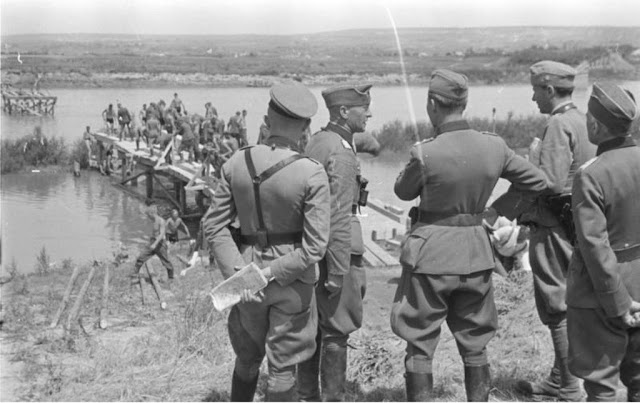
Operation BARBAROSSA, the German Invasion of the Soviet Union, continues. The Eastern Front on 1 July 1941 already is descending into savagery. According to the diary of Marie Vassiltchikov in Berlin, a returning soldier from the front, Burchard of Prussia, describes the fighting as “absolutely beastly.” Burchard reports that neither side is taking many prisoners and fighting is heavy everywhere.
In the Far North, German troops taking part in Operation PLATINUM FOX (part of Operation SILVER FOX) experience their first real failure of the campaign, though it is a minor one. The 2nd Mountain Division fails to break through Soviet defenses on the Rybachy Peninsula and face such determined resistance that they have to go onto the defensive themselves. Army of Norway commander General Dietl decides to switch some units from 2nd Mountain Division down to support the 3rd Mountain Division, which is struggling against strong Soviet defenders to reach the Litsa River.
The Germans and Finns launch Operation ARCTIC FOX (Unternehmen Polarfuchs) at midnight, aimed at capturing Salla. Finnish 6th Division opens the offensive, crossing the border in the direction of Salla. The German 6th SS Mountain Division (Nord) soon follows. The defending Soviet forces of Soviet 14th Army (General Valerian A. Frolov) put up a fierce defense and the offensive gets nowhere.
In the Army Group North Sector, the Soviet troops are in full retreat from the Dvina River. They plan to make a stand on the Stalin Line in Estonia. The German panzers, however, have been ordered to consolidate their position and await the infantry before making any further advances. Once the Germans are able to resume their forward movement, the next objective is Leningrad. German troops do make some ground and take Riga, Latvia.
In the Army Group Center sector, Soviet Western Front commander General Eremenko begins forming a defensive line on the Berezina River. He orders the 13th Army to fall back between Borisov, Brodets, and Kholkolnitza, and the 4th Army to cover the river line from Brodets to Svisloch and Bobruisk. The Stavka rushes the 1st Moscow Motor Rifle Division west from Moscow to Borisov to anchor the line. The problem, though, is that — contrary to Hitler’s 29 June stop order — General Guderian’s 2nd Panzer Group already is in Bobruisk and across the river, and today seizes Berezina. In addition, the 4th Panzer Division has seized a railway bridge at Svisloch.
In the Army Group South Sector, the Soviets are in full retreat again after making a brief stand during the Battle of Brody. General Popel, who only a few days ago excited the entire Red Army with the recapture of Dubno, is forced to break out to the east after a halfhearted attempt to relieve him by a regiment of 22nd Mechanized Corps fails. Panzer Group 1 continues on the offensive, but the Soviet counterattacks have decimated its strength and its remaining panzers have lost much of their initial striking power.
The Axis attack in this sector expands when the German 11th Army, Romanian 3rd Army, and Romanian 4th Army cross the Prut River into the Bessarabia and Bukovina regions of Moldova.
The Wehrmacht High Command announced: “In the course of June 30 the Luftwaffe once again inflicted annihilating blows on the Soviet-Russian bomber and fighter formations. On June 30 the enemy lost 280 aircraft in all, 216 of them in aerial combats. German fighter wings led by [air ace] Lieutenant Col. Molders and by Major Trautloff particularly distinguished themselves during the fighting by shooting down 110 and 65 planes respectively. At Dunaburg [Daugavpils in Latvia] the Trautloff Fighter Wing succeeded in destroying all 40 planes of a Soviet attack group. The Molders Fighter Wing gave equally impressive proof of the superiority of the German Luftwaffe in the region east of Minsk and Bobruisk, where large numbers fo enemy formations soght to disrupt the movements of the advancing German troops. Of the approximately 100 attacking fighters and bombers, the Molders Fighter Wing destroyed 80. In the battle Lieutenant Col. Molders won his 82nd aerial victory, Captain Joppien his 52nd.”
German Luftwaffe formations have intervened in the ground battle with telling effect. They bombed retreating enemy columns east of Lvov where these were marching two or three abreast along the same road; inflicted extremely heavy losses on Soviet troops encircled between Bialystok and Minsk; and attacked the enemy in relay waves where he was falling back through Riga (Latvia). Multitudes of armored cars and hundreds of trucks were destroyed during these operations, enemy batteries were silenced and transport trains smashed to pieces.
While the Germans are outwardly confident about the Luftwaffe’s successes, in reality, the size of the Red Army’s air fleet has come as a shock. The Luftwaffe literally has destroyed thousands of Soviet planes, but this does not seem to have cut very far into their supply. It now is becoming clear that the Soviet Red Air Force had a magnitude of planes greater than was thought before the start of Operation Barbarossa. Today, the Soviet Naval Air Unit 401 IAP begins using new MiG-3 fighters and down four Bf 109 fighters — a very rare success by the Red Air Force over the Luftwaffe at this stage of the war.
This continuing numerical challenge, in fact, is a realization setting in with the Germany Army as well, as they have destroyed thousands of tanks, but the Soviet defense is stiffening, not deteriorating. The Germans comfort themselves with the truth that their tactics at this stage of the war are superior to those of the Soviets.
Soviet Naval Air Unit 401 IAP went into action with its new MiG-3 fighters and destroyed four German Messerschmitt Bf 109 fighters on its first operation. This unit was commanded by a veteran of the Spanish Civil War, Lieutenant-Colonel Stepan Suprun (who was already an ace with fifteen Civil War victories), Hero of the Soviet Union. Many of Suprun’s pilots were pre-war test pilots and therefore highly experienced airmen. During the next two days the 401st IAP destroyed eight enemy aircraft for no loss.
Germany accepts an offer by Croatia to supply a division of troops under German command for service in the Soviet Union.
Soviet submarine M-81 of the Baltic Fleet is mined and sunk near Laine Bank off Vormsi Island, in the Baltic Sea.
Joseph Stalin returned to the Kremlin in Moscow, Russia as Chairman of the new State Defence Committee, set up by law the day before.
General of the Army Dmitry Pavlov, recently relieved of command of Western Front, is arrested. The charges run the gamut from cowardice to willful abandonment of positions — basically, everything that he can be charged with under Articles 58-1b, 58-11 RSFSR Criminal Code. Pavlov’s entire staff is charged, too. The penalty is death, and while no trial has been held, everyone knows the outcome.
Vnukovo Airport opens southwest of Moscow.
Under the provisions of a German Law on the use of Prisoner Labour, Russian prisoners of war were permitted to be sent to work camps for employment in agriculture, construction or heavy industry. The death rate on these camps would be extremely high.
The German advance in Russia this month is so rapid that fewer than 300,000 of Russia’s 2.7 million Jews are able to escape to safety beyond the Volga River.
Nazi killing squads arrive this month in Bessarabia. Romanian troops and militias murder thousands of Jews in the area of their advance. Following the initial killings, internment camps are set up throughout the province. At the camp in Edineti, 70 to 100 people die every day in July and August, mostly of starvation. In all, more than 148,000 Bessarabian Jews perish in the ghettos and camps of Transnistria.
The massacre of 25 Polish professors in the city of Lwów (modern-day Lviv, Ukraine) begins. The professors apparently are those who actively cooperated with the Soviet authorities during the Soviet occupation of late 1939-June 1941. However, there is no indication that the professors acted in a political fashion during the occupation.
The Battle of Palmyra was fought in Syria, resulting in Allied victory. British Habforce, marching west from Iraq, has been banging at the gates of the Vichy French base at Palmyra for the past week. The French position at Palmyra has been well-defended, but British forces are multiplying while the Vichy French are running low on supplies. Today, the 10th Indian Division (Major-General Slim) crosses the border from Iraq with the objective of advancing toward the coast and joining the advance on Beirut.
Defending Vichy 2nd Light Desert Company tries to retake Sukhna from the Arab Legion, but the French are soundly defeated and forced to surrender themselves (80 men and 6 armored cars). This imperils the French flank of Palmyra and causes them to begin rethinking their ability to hold the important base there. British troops essentially capture Palmyra, though the official surrender is not made today.
Off the coast, the Vichy French have a small supply convoy approaching heading for Beirut. The RAF attack with Albacore torpedo bombers and sink 2778-ton French freighter St. Didier in the Gulf of Adalia. This causes the accompanying freighter, 2536-ton Chateau Yqem, to head back to France.
General Sir Claude Auchinleck officially takes over as C-in-C Middle East from General Wavell, who has been appointed C-in-C India. Oliver Lyttelton is appointed Minister of State, and is resident in the Middle East. This removes some of the political responsibilities from CiC India. Churchill has tired of Wavell and with the failure of the latest North African offensive has been able to make changes.
Erwin Rommel was promoted to the rank of General der Panzertruppe.
The British Special Air Service (initially titled “L” Detachment, Special Air Service Brigade) was formed by Colonel David Stirling.
Operation SUBSTANCE: Convoy from Gibraltar comprising six merchantmen with Naval escort delivers 65,000 tons of supplies to island.
Goebbels writes in his diary: “Haushofer and his son have been forced out of public life. They are both responsible for peddling mystic rubbish and have the Hess affair (Hess’ flight to England) on their consciences.
The Opium Law classifies the amphetamine, Perivitin, as a restricted substance, even though ten million tablets are on order for the Heer. The German government classifies Pervitin (aka Methamphetamine) as a restricted substance under the Opium Law. The OKW, though, is so impressed by the substance’s properties that it already has ordered 10 million capsules for distribution to the Wehrmacht. The Pervitin pills have been shown to keep troops alert and energized under trying circumstances. The pills are to be distributed first to Luftwaffe pilots who need to stay alert during long missions, but ultimately will spread throughout the Army, too. Unlike some phony “Vitamin pills” being given to the troops (so that Reichsmarschall Hermann Göring can get kickbacks), these pills pack a punch.
German cruiser Prinz Eugen was bombed in Brest harbor by the Royal Air Force and severely damaged.
Westminster: At Downing Street the visiting Canadian leader, Mackenzie King, presents Churchill with the Canadian “Torch of Victory”.
Coal deliveries to all business establishments in Britain were limited to one ton per month.
Bruce Fraser was made a Knight Commander of the Order of the British Empire.
The Vichy government froze Soviet assets in France.
Iceland and the United States exchanged letters on the defense of Iceland. In a statement the State Department said “it is imperative that the integrity and independence of Iceland should be preserved because of the fact that any occupation of Iceland by a power whose only too clearly apparent plans for world conquest include the domination of the peoples of the New World would at once directly menace the security of the entire Western Hemisphere.”
RAF began daylight bombing raids in France and the Low Countries.
Prestwick, Scotland: A Consolidated B-24 flies from Washington via Montreal and Newfoundland, thus completing the types first transatlantic delivery. The RAF took 26 B-24s in exchange for a similar number of LB-30s. The first six were YB-24s (designated LB-30As) and they went into the North Atlantic Return Ferry Service. Today’s flight used a modified B-24A of the USAAF’s Air Corps Ferrying Command on this, the North Atlantic Transport Service for the aerial transport of passengers and cargo. The flight originated at Bolling Field, Washington D.C.
RAF Bomber Command attacked the port of Brest, France, and the heavy cruiser Prinz Eugen was hit by a single bomb on the port side behind the bridge. The bomb detonated in the forward main artillery command center, killing 60 of the crew.
RAF Bomber Command, Day of 1 July 1941
39 Blenheims and 6 Stirlings to various targets, mostly in northwest Germany. Only 6 aircraft bombed. 2 Blenheims and 1 Stirling lost.
RAF Bomber Command, Night of 1/2 July 1941
Brest
52 Wellingtons; good bombing claimed. 2 Wellingtons were lost on this raid and 1 of them is believed to have crashed alongside the Prinz Eugen. A bomb, possibly from the crashing Wellington, struck the Prinz Eugen, exploding inside the ship and causing serious damage. The executive officer and 60 other sailors were killed.
5 Wellingtons to Cherbourg; 1 was shot down by an R.A.F. fighter in Wiltshire.
Operation Substance, a Royal Navy convoy of six freighters, makes it to Malta with 65,000 tons of supplies.
U-108, commanded by Kapitänleutnant Klaus Scholtz, sank British steamer Toronto City (2486grt), employed as a meteorological vessel, in 47-03N, 30W. At 1825 hours on 1 July 1941 the unescorted Toronto City (Master Edwin John Garlick) was hit in the bow by one G7e torpedo from U-108 about 500 miles north of the Azores and sank by the bow within three minutes. The Germans questioned 23 survivors on rafts and debris before leaving the area, but they were never seen again: the master, 37 crew members, two gunners and three meteorological office personnel were lost. The ship had been employed as a weather observation ship in the Atlantic since October 1940 and was reported missing after sending her last routine weather report at 1500 hours on 1 July. The 2,486 ton Toronto City was carrying ballast and was headed for St. John’s, Newfoundland.
Light cruiser HMS Manchester arrived at Hvalfjord from Denmark Strait patrol.
Destroyer HMS Punjabi departed Scapa Flow for Scrabster to take part in the local War Weapons Week at Thurso. The destroyer arrived back at Scapa Flow at 2300.
Destroyer HMS Croome arrived at Scapa Flow from Greenock at 1400 to carry out working up exercises.
Indian sloop HMIS Jumna departed Scapa Flow with convoy EC.39 at 1800 to join the Western Approaches following her working up exercises. The sloop arrived at Greenock at 0100 on the 4th escorting depot ship HMS Greenwich.
Anti-aircraft ship HMS Curacoa arrived at Scapa Flow, following refitting at Rosyth, having escorting convoy EC.39 from May Island to Pentland Firth.
British drifter Devon County (86grt, Skipper G. H. Barnard RNR) was sunk by a mine in 51-28-51N, 0-59-14E in the Thames Estuary. There were three ratings killed in the drifter.
British steamer Homefire (1262grt) was sunk by German bombing in 53-05-30N, 1-28E. Two crewmen were lost on the steamer.
British fishing trawler Strathgairn (211grt) was sunk on a mine about twenty miles southwest of Barra Head. Five of the crewmen were missing. Six crew members were landed at Stornoway.
British steamers Highwood (1177grt) and Jamaica Planter (4098grt) were damaged by German bombing at Barry while in drydock. One crewman was killed on steamer Highwood.
German heavy cruiser Prinz Eugen was bombed and damaged at Brest.
Armed boarding vessel HMS Malvernian (Cdr J. W. B. Robertson RNR) was abandoned after being badly damaged by German bombing in 47-37N, 19-07W. T/Lt G. W. Jeffrey RNR, T/Lt (E) A. E. Magraw RNR, T/Lt J. R. Slimin RNR, A/Sub Lt (E) K. J. Trineman RNVR, and twenty ratings were lost in the vessel. T/Sub Lt P. Baddeley RNVR, and T/A/Sub Lt A. England RNVR, were wounded. Of a crew of 164, fifty seven survivors were landed. P/T/Lt K. J. Dudgeon RNR, T/A/Sub Lt (E)C. R. Keats RNVR, A/Major R. W. Madoc, RM, T/Lt T. G. Mitchell RNR, T/Paymaster Sub Lt J. M. Moran RNR, T/Lt A. H. Rogers RNVR, T/A/Sub Lt J. L. Wells RNVR, and others were made prisoners of war. Sloop HMS Scarborough proceeding to the scene picked up a boatload of survivors, but could not locate the damaged vessel. She was sunk by German aircraft 11/7/1941 in position 47.37N 19.07W and abandoned but remained afloat; sighted drifting on 19/7 and sunk. The Captain and 31 others made it in boats to Corunna on 21/7. Another boat of 21 survivors arrived at Vigo on 22/7. Finally, a last boat was picked up by German minesweepers.
French destroyers Guepard, Valmy, and Vauquelin departed Beirut to escort a troopship into Beirut. Steamer St Didier (2778grt) was sunk by British Albacore aircraft in the Gulf of Adalia on the 4th. Steamer Chateau Yquem (2536grt) was recalled in view of steamer St Didier’s fate.
Light cruiser HMS Naiad and destroyers HMS Kandahar, HMS Decoy, and HMS Havock departed Haifa for a night sweep off Syria.
Corvette HMS Hyacinth ran aground four miles south of Famagusta. She could not be readily refloated and corvette HMS Erica was damaged in the attempt. On the 3rd, corvette HMS Peony departed Haifa and tug St Issey departed Alexandria to refloat the grounded corvette. Corvette Hyacinth was unsuccessfully attacked by enemy bombers, without success, during the evening of 4 July. The corvette was refloated on the 5th by corvette Peony. Corvette Peony and tug St Issey returned to Alexandria. Corvette Hyacinth proceeded to Alexandria, via Haifa, for repairs, completed on the 15th.
British trawler Vulcan and motor torpedo boats MTB.68 and MTB.215 were sailed from Famagusta to Haifa.
Destroyers HMS Faulknor, HMS Fearless, HMS Forester, HMS Lance, and HMS Legion departed Gibraltar to meet arriving convoy OG.66 and escort it to Gibraltar.
Light cruiser HMS Hermione departed Gibraltar to patrol in the area of 40N, 15W for enemy raider or supply ships.
Dutch submarine HNLMS O.21, escorting convoy HG.66, was recalled and ordered to establish a patrol in the vicinity of 43N, 11W to attack any enemy raiders making for Biscay ports.
Norwegian whaler Pol IX, captured on 14 January 1941 by German raider Pinguin and renamed Adjutant, was scuttled on this date by the German cruiser.
Soviet destroyer Bystry was mined off Sevastopol and beached.
German steamer Durazzo (1153grt) at Maracaibo was taken over by Venezuela and renamed Pampero.
The German commerce raiders Atlantis and Orion rendezvoused with each other north of the island of Tristan da Cunha in the South Atlantic Ocean and began refueling from supply ship Anneliese Essberger.
Convoy SC.36 departed Sidney, CB, escorted by corvettes HMCS Dauphin and HMCS Napanee and anti-submarine yacht HMS Philante. The corvettes were detached on the 4th. Destroyer HMS Chesterfield joined on the 3rd, corvettes HMCS Agassiz and HMCS Wetaskiwin joined on the 4th, and destroyer HMS Churchill on the 8th. On the 13th, the escort was detached when it was relieved by destroyers HMS Sabre, HMS Scimitar, and HMS Shikari, sloop HMS Sandwich, corvettes HMS Arabis, HMS Dianella, HMS Heliotrope, HMS Kingcup, HMS Mallow, HMS Verbena, and HMS Violet, minesweepers HMS Niger and HMS Speedwell, and anti-submarine trawlers HMS Northern Gem and HMS Northern Spray. The sloop, minesweepers, and trawlers were detached on the 17th. The remainder of the escort, less corvette Arabis, were detached on the 18th. With corvette Arabis, the convoy arrived at Liverpool on the 19th.
Today in Washington, the Senate was in recess. The Military Affairs Committee finished hearings on the property-requisition bill; conferees agreed on the shipping priorities bill.
The House was in recess. The Ways and Means Committee agreed tentatively on additional excise taxes; the Rivers and Harbors Committee heard witnesses in support of the St. Lawrence seaway; the Merchant Marine Committee held hearings on the waiving of safety-at-sea regulations; a Labor subcommittee continued hearings on the resolution to establish a commission to study planning for post-war conditions.
All American men over the age of 21 since the first draft registration on October 16, 1940 (those born on or before July 1, 1920) who had not already registered were required to register for the draft.
Brigadier General Lewis B. Hershey, deputy selective service director, today formally ordered deferment of all men now subject to induction into the army who have reached the age of 28. General Hershey telegraphed the order to state selective service directors, telling them to advise local draft boards immediately and saying that he acted at the request of congressional leaders. An estimated 8,000,000 between the ages of 28 and 36 are affected. They are part of the group of 16,500,000 between the ages of 21 and 36 who were signed up last October 16.
President Roosevelt reiterated his hope that the United States might keep out of the war today but added that there was a distinction between hope and belief. The chief executive made this statement in the face of last night’s demand by his secretary of the navy, Frank Knox, that the American navy immediately take steps to “clear the Atlantic of the German menace.”
Charles A. Lindbergh warned tonight against any step that might lead the United States into an alliance with Russia. “I would a hundred times rather see my country ally herself with England, ‘ or even with Germany with all her faults,” the flier said in a nation-wide broadcast from San Francisco’s Civic auditorium, “than with the cruelty, the godless-ness and the barbarism that exists In Soviet Russia. “An alliance between the United States and Russia should be opposed by every American, by every Christian, and by every humanitarian In this country.”
The New York Times military analyst, Hanson W. Baldwin says: “The United States army, after a year of expansion and preparation, is months away from adequate combat efficiency. In the opinion of most high ranking officers, not a single division is ready for war, although all of our organized divisions are already superior in training to the divisions we sent to France in 1917 … Many officers, military iconoclasts though they may be, have out it bluntly and probably correctly: We are still training for a 1917 war.”
Creation of a huge seventeen-State power pool to make available 200,000 kilowatts of needed power in the Southeastern States for aluminum production and other defense purposes was brought near actuality today by a Federal Power Commission order directing immediate construction of seven new interconnections between power plants in six States.
The National Broadcasting Company (NBC) begins television broadcasting. First commercial television broadcast over WNBT, New York (first successful demonstration by C. F. Jenkens in United States and J. L. Baird in England was made in early 1920’s). The first show is a broadcast of the Brooklyn Dodgers vs. Philadelphia Phillies baseball game followed by the 1936 motion picture “Death from a Distance” with Lola Lane.
Bulova Watch Company pays $9 for 1st ever television commercial, which airs during a broadcast of Brooklyn Dodgers-Philadelphia Phillies baseball game.
Mammoth Cave National Park established with 45,310 acres, including world’s largest cave network in Kentucky.
The U.S. and Iceland reach an agreement whereby U.S. troops will replace British troops which are “occupying” Iceland — with the Icelandic government’s tacit support.
Colonel Dwight D. Eisenhower becomes chief of staff to General Walter Krueger, Commander of the Third Army, at Fort Sam Houston in San Antonio, Texas. His first major duty will be to oversee the Louisiana Maneuvers, a series of U.S. Army exercises held around Northern and Western-Central Louisiana, including Fort Polk, Camp Claiborne, and Camp Livingston. These maneuvers also will feature the talents of Omar Bradley, Mark Clark, Lesley J. McNair, Joseph Stilwell and George Patton, Jr.
The first landing, takeoff and catapult launching form an escort aircraft carrier were made aboard USS Long Island (AVG-1), by Lieutenant Commander William D. Anderson, commanding officer of Scouting Squadron Two Hundred One (VS-201).
Naval Coastal Frontiers were established by the U.S. Navy: North Atlantic, Southern, Caribbean, Panama, Pacific Southern, Pacific Northern, Hawaiian, and Philippine. Their commanders were responsible for the direction of local patrol, convoy escort, and antisubmarine warfare operations. Mobilization of all Organized, Fleet, and local defense divisions of the Naval Reserve was completed on this date.
Task Forces were organized by Commander in Chief Atlantic Fleet (Admiral Ernest J. King) to support defense of Iceland and to escort convoys between the U.S. and Iceland. TF 1 (Rear Admiral David M. LeBreton) was based at Narragansett Bay and Boston. TF 2 (Rear Admiral Arthur B. Cook) was based at Bermuda and Hampton Roads. TF 3 (Rear Admiral Jonas H. Ingram) was based at San Juan, Puerto Rico, and Guantanamo. TF 4 (Rear Admiral Arthur L. Bristol) was based at Narragansett Bay. TF 5 (Rear Admiral Richard S. Edwards), TF 6 and TF 8 (Rear Admiral Edward D. McWhorter), TF 7 (Rear Admiral Ferdinand L. Reichmuth) were based at Bermuda. TF 9 (Rear Admiral Randall Jacobs); and TF 10 (Major General Holland M. Smith, USMC).
Patrol Wing 7 (the redesignated Patrol Wing, Support Force), under command of Captain Harold M. Mullinix, (TG 4.2) was established at Argentia, Newfoundland, for operations in North Atlantic.
Northeast Greenland Patrol, under command of Commander Edward H. “Iceberg” Smith, USCG, (TG 6.5) was organized at Boston, Massachusetts, by the U.S. Coast Guard. It consisted of the cutters USCGS Northland and USCGS North Star, and auxiliary USCGS Bear (AG-29).
The U.S. Navy initiated development in July of Mousetrap, a ship-based 7.2-inch mortar-fired bomb which became first USN rocket placed into fleet action in May 1942.
Major League Baseball:
The Cleveland Indians suspend outfielder Roy Weatherly for sulking. Manager Peckinpaugh will keep Weatherly in his doghouse, benching him for an August 10 twinbill and leaving him in Cleveland when the Tribe makes a short swing to St. Louis and Detroit after that.
Even the Phillies now and then turn on their tormentors. Yesterday at Ebbets Field Doc Prothro’s stubborn Phillies outscored the struggling Dodgers, 6-4, in ten innings for their first triumph in eleven starts this year against the Brooklyn forces.
Unlucky Hal Schumacher, who hasn’t come up with a victory in exactly a month, was the victim of two misplays by Babe Young as the Braves scored six times in the third inning today and handed the Giants a 6–4 setback.
Paul Trout pitched a brilliant three-hit game today to give the Tigers a 5–1 victory over the White Sox and even the series at one game each. It was Trout’s sixth triumph, just twice as many as he gained all last year.
In baseball, the New York Yankees play a doubleheader against the Boston Red Sox in Yankee Stadium, New York City in 95-degree weather before 52,832 fans, including New York City Mayor Fiorello LaGuardia. The Yankees sweep the twinbill, winning, 7–2 and 9–2. Joe DiMaggio hits two singles against Red Sox pitchers Mickey Harris and Mike Ryba in the first game which extends his hitting streak to 43-games. In the rain shortened second game, DiMaggio hits the ball in the infield off Red Sox pitcher Jack Wilson and third baseman Jim Tabor makes a poor throw to first allowing DiMaggio to get on. The official scorer, Dan Daniel of the New York World Telegram, scores it as a hit instead of an error thus extending DiMaggio hitting steak to 44 games which ties the major league consecutive game hitting streak set by right fielder Willie Keeler of the Baltimore Orioles in 1897. The Yankees have 25 hits in the 2 games but fail to add a home run among their 15 hits in the first game. This ends their American League streak of 25 consecutive games with at least one home run. The previous record, set by the Tigers in 1940, was 17 games and the Tigers will take back the record in 1994. During the streak the Bombers have connected for 40 homers, 9 by DiMaggio.
Rookie right-hander Phil Marchildon pitched his best game of the season tonight as the Athletics walloped Washington, 10–1, before 13,840 at Shibe Park. He limited the Senators to four hits after hurling no-hit ball for 7 ⅓ innings.
A pair of “Johns” — Johnny Mize and Johnnny Hopp — gave the Cardinals a hand today which won undisputed possession of first place in the National League stakes with an 11–7 victory over the Pirates.
The Cleveland Indians took a big early lead over the St. Louis Browns tonight and held it, although, they were threatened late in the game, to win a 10–6 decision. Trailing by seven runs after two and a half innings, the Browns fought back gamely, but the Indians’ power was too much for them. Included in Cleveland’s fourteen hits were six doubles and two home runs.
Philadelphia Phillies 6, Brooklyn Dodgers 4
New York Giants 4, Boston Braves 6
Detroit Tigers 5, Chicago White Sox 1
Boston Red Sox 2, New York Yankees 7
Boston Red Sox 2, New York Yankees 9
Washington Senators 1, Philadelphia Athletics 10
St. Louis Cardinals 11, Pittsburgh Pirates 7
Cleveland Indians 10, St. Louis Browns 6
The American Volunteer Group (AVG), more familiarly known as the Flying Tigers, is officially formed under Claire Chennault. In actual fact, pilots flying with the AVG are employed with a shell corporation, the Central Aircraft Manufacturing Company (CAMCO). Their mission is to defend Burma, China, and Burma Road.
Germany, Italy, and the other Axis states recognized the Wang Ching-wei regime in Japanese occupied China.
The Chinese Nationalist Kuomintang government has broken off diplomatic relations with Germany and Italy in retaliation for the decision by the Axis powers to recognise its new rival, the Reformed Kuomintang, the puppet regime set up the Japanese in Nanking under General Chingwei. The Kuomintang leader, General Chiang Kai-shek, has reluctantly ordered the recall of the Kuomintang’s ambassador in Berlin and its charge d’Affaires in Rome. The Axis decision to support the Nanking regime is the result of diplomatic pressure from Tokyo, overriding the views of German officials in China who oppose recognition for Nanking. They argue that, following the outbreak of war with the Soviet Union, Germany and China — the latter at war with the Communists in the north — should unite against Communism.
The Axis powers are still trying to cajole the Japanese into striking north into the Soviet Union, but the Japanese high command has decided its future lies to the south. However, many Germans in the theater of operations feel that the Axis should ally with the Nationalist government because they are both fighting against communism.
The Soviets, no doubt hearing of China’s sudden issues with the Axis, propose an alliance.
Crown Prince Yi Un was made the commanding officer of the Japanese 51st Division.
Imperial Japanese Navy aircraft carrier Kaga arrives at Yokosuka, Japan.
At 0500, incomplete Imperial Japanese Navy battleship Musashi departs Nagasaki for Sasebo Navy Yard under tow of seven tugs, including the naval tug Shoho Maru.
German raider Komet has been sailing in company with minelayer Adjutant (the renamed Norwegian whaler POL IX captured on 14 January 1941 by German raider Pinguin). Near the Chatham Islands, Adjutant experiences engine trouble and is scuttled.
Dow Jones Industrial Average: 122.85 (-0.29)
Born:
Twyla Tharp, American dancer and Emmy and Tony Award-winning choreographer (Twyla Tharp Dance Troupe), in Portland, Indiana.
Sally Quinn, American CBS newscaster (“Morning Show”), in Savannah, Georgia.
Rod Gilbert, Canadian NHL right wing (Hall of Fame, 1982; NHL All-Star, 1964, 1965, 1967, 1969, 1970, 1972, 1975, 1977; New York Rangers), in Montreal, Quebec, Canada (d. 2021).
Alfred G. Gilman, pharmacologist, biochemist (1994 Nobel laureate for G-protein discoveries), in New Haven, Connecticut (d. 2015).
Myron Scholes, financial economist and Nobel laureate (1997), in Timmins, Ontario, Canada.
Naval Construction:
The U.S. Navy YMS-1-class auxiliary motor minesweeper USS YMS-14 is laid down by the Rice Brothers Corp. (East Boothbay, Maine, U.S.A.).
The Royal Navy Isles-class minesweeping trawler HMS Liscomb (T 285) is laid down by the Kingston Shipbuilding Co. (Kingston, Ontario, Canada). She is transferred to the Royal Canadian Navy on completion and commissions as the HMCS Liscomb (T 285).
The U.S. Navy Auk-class minesweeper USS Starling (AM-64) is laid down by the General Engineering and Dry Dock Co. (Alameda, California, U.S.A.).
The U.S. Navy PC-461-class (173-foot steel hull) submarine chaser USS PC-472 is laid down by the Defoe Shipbuilding Co. (Bay City, Michigan, U.S.A.).
The U.S. Navy 77-foot Elco patrol motor torpedo boat USS PT-53 is laid down by the Electric Launch Company Ltd. (Elco), (Bayonne, New Jersey, U.S.A.). Transferred to the Royal Navy before completion, she commissions as HMS MTB-311.
The Kriegsmarine (German Navy) Type IXC/40 U-boat U-185 is laid down by AG Weser, Bremen (werk 1025).
The Kriegsmarine (German Navy) Type VIIC U-boats U-447 and U-448 is laid down by F Schichau GmbH, Danzig (werk 1507 and 1508).
The Kriegsmarine (German Navy) Type VIIC U-boat U-468 is laid down by Deutsche Werke AG, Kiel (werk 299).
The Kriegsmarine (German Navy) Type IXC U-boat U-520 is laid down by Deutsche Werft AG, Hamburg (werk 335).
The Kriegsmarine (German Navy) Type VIIC U-boats U-621 and U-622 are laid down by Blohm & Voss, Hamburg (werk 597 and 598).
The Regia Marina (Royal Italian Navy) Acciaio-class submarine Nichelio by laid down by Cantieri Odero Terni Orlando (O.T.O.), (La Spezia,, Italy).
The Royal Navy “S”-class (Third Group) submarine HMS Sportsman (P 229) is laid down by Chatham Dockyard (Chatham, U.K.).
The U.S. Navy Gato-class submarine USS Blackfish (SS-221) is laid down by the Electric Boat Co. (Groton, Connecticut, U.S.A.).
The U.S. Navy Kennebec-class fleet oiler USS Merrimack (AO-37) is launched by the Bethlehem Steel Company (Sparrows Point, Maryland, U.S.A.).
The Kriegsmarine (German Navy) Type IXC U-boat U-159 is launched by AG Weser, Bremen (werk 1009).
The U.S. Navy Aloe-class net tender USS Ash (YN-2; later AN-7) is commissioned. Her first commanding officer is Lieutenant Charles E. Ide, USNR.
The U.S. Navy Accentor-class coastal minesweeper USS Courlan (AMc-44) is commissioned.
The U.S. Navy patrol gunboat USS Dubuque (PG-17) is recommissioned. Her commanding officer is now Commander Milton R. Wortley, USNR..
The Kriegsmarine (German Navy) Type IXC U-boat U-131 is commissioned. Her first commanding officer is Korvettenkapitän Arend Baumann.

