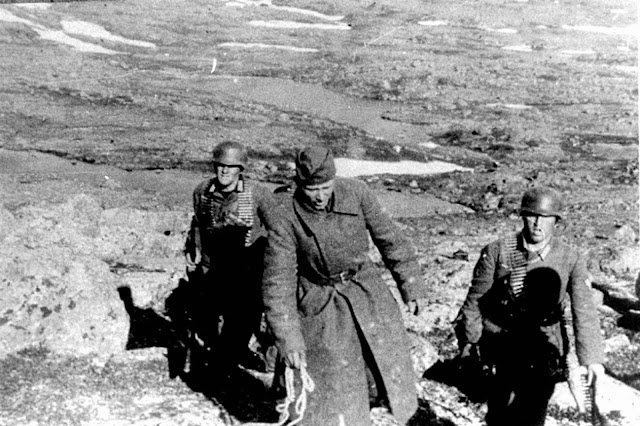
Most likely, he’ll be dead by Spring if not immediately.
On 30 June 1941, Operation Barbarossa is fulfilling all of Adolf Hitler’s dreams of conquest. His troops have advanced deep into Russia at a cost of only 8,886 men killed. By comparison, Soviet losses at Brest Fortress alone have numbered about 2000 dead and 6800 men captured. Still, the Wehrmacht is spoiled from all of its previous cheap successes (excepting Crete) and not used to such high numbers of casualties, so OKW demands detailed reports on losses from the different Army Groups (which is why we have such precise figures).
In the Far North sector, Operation SILVER FOX continues toward Murmansk without achieving any breakthroughs. The German troops, in particular, begin to slow as they lose the element of surprise. General Dietl’s 2nd Mountain Division troops are unable to penetrate the base of the Rybachy peninsula, while the main advance a little further south toward the Litsa River makes little progress.
In addition, the Finnish 2nd Division makes a small attack in central Karelia. Its goal is to prepare for a larger offensive during July. Finnish 2nd Division (Colonel Blick) makes good progress toward its objective of capturing the area between lakes Pyhäjärvi and Tyrjänjärvi. Being familiar with the climate and terrain, the Finns have none of the problems experienced by the German troops further north.
The German 163rd Infantry Division (General of Artillery Engelbrecht) completes its transfer by rail from Narvik to Helsinki. This includes a controversial passage on the train through northern Sweden. The Wehrmacht troops pass through quietly in blacked-out cars and with their weapons in separate cars.
In the Army Group North sector, Soviet troops withdraw from the right bank of the Dvina following the German seizure of a bridgehead at Riga. Rather than follow them, the German panzers by and large follow Hitler’s halt order of 29 June and wait for the infantry to catch up.
In the Army Group Center sector, Field Marshal von Bock’s panzers probe east of East. In a daring raid, the 4th Panzer Division seizes a railroad bridge at Svisloch. This cuts off parts of the Soviet 4th Airborne Corps and 20th Mechanized Corps. The main action, however, is many miles to the rear, where German Fourth and Ninth Armies are reducing the Soviet 10th Army and other forces near Bialystok. The German 45th Infantry Division, fresh from its victory at Brest-Litovsk, receives orders to head east along with the rest of the Wehrmacht — no time to waste on celebrations.
General Heinz Guderian, supported “by back channels” by OKH chief Franz Halder, ignores Hitler’s stop order and continues barreling east toward Bobruisk. This full-scale advance by 2nd Panzer Group he euphemistically characterizes as a “reconnaissance in force.” Guderian also boards an observation plane and flies over the Minsk-Bialystok pocket. He decides from his personal observation that his panzers are not needed there because General Hoth’s 3rd Panzer Group has the situation in hand.
In the Army Group South sector, the Stavka gives up on the Battle of Brody. While it has bought the Soviets some time, the disjointed attacks by large Soviet armored forces against Field Marshal von Rundstedt’s spearhead have cost the Soviets hundreds, if not thousands, of tank losses. The surviving Soviet units of the Southwestern Front are directed to retreat to the Stalin Line in order to defend the approaches to Kyiv. General Popel remains trapped in Dubno with his remaining tanks but prepares to break out to the east in accordance with the Stavka’s orders.
This concludes the Battle of Brody, a decisive German victory. German troops of 1st Panzer Group (Ewald von Kleist) continue advancing toward Kyiv and take Lviv. The Hungarian Carpathian Group makes its first attack of the war to clear passes through the Carpathian Mountains. The retreating Soviets adopt a scorched-earth strategy, mining roads and blowing up bridges, but otherwise, the Hungarians face minimal resistance.
The Red Air Force launches its first major raid of the war, sending a large force of bombers to attack General Guderian’s panzers of the 2nd Panzer Group advancing east of Minsk. They have the misfortune to run into top ace Werner Mölders and his elite JG 51 fighter squadron. The German fighter pilots file claims for 113 victories and Mölders alone claims five.
These successes bring the Mölders (shown below) victory count to 82 planes, besting the 80 victories of Rittmeister Manfred Freiherr von Richthofen (shown above) during World War I (Wolfram Freiherr von Richthofen, the Red Baron’s fourth cousin, is a top Luftwaffe general during World War II and Manfred was a colleague of Hermann Göring, so the name carries both legendary and current weight in 1941). The Red Baron’s World War I victory total was one of the most respected during the inter-war years, so besting it has been an objective for every top Luftwaffe fighter pilot.
Other pilots with five victory claims today are Hptm. Hermann-Friedrich Jöppien, Gruppenkommandeur of I./JG 51 and Lt. Heinz “Pritzl” Bär. While there may be some double… or triple … counting of victories at times, there is little question that 30 June 1941 is a very bad day for the Red Air Force (Luftwaffe victory claims are thoroughly checked for evidence such as wreckage and denied if there is no confirmation — the records are considered quite accurate, though not infallible). In addition to Mölders’ feat, his JG 51 squadron celebrates its 1000th victory of the war, and milestones like that always get a unit celebration.
Both in the air and on the ground, the war is advancing east in a hurry. People in Moscow have been skittish since the first day of the campaign, and tensions are rising. There is an air raid alert in Moscow today, but it turns out to be a false alarm.
Hitler accepts Mussolini’s offer to send an expeditionary force to the Eastern Front. It will be composed of three divisions at first.
The Organization of Ukrainian Nationalists announces the Declaration of the Ukrainian State Act and declares the Ukrainian National Government under the leadership of Iaroslav Stetsko. According to Willem Pruller’s “Diary of a German Soldier” (published after the war), Ukrainians warmly greet advancing German troops, with women giving them food and bouquets of flowers. Many Ukrainians see the Wehrmacht as liberators from the evils of communism.
The formation of the State Committee of Defense was announced. The membership comprised of Soviet Marshal Josef Stalin, NKVD leader Lavrenty Beria, military commander and bureaucrat Klim Voroshilov, politician Georgy Malenkov, and Soviet Commissar for Foreign Affairs Vyacheslav Molotov. The addition of leaders of the Party who have no military experience is an early indication that Stalin views the fight against Hitler as being as much political as military. The greatest need, for now, is to keep the men fighting against hopeless odds and ruthlessly control the rear areas. Stalin apparently chooses the GKO’s members as much for his personal relationship with them as their “other” jobs, as they are all old cronies who can be relied upon to the end.
The GKO is the apex of the Soviet government during World War II. It controls all aspects of both military and civilian life, and everyone in the Soviet Union ultimately answers to it. In practice, the GKO delegates much of its military authority to the Stavka and concerns itself with organizing the homefront.
Stalin ordered the execution of the military leadership on the Soviet Union’s western front. The western front commander, General Dmitri Pavlov, and his leading officers are executed for incompetence on Stalin’s orders.
The Soviet Information Bureau announced: “Fighting is continuing against strong enemy motorized forces in the Lutsk area. Despite his fresh armored reinforcements, all the enemy’s attempt to break through our lines in the direction of Novograd Volynskiy [Ukraine] and Shepetovka have failed and been beaten back. Our armored forces and the Soviet air force even succeeded in destroying a great part of the enemy armored and motorized troops.”
In fact, the panzers already are in Lutsk, while the German attempts to “break through our lines” have all succeeded to date.
Vichy France severed diplomatic relations with the Soviet Union. “The French Government had become convinced that diplomatic and consular agents of the Soviet in France were exercising influence affecting the security of the State.”
Hitler’s murderers are pouring into the USSR behind his tanks. As the Germans advance they festoon the landscape with multiple gallows, each with its full quota of Soviet officials and political commissars. The policy of terror is being carried out by front-line troops as well as by the special task forces of the Gestapo. Hitler has ordered that every officer has the right to shoot any person suspected of “criminal action”. Russians, like all Slavs, are regarded as Untermenschen, sub-humans, by the Germans and killed with casual brutality. No preparations have been made to deal with the thousands of prisoners that the Germans are taking, and they are being left to rot without food or medical attention. There is no doubt that the Nazis intend to follow the extermination policy which they inflicted on the Poles and wipe out all Russians capable of mounting any form of resistance. Rule by terror. Himmler has been designated to act independently of the army to carry out “special tasks”. His SS “Einsatzgruppen”, have moved into the war zone and begun to massacre the Jews.
The last trains leave Jassy (Iasi) carrying Romanian Jews. The two trains head for Calarasi and Podul Iloaiei, respectively. Many people die on the journey, and many others later.
The Australian 21st Brigade claims the ridge overlooking the Damour River Valley. This ridge controls the valley, a key defensive position between Damascus and Beirut. North of Beirut, the Vichy French launch a counterattack at Nebek which makes some small gains but then retreats after fierce defense by the defending Free French 2nd Battalion.
The Headquarters of General Wilson (Allied commander in Syria) announced: “The Allied offensive against Homs (Syria) is making substantial progress. An Australian squadron flying American-model aircraft, shot down a formation of 6 Vichy-French Glenn Martin bombers in aerial combat. The Australians came back without losses to themselves.”
35 aircraft flew off the aircraft carriers HMS Ark Royal (91) and HMS Furious (47) for Malta in OPERATION RAILWAY II. In an accident one aircraft hit the island of the HMS Furious preventing the remaining six aircraft on board to fly off. This starts a fire that kills three officers, injures five Hurricane pilots waiting to take off, and damages all five of their planes. Only nine Hurricanes arrive from Furious and twelve from the accompanying carrier, Ark Royal. The aircraft carriers then returned to Gibraltar.
The Luftwaffe (Junkers Ju 87 aircraft of I Staffeln, Sturzkampfgeschwader 2) attacks a Tobruk supply convoy, damaging sloop Flamingo and gunboat Cricket. The Flamingo has to tow Cricket back to Alexandria. Once there, however, Cricket is judged to be a total loss, though it is used for some time as a stationary anti-aircraft platform.
Scirè launched manned torpedoes into Grand Harbour, Malta; they failed to damage any enemy vessels.
An Italian convoy of six freighters/transports departs Naples bound for Tripoli.
Dutch submarine O-23 torpedoes and sinks 5371-ton Italian freighter Capacitas south of Livorno in the Ligurian Sea (about 11 km off San Vicenzo).
Prime Minister Winston Churchill sends a memo to the new Minister of Supply Lord Beaverbrook in which he notes that “the question of a much heavier tank has now come sharply to the front.” This is because he has received reports from the eastern front about the Soviet KV tank, “a very large tank, said to be over 70 tons, against which the German A/T 6-pounder [Panzer IV] has proved useless.”
The Maud Committee, set up last year in Great Britain to study the feasibility of producing a bomb based on nuclear fission, has presented its findings to the government. It concludes that such a bomb containing 25 pounds of active material would produce an effect equivalent to 1,800-tons of TNT, as well as large quantities of radioactive substances. The material for the first bomb could be ready by 1944, although the plant to produce it will cost 1.25 million pounds.
Egmont Prinz zur Lippe-Weißenfeld’s Bf 110 aircraft collided with another Bf 110, piloted by Rudolf Schoenert while in exercise over northern Netherlands. Both pilots survive.
RAF Bomber Command, Day of 30 June 1941
28 Blenheims and 6 Halifaxes on cloud-cover raids to north-west Germany. 17 aircraft bombed at Bremen. Kiel, Nordernev and Sylt. 1 Blenheim and 1 Halifax lost. 13 Blenheims on a Circus operation to Pont-a-Vendin power-station without loss.
RAF Bomber Command, Night of 30 June/1 July 1941
The Ruhr
64 aircraft — 32 Wellingtons, 18 Whitleys, 14 Hampdens — to Cologne, Duisburg and Düsseldorf. 2 Hampdens and 2 Whitleys lost. No reports of successful bombing.
The Handley Page Halifax bomber made its first daylight operation during a raid on Kiel, Germany but it did not take long to discover that its defensive armament was inadequate for daylight use and by the end of the year Halifax bombers were only used on night raids.
At least 100 of the Soviet bombers attacking German tanks near Minsk, Byelorussia were shot down by aircraft of Oberst Werner Mölders’ JG-51.
Werner Mölders shot down three Soviet bombers, bringing his total score to 82 victories and surpassing the record set by Manfred von Richthofen, “Red Baron”, during WW1.
U-66, commanded by Korvettenkapitän Richard Zapp, sank British steamer St Anselm (5614grt) in 31N, 26W. At 0559 hours on 30 Jun 1941 the Saint Anselm (Master Thomas Ross), a straggler from convoy SL.78, was hit by one torpedo from U-66 and sank by the stern after 25 minutes west of Madeira. The zigzagging ship had been spotted at 1930 hours the day before and was missed by a first torpedo at 01.10 hours after which the master was alerted and avoided skillfully several attacks. The second torpedo fired at 0146 hours from a distance of only 400 meters was avoided, also the next at 0328 hours from 1000 meters. Two minutes later a torpedo hit but proved to be a dud while the fifth torpedo at 03.32 hours missed again. The U-boat then reloaded the tubes and fired another torpedo at 0558 hours which was also a dud before the seventh torpedo hit one minute later. 34 men from the Saint Anselm were lost. The master and 17 survivors were picked up by HMS Moreton Bay (F 11) (Capt C.C. Bell (retired), RN) and landed at Freetown on 13 July. 15 other survivors were picked up by the Spanish steam merchant Tom and landed at Buenos Aires. The 5,614-ton Saint Anselm was carrying pig iron, linseed, and groundnuts and was headed for Hull, England.
Dutch submarine HNLMS O.23 sank Italian steamer Capacitas (5371grt) south of Livorna, seven miles off San Vincenzo in 43-06N, 10-26E. The submarine unsuccessfully attacked a second steamer in the Ligurian Sea.
Battlecruiser HMS Repulse, Dutch light cruiser HNLMS Heemskerk, and destroyers HMS Cossack, HMS Sikh, HMS Inglefield, HMS Achates, HMS Active, HMS Antelope, and HMS Intrepid arrived in the Clyde at 0800 after escorting convoy TC.11.
Heavy cruiser HMS Norfolk departed Scapa Flow and arrived in the Tyne at 2200 for refitting.
Heavy cruiser HMS Suffolk departed Iceland to relieve light cruiser HMS Manchester on Denmark Straits patrol.
Light cruiser HMS Arethusa arrived at Scapa Flow after Faroes Iceland patrol.
Destroyer HMS Croome departed Greenock at 1630 to work up at Scapa Flow, where she arrived at 1400 on 1 July.
Light cruiser HMS Dunedin captured Vichy French steamer Ville De Tamatave (4993grt) east of St Paul.
Submarine HMS Torbay sank a caique off Cape Malea with artillery.
German air attacks on a Tobruk bound convoy composed of Greek steamers Miranda (279grt) and Greek Antiklia (951grt), which departed Mersa Matruh on the 29th escorted by sloop HMS Flamingo, trawler HMS Southern Isle, and gunboat HMS Cricket. The convoy was taken under attack by a large German bombing force from 1340/30th. Sloop Flamingo was damaged by a near miss. Gunboat Cricket was severely damaged. She was towed back to Alexandria by sloop Flamingo, and later tug St Issey. On 2 July, gunboat Cricket arrived at Alexandria in the tow of tug St Issey. Sloop Flamingo also arrived at Alexandria on 2 July. The gunboat was judged to be a total loss.
Greek cruiser RHS Georgios Averoff, destroyer RHS Panther, torpedo boat RHS Sphendoni, submarine RHS Katsonis, and depot ship RHS Hiphaistos departed Alexandria, escorted by Greek destroyers RHS Ierax and RHS Aetos, for the transit of the Canal. These Greek ships were temporarily stationed at Suez.
Ocean boarding vessels HMS Marsdale and HMS Malvernian were ordered to sweep to locate an unidentified freighted sighted by air on 25/26 June.
Convoy OB.341 departed Liverpool, escorted by destroyers HNoMS St Albans and HMS Westcott and corvettes HMS Auricula, HMS Freesia, HMS Hibiscus, HMS Marigold, HMS Myosotis, and HMS Periwinkle. Corvette Periwinkle was detached on 4 July. The destroyers and corvettes Freesia and Myosotis were detached on 5 July. The convoy was dispersed on 6 July.
Convoy HX.136 departed Halifax, escorted by armed merchant cruisers HMS Ascania and HMS California, corvettes HMCS Arrowhead, HMCS Camellia, HMCS Eyebright, and HMCS Mayflower, anti-submarine yacht HMS Philante, and anti-submarine trawler Kos XX. Convoy BHX.136 departed Bermuda on the 28th escorted by ocean escort armed merchant cruiser HMS Ascania. The convoy rendezvoused with convoy HX.136 on 3 July and the armed merchant cruiser was detached. On 4 July, destroyers HMS Burnham and HMS Chesterfield, corvettes HMCS Agassiz and HMCS Wetaskiwin joined. Destroyer HMS Churchill joined on 6 July. On 13 July, the original escorts and those joining on 4, less trawler Kos XX, and 6 July were detached. Destroyers HMS Keppel, HMS Sabre, and HMS Shikari, corvettes HMS Dianella and HMS Kingcup, minesweeper HMS Hebe, and anti-submarine trawlers HMS Lady Elsa and HMS Wellard joined. The convoy arrived at Liverpool on 18 July.
In Washington, the Senate completed action on pending appropriation bills and the bill extending the Commodity Credit Corporation and adjourned at 10:44 PM, until noon Thursday. Received were the Johnson-Kilgore bill for consolidation of Army and Navy Departments and OPM into a Department of National Defense and the Wheeler resolution for an investigation of reports of firing on German ships. The reappointment of John F. Fahey to the Federal Home Loan Bank Board was confirmed. The Judiciary Committee approved the nomination of Robert H. Jackson to the Supreme Court and the Military Affairs Committee heard opposition to the property requisitioning bill.
The House completed action on appropriation bills and the Commodity Credit Corporation measure, defeated the bill to permit wiretapping in certain cases, received the May resolution to permit retirement of unfit Army officers, the Tinkham resolution on policy toward Russia and the Walter bill granting Federal district courts jurisdiction in industrial disputes threatening a work stoppage and adjourned at 10:30 PM until noon Thursday. The Ways and Means Committee agreed upon excise taxes and the Roads Committee approved $250,000,000 for defense highways and emergency landing fields.
Men newly come of age, some 750,000 of them throughout the nation, will register for compulsory military service tomorrow with the chances increased that they will be called to the colors within the year. Revising original estimates, selective service officials calculated today that the army probably would ask for recruits at the rate of about 75,000 a month, instead of 50,000. A heavy percentage is expected to come from the ranks of those who enroll tomorrow since members of the military “class of 1941” are least likely to be physically disqualified, or deferred because of dependents or employment In vital defense industries. Half of them, however, probably will not be summoned before next summer.
Congress completed action on all supply measures for the fiscal year 1941-42 tonight by passing six bills which brought the total appropriations to a record $33,310,870,190.63. Working overtime to meet a deadline at midnight, when the 1941 fiscal year ends, both houses stayed in session until 10:45 o’clock and finally sent to the White House the last six bills, which totaled $4,287,896,894.75. Appropriations for the fiscal year 1942 are $14,238,879,046 more than the previous record year in the nation’s history. Immediately Republicans in both houses predicted that the country would take action against members at the next election for not paring non-defense items. Although Administration leaders had asked that $1,000,000,000 be cut from non-defense items, Representative Taber of New York, the ranking Republican member of the House Appropriations Committee, pointed out that the non-defense items for the fiscal year 1942 are actually $88,378,352 more than the non-defense items in 1941.
Tentative agreements were reached today by the ways and Means Committee on a large number of excise duties to be written into the defense tax measure, calling for $3,500,000,000.
Secretary of the Navy Frank Knox gives a dinner speech at the Bethlehem Shipbuilding Company in Fore River, Massachusetts. He emphasizes the importance of patrolling the seas so that the U.S. industrial might can deliver weapons of war to make the German people “understand the cruelty and ruthlessness which Hitler has unloosed upon the world.” Knox declared flatly tonight that “the time to use our navy to clear the Atlantic of the German menace is at hand. Now is the time to strike,” he asserted in an address before the thirty-third annual conference of governors of the United States.
The House of Representatives tonight defeated, 154 to 146, legislation which would have authorized the Department of Justice to tap telephone and telegraph wires to obtain evidence in espionage, sabotage, extortion and kidnaping cases.
The nomination of Attorney General Jackson to be an Associate Justice of the Supreme Court was unanimously approved by the Senate Judiciary Committee today despite a protest by Senator Tydings of Maryland that Mr. Jackson was unfit for the office.
The names of three naturalized Germans were added yesterday to the list of twenty-six men and three women arrested by Federal agents over the week-end in a nation-wide spy hunt. The three were described as couriers for the ring by J. Edgar Hoover, director of the Federal Bureau of Investigation. They are accused of transmitting information to German agents in South American ports. Mr. Hoover disclosed that Federal agents boarded the Moore-McCormack liner Uruguay as she arrived at Quarantine and arrested Adolph Henry August Walischewsky, a steward, and then boarded the American Export liner Excalibur and seized Conradin Otto Dold, second steward. The third prisoner, Heinrich Clausing, was arrested on the steamship Argentina before she docked late Sunday night at Santos, Brazil.
Senator Burton K. Wheeler, Montana Democrat, proposed today that the Senate investigate whether the American navy has “begun shooting” in carrying out its patrol activities.
William Green, president of the American Federation of Labor, has called for intensification of labor’s war against the Communists, declaring that “whatever foreign policy the Administration may follow as a military expedient, there can be no reversal of our unrelenting opposition to Communists within our democracy.”
The United States’ closely guarded military secret the Norden bomb-sight has for several years been examined by a man now charged with espionage, it was disclosed today as three more men were arrested in the government’s nationwide spy hunt. The arrests brought the weekend total to 32. Seven of the 29 whose arrests were announced yesterday mumbled “guilty” when arraigned before U. S. Commissioner Martin C. Epstein in Brooklyn. The Norden Inspector, Herman Lang, 40, German-born draftsman, and Everett Minster Roeder, 47, employed in an important capacity in the Sperry gyroscope factory, were among 18 defendants who pleaded innocent here, and were held for hearing July 15.
Franklin Roosevelt dedicated the Franklin D. Roosevelt Library in Hyde Park, New York. President Roosevelt dedicated today the $350,000 library which bears his name with a declaration of faith in the future of free America.
On this date, the USN has 1,899 ships and district craft and 338,786 personnel consisting of 284,427 sailors and 54,359 Marines. There are also 19,235 members of the USCG.
The active duty strength of the U.S. Marine Corps was reported to be 3,339 officers and 51,020 enlisted men for the total of 54,359.
By this date the U.S. Army has accepted 85 SCR-268 radar sets into service for AAA defense.
Two copies of Frank Whittle’s advanced W-1 jet engine have arrived in the United States aboard a B-17 pursuant to General Hap Arnold’s request. Impressed, he tasks the U.S. Army Air Force to develop an engine based upon it. However, the first order issued today, a $483,600 joint Army-Navy contract, visualizes a turboprop, not a pure jet engine. While it may appear comforting for aviators of the day to see a propeller on the engine, in fact, a turboprop is a much more difficult project than simply a jet engine. Turboprop engine development was initiated as a joint Army-Navy project, with a Navy contract to Northrop Aircraft for the design of an aircraft gas turbine developing 2,500 hp (1,864 kW) at a weight of less than 3,215 pounds (1,458 kg).
The USN places an order for two Grumman XF6F-1 Hellcat prototypes, BuNos 02981 and 02982.
Major League Baseball:
Nels Potter is sold by Philadelphia Athletics to the Red Sox where he’ll go 2–0. The Browns will select him in the Rule 5 draft in November 1942.
Pete Reiser triples on the 1st pitch of the game and the next time up hits the 1st pitch for a home run as the Dodgers whip the Phillies, 9–2. Whit Wyatt wins his 12th, allowing 6 hits. The win gives the Dodgers a first-place tie with the Cards.
The Giants score 3 runs in the 12th to break up a scoreless pitching duel between the Braves’ Manuel Salvo and New York’s Cliff Melton and win, 3–0. Salvo loses his 10th in a row.
The White Sox knocked Schoolboy Rows out of the box in the ninth inning today and scored two runs to beat the Tigers, 7–6. Detroit had taken the lead with a run in the first half of the ninth.
The Reds pounded veteran Charlie Root from the box with five hits tonight to score five runs in the first inning and start Elmer Riddle to a 7–1 victory over the Cubs before 24,536 spectators. It was Riddle’s eighth triumph of an unbeaten season.
Maurice Van Robays’s triple, scoring two mates in the third inning, proved the deciding blow in the Pirates’ 4–3 triumph over the Cardinals tonight. Ken Heintzelman, Pirate southpaw, gave a dozen hits but couldn’t be tapped when the tying and winning runs were on base. In the eighth Herman Triplett opened with a single and went to third on Johnny Mize’s single, but he held the base as Enos Slaughter forced Mize and then Eddie Lake hit into a double play.
The Browns score 9 runs in the 7th to drive Bob Feller out of the box and beat the Indians, 12–6. Joe Grace has a double in homer in the big inning. The defeat dropped Cleveland to a point two games behind the first place Yankees.
Philadelphia Phillies 2, Brooklyn Dodgers 9
New York Giants 3, Boston Braves 0
Detroit Tigers 6, Chicago White Sox 7
Chicago Cubs 1, Cincinnati Reds 7
St. Louis Cardinals 3, Pittsburgh Pirates 4
Cleveland Indians 6, St. Louis Browns 12
Light cruiser HMS Enterprise departed Colombo on patrol.
Japanese planes bombed Chungking again today in the ninth raid of the month on this provisional Chinese capital. New damage resulted in the western district and the crowded quarters across the Chialing River. As in yesterday’s attack, in which the counselor of the British Embassy and three other Britons, including a woman, were injured, the planes came over in two waves in daylight, taking their time as they dropped explosives on selected targets.
The Japanese Government’s search, for a policy toward the Russo-German war was believed approaching a climax today as a result of new conferences by political and military leaders.
The Dutch government-in-exile still controls extensive possessions in the South Pacific, and it has the resources to defend them if necessary. Today, the Netherlands Purchasing Commission, acting on behalf of the Dutch government in exile in London, signs contract 71311/NA with North American Aviation. This cash deal calls for delivery to the Dutch of 162 B-25C bombers (designated NA-90). Delivery is to made to the Dutch East Indies once the USAAF has received its own initial orders of roughly 1000 B-25s — which is not projected to take place until November 1942.
Dow Jones Industrial Average: 123.14 (-0.26)
Born:
Larry Hall, American rocker (“Sandy”), born in Hamlet, Ohio (d. 1997).
Mike Leander, English songwriter and record producer, born in Walthamstow, Essex, England, United Kingdom (d. 1996).
Otto Sander, German actor, in Hanover, Germany (d. 2013).
Naval Construction:
The U.S. Navy YMS-1-class auxiliary motor minesweeper USS YMS-49 is laid down by the Wheeler Shipbuilding Corp. (Whitestone, Long Island, New York, U.S.A.).
The Nihon Kaigun (Imperial Japanese Navy) auxiliary minesweeper HIJMS Wa-1 is laid down by the Ōsaka Iron Works, Osaka, Japan.
The U.S. Navy Barnegat-class small seaplane tender USS Rockaway (AVP-29) is laid down by the Associated Ship Building Inc. (Seattle, Washington, U.S.A.).
The Nihon Kaigun (Imperial Japanese Navy) Ro-100-class submarines HIJMS Ro-100, HIJMS Ro-103, and HIJMS Ro-107 are laid down by the Kure Naval Arsenal, Kure, Japan.
The U.S. Navy Benson-class destroyers USS Hobby (DD-610) and USS Kalk (DD-611) are laid down by the Bethlehem Shipbuilding Corp., (San Francisco, California, U.S.A.)
The U.S. Navy Baltimore-class heavy cruiser USS Boston (CA-69) is laid down by the Bethlehem Shipbuilding Corp. (Quincy, Massachusetts, U.S.A.).
The Royal Canadian Navy Bangor-class (Diesel-engined) minesweeper HMCS Trois Rivieres (J 269) [ex HMCS Three Rivers] is launched by Marine Industries Ltd. (Sorel, Quebec, Canada).
The Royal Australian Navy Bathurst-class minesweeper-corvette HMAS Launceston (J 179) is launched by Evans Deakin Ltd. (Brisbane, Queensland, Australia).
The U.S. Navy SC-497-class (110-foot wooden hull) submarine chaser USS PC-507 (later SC-507) is launched by the Mathis Yacht Building Co. (Camden, New Jersey, U.S.A.).
The Royal Navy harbor defence motor launch HMS HDML 1104 is commissioned.
The Royal Navy LCT (Mk 2)-class landing craft, tank HMS LCT 116 is commissioned.
The Royal Canadian Navy Bangor-class (VTE Reciprocating-engined) minesweeper HMCS Wasaga (J 162) is commissioned. Her first commanding officer is T/Lieutenant Commander Walter Redford, RCNR.
The U.S. Navy 77-foot Elco patrol motor torpedo boat USS PT 28 is commissioned.
The U.S. Navy Gar-class submarine USS Grayback (SS-208) is commissioned. Her first commanding officer is Lieutenant Willard Arthur Saunders, USN.
The Royal Navy Flower-class corvette HMS Samphire (K 128) is commissioned. Her first commanding officer is ieutenant Commander Frederick Thomas Renny, DSC, RNR.
The Royal Canadian Navy Flower-class corvette HMCS Camrose (K 154) is commissioned. Her first commanding officer is T/Lieutenant Louis Raymond Pavillard, RCNR.
The Nihon Kaigun (Imperial Japanese Navy) Kagerō-class destroyer HIJMS Hamakaze (浜風; “Beach Wind”) is commissioned. Her first commanding officer is Commander Orita Tsuneo.
The Royal Navy Dido-class light cruiser HMS Euryalus (42) is commissioned. Her first commanding officer is Captain Eric Wheeler Bush, DSO, DSC, RN.
For the month of June 1941, German U-boats sank 60 ships (total 302,032-tons) and damaged 5 more ships (40,482-tons).
For the month of June 1941, the Allies altogether lose in the Atlantic:
104 ships
415,255 tons of shipping
Elsewhere, the Allies lose five ships of 16,770 tons. Overall, Allied losses are down from 486,796 tons to 389,316 tons. The Allies suffering lower losses to U-boats, aircraft, and mines, but slightly higher losses to surface raiders.
The Kriegsmarine, meanwhile, loses four U-boats and the Italians one submarine, still a very low number relative to the damage they are causing. The Axis loses 17 ships of 58,425 tons in the Mediterranean, mostly Italian.

