As of 29 June 1941 is one week into Operation Barbarossa, and the invasion is going right on schedule for Germany. The biggest success so far has been the capture of Minsk, the largest city on the high road to Moscow. Today, the Germans also clean up their supply route to Minsk by eliminating Soviet resistance at the Brest Fortress. If anything, the German success is greater than expected — which provides Hitler with his first real chance to interfere with operations.
The Soviets issue a directive — the first of many — aimed at punishing cowardice and desertion. The NKVD is instructed to set up posts behind the lines and apprehend any troops retreating without authorization. Summary courts-martial are established that have the authority to impose the severest penalties on soldiers and civilians alike.
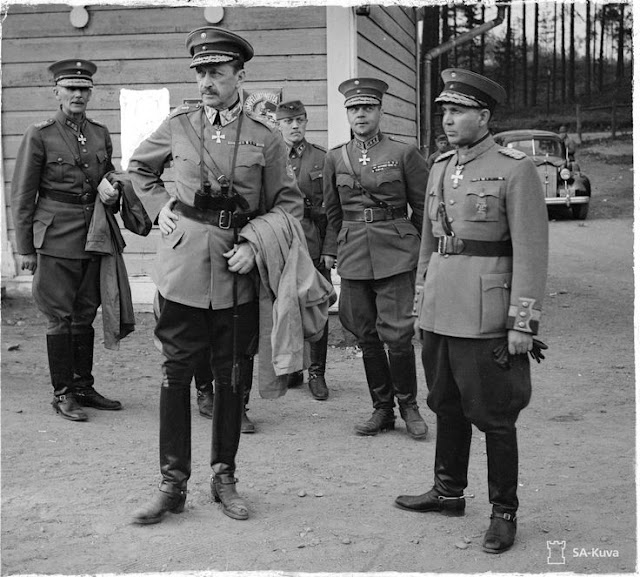
In the Far North, Finland finally launches its first offensive in conjunction with Wehrmacht troops commanded by the hero of Narvik, Eduard Dietl. The overall Finnish military commander is Field Marshal Baron Carl Gustaf Emil Mannerheim, a legendary World War I leader. The Germans and Finns launched Operations SILVER FOX and PLATINUM FOX, aimed at capturing the key Soviet port of Murmansk.
The German Army of Norway and the Finnish forces must cross very rugged terrain before reaching the port. The Finnish 3rd and 6th Divisions are attached to the German forces and nominally under their command, and they face Soviet 14th Army and 54th Rifle Division. The 3rd Mountain Division advances through the Titovka Valley and secures a key bridge over the river in the valley, while the 2nd Mountain Division takes the neck of the Rybachy Peninsula.
The main Finnish objective during all these attacks, as always during the Continuation War, is the recovery of Finnish territory lost as a result of the Winter War. Finnish 18th Division (Colonel Pajari) advances into Enso, a formerly Finnish town just across the border. The Soviets put up fierce resistance, and elsewhere the operation is hampered by German troops who are unfamiliar with the terrain and the climate. The Soviets land reinforcements on Fisherman’s Peninsula. The German advance slows and then stops very quickly. The German Army 20 Gebirgsarmee began advancing on Murmansk in northern Russia. The German advance out of Norway, directed at the vital northern port of Murmansk, was stopped by Soviet defenses.
The Luftwaffe bombs and sinks Estonian freighter Märta at Ventspils.
Finnish minelayers lay mines off the Soviet coast.
212,000 children were evacuated from Leningrad. The government broadcasts a “scorched earth” policy, asking citizens to leave “nothing” for the Germans.
In the Army Group North sector, the Soviets are in disarray. Stalin recalled General of the Army Dimitri Pavlov and his entire staff on the 28th and replaced him with General Andrey Ivanovich Eremenko. Eremenko arrives at the Western Front headquarters at Mogilev in the morning to hear that the German 3rd Panzer Division has captured a bridgehead over the Berezina at Bobruisk and other panzers are across the Dvina at Riga. Considering that the plan was for the Soviet 4th Army to make a stand on the Berezina, this creates a dangerous situation. The Stavka rushes the elite 1st Moscow Motor Rifle Division to Borisov to try to hold the line.
General Timoshenko, who has virtually taken over command of the Northwestern Front from General Kuznetsov, orders a stand on the Velikaya River. The Stavka now for the first time becomes concerned about the defense of Leningrad and hopes to make a successful defense of the city on the Stalin Line.
The Wehrmacht seizes the port of Libau after overcoming a fierce Soviet defense. The Germans take many casualties, and the fighting only ends when the defending Soviet 67th Rifle Division runs out of ammunition.
The Soviets at Brest Fortress in Brest-Litovsk remain dug in when the day begins. The Wehrmacht has used an assortment of advanced weaponry, including 15 cm Nebelwerfer 41 rocket mortars and flamethrowers, but the Soviets are dug in and refusing to surrender. Today, the German 45th Infantry Division calls in air support and the Luftwaffe sends Junkers Ju 88 bombers twice during the day. They drop 3,970 lb (1,800 kg) “blockbuster” bombs, the maximum that the planes can carry and the heaviest dropped by the Luftwaffe during World War II. This does the trick, and the 360 Soviet defenders surrender. However, some isolated Soviet soldiers remain hidden in the ruins until 23 July, when a Soviet lieutenant is captured — and perhaps longer.
In the Army Group Center sector, Hitler is tired of simply watching the brilliant offensive unfold through the Baltic states. He decides to impose his will and do something similar to what he did just over a year ago — put a brake on the advance. Hitler has Commander-in-Chief of the German Army Walther von Brauchitsch order commander of Army Group Center Fedor von Bock to stop his panzers and consolidate his position. In the first of many such instances, the Wehrmacht complies with the order in form but not in substance. Von Bock quietly encourages General Guderian to continue sending his 2nd Panzer Group east toward Bobruisk. The continued advance is explained to Hitler as a “reconnaissance-in-force,” though in reality the generals simply ignore him.
In the Army Group South sector, massive Soviet tank forces have done little to hurt the advancing panzers at the Battle of Brody. However, at the cost of hundreds if not thousands of tanks, the Soviets at least have slowed the panzers. Soviet 22nd Mechanized Corps (Major-General S.M. Kondrusev) reports that it is down to only 19% of the tanks with which it began the war. Major-General N.V. Feklenko’s 19th Mechanized Corps reports that it has only 32 tanks remaining out of its starting force of 453 tanks. General Popel still has a large force of tanks, but he is trapped in Dubno and attempts by other Soviet forces have failed. German 16th Motorized, 75th Infantry Division, two other infantry divisions, and the 16th Panzer Division begin the process of reducing Popel’s pocket.
Luftwaffe boss Hermann Göring, eager to burnish his own credentials with Hitler, claims:
“In the first week of the campaign, the Luftwaffe has destroyed 4,990 Russian enemy aircraft for the loss of 175 of its own.”
This, in fact, is not far from the truth if you count all of the Soviet aircraft destroyed on the ground. However, many of the Soviet planes destroyed were obsolete or non-combat planes. In any event, the USSR has thousands of planes further from the front.
A haggard and tense Stalin set up a Soviet Defense Committee consisted of Molotov, Voroshilov, Malenkov, Beria, and himself, and then retired to his dacha on the outskirts of Moscow, Russia, staying there until the following day writing a speech to the Soviet people and drafting two important directives on the Soviet war effort. The Red Army, too, is recovering from its initial unpreparedness and its well-armored, fast T34 tank has given the Germans a nasty surprise. What has really surprised the Germans, however, is the resistance being put up by the ordinary Russian soldiers fighting in the defense of their homeland.
A report from Einsatzgruppe A states that by this date 2,300 Jews have been “rendered harmless” in Kovno (Kaunas), Lithuania.
6,000 Jews are murdered in a pogrom in Bucharest, Romania
The pogrom in Jassy (Iasi), Romania continues. Local Romanian forces round up 5000 Jews for transport to concentration camps in sealed cattle trucks. The Romanian forces beat down doors and kill an estimated 260 Jews today, with thousands ultimately killed.
The British advance on Palmyra from Iraq continues today. Habforce’s Arab Legion troops occupy Sukhna, which is about 40 miles northeast of Palmyra. The Vichy French notice this and prepare a counterattack. Right outside Palmyra, meanwhile, the Vichy French Foreign Legion drives the Wiltshire Yeomanry from a ridge overlooking the town and airfield.
In the Damour Valley east of Beirut, French artillery pounds British troops. British Brigadier William George Stevens keeps his main forces in the rear to avoid casualties but sends armed reconnaissance patrols to probe the French defenses.
From Paris, the government issues a communiqué:
“The British Fleet has bombed our coastal positions in the Middle East. We have evacuated several of our bases in the mountains of southern Lebanon under cover of artillery fire which inflicted heavy losses on our assailants. Our aerial forces, supported by naval aircraft, repeatedly intervened in the ground fighting, especially around Palmyra (Syria). A British colonel and 40 men were captured.”
As the communiqué suggests, there continues to be very hard fighting in the mountains east of Beirut.
The RAF stages a rare assassination mission aimed at Vichy French General Henri Dentz, bombing his official residence. Dentz escapes injury. The French Havas News Agency quickly issues a communiqué:
“This afternoon British aircraft bombed and destroyed the residence of the French High Commissioner in Beirut. There were large numbers of dead and wounded.”
Events throughout World War II will establish that it is extremely difficult to kill a specific person with aerial bombing. Generally, to be successful, such operations must isolate the target and kill him directly rather than sending bombers over a particular house or town.
Offshore, Royal Navy light cruiser HMS Naiad and two accompanying destroyers bombard Damur during the night.
Spanish leader Francisco Franco has agreed that German U-boats may receive supplies in Spanish waters as long as it is done in a low-key way. One such instance happens today when U-69 (Kptlt. Jost Metzler) refills its tanks from an interned German tanker, Charlotte Schliemann, which is berthed at Las Palmas de Gran Canaria harbor, then departs. The entire incident happens in the early morning hours so that nobody will notice.
Hitler issued a secret decree formally designating Hermann Göring as his successor. This is the decree that was referred to in the Göring telegram of April 1945. Hitler issues a secret decree which formally named Hermann Göring his successor in the event of his death. It gives Göring the power to act as Hitler’s deputy with freedom of action in the event Hitler ever loses his freedom of action — either by way of incapacity, disappearance or abduction.
German submarine U-651 was depth charged and sunk in the North Atlantic by British warships.
Italy annexes to its puppet state of Albania districts of Yugoslavia that are adjacent to Albania.
Lord Beaverbrook became the British Minister of Supply. Beaverbrook is a close confidant of Winston Churchill, somewhat akin to the relationship that Harry Hopkins has to President Franklin Roosevelt and a key figure in England’s wartime economy.
Royal Navy destroyer HMAS Waterhen is making a nightly run to Tobruk when its luck runs out. A Regia Aeronautica Junkers Ju 87 bombs Waterhen about 100 miles east of Tobruk. The destroyer is taken in tow by HMS Defender, but Waterhen sinks on the way back to Alexandria. There are no casualties.
Royal Navy submarine HMS Urge makes an unsuccessful attack on Italian heavy cruiser Gorizia south of Messina, Sicily. While Urge’s crew claims two hits and explosions, apparently Gorizia is undamaged. Gorizia and other ships then attack Urge, but it escapes. Royal Navy submarine Utmost attacks the same ships, also unsuccessfully.
The aircraft carriers HMS Ark Royal (91) and HMS Furious (47) and their escorts sailed from Gibraltar with 42 aircraft bound for Malta in Operation RAILWAY II.
RAF Bomber Command, Night of 29/30 June 1941
Bremen
106 aircraft — 52 Wellingtons, 30 Hampdens, 24 Whitleys — of which 69 claimed good bombing results. 7 aircraft — 4 Wellingtons, 2 Hampdens, 1 Whitley — lost.
Hamburg
28 aircraft — 13 Stirlings, 7 Wellingtons, 6 Manchesters, 2 Halifaxes. 4 Stirlings and 2 Wellingtons lost. Hamburg reports much damage with 8 people killed, 115 injured and 465 bombed out, also a large fire which completely destroyed a store containing 650-tons of rice and 200-tons of animal foods. 3 bombers were shot down over Hamburg by night fighters and the rice-store fire may have been started by a crashing bomber.
3 Hampdens laid mines in the Frisians without loss.
U-103, commanded by Korvettenkapitän Viktor Schütze, sank in error Italian steamer Ernani (6619grt), which had departed Tenerife to escape to Bordeaux, 450 miles west of Las Palmas. At 0051 hours on 29 June 1941, U-103 fired its last torpedo at an unescorted steamer of 6600 GRT, observed a hit in the engine room and the subsequent sinking of the ship about 450 miles west of the Canary Islands. The steamer had been spotted at 1642 hours the day before and was missed with a stern torpedo at 2328 hours. After the sinking, the U-boat approached the lifeboats and Schütze questioned some survivors but he did not believe them when they told him that they were from the Italian steamer Ernani en route from Las Palmas to Horta, because the course of the ship didn’t correspond with the mentioned destination. In fact, the U-boat had sunk the Italian blockade runner Ernani (Master Guglielmo Rastelli), disguised as the Dutch steam merchant Enggano. She was the ninth and last Italian merchant ship that left the Canary Islands to run the blockade in an attempt to reach a French port (only five managed to reach their destination) and planned to arrive at Bordeaux between 9 and 11 August. Her crew began to disguise the ship only after leaving Las Palmas and they built a fake crow’s nest on a mast and additional bulwarks, removed the other mast and painted the hull and funnel black, but the work was not yet completed when the ship was torpedoed. The torpedo struck on the starboard side between the engine room and #4 hold and opened a large hole, causing the ship to sink by the stern within four minutes. Two crew members on watch below were killed, while the remaining crew members had barely time to abandon ship in both port lifeboats because both boats on the starboard side had been destroyed. As the Germans questioned the Italians in English, the master thought that they had been sunk by a British submarine, lied about the port of destination and asked for help. He was told that they couldn’t help them in any way but promised to send a radio message after leaving the area as no distress signal had been sent. The lifeboats unsuccessfully searched the area for the two missing men until midnight and then began to row and sail towards the nearest land. On 10 July, the weather deteriorated and the boats were tossed around violently by strong wind and heavy seas. The lifeboat in charge of the first officer began leaking during the storm and had to be abandoned eventually. Its occupants were taken aboard the other lifeboat which was in charge of the master. Around noon on 12 July, the exhausted survivors made landfall near Fuencaliente Lighthouse on La Palma, Canary Islands. The sinking of Ernani was investigated by the BdU after the Italian Navy protested, but no reason was found to blame Schütze for this mistake as he had not been informed about the presence of a friendly ship in the area and could not recognize the ship correctly as her appearance had been altered.
U-651, commanded by Peter Lohmeyer, attacks convoy HX.133. Destroyers HMS Malcolm and HMS Scimitar, corvettes HMS Arabis and HMS Violet, CAM ship HMS Maplin, minesweepers HMS Niger and HMS Speedwell, and three anti-submarine trawlers joined the convoy. U-651 sank British steamer Grayburn (6342grt) in 59-30N, 18-07W. At 0030 hours on 29 June 1941, U-651 fired two G7e torpedoes at the convoy HX.133 south of Iceland and sank the Grayburn in station #93. The U-boat was sunk by the escort vessels of the convoy later that day. The Grayburn (Master John William Sygrove) had originally been in station #73, but changed to station #93 after some ships straggled from the convoy in heavy fog. She was hit on port side amidships by a torpedo, immediately settled on an even keel and sank within 5 minutes. Because the port lifeboat had been destroyed, most survivors tried to abandon ship in the starboard lifeboat which was pulled down and turned over by the suction from the sinking ship, throwing the 30 occupants into the water and drowning all but two of them. Five men managed to launch a small jolly boat and others rescued themselves on rafts or cling to debris. 16 survivors, two of them slightly injured, were picked up by HMS Violet (K 35) (Lt F.C. Reynolds, RCNVR) and HMS Northern Wave (FY 153) (T/Lt W.G. Pardoe-Matthews, RNR), later transferred to the British rescue ship Zaafaran (Master Charles Kavanagh McGowan, DSC) and landed at Gourock on 2 July. Another survivor was rescued by HMS Arabis (K 73) (LtCdr J.P. Stewart, RNR) and landed at Londonderry. The master, 26 crew members and all eight gunners (the ship was armed with one 4in, one 40mm and four machine guns) were lost. The 6,342-ton Grayburn was carrying scrap and steel and was headed for Swansea, England.
U-651 was subsequently sunk by destroyers HMS Malcolm and HMS Scimitar, corvettes HMS Arabis and HMS Violet, and minesweeper HMS Speedwell in 59-52N, 18-36W. The U-651, commanded by Kapitänleutnant Peter Lohmeyer, was sunk south of Iceland in the North Atlantic Ocean by depth charges from the destroyers HMS Malcolm (D 19) and HMS Scimitar (H 21), the corvettes HMS Arabis (K 73) and HMS Violet (K 35), and the minesweeper HMS Speedwell (J 87). Of the ship’s complement, all 45 survived. During its career under Kapitänleutnant Lohmeyer the U-651 sank 2 ships for a total of 11,639-tons.
U-66, commanded by Korvettenkapitän Richard Zapp, in attacks on stragglers from convoy SL.78 sank Greek steamer George J. Goulandris (4345grt) at 29-05N, 25-10W and Greek steamer Kalypso Vergotti (5686grt) at 29N, 25W.
At 1146 hours on 29 June 1941 the unescorted George J. Goulandris (Master Dimitrios Lekkas), a straggler from convoy SL.78, was hit on the starboard side by two G7e torpedoes from U-66 about 380 miles west of the Canary Islands. The first torpedo struck in #2 hold and the second in #4 holds, blowing off the hatches and sugar from the cargo over the decks. The crew could not send a distress signal as the wireless had been wrecked and abandoned ship in two lifeboats within three minutes when the ship began to settle quickly, sinking 15 minutes after being hit. The U-boat surfaced shortly afterwards and the Germans questioned the master, asking the usual questions about the name and nationality of the ship, its cargo and destination. They then gave provisions and cigarettes to the occupants of both boats before leaving the area. The survivors were picked up two hours after the sinking by Batna from the same convoy and were landed at Oban on 12 July.The 4,345-ton George J. Goulandris was carrying sugar and was headed for Leith Roads, England.
At 1850 hours on 29 June 1941 the Kalypso Vergotti, a straggler from convoy SL.78, was hit by a torpedo from U-66 and sank within 50 seconds west of the Canary Islands. Two empty lifeboats and a few survivors swimming in the water were seen by the Germans after the attack. The 5,686-ton Kalypso Vergotti was carrying iron ore and was headed for Glasgow, Scotland.
U-123, commanded by Kapitänleutnant Reinhard Hardegen, sank British steamer Rio Azul (4088grt) from convoy SL.78 at 29N, 25W. At 1936 hours on 29 Jun 1941 the Rio Azul (Master Thomas Vickers Sutherland) in convoy SL.78 was hit near the bridge by one stern torpedo from U-123 about 200 miles southeast of the Azores. Hardegen assumed that the ship was a Q-ship but this was not the case. She broke in two and sank in a short time. The master, 31 crew members and one gunner were lost. Six crew members and three gunners were picked up by HMS Esperance Bay (F 67) (Capt G.S. Holden (retired), RN) and landed at Scapa Flow, Orkneys. The 4,088-ton Rio Azul was carrying iron ore and was headed for Middlesbrough, England.
U-564, commanded by Oberleutnant zur See Reinhard Suhren, sank Icelandic steamer Hekla (1215grt) in 58-20N, 43W. At 19.58 hours on 29 Jun 1941 the unescorted Hekla was torpedoed by U-564 and sank within two minutes. Seven men survived the sinking and spent 10 days on a life raft before they were picked up by HMS Candytuft (K 09) (LtCdr F.B. Collinson, RD, RNR) escorting the convoy OB-341, but one man died the next night onboard the corvette. The surviving 6 men were taken to St. Johns, Newfoundland. One of the men spent over 6 months in a hospital before going back to Iceland. The 1,215-ton Hekla was carrying ballast and was headed for New York, New York.
Heavy cruiser HMS Norfolk arrived at Scapa Flow after escorting convoy SL.77.
Heavy cruiser HMS Cumberland arrived at Sheerness for refitting at Chatham completed on 11 October.
Minelaying cruiser HMS Adventure arrived at Scapa Flow to work up after repairs for her January mining.
Light cruiser HMS Kenya began repairs for her collision and refitting in the Tyne.
British steamer Cushendall (626grt) was sunk by German bombing in 56-57N, 2-03W. Two crewmen were killed on the steamer.
British steamer Silverlaurel (6142grt) was damaged by German bombing in King George Dock, Hull.
British steamer Empire Meteor (7457grt) was damaged by German bombing in 53-05N, 1-30E.The steamer arrived in the Humber on the 30th in tow.
British tug Empire Larch (487grt) was damaged by German bombing off Great Yarmouth. The steamer arrived at Great Yarmouth on the 30th
Norwegian tanker Leiesten (6118grt) was damaged on a mine off B 3 Buoy, Barrow Deep. The tanker arrived at Gravesend on the 30th in tow.
Light cruiser HMS Naiad and two destroyers operated off Damur during the night of 29/30 June and carried out minor bombardments.
Destroyer HMS Jervis was detached from operations off Syria to Alexandria.
Destroyer HMS Defender and Australian destroyer HMAS Waterhen, carrying supplies to Tobruk, were attacked by German bombers. Destroyer Waterhen was badly damaged at 2005.As destroyer Defender approached to tow, a submarine was sighted close ahead of the destroyer. Anti-submarine attacks were conducted on Italian submarine Tembien, but no damage was done. The Australian destroyer was taken in tow by destroyer Defender. Destroyer Waterhen capsized and was lost in 32-15N, 25-20E at 0150/30th. There were no casualties on the destroyer. Destroyer HMS Jackal departed Alexandria to assist destroyer Waterhen, but when it was found she had been lost, she returned with destroyer Defender.
Submarine HMS Urge unsuccessfully attacked an Italian Gorizia heavy cruiser at 0914 in 37-55N, 15-35E. Heavy cruiser Bolzano was in the company of a second heavy cruiser and four destroyers. The submarine was heavily counterattacked, but did not sustain damage.
Submarine HMS Utmost unsuccessfully attacked an Italian heavy cruiser in the same force on that day.
Destroyers HMS Wishart and HMS Avonvale departed Gibraltar to meet arriving armed merchant cruiser HMS Cilicia escorting troopship Cameronia from Freetown. The destroyers relieved the cruiser and took the troopship to Gibraltar, arriving on 4 July.
President Roosevelt issued today an Executive order authorizing the induction of 900,000 men in the land forces during the year beginning July 1. This is the maximum number allowed by the Selective Service Act. Mr. Roosevelt explained that “the national interest” made this step essential. The President’s order allows the induction of 100,000 more selectees than were authorized last year and 250,000 more than have been put in service. With the world theatres of war expanding and with events yet to reveal whether ‘he final effect of Germany’s war on Soviet Russia will be disastrous or helpful to countries opposed to Hitler, the President ignored the oppressive heat of the Hudson Valley today and moved on several fronts to improve military preparedness.
In the biggest spy suspect roundup in the history of the United States, J. Edgar Hoover, Director of the Federal Bureau of Investigation, announced today that 29 persons, 3 of them women and 22 of them of German birth, had been arrested on charges of conspiracy to engage in espionage activities in the United States. Culminating a two-year investigation and a program of “most extensive counter-espionage,” Hoover said, 18 of the group were arrested in their homes and in taverns in the New York metropolitan area during the past 24 hours by F.B.I, men who moved swiftly and with the greatest secrecy.
A relatively high percentage of the 750,000 young men to be registered for military service Tuesday may be inducted into the army within the next few months. This was forecast by military manpower experts today as officials of the national selective service system prepared to register virtually all men in the country, aliens as well as citizens, who have attained the minimum selective service age of 21 since last Oct. 16. A factor which authorities said would operate in favor of swift induction for thousands of the men to be enrolled Tuesday is that comparatively few of them will have physical, economic or occupational reasons for deferment, whereas a high percentage of the older men 21 to 35 inclusive registered last October have such reasons.
C.I.O. and A.F.L. machinists will return to work tomorrow in 11 San Francisco Bay Area shipyards and drydocks where vital warship and merchant marine construction has been crippled since they struck May 10. Six hundred C.I.O. machinists in Oakland voted unanimously today to stand by their earlier decision to end their strike.
Former President Herbert Hoover gives a radio speech over the NBC network. It follows a speech he gave in May, and he notes:
“In these six weeks, opposition against joining in this war has grown stronger in the American people. Yet we have moved officially nearer to war.”
Hoover spends a large part of his speech discussing Japan. He notes that it “cannot make an effective air attack upon us,” though it “could do some terrorization.” He urges preparing for war in order to avoid having to declare war on Japan or Germany and urges that Roosevelt “Stop this notion of ideological war to impose the four freedoms on other nations by military force and against their will.”
Hoover also raises a sensitive topic: communism:
“If we go further and join the war and we win, then we have won for Stalin the grip of communism on Russia…. If we join the war and Stalin wins, we have aided him to impose more communism on Europe and the world.”
Hitler similarly views the war as a struggle against war communism… in addition to being his means to global hegemony.
U.S. Navy Task Group 2.8, comprised of the aircraft carrier USS Yorktown (CV-5), heavy cruisers USS Quincy (CA-39) and USS Vincennes (CA-44), and destroyers USS Wainwright (DD-419), USS Hammann (DD-412), USS Mustin (DD-413), and USS Stack (DD-406), departed Hampton Roads for a neutrality patrol. The Yorktown Air Group consists of Fighting Squadron Forty Two (VF-42), Scouting Squadron Forty Two (VS-42), Marine Observation Squadron One (VMO-1) and half of Marine Scouting Squadron One (VMS-1). The USS Yorktown, accompanied by the USS Wainwright and USS Stack, departed the patrol on July 10, returning to Hampton Roads on the July 12. The USS Quincy, USS Vincennes, USS Hammann, and USS Mustin would continue the cruise, putting into Bermuda on July 15.
A U.S. excursion boat, the Don, founders under mysterious circumstances in heavy fog off Ragged Island, Casco Bay, Maine. There are 34 deaths. It is unclear what happened, but one theory is that the engine exploded.
Polish statesman, pianist and composer Ignace Jan Paderewski dies in New York City at age 80. Upon receiving word of Paderewski’s death, President Franklin D. Roosevelt called the U.S. State Department and asked that the department inform Paderewski’s family and officials of the Polish embassy that Paderewski’s body could be given a temporary resting place in the vault of the Mast of the USS Maine Monument in Arlington National Cemetery. President Roosevelt said, “He may lie there until Poland is free.” On 26 June 1992, Paderewski’s remains were moved from the USS Maine Memorial and were flown to Warsaw by the U.S. Air Force.
Major League Baseball:
Joe Medwick’s towering three-run homer off Southpaw Art Johnson that gave the Brooklyn Dodgers and Curt Davis the first game, 5–2, was offset by a three-run, first-inning assault on Hugh Casey in the nightcap and an inside-the-park home run by Carvel Rowell in the fifth for a 6–2 victory by the Boston Braves today.
The Pirates swept a doubleheader with the Cubs, 8–2 and 3–2, before 17,440 today and took fifth place in the National League from the Chicagoans. Maurice Van Robays’s single converted a double by Elbie Fletcher in the ninth to decide the nightcap after the Pirates had clinched the opener by finding Larry French for five runs in the fourth inning. John Lanning, whose only previous victory was in a one-inning relief appearance, went the route in the opener, allowing only four hits, all doubles.
The White Sox sent up thirteen batters to score eight runs in the sixth inning today to give Ted Lyons the 240th victory of his major league career and whip the Indians, 9–3. Ken Keltner hit his thirteenth homer in the Tribe’s fourth inning.
The Tigers snapped a four-game losing streak by taking the final of a three-game series with the Browns today, 3 to 1, behind the four-hit pitching of Hal Newhouser. Detroit got only six hits off three hurlers, but bunched four singles and a hit batsman in the seventh for three runs. Newhouser was relieved after yielding a double to Roy Cullenbine at the start of the ninth and Al Benton retired the side without damage. The Browns tallied in the eighth.
First, the Giants trampled all over Philadelphia, 10–7, in what was to have been the opening engagement of a doubleheader. Then, before the Phillies had a chance to strike a blow in retaliation, an itinerant shower, which had been hovering in the background through most of the afternoon, cracked down on the arena to cause a postponement of the nightcap. A. first-inning explosion that routed Lee Grissom before that dour left-hander could retire more than one man and which saw Joe Moore clout Rube Melton for a homer with two aboard to round out a cluster of five runs for the Giants had the Phillies fighting from an uphill position throughout.
In a Sunday doubleheader in Philadelphia, the Red Sox slug out a 13–1 win in game one. Joe Cronin hits his 2nd grand slam of the year. The A’s come back in game 2 to edge the Sox, 3–2. With the Yankees winning a pair against the Senators, New York is in first place by 1 ½ games.
The Cardinals smothered the Reds, 14–4, in the second game of a twinbill today after the Reds had taken the first, 6–2. The split enabled the Cards to maintain their National League lead of one game over Brooklyn. The crowd of 18.755 fans saw the Redbirds put together their biggest inning of the season when they gathered eight runs in the seventh round of the nightcap. The Cards got seven bases on balls. The first of five Red flingers, Johnny Vander Meer, was pitching good ball and had seven strikeouts to his credit when he was withdrawn for a pinch hitter in the seventh.
In baseball, the Washington Senators host the New York Yankees in a doubleheader at Griffith Stadium in Washington, D.C. In the first game, Yankee star Joe DiMaggio gets a double off Senator’s pitcher Dutch Leonard extending his hitting streak to 41-games and tying George Sisler’s modern-day major league record set in 1922. Between games, DiMaggio’s bat, a 36-ounce (1.02 kg), 36-inch (91.4 cm) Louisville Slugger with an ink mark on the bottom of the knob, is stolen. He goes hitless in three attempts in the second game, then remembers that he had loaned Yankee right fielder Tommy Henrich one of his bats earlier in the year. Henrich gives it to him, and he singles off Red Anderson in the seventh inning extending his streak to 42-games. “I’m glad a real hitter broke it,” said Sisler of his record. New York sweeps, winning 9–4 and 7–5.
Brooklyn Dodgers 5, Boston Braves 2
Brooklyn Dodgers 2, Boston Braves 6
Pittsburgh Pirates 8, Chicago Cubs 2
Pittsburgh Pirates 3, Chicago Cubs 2
Chicago White Sox 9, Cleveland Indians 3
St. Louis Browns 1, Detroit Tigers 3
Philadelphia Phillies 7, New York Giants 10
Boston Red Sox 13, Philadelphia Athletics 1
Boston Red Sox 2, Philadelphia Athletics 3
Cincinnati Reds 6, St. Louis Cardinals 2
Cincinnati Reds 4, St. Louis Cardinals 14
New York Yankees 9, Washington Senators 4
New York Yankees 7, Washington Senators 5
Exiled Romanian King Carol II arrives in Mexico and establishes his residence there for the remainder of the war. He claims to be the leader of a government-in-exile but receives no recognition or support for the same.
Japanese bombers attacked Chungking (Chongqing), China; among the property damaged was the British Embassy in the city and the U.S. Navy gunboat USS Tutuila at Lungmenhao lagoon.
Light cruiser HMS Danae arrived at Penang.
Light cruiser HMS Dauntless arrived at Singapore.
Japan is extremely anxious to maintain friendly relations with the United States and the imperial government “sees no reason why the two countries cannot remain friendly,” Premier Prince Fumimaro Konoe said today in an interview.
Born:
Kwame Ture [Stokely Carmichael], American activist (Black Power movement), in Port of Spain, Trinidad and Tobago (d. 1998).
John Boccabella, MLB catcher, first baseman, and outfielder (Chicago Cubs, Montreal Expos, San Francisco Giants), in San Francisco, California.
Larry Stahl, MLB outfielder, pinch hitter, and first baseman (Kansas City A’s, New York Mets, San Digo Padres, Cincinnati Reds), in Belleville, Illinois (d. d. 2026).
Ed Cummings, AFL linebacker (New York Jets, Denver Broncos), in Anaconda, Montana (d. 2020).
Margitta Gummel-Helmbold, East German track & field athlete (Olympic gold medal, women’s shot put, 1968), in Magdeburg, Germany (d. 2021)
Died:
Ignacy Jan Paderewski, 80, Polish pianist and statesman (Prime Minister of Poland, 1919), of pneumonia.
Naval Construction:
The Вое́нно-морско́й флот СССР (ВМФ) (Soviet Navy) “M” (Malyutka)-class (3rd group, Type XII) submarine M-120 is launched by Marti Yard (Nikolayev, U.S.S.R.) / Yard 198.
The Вое́нно-морско́й флот СССР (ВМФ) (Soviet Navy) Project 48 (Kiev-class) flotilla leader Erevan is launched by Marti Yard (Nikolayev, U.S.S.R.) / Yard 198. She is never completed.
The Royal Canadian Navy Flower-class corvette HMCS Kenogami (K 125) is commissioned. Her first commanding officer is Lieutenant Commander Reginald Jackson, RCNVR.
The Royal Navy Hunt-class (Type II) escort destroyer HMS Croome (L 62) is commissioned. Her first commanding officer is Lieutenant Commander John Douglas Hayes, RN.

