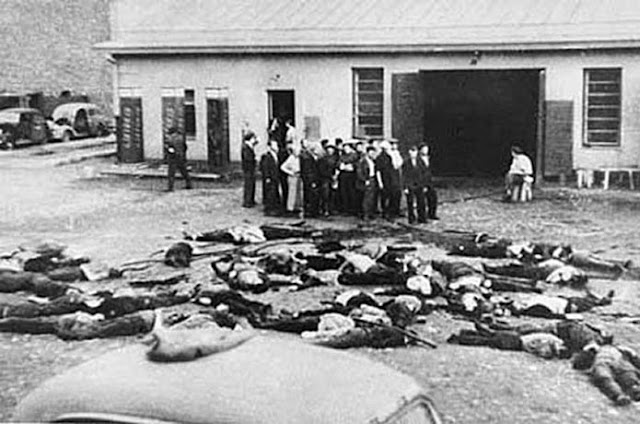
In Kovno (Kaunas), Lithuania, a group of Lithuanian nationalists gathered more than 50 Jewish men in a horse stable and beat them violently with iron bars in public view. None of the victims survived the Lietukis Garage Massacre. The Holocaust in Lithuania was initiated by members of LAF (‘Lithuanian Activist Front’), the Pro-Hitler group of activists who began to slaughter Jews around the country even before the Germans arrived (or took administrative control) in numerous locations in the days following the outbreak of war on 22 June 1941. They became known as The White Armbanders (in the Yiddish of the soon to be murdered Jews of Lithuania: “Di vayse orem-bendlakh”). When the Germans did assume control, and the city-center barbarity shifted to the organized out-of-town mass-grave genocide of the entire Jewish population (‘The Holocaust by Bullets’), the LAF murderers were quick to volunteer for the thousands of ‘shooting jobs’ being made available.
Bialystok: Over 2,000 Jews are killed when German troops rampage through the city. The Einsatzgruppen (special execution squads) are enthusiastically following closely behind the front lines and quickly going to work. Without taking anything away from the culpability of the Einsatzgruppen, many of these pogroms are public and entirely in the open, with locals eagerly participating. In fact, often local citizens take up crowbars or other blunt instruments and beat their victims in front of laughing crowds. German troops and Police Battalion 309 entered the city of Białystok, Poland. What began as a search evolved into a horrific massacre, with approximately 2,000 to 3,000 Jewish residents murdered. Hundreds were locked in the Great Synagogue and burned alive.
Hungary declared war on the Soviet Union. Using the previous day’s bombing attack on the city of Košice as a pretext, the Hungarian Government declared war on the Soviet Union. Purportedly in response to the controversial (because the actual source of it is unclear) air attack on Kassa on the 26th — but almost certainly stemming from deeper impulses — Hungary declares war upon the Soviet Union. While not exactly a major military power, Hungary does have a capable army and a geopolitically important location in the heart of Europe. Hungary’s main beef, however, is not with the Soviets, but with its neighbor to the south — Romania. For the time being, those differences will be set aside in the hope that everyone will acquire vast new holdings in the East.
Denmark severed diplomatic relations with the Soviet Union.
The Finnish sector remains quiet. The Finns are preparing plans for an invasion of the Karelian Isthmus but are not yet ready to attack, while the Soviets are hard-pressed against the Germans and are pulling troops away from the northern sector.
In the Army Group North sector, Adolf Hitler has directed the leading panzer elements of Field Marshal von Leeb’s forces to consolidate their positions while the infantry catches up. This includes reinforcing the small bridgehead across the Dvina River secured by German commandos at Daugavpils. German 18th Army advancing along the coast takes the port of Liepaja.
The Battle of Raseiniai ended in German victory. In the Army Group Center sector, General Heinz Guderian’s 2nd Panzer Group completes an encirclement by hooking up with General Hoth’s 3rd Panzer Group. The German advance forms two pockets: one around Bialystok, and the other west of Minsk. Inside the pockets are large elements of the Soviet 3rd, 4th, 10th, 11th, and 13th Armies. German 9th and 4th Armies will invest the pocket while the panzers are released to advance further east. Eventually, the Germans claim to have captured 324,000 Soviet troops, 3,300 tanks, and 1800 artillery pieces.
In the Army Group South sector, the German 17th Army continues advancing toward Lviv. Advance elements of the German 11th Panzer Division reach Ostrog, which is 30 km behind Soviet lines. However, the main story is the frantic Soviet effort to stop or blunt the German advance.
A Soviet counterattack against the advancing 1st Panzer Group from both north and south continues at the Battle of Brody. The Soviet 9th, 19th, and 8th Mechanized Corps are involved, but the Soviet attacks are uncoordinated and self-supporting. Some of the Soviet attacks miss the fast-moving panzers and instead hit the following German 6th Army’s 297th Infantry Division.
The major attack of the day occurs by the tanks of Soviet Lieutenant-General Nikolai Popel, commander of the 8th Tank Corps. A People’s Commissar and thus subject to execution if caught by the Germans, Popel has about 300 tanks, including 100 T-34 and KV tanks which are the only types the Soviets have which are giving the Germans trouble. Popel hits the rear of the 11th Panzer Division, cutting its line of communications and taking the crossroads town of Dubno. General Franz Halder writes in his diary:
“In the Army Group South sector, heavy fighting continues on the right flank of Panzer Group 1. The Russian 8th Tank Corps has effected a deep penetration of our front and is now in the rear of the 11th Panzer Division. This penetration has seriously disrupted our rear areas between Brody and Dubno. The enemy is threatening Dubno from the southwest … the enemy also has several separate tank groups acting in the rear of Panzer Group 1, which are managing to cover considerable distances.”
Popel decides to dig in at Dubno and await reinforcements. Other Soviet forces hear of Popel’s success and plan their own attacks on the 28th.
However, the Soviet leadership is doubtful that Popel’s attack will lead to good things. General Kirponos orders a halt to the counteroffensive, fearing that advancing into the Wehrmacht’s flanks will simply make it easier for the panzers to encircle them. In fact, Kirponos is so fearful that, rather than try to exploit Popel’s success, he orders a general retreat.
When Chief of Staff Georgy Zhukov hears of this, he immediately countermands Kirponos’ orders. Even though Kirponos’ orders to retreat stand for only two hours, they cause confusion throughout the widely scattered Soviet forces. Some Soviet commanders, such as the commander of the 9th Mechanized Corps General Rokossovsky, agree with Kirponos and decide to simply ignore Zhukov’s new orders to attack — a very brave decision in the Soviet Union. All of this leads to recriminations that are typical of this period within the Soviet military.
The Luftwaffe continues to have dominance over Soviet skies. However, it is taking losses. One of those today is 34-victory ace Heinz “Pietzsch” Bretnütz, shot down over Lithuania in the opening operations of Operation Barbarossa. Lithuanian farmers hide him from Soviet soldiers for several days, but just after the Wehrmacht arrives, he dies today from a leg injury. Bretnütz was the leader of II./JG 53. While the Luftwaffe has a broad spectrum of pilots who are among the best in the world, it does not have a tremendous amount of depth — so losses of top pilots like Bretnütz matter.
The government mobilizes members of the Komsomol — the Soviet equivalent of the Hitler Youth — as “political soldiers.”
Joseph Stalin gave permission to military tribunals to give out death sentences to members of the Red Army without his personal approval.
Members of the Communist Party and of the Komsomol [League of Communist Youth] are mobilized as “political soldiers”.
A British military mission led by Ambassador Sir Stafford Cripps arrives in Moscow. Privately, the members fear they will have to be evacuated soon — when the Germans arrive.
The Soviet Information Bureau announced: “Our troops are fighting fiercely against large Fascist armored units in the Minsk area. Battle is still going on. Violent armored conflicts have been waged all day near Lutsk [western Ukraine; today Polish ‘Luck’]. Our operations have proceeded favorably.” [Ed: Propaganda and “happy talk.”]
The Luftwaffe bombs and sinks 288-ton Latvian ferry Vieniba, apparently being used as a hospital ship, near Libava (Libau). The ship sinks close enough to land for eight crewmen to swim to shore, and five other people are rescued later. However, an unknown number of people estimated at around 800 perish in the sinking, including many Latvians. The ship reputedly is carrying a large number of wounded soldiers.
There is a major caveat to the “loss” figures, as some claim that many Estonian crewmen survive the sinking. However, according to these rumors, they decide not to reveal their survival because they do not wish to get killed in the war. So, the figure of 800 dead may be somewhat lower — but not necessarily.
The reason this is a controversial sinking is (with the proviso that these are unreliable sources) the Wehrmacht knows that the Vieniba is a hospital ship and agree not to attack it. However, this information does not get to the Luftwaffe, which sinks it anyway.
Adolf Hitler remains planted at his new headquarters in Rastenburg, East Prussia. This enables him to pose as “leading from the front” in headlines around the world, though he could have as much control over operations by sitting at his desk in the Chancellery in Berlin.
While this situation meets Hitler’s needs, his staff privately is grumbling about the environment. General Alfred Jodl’s staff diarist writes in a private letter:
“We are being plagued by the most awful mosquitoes. It would be hard to pick on a more senseless site than this— deciduous forest with marshy pools, sandy ground, and stagnant lakes, ideal for these loathsome creatures.”
Having little to do seems to focus Hitler on the minutiae of operations, something that previously he largely left to the generals. He begins coming to the conclusion — as he had at Dunkirk in May 1940 — that the panzers are rushing ahead too fast and need to be restrained, especially in the Army Group North sector.
While major operations are in a lull after the capture of Damascus, the Australians continue consolidating their position. The 2/3 Battalion makes a major effort to capture Jebel Mazar in the Merdjayoun sector. While this mainly consists of simply organizing a party to climb the massif, the Vichy French cannot fail to see this. They immediately send units of the I/17th Senegalese, V/1st Moroccan, and other foreign troops in an unsuccessful counterattack.
Elsewhere, the Vichy French continue to resist fiercely. At Palmyra, site of a major French airbase, the French continue to hold out against the British Habforce lingering in the area.
Royal Navy light cruisers HMS Hotspur, Jervis, Kingston, and Naiad bombard Damour, Lebanon (south of Beirut) at dawn to aid the arduous Australian advance up the coast.
With the sea route to Syria and Lebanon very risky, the Vichy French decide to send a trainload of supplies from France bound for Lebanon.
Free French leader Charles de Gaulle appoints Georges Catroux High Commissioner to the Levant in 1941. He is slated to take over control of Syria and Lebanon once Vichy French General Dentz is removed from power.
The East African 22nd Infantry Brigade captures Dembi in Galla-Sidamo, Abyssinia. The RAF attacks Italian fortifications at Debra Tabor.
Italian submarine Jantina attacks Australian sloop HMAS Parramatta off Marsa Matruh. The torpedo misses, and Parramatta launches an unsuccessful depth charge attack against the submarine along with destroyer HMS Stuart. However, the Jantina escapes.
22 aircraft flew off the aircraft carrier HMS Ark Royal (91) for Malta in Operation RAILWAY I. All but one arrived safely. The HMS Ark Royal immediately returned to Gibraltar.
An Axis convoy of four ships with escorts departs from Taranto bound for Tripoli. It has a heavy escort (some at a distance) including two cruisers and seven destroyers.
Nazi manifest against the Jews in Amsterdam.
The Central Committee of the Communist Party of Yugoslavia appointed Tito as Commander-in-Chief of the Yugoslavian People’s Army.
Cargo ship Empire Ability from convoy SL.78 was torpedoed and sunk by the German submarine U-69.
German submarine U-556 was depth charged and sunk in the North Atlantic by British corvettes.
Cargo ship Empire Activity was torpedoed off Newfoundland by German submarine U-96.
Dutch cargo liner Maasdam was torpedoed and sunk off Greenland by German submarine U-564.
RAF Bomber Command, Day of 27 June 1941
23 Blenheims on a Circus operation to a steelworks at Lille which was bombed accurately. No Blenheim losses.
RAF Bomber Command, Night of 27/28 June 1941
Bremen
73 Wellingtons and 35 Whitleys; they encountered storms, icing conditions and, reported for the first time in Bomber Command records, ‘intense night-fighter attacks’. 11 Whitleys — 31 percent of the Whitleys dispatched — and 3 Wellingtons were lost, the heaviest night loss of the war so far. No report is available from Bremen but many of the bombers must have found their way by mistake to Hamburg, 50 miles away. This city reports 76 bombing incidents, 14 fires, 7 people killed, 39 injured and 55 bombed out and 5 bombers shot down by night fighters over the city.
Vegesack
28 Hampdens to attack U-boat construction yards. No losses.
Minor Operations: 4 aircraft to Dunkirk, 3 to Emden, 1 to Cologne, 1 to Düsseldorf, 3 Hampdens to the Frisians, 4 O.T.U. sorties. No losses.
Over Malta, the RAF continues to have success against the Regia Aeronautica. A formation of Hawker Hurricanes intercepts a large formation of Italian Macchi fighters — considered to be among Italy’s best. The British shoot down six of the Italian planes and damage several others. This is Italy’s version of RAF Circus operations over France, as the large formation of Macchi’s only escort one SM-79 bomber that is there only to entice the Hurricanes into battle.
U-69, commanded by Kapitänleutnant Jost Metzler, sank British steamer River Lugar (5423grt) from this convoy at 24N, 21W. At 0119 hours on 27 June 1941, U-69 fired a spread of two torpedoes at two overlapping steamers in convoy SL.78 about 200 miles southeast of the Azores and heard one detonation, but no hit can be confirmed from Allied sources. At 0149 hours, another torpedo was fired that hit the River Lugar amidships, which broke in two and sank within seconds. In a third attack at 0237 hours, the Empire Ability was hit, caught fire and sank after 21 minutes. The master, 34 crew members, four gunners and one passenger (DBS) from the River Lugar (Master William Frame) were lost. Six crew members were picked up by HMS Burdock (K 126) (T/Lt H.J. Fellows, SANFVR) and landed at Milford Haven. The 5,423-ton River Lugar was carrying iron ore and was headed for Barry Roads, England.
U-69 also sank British steamer Empire Ability (7603grt) from convoy SL.78 at 23-50N, 21-10W. At 0119 hours on 27 June 1941, U-69 fired a spread of two torpedoes at two overlapping steamers in convoy SL.78 about 200 miles southeast of the Azores and heard one detonation, but no hit can be confirmed from Allied sources. At 0149 hours, another torpedo was fired that hit the River Lugar amidships, which broke in two and sank within seconds. In a third attack at 0237 hours, the Empire Ability was hit by a torpedo, caught fire and sank after 21 minutes. The master, 60 crew members, two gunners, 17 military personnel and 27 passengers from the Empire Ability (Master Herbert Flowerdew) were picked up by the Amerika, transferred to HMS Burdock (K 126) (Lt H.J. Fellowes, SANVR) and landed at Milford Haven. The 7,603-ton Empire Ability was carrying sugar, rum, kernels, fiber, and passengers and was headed for Liverpool, England.
U-79, commanded by Kapitänleutnant Wolfgang Kaufmann, damaged Dutch tanker Tibia (10,356grt) from convoy HX.133 in 59-55N, 30-49W. At 0056 hours on 27 June 1941 the Tibia (Master Hendrik Velthuis) in station #52 of convoy HX.133 (en route from Curaçao to Old Kilpatrick via Bermuda loaded with diesel oil) was hit on the starboard side by one torpedo from U-79 (Kaufmann) in 59°55N/30°49W. After a slight decrease in speed, the ship rejoined the convoy and was later repaired at Tyne. No casualties among the crew of 50 men.
U-123, commanded by Kapitänleutnant Reinhard Hardegen, attacked convoy SL.78. At 2357, 2358 and 2400 hours on 27 June 1941, U-123 fired one torpedoes each at three ships in convoy SL.78 from between the columns west-southwest of the Canary Islands. British steamer P.L.M. 22 (5646grt) and Dutch steamer Oberon (1996grt) were sunk at 25-43N, 22-47W. The first torpedo sank P.L.M. 22, the second the Oberon and the third missed the intended target, but was thought to have hit another ship in the convoy.
The master, 31 crew members and one gunner from P.L.M. 22 (Master Yves Le Bitter, MM and Chevalier du Mérite Maritime) were lost. Nine crew members, one gunner and one passenger were picked up by HMS Armeria (K 187) (A/T/LtCdr H.N. Russell, DSC, RNR), transferred to HMS Asphodel (K 56) (LtCdr K.W. Stewart, RN) and landed at Freetown on 4 July. The 5,646-ton P.L.M. 22 was carrying iron ore and was headed for Middlesbrough, England.
The Oberon (Master E.O.J. Jans) was struck by a torpedo in the engine room, killing four men on watch below and a purser. The survivors were picked up by a British corvette, but one man later died of wounds. The 1,996-ton Oberon was carrying palm kernels and general cargo and was headed for Hull, England.
U-556, commanded by Kapitänleutnant Herbert Wohlfarth, and U-564, commanded by Oberleutnant zur See Reinhard Suhren, attacked convoy HX.133.
U-564 sank Dutch steamer Maasdam (8812grt) in 60N, 30-35W. At 0155 hours on 27 June 1941, U-564 (Suhren) fired three single torpedoes in one minute intervals at the convoy HX.133 about 300 miles south of Iceland and observed three hits. The Maasdam and Malaya II were sunk and the Kongsgaard was damaged. The Maasdam (Master J.P. Boshoff) was hit by one torpedo on the port side at #2 hold. Several lifeboats were destroyed, but the most of the 48 crew members and 32 passengers (17 American Red Cross nurses and US Marines under Maj Walter L. Jordan, the advance detail for the Marine Detachment at the American Embassy in London) safely abandoned ship before she sank. Two passengers were lost. 44 survivors, among them nine of 17 American Red Cross nurses, were rescued by the Norwegian motor tanker Havprins and landed at Barry. The remaining survivors were picked up by another Norwegian vessel. The 8,812-ton Maasdam was headed for Liverpool, England. Among the survivors are U.S. Marines under Major Walter L. Jordan, USMC, the advance detail for the Marine Detachment at the American Embassy in London.
U-564 also sank British steamer Malaya II (8651grt) in 59-56N, 30-35W. The Malaya II (Master Vilhelm Kragelund) in station #91 was hit by one torpedo in hold #2 and disintegrated when the cargo of dynamite exploded. The master, 38 crew members and four gunners were lost. Six crew members were picked up by HMCS Collingwood (K 180) (T/Lt W. Woods, RCNR) and landed at Reykjavik. The 8,651-ton Malaya II was carrying metal, wheat, and TNT and was headed for Cardiff, Wales.
U-564 also damaged Norwegian tanker Kongsgaard (9467grt) in 60N, 30-42W. At 0155 hours on 27 Jun 1941, U-564 (Suhren) fired three single torpedoes in one minute intervals at the convoy HX.133 and observed three hits. The Maasdam and Malaya II were sunk and the Kongsgaard was damaged. The Kongsgaard (Master Leif Moen) was torpedoed amidships and caught fire in position 60°N/30°42W. The crew first abandoned ship in the lifeboats, but the master, one mate and nine crew members later reboarded the vessel and managed to extinguish the fire with the help of more men. After picking up the remaining crew, the tanker continued and arrived at Belfast on 2 July. Three days later, a telegram from the First Lord of the Admiralty arrived, congratulating them on bringing their ship safely to port after being torpedoed.
U-556, commanded by Kapitänleutnant Herbert Wohlfarth, was sunk by corvettes HMS Nasturtium, HMS Celandine, and HMS Gladiolus southwest of Iceland in 60-18N, 29-20W. The U-556 was sunk southwest of Iceland in the North Atlantic Ocean by depth charges from the corvettes HMS Nasturtium (K 107), HMS Celandine (K 75), and HMS Gladiolus (K 34). Of the ship’s complement, 5 died and 41 survived. During its career under Kapitänleutnant Wohlfarth the U-556 sank 6 ships for a total of 29,552-tons and damaged 1 ship for a total of 4,986-tons. Kapitänleutnant Wohlfarth was among the survivors and was considered one of Germany’s top U-boat aces.
The Soviet submarine M-99 was torpedoed and sunk by the U-149, commanded by Kapitänleutnant Horst Höltring, east of Dagö Island, Estonia. At 0427 hours on 27 June 1941, M-99 (SrLt Boris M. Popov) was hit by two torpedoes from U-149 and sank immediately east of Dagö Island.
Soviet submarine S-10 was torpedoed and sunk by German motor torpedo boats S.59 and S.60 in Irben Strait.
Heavy cruiser HMS Cumberland, escorted by HMS Hambledon and HMS Windsor, departed Scapa Flow at 1030 to refit at Chatham. The heavy cruiser arrived at Sheerness on the 28th.
Destroyers HMS Lightning, HMS Eskimo, HMAS Nestor, and ORP Krakowiak departed Scapa Flow at 1930 to search for a submarine reported by air in 59-20N, 4-04W. The destroyers arrived back at 2200/28th.
Destroyer HMS Icarus, with damaged propellers, departed Reykjavik at 1200 to meet convoy HX.133 and then proceed to Ardrossan to repair.
Submarine HMS L.26 grounded on the west coast of Mull. The submarine was refloated on the 28th. Submarine L 26 was repaired at Ardrossan from 8 July to 26 July. She was permanently repaired at Plymouth from 19 September to 5 February 1942.
Minesweeping trawler HMS Force (324grt, A/T/Skipper C.E. Smalley RNR) was sunk by German bombing off Great Yarmouth.
Dutch steamer Montferland (6790grt) was sunk by German bombing in 52-47n, 1-50E. The entire crew was rescued.
Italian submarine Glauco was sunk by destroyer HMS Wishart, which just left convoy HG.66, west of Gibraltar in 35-06N, 12-41W. Seven officers and forty four ratings were rescued from the submarine. The destroyer arrived at Gibraltar on the 28th.
Destroyer HMS Firedrake departed Chatham after repairs to return to Gibraltar and duty with Force H.
Submarine HMS Clyde departed Gibraltar westward for Operation VIGOROUS. Due to mistaken identity, she was attacked by destroyer HMS Avonvale in the Straits and sustained some damage. However, the submarine was able to continue on her mission. The operation was a patrol in the area of the Canary Islands for a German supply ship, reportedly due to supply a German submarine on the 30th. Nothing was found and the submarine returned to Gibraltar on 5 July.
Submarine HMS Osiris unsuccessfully attacked a steamer in the Tyrrhenian Sea.
Submarine HMS Triumph sank Italian submarine Salpa off Mersa Matruh in 32-05N, 26-47E.
Italian submarine Jantina unsuccessfully attacked Australian sloop HMAS Parramatta in 31-34N, 27-28E. The sloop counterattacked and was joined by destroyer HMAS Stuart, but the submarine was not damaged.
Light cruiser HMS Naiad and destroyers HMS Kingston, HMS Jervis, and HMS Hotspur bombarded Damur at dawn on the 27th.
Light cruiser HMS Mauritius arrived at Mombasa after escorting convoy CM 11 to Aden.
Observer Sub Lt (A) M.S.T. Broadwood of 700 Squadron, Petty Officer Airman H.D. Millington, Petty Officer Airman W.A.H. Peters, and Air Artificer 4/c T.G. Finan were killed in an air accident in Heavy cruiser HMS Exeter at 13-38S, 42-02E in Mozambique Channel.
Ships for Convoy WS.9B departed Avonmouth on the 27th, Liverpool on the 28th, and the Clyde on the 29th. The three sections rendezvoused at sea on the 30th. Steamers Tamaroa (12,405grt), Pulaski (6345grt), Anselm (5954grt, which returned with defects), Oronsay (20,043grt), Athlone Castle (25,564grt), Monarch of Bermuda (22,424grt), Ceramic (18,713grt), Clan Forbes (7529grt), Arundel Castle (19,118grt), Mataroa (12,390grt), Pampas (5415grt), Rangitata (16,737grt), and Elisabeth Bakke (5450grt) composed the convoy. Destroyer HMS Wells escorted the convoy from 29 June to 1 July. Anti-aircraft cruiser HMS Cairo and destroyers HMS St Francis, ORP Garland, HMS Reading, ORP Piorun, HMS Vanquisher, HMS Winchelsea, HMS Maori, and HMS Castleton escorted the convoy from 29 June to 2 July. Light cruiser HMS Edinburgh, which departed Scapa Flow on the 25th for the Clyde and arrived on the 26th, and destroyer HMS Wolverine escorted the convoy from 28 June to 3 July. Armed merchant cruiser HMS Cathay was with the convoy from 29 June to 4 July. Armed merchant cruiser HMS Chitral was with the convoy from 29 June to 7 July. Light cruiser HMS Galatea and armed merchant cruiser HMS Moreton Bay were with the convoy for the entire voyage to Freetown. Destroyers HMS Wivern, HMS Wild Swan, and HMS Brilliant and corvette HMS Asphodel joined the convoy on 10 July and escorted it to Freetown, and arrived at Freetown on 13 July. On 16 July, the convoy sailed escorted by destroyers HMS Brilliant, HMS Velox, HMS Vansittart, and HMS Boreas from 16 to 18 July. Light cruiser HMS Galatea escorted the convoy through to Capetown. Steamers Ceramic, Clan Forbes, Pampas, Elisabeth Bakke, Pulaski, and Rangitata arrived at Capetown on 27 July. Steamers Oronsay, Athlone Castle, Monarch of Bermuda, Arundel Castle, Tamaroa, and Mataroa arrived at Durban on 30 July. Steamers Clan Forbes, Pulaski, Pampas, and Elisabeth Bakke departed Capetown on 30 July escorted by armed merchant cruiser HMS Queen of Bermuda. They rendezvoused with Oronsay, Arundel Castle, Monarch of Bermuda, and Athlone Castle which sailed from Durban on 3 August escorted by light cruiser HMS Galatea, and arrived at Aden on 14 August. The ships travelled independently to Suez.
Convoy OB.340 departed Liverpool, escorted by destroyers HMCS Assiniboine and HMS Bulldog, corvettes HMS Aubretia, HMS Carnation, HMS Hollyhock, and HMS Nigella, minesweepers HMS Britomart and HMS Salamander, and anti-submarine trawlers HMS Angle, HMS King Sol, HMS Notts County, and HMS St Apollo. This section was detached on 3 July when destroyer HMS Havelock, sloop HMS Fleetwood, and corvettes HMCS Alberni, HMCS Chambly, HMCS Collingwood, and HMCS Orillia joined. The convoy was dispersed on 13 July.
Convoy SL.79 departed Freetown escorted by armed merchant cruiser HMS Dunottar Castle to 10 July and corvettes HMS Columbine, HMS Crocus, and HMS Cyclamen to 5 July. Ocean boarding vessel HMS Marsdale departed Gibraltar on 11 July and joined the convoy for passage to England. On 14 July, the convoy joined convoy HG.67 for the passage to England, and arrived at Liverpool on 24 July.
In Washington today, Senate passed the $10,384,821,624 War Department Appropriation Bill and the $54,795,200 District of Columbia Appropriation Bill; completed Congressional action on the measure expanding the powers of the Federal Housing Administration and on a bill authorizing $150,000,000 for Federal public works in crowded defense areas; confirmed the nomination of Harlan F. Stone to be Chief Justice of the United States and. recessed at 5:35 PM until noon tomorrow. A Judiciary subcommittee heard opposition to the nomination of Attorney General Robert H. Jackson to the Supreme Court.
The House debated the Casey resolution for a committee investigation of the price situation, received various legislative proposals and adjourned at 3:34 PM until noon tomorrow. The Ways and Means Committee received new Treasury tax proposals and the Rivers and Harbors Committee heard further opposition to the St. Lawrence seaway project as the Rules Committee approved a bill authorizing the Rivers and Harbors body to investigate the project.
Declaring that the country was way behind in producing ammunition, President Roosevelt indicated he was only partly satisfied with the management of the defense program.
The Senate passed unanimously in 80 minutes today the $10,384,821,624 Army Appropriation Bill, the largest single money bill in the history of Congress. Only twenty-four Senators were on the floor when the voice vote was taken. The legislation then was rushed to conference, with the House conferees accepting the Senate amendments. This bill, which is intended to maintain an army of 1,518,799 officers and men for twelve months, starting next Tuesday, represents an expenditure of $79.88 for every person in the United States and is $159.343.311.09 more than the record Army appropriation bill passed on July 9, 1918. Eager to get through all remaining appropriation bills and conference reports before the end of the fiscal year Monday night, the Senate raced through the bill so rapidly that Minority Leader McNary repeatedly complained over the speed of the action. There was very little debate on what the nation would get for this great sum. Senator Elmer Thomas, Democrat of Oklahoma, merely gave an explanation of the bill’s highlights and Chief Clerk John Crockett read it through as quickly as possible.
The War Department today asked congress to authorize a far-reaching purge of unfit officers whose retention Acting Secretary of War Robert Patterson warned would constitute “a real danger to national security.” Almost immediately after the request was received Senator Elbert D. Thomas, Utah Democrat, introduced a bill on behalf of Chairman Robert R. Reynolds, North Carolina Democrat, of the senate military affairs committee, to carry it out. Thomas said the bill calls for “revitalization” of the army. His words recalled, a statement made earlier this week by Gen. George C. Marshall, chief of staff, that the army is making every effort to utilize youth, vigor and ability in its field forces while older officers are being retained in posts where they can use “their brains and experience.”
Rumors of peace between Germany and England are almost certain to be revived if Hitler’s invasion of the Soviet Union is successfully finished in the next few weeks or months. Indeed, a number of isolationist leaders in the United States, notably Colonel . Charles A. Lindbergh have already urged that Britain try to arrange a negotiated peace. The majority of American voters (62%) interviewed just before the outbreak of the Nazi-Soviet conflict expressed overwhelming opposition to the idea that Britain should try to arrange a peace with Hitler even if she were permitted to keep all her empire intact. One of the main reasons given by the majority is that “Hitler’s peace promises couldn’t be trusted.” while those on the minority side (29%; 9% undecided) argue chiefly that any kind of peace would be better than the “senseless” slaughter in Europe in which “nobody gains.”
Defense requirements will force a greater cut in production of automobiles and trucks than the 20 percent reduction originally ordered, John D. Biggers, O.P.M. production director, announced tonight. He called all automobile manufacturers to a conference July 2 to discuss the situation. Biggers did not say how much of an additional cut would be necessary. The cut will affect 1942 models, since the 1941 model year is about ended. The 20 percent cut already ordered would mean a reduction of 1,065,820 units under the current year’s schedule. A telegram addressed to every manufacturer of passenger cars and trucks said that the automobile industry was the first to be asked to accept curtailment because of Its “adaptability to national defense.” He said the reduction was made necessary “partly because of shortages of critical materials and partly because it is necessary to devote your resources of management, technicians, skilled workers and machine tools increasingly to the defense program.”
Defense officials recommended today the construction of eight new aluminum plants to produce an additional 600,000,000 pounds a year, raising the national capacity to 1,400,000,000 pounds. William S. Knudsen, O.P.M. director general, and Sidney Hillman, associated director, sent the recommendation to Secretary of War Stimson for approval, after which it will be sent to Defense Plant Corp., which would be asked to finance the new plants.
Acting Attorney General Biddle today announced that he had authorized criminal proceedings In St. Paul against leaders of the Socialist Workers party on charges of seditious conspiracy and advocating “the overthrow of the government of the United States by force and violence.” The justice department said the principal party leaders against whom prosecution would be brought also were leaders of local number 6-14 of the General Drivers, Helpers & Inside Workers union of Minneapolis.
The U.S. Federal Bureau of Investigation raided the offices of the Socialist Workers Party in Minneapolis and St. Paul in Minnesota, United States, seizing large quantities of Communist literature.
The Douglas XB-19 four-engined bomber makes its first flight. It has a length of 132.25 feet (40,34 meters), a wingspan of 212 feet (64,62 meters), an empty weight of 86,000 pounds (39 009 kilograms), normal range of 5,200 miles (8 369 kilometer) and a maximum range of 7,710 miles (12 408 kilometers). Although not delivered with armament, it was designed to have one 37 mm cannon and one .30 caliber (7.62 mm) machine gun in the nose and forward dorsal turret; a .50 caliber (12.7 mm) machine gun in the tail, rear dorsal turret, ventral turret, left and right waist positions; and a .30 caliber machine gun on each side of the bombardier’s position and on each side of the fuselage below the horizontal stabilizer. A normal crew consisted of 16-men but two additional flight mechanics and a six-man relief crew could be accommodated in a special compartment fitted with eight seats and six bunks. To feed this mob, a complete galley was included. The government paid Douglas $1.4 million ($17.32 million in 2006 dollars) but Douglas had spent an additional $4 million ($49.47 million in 2006 dollars) of their own money. The aircraft was used as a flying laboratory and provided valuable data that was used to develop the Boeing B-29 and the Convair “Aluminum Overcast,” aka, the B-36. During these tests, the plane had many engine-cooled problems and in 1943, the four 2,000 hp Wright R-3350 air-cooled radials engines were replaced with four 1,600 hop Allison XV-3420-1 liquid-cooled engines and the aircraft was redesignated XB-19A. This increased its maximum speed and eliminated the cooling problems. During the next 2-1/2 years, it was transferred from Wright Field, Dayton, Ohio, to Patterson Field in Dayton, to Lockbourne AAAB in Columbus, Ohio, and finally to Clinton County AAFld, Wilmington, Ohio. Finally, it was placed in storage at Davis-Monthan Field, Tucson, Arizona on 17 August 1946 and was scrapped in 1949.
Metro-Goldwyn-Mayer releases “They Met in Bombay,” starring Clark Gable and Rosalind Russell. Gable and Russell play jewel thieves whose plans fall apart when Gable’s character inadvertently becomes a war hero.
Major League Baseball:
The Chicago Cubs had to contend with a “tenth man” on the field for the Pirates today, but even removal of the playful fan by police failed to help the Bruins cause and they lost, 4–2, for the sixth time in their last seven starts.
Back in first place after the Yankees’ setback in the afternoon, the Indians took a full game lead in the American League by defeating the White Sox, 3–1, under the lights tonight. Southpaw Al Milnar yielded seven hits as he pitched his seventh victory before a crowd of 42,039.
Four-hit pitching by Bob Harris ended to day the most depressing jinx of the Browns, who defeated Detroit, 9–0. It was the first St. Louis victory here in fifteen starts since April 16, 1940. Harris permitted only seven Tigers to get on base, and none advanced beyond second as he was credited with his fourth victory. The Brownies meanwhile gathered thirteen safeties off Paul Trout and Luther Thomas. Walt Judnich’s two-run single in the second inning ended the stay of Trout, who was charged with his third defeat against five victories.
Back from their impressive tour of the West, the Giants celebrated their homecoming by flattening Doc Prothro’s Phillies, 7–4, at the Polo Grounds last night. Bill Terry’s forces, in fact, ripped into their hapless tail-end adversaries with such zeal and enthusiasm that they flattened them literally as well as figuratively, with the result that one of the sorely beset Doc’s men, Nick Etten, ended the night in a hospital nursing a painfully battered jaw.
Baseball’s New York Yankees go on the road and open a two-game series at Shibe Park in Philadelphia against the Philadelphia Athletics. Yankee star Joe DiMaggio goes 2-for-3, a home run and a single, against A’s pitcher Chubby Dean, and extends his hitting streak to 39 games. But the Yankees lost to the Athletics, 7–6.
The Cardinals broke their first place tie with the idle Dodgers and went a half game out in front in the hot National League race by defeating the Reds, 5–3 tonight on Don Padgett’s eighth inning homer with a mate on base.
The Senators bunched their eight hits effectively to defeat the Red Sox, 5–3, before 18,500 spectators tonight as Steve Sundra scattered eight safeties. The Senators made four hits in the sixth that produced three runs. The scores resulted from doubles by George Archie and Jake Early and singles by Roger Cramer and Cecil Travis.
Pittsburgh Pirates 4, Chicago Cubs 2
Chicago White Sox 1, Cleveland Indians 3
St. Louis Browns 9, Detroit Tigers 0
Philadelphia Phillies 4, New York Giants 7
New York Yankees 6, Philadelphia Athletics 7
Cincinnati Reds 3, St. Louis Cardinals 5
Boston Red Sox 3, Washington Senators 5
The creation of a naval base in Newfoundland was vital to the provision of Trans-Atlantic convoy escort. This was due to the unanticipated high fuel consumption by ‘short-legged’ escorts while engaged in anti-submarine warfare. Eventually, the River-class frigates and Castle-class corvettes, with 7,000 nautical miles of endurance at medium speed, proved equal to the task. The use of over 200 escort oilers, beginning in the late 1942, was also vital to the efficient operation of the older warships that had much shorter cruising ranges. However, until the escort oilers and long-range escorts could enter service, the lack of fuel was a critical factor in the generally poor performance of RCN and RN warships.
German raider Komet makes a rendezvous with captured whaler Adjutant, which has just completed laying mines off of New Zealand. With its usefulness at an end, Adjutant is scuttled and Komet sails off on its next mission.
The Japanese conclude negotiations with the government in the Dutch East Indies. They have not gotten what they wanted, which is complete control of all exports.
With Vladivostok and the Russian Maritime Provinces in the center of public interest the Japanese Cabinet met today and there was an extraordinary liaison conference between the government and the High Command. Lieutenant General Eugen Ott, the German Ambassador, called on Foreign Minister Yosuke Matsuoka in Tokyo, and Lieutenant General Hiroshi Oshima, the Japanese Ambassador, called on Joachim von Ribbentrop, the German Foreign Minister, in Berlin. “The situation is so delicate there will be no statement on the government’s foreign policy today,” Koh Ishii, the government spokesman, said. He emphasized, however, that any British-American aid via Vladivostok would put Japan in an awkward, embarrassing position, so Japan was watching developments with the keenest interest.
The Japanese decide that getting charts of the Panama Canal zone out of the Zone is too dangerous because all departing passengers and luggage are being searched. However, they still want the charts, which they plan to use in a future attack on the Panama Canal. The Japanese continue exerting diplomatic efforts through various sources (such as the Japanese minister in Mexico) to prevent airline authorities (specifically Pan American Airways) from searching diplomatic luggage.
Dow Jones Industrial Average: 123.46 (-0.5)
Born:
Errol Mann, NFL kicker (NFL Champions, Super Bowl XI-Raiders, 1976; Green Bay Packers, Detroit Lions, Oakland Raiders), in Breckenridge, Minnesota (d. 2013).
James P. Hogan, British sci-fi author (“Giants’ Star”), in London, England, United Kingdom (d. 2010).
Krzysztof Kieślowski, Polish film director (“The Double Life of Veronique”), in Warsaw, General Government [Poland] (d. 1996).
Naval Construction:
The Royal Navy LCT (Mk 2)-class landing craft, tank HMS LCT 147 is laid down by Stockton Construction (Thornaby, U.K.).
The U.S. Navy YMS-1-class auxiliary motor minesweepers USS YMS-19 and USS YMS-20 are laid down by the Herreshoff Manufacturing Co. (Bristol, Rhode Island, U.S.A.).
The U.S. Navy YMS-1-class auxiliary motor minesweeper USS YMS-48 is laid down by the Wheeler Shipbuilding Corp. (Whitestone, Long Island, New York, U.S.A.).
The U.S. Navy YMS-1-class auxiliary motor minesweeper USS YMS-80 is laid down by Stadium Yacht Basin (Cleveland, Ohio, U.S.A.).
The Royal Navy LCT (Mk 2)-class landing craft, tank HMS LCT 110 is launched by Vickers Armstrong (Newcastle-on-Tyne, U.K.).
The Royal Navy Isles-class minesweeping trawler HMS Fara (T 162) is commissioned. Her first commanding officer is Lieutenant Commander Norman Loris Pickersgill, RCNVR.
The U.S. Navy 77-foot Elco patrol motor torpedo boat USS PT-27 is commissioned.
The Вое́нно-морско́й флот СССР (ВМФ) (Soviet Navy) “S” (Stalinec)-class (2nd group, Type IX-modified) submarine S-11 is commissioned.

