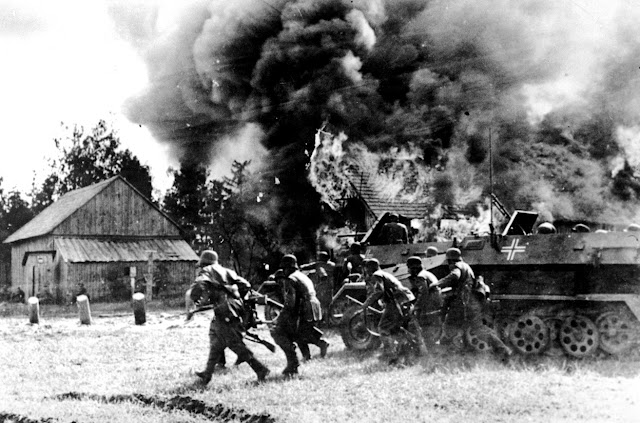
Operation BARBAROSSA continues barreling ahead on 26 June 1941. In the Army Group North sector, spearhead panzers reach Daugavpils and the Dvina River.
While Finland has declared war (the “Continuation War” of the “Winter War”), it is still preparing for its offensives towards Leningrad, the Svir River, and the Murmansk railway. The Germans in the far north of Finland — the German Army of Norway — also are preparing for operations toward Murmansk, but nothing major has begun yet.
However, the Soviet naval base at Hango in southern Finland is close at hand and a fairly easy target — if the Finns decide to mount a major effort. Hango, granted to the USSR under the armistice terms of the Winter War, is isolated both by land and by German control of the Baltic. However, the Soviet troops there are well-supplied and at this time they are determined to hold out.
In the Army Group North sector, the 1st Panzer Division and 36th Motorized Infantry Division of the XLI Panzer Corps and following infantry divisions slice through the rear of the Soviet mechanized corps and close an encirclement around Soviet 3rd Mechanized Corps (out of fuel) and the 2nd Tank Division.
Advance elements of LVI Panzer Corps (Brandenburg Division troops wearing Soviet uniforms) of General von Manstein’s 4th Panzer Group seize two bridges at Daugavpils over the Dvina River, enabling the panzers to establish a bridgehead. This concludes the Battle of Raseiniai, a decisive German victory. German Chancellor Adolf Hitler ordered these forces to stop, consolidate, gather supplies and wait for the infantry forces, far to the rear, to catch up.
The Soviets are in the disarray, and the bridgehead is a major problem. General Kuznetsov is under orders (from Semyon Timoshenko) to defend the Dvina and begins to organize a counterattack to eliminate it using the 21st Mechanized Corps. However, this will take time to organize due to the chaotic state of supplies and troops behind Soviet lines. Adolf Hitler, however, is worried that the panzers are outrunning the infantry, so he orders a temporary halt to the advance.
In the Army Group Center sector, the Soviet Western Front is in disarray after a failed counterattack toward Grodno on the 25th. The Soviets are withdrawing toward Slonim and Minsk. The German 2nd (Guderian) and 3rd (Hoth) Panzer Groups aim toward a meeting near Minsk that they hope will bag huge Soviet forces. These Soviet forces struggling to avoid encirclement include General Boldin, deputy commanding officer of Soviet Western Front. The 7th Panzer Division of Army Group Center cut the Minsk-Moscow highway north of Minsk. This was the main supply route for the Soviet West Front. This closed the Bialystok pocket in Poland.
Brest Fortress continues to hold out behind the German lines. It is an important fortress because it controls the crossings of the Bug River and the Warsaw-Moscow railway and highway. In the evening, the Germans managed to capture most of the northern Kobrin fortification except for an installation known as the East Fort. The Soviet defenders refuse to surrender, so the Germans decide to destroy it using the Luftwaffe. Small Soviet forces tried to break out from the siege but failed and suffered many casualties today.
In the Army Group South sector, the Battle of Brody continues. The Germans continue advancing, but the Soviets launch several flank attacks to try to stop them. While the Soviets have many powerful forces in the area, their counterattacks suffer from a lack of coordination. These attacks fell particularly hard on the 16th Panzer Division in the area around Ostrov.
The 10th Tank Division has a savage day near Radekhiv, destroying 23 panzers at a cost of 13 KV and 12 BT-7 tanks. The 19th Mechanized Corps (Major General N.V. Feklenko) attacks from the north toward Dubno but comes up short. While there are heavy losses on both sides, these flank attacks do little to slow down the advancing panzers.
The most tactically significant battle of the day occurs when 8th Mechanized Corps attacks toward Brody–Berestechko. The 8th takes a column of the 11th Panzer Division advancing in a column by surprise and savages it. The Germans are reduced to using motorcycle troops of the 48th Panzer Corps against Soviet tanks. Soviet General Popel prepares to take advantage of this by preparing to it the rear of the 11th Panzer Division with his 300 tanks, but he is still assembling his forces when the day ends.
The 11th Panzer Division of Army Group South was blocked in its advance at Dubno.
At Jassy (Iasi), Romania, Romanian and German soldiers go from house to house in order to kill Jews. Some Jews are spared for the moment but put in cattle wagons in order to be taken to another location for eventual execution. The number of people executed is unknown, but could be as high as 12,000.
The Soviet NKVD takes a large but unknown number of prisoners from jails in Minsk to the Tsagelnya Forest and executes them. This is a well-known site, and after the conclusion of World War II a memorial will be erected with events held there every year.
General Zhukov returns from an inspection tour of the front and meets with Premier Joseph Stalin and Generals Vatutine and Timoshenko. Stalin remains hidden from public view but retains control of the military via his place of preeminence on the Stavka.
In the Soviet capital of Moscow, Joseph Stalin visited the General Staff headquarters twice, voicing frustration at the heavy losses that the Red Army was suffering against the invading German forces. As usual, when he is unhappy, Stalin vents his wrath on subordinates. Today he recalls General Meretskov from Leningrad and arrests him. Meretskov is in for torture, during which he implicates other generals in a supposed anti-Stalin plot.
General Ivan Konev takes command of the Soviet 19th Army.
Soviet cruiser Voroshilov and accompanying destroyers bombard Constanta, which is being attacked by both sea and air. The Soviets blow up a Romanian ammunition train. However, they are chased off by the Royal Romanian Navy’s coastal fortifications (Gruparea de artilerie de coasta Constanta, comprised of six batteries ranging in size from 150mm and 120mm down to 75mm) and Romanian destroyers Regina Maria and Marasti. German 28cm coastal battery “Tirpitz” aids in the defense.
Soviet destroyer Moskva is hit and sinks during the engagement, although which battery hit it and the effect of hitting a mine while withdrawing to Sevastopol has been debated ever since. Destroyer Kharkiv is damaged by a near miss when the Luftwaffe attacks, but makes it back to Sevastopol. Cruiser Voroshilov also hits a mine but also makes it back to port.
A fight takes place in the early morning hours on the Chilia branch of the Danube Delta, near the commune of Ceatalchioi which is known simply as the Action of 26 June 1941. Two Romanian pocket torpedo gunboats, V-1 and V-3 of the Romanian Danube Flotilla, take on three Soviet armored motor gunboats, which are there to lay mines. The Romanian commander of V-3 spots the Soviets and opens fire with his 47 mm gun. The middle of the three Soviet boats explodes, and the other two quickly retreat. One of the remaining Soviet boats hits a rock and is disabled, allowing the Romanians to capture it. This Soviet ship was repaired and commissioned in the Romanian Navy as V-7.
The Soviet Army High Command announced: “Yesterday enemy troops pursued an offensive in the direction of Vilna and Baranovichi [White Russia]. In the course of the day sizeable Soviet aerial forces attacked the enemy units. Nevertheless a number of enemy armored swarms succeeded in penetrating the Vilna and Oshmyany [White Russia] area. Thanks to the bitter resistance of our troops, enemy infantry units have been cut off from their armored spearheads.”
The Wehrmacht High Command announces: “…after two days of fighting the German panzer arm brought to a victorious end a massive armored battle north of Kovno in which a number of Soviet divisions were encircled and destroyed. We captured more than 200 Soviet armored cars, 29 of them of the heaviest type, over 150 heavy guns and hundreds of trucks. Our armored units and motorized divisions have pressed along both sides of the Bialystock troop pocket and reached the area around Minsk. We are about to achieve another great victory.”
Finland announces a state of war with the Soviet Union. President Risto Ryti explains in a radio broadcast the reasons that have led to the new war and states that the USSR is the aggressor.
Half an hour after Finland officially declares a state of war with the USSR, the Finnish embassy’s door in Moscow is closed from the outside. Next, the guard’s weapons were taken. In the afternoon Finnish staff are told that evacuation will begin in an hour. They are allowed to take two suitcases.
Three unidentified planes of apparently Soviet origin bombed the city of Kassa (Košice), killing and wounding over a dozen people and causing minor material damage. This incident became the pretext for Hungary declaring war on the Soviet Union the next day. The true identity of the attacking nation has never been established. The official explanation preferred by Soviet historians was the idea of a feigned attack by Germany to provoke Hungary into attacking the Soviet Union, employing Soviet planes captured on conquered airfields. Another possibility is that the Soviet bombers mistook Košice for a nearby city in the First Slovak Republic, which was already at war with the Soviet Union.
Francoist Spain lives up to its commitment to provide troops to aid Operation Barbarossa by beginning to form its “Blue Division.”
Italian Leader Benito Mussolini announces plans to send an Italian expeditionary force to the Eastern Front.
An advisor to Vidkun Quisling writes a letter to the leader suggesting that Slavic peoples should be removed from northern Russia because they “don’t know how to make use of the land.” The land, he writes, could be better used by Germanic peoples” (which he apparently believes includes Norwegians).
Adolf Hitler is in Rastenburg, East Prussia at his brand new Wolf’s Lair headquarters. It is in a pine forest full of marshes and stagnant lakes that is the perfect breeding ground for mosquitos. On the plus side, the complex has a railway line that has been closed to through traffic but can be used when considered appropriate. Hitler is receiving constant reports from the front, but with everything going well has little to do.
Tomahawk fighters of No. 3 Squadron RAAF destroyed 5 French D.520 fighters and damaged a further six on the ground at Homs Airfield in Syria. With the British in possession of Damascus, the Vichy French troops are consolidating their defenses around Beirut. The most consequential action occurs in the air, where a strafing run on Homs airfield by Tomahawks of 3 Squadron RAAF destroys five new Dewoitine D.520s of Fighter Squadron II/3 (Groupe de Chasse II/3) and cause damage to six others.
Lieutenant-General Lavarack, commanding operations in Syria and Lebanon, orders Major-General Allen of the 7th Australian Division to focus on the advance along the coast. The Vichy French Army is far from beaten, and their artillery maintains a fierce barrage. For the time being, a lull develops in ground operations as the Australian commanders ponder their next move.
The Royal Navy bombards Vichy French positions at Abey.
The aircraft carrier HMS Ark Royal (91) and her escorts sailed from Gibraltar with 22 aircraft bound for Malta in Operation RAILWAY I.
Since the eastern Mediterranean has quieted down, battleships HMS Queen Elizabeth, HMS Valiant, HMS Warspite and numerous supporting vessels depart Alexandria for gunnery practice.
Adolf Hitler officially named Hermann Göring as his successor.
P. G. Wodehouse, the creator of Jeeves and Bertie Wooster, broadcast a talk to the United States from Berlin tonight. He described how he was interned after the Germans overran Le Touquet, where he had a villa: “Wodehouse, old sport, I said to myself, this begins to look like a sticky day.” Aged nearly 60, he has been released four months early from camp and brought to Berlin, where he agreed to do a series of talks. He said that internment was “quite an agreeable experience”. He is staying at the Adlon, Berlin’s best hotel.
The meat ration in Germany is cut to 14 ounces per week (double for laborers); the artificial honey ration is raised in an attempt to compensate.
British Prime Minister Winston Churchill meets with the prime minister of the Yugoslavian government-in-exile.
James Johnson shot down a German Bf 109 fighter during a Circus mission.
RAF Bomber Command, Day of 26 June 1941
23 Blenheims on a Circus operation to Comines power-station but the target was not reached. No Blenheims lost.
RAF Bomber Command, Night of 26/27 June 1941
Cologne
32 Wellingtons and 19 Whitleys; electrical storms allowed only 7 aircraft to claim attacks on the main target. 1 Wellington lost. Cologne reports no bombs.
Düsseldorf
30 Hampdens and 14 Wellingtons encountered thick cloud, snow and icing. Results of bombing not observed. 1 Wellington lost.
Kiel
41 aircraft — 18 Manchesters, 15 Stirlings, 8 Halifaxes — but ground haze spoiled bombing. 2 Manchesters lost. Light damage and no casualties in Kiel.
Minor Operations: 3 Wellingtons to Emden, 1 Hampden minelaying in Frisians, 3 O.T.U. sorties. No losses.
The Luftwaffe bombs Leningrad. This is one of the first raids, but Luftwaffe raids on Leningrad soon will become a daily occurrence. Hungarian Heinkel He 170s, flying as part of the I Long Range Reconnaissance Group, launch their first mission.
Near Daugavpils, Kommodore Werner Mölders downs two planes, a Soviet Pe-2, and an I-16. This raises his total number of victories to 77. Werner Mölders continues to be the leading air ace of the war at this time, with most of his victories against the RAF.
While flying a Fiesler Storch observation/transport plane, Hauptmann Lothar Keller of II./JG 3, a 20-victory Experten (ace), perishes. He is replaced as Gruppenkommandeur by Hauptmann Gordon Gollob.
The Red Air Force bombs Bucharest.
The RAF raids Gazala in North Africa.
At Malta, there is a continuous bombing by the Italians over a five-hour period. The raid starts around 22:00 and lasts until around 03:00 the next morning. The residents of Malta consider these “nuisance” raids because they seem less intended to cause damage than to keep people awake by simply circling around Valletta.
Finnish vessels Vesihiisi and Iku-Turso are engaged in minelaying operations along the Estonian coast.
Light cruiser HMS Euryalus was commissioned at Chatham.
Destroyer HMS Winchester departed Scapa Flow at 1030 for the Clyde to form part of the escort for aircraft carrier HMS Victorious to Scapa Flow.
Destroyer HMS Hambledon arrived at Scapa Flow at 1830 from Chatham after fitting of SA equipment.
Indian sloop HMIS Jumna departed Scapa Flow escorting tanker War Bharata to the Faroes. The sloop arrived back at Scapa Flow at 0400/27th to problems with the tanker’s machinery. The sloop sailed again at 1400 escorting tanker War Pindari, which had taken the place of the original tanker. After delivering the tanker, the sloop departed at 2300/28th escorting tanker War Diwan and Quentin Roosevelt to Scapa Flow arriving at noon on the 30th.
Minesweeping trawler HMS Tranio (275grt, T/LTA.L.G. Gillies RNR), in tow, was sunk by German bombing near No. 57 Buoy (Smith’s Knoll). There were no casualties on the trawler.
Battlecruiser HMS Renown, aircraft carrier HMS Ark Royal, light cruiser HMS Hermione, and destroyers HMS Faulknor, HMS Forester, HMS Fury, HMS Fearless, and HMS Foxhound departed Gibraltar. Destroyers HMS Fearless and HMS Foxhound were relieved before the operation by destroyers HMS Lance and HMS Legion. On the 27th, aircraft carrier Ark Royal flew aircraft off to Malta in Operation RAILWAY. Force H arrived back at Gibraltar on the 28th.
Battleships HMS Queen Elizabeth, HMS Warspite, and HMS Valiant, light cruiser HMS Ajax, minelayer HMS Abdiel, and destroyers HMS Kandahar, HMS Griffin, HMS Hero, HMS Jaguar, HMS Defender, HMS Kimberley, and HMS Hasty departed Alexandria for gunnery and other exercises between Alexandria and Port Said. Battleship Warspite was detached that afternoon for Port Said, escorted by destroyers Kandahar, Griffin, and Kimberley arriving at 2200/26th. The battleship transited the Canal and began the passage to the USA, via Colombo and Singapore. Destroyers Kandahar and Griffin then proceeded to Haifa to operate off Syria. Destroyer Kimberley rejoined the Battle Fleet. On the 26th, light cruiser HMS Phoebe and minelayer HMS Latona joined the Fleet exercises.
Submarine HMS Severn sank Italian steamer Polinnia (1292grt) was sunk southeast of Ischia in 40-05N, 12-08E.
Submarine HMS Utmost sank Italian steamer Enrico Costa (4080grt) four miles from Cape Todaro in 38-07N, 14-37E.
Submarine HMS P.33 arrived at Gibraltar from the Clyde. On the 28th, the submarine departed for Malta.
British troopship Nieuw Amsterdam departed Suez with the King of Greece, members of the Royal Family, the Greek Prime Minister, other ministers and their families, British, Dutch, and Polish Ministers and families, 151 other passengers, five naval personnel, 1,000 prisoners of war, and seventy five escorts. The troopship was met by heavy cruiser HMS Cornwall on 3 July. They arrived at Durban on 7 July.
British steamer Mareeba (3472grt) was sunk by German raider Kormoran at 8-15N, 88-06E. Twenty six crewmen were lost and twenty five were rescued and made prisoners of war.
Yugoslavian steamer Velebit (4153grt) was sunk by German raider Kormoran in the Bay of Bengal. Six crewmen were rescued; of which two died. Twelve crewmen were made prisoners of war. Seven were killed by the gunfire which sank the ship and seven crewmen were missing.
Soviet destroyers Moskva and Kharkov bombarded Contanza, Rumania. The bombardment was covered by cruiser Voroshilov and destroyers Smyshleny and Soobrazitelny. Destroyer Moskva was sunk by a mine as the destroyers retired. Destroyer Kharkov was damaged by near misses of German bombing. Destroyers Smyshleny and Soobrazitelny escorted destroyer Kharkov. Cruiser Voroshilov was damaged by the explosion of a mine. Destroyers Besposchadny and Bodny departed Sevastopol to join the cruiser and escort it back to port.
During the night of 26/27 June, Soviet destroyer Storozhevoi was torpedoed by a German S-boat in the Irben Strait. The destroyer was towed to Leningrad and repaired.
Soviet submarine M-83 was scuttled at Libau.
Soviet submarine M-101 or M-72 was torpedoed by U-149 in 59-20N, 21-12E. Submarine M-101 was sunk. Submarine M-72 was damaged and taken to Kronstadt. There is dispute which Soviet submarine was hit by the German submarine and which was mined.
Convoy OB.339 departed Liverpool, escorted by destroyer HMS Broadwater, sloop HMS Leith, and corvettes HMS Bittersweet and HMS Fennel. On 2 July, destroyers HMS Ramsey and HMS Richmond and corvettes HMCS Cobalt and HMS Polyanthus joined. Destroyer Ramsey was detached on 3 July. Armed merchant cruiser HMS Wolfe joined on 6 July. On 9 July, destroyers HMS Burwell and Richmond and sloop Leith were detached. On 10 July, destroyer Broadwater and corvette Cobalt were detached. The convoy arrived at Halifax on 12 July.
Convoy HX.135 departed Halifax, escorted by destroyer HMCS St Croix, sloop HMS Londonderry, corvettes HMCS Barrie and HMCS Matapedia, and auxiliary patrol vessel HMCS Reindeer. The corvettes and the patrol vessel were detached that day. The destroyer was detached on the 29th. Convoy BHX.135 departed Bermuda on the 24th escorted by ocean escort armed merchant cruiser HMCS Prince David. The convoy rendezvoused with convoy HX.135 on the 29th and the armed merchant cruiser was detached. On 1 July, escort ships HMS Culver and HMS Hartland joined the convoy and HMS Banff and HMS Fishguard joined on 4 July. Minesweeper HMS Hussar and corvettes HMS Abelia and HMS Anemone joined on 6 July. Destroyers HMS Broke, HMS Douglas, HMS Saladin, and HMS Skate, corvette HMS Veronica, and anti-submarine trawlers HMS St Elstan, HMS St Kenan, and HMS St Zeno joined on 7 July. Destroyers Saladin and Skate were detached on 10 July and the remainder of the escort on 11 July. The convoy arrived at Liverpool on 12 July.
In Washington, President Roosevelt asked Congress today to authorize a $300,000,000 defense housing program, proclaimed an extension for three months from July 1 of the 1 ½ cents per pound postage rate for mailing books, signed a bill giving full pay to retired Army, Navy and Marine Corps officers who are recalled to active service, and left for Hyde Park.
The Senate received the Defense Investigation Committee’s report on the aluminum shortage, the Smith bill for establishment of a National Railway Adjustment Board, the Davis resolution calling for a special committee to study post-war problems, and adjourned at 1:32 PM until noon tomorrow. The Naval Affairs Committee received the Navy’s request for authority to extend enlistments for the duration of the emergency.
The House passed the bill increasing the lending authority of the Commodity Credit Corporation for increased commodity loans, heard Representative Fish of New York oppose United States” involvement in war and adjourned at 4:10 PM until noon tomorrow. The Rivers and Harbors Committee heard Mayor Holling of Buffalo and others in opposition to the St. Lawrence seaway project.
President Roosevelt today went to his Hudson River retreat at Hyde Park for a long week-end. Further steps in the government’s policy of extending aid to Russia against the Nazis thus appeared to be postponed at least until next week. The President arranged, however, for leased telephone wires to carry word of the latest war developments. Before leaving the capital he conferred with Major General Thomas Holcomb, commandant of the Marine Corps, who has charge of the movement of any Marine force outside the limits of the continental United States. They were closeted in a luncheon meeting at the White House until Mr. Roosevelt left to board his special train.
The U.S. government moved today to fix automobile tire prices at the June 16 level, and there were new indications that efforts would be made to set up some sort of mandatory price controls applying to American industry generally. Leon Henderson, price administrator, made known that a price schedule applying both to tires and tubes would be issued, probably next week after conferences with representatives of manufacturers.
Senator Andrew Jackson Houston, Texas Democrat, 87, oldest senator ever to serve, died tonight following an operation for an abdominal tumor at Johns Hopkins hospital in Baltimore, Maryland. The senator, who was the son of the famed Sam Houston, who founded the state of Texas, was sworn in June 2, to fill a vacancy created by the death of Senator Morris Sheppard, Democrat, until a successor could be elected.
Senator Bailey, North Carolina Democrat, said today it was necessary to put the entire American merchant marine on a “war economy” to cope with critical shortages of ships “both coastal and trans-oceanic.” The chairman of the senate commerce committee said this could be accomplished under the merchant ship priorities bill pending before his committee after house approval.
Secretary of the Interior Harold L. Ickes tonight sounded a virtual call to arms and branded Charles A. Lindbergh as one of Adolf Hitler’s “stooges” and an American “Quisling.” He labelled Lindbergh and his followers as “Nazi wolves in pacifists’ clothing…” In effect, Ickes called upon the United States to enter the war now while Germany is preoccupied with Russia because “such a golden opportunity cannot be expected to come again.”
The navy asked congress today to approve legislation enabling it to hold in service all enlisted men, regardless of the expiration dates of their enlistment terms, “as long as the national interest is imperiled.” Rear Admiral Chester W. Nimitz, chief of the bureau of navigation, asked the senate naval affairs committee to approve a bill authorizing the navy to retain men in service whenever congress formally declares that the national welfare is in danger. He asked that the provision be added to a pending bill which would require all future volunteers in the navy to agree to serve an indeterminate period during a national emergency.
The United States will give immediate attention and as favorable consideration as is possible to any request from the Soviet Union for material assistance. Constantine A. Umansky, the Russian Ambassador, was thus informed by Sumner Welles, Acting Secretary of State, during a half hour’s conference late today.
A special Senate committee investigating the defense program reported today that an aluminum shortage of a least 300,000,000 pounds a year was threatening to curtail aircraft production by 25 percent in 1942. Inaccurate estimates of aluminum requirements for the 33,000 Army and Navy planes now being built or planned were responsible for this situation, Senator Mead of New York told the Senate in reading the report of the Truman committee. The Office of Production Management, he said, admitted that it would need 100,000,000 pounds of aluminum a month after February for the defense program alone, while the maximum that could be produced by that time under present plans was 75,000,000 pounds a month.
A mob of approximately 200 hooded men tonight were reported to have beaten two carpenters and threatened others at the sleeping quarters of a defense housing project in Florida. Edward Walker, building superintendent, said the white-hooded men came to the workers’ barracks brandishing guns, clubs and rocks. He said two carpenters, Fred Nunnally and W. Parry, ran for their car and attempted to flee toward Miami. Walker said some of the mob fired shots at the two men, later caught them on the Overseas highway connecting this island to the mainland and beat them. An appeal was made to Governor Spessard L. Holland for protection of workers employed at the housing unit, it was reported tonight.
In New York, the Transport Workers Union, C.I.O., voted last night, at the first of four divisional meetings, to strike on the city’s unified transit lines next Tuesday unless the Board of Transportation agreed before that date to enter into negotiations with the union for a collective bargaining agreement covering all but a few hundred of the 32,000 civil service employees of the city-operated system.
The mixed Marine-Army I Corps (Provisional), which was attached to the U.S. Navy Atlantic Fleet, was redesignated Task Force 18 of the Atlantic Fleet.
The Technicolor drama film “Blossoms in the Dust” starring Greer Garson and Walter Pidgeon premiered at Radio City Music Hall in New York City. Directed by Mervyn LeRoy, it is a biopic pic about an advocate for the rights of illegitimate children, Edna Gladney.
Major League Baseball:
Although knocked out of the box, Cleveland’s Bob Feller wins his 16th, beating the Red Sox, 11–8. After Feller spotted the Red Sox a 5–1 lead in the third inning, the Indians rallied to win today before 24,000 at Fenway Park. Feller, who gave Boston eleven of its twelve hits, including homers by Lou Finney and Bobby Doerr, was replaced by Clint Brown in the eighth when, with two out, Finney lashed a two-bagger. Cleveland scored six runs in the seventh, batting Mickey Harris and Mike Ryba for as many hits, including two-baggers by Ray Mack and Hal Trosky, to pull into a 10–5 lead. The Sox made three more
The Dodgers rushed into a tie for first place with the Cardinals in most emphatic fashion by swamping the Braves beneath an 11–2 score at Ebbets Field last night. Brooklyn scored seven runs in the third inning before a put-out was made, knocking out two of Casey Stengel’s pitchers. Two tallies came in the second inning and two more in the eighth.
In the final game of a three game series at Yankee Stadium in New York City, the St. Louis Browns send Elden Auker to the mound to face the Yankee’s Marius Russo. Yankee pitcher Mario Russo loses a no hitter in the 7th inning when the Browns’ George McQuillan — a future Yankee — homers. As Russo later put it, “I was pitching a no-hitter into the seventh inning, but nobody cared. They cared only for one thing, to see Joe (DiMaggio) get a hit.” And the hit came about thanks to some crafty managing by Yankee manager Joe McCarthy. The Yankees were leading the Browns 3–1, but Auker was giving DiMaggio trouble again. DiMaggio was 0-for-3, and because he was scheduled to bat fourth in the bottom of the eighth inning, there was a chance he might not get a last crack at Auker. Yankee first baseman Johnny Sturm opened the eighth inning by popping out, then third baseman Red Rolfe walked and here, McCarthy made sure DiMaggio got his at-bat. He instructed the powerful right fielder Tommy Henrich — who would hit 31 homers in 1941 — to bunt, therefore avoiding a possible inning-ending double play. Henrich sacrificed successfully, and up came DiMaggio. On the first pitch, he lined a double over third base. DiMaggio’s hitting streak was now 38 games.
Philadelphia Athletics’ centerfielder Indian Bob Johnson drives in 6 runs on 4 hits, including two 3-run homers, to pace the Athletics to an 8–4 win over the Tigers. The defending American League champion Tigers are in 5th place.
Jimmy Bloodworth’s single to right with two out in the sixteenth inning scored Buddy Lewis from second base to give the Senators a 3–2 victory over the White Sox today in their second straight extra-inning game.
Cleveland Indians 11, Boston Red Sox 8
Boston Braves 2, Brooklyn Dodgers 11
St. Louis Browns 1, New York Yankees 4
Detroit Tigers 4, Philadelphia Athletics 8
Chicago White Sox 2, Washington Senators 3
A powerful earthquake struck the Andaman Islands in the Bay of Bengal.
German raider Kormoran has a big day in the Bay of Bengal. First, it spots a darkened freighter that does not respond to a warning shot. Kormoran then opens fire and sinks 4153-ton Yugoslavian freighter Velebit. There are 17 survivors (two eventually succumb to their injuries), while 14 men perish. The Velebit actually doesn’t sink right away, and 8 sailors who stay on it manage to keep the pumps working long enough for it to drift to a grounding on a nearby reef.
Kormoran then spots another ship. This one also ignores a warning shot, so Kormoran uses gunfire to sink 3472-ton Australian freighter Mareeba midway between Sri Lanka and the Andaman and Nicobar Islands. There are 26 deaths and the 25 survivors become prisoners of war (some sources say there the entire crew is saved, and it only numbers 48 people — ship records can be very sketchy at times). The Mareeba has enough time to get off a distress call, but nothing comes of it.
Dow Jones Industrial Average: 123.96 (+0.44)
Born:
Gil Garrido, Panamanian MLB shortstop, second baseman, and third baseman (San Francisco Giants, Atlanta Braves), in Panama City, Panama.
Gerry Allen, NFL running back (Baltimore Colts, Washington Redskins), in Canton, Ohio.
Yves Beauchemin, Canadian novelist (L’enfirouapé), born in Rouyn-Noranda, Quebec, Canada.
Naval Construction:
The U.S. Navy YMS-1-class auxiliary motor minesweeper USS YMS-47 is laid down by the Wheeler Shipbuilding Corp. (Whitestone, Long Island, New York, U.S.A.).
The U.S. Navy YMS-1-class auxiliary motor minesweeper USS YMS-86 is laid down by the Al Larson Boat Shop Inc. (Terminal Island,California, U.S.A.).
The U.S. Navy YMS-1-class auxiliary motor minesweeper USS YMS-102 is laid down by the Astoria Marine Construction Co. (Astoria, Oregon, U.S.A.).
The U.S. Navy YMS-1-class auxiliary motor minesweepers USS YMS-114, USS YMS-115, and USS YMS-116 are laid down by the San Diego Marine Construction Co. (San Diego, California, U.S.A.).
The U.S. Navy Acme-class coastal minesweeper USS Radiant (AMc-99) is laid down by Anderson & Cristofani (San Francisco, California, U.S.A.).
The Royal Australian Navy Bathurst-class minesweeper-corvette HMAS Horsham (J 235) is laid down by Melbourne Harbour Trust (Williamstown, Victoria, Australia).
The U.S. Navy 77-foot Elco patrol motor torpedo boat USS PT-52 is laid down by the Electric Launch Company Ltd. (Elco), (Bayonne, New Jersey, U.S.A.)
The Kriegsmarine (German Navy) Type VIIC U-boat submarine U-304 is laid down by Flender Werke AG, Lübeck (werk 304).
The Royal Navy River-class frigate HMS Rother (K 224) is laid down by the Smiths Dock Co., Ltd. (South Bank-on-Tees, U.K.).
The Royal Navy “S”-class destroyer HMS Scourge (G 01) is laid down by the Cammell Laird Shipyard (Birkenhead, U.K.). She is sold to the Netherlands postwar and becomes the HrMs (HNMS) Evertsen.
The Royal Navy LCT (Mk 2)-class landing craft, tank HMS LCT 138 is launched by Stockton Construction (Thornaby, U.K.).
The Royal New Zealand Navy Isles-class minesweeping trawler HMNZS Scarba (T 175) is launched by Cook, Welton & Gemmill (Beverley, U.K.); completed by Holmes.
The Royal Navy Isles-class minesweeping trawler HMS Eday (T 201) is launched by Cochrane & Sons Shipbuilders Ltd. (Selby, U.K.); completed by Amos & Smith. In 1944 she is transferred to the Sjøforsvaret (Royal Norwegian Navy) and becomes the HNoMs Tromøy (T 201).
The Royal Navy Bangor-class (Reciprocating-engined) minesweeper HMS Parrsborough (J 117) is launched by the Dufferin Shipbuilding Co. (Toronto, Ontario, Canada); completed by Montreal-Loco.
The Royal Australian Navy Bathurst-class minesweeper-corvette HMAS Rockhampton (J 203) is launched by Walkers Ltd. (Maryborough, Queensland, Australia).
The Kriegsmarine (German Navy) Type VIIC U-boats U-583 and U-584 are launched by Blohm & Voss, Hamburg (werk 559 and 560).
The Вое́нно-морско́й флот СССР (ВМФ) (Soviet Navy) “M” (Malyutka)-class (3rd group, Type XII) submarine M-119 is launched by Marti Yard (Nikolayev, U.S.S.R.) / Yard 198.
The Royal Navy Flower-class corvette HMS Sweetbriar (K 209) is launched by the Smiths Dock Co., Ltd. (South Bank-on-Tees, U.K.).
The Royal Canadian Navy Flower-class corvette HMCS Timmins (K 223) is launched by Yarrows Ltd. (Esquimalt, British Columbia, Canada).
The Nihon Kaigun (Imperial Japanese Navy) Hiyō-class aircraft carrier HIJMS Junyo (隼鷹, “Peregrine Falcon”) is launched by Mitsubishi, Nagasaki, Japan.
The Royal Navy Fairmile B-class motor launch HMS ML 270 is commissioned.
The Royal Navy Fairmile B-class motor launch HMS ML 275 is commissioned.
The Royal Navy M 1-class minelayer HMS M 5 (M 74) is commissioned.
The Royal Navy British Power Boat 63-foot-class motor anti-submarine boat HMS MA/SB 27 is commissioned.
The U.S. Navy 77-foot Elco patrol motor torpedo boat USS PT-24 is commissioned.
The Kriegsmarine (German Navy) Type 37 torpedo boat T15 is commissioned.
The Kriegsmarine (German Navy) Type VIIC U-boat U-453 is commissioned. Her first commanding officer is Kapitänleutnant Gert Hetschko.
The Kriegsmarine (German Navy) Type VIIC U-boat U-576 is commissioned. Her first commanding officer is Kapitänleutnant Hans-Dieter Heinicke.
The Royal Canadian Navy Flower-class corvette HMCS Prescott (K 161) is commissioned. Her first commanding officer is T/Lieutenant Henry Auchinoole Russell, RCNR.

