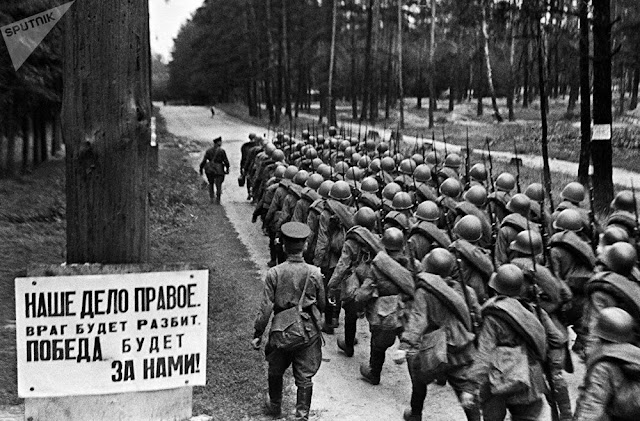
The German advance in Russia continued as shattered Soviet forces flooded east pursued by the German invaders. German panzer units began to meet Soviet tank formations rushing to the front. The Soviet forces were badly organized and depleted because of constant air attacks.
The Germans have unleashed a massive war machine on the USSR. The three million troops (including those held in reserve) have the support of 3,350 tanks, 7,184 guns and 2,815 aircraft. In addition, eight divisions have been deployed to Finland.
This leaves Hitler with just 61 divisions (amounting to 600,000 men) to cover the rest of Europe and North Africa, but divisions from Finland, Romania, Slovakia and Hungary, plus some Italian forces, should leave for the USSR in a the near future, as it seems likely that those countries will declare war on the USSR.
The USSR has about 132 divisions including 34 armored divisions (2,500,000 men) in the border districts of the west, a further 20 facing Finland, and 133 divisions in the interior and Far East. This will more than double once mobilization is complete. The Russian tank armory has some 20,000 machines, although many are obsolete, with new, more powerful, types only just being introduced. First line fuel, ammunition and tank radios are in short supply. The Red Air Force has 18,000 aircraft, of which well over half are in the west. Most are obsolete, and over 3,500 have already been lost. Even more serious are Stalin’s refusal to prepare for an invasion, his unfinished reorganization of the Red Army, and his purge of many of his best commanders before the war.
Stavka was created. The Soviet Main Military Council, now reduced from eleven to seven members, is renamed the “Stavka” (General Headquarters) of the High Command. The change is made by eliminating six deputy defense commissars and adding General Voroshilov and Admiral Kuznetsov. Other members include Generals Timoshenko, Semen Budenny and Zhukov, Foreign Minister Molotov, and of course Stalin. There are numerous “advisors” to the Stavka: Beria, Shaposhnikov, Meretskov, Vatutin, Kulik, Zhigarev, Voronov, Mikoyan, Kaganovich, Voznesensky, Zhdanov, Malenkov, and Mekhlis. However, only the seven are permanent members.
While there are seven members of the Stavka, it is understood by everyone that Stalin has the last word on everything. This is long-established Soviet (and Russian) practice, with someone (such as Stalin) holding the de facto power while someone else holds the de jure power. Timoshenko technically is the chairman of the Stavka, but Stalin has the real power. As Zhukov says at one point, the difference between Stalin and the highest-ranking Soviet Marshal is the same as between a Marshal and a private. This lineup will remain intact and function effectively through crises, with some of the members there due to ability (such as Zhukov) and others there simply because they are Stalin’s cronies (such as Budenny).
Already, recriminations are raining down from Stalin on military figures that he feels are failing in their defense of the country. Soviet Bomber Commander General Kopets commits suicide, the first of many. By some accounts, Stalin is in the midst of a personal crisis brought on by Operation Barbarossa.
Full conscription is introduced throughout the Soviet Union.
Slovakia declared war on the Soviet Union. Slovakia declares war on the USSR on 23 June 1941, joining Germany and Italy. Hungary and Finland remain on the sidelines, though both are gearing up for war. Croatia offers to send troops to assist the Wehrmacht.
Mussolini offers to send a corps (three divisions) of Italian troops to the eastern front. The Germans are glad for the help but expect more.
The Provisional Government of Lithuania was announced with the goal of establishing an independent Lithuania.
The Battles of Brody and Raseiniai began on the Eastern Front. In Army Group North (Field Marshal Wilhelm Ritter von Leeb), the German 4th Panzer Group faces an ineffective counterattack by Soviet 3rd and 12th Mechanized Corps in the Battle of Raseiniai. The Germans are barely slowed, but the Soviets continue attacking because they don’t have another plan. By the end of the day, the German tanks have advanced about 50 miles.
The Battle of Raseiniai is significant not because of its tactical effect, but because the Germans experience a severe shock at Soviet tank strength. Specifically, at one point a single Soviet KV-1 or KV-2 tank pierce the German lines and winds up at a column of German trucks of the 6th Panzer Division. When four 50-mm anti-tank guns prove ineffective in stopping it, the Germans move up a heavy 88-mm Flak gun to about 730 meters (800 yards), but the Soviet tank destroys it before it can fire (Flak guns have no protection and are very immobile). This standoff lasts until the 25th when another 88-mm gun and some German panzers finally destroy it. This proves beyond a shadow of a doubt that German military intelligence was sorely lacking about Soviet tank strength.
The German 6th Panzer Division encountered Soviet KV tanks for the first time at the Dubysa River in Lithuania. German General Reinhard was surprised to learn that the Soviet military possessed such a heavy tank, especially after learning that some German 105-millimeter shells were bouncing off the thick armor, and that some KV tanks had reportedly crushed German vehicles and guns by driving over them.
In Army Group Center, 2nd Panzer Group and 3rd Panzer Group break out past the Bug River. General Guderian’s 2nd Panzer Group shrugs off Soviet 4th Army, bypasses Brest Fortress, and takes the main road toward Minsk. General Hermann Hoth’s 3rd Panzer Group sidesteps Soviet 3rd Army and heads toward Vilnius, which its forward units reach late in the day.
In Army Group South, the terrain is advantageous to the defense, and this axis of advance gives the Wehrmacht the most problems. German 1st Panzer Group and 6th Army have broken through Soviet 5th Army, but late on the 23rd, the Soviets make their first serious counterattack in the Battle of Brody (considered the largest tank battle of the war up until the Battle of Kursk in July 1943). Soviet 22nd and 15th Mechanized Corps, containing new T-34 medium and KV heavy tanks, hit the flanks of the advancing 1st Panzer Group from north and south, respectively. This develops into a lengthy battle, but eventually, the German III Motorized Corps destroys the 22nd Mechanized Corps, while the 6th Army’s 297th Infantry Division handles the Soviet 15th Motorized Corps.
The Soviet Army armored counter attack near Tilsit, Ostpreußen, Germany (now Sovetsk, Russia) was beaten back. Meanwhile, German forces crossed the Bug River, penetrating 50 miles beyond the Soviet lines. From the air, German Luftwaffe aircraft destroyed another 1,200 Soviet aircraft on this day.
German Gestapo leader Mueller issued directives to the Gestapo office in the city of Tilsit, Germany (now Sovetsk, Russia) to set up Einsatkommando Tilsit which would be responsible for killing Jews in Lithuania.
Adolf Hitler, aboard his command train Amerika, reaches his forward headquarters at Rastenburg, the Wolf’s Lair (Wolfschanze) at about 01:30. This is his first visit to the Wolf’s Lair, which is still under construction (and will be throughout the war).
The Soviets evacuate their embassy in Helsinki.
Berlin: The German News Office announced: “Early Sunday morning 9 Russian Glenn Martin bombers flew into East Prussia and 7 of them were shot down by German fighter planes. In another attempted raid on military installations in the General Government of Poland close behind the front lines, all but 2 out of 35 Russian bombers were destroyed by German fighter planes.”
The Wehrmacht High Command announced: “In the east the struggles of the German army and the Luftwaffe against the Red Army are proceeding successfully according to schedule. Very weak forces of the Red Air Force dropped bombs in East Prussia without notable effect. [German ace] Lieutenant Col. Molders won his 72nd air victory yesterday.”
Churchill states: “The Russian danger is our danger and the danger of the United States, just as the cause of any Russian fighting for his hearth and home is the cause of free men and free people in every country of the globe.”
Communiqué No. 1 of the Red Army High Command stated: “Early in the morning of June 22, the troops of the German-Fascist Wehrmacht attacked our border forces along the entire line extending from the Baltic Sea to the Black Sea. The enemy Luftwaffe bombed a number of our airfields and villages, but everywhere it encountered energetic resistance from our fighter planes and ground defences, which inflicted heavy losses on the Hitlerite Fascists. Sixty-five German aircraft were shot down.”
At some point during this week — details are very sketchy — Soviet Premier Joseph Stalin attempts to broker a peace deal with Hitler through a Bulgarian diplomat, Ivan Stamenov. Foreign Minister Molotov has Lavrentiy Beria arrange this by using one of Beria’s subordinates, NKVD officer Pavel Sudoplatov, who has a “casual” lunch at a Moscow restaurant with the diplomat. Sudoplatov explains to Stamenov what to say to Hitler. Stalin is willing to offer huge concessions for peace, including giving the Reich all of Ukraine and all of the areas granted to him in the “secret protocol” to the 23 August 1939 Molotov/Ribbentrop Pact in the Baltic States. Stalin does, though demand to know why Hitler invaded the USSR.
Hitler turns Stalin down flat and will not even consider the offer. This is one of Hitler’s biggest mistakes. These revelations were hidden for many years but came to light during the period after Stalin died from natural causes in the 1950s. There are few other details of this little-known incident, but there is no reason to doubt that it happened. This peace offer was classified as treason and was one of the charges used to condemn Beria to death. The others involved — including the Bulgarian Stamenov diplomat used as the go-between — submitted affidavits confirming the incident. Sudoplatov confessed to it under interrogation and also was convicted of treason, serving 15 full years in prison (yes, there are many questions about the validity of such “proof,” but there was a lot of corroboration). Molotov was never tried for treason despite his deep role in the incident, but gradually fell out of favor, lost his positions one by one, and by 1962 was a “non-person” in the Soviet bureaucracy.
Moscow is attacked by 115 bombers.
In response to a formation of Soviet bombers approaching Constanta, Locotenent Aviator [lieutenant] Horia Agarici took off from nearby Mamaia Airfield in his Hurricane No. 3 which he ended up flying without its engine cowling which had been removed for servicing (three other aircraft of the escadrila were already grounded for maintenance or much-needed overhaul), and which was the only fighter to make contact with the incoming Soviet formation of seven (or nine, I’ve seen both numbers listed) SB-2 bombers. Agarici pressed his attacks until running out of ammunition, shooting down three and driving off the remaining bombers — one source reports two shot down over land with wreckage later identified and a third downed over the Black Sea, while another source reports all three crashed on land, but generally he’s credited with three kills that, under the Romanian practice of counting twin-engined aircraft as “double points” made him an ace in a day with six official victories to his score.
Luftwaffe fighter ace Max-Hellmuth Ostermann claims two Soviet bombers downed.
Despite fears of inadequate Lithuanian forces guarding the radio station in Kaunas, Leonas Prapuolenis of the Lithuanian Activist Front read the declaration of Lithuanian independence and the list of members of the Provisional Government.
Lithuanian partisans led by Juozas Ambrzevicius (Juozas Brazaitis) liberate Vilnius and Kaunas. Leonas Prapuolenis of the Lithuanian Activist Front broadcasts an announcement of Lithuanian independence over the radio, introducing the Provisional Government of Lithuania and its leaders. This begins a trend during World War II in which a prime military objective is to seize radio stations quickly in order to make declarations such as this. Ambrzevicius serves as the Provisional Government’s first (acting) prime minister.
While most Soviets flee quickly, some decide to stay. These include some Soviet security personnel. When the rebels find them on 23 June, they lock the Soviets (who allegedly include some Jews) in a garage. Eventually, in a very controversial incident, the Soviets are killed — exactly by whom is the controversy. Some say the Soviets are killed by the Germans, others recently that recently liberated political prisoners kill them.
Serbs in eastern Herzegovina rebel against the controlling Italian authorities in the Independent State of Croatia. About 200 Ustaše state police encounter a group of rebels they estimate to number between 600 and 1,000 and take severe casualties. This apparently spontaneous uprising lasts well into July. This is sometimes termed the first operation by Tito’s partisans, but it is unlikely that he is involved at this stage.
The secret police (NKVD) arrest and imprison about 3000-4000 Ukrainians in Lviv as a security measure, kill some indiscriminately. The Soviet government rightly suspects the loyalties of Ukrainians — because of Soviet actions like this.
Habforce from Iraq attacks Palmyra, the site of a major Vichy French airbase. The French continue holding Palmyra largely because of their dominance of the skies in the sector.
2/33 Bn with strong artillery support captures Ibeles Saki, outflanking Merdjayoun. Patrols discover French withdrawn from Merdjayoun. A small Vichy French Foreign Legion force in Palmyra continues spirited resistance against attacks by four allied cavalry regiments (including the Arab Legion) and an infantry battalion. Despite numbering less than three companies, they will not surrender until 3 July, continuing the FFL’s tradition of defence against hopeless odds. On the coastal axis, Brig Stevens complains personally to Gen Wavell that he cannot get ammunition for his battalions’ 3-inch mortars. Next day 320 bombs arrive for each battalion.
On this flank the 2/33rd had been patrolling and had discovered not only that the impetus of the enemy’s drive had been exhausted but that he was abandoning some of his gains. On the night of the 20th a patrol found that Fort Khiam was unoccupied, and on the night of the 21st that the French had abandoned Khiam village and Bmeriq. On the eve of the planned attack on Ibeles Saki, Berryman ordered that a troop of horsed cavalry be formed by the 6th Cavalry to patrol the rugged hills of the Anti-Lebanon and protect his right. It will be recalled that, on the 16th, Captain Bennett’s roving company of the 2/33rd had captured thirty-two good cavalry horses at Rachaya. In the ranks of the 6th Cavalry were many countrymen and some who had served at home in light horse regiments of the militia. From such men was formed a cavalry troop, at first of eighteen men but in a few days increased to forty, when saddles and packs arrived from Palestine; its unofficial title was the “Kelly Gang”. On the night of the 22nd, a few hours after the horses had been taken over, Lieutenant Burt (a dairy farmer in civil life) led the force to Bmeriq and patrolled the area beyond; and, in the following days, the cavalrymen, then under Lieutenant Millard, rode through the country bounded by Bmeriq, Kafr Hammam, Kafr Chebaa and Mazraat Islamiye in the tangled mountains overlooking the Merdjayoun valley from the east.
During the night of the 22/23, French destroyer Guepard sorties briefly from Beirut Harbor and runs into Royal Navy light cruisers HMS Leander and Naiad, along with three Royal Navy destroyers. After a brief exchange of gunfire, both Guepard and Leander are lightly damaged and Guepard retires to Beirut.
The British establish a 5,000-man 1st Greek Brigade in Palestine under the command of Colonel Ev. Antoniou. This formation, however, requires training and cannot be used right away
The June 1941 uprising in eastern Herzegovina began when Serbs in eastern Herzegovina rebelled against the authorities of the Independent State of Croatia.
The 5,000 man 1st Greek Brigade was established by the British in Palestine under the command of Colonel Ev. Antoniou. The Brigade (under Colonel Pafsanias Katsotas) would later see action in 1942 at El Alamein in Egypt as a part of the British 50th Division.
The Italian and German air forces bombard Tobruk.
British forces advanced to Palmyra in Syria but the Vichy French garrison remained in control of the city.
RAF Blenheims of 11 Sqn. raid the Vichy French airbase at El Qusseif where French LeO 451 bombers are stationed.
The Southern Railway Central Station in London, England, United Kingdom, damaged by German bombing over the night of 21 to 22 Jun 1941, was cleared of debris and returned to full operational status.
The RAF completes its first chain of GEE guidance stations, with three now set up. These will be used to guide RAF bombers to their targets.
RAF Bomber Command, Day of 23 June 1941
39 Blenheims on coastal sweeps and a Circus operation to Choques power-station. 2 Blenheims lost.
RAF Bomber Command, Night of 23/24 June 1941
Cologne
44 Wellingtons and 18 Whitleys. 1 Wellington lost. Cologne reports a few bombs but no casualties.
Düsseldorf
30 Hampdens and 11 Manchesters. No aircraft lost. Crews report: ‘Fires started.’
Kiel
26 aircraft — 13 Stirlings, 10 Halifaxes, 3 Wellingtons. 1 Halifax lost. Little damage in Kiel but 1 person was killed and 8 injured when a large bomb appeared to explode in the air above the old town. The casualties are believed to have been in the open, watching a bomber trying to escape from a large searchlight cone. The bomber escaped from the mass of Flak being fired at it.
Minor Operations: 2 aircraft to Boulogne, 1 each to Bremen, Emden and Hannover, 1 minelaying in the Frisians, 7 O.T.U. sorties. No losses.
During the early morning hours, the Luftwaffe raids Alexandria Harbor for just under two hours. They manage a near-miss of battleship HMS Warspite. This floods two bulges, and the ship needs repairs.
The Luftwaffe and Regia Aeronautica bomb Tobruk.
The RAF based on Malta attacks Syracuse Harbor. The British damage a hangar, some barracks, and some flying boats.
German submarine U-144, commanded by Kapitänleutnant Gert von Mittelstaedt, sank Soviet submarine M-78 nine miles west of Vindava, Latvia at 0654 hours, killing all 15 aboard. At 0654 hours on 23 June 1941, M-78 (SrLt Dmitriy L. Shevchenko) was hit by two torpedoes from U-144 and sank immediately 9 miles west of Vindava. The commander of the 4th Submarine-Division, KLt Stepan Ionovich Matveyev, was lost with the submarine. They had left Liepaja the day before together with M-77, had been attacked at 0336 hours on 23 June off Uzava by German aircraft and were proceeding on the surface to recharge their batteries.
Soviet destroyer Gnevniy hit a mine and sank off the island of Hiiumaa, Estonia.
Soviet destroyer Bystryb hit a mine and sank in the Black Sea off Sevastopol, Russia.
Soviet submarines Ronis, Spidola, and S-1 were scuttled by their own crews at Libau, Latvia to prevent German capture.
Soviet Navy light cruiser Voroshilov bombarded Constanza, Romania.
Light cruiser HMS Nigeria arrived at Scapa Flow from Faroes Iceland patrol.
Light cruiser HMS Manchester and destroyer HMS Eclipse departed Iceland to relieve heavy cruiser HMS Suffolk on Denmark Straits patrol.
Minesweeping trawler HMS Nogi (299grt, Skipper E.C. King DSC RNR) was sunk by German bombing in 52-57N, 1-28E off Norfolk.
Convoy HX.133 was sighted by U-203.
German supply ship Alstertor was located on the 22nd by Ocean boarding vessel HMS Marsdale and a Catalina aircraft, but contact was lost. The supply ship scuttled in 41-12N, 13-10W after she was intercepted by destroyers HMS Faulknor, HMS Foresight, HMS Forester, HMS Foxhound, and HMS Fury of the 8th Destroyer Flotilla. Survivors from the ship included seventy eight British prisoners from British steamers Trafalgar and Rabaul. The destroyers rescued the survivors from ship’s boats. The destroyers then proceeded to meet aircraft carrier HMS Furious arriving from the Clyde. Submarine HMS P.33, which had also been searching for the German ship was directed to continue her passage to Gibraltar.
Dutch submarine HNLMS O.24 arrived at Gibraltar from patrol in the Mediterranean.
British steamer Hull Trader (717grt) was sunk on a mine one mile 270° from No.57C Buoy, Cromer. Eleven crewmen were lost on the steamer.
British steamer Trelissick (5265grt) was sunk by German bombing 3½ miles 114° from Sheringham Buoy, Cromer. Two crewmen were lost on the steamer.
British steamer Camroux II (324grt) was damaged on a mine one mile northeast of No.17 Buoy, Flamborough Head. The steamer was towed to Immingham.
British steamer Tolworth (1351grt) was damaged by German bombing in 53-05N, 1-25E. The steamer was drydocked in the Tyne for repairs.
French destroyer Guepard was engaged by light cruisers HMS Naiad and HMS Leander and destroyers HMS Jaguar, HMS Kingston, and HMAS Nizam north of Beirut in 34-05N, 35-33E at 0148. Destroyer Guepard was damaged by British gunfire. Light cruiser Leander was struck by one shell which did not explode. Destroyers HMS Jervis, HMS Havock, HMS Hotspur, and HMS Decoy were submarine hunting in the area.
Following temporary repairs at Alexandria, light cruiser HMS Orion departed Alexandria on the 23rd for Port Said to have her catapult re-embarked. The cruiser departed Aden for Simonstown on the 29th. At Simonstown, her catapult was removed and installed on seaplane carrier HMS Albatross. The light cruiser went across the Pacific and departed Balboa on 28 August. Cruiser Orion arrived at Mare Island on 5 September and was under repair until 15 February 1942.
There was a German air raid on Alexandria from 0315 to 0510/23rd. Battleship HMS Warspite was slightly damaged by a near miss of a heavy bomb. Two bulges were flooded.
Soviet submarine M-78 was sunk by U-144 east of Ventspils, Latvia, west of Windau.
Soviet cruiser Maksim Gorki was mined in the Baltic. The cruiser lost her bow back to A turret. The cruiser was repaired at Leningrad.
Soviet destroyer Gnevny was sunk by a mine off Hango.
Soviet destroyer Bystry was sunk by German bombing at Sevastopol. The destroyer was later salved.
Soviet submarine S-3 was sunk by German motor torpedo boats S.35 and S.60 off Stienort.
In Washington today, President Roosevelt conferred with Arthur Bliss Lane, United States Minister to Yugoslavia: Viscount Halifax, the British Ambassador, and Jesse Jones, Secretary of Commerce. The White House announced the President had signed the bill to amend the Federal Crop Insurance Act and also several minor measures.
The Senate adopted a resolution of regret over the death of Senator Harrison and recessed at 12:05 PM until noon Thursday. The Appropriations Committee approved the $10,545,000,000 War Department Military Functions Bill: the Judiciary Committee approved the nomination of Chief Justice Harlan F. Stone and postponed action on the nomination of Robert H. Jackson to the Supreme Court; an Interstate Commerce subcommittee opened hearings on construction of oil pipe lines to the East Coast; the Military Affairs Committee received from the War Department a substitute for the property requisitioning bill.
The House heard the late Senator Harrison eulogized, received the Boggs bill to prohibit Fascists, Communists and Bund members from belonging to labor unions or holding Federal jobs and adjourned at 1:03 PM until noon tomorrow. The Banking and Currency Committee heard Marriner S. Eccles urge extension of authority for using government obligations as collateral for reserve notes; the Rivers and Harbors Committee continued hearings on the St. Lawrence seaway proposal: the Ways and Means Committee considered estate and gift tax rates.
The United States cast its sympathies officially on the side of Soviet Russia in the new conflict with Germany today and opened the definite prospect of lease-lend or other material aid to the red forces. A government declaration issued on behalf of President Roosevelt by Sumner Welles, acting secretary of state, asserted the principles and doctrines of “communistic dictatorship” were as “intolerable and as alien to the American people as were those of Nazi dictatorship.” But it branded Adolf Hitler’s armies as “the chief dangers of the Americas” and said “any defense against Hitlerism” and “any rallying of forces opposing Hitlerism from whatever source” would hasten downfall of German leaders and “rebound to the benefit of our own defense and security.” Russia has not yet asked for lease-lend aid from the United States, Welles explained, and until such a request is received the American government is withholding any decision. He pointed out, however, President Roosevelt had full authority under the act to extend lease-lend aid to all countries defending themselves against aggression.
The account of the sinking of the Egyptian passenger liner ZamZam on April 17 by the German commerce raider Atlantis by Charles J.V. Murphy accompanied by photographs taken by David E. Sherman appeared in June 23 issue of LIFE magazine. The photographs of the Atlantis disguised as the Norwegian freighter Tamesis later helped the British identify and destroy the Atlantis.
The full Senate Judiciary Committee today unanimously approved the nomination of Justice Harlan Fiske Stone as Chief Justice of the United States but postponed action on the nomination of Attorney General Robert H. Jackson to an associate justice. A hearing on Mr. Jackson’s nomination was set for Friday at the request of Senator Millard E. Tydings, Democrat, of Maryland, who said he wanted to testify. It is assumed that the Senate will confirm Justice Stone when it meets again on Thursday.
Representative Martin Dies predicted today that Hitler would be in control of Russia within thirty days, and said America must prepare for an emergency unprecedented in her history.
Negotiations between Southern soft-coal operators and the C. I. O.’s United Mine Workers of America reached a crisis late today. A final decision on a collective bargaining contract or another production stoppage, perhaps affecting 350,000 miners in the entire Appalachian area, seemed probable before tomorrow night. Neither the operators nor John L. Lewis, president of the U.M.W., would discuss details of the contract difficulties, but the Southern operators’ representatives were in conference at their hotel throughout the afternoon and into the evening trying to decide whether to accept a contract offered by Mr. Lewis. “They have our final word,” Mr. Lewis told reporters about 6 PM.
Rebuffed in an effort to get striking A.F.L. and C.I.O. Machinists back to work in San Francisco shipyards, the U.S. Navy took steps yesterday to supply these key men to strike-bound yards from government civil service lists. Meantime, however, the Bethlehem Shipbuilding Co., one of the 11 shipyards and drydocks affected by Ihe strike, agreed to sign a coast-wide contract negotiated by the A.F.L. metal trades, and there was speculation this might end the strike. Other strike-bound yards already had accepted the agreement. Bethlehem’s failure to sign had been cited by strikers as one reason or refusing to return to work.
A narrower “property seizure” bill, specifying Items the president could requisition, was proposed today by Robert P. Patterson, undersecretary of war. The substitute would empower the president to take over military or naval equipment, machine tools, manufacturing equipment, patents and plans “to promote the national defense and to overcome shortages.” Patterson told the senate military committee the substitute “ought to fill our needs” but both he and Chairman Emory S. Land of the maritime commission emphasized need for speedy passage. The original measure, opposed by some congressmen as too broad, placed no restriction on the president’s commandeering power so long as the property involved was needed for defense.
Cooperation with Great Britain to bring about as quickly as possible the defeat of Germany and, as well, the “coalescence” of the American and British navies to maintain peace in the world, are roles to be played by the United States as a world power, Major George Fielding Eliot declared tonight at the opening session of the annual Institute of Public Affairs at the University of Virginia.
The U.S. Army probably will hold some selectees beyond the one-year training period for which they were called, but if possible it wishes to demobilize most of them at the expiration of a year of service, General George C. Marshall, Chief of Staff, said today.
Members of the Senate and House and the public paid respects to the late Senator Pat Harrison today as the body of the Senator, who died yesterday, lay in state from 2 to 6 PM in the flower-decked Senate chamber.
Major League Baseball:
Brooklyn’s Fred Fitzsimmons beats the Pirates, 9–4, for his 13th straight win over the Bucs, stretching back to June 16, 1939. It’s his last decision against Pittsburgh. Before the victory was racked up, three Brooklyn pinch-hitters and two relief pitchers had been called upon and Manager Leo Durocher had gone in to play second base. The third of the emergency hitters, young Herman Franks, delivered the blow that put the contest beyond reach of Frankie Frisch’s men. Batting for Fitz in the eighth. with the score 4–4 and two Dodgers aboard, Franks walloped his first home run of the season into the upper right-field tier off Bob Klinger.
Following their heroic efforts in St. Louis over the week-end the Giants experienced a let-down today. Gilt-edged pitching by Claude Passeau may have had something to do with it, for the score by which Jimmy Wilson’s Cubs beat Colonel Bill Terry’s troops in the opening clash of a three-game series was 1–0. Only three hits fell to the lot of the New Yorkers. Dick Bartell opened the game with the first of these, a single that did not get beyond the infield. Mel Ott got the next, a double that was slightly tainted inasmuch as Phil Cavarretta just missed making a shoestring catch of it in center, and the third was a single by Babe Young that came with two down in the ninth.
New York Giants 0, Chicago Cubs 1
Brooklyn Dodgers 9, Pittsburgh Pirates 4
Japanese military reports early today said waves of Japanese naval bombers lashed far into the interior yesterday to blast ten Chinese bases spread across four provinces. One of these raids, the Japanese said, was on Tsinghai Province, in Western China, and along the overland route for Russian supplies for the Chinese. The Japanese called it one of the longest ever carried out in aerial warfare. They said this consisted of an attack on Sining, about 875 miles from Hankow or more than 1,250 miles from the mouth of the Yangtze River. The raiders attacking Sining apparently took off from the Hankow region, as the Japanese said they flew virtually the whole distance over hostile territory.
Vast areas of West and Northwest China were bombed severely by Japanese planes during the week-end, the Chinese Central News reported today. It said seventy-one planes raided Shensi and Kansu Provinces yesterday, damaging a number of towns. Shensi’s capital, Sian, was held under an air alarm throughout the day. Sian has been a Chinese Communist center and is a terminus of the supply route from Russia.
German Foreign Minister Joachim Ribbentrop sends a cable to Tokyo requesting that they declare war on the Soviet Union via Manchuria (Manchukuo). The Japanese take this into consideration, but ultimately decide to wait until the Germans take Moscow, Stalingrad, and other key objectives in the western USSR. The Japanese military forms a committee to look into the desirability of either attacking north (into the USSR) or south (against the British and Dutch).
The Japanese Government is expected to announce its stand in the new world situation resulting from the Russo-German conflict following a Cabinet session today. Pending the announcement, the people have been urged to maintain the utmost reserve and leave everything to the authorities. The Cabinet spokesman, Koh Ishii, was determinedly noncommittal at his press conference today, but affirmed that “Japan will remain faithful to her treaty obligations to both parties.” There was much coming and going in official circles yesterday and almost continuous conferences in civil and military quarters. The only hint of the drift of official opinion was a statement by Domei, the official news agency, that said: “While clarifying the sincere desire of the Imperial Government to contribute to everlasting world peace, the government now deems it necessary to drive home to the whole nation the national policy for steady construction of a new order in East Asia.”
U.S. Navy Chief of Naval Operations Admiral Stark ordered the 1st Defense Battalion of the Fleet Marine Force of the U.S. Marine Corps to be established at Wake Island as soon as possible.
Dow Jones Industrial Average: 123.97 (+1.46)
Born:
Robert Hunter, American poet, singer and songwriter (Grateful Dead — “Box Of Rain”; “Ripple”; “Friend Of The Devil”; “Truckin’”), in Arroyo Grande, California (d. 2019).
Roger McDonald, Australian author and poet (“1915”), in Young, New South Wales, Australia.
Jack Jacobson, AFL defensive back (San Diego Chargers), in Stillwater, Oklahoma (d. 2021).
Died:
Frederick Gottwald, 82, American painter.
Naval Construction:
The U.S. Navy 77-foot Elco patrol motor torpedo boat USS PT-51 is laid down by the Electric Launch Company Ltd. (Elco), (Bayonne, New Jersey, U.S.A.).
The Kriegsmarine (German Navy) Type IXC U-boat U-519 is laid down by Deutsche Werft AG, Hamburg (werk 334).
The Royal Navy Hunt-class (Type III) escort destroyer HMS Eggesford (L 15) is laid down by J.S. White & Co. (Cowes, U.K.).
The Royal Navy Hunt-class (Type III) escort destroyer HMS Tantaside (L 69) is laid down by Yarrow Shipbuilders Ltd. (Scotstoun, Scotland).
The Royal Navy Hunt-class (Type III) escort destroyer HMS Melbreak (L 73) is laid down by Swan Hunter and Wigham Richardson Ltd. (Wallsend-on-Tyne, U.K.); completed by Wallsend.
The Royal Navy White 73-foot-class motor torpedo boat HMS MTB 46 is commissioned.

