War Without Pity: Panzers East
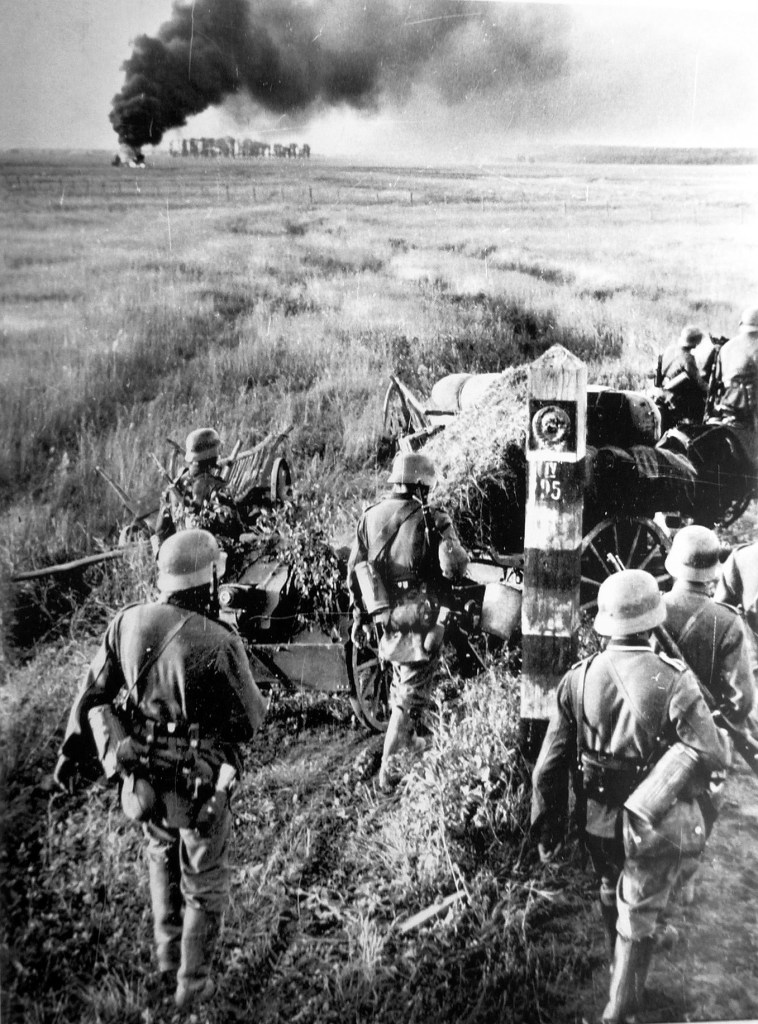
They crossed over the border the hour before dawn
Moving in lines through the day
Most of our planes were destroyed on the ground where they lay
Waiting for orders we held in the wood…
Word from the front never came
By evening the sound of the gunfire was miles away
Ah, softly we move through the shadows, slip away through the trees
Crossing their lines in the mists in the fields on our hands and our knees
And all that I ever was able to see…
The fire in the air glowing red silhouetting the smoke on the breeze…
All summer they drove us back through the Ukraine
Smolensk and Vyazma soon fell
By autumn we stood with our backs to the town of Orel
Closer and closer to Moscow they come
Riding the wind like a bell…
General Guderian stands at the crest of the hill…
“Roads to Moscow,” © Al Stewart, Universal Music Publishing Group (1973).
German forces launched Operation BARBAROSSA, the Axis invasion of the Soviet Union. As Adolf Hitler has planned since July 1940, the Reich invades the Soviet Union on 22 June 1941. The attack is made without a declaration of war and proceeds along a 2000-mile (2900 km) front. It is one of the greatest miscalculations in history. A German declaration of war was presented to Soviet ambassador Vladimir Dekanozov in Berlin and by German ambassador Friedrich-Werner Graf von der Schulenburg to Soviet Foreign Minister Vyacheslav Molotov in Moscow.
At about 0100 hours, the Red Army was ordered to assume defensive posture, but it was too late to improve defenses significantly as Germany tore up the non-aggression pact and launched Operation BARBAROSSA.
At 3 o’clock in the morning on June 22, 1941, six thousand German army cannon belched fire and destruction at Russian outposts along a frontier border through what was once Poland. Up and down the line, terrified Russian guards radioed their headquarters with the same message: “We are being fired on; what shall we do?” The replies from headquarters were one of disbelief: “You must be insane. And why is your signal not in code?” But the outpost guards were not insane. Operation BARBAROSSA, Adolf Hitler’s invasion of the Soviet Union, had begun.
The greatest and most pitiless battle of our modern age begins as Germany launches BARBAROSSA, invading the Soviet Union along an 1,100-mile front, with three million soldiers, the largest invasion in history. The Germans have 140 of their own divisions, including 17 Panzer and 13 motorized divisions. There are also 14 Rumanian, two Hungarian, and 21 Finnish divisions. Facing them are the 230 divisions of the Soviet Army. 170 divisions are in the western part of the Soviet Union and 134 are directly opposing the Germans. The invasion today begins at 0300 hours with ground and air attacks. In support, German aircraft destroyed 2,000 aircraft, many on the ground, allowing the Germans to gain air superiority across the entire front. Most German operations run according to plan. A most significant setback is the taking of the citadel within the town of Brest Litovsk. This slows the use of the German communications network planned to be centered here.
Army Group North, under command of Field Marshal Wilhelm von Leeb, attacked through the Baltic States in the direction of Leningrad and advanced 40 miles.
Army Group Center, under command of Field Marshal Fedor von Bock, attacked north of the Pripet Marshes from Brest-Litovsk and captured most of the Bug River bridges intact.
Army Group South, under command of Field Marshal Gerd von Rundstedt, attacked south of Pripet Marshes in the direction of Kiev.
In the south, the Rumanian 11th Army and Germans forces attacked across the Pruth River into Bessarabia.
The Luftwaffe has planes in the air as the day begins, and at around 03:15 they begin bombing Soviet-occupied cities in Poland and further north and east. The targets include the naval base at Kronstadt, Sevastopol, and Ismail in Bessarabia.
At 0325 hours, Georgy Zhukov woke Iosef Stalin by phone to inform him of the news of the invasion; initially, Stalin refused to give Zhukov the permission to strike back at the Germans, believing it to be a German provocation. At 0630 hours, Stalin finally realized it was a full scale invasion and gave his authorization for the Red Army to fire back. Despairing when he realized the full measure of the invasion, Iosef Stalin is said to have exclaimed, “Everything which Lenin created we have lost forever!” Some Soviet sources, including Molotov and Khruschev, support the view that Stalin suffered a nervous breakdown. Stalin went so far as to announce he was going to resign, and went into seclusion in his dacha near Moscow. At one point during the next ten days, a group of Politburo members arrived one day at his dacha. Stalin thought they had come to shoot him. But instead of delivering a 7.62 mm ticket to the afterlife, they had come to seek his leadership and guidance on what to do next. Stalin, given time, rallied and would ultimately lead the Soviet Union to victory. But the cost would be horrific.
Stalin, despite the warnings given to him by Churchill and his own spies, seems to have been taken completely by surprise. The first that the Russians knew of the invasion was when the guns fired. At 4.00 A.M. Vladimir Dekanozov, the Soviet ambassador to Berlin, was called to the Wilhelmstrasse to be told that Germany had entered Russia in response to “border violations”.
In fact, the invasion is the culmination of months of planning by the German general staff, acting on Hitler’s orders. Operation Barbarossa is designed to destroy the Soviet Union and Bolshevism. Hitler is certain of success. He has told General Alfred Jodl: “We have only to kick in the door and the whole rotten structure will come crashing down.” In a proclamation broadcast this morning Hitler boasted that the German army’s movements were “the greatest the world has ever seen.” First reports indicate that the Finns and Romanians are fighting alongside the German.
At about 0300 hours, Benito Mussolini was awaken as an urgent message was received from Adolf Hitler’s office, informing Mussolini of the invasion of the Soviet Union; though annoyed by not having been notified earlier, he dutifully declared war on the Soviet Union. Romania would also make a declaration of war on the Soviet Union on this date.
The war between Germany and the Soviet Union is indeed war without pity, and the most ghastly theater of World War II. The battles on the Eastern Front constituted the largest military confrontation in history. They were characterized by unprecedented ferocity, wholesale destruction, mass deportations, and immense loss of life due to combat, starvation, exposure, disease, and massacres. The Eastern Front, as the site of nearly all extermination camps, death marches, ghettos, and the majority of pogroms, was central to the Holocaust. Of the estimated 70 million deaths attributed to World War II, over 30 million, many of them civilian, occurred on the Eastern Front. The Eastern Front was decisive in determining the outcome of the European portion of World War II, eventually serving as the main reason for Germany’s defeat. It resulted in the destruction of the Third Reich, the partition of Germany for nearly half a century, and the rise of the Soviet Union as a military and industrial superpower.
German mobile killing squads, called special duty units (Einsatzgruppen), were assigned to kill Jews, Gypsies, and officials of the Soviet state and the Soviet Communist party during the invasion of the Soviet Union. These squads followed the German army as it advanced into Soviet territory, and carried out mass-murder operations. The Einsatzgruppen were squads composed primarily of German SS and police personnel. Behind the lines, SS Einsatzgruppen systematically kill thousands of Jews in every city, town and village of western Russia, mopping-up all civilian resistance with remorseless cruelty.
General Dmitry Pavlov ordered, belatedly as the German invasion had already begun, his troops to man the fortified regions in his sector in Byelorussia at 0300 hrs.
The Luftwaffe’s fighter force consists of JG 3 under Maj Gunther Lutzow equipped with the Bf 109F; II and III./JG 27 under Maj Wolfgang Schnellmann with the Bf109E; JG 51 under Molders with the Bf109F, II and III./JG 52 under Maj Hans Trubenbach with the Bf109E; JG 53 under Maj Gunther von Maltzahn with the Bf 109F; JG 54 under Maj Hannes Trautloft with the Bf109F; and JG 77 under Maj Bernhard Woldenga with the Bf109E. There is a single Bf110 equipped Zerstorergeschwader, ZG 26 Horst Wesel.
The Luftwaffe claims 1,811 Soviet aircraft for the loss of 32 of its own machines.
The attack started at 0315 hours with strikes against Russian airfields in an attempt to wipe the Red Air Force out on the ground. The airfields were so widely dispersed that it is only possible to allocate three bombers to attack each. Many of the Ju88s and Do17s carry 2kg SD 2 and 10kg SD 10 fragmentation bombs, the latter being dropped from high altitudes in bundles of four. These prove extremely effective against aircraft and personnel but have an unfortunate habit of failing to release from the aircraft’s bomb racks. The bombs would become fused and a slight jolt would cause them to detonate and blow the aircraft to pieces.
The initial attack on the Soviet airfields is followed by the bombing of Moscow, by Ju88s of KG 3 and KG 54 and He 111s of III./KG 26, part of KG 28, KG 53 and Kgr 100. 127 bombers take part in the raid dropping 104-tons of HE and 46,000 incendiary bombs.
Werner Mölders shot down three Soviet bombers and one fighter; he was awarded Swords of his Knight’s Cross, to be presented to him by Adolf Hitler on 3 Jul.
12 He 112s of Royal Romanian Air Force Grupul 5 escort a flight of Potez 63 light bombers on attacks on the Soviet airfields of Bolgrad and Bulgarica early in the morning. During this attack Sublocotenent Aviator Teodor Moscu became Romania’s first fighter hero of the War, shooting down two Polikarpov I-16 fighters with credit for a third “probable”; Moscu’s Heinkel was badly shot up in the ensuing air battle where the Romanians were outnumbered nearly three to one, making a wheels-up emergency landing from which he walked away from. Moscu soon added a pair of additional victories to his aerial score, while his Heinkel was eventually repaired and returned to frontline service with Escadrila 51.
The Germans executed Operation RENNTIER to secure the nickel mines around Petsamo in Finland.
The first of many Finnish refusals to do as asked by the Reich takes place today. German troops intend to start reconnaissance across Finland’s Eastern border on 22 June. They wish to take a tactically significant mountain top in Salla. However, the Finns refuse permission for these incursions of Soviet territory. An artillery exchange between Soviet and Finnish forces takes place near Hanko. At the end of the day, Finland remains neutral, though obviously hostile to the Soviets.
Officially Finland is neutral in the Russo-German war, but in all practical respects Finland has committed herself to join the Barbarossa offensive. The Finnish Defense Forces are fully mobilized and stationed along the eastern border. In northern Finland German ground forces are already operating against the Soviets, and Luftwaffe is freely using designated Finnish airfields to attack Soviet targets. But Finns are not just waiting for a proper excuse to start military operations. Early tonight, Finnish submarines lay mines in the Gulf of Finland. One infantry regiment and a light artillery battalion occupy the demilitarized Ahvenanmaa (Aland) islands in the Baltic Sea. Soviet planes attack the Finnish armored ships in nearby waters, but make no damage. A sixteen-man Finnish long-distance patrol, clad in civilian clothing, is flown by two German He 115’s to the Soviet rear. Their mission is to destroy locks in the Stalin canal. The locks prove too well guarded, but on its way home the patrol cuts the Murmansk railway. It returns back to the Finnish lines on 11 July, with losses of two men.
The June Uprising in Lithuania began when a segment of the Lithuanian population rose up and declared the restoration of the country’s independence. The Lithuanian Activist Front began the June Uprising against Soviet Forces in Lithuania. After a morning meeting it was decided that with their main forces in Kaunas that the LAF would not fight the Soviets but secure the political infrastructure of Kaunas and declare independence. By the end of the day the LAF controlled the Presidential Palace, post office, telephone and telegraph, radio station and radiophone.
Hitler issued a lengthy proclamation of war with the Soviet Union presenting his justification for the German invasion. Hitler presented himself as doing everything he could to preserve peace and only turning to force as a last resort. After having gotten a few hours of sleep after staying up much of the night following the advance of the invasion, Hitler addresses the Reichstag. Giving a characteristically distorted account of the events leading up to the invasion (“For weeks constant [Soviet] violations of this frontier have taken place”), Hitler casts the battle as one for the preservation of Europe:
“German and Rumanian soldiers are united under Chief of State Antonescu from the banks of the Pruth along the lower reaches of the Danube to the shores of the Black Sea. The task of this front, therefore, no longer is the protection of single countries, but the safeguarding of Europe and thereby the salvation of all.”
After finishing his business in Berlin, Hitler boards his command train Amerika. He sets out for his new military headquarters in the pine forests of East Prussia near the town of Rastenburg — the Wolf’s Lair (Wolfsschanze). Hitler chooses that name on the train because it was his own code name during the 1920s. While he would be perfectly capable of running operations from Berlin, Hitler prefers to be seen as commanding the war effort “from the front.”
After he comes to accept that Germany has launched a full-scale invasion, Stalin loses his nerve. He appears (according to those present) as if he cannot make decisions. Stalin spends more time talking with his internal security chief, Lavrentiy Beria, and Foreign Minister Molotov than he does with his generals. This suggests that he is more concerned for the moment about protecting his own position as leader of the Soviet Union (or whatever will be left of it after the invasion) than figuring out how to stop the Germans. This begins a lengthy period in which Stalin retreats, makes no public appearances or speeches, but retains control of the government with an iron hand using the state security apparatus.
Italy and Romania also declared war on the Soviet Union.
Spanish Foreign Minister Serrano Suner telephones to inform Foreign Minister Ribbentrop that Spain would be happy to contribute a volunteer division — the “Blue” Division — for operations against the Soviet Union.
Vyacheslav Molotov gave a broadcast authorized by Stalin to the citizens of the Soviet Union. “This war has been forced upon us, not by the German people, not by German workers, peasants and intellectuals, whose sufferings we well understand, but by the clique of bloodthirsty Fascist rulers of Germany who have enslaved Frenchmen, Czechs, Poles, Serbians, Norway, Belgium, Denmark, Holland, Greece and other nations,” Molotov said. “The government of the Soviet Union expresses its unshakable confidence that our valiant army and navy and brave falcons of the Soviet Air Force will acquit themselves with honor in performing their duty to the fatherland and to the Soviet people, and will inflict a crushing blow upon the aggressor..”
The NKVD requests all members of the German Embassy to leave their private residences and to assemble in the embassy chancellery.This is standard practice in such situations, as much for the safety of embassy personnel as anything else, but it has an element of foreboding. Nobody is harmed. Ambassador Schulenberg already has taken the precaution of sending his dog back home to Germany.
The Wehrmacht High Command announced: “Since the early morning hours of today, we have been engaged in hostilities along the Soviet Russian border. An attempt by enemy aircraft to fly into East Prussia, has been repelled with heavy losses. German fighter planes shot down large number of Red bombers. In the struggle against the British Isles, powerful German aerial formations bombed the harbor installations of Southampton last night. Extensive fires broke out in the docks, warehouses and food manufacturing works. Further air attacks were aimed at airfields in northern Scotland and the Midlands. A large British freight vessel was severely damaged by bombs north of Sunderland. Yesterday afternoon a small number of British bombers with powerful fighter cover flew against the French Channel coast. German fighter planes shot down 26 British aircraft in violent dogfights. German flak and naval artillery brought down two more enemy aircraft. [German ace] Lieutenant Col. Galland won three air victories in these struggles.”
Winston Churchill gave a speech announcing the German invasion of the Soviet Union and explaining Britain’s new alliance with Russia. “No one has been a more consistent opponent of Communism than I have for the last twenty-five years,” Churchill said. “I will unsay no word that I have spoken about it. But all this fades away before the spectacle which is now unfolding … Any man or state who fights on against Nazidom will have our aid. Any man or state who marches with Hitler is our foe … It follows, therefore, that we shall give whatever help we can to Russia and the Russian people. We shall appeal to all our friends and allies in every part of the world to take the same course and pursue it, as we shall, faithfully and steadfastly to the end..”
He also calls Hitler “this bloodthirsty guttersnipe” and, countering Hitler’s pose as a defender of Europe from communism, states that Hitler’s regime “is indistinguishable from the worst features of communism.”
British Ambassador Sir Stafford Cripps is in Moscow and is able to coordinate the early stages of an alliance. Soviet Ambassador Maisky meets with Foreign Secretary Eden in London.
After evacuation of Damascus, Colonel Keime’s weary French force of V/1st Moroccan, I and III/17th Senegalese, III/24th Colonial and I and III/29th Algerian battalions withdraw through the mountains to the Barada Gorge, dominating the Beirut-Damascus Road. At Palmyra, Habforce (4 Cav Bde, 1/Essex and Arab Legion) is under persistent French air attack. Maj-Gen Clark calls for urgent air support. Nine Gladiators arrive but airfield cannot be defended and they withdraw to Iraq. On the central axis, 6th Aust Cav have formed a horsed troop from captured French cavalry horses, which patrols from Merdjayoun.
With Damascus having fallen on the 21st, things largely quiet down in Syria and Lebanon. The Battle of Merdjayoun continues, but neither side makes much progress. The Vichy French have sent a secret representative to London via Lisbon to discuss terms of peace. However, those talks are just beginning and show no prospect of ending the conflict in the very near future.
During the night, Vichy French destroyer Guépard sorties from Beirut Harbor. It engages two Royal Navy cruisers and six destroyers off the Syrian coast. With the odds stacked against it, the French ship quickly retreats to Beirut after taking one 6-inch shell from HMS Leander. The RAF raids Beirut Harbor during the day and damages Vichy French destroyer Vauquelin.
The Vichy French forces that evacuated Damascus on the 21st make their way west to Beirut. Habforce continues advancing and takes the Vichy French airfield at Palmyra. However, the French counterattack and retake the airfield, forcing Habforce back into Iraq.
Jews from the Dorohoi district of Romania were branded as communists and spies and transported by cattle cars to concentration camps in Tirgu and Craiova.
Various Communist and Socialist French Resistance movements merge to one group.
The Royal Navy mounts some supply missions to Tobruk, sending 758-ton British tanker Pass of Balmaha and 951-ton Greek store ship Antiliklia, both with a heavy escort. However, the Luftwaffe is dominating the skies and forces the Antiklia to take refuge in Mersa Matruh.
Figures published today reveal that since the start of the war the British armed forces have lost 18,627 killed, whereas civilian casualties are 35,756 killed. Proportionally the RAF has lost more than either the army or navy, and that its ration of killed is higher than that of other categories of casualties. The toll for the air force is 6,326 dead, 1,338 wounded, 1,879 missing and 408 prisoners.
After dark and into the next date, a British fleet of two cruiser and six destroyers attacked French destroyer Guepard off Syria; Guepard was able to flee under the cover of darkness.
RAF Bomber Command, Day of 22 June 1941
17 Blenheims on coastal searches and a Circus operation. No ships were seen; Hazebrouck railway yards bombed. No Blenheims lost.
RAF Bomber Command, Night of 22/23 June 1941
Bremen
45 Wellingtons and 25 Hampdens; the targets were haze-covered and bombing was scattered. 1 Hampden and 1 Wellington lost.
Wilhelmshaven
16 Wellingtons and 11 Whitleys. Wilhelmshaven reports bombing only in Cäciliengroden, a village on the coast 4 km to the south, where one house was hit and ‘several’ people were killed and wounded.
3 Wellingtons to Emden and 1 Hampden to Diisseldorf without loss.
At Malta, a Bristol Blenheim bomber making an attack on an Axis convoy suffers severe damage. The pilot is badly wounded, so the observer, Sergeant JS Sargent, takes control and manages to get the plane back to Malta despite having no flying training.
The Luftwaffe is intensely active right from the start on all BARBAROSSA fronts in the East, though much less so in the far North. It sends 500 bombers, 270 dive-bombers (Junkers Ju-87 Stukas) and 480 fighters (Bf-109s) against 66 Soviet airfields. Almost all Luftwaffe claims consist of Soviet planes destroyed on the ground, some 1800 aircraft on the ground and 322 in the air. German bombers raid Kyiv, Kovno (Kaunas), Sevastopol, Murmansk, Odesa, and Zhytomyr. Total Luftwaffe losses for the day number 35 aircraft — equivalent to a typical bad day during the Battle of Britain.
Most Luftwaffe pilots do not see any Soviet aircraft in the skies all day long. However, the Luftwaffe losses from the ground fire are not inconsequential. The Luftwaffe faces not only the RAF in the west but also the Red Air Force in the east. From now on, what one front gets is at the expense of the other.
The Luftwaffe sends Junkers Ju 88s of KG 3 and KG54, and Heinkel He 111s of KG 26, KG 28, KG 53 and Kgr 100 to bomb Moscow. The 127 bombers unload 104 tons of high explosives and 46,000 incendiary bombs on the Soviet capital.
Luftwaffe ace Werner Mölders, who, unlike fellow top scorer Adolf Galland has been moved east to support the invasion, shoots down three Soviet bombers and one fighter.
The Royal Romanian Air Force sends 12 Heinkel He-112s escorting some Potez 63 light bombers on raids in the Soviet Union. They attack Soviet airfields at Bolgrad and Bulgarica early in the morning. Romanian pilot Teodor Moscu shoots down two Soviet Polikarpov I-16 fighters and files a “probable” claim for a third. He later is forced to crash-land but walks away as Romania’s first war hero. Overall, the Romanians lose eleven planes today.
The Red Air Force is completely overwhelmed all across the front. Soviet bombers do manage to bomb Constanta, Romania, the first of 38 raids against this port during the month.
U-141, commanded by Oberleutnant zur See Philipp Schüler, sank Swedish steamer Calabria (1277grt) from convoy SL.75 100 miles from Inishtrabull. At 0329 hours on 22 June 1941 the unarmed Calabria (Master John Godfrid Olsson), a straggler from station #115 in convoy SL.76 due to a foul bottom since 4 June, was hit on the starboard side aft of amidships by one torpedo from U-141 and sank by the stern after 30 minutes about 100 miles 280° from Inishtrahull Lightship. The ship had been missed with the first two torpedoes at 0027 and 0213 hours. Three crew members on watch below were killed by the explosion. All survivors, four of them injured, abandoned ship in the port lifeboat about ten minutes after the hit because the starboard boat had been damaged. While the lifeboat sailed for the nearby coast, they observed an outbound convoy and twice spotted an aircraft without being able to attract attention until a third aircraft finally saw them about three miles off land and alerted the destroyers HMS Cossack (F 03) (Capt P.L. Vian, DSO, RN) and HMS Sikh (F 82) (Cdr G.H. Stokes, RN), which were on an anti-submarine patrol in the area and had inspected the Swedish ship a few days before the attack. At 2300 hours on 23 June, the survivors were picked up by the latter about 1,5 miles from Inishtrahull, transferred to HMS Guardian (T 89) (A/Capt H.A.C. Lane, RN) at Moville and eventually landed at Londonderry. The 1,277-ton Calabria was carrying palm kernels and copra and was headed for Hull, England.
U-77, commanded by Oberleutnant zur See Heinrich Schonder, sank British weather ship Arakaka (2379grt) in 47N, 40W. At 2236 hours on 22 June 1941 the unescorted Arakaka (Master William Walker) was hit at the aft end of the engine room by one stern torpedo from U-77 and sank by the stern within one minute about 450 miles east of St. John’s, Newfoundland. The U-boat had spotted the slowly moving vessel about one hour earlier in heavy fog and had some troubles getting into a favorable attack position due to deteriorating visibility and high seas, losing contact momentarily until eventually carrying out a submerged torpedo attack from a distance of less than 600 meters. Surfacing after the attack, the U-boat investigated the sinking position and found a large oil slick, a wide field of debris and a few survivors clinging to an upturned lifeboat. They were questioned by the Germans, who apparently misunderstood the name of the ship as the Greek steam merchant Alexandra (4355 grt). The master, 35 crew members, one gunner and three meteorological office personnel were lost. The ship had been employed as a weather observation ship in the Atlantic since September 1940.
Destroyer HMS Heythrop arrived at Scapa Flow at 1700 to work up.
Naval trawler HMS Beech (540grt, T/LTA.P. Cocks RNVR) was sunk by German bombing at Scrabster. Cocks was lost with the trawler.
Submarine HMS Thrasher departed Gibraltar with supplies for Malta, arriving on the 29th.
Submarine HMS Union sank Italian steamer Pietro Querini (1004grt) south of Pantelleria in 36-11N, 12E.
Submarine HMS Severn unsuccessfully attacked a submarine in 40-44N, 14-20E.
French destroyer Vauquelin, which arrived on the 21st from Toulon, was damaged by British bombing at Beirut.
British tanker Pass of Balmaha (758grt) departed Alexandria escorted by sloops HMS Auckland and HMAS Parramatta for Tobruk.
Greek store ship Antiklia (951grt) departed Alexandria for Tobruk, escorted by sloop HMS Flamingo. Due to air attacks on the tanker convoy, this group was ordered on the 25th to remain at Mersa Matruh.
Destroyers HMS Wishart and HMS Duncan with troopship Scythia arrived at Gibraltar.
Destroyers HMS Faulknor, HMS Foresight, HMS Forester, HMS Foxhound, and HMS Fury departed Gibraltar on the 22nd to intercept a German supply ship sighted by ocean boarding vessel HMS Marsdale.
Submarine HMS Thrasher departed Gibraltar with stores for Malta and Alexandria.
British deperming ship HMS Corbrae and anti-submarine whalers Kos 10 and Kos 11 departed Gibraltar for Freetown, with local escort of destroyer HMS Eridge.
The following ships were seized on the 22nd by Germany upon invasion of Russia. Estonian steamer Hildur (1856grt) at Stettin. Renamed Rimage. Latvian steamer Ausejkus (1309grt). Renamed Cortelsburg. Soviet steamer Dnestr (3580grt). Renamed Pernau. Soviet steamer Elton (1799grt). Renamed Insterburg. Soviet steamer Kaganovitch (3663grt). Renamed Libau. Soviet steamer Khasan (3979grt). Renamed Palatia. Soviet steamer Magnitogorsk (3566grt). Renamed Trostburg. Latvian steamer Spidola (2833grt). Renamed Rudau. Soviet steamer Tallinn (4479grt). Renamed Ditmar Koel. Soviet steamer Volgoles (3946grt). Renamed Calmar. Soviet steamer hopper Maja was built at Hamburg for Russia, completing trials on the 19th.
The German commerce raider Atlantis, disguised as the Dutch motor-ship Brastagi, sank by gunfire the 4,530-ton British freighter Balzac in the shipping lanes off the west coast of Africa at 12S, 29W. The Trafalgar was bound for Liverpool from Rangoon, Burma with a cargo of rice, ‘vast quantities of beeswax’ and other mixed cargo. Four of the crew died and the other 48 were taken prisoner.
After all hopes of finding any survivors from the sunken submarine USS O-9 (SS-170) were lost and continued diving operations in the vicinity deemed hazardous, U.S. Secretary of the Navy William F. “Frank” Knox personally conducted a memorial ceremony, held on board submarine USS Triton (SS-201), over the last known location of the lost boat.
Establishment of close economic cooperation among the United States, Great Britain and Russia was envisaged in diplomatic quarters today as a result of the German invasion of the Soviet Union. Striking with bombshell effect comparable to the surprise Russian-German non-aggression pact of 1939, Germany’s sudden war move eastward caused intense diplomatic activities in the capital. The American government withheld any formal statement of its views but state department sources described the German action, as convincing proof that Adolf Hitler was bent on domination of the entire world.
U.S. Senator Harry Truman announces that, “If we see that Germany is going to win, we will help Soviet Russia, but if it is the other way around, we will have to help Germany. Let’s leave them alone so that they will weaken each other as much as possible.”
Senator Pepper, Florida Democrat, proposed today that congress implement President Roosevelt’s demand for maintenance of the ‘Freedom of the seas’ by repealing the Neutrality Act which prevents American shipping from entering war zones.
Pat Harrison, the senate’s president pro tempore, chairman of its finance committee and beloved by all his colleagues, died today in Emergency hospital. The tall, genial 59-year-old Mississippi Democrat, a colorful and influential figure during 30 years in congress, had undergone an operation for an intestinal obstruction last Monday. He rallied well after this ordeal, but in mid-week took a turn for the worse. “Senator Harrison died at 6:35 a.m.” said a brief announcement by his personal friend and physician, Dr. Sterling Ruffin.
Secretary Hull said today that the State Department was drafting legislation tightening the restrictions on dissemination of foreign propaganda in the United States. He made the statement in a letter to Senator Mead, New York Democrat, in reply to a suggestion from the New Yorker that axis propaganda films be barred from American motion picture theaters. Mead mentioned such pictures as “Victory in the West” and “Baptism of Fire.” Hull also wrote that the state, treasury and justice departments were “giving active consideration to the question of whether the dissemination of axis propaganda in this country cannot be prevented by other means, and it is my hope that a solution will soon be found by which a proper control over the dissemination of propaganda material may be effected.”
Leaders of the Communist party in the United States described the German assault on Soviet Russia tonight as an attack not only upon the Russian people but the people of the United States and the entire world. “It (Russia) is waging a struggle for the cause of the freedom of all nations and peoples,” said a statement issued by William Z. Foster, party chairman, and Robert Minor, acting party secretary. “The armed assault by German fascism and its satellites against the Soviet union is an unprovoked attack upon the greatest champion of peace, freedom, and national independence, the land of socialism,” the statement asserted.
[Ed: LMAO. So after fighting to keep the U.S. from helping the allies for two years, NOW they want an immediate second front. Fuck These Guys.]
John T. Flynn, chairman of the New York chapter of the America First committee, declared Germany now was resuming where she left off when England delayed her original objectives in the Ukraine and in Rumania. “If Germany wins, Russia will go Fascist,” he said. “If Russia defeats Germany, Germany will go Communist. There is no choice for us at all. The question now is, are we going to fight to make Europe safe for communism?”
Soldiers of the Fourth United States army at Camp Hunter Liggett, California, camouflaged their vehicles with paint, straw, brush and mud today, preparatory to launching the biggest war game in west coast history. The troops more than 60,000, divided into blue and red armies stripped their camp areas to bare essentials for the last night of rest before they move off at dawn tomorrow for bivouac centers, from which they will start the realistic week-long maneuvers.
Approximately 15,000 United Automobile Workers (C.I.O.) employees of the Ford Motor Co. today ratified the first union contract in Ford history. Approval of the contract was by a five to one majority with slight opposition developing in a four-hour discussion to terms of the agreement stipulating that there shall be one steward for each group of 550 employees.
U.S. Marines sail from Argenta, Newfoundland, bound for occupation duty in Iceland. They will take over occupation duties there from the 25,000 British troops.
Major League Baseball:
The Browns blasted twenty-nine hits today, but the best they could get was an even break with the Red Sox. Landing on Jack Kramer for six runs in the first inning of the opener, the Sox withstood the sixteen-hit St. Louis attack and triumphed, 7–5. In the nightcap the Browns collected thirteen hits to win, 12–3. Chet Laabs of the visitors drove in nine runs, getting a homer in each contest. He also hit one yesterday.
The Boston Braves today handed the Cubs their first double defeat of the year. Al Javery’s six-hit pitching won the nightcap, 3–2, after Boston had come from behind with two runs each in the eighth and ninth innings to take the opener, 6–5. A crowd of 25,136 saw the games.
Before an all-time record crowd of 35,792 for Cincinnati, Brooklyn beat the Reds and Paul Derringer in sixteen innings, 2–1, the winning marker being unearned because of a wild throw by Frank McCormick. Then the Dodgers took the nightcap, 3–2, with Johnny Vander Meer the losing hurler and Kirby Higbe the winner. It was the latter’s ninth victory of the campaign.
The Detroit Tigers and the New York Yankees complete their three game series at Yankee Stadium in New York. Edging the Tigers, 5–4, the Yankees set an American League mark for homers in consecutive games at 18. The Tigers set the mark last year with 17. Yankee star Joe DiMaggio goes 2-for-5 against Tiger pitchers Hal Newhouser and Bobo Newsom. DiMaggio’s home run and single extend his hitting streak to 35 games.
In Philadelphia, the White Sox and A’s exchange shutouts, with the Sox taking game 1 by a 14–0 margin behind Ted Lyons. Ben Chapman contributes a grand slam, the only one the Sox will have this year. Phil Marchildron tosses a 3–0 shutout in game 2, the first for the A’s this season.
The Phillies ended a seven-game losing streak by pounding five Pirate pitchers for seventeen hits to win the second game of a doubleheader, 7–4, after dropping the first, 4–1, today. Max Butcher was the loser in the parade of hurlers in the nightcap. The Phils greeted him with two runs in the first inning and never were headed. Nick Etten and Danny Litwhiler each had four hits for the Phillies.
The Giants today tripped the front-running Cardinals in both games of a torrid doubleheader. With Carl Hubbell apparently beaten by his old colleague, Harry Gumbert, in the opener, Bill Terry’s forces routed Gumbert in the ninth inning with a three-run blast to win this game, 4–3. Then they fought back with equal stubbornness behind young Johnny Wittig’s pitching to bag the second one, 3–2, and sparkling in the twin victories was mighty Walter Brown, who moved on the scene to do the relief pitching in the ninth inning of both contests.
Bobby Feller reached the halfway mark of his 1941 goal of thirty victories today, hurling his fifteenth triumph by letting the Senators down with seven blows while the Indians were clubbing out a 6–0 decision. It was Cleveland’s only conquest of the three-game series here and enabled the league leaders to maintain their two-game margin over the Yankees.
St. Louis Browns 5, Boston Red Sox 7
St. Louis Browns 12, Boston Red Sox 3
Boston Braves 6, Chicago Cubs 5
Boston Braves 3, Chicago Cubs 2
Brooklyn Dodgers 2, Cincinnati Reds 1
Brooklyn Dodgers 3, Cincinnati Reds 2
Detroit Tigers 4, New York Yankees 5
Chicago White Sox 14, Philadelphia Athletics 0
Chicago White Sox 0, Philadelphia Athletics 3
Philadelphia Phillies 1, Pittsburgh Pirates 4
Philadelphia Phillies 7, Pittsburgh Pirates 4
New York Giants 4, St. Louis Cardinals 3
New York Giants 3, St. Louis Cardinals 2
Cleveland Indians 6, Washington Senators 0
The outbreak of war between Germany and Russia despite the Russian-German nonaggression pact froze official Japan into icy silence. The only official comment was that there would be no comment.
Major attention in Washington today was centered upon the Far East rather than upon Europe as a result of Germany’s attack on the Soviet Union. If Japan decides to play the part of an active Axis partner in the conference of leaders in Tokyo tomorrow, the United States, with most of its naval strength in the Pacific, might be forced to resist.
Born:
Ed Bradley, American journalist and CBS news correspondent (“60 Minutes”), in Philadelphia, Pennsylvania (d. 2006).
Joseph Giordano, American trauma surgeon who operated on President Ronald Reagan after he was shot, in Jersey City, New Jersey (d. 2025).
Howard Kindig, AFL-NFL defensive end, defensive tackle, tackle, and center (NFL Champions, Super Bowl VII-Dolphins, 1972; San Diego Chargers, Buffalo Bills, Miami Dolphins, New York Jets), in Mexico, Missouri.
Michael Lerner, American actor (“Eight Men Out”; “Harlem Nights”; “Barton Fink”), in Brooklyn, New York, New York (d. 2023).
Terttu Savola, Finnish politician, in Vimpeli, Finland.
Naval Construction:
The Kriegsmarine (German Navy) Type VIIC U-boat U-467 is laid down by Deutsche Werke AG, Kiel (werk 298).
The Вое́нно-морско́й флот СССР (ВМФ) (Soviet Navy) Project 7U-class (Storozhevoy-class) destroyer Svirepy (Свирепый, “Fierce”) is commissioned.
The Вое́нно-морско́й флот СССР (ВМФ) (Soviet Navy) Project 7U-class (Storozhevoy-class) destroyer Strashny (Страшный, “Terrible”) is commissioned.
 History Diaries