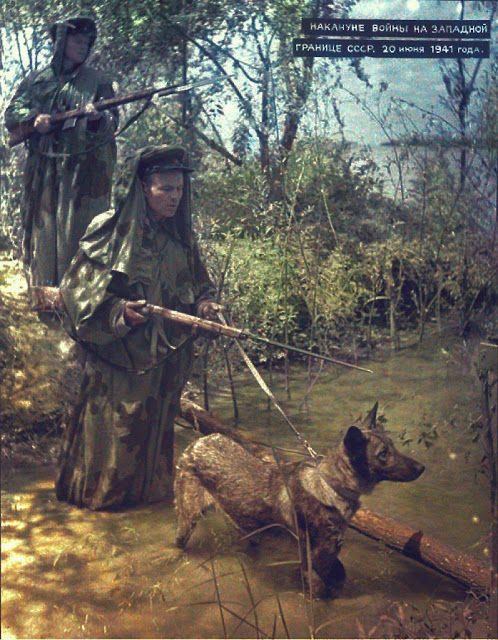
Two Days to BARBAROSSA.
Adolf Hitler tells OKW to distribute the “Proclamation To The Troops of the Eastern Front” that he was working on during the 19th. Of course, there is no “Eastern Front” yet, so the very title is a tip-off to the document’s contents.
Issued in secret, the four-page document includes a lengthy recitation of the warped view of recent history that characterizes his speeches. The Proclamation also includes some specious claims (such as that there were no German troops on the border “until a very few weeks ago” when in fact he has been planning Operation Barbarossa for almost a full year). It is overkill for an “Order of the Day” and reads as an attempted justification for his attack, which he claims has been forced upon him by the Jewish-Bolshevik rulers of Moscow. In other words, it is simply more of the same rationalizations and prevarications that characterize all of his justifications for war.
The Proclamation ends:
“At this moment, soldiers of the eastern front, an assembly of strength the like of which in size and scale the world has never seen is now complete. In league with Finnish divisions, our comrades are standing with the Victor of Narvik [Dietl] on the shores of the Arctic in the north. German soldiers under the command of the Conquerer of Norway [Falkenhorst], and the Finnish heroes of freedom under their own Marshal [Mannerheim] are protecting Finland. On the eastern front stand you. In Romania, on the banks of the Prut, and along the Danube right down to the beaches of the Black Sea are German and Romanian troops united under Antonescu, the head of state. When this, the biggest front line in history, now begins its advance it does so not just to provide the means of ending for all time this great war, or to defend those countries currently concerned, but for the salvation of our entire European civilization and culture.
“German soldiers! You are thus entering upon a harsh and demanding fight — because the fate of Europe, the future of the German Reich, the existence of our nation now rest on your hands alone.
“May the Lord God help us all in this struggle.”
Hitler confirms with OKW operations chief General Alfred Jodl that Operation BARBAROSSA will begin on 22 June.
The German troops amassing on the border with the Soviet Union were told that they were undergoing a large scale exercise. This makes sense to the troops — why attack the Soviet Union when the Reich is still at war with England?
The Kriegsmarine, meanwhile, now is laying mines in the Baltic. U-boats there have orders to shoot at any Soviet ships (there are none). All Soviet ships in Reich ports are prevented from leaving under one pretext or another.
During the day, Adolf Hitler tells his secretaries that he just finds something “wrong” about Russia — it reminds him of the ghost ship in “The Flying Dutchman.” He explains:
“Because we know absolutely nothing about Russia. It might be one big soap-bubble, but it might just as well turn out to be very different.”
This will be a recurrent theme throughout World War II — how little the Reich knows about Russia.
Hitler is confident about Operation Barbarossa but also concerned. In his diary entry today, adjutant Hewel writes that Hitler:
“…told me that this morning [June 20] he again poured over every minute detail, but found no possibility for the enemy to get the better of Germany. He thinks Britain will have to give in — and he hopes it will be before the year is over.”
Hewel also writes that Hitler admits there “must always be a big element of risk.” Among Hitler’s worries are secret weapons, fanatical Soviet resistance, and the unknown.
Hitler needs to take pills to get to sleep. This is the beginning stage of his growing reliance on drugs for normal functioning.
Maneuvers against theoretical enemy troops and warplanes were in progress in several sections of Russia today. But the Kremlin continued to ignore all foreign rumors regarding Soviet-German relations. Russian citizens went about their customary tasks, and an air of complete calm appeared to surround government headquarters. Provincial newspapers told of mock battles in Odessa and White Russian districts. The accounts said that 40,000 members of the Odessa Volunteer Air Raid Precautions society “repulsed” theoretical enemy attacks from the sea and air. The Russian radio and press reported official communiques of all belligerents but for the most part devoted their attention to internal Russian affairs. Reports that Germany had started an actual invasion of Russia were described by Soviet circles as a “delirious fabrication by forces hostile to Germany and Russia.”
Germany first briefed Romania on the plan to invade the Soviet Union. The Germans reveal the secret of Operation BARBAROSSA to the Romanians. This is significant because security for the operation has been extremely tight and very few people outside the upper echelons of the Wehrmacht have been told. The Germans hope to have significant participation from Romanian troops during the invasion, not to mention the fact that the entire Wehrmacht runs on Romanian oil and thus their cooperation in any endeavor is necessary.
Reservists under 45 are called up in Finland. In southeastern Finland civilian population in municipalities along the Fenno-Soviet border are evacuated. The military begins evacuating communities along the border with the Soviet Union in preparation for Operation BARBAROSSA — which Finland will join independently at a later date as the “Continuation War.”
A Soviet aerial formation, the 6th Fighter Corps, is set up in Moscow for the defense of the capital. On Sunday 22 June, civil air raid precautions in Moscow are to be tested “under realistic conditions.”
Soviet Navy light cruiser Voroshilov completed a week-long exercise.
In a case of odd timing, Soviet anthropologists Mikhail M. Gerasimov, Lev V. Oshanin and V. Ia. Zezenkova open the tomb of the Ruler of the Golden Horde, Timur (also known as Tamerlane). His tomb in Samarkand reportedly is inscribed with the words:
“When I rise from the dead, the world shall tremble.”
Inside the casket reportedly is another inscription:
“Whomsoever opens my tomb shall unleash an invader more terrible than I.”
The locals are sure that this violation of the tomb of Timur will lead to bad things — such as an invasion.
Soviet spies in Bulgaria radio the Kremlin that the Germans plan to invade on 21 or 22 June. The warning is filed.
Sleeper Soviet spy Richard Sorge, posing as a journalist in Tokyo, has sent many warnings to Moscow about Operation Barbarossa. Today, he tries again, drafting a final warning:
“[German Ambassador to Japan] Ott told me that war between Germany and the USSR is inevitable…. Invest [the code name for Japanese journalist Hotsumi Ozaki] told me that the Japanese General Staff is already discussing what position to take in the event of war.”
Sorge gives the message to his crony, Max Clausen, for transmission, but for pragmatic reasons, it is not sent until 21 June.
As the day begins on 20 June 1941, the 5th Indian Brigade at Mezzeh is in dire straits. The Vichy French based in Damascus three miles to the east have surrounded them, and they are running out of supplies. They have managed to send three men through the French lines to get word to headquarters that they cannot hold out much longer. Operation Exporter may not be in trouble, but these trapped men are.
Brigadier Wilfrid Lewis Lloyd, now back in command of the 5th Indian Infantry Brigade after temporarily being in command of Genforce (now under the command of Major-General John Evetts), makes his best effort to relieve his encircled troops. He sends two companies from the 3/1st Punjab Regiment, two companies of French Marines and a battery of artillery to open a corridor to Mezzeh. The Vichy French, however, fight hard and slow the relief column, and the relief troops (the 2/3rd Battalion and 2/5th Field Regiment) get no help from the flanks.
The Indian troops, with no food or water and having run out of ammunition, surrender at 13:30, a hugely embarrassing blow for the British command. This goes a long way to restoring Gallic pride on the Vichy side and, somewhat perversely, leaves them more open to the idea of eventual surrender.
However, the hard fighting around Damascus continues. The Australian relief column continues fighting forward and retakes Mezzeh at 19:00. However, now it is an empty city and of little tactical significance beyond being one of many road junctions. The battle around Damascus now degenerates into a classic melee in which both sides jostle for control of the roads and hills (which hold forts) overlooking those roads, with neither side in control as the day ends.
The British started shelling the Syrian “holy city” of Damascus, French authorities said today, as the British advance pressed to within a few miles of the metropolis. The Mahajamrene sector of Damascus was reported worst hit by the shelling which began last night. The French said fires were started throughout that quarter of the city. Syrian authorities at once sent a protest to Baghdad, asking the Iraqis to point out to the British that the bombardment would have an adverse effect upon Arab opinion. The city contains many shrines of the Muslims, and the French previously had expressed the view the British would go slow in firing upon the city.
The Vichy Government decides to ramp up peace feelers to Great Britain. It gives up trying to use the American Consul-General to broker a deal, and instead, Premier Petain covertly sends a representative directly to London. This is fairly easily done via Lisbon.
Luftwaffe General Hellmuth Felmy, the commander of Special Staff F (Sonderstab F), the Luftwaffe’s mission to Iraq, is reassigned. The entire idea of the Axis intervening in Iraq has now drifted completely out of the realm of possibility, so Felmy becomes commander of Army Group Southern Greece (Befehlshaber Südgriechenland). In any event, in these commands, he never has to leave Athens and never has any real responsibility — the reassignment is simply an admission of the ridiculousness of continuing with the fiction of an Axis presence in Iraq.
After sundown, Free French, British, and Australian troops captured Qadim.
The Office Francais d’Information (OFI) [Vichy] announced: “Yesterday the British attempted unsuccessfully to attack Damascus and Merjayoun [Lebanon]. Indian and British troops advanced in the area south and southeast of Damascus, but we succeeded in repulsing them in counterattacks by our armored units and took 400 prisoners. Yesterday afternoon our troops warded off an enemy attack in the mountainous zone of southern Lebanon. We took 80 prisoners in this operation. Along the coast, the British fleet continued to bombard or positions.”
In view of the failure of “Operation BATTLEAXE”, the British attack against Rommel to relieve Tobruk, Churchill has decided to replace Sir Archibald Wavell as C-in-C Middle East. He believes that the defeat, coming so soon after Rommel’s successful offensive and his rebuff of the Allied attack last month, shows that fresh blood is needed to restore British fortunes.
He resolves to replace Middle East Commander General Archibald Wavell with the Commander-in-Chief India, General Claude Auchinleck. Having been in command of a backwater, Auchinleck has minimal combat experience during World War II (like many other World War II leaders he made his reputation in the Great War), but Churchill doesn’t want to recall Wavell to England and make his command change painfully obvious to the public — which would result in uncomfortable questions about his own competence.
Wavell will be told shortly that his successor is to be General Auchinleck, C-in-C India. Although the latter’s only combat experience so far in this war has been command of the Anglo-French forces at Narvik, he saw much action in Mesopotamia in 1914-18 and later on the North-West Frontier of India. Known as “The Auk”, he is highly regarded and has a keen brain, although he is not as intellectual as Wavell.
Alfred Rosenberg delivered a speech in which he stated that the job of feeding Germans was the top German priority, while feeding the conquered peoples in Eastern Europe was not of Germany’s concern. He states that the sole use of the conquered peoples in Eastern Europe is to feed German troops and citizens. Their own survival is not a priority. This is a refrain that will recur from various German leaders throughout the war.
The Norwegian occupation authorities finally force actors and directors to end their theater strike that began on 21 May. The strike has been a major public relations failure for the Germans, receiving publicity in Swiss publications. The strike leaves very hard feelings in the occupation authorities, and the German Ministry of Culture takes full control of Norwegian Theaters. Many prominent theatrical figures are arrested at the Grini concentration camp for the remainder of the war. The strike ultimately has a devastating effect on the Norwegian theatrical scene, as the public decides to boycott shows to show solidarity and puts many theater workers out of work.
Danish artist Peder Mørk Mønsted (Peter Mork Monsted) passes away. He painted brilliantly vivid landscape paintings and was very popular in Germany. His art has enjoyed a resurgence in popularity.
German submarine U-203 (Kptlt. Rolf Mützelburg), on its first patrol out of Kiel and cruising off Iceland, spots US Navy battleship USS Texas (BB-35) just within the “Blockade Zone” established around Great Britain. Technically, at least according to the Germans, this justifies sinking the ship. However, Mützelburg is unable to maneuver into firing position, and the faster battleship gets away. This very nearly starts World War II for the United States six months early. As a result of this event, Grossadmiral Erich Raeder, chief of the German Navy, issues an order stating that U.S. warships may only be attacked if they cross the western boundary of the blockade area by 20+ miles (32.2+ km) or within the 20-mile (32.2 km) strip along the western edge of the zone.
RAF Bomber Command, Day of 20 June 1941
11 Blenheims on coastal sweeps. 1 ship was claimed sunk off the Frisians. No aircraft lost.
RAF Bomber Command, Night of 20/21 June 1941
Kiel
115 aircraft — 47 Wellingtons, 24 Hampdens, 20 Whitleys, 13 Stirlings, 11 Halifaxes — in an attempt to identify and bomb the 77tpitz. No aircraft succeeded in doing so and the city was attacked instead. 2 Wellingtons lost. Kiel reports: much cloud, a few bombs dropped, 1 person injured, ‘Flak fire in all directions’, 1 barrage balloon shot down.
Minor Operations: 5 Wellingtons to Boulogne, 4 Hampdens on unspecified ‘special tasks’ to Essen and Cologne, 2 O.T.U. sorties. No losses.
U-123, commanded by Kapitänleutnant Reinhard Hardegen, sank Portuguese steamer Ganda (4333grt) in 34-10N, 11-40W. At 2010 hours on 20 June 1941 the unescorted and neutral Ganda was hit near the engine room by one of two torpedoes from U-123 off Casablanca. After the crew abandoned ship, she was hit by a coup de grâce at 2019 hours. When the ship settled but did not sink, the U-boat surfaced and sank her by gunfire. As the Germans approached the lifeboats for questioning they noticed their mistake of sinking a neutral ship and left. After the patrol the war diary was altered upon order of the BdU. The second officer, the chief engineer, a crewman and two passengers were lost and 19 others wounded. The master, 46 crew members and 14 passengers abandoned ship in a motorboat and a lifeboat. The 26 occupants of the lifeboat were picked up by a ship and landed in Lisbon on 22 June. The 42 occupants of the motorboat were later picked up by a Spanish trawler about 300 miles from the coast and landed at Huelva. The 4,333-ton Ganda was carrying general cargo, including port wine and was headed for Mozambique.
U-203 sighted American battleship USS Texas (BB-35), escorted by destroyers USS Mayrant (DD-402), USS Rhind (DD-404), and USS Trippe (DD-403), off Iceland. U-203 was unable to obtain a firing position. Afterwards, the German command placed restrictions on the possibility of German U-boats attacking U.S. Navy warships.
Light cruiser HMS Sheffield departed Scapa Flow to refit at Rosyth.
Destroyer HMS Hambledon departed Scapa Flow at 0300 to meet steamers Amsterdam and Lady of Mann off the entrance of Aberdeen at 1030.Steamer Lady of Mann was detached off Duncansby Head to Kirkwall. Steamer Amsterdam was escorted to Lerwick, arriving at 2200. The two ships departed Lerwick at 1030/21st and steamer Lady of Mann joined at 1630. The ships arrived off Aberdeen at 2300. The destroyer then proceeded to Chatham for fitting of SA equipment prior to joining the Nore Command.
Minesweeping trawler HMS Resmilo (258grt, Skipper R.D. Stephen RNR) was sunk by German bombing at Peterhead. There were no casualties on the trawler.
Minelayer HMS Teviotbank laid mines in the North Sea in minefield BS.64, escorted by destroyer HMS Mendip.
Norwegian steamer Schieland (2249grt) from convoy FS.520 was sunk by German bombing in 53-18N, 1-01E. There were nine survivors from the steamer; one of which later died of injuries, picked up by destroyer HMS Mendip.
British tanker Inverarder (5578grt) was damaged by German bombing off the Isle of Wight. The tanker was beached off Motherbank Buoy, Solent. The taken was refloated and taken to Southampton for repairs.
British steamer Ilse (2844grt) was damaged on a mine on the west side of Hartlepool Approach Channel, in 54-41N, 1-20W. One crewman was killed. The back of the ship was broken. The afterpart was taken to Middlesborough and a new forepart was built on.
British steamer Cormount (2841grt) was damaged by German aerial torpedoing off Outer Dowsing Light Vessel. One gunner was killed on the steamer.
Destroyers HMS Decoy, HMS Hotspur, and HMS Havock departed Alexandria for Haifa. On the 21st destroyers HMS Hero, HMS Kimberley, and HMS Jackal departed Haifa on relief for Alexandria.
Submarine HMS Parthian departed Alexandria to patrol off Syria to destroyer Vichy warships.
Submarine HMS Severn unsuccessfully attacked a steamer off Palermo.
Submarine HMS Tetrarch unsuccessfully attacked a steamer off Lemnos.
Italian submarine Ondina sank Turkish steamer Refah (3805grt) forty miles south of Mersin. Twenty five crewmen and one hundred and forty two passengers were lost on the steamer.
Italian steamer Buccari (4543grt) was lost in an explosion at Taranto.
Destroyers HMS Faulknor, HMS Fearless, HMS Forester, and HMS Foxhound departed Gibraltar to escort battlecruiser HMS Renown and aircraft carrier HMS Ark Royal into Gibraltar. Destroyer HMS Fury was ordered to part company with ocean boarding vessel HMS Marsdale and join the escort. On the 22nd, Force H arrived back at Gibraltar.
British deperming vessels HMS Springtide and HMS Springdale and naval trawler HMS Canna departed Gibraltar for Freetown with destroyer HMS Avonvale as local escort. Norwegian tanker Norvinn sailed and company and proceeded to the west.
Light cruiser HMS Mauritius relieved heavy cruiser HMS Shropshire in the 4th Cruiser Squadron at Colombo.
The submarines USS O-6 (SS-167), USS O-9 (SS-170) and USS O-10 (SS-171) conducted deep submergence trials out of Portsmouth, New Hampshire. While the USS O-6 and USS O-10 conducted their test dives without incident, the USS O-9 (Lieutenant H.J. Abbot), the last boat to make the test dive, accidentally sank from an unknown cause off the Isles of Shoals, southeast of Portsmouth, in 42-59N, 70-27W. The O-9 was lost with all 33 of her crew.
Convoy OB.337 departed Liverpool, escorted by destroyers HMS Chelsea and HMS Veteran, catapult ship HMS Springbank, and corvettes HMS Arbutus, HMS Begonia, HMS Larkspur, HMS Pimpernel, and HMS Rhododendron. Destroyers HMS Mansfield and HMS Verity and corvette HMS Jasmine joined on the 21st. Destroyer Veteran was detached on the 21st and destroyers Mansfield and Verity on the 24th. The convoy was dispersed on the 28th.
Convoy HX.134 departed Halifax, escorted by battleship HMS Revenge, armed merchant cruiser HMS Maloja, corvettes HMCS Dauphin and HMCS Napanee, and auxiliary patrol vessel HMCS Rayon D’or. The corvettes and the patrol vessel were detached later that day. Convoy BHX.134 departed Bermuda on the 19th escorted by ocean escort armed merchant cruiser HMS Ascania. On the 23rd, the convoy rendezvoused with convoy HX.134 and the armed merchant cruiser was detached. On the 24th, sloops HMS Aberdeen and HMS Sandwich and corvettes HMCS Hepatica, HMCS Primrose, HMCS Trillium, and HMCS Windflower joined. This group, including the armed merchant cruiser, was detached on 4 July. Corvette HMS Bittersweet joined on 3 July and on 4 July, destroyers HMS Roseborough, HMS Salisbury, and HMS Sherwood, corvettes HMS Carnation, HMS Hollyhock, and HMS Nigella, minesweepers HMS Britomart and HMS Salamander, and anti-submarine trawler HMS St Apollo joined. Destroyer HMS Bulldog joined on 5 July. Destroyer Bulldog, sloop Aberdeen, and corvette Aubretia were detached on 8 July. The remainder of the escorts arrived with the convoy at Liverpool on 9 July.
Convoy SC.35 departed Sidney, CB, escorted by armed merchant cruiser HMS Ausonia and auxiliary patrol boats HMCS Raccoon and HMCS Reindeer. The patrol vessels were detached on the 24th. On the 24th, sloop HMS Aberdeen and corvettes HMCS Trillium and HMCS Windflower joined the convoy. The corvettes were detached on 4 August. On 4 August, destroyers HMS Bulldog and HMS Salisbury, corvettes HMS Aubretia, HMS Carnation, HMS Hollyhock, and HMS Nigella, and minesweepers HMS Britomart and HMS Salamander joined the convoy. Minesweepers HMS Seagull and HMS Sharpshooter joined on 7 July. Corvette HMS Picotee joined on 8 July. On 8 July, sloop Aberdeen and the minesweepers were detached. The convoy arrived in the Clyde on 9 July.
In Washington, President Roosevelt sent to Congress today a message condemning the sinking by Germany of the American steamship Robin Moor, signed an order putting petroleum products under export control and signed the bill to deny visas to aliens whose activities might endanger public safety in this country. His press conference was canceled.
The Senate passed the $936,390,000 Relief Appropriation Bill, the bill extending the life of the Maritime Labor Board for one year and the bill giving the President control over movements of individuals to and from the United States, completed Congressional action on the $188,325,923 Interior Department Appropriation Bill and the $279,150,000 State-Justice-Commerce Appropriation Bill and adjourned at 2:27 PM until noon on Monday.
The House passed the bill authorizing $260,000,000 in flood-control projects and the bill authorizing $19,500,000 for development of naval shore bases for dirigibles, approved the conference report on the $1,060,500,063 Agriculture Appropriations Bill, completed Congressional action on the bill authorizing the President to control movement of individuals to and from the United States and adjourned at 5:33 PM until noon on Monday.
President Roosevelt told Congress that the United States would not yield to such “outrageous and indefensible” acts as the sinking of the SS Robin Moor and said that Germany would be held accountable. U.S. President Franklin D. Roosevelt addressed Congress and denounced the sinking of the American merchant steamship SS Robin Moor by the U-69 on May 21, 1941. “The total disregard shown for the most elementary principles of international law and of humanity brands the sinking of the Robin Moor as the act of an international outlaw.” Roosevelt noted that the Robin Moor’s destruction was a “warning that the United States may use the high seas of the world only with Nazi consent. Were we to yield on this we would inevitably submit to world-domination at the hands of the present leaders of the German Reich. We are not yielding,” the President declared, “and we do not propose to yield.” Undersecretary of State Sumner Welles sent this message to the German Embassy for the information of the German government.
President Roosevelt warned Nazi Germany, in effect but unmistakably today, that if it persists in such acts of “piracy” as the sinking of S.S. Robin Moor, this nation will resist with force. The destruction of that vessel must be construed, he said in a special message to congress, as essentially part of a German plan for world domination, a first step in an effort to grasp control of the seas.
The President does not, of course, mention that Robin Moore was carrying war supplies to the British. However, to be fair to Roosevelt, the Robin Moore was sunk outside of the blockade zone set up by the Reich around Great Britain and the attack thus was illegal despite renewed warnings by the Germans in May about the dangers on the high seas. So, both sides have some facts with which to justify their positions, but all that matters, for the time being, is whether the United States is going to declare war over the affair — and it isn’t. Not yet…
President Roosevelt put all petroleum products under export controls today and forbade shipments from Atlantic Coast ports to any countries except the British Empire, Egypt, and those in the Western Hemisphere. The White House said that the action was necessary to meet a threatened shortage of petroleum products in the Eastern United States. Although some persons have advocated shutting off all oil from Japan and Russia, the State Department issued a general license permitting these countries to take petroleum products from any port except those on the Atlantic.
Charles Lindbergh gives an isolationist speech in Los Angeles.
Ford Motor Company signed its first contract with United Automobile Workers and Congress of Industrial Organizations. Henry Ford’s long fight against unionization of his far-flung automobile empire ended today when the Ford Motor Co. signed a union shop agreement with the C.I.O.’s United Automobile Workers union. The pact an historic milestone in American labor relations covers all of the 130,000 production and maintenance workers at Ford plants throughout the country. Simultaneously, the national labor relations board announced it had wiped its slate clean of all cases involving Ford and the U.A.W. All charges by the union now on file in any board office will be withdrawn by the union “as settled amicably between the parties,” the announcement said. Union leaders hailed the contract which will be submitted to Ford workers for ratification next week as marking the elimination of the only major holdout against unionism in the automobile industry.
The interstate commerce commission today suspended until January 20, 1942, proposed rate reductions of 10 cents per 100 pounds on carload shipments of citrus fruit from Arizona and California to points in Idaho, Oregon and Washington. The commission will determine the reasonableness of rates before deciding whether they should be permitted to become effective In 1942.
The Senate, without a record vote, adopted today a House amendment of a World War law to give the President almost unlimited authority to regulate or prohibit the movement into or out of the country of both citizens and aliens.
Airplanes moving at a speed approaching the velocity of sound have given engineers the problem of producing measuring and recording instruments that will function accurately under such conditions, it was reported in Philadelphia today. Correct measurement of air temperature and pressure by methods previously used is no longer possible, H. W. Emmons of Harvard and J. G. Brinerd of the University of Pennsylvania told a meeting of the applied mechanics division of the American Society of Mechanical Engineers.
The United States Army Air Corps (USAAC) was renamed the United States Army Air Force (USAAF) under the command of Major General Henry H. “Hap” Arnold. The USAAF was to be somewhat autonomous from the U.S. Army. Arnold becomes Chief of the Army Air Forces and acting “Deputy Chief of Staff for Air” with authority over both the Air Corps and Air Force Combat Command (successor to GHQAF). Arnold would prefer that the air force become a separate branch of the military equal to the Army and Navy, but Chief of Staff George C. Marshall (an old friend from before World War I) convinces Arnold to wait until after the brewing war for complete separation.
The U.S. Navy placed a contract with the Douglas Aircraft Company for two prototype aircraft of a new carrier torpedo/dive bomber design.
The U.S. Navy battleship USS Texas (BB-35) and destroyers USS Mayrant (DD-402), USS Rhind (DD-404), and USS Trippe (DD-403) were sighted by the U-203 within what the German navy regarded as the war, or “blockade” zone in the Atlantic Ocean. The American force, however, unaware of the U-boat, outdistanced the submarine and frustrated its attempted attack. In the wake of this incident, the commander in chief of the German navy (Grand Admiral Erich Raeder) ordered that American warships could only be attacked if they crossed the western boundary of the blockade area by 20 or more miles, or within the 20-mile strip along the western edge of the blockade zone.
U.S. Navy Task Group 2.6, comprised of the aircraft carrier USS Wasp (CV 7), heavy cruiser USS Tuscaloosa (CA-37), and destroyers USS Anderson (DD-411) and USS Rowan (DD-405), departed Hampton Roads for a 4,320-mile neutrality patrol that would conclude at Bermuda on July 4.
Three U.S. Navy submarines conduct deep submergence tests about 15 miles (24 km) off Portsmouth, New Hampshire. These tests go very badly when USS O-9 (SS-70) implodes and kills its 33 crewmen. On the morning of 19 June 1941, O-9 and two of her sisters, O-6 and O-10, left as a group from the submarine base in New London, for the submarine test depth diving area east of the Isles of Shoals. Upon reaching their designated training area the following day, some 15 mi (24 km) off Portsmouth, New Hampshire, O-6 made the first dive, followed by O-10. Finally, at 07:38, O-9 began her dive; the sub did not surface thereafter but was crushed by the pressure of the water over 400 ft (120 m) below. The sub went down in the area where Squalus had been lost. There is nothing that can be done, it is a great tragedy that receives surprisingly little publicity and is not long widely remembered.
“Berlin Diary” by the American journalist William L. Shirer was published.
The comedy film “The Big Store” starring the Marx Brothers was released.
“Out of the Fog,” a gangster drama, based on Irwin Shaw’s play “The Gentle People,” is released. It is directed by Anatole Litvak and stars Ida Lupino, John Garfield, Thomas Mitchell, Eddie Albert, George Tobias, Leo Gorcey and John Qualen. The plot has fisherman Mitchell being shaken down by gangster Garfield. Afraid to go to the police, Mitchell decides to take matters in his own hands after Garfield falls in love with Mitchell’s daughter (Lupino).
“The Reluctant Dragon,” an animated documentary, is released. It has Robert Benchley taking the audience on a tour through the Walt Disney studios. Alan Ladd plays one of the animators we meet along the way. The film roughly breaks even and does not alleviate the financial strain under which Disney Studios has been laboring since the failure of “Pinocchio.” However, as with all Disney animated films, the characters live on in the Disney universe and make appearances in “Who Framed Roger Rabbit” (1988) and some other later productions.
Major League Baseball:
Although outhit, 11 to 7, by the St. Louis Browns, the Boston Red Sox took the series opener today, 4–2, making better use of their hits. Jumping on Eldon Auker for three runs in the sixth, the Sox provided Joe Dodson with his fourth victory, against two defeats. Dom DiMaggio and Ted Williams led off with doubles, and after George McQuinn committed an error by dropping a thrown ball at first base, Foxx was walked intentionally and Tabor singled.
Larry French, sidetracked from two starting turns because of his disappointing record, came back to shut out the Braves on four hits today while the Cubs cashed passes for three runs and added two more on homers by Phil Cavarretta and Babe Dahlgren for a 5–0 triumph.
On May 13 Hugh Casey limited the Reds to six hits to gain the decision over Bucky Walters. Today he gave the world champions only three while the Dodgers were collecting nine off Walters for a 6–2 triumph. The big blow off Walters was Dolph Camilli’s fifteenth homer of the campaign, a 400-foot clout into the right centerfield seats in the sixth with Lew Riggs on base via a single to right.
The Detroit Tigers play the New York Yankees in Yankee Stadium in New York City and Joe DiMaggio goes 4-for-5 against Tiger pitchers Bobo Newsom and Archie McKain. The Yankees amass 17 hits in all and roll over the Tigers and pitchers Newsom and McKain on the way to a 14–4 victory. DiMaggio’s double and three singles extend his hitting streak to 33 games. While DiMaggio is setting history with his streak, his batting average remains far below that of Boston Red Sox player Ted Williams, who is en route to the last .400 season in MLB history.
The Phillies lost their fifth straight game today, but carried the Pirates to the very last ditch in the ninth inning before bowing, 7 to 6. With the bases filled and two out, Frank Gustine belted a sharp single to center, scoring Elbie Fletcher with the winning run. Nick Etten’s homer with two on in the seventh put the Quakers four runs in front, but the Pirates rallied to tie it up in the eighth.
Lashing into the opposition with an eighth-inning surprise attack, the Giants tonight floored the National League-leading Cardinals by a score of 6–2 in the opening clash of a four-game series. Five runs hurtled across in this round, Harry Danning’s sixth homer of the year providing the first tally and bespectacled Bob Carpenter blasting home two more with a single that put his pitching adversary, Lon Warneke, to rout.
The lowly Washington Senators allowed the Cleveland Indians to tie the score with a three-run drive in the ninth, but pushed over a run in their half of the inning to beat the American League leaders, 7–6, today.
St. Louis Browns 2, Boston Red Sox 4
Boston Braves 0, Chicago Cubs 5
Brooklyn Dodgers 6, Cincinnati Reds 2
Detroit Tigers 4, New York Yankees 14
Philadelphia Phillies 6, Pittsburgh Pirates 7
New York Giants 6, St. Louis Cardinals 2
Cleveland Indians 6, Washington Senators 7
Japan’s establishment of monopoly control systems in Manchuria and North China is slowly but surely ruining both countries, and unless changed will completely bankrupt the rich northern areas within two years, according to foreign business men and travelers who have been making detailed inspection trips in the hope of increasing their imports. At present, Manchukuo’s soy bean crop is approximately half of what it has been in previous years, and all indications point to further reductions. The reason for this serious curtailment in Manchukuo’s most important product is that, after the harvest, the peasant farmer-producer must sell his bean crop to a government-controlled receiving agency, at prices fixed by the agency. Afterward the farmer must buy necessaries for living and continue farming entirely through government-controlled selling agencies, and again at prices announced by the agencies. The travelers point out that soy beans are only taken as an example. All the products of Manchukuo and North China are similarly handled by controlled agencies, with the result that farmers are not able to show even the smallest profit for a year’s labor. In many localities, as a result, farmers are abandoning attempts to raise the usual products and are turning to the cultivation of the opium poppy, in some cases under government control and in others for bootleg markets.
The Japanese protest at the opening of the luggage of Japanese Minister Yoshiaki Miura by Pan American Airways employees in Guatemala. Diplomat Sadao Iguchi goes to the office of the Chief of the Far Eastern Section in Washington and requests that the airline be told the proper handling of diplomats’ baggage, i.e., not to search them. The reason the Japanese are so concerned with this issue at this time is that they have come into possession of detailed maps of the Panama Canal Zone from Italians living there and wish to transport them to Tokyo. There, the maps could be used for planning military attacks.
Dow Jones Industrial Average: 122.19 (-1.29)
Born:
Ulf Merbold, German physicist and 1st non American NASA astronaut (1978 ESA Group; STS 9 [Columbia], 1983; STS-42 [Discovery], 1992; Soyuz TM-20/Mir/TM-19, 1994), in Greiz, Thuringia, Germany.
Stephen Frears, British film director (“Prick Up Your Ears”, “Dangerous Liaisons”), in Leicester, England, United Kingdom.
Luis Alcaraz, Puerto Rican MLB second baseman and third baseman (Los Angeles Dodgers), in Humacao, Puerto Rico.
Al Snyder, AFL and NFL wide receiver (Boston Patriots, Baltimore Colts), in Baltimore, Maryland.
Naval Construction:
The U.S. Navy YMS-1-class auxiliary motor minesweeper USS YMS-45 is laid down by Wheeler Shipbuilding Corp. (Whitestone, Long Island, New York, U.S.A.).
The U.S. Navy YMS-1-class auxiliary motor minesweeper USS YMS-88 is laid down by Hubbards South Coast Co. (Newport Beach, California, U.S.A.).
The U.S. Navy YMS-1-class auxiliary motor minesweeper USS YMS-130 is laid down by Tacoma Boat Building Co. (Tacoma, Washington, U.S.A.).
The Вое́нно-морско́й флот СССР (ВМФ) (Soviet Navy) “M” (Malyutka)-class (4th group, Type XV) submarines M-234 and M-235 are laid down by Krasnoye Sormovo (Gorkiy, U.S.S.R) / Yard 112.
The Royal Navy “R”-class destroyer HMS Relentless (H 85) is laid down by the John Brown Shipbuilding & Engineering Company Ltd. (Clydebank, Scotland).
The Royal Canadian Navy Bangor-class (Diesel-engined) minesweeper HMCS Brockville (J 270) is launched by Marine Industries Ltd. (Sorel, Quebec, Canada).
The Kriegsmarine (German Navy) Type IXC U-boat U-506 is launched by Deutsche Werft AG, Hamburg (werk 296).
The Royal Navy corvette HMS Campion (K 108) is launched by John Crown & Sons Ltd. (Sunderland, U.K); completed by Clark.
The U.S. Navy Aloe-class net tender USS Catalpa (YN-5; later AN-10) is placed in service. Her first commanding officer is Lieutenant (j.g.) Flave J George, Jr., USNR.
The U.S. Navy fleet oiler USS Chenango (AO-31) [ex-Esso New Orleans] is commissioned. Her first commanding officer is Commander William H. Mays, USN. She will be converted to an escort carrier in early 1942, commissioning as USS Chenango (ACV-28; later CVE-28) in September, 1942.
The Royal Navy MMS I-class motor minesweeper HMS MMS 33 (J 533) is commissioned.
The Royal Navy Isles-class minesweeping trawler HMS Hoxa (T 16) is commissioned. Her first commanding officer is T/Lieutenant Hugh Patrick Davies, RNR.
The U.S. Navy coastal minesweeper USS Grouse (AMc-12) [ex-New Bol] is commissioned. Her first commanding officer is Lieutenant (j.g.) Theodore L. Bergen.
The Royal Navy Abdiel-class minelayer HMS Manxman (D 70) is commissioned. Her first commanding officer is Captain Robert Kirk Dickson, RN.
The U.S. Navy 77-foot Elco patrol motor torpedo boat USS PT-20 is commissioned.
The Kriegsmarine (German Navy) Type VIIC U-boat U-351 is commissioned. Her first commanding officer is Oberleutnant zur See Karl Hause.
The Royal Navy escort carrier HMS Audacity (D 10) [ex-German MV Hannover] is commissioned. Her first commanding officer is Her first commanding officer is Douglas William MacKendrick, RN.
 History Diaries