The Soviet Union ordered black-outs in all cities along the border with Germany and the camouflaging of airfields, but still did not deploy for defense; the latter order, the camouflaging of airfields, would be scarcely commenced when the invasion took place. The Soviet Navy issues a Grade 2 Alert to its units. The Red Air Force orders camouflaging of airfields, and the government orders blackout in cities along the western border. Some of these orders, such as the camouflaging of airfields, take days to begin implementing and are barely started when Operation Barbarossa begins.
General Pavel Batov assumes command of the 9th Rifle Corps.
The Kriegsmarine began mining the Baltic Sea.
After some meetings during the day, Adolf Hitler spends the evening drafting his “Proclamation” for Operation Barbarossa. This will be issued to the troops shortly before the opening of Operation BARBAROSSA. It is a curiously dour document that pins the entire future of European civilization itself on the outcome of the invasion.
Around 18:00, Foreign Minister Ribbentrop telephones to say that Soviet Ambassador Dekanozov has stopped by the Ministry, transacted some normal business, made some small talk and jokes, and then left without incident. This ends 24 hours of uncertainty after Dekanozov on the 18th had indicated he needed to visit the German Ministry for unspecified reasons.
The Wehrmacht cancels all soldier leaves. Reichsfuhrer-SS Heinrich Himmler, however, who technically is not in the Wehrmacht, flies home to his private house on Lake Tegerness to visit with his family. They go to a nearby field in the Valepp Valley and pick daisies by the roadside for the propaganda cameras.
Soviet anthropologist Mikhail Gerasimov opens the tomb of Timurid Empire founder Timur and allegedly finds an inscription stating that whoever opens the tomb shall “unleash an invader more terrible than I.” Three days later, Germany invades the Soviet Union.
Soviet agents in Germany and Finland continue issuing warnings to the Kremlin of a coming German attack on the Soviet Union. The spy reports now routinely identify the date of the attack as 22 June.
Three Days to BARBAROSSA.
The Battle of Merdjayoun began in French Lebanon. The British approach toward Damascus during Operation EXPORTER has gained ground on 19 June 1941, but suddenly shows signs of stalling due to fierce Vichy French counterattacks. This has resulted in overall control of the advance being taken away from General Henry Maitland Wilson on the 18th, and today results in Major-General John Evetts, commander of the British 6th Infantry Division, replacing Brigadier Wilfrid Lewis Lloyd as commander of Gentforce east of Merdjayoun.
The 5th Indian Brigade has taken Mezzeh, a key junction on the Damascus/Beirut road, during the night. However, they spend the 19th trying to keep it against furious French counterattacks. Evetts quickly requests reinforcements and receives the British 16th Infantry Brigade from the 7th Australian Division and three Australian battalions: the 2/3rd Machine Gun Battalion and the 2/3rd and 2/5th Infantry Battalions.
The British and Australian reinforcements, however, require time to get to Mezzeh, and it is time that the embattled Indian troops may not have. By evening, they are isolated and taking tremendous casualties from the French and their Renault R35 tanks. Expecting the advance to continue straight to Damascus, the Indian troops have not carried with them mundane things like food and water for an extended siege. So, there is no food or water, and there are dead men everywhere. After dark, the Indian troops send three men who manage to get past the encircling French forces and report the dire situation to Evetts. The French claim to have taken 400 prisoners. Indian 5th Infantry Brigade remains surrounded.
Near Merdjayoun, meanwhile, the situation if anything is even worse for the British. Easily taken a week ago by the Australian 25th Brigade, the majority of those troops were sent east to help with the advance along the coast. The 25th had left behind only a small force to defend Merdjayoun, but this was considered acceptable because the Vichy French were giving ground.
This turns out to have been a bad idea, as the French already have retaken part of Merdjayoun and have placed the embattled Australians in a precarious position. On the 19th, the Vichy French there continue the attack against the outnumbered Australians and claim to take 80 prisoners. Australian Lieutenant Roden Cuttler, a forward artillery observer, takes over a Bren gun and anti-tank rifle after others at his outpost are killed and helps to hold an outpost in the town against the French. After being surrounded, he escapes in the dark. For this and subsequent valor, Cuttler earns the Victoria Cross, the only Australian artilleryman to earn it during World War II.
Lieutenant General Sir John Dudley Lavarack, who now has operational control in Syria and Lebanon, confers with Wilson in Jerusalem. Lavarack gets permission from Wilson to let the forces around Damascus and around Merdjayoun work things out as best they can while the main effort remains on the coast road to Beirut.
The Vichy government, meanwhile, already is asking the British via the American consulate for peace terms. However, there is no indication that this will end the conflict anytime soon, at this point it is just casual talk.
Germany requested the withdrawal of United States consular staffs from territories under their control by July 15, 1941. This action was made in response to U.S. government’s decision on June 16, 1941 to close of all German consulates in the United States by July 10, 1941.
Italy requested the withdrawal of United States consular staffs from territories under their control by July 15, 1941. This action was made in response to U.S. government’s decision on June 16, 1941 to close of all Italian consulates in the United States by July 10, 1941.
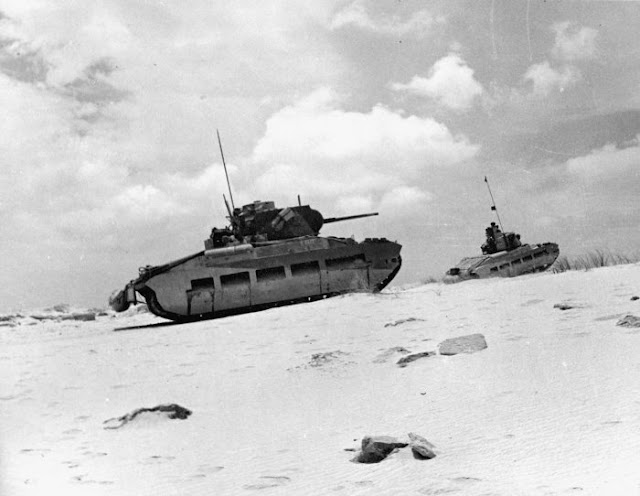
The German News Bureau reported: “The most recent reports indicate that the British have lost more tanks (in North Africa) than was earlier estimated: When we cleared up the battlefield, we found 200 British tanks destroyed or immobilized by German and Italian guns, which the British were forced to abandon when they retreated.”
The German figures are exaggerated — British tank losses were far fewer than 100, let alone 200 — but the complete British defeat gives the Germans a welcome opportunity to pat their staggering Italian allies on the back in the shared victory.
An Axis convoy departs from Naples with five freighters/transports bound for Tripoli. It is escorted by four Italian destroyers.
The Royal Navy headquarters at Alexandria institutes a major resupply of the embattled British forces in the Western Desert. It begins the “Tobruk Ferry,” which entails sending destroyers to Mersa Matruh and Tobruk at night. The Luftwaffe dominates the skies over North Africa at this time and such naval missions are extremely hazardous.
Following a review of Malta’s defenses, the War Office promises large reinforcements. Whitehall promises thousands of additional troops to prevent a German takeover as in Crete — but there remains the small matter of actually getting them there. Governor Dobbie replies that the most urgent needs are additional RAF forces and an infantry battalion.
King George VI and Queen Elizabeth visit factories and war ruins in Billingham and other areas in the northeast.
Romania orders the evacuation of about 2,000 Jews in Darabani under the pretext they were pro-Soviet sympathizers. Forced from their homes within 30 minutes, they were robbed and marched 22 miles to the Dorohoi station before being deported to concentration camps in southern Romania. They were interned in the camps in Oltenia; men in Târgu Jiu, and women in Turnu-Severin. After three months, they were brought to Dorohoi, from where they were deported on November 7th, 1941 to Transnistria. The deported Jews were searched by representatives of the National Bank, and the money and valuables, such as gold and jewelry, were confiscated. In return, they received Transnistrian money, that was worthless. During the years of deportation, many of the Jews in Darabani died of starvation, cold, and disease. After the end of the war, in 1947, about 1,000 Jews lived in Darabani. Over time, most of them emigrated. So, in 1992 no Jews lived in the city.
General Halder, Chief of the OKH (Army High Command), visits Hungary for a conference.
Hitler talks to Hans Frank, the Governor-General of the occupied Polish territories (Generalgouverneur für die besetzten polnischen Gebiete). Frank controls all of the territories, known as the General Government, that encompass pre-war Poland aside from those directly incorporated into the Reich — roughly half of the original 187,000 square miles occupied by the Wehrmacht (which of course does not include the far larger portion allocated to the Soviet Union).
Frank long has objected to having Jews from throughout Occupied Europe shipped to the General Government for internment. This is partly because he resents having them under his administration, but more importantly, because controlling them has expanded the influence in the General Government of Reichsführer-SS Heinrich Himmler — at Frank’s expense. Frank sees himself as a sort of overlord and chafes at having other authority in “his” territory.
Hitler tells Frank that the territories soon to be wrested from the Soviet Union will become the new “home” of the Jews. These new destinations in “the East” are to replace the nebulous destination of Madagascar that has been bruited about within the government as the eventual home of European Jewry. Frank is delighted and quickly tells his staff that there will be no need for more Ghettos such as the ones in Warsaw and Lodz because all the Jews from now on — including the ones already in the Ghettos — will be heading “east.’
Hitler, however, is unclear about what he really intends for the Jews. The only thing that Frank cares about is that the Jews are heading “east” of his own domain, so he does not press for further details. Where in the “east” Hitler means is left undefined, and what would happen to the Jews once they got there is deemed an unimportant detail at this stage. This will be resolved at the Wannsee Conference in January 1942.
Luftwaffe night-fighter ace Egmont Prinz zur Lippe-Weißenfeld is mentioned in the Wehrmachtbericht bulletin of the headquarters of the German Wehrmacht. This is considered one of the highest honors a German officer can receive and is coveted even by generals. Prince Lippe-Weißenfeld (he is an heir to the throne of the Principality of Lippe, which was abolished under the Weimar Republic) now has about 10 victories over the bombers, which are considered the most prestigious enemy aircraft to destroy.
RAF Bomber Command, Day of 19 June 1941
36 Blenheims on a Circus operation to Le Havre docks. Only 9 aircraft bombed. No Blenheims lost. There is a thick haze that confuses many of the RAF navigators, and only 24 of the bombers make the rendezvous over Tangmere. An additional 15 bombers failed to find the target, and only nine bombers actually make it to Le Havre. They bomb No. 1 Dry-Dock successfully. RAF No. 616, flying escort, tangles with the Luftwaffe near Le Havre and claims one fighter.
RAF Bomber Command, Night of 19/20 June 1941
Cologne
28 Wellingtons; 1 lost. Good bombing was claimed but Cologne only reports 60 incendiary bombs in the city with no casualties.
Düsseldorf
20 Whitleys; 1 lost. Ground haze.
The Flag of A/Vice Admiral A T B. Curteis CB, Second in Command, Home Fleet, transferred his flag from light cruiser HMS Arethusa to battleship HMS Prince of Wales.
Rear Admiral E.N. Syfret CB, assumed command of 18th Cruiser Squadron on light cruiser HMS Kenya. On the 20th, the flag was transferred to light cruiser HMS Edinburgh.
Destroyers HMS Eclipse and HMS Echo departed Scapa Flow at 2000 for Reykjavik to reinforce the anti-submarine screen for the cruisers on the Denmark Straits patrol. The destroyers arrived during the afternoon on the 21st.
Destroyer HMS Vanessa was damaged by German bombing in the North Sea. The destroyer was then involved in a collision with anti-submarine trawler HMS Turquoise (430grt). The destroyer was towed to Yarmouth by destroyer HMS Vesper. The destroyer received temporary repairs at Great Yarmouth from 19 to 30 June. The destroyer was then towed to the Thames and repairing at London to 15 April 1942.
Anti-aircraft ship HMS Alynbank departed Scapa Flow at 1240 to meet convoy WN.42 in the Pentland Firth and escorted it to Methil where they arrived at 1900/19th.
Minelayer HMS Plover, escorted by destroyer HMS Cotswold, laid minefield BS.59 off the east coast of England. Minesweepers accompanied the minelay.
Destroyer HMS Wrestler departed Gibraltar for Freetown to join the South Atlantic Command.
British steamer Empire Warrior (1306grt), after breaking away from convoy HG.64 was sunk by German bombing two and three quarters miles off Guadiana Bar, Gulf of Cadiz, 37-06N, 7-24W. The entire crew was rescued by a Portuguese destroyer.
Swedish steamer Gunda (1770grt) after breaking away from convoy HG.64 was sunk by German bombing in 37-36N, 9-53W. The steamer had been taken in tow by British steamer Peterel, but later sank. The entire crew was rescued by the steamer and anti-submarine trawler HMS Imperialist.
President Roosevelt signed an executive order authorizing government workers on cantonments, air fields and fortifications in the Canal Zone and Alaska to work longer than eight hours a day. His callers included Secretary Stimson, Chairman George of the Senate Foreign Relations Committee, Representative Joseph A. Gavagan of New York, Gerald Cruise of the New York State Power Authority and John Blandford Jr., assistant budget director.
The Senate rejected an amendment for increasing relief appropriations, passed the $1,200,509,060 Labor-Federal Security Appropriation bill, received the President’s request for authority to suspend safety-at-sea regulations and recessed at 5:42 PM until noon tomorrow. The Military Affairs Committee continued hearings on the property requisitioning bill; the Interstate Commerce Committee heard further support for the radio investigation proposal; the Banking and Currency Committee heard opposition to extension of the President’s monetary powers.
The House approved a conference report on the $279,416,547 State-Justice-Commerce appropriation bill, received the President’s request to suspend safety-at-sea rules and adjourned at 5:43 PM until noon tomorrow. The Rivers and Harbors Committee heard support for the St. Lawrence seaway. The Ways and Means Committee announced its proposals on income and excess profits taxes.
The U.S. government today ordered a curtailment in consumption of rubber in order to build up its stockpile for use in the defense program. Officials said that a formula would be worked out under which processors would be allotted a fixed percentage of the amount of rubber they formerly had processed. It was expected that processors would not be told which items they must cut down on, but officials acknowledged that tire manufacturing would be curtailed. Officials of the Office of Production Management said that under the program, consumption of rubber during the last six months of 1941 would be reduced from the current rate of 817,000-tons annually to a rate of about 600,000-tons. Tire manufacturing consumes about 70 percent of the rubber used in the United States. Much of the rubber used in the United States comes from the Dutch East Indies and British Malaya. There has been considerable concern in some quarters lest the supply be cut off by a Japanese move into that area of the world. It was stated that there was no shortage of rubber now but controls were considered necessary because of shipping uncertainties and the necessity of building up adequate stocks for defense.
Lord Halifax, the British Ambassador to the United States, gives a speech at the Harvard Alumni luncheon. He notes:
“The President has declared in terms that no man can mistake on which side in this grim contest stands the United States. And there is no need for me to dwell upon the encouragement that his words have brought to my people, to the whole British Commonwealth, or to lovers of freedom everywhere.”
He calls England “the last home of freedom in Europe.”
Apparently given as a response to the University of Rochester, New York conferring an honorary degree on Winston Churchill, Oxford University confers the degree of Doctor of Civil Law on President Franklin Roosevelt. Neither man, of course, attends the ceremony.
The German-controlled Paris press said today that a break in diplomatic relations between Vichy and Washington was imminent and probably would be followed by United States seizure of French possessions in the Western Hemisphere. Official sources in Vichy said, however, that no diplomatic dispatches had been received to indicate that such a development was pending.
Accusing Secretary of Labor Perkins of an “all out surrender to subversive leadership of the C.I.O.,” Representative Leland M. Ford, California Republican, wrote her that her “coddling and encouragement of socialistic, communistic outlaw labor leaders such as Harry Bridges” was responsible for many strikes in the defense industry. He said it was his opinion that if Miss Perkins did not resign and turn the office over “to someone who will handle it like it should be handled, you will be discharged as ought to be.”
Undersecretary of State Sumner Welles warned tonight that the United States will take “necessary and appropriate steps” to prevent German and Italian nationals from evading, through Latin America agents, freezing orders directed against their assets here.
The W.P.A. today ordered its rolls cut a maximum of 1,000,000 within the next three weeks to bring the total to the lowest since creation that relief agency. Howard O. Hunter, works project administrator, ordered a 415,000 reduction, saying it was necessary to bring the work program in line with the expected cut in the relief appropriation by congress.
Small strikes in industries vital to defense operations rapidly are becoming more serious problems in the defense picture than the large dramatic ones which automatically command national attention. This was demonstrated today in a survey of officially verified reports detailing a few examples of stoppages in primary production on which large operations in military aircraft, ordnance and articles of war are involved. These strikes are obscure compared with the one involving the whole merchant marine building program, but are possibly more important in the aggregate. Operations on War Department ordnance and matériel contracts suffered a loss of 106,900 man-days of work due to trikes in the week ended last night, but even so they displayed an extraordinary drop compared with recent weeks. This was shown by telegraphic reports from commanders of the ordnance districts giving the status of strikes up to last midnight and correlated in Washington today.
The enrollment of 64,000 volunteer air-raid wardens, to begin the work of giving New York City the same civilian defense that London employs, will begin at 9 o’clock this morning at each of the eighty-two police precincts in the city. It marks the beginning of public participation in a plan carefully worked out by Mayor La Guardia and Commissioner Valentine, the latter in his capacity as Police Defense Coordinator.
The breakfast cereal “Cheerios” is invented. These O-shaped 1/2-inch (12.7 mm) diameter, .0025 ounce (71 mg) cereals with 400 equaling one serving are originally called “Cheerie Oats.”
Major League Baseball:
Heber (Dick) Newsome, a first-year man, became the leading Red Sox pitcher today as he racked up his sixth victory, a 6–4 decision over the Tigers. The right-hander, who has lost three games, allowed eleven hits, including homers by Paddy Mullin and Pinky Higgins, but held Detroit in check while the Red Sox bunched ten hits off four pitchers. The victory, Newsome’s third in a row, gave Boston a split in the four-game series and protected the Red Sox hold on third place. Boston landed on Tommy Bridges for four runs in the first two innings. Ted Williams drove in two in the first with a single after Dom DiMaggio had walked and Lou Finney doubled.
Partial revenge for treatment accorded them by the Cubs on Brooklyn’s first visit to Chicago came to the Dodgers today. Pounding: Claude Passeau and Vance Page for fifteen hits and twenty-three total bases, they took the series finale, 9–4, to give Kirby Higbe his eighth triumph of the campaign. Babe Dahlgren hit two successive home runs, his Nos. 8 and 9, in the sixth and eighth and turned in some sparkling plays afield. Peewee Reese led the assault with two doubles and two singles. His roommate, Pete Reiser, was the leader in runs’ scored-three.
The Yankees remain 3 games in back of Cleveland as they beat the White Sox, 7–2, at Yankee Stadium. Charlie Keller hits his 2nd grand slam in two weeks for New York. Yankee star Joe DiMaggio goes 3-for-3 against Chicago White Sox pitchers Eddie Smith and Buck Ross. DiMaggio’s home run and two singles extends his hitting streak to 32-games.
Cleveland’s league-leading Indians blasted three Philadelphia pitchers for nineteen hits, including three home runs, to swamp the Athletics, 12–1, today for a clean sweep of their three-game series. Outfielder Jeff Heath drove a home run, two doubles and a single to pace a Cleveland attack that saw every Indian except Rolfe Hemsley get at least one safety. Heath’s home run came in the fifth inning with. Gee Walker on base, while Ken Keltner homered with none on in the sixth and Lou Boudreau, with Ray Mack and Jim Bagby aboard, in the seventh.
The New York Giants beat the Pittsburgh Pirates, 9–6, in their series finale. Harry Danning’s contributions in the first seven innings included a triple and two doubles, all three blows accounting for important runs. The second double, smashed off Johnny Lanning in the seventh with the bases full, put the Giants back in the game at a, moment when it looked as if Hal Schumacher had irretrievably lost it.
The Cardinals were on the brink of defeat today but Frank Crespi’s eleventh-inning single brought victory, 7–6, over the last-place Phillies. The bases were loaded when his blow to center sent Johnny Hopp across the plate. Hopp had walked to start the inning. Don Padgett singled him to third and heavy hitter Enos Slaughter was passed intentionally. By winning, St. Louis maintained its three-game lead over second-place Brooklyn.
Dutch Leonard was in form today and the Senators came up with all kinds of hitting to defeat the Browns, 12–0, and even their abbreviated series at a game apiece. The portly knuckleballer allowed just three hits and pitched to only twenty-nine men. Until Pinch-hitter Chet Laabs singled in. the ninth the only Brown to solve Leonard was George McQuinn, who got a pair of singles. Neither runner got past first.
Detroit Tigers 4, Boston Red Sox 6
Brooklyn Dodgers 9, Chicago Cubs 4
Chicago White Sox 2, New York Yankees 7
Cleveland Indians 12, Philadelphia Athletics 1
New York Giants 9, Pittsburgh Pirates 6
Philadelphia Phillies 6, St. Louis Cardinals 7
St. Louis Browns 0, Washington Senators 12
Koh Ishii, director of the official Japanese Information Bureau, declared tonight that although “it is almost certain that the United States will enter the European war on the British side,” the Washington Government was now strongly deterred by Japan’s dominance in the Far Eastern seas.
British steamer Ellenga departed Singapore with forty three personnel. The steamer called at Penang on the 21st and embarked eighty three additional personnel. The steamer was escorted by light cruiser HMS Durban to longitude 85 East.
Dow Jones Industrial Average: 123.48 (-0.02)
Born:
Václav Klaus, 2nd President of the Czech Republic (2003–2013), in Prague, Protectorate of Bohemia and Moravia.
Conchita Carpio-Morales, Ombudsman of the Philippines (2011-18), in Paoay, Ilocos Norte, Commonwealth of the Philippines.
Marlene Warfield, American actress (“Across 110th Street”, “Maude”), in Queens, New York, New York (d. 2025).
Charlie Parker, AFL guard (Denver Broncos), in Greenville, Mississippi.
Naval Construction:
The U.S. Navy YMS-1-class auxiliary motor minesweeper USS YMS-40 is laid down by Robert Jacob Inc. (City Island, New York, U.S.A.).
The U.S. Navy YMS-1-class auxiliary motor minesweeper USS YMS-58 is laid down by the Gibbs Gas Engine Co. (Jacksonville, Florida, U.S.A.).
The Kriegsmarine (German Navy) Type VIIC U-boats U-619 and U-620 are laid down by Blohm & Voss, Hamburg (werk 595 and 596).
The Nihon Kaigun (Imperial Japanese Navy) B1-type (I-15-class) submarines HIJMS I-38 and HIJMS I-39 are laid down by the Sasebo Navy Yard (Sasebo, Nagasaki Prefecture, Japan).
The Royal Navy “R”-class destroyer HMS Redoubt (H 41) is laid down by the John Brown Shipbuilding & Engineering Company Ltd. (Clydebank, Scotland).
The Royal Navy “R”-class destroyer HMS Roebuck (H 95) is laid down by the Scotts Shipbuilding & Engineering Co. (Greenock, Scotland).
The U.S. Navy Aloe-class net tender USS Elder (YN-15; later AN-20) is launched by the Marietta Manufacturing Co. (Point Pleasant, West Virginia).
The U.S. Navy Accentor-class coastal minesweeper USS Endurance (AMc-77) is launched by the Gibbs Gas Engine Co., Jacksonville, Florida.
The U.S. Navy 77-foot Elco patrol motor torpedo boat USS PT-35 is launched by the Electric Launch Company Ltd. (Elco), (Bayonne, New Jersey, U.S.A.).
The Royal Navy harbor defence motor launch HMS HDML 1020 is commissioned.
The U.S. Navy Cimarron-class fleet oiler USS Guadalupe (AO-32) is commissioned. Her first commanding officer is Commander Harry Raymond Thurber, USN.
The Kriegsmarine (German Navy) Type VIIC U-boat U-575 is commissioned. Her first commanding officer is Kapitänleutnant Günther Heydemann.
The Royal Canadian Navy Flower-class corvette HMCS Moose Jaw (K 164) is commissioned. Her first commanding officer is Lieutenant Frederick Ernest Grubb, RCN.
 History Diaries