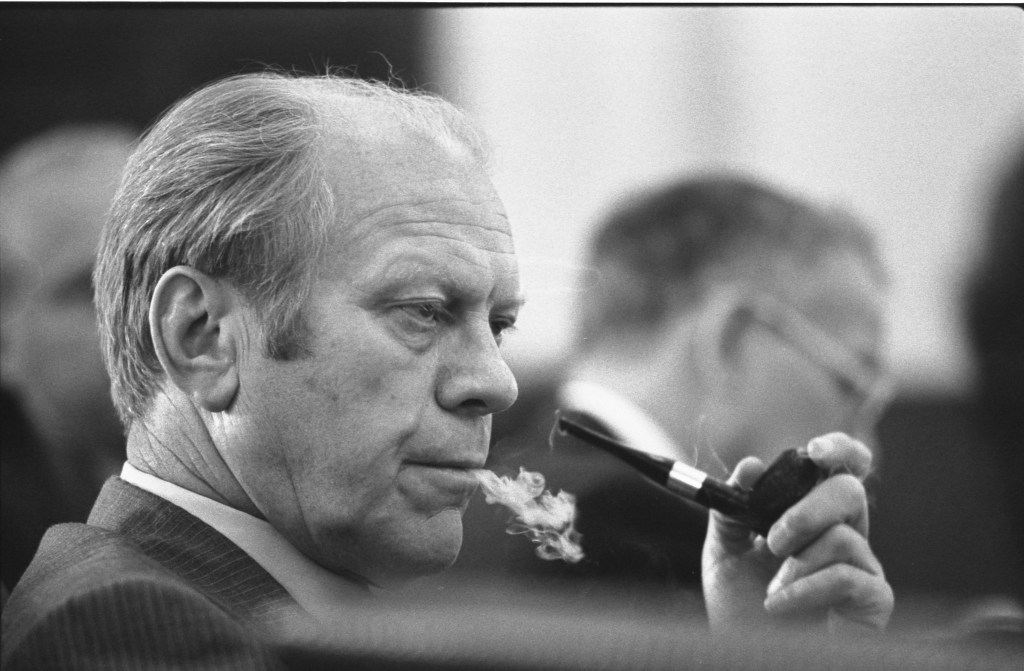
The House for the second time rejected an effort to hold up production funds for the B-1 bomber until February 1 as it approved a $105.6 billion military appropriations bill. Final passage came on a 331-53 vote. The bill, which was $550.4 million less than the total asked by President Ford, now must go to the Senate. Ford has said he favored the B-1 to replace the B-52 strategic bomber in the 1980s. Democratic presidential contender Jimmy Carter has said he would scrap plans for the plane.
A newly declassified Central Intelligence Agency study says there is a good chance that in the next few years foreign-linked terrorists will be increasingly tempted to stage major actions in this country. “The influx of foreign travelers and dignitaries expected in connection with such major U.S.‐sponsored events as the current Bicentennial celebrations and the 1980 Winter Olympics will inescapably afford a host of opportunities for dramatic terrorist action,” the report says. The study, attempting to assess the global dynamics of terrorism, was prepared by David L. Milbank, a C.I.A. analyst, who used a comprehensive new data bank developed by the agency. The study carries a disclaimer that it does not represent an official C.I.A. position, and the views expressed are strictly of the author.
The risk of a nuclear war has been increased by official campaigns aimed at lessening fears of such a holocaust, the Stockholm International Peace Research Institute said today. In its annual report, me institute said that in spite of military doctrines developed by the United States and the Soviet Union, “neither side could, in reality, win an all‐out nuclear war, either now or in the foreseeable future.” “The risk of an outbreak of nuclear war is much increased by current official campaigns to reduce the fear of the consequences of a full‐scale nuclear war,” the institute said. It said that in 1975 world military expenditures were $280 billion, but the North Atlantic Treaty Organization and the Warsaw Pact countries were spending less than before. The report said that in 1955 the two alliances accounted for 91 percent of the world’s total military expenditures, while in 1975, they were down to 78 percent.
The widest publicity given by the Spanish press in the last 40 years to the problem of torture in Spain has prompted the Government to open an investigation and to declare its opposition to such practices. At the same time, the press has been ordered to remain silent on the subject while the, investigation proceeds. The findings will be made public. according to the Minister of Justice, Antonio Garrigus. There is wide skepticism that the investigation will be pushed very‐far or that extensive measures will be taken against members of the police and Civil Guard who are alleged to be involved in the torture of political suspects and dissidents. A transitional government with no proven popular base has, by opening an investigation, moved into a dangerous field where the support of essential forces such as the military, the police and the Civil Guard is at stake. Attacking these forces has traditionally been taboo in Spain. For almost 40 years, under Franco’s rule, accusations, of torture practiced on Spaniards could circulate only clandestinely or had to be made outside the country through such organizations as Amnesty International, the London‐based group dedicated to the protection of human rights.
Three Lebanese men who were said to have confessed an involvement in the slaying of Francis Meloy, the United States Ambassador to Lebanon, Robert Waring. the embassy’s economic counselor, and their driver Wednesday were arrested in Beirut. Mahmoud Labady, an official of the Palestinian press service Wafa said at a news conference that the three men had been arrested by security agents of Al Fatah, the Palestinian guerrilla organization. He suggested strongly that the men had been in the employ of what he called an “outside power.” Mr. Labady, who provided few details about the identity of the men, said they were still being interrogated and would be turned over to an Arab League peacekeeping force when it arrived in Lebanon. All sides in the 14‐month Lebanese civil war denounced the murders. A Palestinian communiqué called them “a flagrant crime,” and there were suggestions from many quarters that the killings might have been an attempt to roil the military situation in the country, which has begun to quiet down.
President Hafez al‐Assad of Syria arrived here today for talks with President Valéry Giscard d’Estaing and vowed to continue his country’s present military action in Lebanon. President Assad’s trip here is his first official visit to a major Western nation. Addressing the French President, who greeted him at the airport, the Syrian leader declared: “We have made every effort in favor of Lebanon and the Palestinian revolution. We shall continue to provide our aid in spite of the sacrifices we must bear.” Syrian troops moved into Lebanon in force earlier this month with the apparent intention of restoring Lebanese political unity and peace after 14 months of civil war. Mr. Giscard d’Estaing said at the airport that France and Syria were both concerned by the Lebanon crisis and he expressed hope that their talks would bring “useful results” in the quest for peace.
The last military unit searching for Americans missing in action in Indochina probably will be dismantled soon. A Pentagon official testified that the unit already has left Asia, and has decided there is little hope of getting more information on the 818 servicemen still listed on the MIA rolls. Roger Shields, deputy assistant defense secretary for international security affairs, told the House Select Committee on MIAs that the Joint Casualty Resolution Center was moved from Thailand to Hawaii in late May. Communist governments have tied a further accounting of the missing Americans to a U.S. provision of military aid.
Japan’s Self Defense Agency disclosed that retired Admiral Osamu Yokoyama was a paid secret agent for the Lockheed Aircraft Corp. It said Yokoyama, 61, who retired in 1967, received $6,000 annually.
Indonesia annexes Portuguese East-Timor.
Frank Sturgis, a former CIA operative in Cuba and a Watergate burglar, offered the CIA two plans for the murder of Fidel Castro before he organized a 1960 plot to poison the Cuban premier, the Philadelphia Bulletin reported in a copyrighted story. Sturgis was quoted as saying he first proposed an open-air assassination and then the planting of explosives in a conference room. When both were rejected, he developed the futile poison plan. Sturgis, now employed by a Miami book manufacturer, was paroled 18 months ago after serving 13 months of a one-to-four-year sentence for the Watergate burglary.
The Organization of American States called on the United States and Panama to settle their differences over the future of the Panama Canal Zone by the end of this year. In a resolution adopted at the plenary session of its sixth general assembly, the OAS said it hoped both sides could agree on a new treaty that would remove sources of conflict between them.
An Argentine federal judge has ordered former President Maria Estela Peron to face trial for alleged embezzlement of secret presidential funds, sources in Buenos Aires said. The 45-year-old Mrs. Peron is already awaiting trial in another case concerning embezzlement of public funds channeled to a Peronist charity she headed.
An appeal for U.S. military aid was made by the African nation of Zaire. Officials of the government of President Mobutu Sese Seko made the plea to U.S. Defense Secretary Donald H. Rumsfeld when he visited the capital of Kinshasa. The Mobutu government asked for aircraft, artillery, armor and small arms. Said the commissioner for political affairs, Ensulu Baansamponso Bakokela Lokansa: “The very recent experiences of Angola caution us even more than before to be on our guard and vigilant.” Rumsfeld responded that “the United States will work with Zaire as it seeks both to increase the prosperity of the people and to ensure their security.”
The public prosecutor accused 13 British and American mercenaries of the crime of genocide; today and demanded the death penalty for them all. Emphasizing that the trial of the mercenaries should be an example of “revolutionary justice,” Manuel Rui Alves Monteiro, the prosecutor, declared that “the grave faults committed can only be punished by the firing squad.” In an emotional speech of more than three hours, Mr. Monteiro hardly made any reference to the evidence against the defendants and directed the brunt of his attacks against “the forces of imperialism.” His final plea for the death penalty, was greeted by applause from the court and the press gallery and by shouts of “death.”
Rioting continued for a third day in Soweto, a black township near Johannesburg, with the rioters, mostly young people, directing their fury at government buildings and vehicles. The death toll increased as more than 1,000 policemen armed with rifles and sten guns moved into the streets. The official toll yesterday was 54 dead and 300 injured. Only two of the dead were white, both officials of the West Rand Bantu Administration Board, the agency responsible for Soweto. They were said to have been stoned and stabbed when the violence broke out on Wednesday morning. The rioting was the most serious here since the Sharpeville massacre on March 21, 1960, when police killed 72 blacks and injured 182. There was a widespread feeling that the repercussions this time could be even greater than they were after Sharpeville. The police commander, General W. H. Kotze, said at mid‐evening that there was “no end to the violence in sight.” He acknowledged that casualties were mounting, but said that there would be no revised figures available before morning. Official statements indicated that much of the violence was directed at government property.
Secretary of State Henry A. Kissinger said today that the United States regretted the outbreak of violence in South Africa and that he would express continued opposition to apartheid when he met next week with Prime Minister John B. Vorster. Discussing for the first time the goals of the highly sensitive two‐day meeting with Mr. Vorster in West Germany. Mr. Kissinger said he expected no major agreements to emerge from the sessions. But he said he hoped to persuade Mr. Vorster to cut South Africa’s ties with both the white minority government in Rhodesia and with South‐West Africa, where pressure is strong for South Africa to allow an independent nation of Namibia to develop from the former United Nations mandate. Questions about the Ford Administration’s new Africa policy and about the Lebanese situation dominated Mr. Kissinger’s 90‐minute appearance before the House International Relations Committee.
President Ford asked Congress to fix “a serious flaw” in the Social Security System that makes it possible some future retirees could draw more in benefits than they earned while working. Ford would allow yearly cost-of-living increases for those who already have retired. But his plan would freeze at 1978 levels the percentage of pre-retirement income retired persons could draw in Social Security payments. Ford also urged Congress to pass his proposed 0.3% increase in payroll contributions by both employees and employers. This would “stop the drain on the trust funds — which are now expected to pay out about $4 billion more in benefits each year than they take in,” Ford said. He said it “would cost no employee more than $1 per week in additional contributions.”
Jimmy Carter has all but ruled out using the Federal Bureau of Investigation to make background checks of those he is considering as a Vice‐Presidential nominee for the Democratic Party. “I’d be reluctant to do that,” be said here today. “I don’t believe I will.” Attorney General Edward H. Levi made the offer of F.B.I. assistance several weeks ago to prospective Presidential candidates of both major parties, but Mr. Carter said he was not convinced of the legality of such an arrangement and his aides said there also were serious doubts about its propriety. Still, the 51‐year‐old Presidential candidate, now apparently assured of the Democratic nomination, left open the possibility that, if allegations were made against his final selection, he might ask for help from the F.B.I. to determine the accuracy of such charges. “With the permission of the person involved, of course,” Mr. Carter added, “and if we don’t get that permission, that person would no longer be considered.” Mr. Carter’s remarks came at a news conference sandwiched between strategy sessions with members of his campaign staff and followed what he called “a couple of hours of arguing” over various aspects of the selection process for his running mate.
President Ford’s annual Christmas visits to the charming village of Vail in the Colorado Rockies have done much to promote the state’s skiing industry but seem to have earned him few political credits. Like their counterparts in the other Western states, Colorado Republicans appear to prefer Ronald Reagan. Colorado’s 31‐member national convention delegation will be one of the last in the nation to be chosen, with most of the delegates scheduled for selection at district and state conventions on July 9 and 10. Ford strategists originally saw the contest as a tossup. But no more. The Reagan forces now predict a sweep, and the President’s supporters would be happy to settle for a healthy minority. Of the 10 convention states remaining on the electoral calendar, Mr. Ford seems to hold convincing leads only in Minnesota, Connecticut and Delaware. He therefore badly needs a victory in Iowa, which chooses its 36 delegates tomorrow and Saturday.
The Supreme Court held today that a defendant’s silence after being advised of his right to remain silent under questioning could not be used against him in a trial. Ruling 6 to 3 in favor of two men convicted in Ohio marijuana cases, the Court based its decision on the landmark 1966 Miranda ruling requiring that suspects be informed of their rights before being questioned. Specifically, the Court ruled that if a defendant is warned at his arrest of his right to remain silent, as required by the Miranda decision, and if he then does not give his exculpatory story until the trial, the prosecutor may not try to shake the story by cross‐examining the defendant about why he did not tell the story when he was first arrested. To allow the prosecutor to do this, the Court said in an opinion by Associate Justice Lewis F. Powell Jr., would be “fundamentally unfair” and would violate the defendant’s right to due process. The Court has itself been criticized for some rulings that appear to have eroded the Miranda decision various ways. But it based its ruling today on its 1966 ruling, saying, in part, that the so‐called “Miranda warnings” carry an “implicit” assurance that silence will carry no penalty.
The Supreme Court unanimously upheld the President’s authority to impose fees on imported oil when it is decided that oil imports must be limited for national security reasons and rejected challenges to the fees by nine states, 10 utility companies and a member of Congress. The decision reversed the United States Court of Appeals, which ruled last summer that the President had authority to limit imports only through “direct” methods, such as import quotas.
The House passed a $105 billion defense appropriations bill tonight after refusing, by a 20‐vote margin, to delay a decision on production of the B‐1 bomber until next February, under a new Administration. By a 207‐to‐186 vote, the House rejected an amendment that would have specified that no funds be spent to procure the new bomber until after February 1. The amendment was offered by Representative Joseph P. Addabbo, Democrat of Queens, who contended that a production decision on such an expensive weapons program should be left to the winner of the Presidential election in November. The House Vote was a victory for the Ford Administration, which plans to make the production decision in November following a flight test program now in progress. Despite the House vote, the future of the B‐1 program was still in some doubt in Congress.
There should be adequate supplies of gasoline this summer despite unexpectedly high demands but motorists may have to pay record high prices, according to Federal Energy Administration chief Frank Zarb. “Although we are not forecasting any gasoline demand that cannot be met,” he said, “we do urge drivers to obey the speed limit and be frugal in their driving habits.” Zarb said he expects gasoline prices to rise by about 2 cents a gallon during the summer.
Major expansion of mining and processing capacity for the production of raw uranium is needed despite the fact the United States has more than enough for nuclear generating plants through at least 1990, according to a government panel report. The Energy Resources Council said that with current technology and at prices of $30 a pound the United States has about 1.84 million tons of uranium available which would be enough to fuel at least 300 reactors of 1,000 megawatt capacity over their entire lifetimes. Experts predict that 225 reactors are expected to be in operation by that time. However, the report said that estimated demand will quadruple in the next 20 years which will require a major production expansion in the uranium industry.
Frank Fitzsimmons, president of the International Brotherhood of Teamsters, disclosed that he and other top union officials had been subpoenaed to appear in Washington. Other union sources said the subpoenas were issued by a joint investigative force of the Labor and Justice Departments, which is investigating alleged abuses in the union’s Central States pension funds.
A gunman opened fire in a packed rush-hour commuter train in Chicago, killing a man and seriously injuring his sister. Two other passengers were injured slightly. The assailant escaped in the panic. Police said they were searching for the former boyfriend of Rose Turner, 21, whose condition was described as “very critical.” Her brother, Charles, 36, died in surgery.
General Foods Corp., the nation’s largest coffee processor, citing “the continuing upsurge in green coffee costs, sharply increased the wholesale price of ground and instant coffees. It said they probably would be passed along to consumers in six to eight weeks. The increases for ground included: up 30 cents a pound for Maxwell House, up 35 cents for Yuban and up 30 cents a can for Max-Pax. For instant: 4.5 cents an ounce for Maxwell, up 5.5 cents an ounce for Yuban and up 6.5 cents an ounce for freeze-dried Maxim.
A resolution urging its 32,000 churches to refuse ordination and employment to homosexuals was overwhelmingly approved at the 119th annual Southern Baptist Convention in Norfolk, Virginia. The convention represents the largest Protestant denomination in the United States and it was the first stance the group had ever taken on the issue. The resolution also reaffirmed “our Christian concern that all persons be saved from the penalty and power of sin through our Lord Jesus Christ, whatever their present life-style.”
Court transcripts just released show entertainer Claudine Longet told a deputy sheriff she had shot her lover, but that it had been accidental. “It was a voluntary statement,” Mary F. Wiggins testified at a preliminary hearing in Aspen, Colo., last June 10 when Miss Longet, 34, was bound over for trial in the shooting death in Aspen on March 10 of professional skier Vladimir (Spider) Sabich, 31. The French-born singer-actress has pleaded not guilty to manslaughter and her trial is set to begin August 30.
Nursing home magnate Bernard Bergman was sentenced in federal court in New York City to four months in jail for defrauding the government of $1.2 million in Medicaid funds. The sentence was immediately denounced by New York special prosecutor Charles J. Hynes. “One wonders whether essential justice has been accomplished… I am deeply troubled and discouraged by the cynicism generated by what the people consider to be a special justice for the privileged.” U.S. Dist. Judge Marvin Frankel said, however, he had given Bergman “a stern sentence.”
Senator James Buckley was endorsed by a wide margin by the New York Republican State Committee for re-election this year over Representative Peter Peyser of Westchester County. Mr. Peyser said he would challenge Mr. Buckley in the Republican primary. If he gets on the ballot by means of designating petitions he will force the first state-wide Republican primary in 55 years, The winner of that primary would run against the Democrats who are seeking to replace Mr. Buckley.
The Court of Appeals, highest court in the U.S. state of New York, voided the state’s blue laws prohibiting the sale of most items on Sundays. The ban had been in existence since 1656, when implemented by the Dutch colony of the New Netherlands, but was voided after 320 years as unconstitutional, in a unanimous decision. The Court declared that parts of the statue were rarely enforced by police and routinely disregarded by thousands of businesses”, rendering them “constitutionally defective”. Prior to that time, the discount stores and supermarkets had been making sales anyway without consequence. At the time, blue laws were still in effect in 30 of the 50 states of the U.S.
New Wave band Blondie release their debut single “X Offender,” written by Debbie Harry and Gary Valentine.
The National Basketball Association and the American Basketball Association agreed to the ABA–NBA merger, with four ABA teams (the Denver Nuggets, the Indiana Pacers, the New York Nets and the San Antonio Spurs) being admitted to the NBA.
Major League Baseball:
California’s Gary Ross allowed only two hits and pitched the Angels to a 2–0 victory over the Milwaukee Brewers in his first complete game in the major leagues since July 6, 1968. The Angels scored both their runs in the second inning on singles by Tommy Davis and Bruce Bochte, a sacrifice fly by Dan Briggs and single by Dave Chalk.
The losing streak of the White Sox was extended to seven games, their longest in five years, when the Yankees eked out a 5–4 victory over the Pale Hose. The White Sox knocked out Catfish Hunter in the eighth inning during a two-run rally, but it wasn’t enough. Hunter was removed after giving up a single by Chet Lemon and walking Ralph Garr. Sparky Lyle relieved and after Jorge Orta singled to load the bases and Pat Kelly struck out, two runs scored on a wild throw by Chris Chambliss, but Lyle retired the next two batters on short flies.
The Twins received a lucky break from the weather and posted a 4–0 victory over the Tigers in a game that was stopped by rain in the bottom half of the sixth inning. Mike Cubbage batted in three runs for the Twins. In the Tigers’ sixth, Aurelio Rodriguez homered with a man on base and two more runs scored with the aid of a triple by Dan Meyer, but rain stopped play while the Twins were at bat in their half, causing the score to revert to five full innings.
At Shea, Dave Kingman hits a game-ending homer in the 14th inning off reliever Charlie Hough to give the Mets a 1–0 victory over the Dodgers. It was his 23rd homer of the season. Skip Lockwood (3-2) got the victory with four innings of one-hit relief after Russ Swan had allowed just two hits in his ten innings of work.
While Dick Pole (3–4) pitched his first complete game of the season in eight starts, Dwight Evans, Jim Rice and Carlton Fisk smashed homers to help the Red Sox defeat the Athletics, 8–3. Mike Torrez (6–8) took the loss for the A’s.
After Mike Schmidt homered in the eighth inning to tie the score, the Phillies pushed over another run in the ninth and defeated the Giants, 3–2. Pinch-hitter Ollie Brown opened the stanza with a single and took third on a single by Garry Maddox. After a walk to Bob Boone and force-out at the plate by Bobby Tolan, Dave Cash hit a long sacrifice fly to plate the winning run.
A three-run homer by Reggie Jackson in the eighth inning shattered a 1–1 tie and carried the Orioles to a 4–1 victory over the Rangers. Wayne Garland, who was the beneficiary of the blow, won his sixth game without a defeat.
Milwaukee Brewers 0, California Angels 2
New York Yankees 5, Chicago White Sox 4
Detroit Tigers 0, Minnesota Twins 4
Los Angeles Dodgers 0, New York Mets 1
Boston Red Sox 8, Oakland Athletics 3
San Francisco Giants 2, Philadelphia Phillies 3
Baltimore Orioles 4, Texas Rangers 1
The Dow Jones industrial average soared 14.57 points Stock Exchange to penetrate yesterday on the New York the 1,000‐point level for the sixth time this year. Trading was the heaviest in almost three months. Analysts cited an increasing conviction among investors that the rise in interest rates appeared to be leveling off. They were also encouraged by the strong demand for Wednesday’s 12‐million‐share offering of American Telephone and Telegraph stock. Yesterday’s surge, which put the Dow at 1.003.19, was reflected in a wide 11‐to‐3 ratio of advancing issues over declines. Institutional activity picked up helping to push volume to 28.81 million shares highest since March 24.
Dow Jones Industrial Average: 1003.19 (+14.67, +1.48%)
Born:
Scott Adkins, English action film star (“John Wick: Chapter 4”; “Boyka: Undisputed”); in Sutton Coldfield, West Midlands, England, United Kingdom.
Mike Peterson, NFL linebacker (Indianapolis Colts, Jacksonville Jaguars, Atlanta Falcons), in Gainesville, Florida.
Eric Hicks, NFL defensive end (Kansas City Chiefs, New York Jets), in Erie, Pennsylvania.
Sven Nys, Belgian mountainbiker & cyclo-crosser, in Bonheiden, Belgium.
Pyotr Svidler, Russian chess grandmaster and Russian national champion; in Leningrad, Russian SFSR, Soviet Union.
Died:
Lord Casey, 85, Governor-General of Australia from 1965 to 1969.
Francisco “Paco” Urondo, 46, Argentine novelist who had become a member of the Montoneros guerillas, was shot to death in an ambush by the Argentine Federal Police in Mendoza.
 History Diaries